Monthly Archives: November 2026

A new Mikado

Stanley Woo is the Lord High Executioner Co-Co, in Foote in the Door’s production of the RA Shiomi adaptation of The Mikado. Photography by Kaylin Schenk, Muze Imagery

I don’t think I’d ever seen a performance of Gilbert and Sullivan’s The Mikado. I knew it was typical of the G&S oeuvre, with clever rhymes, impressive solos and duets, a large ensemble, and a setting of gratuitous Orientalism that Wikipedia describes as a “fantasy Japan”, which the original creators used as an unsubtle allegory to their own society.

Local musical theatre company A Foote in the Door is currently performing a new adaptation of The Mikado by Japanese-Canadian playwright R.A. Shiomi. Shiomi kept the ridiculous rhymes, catchy tunes, and breathtaking solos, and skipped the whole fake-Japan thing to set it directly in Edwardian England (far enough from our own society that we are comfortable laughing at them, but familiar enough that we can still wince recognizing some examples of bureaucratic tangles and corrupt loopholes.) This was a clever and effective choice, from my perspective, allowing me to enjoy the melodies and ridiculous plot without the problematic context. I probably wouldn’t have chosen to see The Mikado otherwise.

Songs I recognized immediately included the oft-parodied “Three little maids from school” (Ruth Wong-Miller, Jill Hoogewoonink, and Rachel Haverkamp, in navy uniforms with tennis rackets), and “As some day it may happen”, the one with “I have a little list”, the Lord High Executioner’s song about people who would not be missed if they were executed. This one was particularly funny in Shiomi’s updating, with Stanley Woo (of Apocalypse Kow) delivering the sentences with graphics presented by aide Chris-Tush (Aaron Schaan). The “little list” included lots of modern irritants and social crimes, and ended to audience cheers with “Alberta Separatists”.

As in Pirates of Penzance, there’s a young couple played by Brendan Smith and Ruth Wong-Miller, and some ridiculous obstacles to their marriage. Franki-Poo, or Franklin Poole, is the heir to the Mikado’s throne but currently a wandering minstrel / second trombone, having escaped the court to dodge marriage to Katy Shaw (Rachel Frey), but is now a handy target for the executioner’s need to sentence someone to beheading. And Tum-Tum – really Taylor, but nicknamed Tum-Tum for how she makes everyone’s heart pound – is the ward of the Lord High Executioner Co-Co, who wants to marry her himself. The inherent power-imbalance of older men marrying their wards in many narratives of this era is softened in this adaptation by a line where Tum-Tum sighs that noble girls aren’t free of guardianship until they are 50.

Most of the character names are wordplay from the original fake-Japanese/fake-Chinese ones, although Pooh-Bah, Lord High Everything Else, is the same as in the original. This pompous and opportunistic bureaucrat is played with relish by Scott McLeod (with Ron Long scheduled to take over later in the run). The small role of The Mikado (ruler of this land) is played by company co-founder Russ Farmer, also credited as director, set designer, and master builder. A variety of ensemble roles is filled out by the cast of 22.

I love to sit in the front at Théâtre Servus Credit Union to appreciate the costume details (Viola Park) and the live orchestra (conducted by Heidi Schwonik) – but then I have to tilt my head up to check the supertitles for some of the clever lyrics. It’s a good problem to have, for a production that’s delightful to both my eyes and my ears. The Mikado plays until November 22nd, with tickets here.

The Cottage!

Can all awkward situations be improved with tea? Mat Hulshof, Lauren Boyd, Cynthia Jimenez-Hicks, Brennan Campbell, and Jill Agopsowicz in The Cottage, at Teatro Live! Set Design Ami Farrow, Costume Design Brian Bast, Lighting Design Victor Snaith Hernandez. Images by Marc J Chalifoux Photography.

The Cottage, by Sandy Rustin, sounded like it was going to be Noel Coward-ish – a period comedy with overlapping infidelities. But it was much more fun and more unpredictable than that, without the cruelty of a lot of Coward’s couples. It was a great fit for Teatro, with a crowd of quirky characters, delightful period set (Ami Farrow) and costumes (Brian Bast), and an admirably fast pace set by director Farron Timoteo.

The story’s set in a cosy English country cottage in 1923, starting in the early morning. Clothing strewn dramatically around the room suggests the aftermath of a passionate night. Sylvia (Jill Agopsowicz, whom I first saw in the Citadel’s One Man Two Guv’nors in 2014) floats downstairs in tasteful champagne underthings and makes several attempts to pose appealingly for someone. That someone turns out to be her longtime lover Beau (Mat Hulshof), hiding his wedding ring in the pocket of his silk dressing gown. Both of them are married to other people, but Beau is shocked to find out that Sylvia’s decided to normalize the situation by sending telegrams to their spouses declaring their intent to marry. So far, the tropes seemed familiar, although their execution was very funny.

Jill Agopsowicz and Mat Hulshof in The Cottage, at Teatro Live! Set Design Ami Farrow, Costume Design Brian Bast, Lighting Design Victor Snaith Hernandez. Images by Marc J Chalifoux Photography.

Then there came a knock at the door, and another, and – things got more and more complicated. Their spouses were played by Brennan Campbell and Lauren Boyd, with additional personal complications played by Cynthia Jimenez-Hicks and Jake Tkaczyk. By intermission I had some guesses about how it would all work out, and I was wrong!

Jake Tkaczyk and Jill Agopsowicz in The Cottage, at Teatro Live! Set Design Ami Farrow, Costume Design Brian Bast, Lighting Design Victor Snaith Hernandez. Images by Marc J Chalifoux Photography.

Conflicts arose, and characters with little aptitude for fighting used some hilarious found-weaponry to threaten each other and defend themselves, from a toilet plunger to a giant urn, as well as a rifle which might or might not be loaded. Hulshof’s performance was reminiscent of his many previous Teatro characters, as the normally-smug barrister and cad tries to cope with a situation where he’s lost all control. Sylvia (Agopsowicz) gradually shows herself to be more insightful than I expected, willing to learn from her rivals as well as her exes. All the characters had layers of pretense which dropped away or were exposed, including an accent and some particularly dramatic facial hair. Clues and details end up falling into place, leading to an ending which felt satisfying to me although less so to most of the characters. Over the last decade, I’ve seen several plays that claimed to be feminist approaches to farce, but The Cottage fit that description better than any of the others. It wasn’t a guilty pleasure for me; it was just fun.

Running time is well under two hours, and performances continue until November 29th, with tickets available here .

Iron Matron

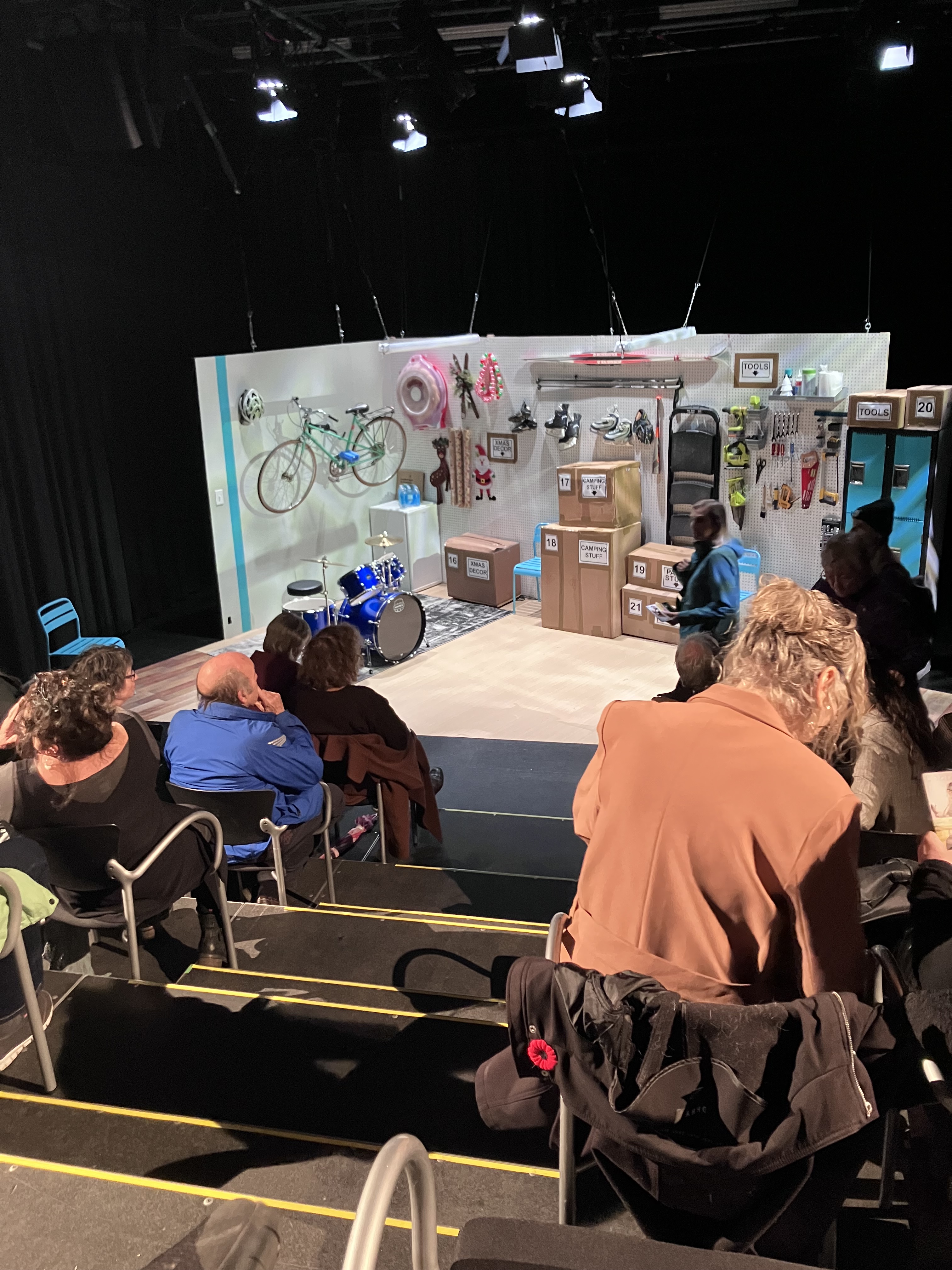
Preshow set for Iron Matron. Set design Trevor Schmidt, lighting design Rae McCallum, sound design Lindsey Walker.

Trevor Schmidt’s latest comedy, Iron Matron, has two more shows in its run, finishing with a matinee and an evening show on Saturday November 7th. If you like kind-hearted and funny shows about getting older, about old friendships and new balances, and about second chances, you should make time to see it!

The action is all set in Alice (Pamela Schmunk)’s garage – or, she explains, the garage of her son and daughter-in-law, underneath the “mother-in-law suite” she lives in. It’s the cleanest and most organized garage-space I’ve ever seen – but there are reasons for that, explained later.

The play starts with Alice making awkward conversation with an old classmate she’d lost touch with, Corinne (Linda Glass). Alice is divorced – she fits that into the conversations frequently. Alice is a charming mix of insecurity and obliviousness, a 60-year-old Tigger in baggy flowered overalls, and Corinne is poise personified in tasteful shades of mint and rose. (Costumes by Schmidt). So Alice keeps making suggestions or asking questions that Corinne dodges, and Alice doesn’t notice. Alice wants to learn guitar and start a band, and since Corinne teaches music she wants Corinne to join. Corinne makes it clear, at least to the audience, that she has quite enough going on in her life and isn’t enthusiastic about this crazy project, but Alice persists and Corinne gives in.

They aren’t very good. At all. Maybe hiring a drummer will help? So they post an ad somewhere, and Rita (Pat Darbasie) shows up. Rita’s an arthritic butch lesbian in leather and ink, travelling everywhere with drumsticks and liniment. More relevantly, she’s been a career touring musician but she’s between gigs and willing to help them out. Alice resists at first, telling Corinne that adding a third to a group always messes things up and creates conflict. But as the three women start to practise and start to talk, it becomes clear that shaking things up might be good for all of them! Whether or not the friendship worked well when Allie and Corrie were young, the patterns clearly aren’t helpful any more. And Rita’s an outsider, here for a job rather than to make friends in the suburbs, so she sees them more clearly and asks about some of what she sees.

I love stories where the characters being themselves is the funny part, and Iron Matron is great for that. I hadn’t seen Pamela Schmunk on stage before, but I kept thinking that Alice was someone I knew. Linda Grass had a beautiful portrayal of a woman successfully holding it together, and Pat Darbasie’s Rita was so different from any character I’d seen her play before, hilariously believable.

Like the younger characters Patty and Joanne in Schmidt’s show last year, Alice is looking for a project of her own, but also for community. Iron Matron is a fascinating new take on similar themes, but with women who are at older stages of life. It also made me think about how the lessons in building friends and allies learned by junior-high girls in Robot Girls aren’t permanent, but should equip the characters better to cope with the challenges they might encounter in their 40s (How Patty and Joanne Won High Gold at the Grand Christmas Dance Cup Competition) and in their 60s (Iron Matron)

Trevor Schmidt consistently captures the feeling of conversations among women who don’t quite get each other, but who aren’t mean about it. And by the end I liked all of them and respected all of them, and I wanted to see the characters again.

But if you want to see them, you need to hurry. There are two shows today (Saturday) at the Studio at the Arts Barns, and tickets are here.