Tag Archives: lindsey walker

Iron Matron

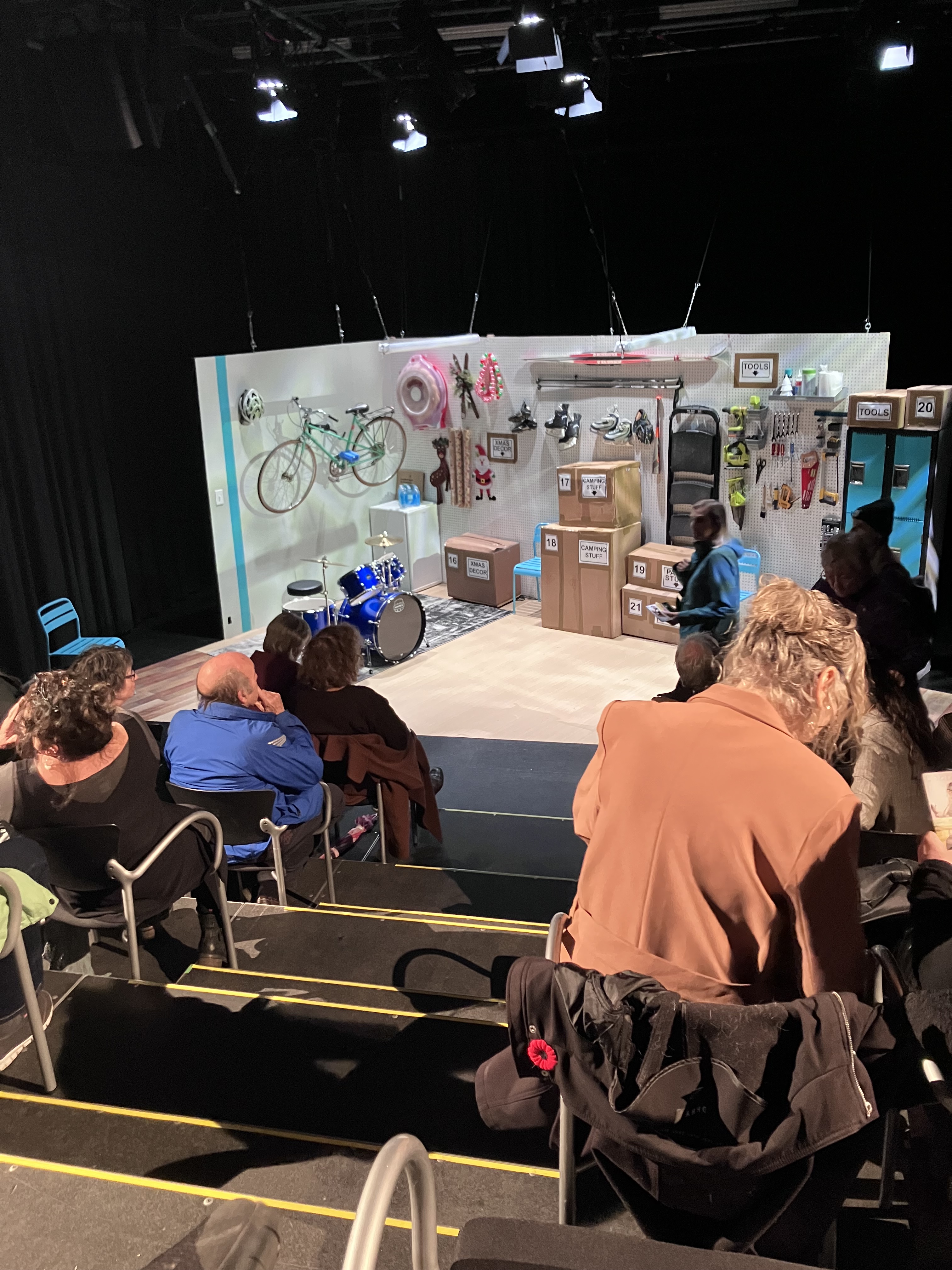
Preshow set for Iron Matron. Set design Trevor Schmidt, lighting design Rae McCallum, sound design Lindsey Walker.

Trevor Schmidt’s latest comedy, Iron Matron, has two more shows in its run, finishing with a matinee and an evening show on Saturday November 7th. If you like kind-hearted and funny shows about getting older, about old friendships and new balances, and about second chances, you should make time to see it!

The action is all set in Alice (Pamela Schmunk)’s garage – or, she explains, the garage of her son and daughter-in-law, underneath the “mother-in-law suite” she lives in. It’s the cleanest and most organized garage-space I’ve ever seen – but there are reasons for that, explained later.

The play starts with Alice making awkward conversation with an old classmate she’d lost touch with, Corinne (Linda Glass). Alice is divorced – she fits that into the conversations frequently. Alice is a charming mix of insecurity and obliviousness, a 60-year-old Tigger in baggy flowered overalls, and Corinne is poise personified in tasteful shades of mint and rose. (Costumes by Schmidt). So Alice keeps making suggestions or asking questions that Corinne dodges, and Alice doesn’t notice. Alice wants to learn guitar and start a band, and since Corinne teaches music she wants Corinne to join. Corinne makes it clear, at least to the audience, that she has quite enough going on in her life and isn’t enthusiastic about this crazy project, but Alice persists and Corinne gives in.

They aren’t very good. At all. Maybe hiring a drummer will help? So they post an ad somewhere, and Rita (Pat Darbasie) shows up. Rita’s an arthritic butch lesbian in leather and ink, travelling everywhere with drumsticks and liniment. More relevantly, she’s been a career touring musician but she’s between gigs and willing to help them out. Alice resists at first, telling Corinne that adding a third to a group always messes things up and creates conflict. But as the three women start to practise and start to talk, it becomes clear that shaking things up might be good for all of them! Whether or not the friendship worked well when Allie and Corrie were young, the patterns clearly aren’t helpful any more. And Rita’s an outsider, here for a job rather than to make friends in the suburbs, so she sees them more clearly and asks about some of what she sees.

I love stories where the characters being themselves is the funny part, and Iron Matron is great for that. I hadn’t seen Pamela Schmunk on stage before, but I kept thinking that Alice was someone I knew. Linda Grass had a beautiful portrayal of a woman successfully holding it together, and Pat Darbasie’s Rita was so different from any character I’d seen her play before, hilariously believable.

Like the younger characters Patty and Joanne in Schmidt’s show last year, Alice is looking for a project of her own, but also for community. Iron Matron is a fascinating new take on similar themes, but with women who are at older stages of life. It also made me think about how the lessons in building friends and allies learned by junior-high girls in Robot Girls aren’t permanent, but should equip the characters better to cope with the challenges they might encounter in their 40s (How Patty and Joanne Won High Gold at the Grand Christmas Dance Cup Competition) and in their 60s (Iron Matron)

Trevor Schmidt consistently captures the feeling of conversations among women who don’t quite get each other, but who aren’t mean about it. And by the end I liked all of them and respected all of them, and I wanted to see the characters again.

But if you want to see them, you need to hurry. There are two shows today (Saturday) at the Studio at the Arts Barns, and tickets are here.
Peter Quilter’s Autumn – delightfully specific

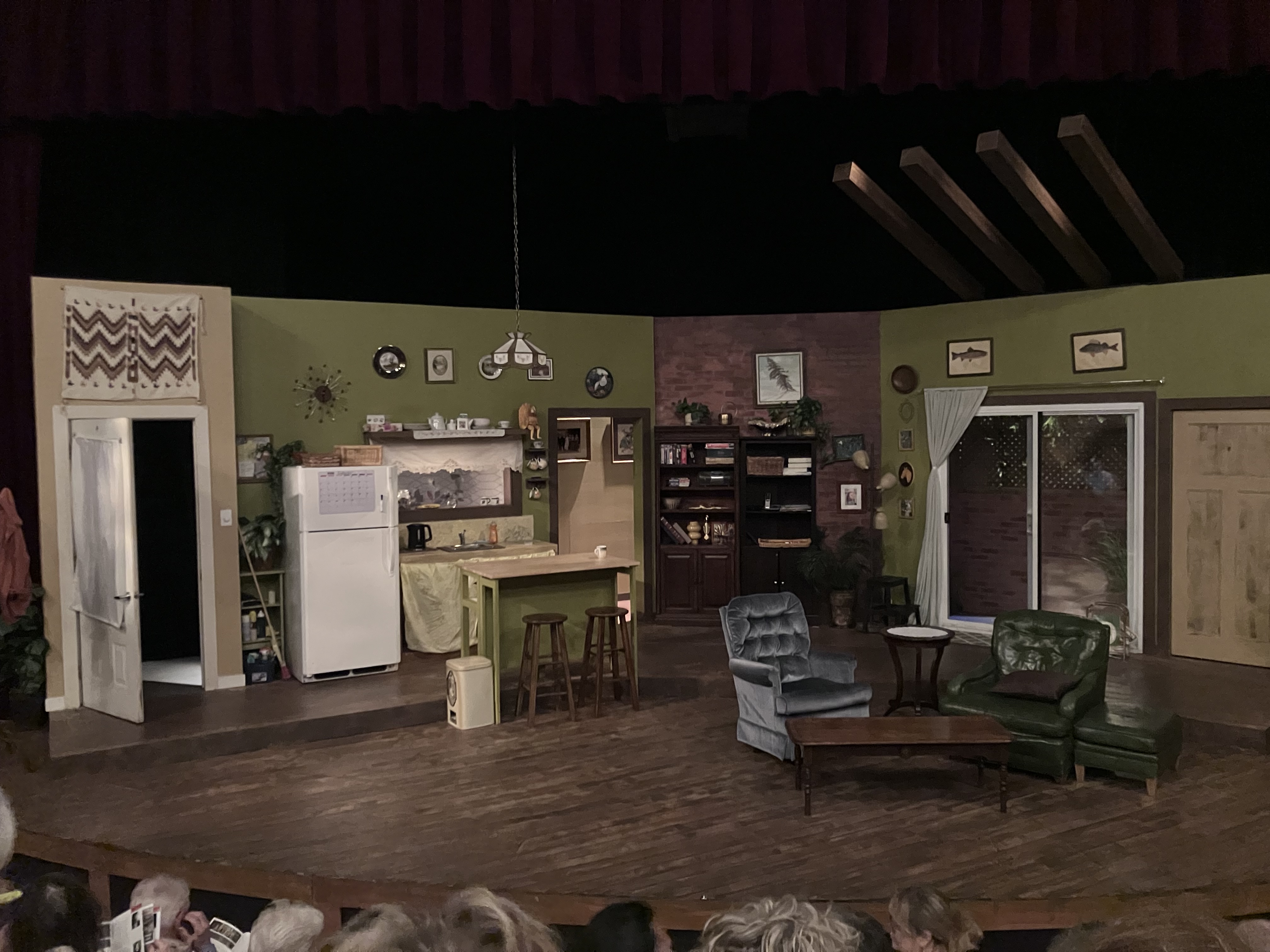
Even Gilchrist’s set for Autumn, at Shadow Theatre, with lighting by Rory Turner.

Lana Michelle Hughes’ first directing gig as the new Artistic Director of Shadow Theatre is the poignant and relatable portrait of two bickering sisters, Autumn. Not “middle-aged sisters”, because as Rose (Karen Johnson Diamond) points out, sixty is only middle-aged if you’re going to live til a hundred and twenty. Oof.

Slightly younger sister Kathryn (Cathy Derkach) arrives for a planned visit, filling up the space with suitcases and drama. Rose tidies her away “You’re in the big bedroom” and settles her down and responds with gentle snark to Catherine’s criticisms of everything, from the snacks to the wine to the plans for the garden. Catherine mostly doesn’t even listen, busy with attention-grabbing stories about her current divorce and advice Rose hasn’t asked for.

We learn that this isn’t Rose’s home – they’re meeting at their late parents’ second home or retirement cottage. Many of the specific details in the set (Even Gilchrist) now make more sense – the main room is a cozy and appealing space with exposed beams and brick, but it feels like it was decorated in the 1980s or 1990s, with two comfortable non-matching recliners, shelving units holding everything from a cassette player and tapes to a worn Trivial Pursuit game, prints on the walls and a white-board calendar on the fridge.

And they’re meeting to plan and prepare for Catherine’s daughter Imogen’s short-notice (shotgun) wedding, which they’re going to host at the house. The action takes place in the 10-day period between Catherine’s arrival and the wedding. Long enough for the sisters to poke at each other’s sore spots, and get to know more about each other’s current lives, reveal some assumptions and address some conflicts.

When you hear the basics of this story – two bickering sisters, one daughter/ niece’s arrival anticipated, a handsome young neighbour to ogle while doing yardwork – you might recall one of the plays in last year’s Shadow season, Kristen da Silva’s Where You Are, a four-hander with similar characters. But I thought the concept was rich enough and the characterizations compelling enough in Autumn that I was completely engaged, and eventually satisfied. Both performers portrayed their characters with prickly affection and amusing consistency. The costume choices (Ami Farrow) helped me get to know who they were, Kathryn in blouses and blazer, skirt or dress pants and heels, tasteful solids, but Rose in colourful drapey things and Birkenstocks, undyed hair in braids.

But unlike Where You Are, in which the audience gets to see the sisters interacting with the daughter / niece (Nikki Hulowski) and the young neighbour (Brennan Campbell), in Autumn there are only two performers on stage. Kathryn’s daughter Imogen and her fiance Daniel, and the gardener Barry, are all part of the narrative, but we don’t exactly see any of them, and that’s not a distraction. Apart from a few stage-crew hands delivering props through doors, these three characters are evoked entirely by the very specific actions and gazes of Derkach and Johnson-Diamond, with support from the lighting (Rory Turner) and sound (Lindsey Walker) atmospheres. The set includes sliding doors to the yard, with lattice-top fence behind and barely-visible greenery behind that. The lighting and the music and sound selections make it easy to believe that a wedding’s taking place in the garden, and then that the newlyweds are passing through the cottage, collecting their motorbike helmets, and heading down the driveway, as we watch the relieved mother and aunt hover on the edge of the party and send them off. The director and performers have convincingly created the non-visible elements of the story and followed them through with consistency.

There are happy endings in Autumn, the kind of resolutions that are satisfying because the imperfect characters stay who they are, just with a little more understanding of each other and self-awareness. And maybe it landed more strongly with me because I’m thinking of my own faraway siblings and niblings in my birthday week – but I enjoyed it.

Autumn is playing at the Varscona Theatre until May 24th, with tickets here.

Pageant, down home style, second try.

Last year I didn’t manage to see Best Little Newfoundland Christmas Pageant Ever at the Varscona, because I left the ticket-buying too late and the only performance I could get to was sold out and I didn’t make it up to the top of the waitlist.

This year I got closer.  I actually saw the first half of the show before looking at the clock at intermission and realizing I’d mis-calculated the time of my later-evening commitment, so I wouldn’t be able to stay til the end.  So I’ve seen half of this show, and next year it is definitely going on my booking list earlier.

Like the Christmas Carol, I got the impression that many of the patrons at this show had seen the production in previous years and were anticipating the jokes, whereas my only familiarity was with the source material.  And I suddenly realised partway through the show that the fussy little girl Alice (Lindsey Walker), the one who gets ousted from her perennial pageant role as Mary by Imogene Herdman’s (Cheryl Jameson) and her brothers’ (Graham Mothersill, Corbin Kushneryk) threats, was missing the point complaining constantly about the way their story wasn’t sticking to the traditional telling of the Nativity, so I had better throw out the little list in my head of all the ways in which this adaptation deviated from the original Barbara Robinson novel since I was missing the point in the exact same way.

Fortunately, I had this realization, or generally got caught up in the show, early enough to be enjoying it.  There was a cast of only seven, including a piano player (Jeff Black), and a little bit of amusing double-casting.  That meant that not all the canonical Herdmans were on stage, just Ralf (“with an F”), Leroy, and Imogene. But it worked out fine.

In written fiction, I am always a little slow to recognize unreliable narrators or other quirks of a first-person point-of-view character.  In the stage version, then, I was surprised to find the narrator character Beth (Kayla Gorman) a bit of a caricature, with distinctive child-like can’t-stand-still and seeming to side with Alice’s disapproval of the Herdmans.  It wasn’t at all inconsistent with the source material; I was just caught by surprise.

Compared to the novel, then, Beth’s mother the pageant director has a bigger role.  Mrs. O’Brien is played with appealing earnestness, bewildered but coping, by Natalie Czar-Gummer.  She incorporates the audience in the story as kids showing up for auditions, and then has each section sing one of the carols as shepherds, wise men, or angels.

The adaptation was originally done by  a company in Newfoundland, with a few changes to the original story like the usual director having collided with a moose, and the church being Catholic.  The performers’ accents are credible and not overdone.  It felt like an affectionate tribute to a culture where lots of Edmonton residents have roots.

Note to self:  if this plays next Christmas, buy a ticket early and block off the whole evening.