Monthly Archives: May 2026

Peter Quilter’s Autumn – delightfully specific

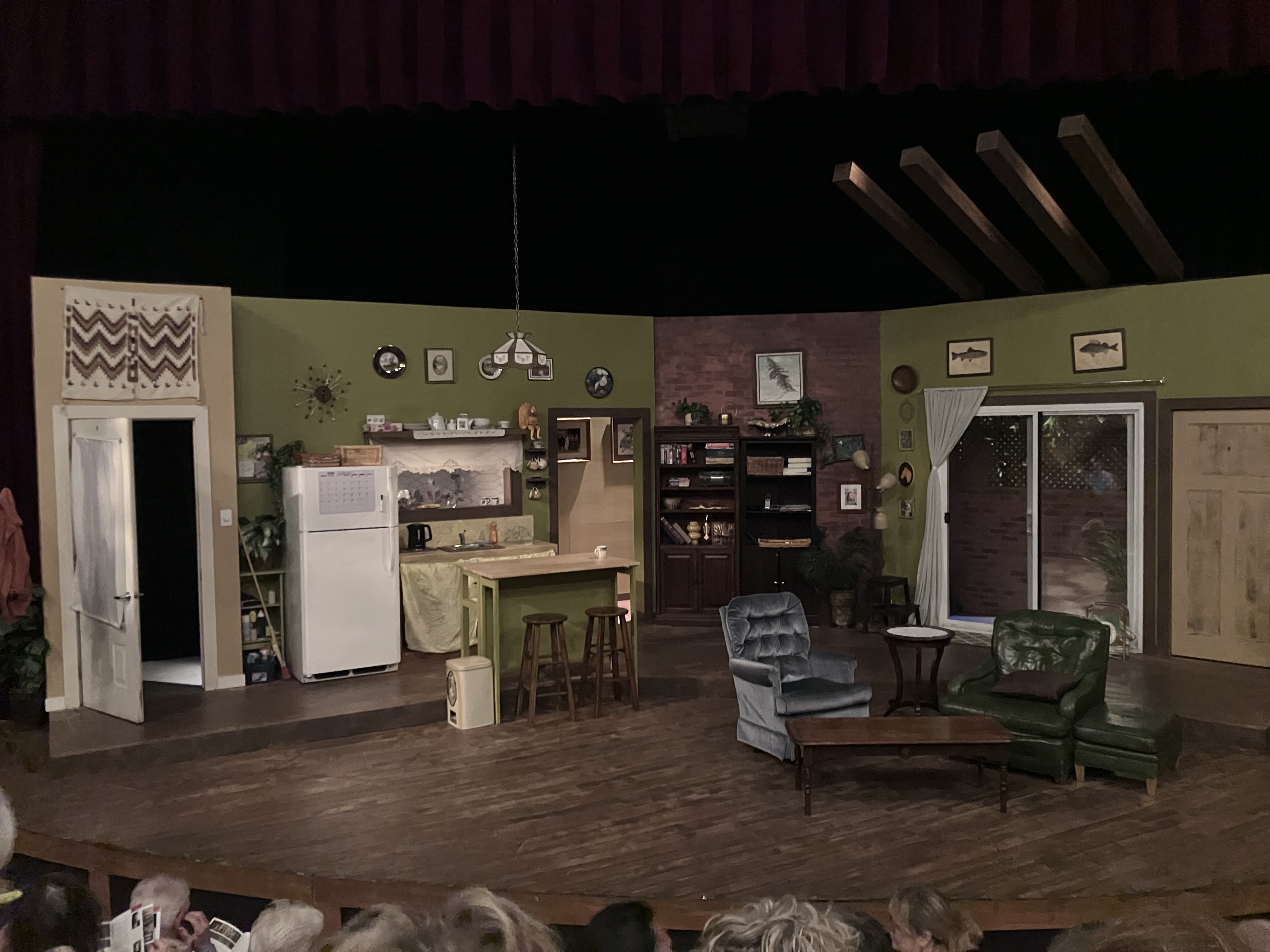
Even Gilchrist’s set for Autumn, at Shadow Theatre, with lighting by Rory Turner.

Lana Michelle Hughes’ first directing gig as the new Artistic Director of Shadow Theatre is the poignant and relatable portrait of two bickering sisters, Autumn. Not “middle-aged sisters”, because as Rose (Karen Johnson Diamond) points out, sixty is only middle-aged if you’re going to live til a hundred and twenty. Oof.

Slightly younger sister Kathryn (Cathy Derkach) arrives for a planned visit, filling up the space with suitcases and drama. Rose tidies her away “You’re in the big bedroom” and settles her down and responds with gentle snark to Catherine’s criticisms of everything, from the snacks to the wine to the plans for the garden. Catherine mostly doesn’t even listen, busy with attention-grabbing stories about her current divorce and advice Rose hasn’t asked for.

We learn that this isn’t Rose’s home – they’re meeting at their late parents’ second home or retirement cottage. Many of the specific details in the set (Even Gilchrist) now make more sense – the main room is a cozy and appealing space with exposed beams and brick, but it feels like it was decorated in the 1980s or 1990s, with two comfortable non-matching recliners, shelving units holding everything from a cassette player and tapes to a worn Trivial Pursuit game, prints on the walls and a white-board calendar on the fridge.

And they’re meeting to plan and prepare for Catherine’s daughter Imogen’s short-notice (shotgun) wedding, which they’re going to host at the house. The action takes place in the 10-day period between Catherine’s arrival and the wedding. Long enough for the sisters to poke at each other’s sore spots, and get to know more about each other’s current lives, reveal some assumptions and address some conflicts.

When you hear the basics of this story – two bickering sisters, one daughter/ niece’s arrival anticipated, a handsome young neighbour to ogle while doing yardwork – you might recall one of the plays in last year’s Shadow season, Kristen da Silva’s Where You Are, a four-hander with similar characters. But I thought the concept was rich enough and the characterizations compelling enough in Autumn that I was completely engaged, and eventually satisfied. Both performers portrayed their characters with prickly affection and amusing consistency. The costume choices (Ami Farrow) helped me get to know who they were, Kathryn in blouses and blazer, skirt or dress pants and heels, tasteful solids, but Rose in colourful drapey things and Birkenstocks, undyed hair in braids.

But unlike Where You Are, in which the audience gets to see the sisters interacting with the daughter / niece (Nikki Hulowski) and the young neighbour (Brennan Campbell), in Autumn there are only two performers on stage. Kathryn’s daughter Imogen and her fiance Daniel, and the gardener Barry, are all part of the narrative, but we don’t exactly see any of them, and that’s not a distraction. Apart from a few stage-crew hands delivering props through doors, these three characters are evoked entirely by the very specific actions and gazes of Derkach and Johnson-Diamond, with support from the lighting (Rory Turner) and sound (Lindsey Walker) atmospheres. The set includes sliding doors to the yard, with lattice-top fence behind and barely-visible greenery behind that. The lighting and the music and sound selections make it easy to believe that a wedding’s taking place in the garden, and then that the newlyweds are passing through the cottage, collecting their motorbike helmets, and heading down the driveway, as we watch the relieved mother and aunt hover on the edge of the party and send them off. The director and performers have convincingly created the non-visible elements of the story and followed them through with consistency.

There are happy endings in Autumn, the kind of resolutions that are satisfying because the imperfect characters stay who they are, just with a little more understanding of each other and self-awareness. And maybe it landed more strongly with me because I’m thinking of my own faraway siblings and niblings in my birthday week – but I enjoyed it.

Autumn is playing at the Varscona Theatre until May 24th, with tickets here.
Request Programme – unique performances of nightly repetition

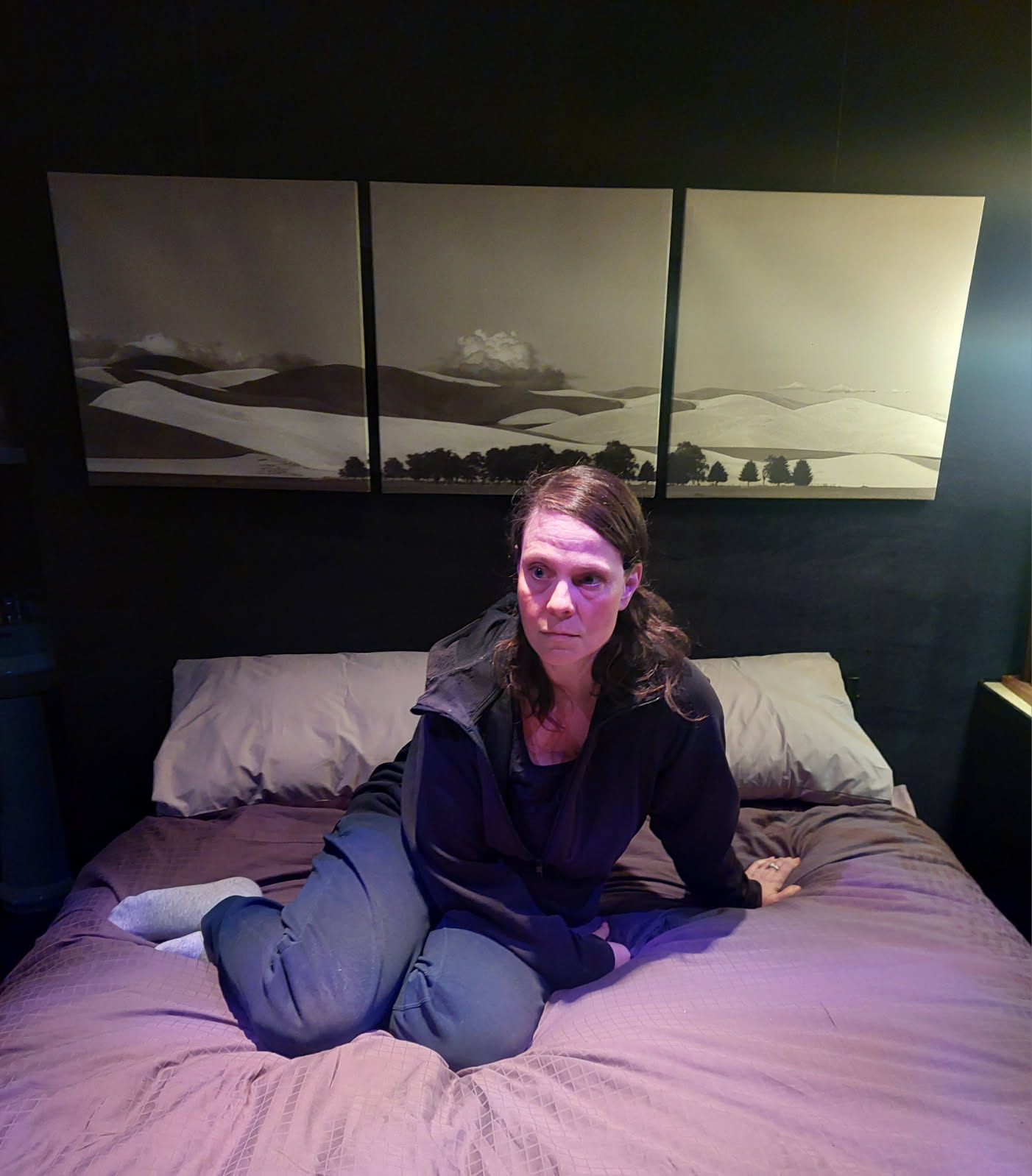
Vanessa Sabourin in Request Programme, Northern Light Theatre.

Request Programme, originally written in German in the 1970s by Franz Xaver Kroetz and translated by Katharena Hehn, takes its title from a radio show, the kind of show where a host responds to song requests sent in by audience members by playing the songs, but also by responding in compassionate, almost-intimate ways to the glimpses of regret, sadness, hope, loneliness, and humour she gets in the letters and texts. It felt very familiar, like shows I’ve heard on CBC radio, or European selections played overnight on NPR on long drives, or Join the Conversation on Now! radio. It’s a structure that supports a different show every night.

I think that Request Programme, the current Northern Light Theatre production directed by Trevor Schmidt, must have a similar blend of an underpinning routine with specifics that vary each night, making it worth watching more than once during the run. I’ve only seen it once so far – I saw it on opening night, with Vanessa Sabourin as the sole performer on stage. Each performance has a different on-stage performer, all local female actors who have worked on previous Northern Light Theatre productions. The voice of the radio host is also significant to the story but isn’t explicitly identified in the credits – I’m pretty sure the voice I heard, warm and grounded, was Nadien Chu. And the playlist of artists in the radio programme is ten Edmonton singer/songwriters, all women, each with one recent original song.

The character on stage does not speak at all. But as in many effective movement-based performances, I could tell enough about what was going on and why that I was engaged in the character’s journey, and cared about their outcome. I’ve had similar experiences with wordless or near-wordless clown and physical theatre (such as 7 Ways to Die: A Love Story, by Keltie Brown Forsyth and Alex Forsyth, or Lost ‘n’ Lost Department, by Elaine Weryshko, Jed Tomlinson, and Kristin Eveleigh, with dance (Black Hair, Blue Eyes, a piece at Expanse Festival 2014 with Ainsley Hillyard, Mat Simpson, and Liam Cody, many of the Ballet Edmonton works, or Betroffenheit (Jonathon Young, Crystal Pite), and with theatre (Small Mouth Sounds, the Jim Guedo-directed play about people at a silent yoga retreat).

A woman comes home late in the evening to a small tidy apartment in a city. The apartment reminded me of one of the self-contained apartment setups in the IKEA store – set design by Schmidt – full enough that it felt like she actually lived there, but without much that was revealing or personal. Not enough kitchen for someone who enjoys cooking or eating, no photos except for possibly one on the kitchen table that we couldn’t see, the small clothes-rack of someone who has recently started over. I thought she was probably coming home from work, because she was wearing dress shoes and clothes more formal than the ones she changes into, but her totebag also contained a few basic groceries. As she passes the evening, I had the sense that she was struggling to settle to anything – whether eating the sandwich she makes, finding something to watch on TV, making tea, reading a book, or doing a jigsaw puzzle. She didn’t seem to have any inclination to human contact either – no letters in the mail, no landline or cell phone, no computer, no waving out the window. She was going through the motions.

But she turns on the radio just in time for the nightly Request Programme, and listens to the whole thing. I could see that some of the host’s commentary and request letters landed with her, and some of the song lyrics too. In “In a While” Cayley Thomas sang of losing a brother before his 25th birthday. Lindsay Walker’s “I Won’t Give Up” is an fiercely inspiring anthem to carrying on, and Alex Dawkins’ “Pretty Girls” evoked passion and regret. A couple of times I wondered if the listener whose note the host was responding to might have been Sabourin’s character – but I thought probably she wasn’t sufficiently engaged with even that version of community. The people who were writing to the radio programme wanted someone to hear their pain, their loss, their fears – and I don’t think the woman on stage saw any point in that.

I didn’t know the details of why Sabourin’s character was so alone, so restless, so numb. But I worried about her, to the point of barely breathing near the end of the show. I grasped at hints of the character planning for the next day such as putting the leftovers in the fridge and rinsing out her knee-high stockings, but maybe those were autopilot actions. The ending did not feel inevitable but it was not a shock and was not overdrawn. I want to see another actor’s version. I don’t know how detailed the play script is – how much of a movement score or blocking is provided – but I understand that each performer had limited preparation time and possibly did not get to hear the radio show music and narration beforehand. Request Programme is fascinating and disturbing, an evocation of the spectrum between alone and lonely, between self-disciplined routine and dissociation, between surviving and … not.

Request Programme continues at the Fringe Arts Barns Studio until May 16th. Tickets are here.