Tag Archives: rae mccallum

Iron Matron

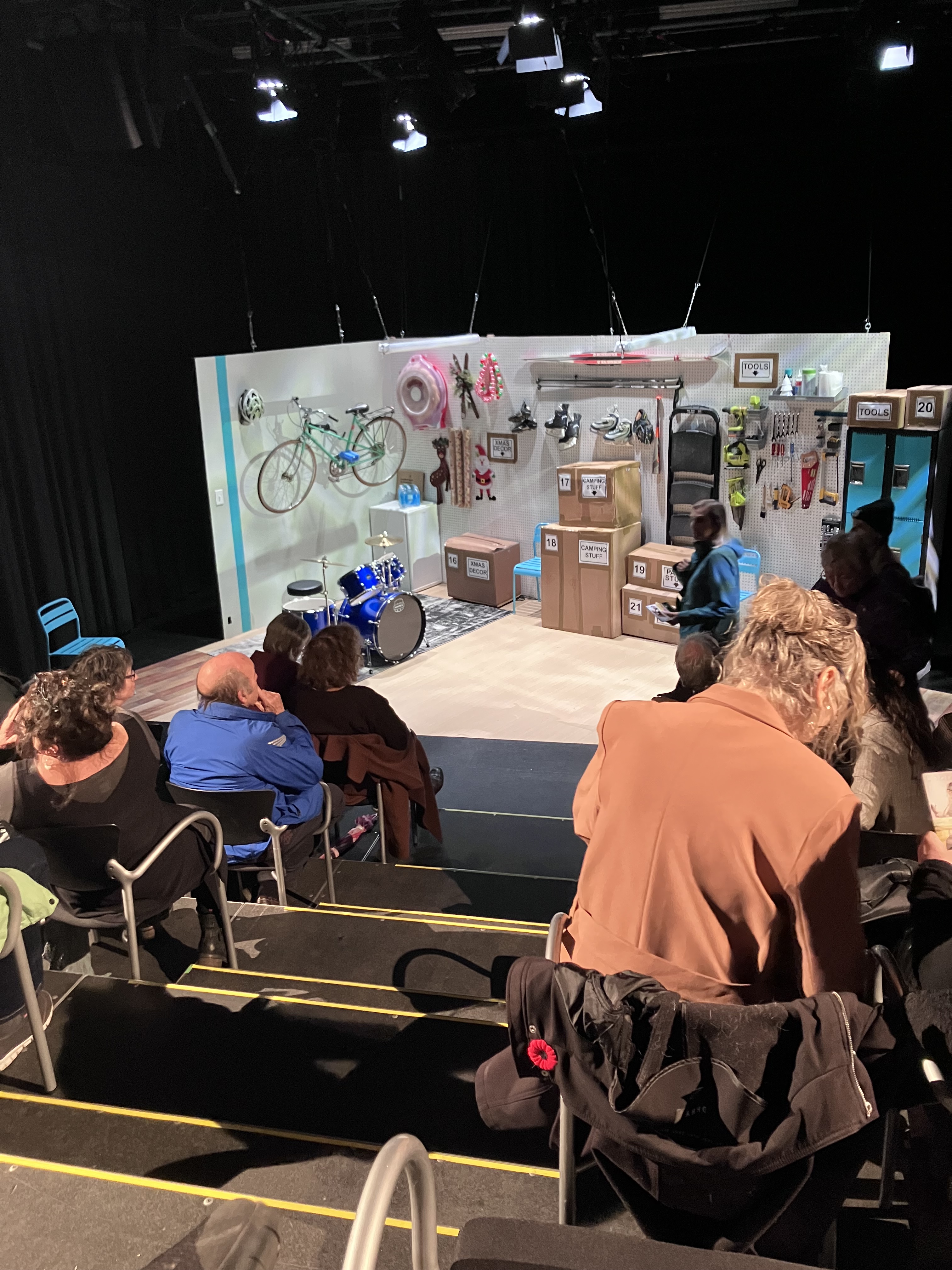
Preshow set for Iron Matron. Set design Trevor Schmidt, lighting design Rae McCallum, sound design Lindsey Walker.

Trevor Schmidt’s latest comedy, Iron Matron, has two more shows in its run, finishing with a matinee and an evening show on Saturday November 7th. If you like kind-hearted and funny shows about getting older, about old friendships and new balances, and about second chances, you should make time to see it!

The action is all set in Alice (Pamela Schmunk)’s garage – or, she explains, the garage of her son and daughter-in-law, underneath the “mother-in-law suite” she lives in. It’s the cleanest and most organized garage-space I’ve ever seen – but there are reasons for that, explained later.

The play starts with Alice making awkward conversation with an old classmate she’d lost touch with, Corinne (Linda Glass). Alice is divorced – she fits that into the conversations frequently. Alice is a charming mix of insecurity and obliviousness, a 60-year-old Tigger in baggy flowered overalls, and Corinne is poise personified in tasteful shades of mint and rose. (Costumes by Schmidt). So Alice keeps making suggestions or asking questions that Corinne dodges, and Alice doesn’t notice. Alice wants to learn guitar and start a band, and since Corinne teaches music she wants Corinne to join. Corinne makes it clear, at least to the audience, that she has quite enough going on in her life and isn’t enthusiastic about this crazy project, but Alice persists and Corinne gives in.

They aren’t very good. At all. Maybe hiring a drummer will help? So they post an ad somewhere, and Rita (Pat Darbasie) shows up. Rita’s an arthritic butch lesbian in leather and ink, travelling everywhere with drumsticks and liniment. More relevantly, she’s been a career touring musician but she’s between gigs and willing to help them out. Alice resists at first, telling Corinne that adding a third to a group always messes things up and creates conflict. But as the three women start to practise and start to talk, it becomes clear that shaking things up might be good for all of them! Whether or not the friendship worked well when Allie and Corrie were young, the patterns clearly aren’t helpful any more. And Rita’s an outsider, here for a job rather than to make friends in the suburbs, so she sees them more clearly and asks about some of what she sees.

I love stories where the characters being themselves is the funny part, and Iron Matron is great for that. I hadn’t seen Pamela Schmunk on stage before, but I kept thinking that Alice was someone I knew. Linda Grass had a beautiful portrayal of a woman successfully holding it together, and Pat Darbasie’s Rita was so different from any character I’d seen her play before, hilariously believable.

Like the younger characters Patty and Joanne in Schmidt’s show last year, Alice is looking for a project of her own, but also for community. Iron Matron is a fascinating new take on similar themes, but with women who are at older stages of life. It also made me think about how the lessons in building friends and allies learned by junior-high girls in Robot Girls aren’t permanent, but should equip the characters better to cope with the challenges they might encounter in their 40s (How Patty and Joanne Won High Gold at the Grand Christmas Dance Cup Competition) and in their 60s (Iron Matron)

Trevor Schmidt consistently captures the feeling of conversations among women who don’t quite get each other, but who aren’t mean about it. And by the end I liked all of them and respected all of them, and I wanted to see the characters again.

But if you want to see them, you need to hurry. There are two shows today (Saturday) at the Studio at the Arts Barns, and tickets are here.


The world of Angry Alan

Cody Porter in Northern Light Theatre’s Angry Alan. Photo by Brianne Jang of BB Collective Photography.

The posters for Angry Alan, the new production at Northern Light Theatre, portray an angry man. The character on the poster seems to be mid-rant, gesturing towards an audience with his laptop open and his mouth open. So I expected that. But when the actor in this solo show, Cody Porter, first appears frozen at the dark vom entrance to the theatre, looking at the audience apprehensively, and then walks cautiously towards the stage as an unfamiliar space, I didn’t see anger. Even as he starts to tell his story, his distracted demeanour and circumlocutions convey that he’s telling a story he doesn’t want to tell.

Roger, currently a junior manager at a Safeway store, starts with a self-deprecating anecdote he knows his listeners will relate to – checking his phone before going for a run and getting sucked into hours of clicking links and watching videos. In one of those links, he finds a video “about history”, by a man whose seductive analysis of society reassures him that life has not been fair to him, because he is a man.

I was drawn in despite myself, to Trevor Schmidt’s production of Penelope Skinner’s 2018 script Angry Alan. I expected to be frightened for myself and others, and enraged, and frustrated. But this naive guy talking about how the messages he found online were new to him and how they gave him comfort – I kind of liked him.

Roger tells us he keeps reading, and keeps watching, and signs up for mailing lists. He notices things in his own life that fit the patterns he’s told about by “Angry Alan.” At work, he’s expected to suppress his own feelings and let customers (female customers, it seems), not only express their feelings but manipulate the employees with them. This fits what Alan’s group is saying – that society expects men to pay attention to women’s feelings but not their own. Once he’s watching for this pattern, he observes that a male bagger gets fired because a female customer cries about broken eggs. Maybe he could intervene, and protest?

He tells us he has a son he doesn’t talk to often, because of divorce and custody arrangements. And, parroting the arguments of Angry Alan and other men’s-rights activists, he extrapolates that this shows a system biased in favour of women and mothers, and that feminism has “gone too far”.

In both cases, I was gripped by the apparently-logical steps from the character’s real problems to erroneous and dangerous conclusions. I found myself wanting to make noises and gestures of disgust, and I was disturbed that some in the opening-night audience were laughing. It was outrageous, but it was not ridiculous. Maybe it was a laughter of shock and discomfort.

By the time Roger is ready to talk about his discoveries to anyone else in his life, he has gone far enough into the us-vs-them world that nobody can talk him back. Roger uses the metaphor of having a Red Pill Moment, calling back to the film The Matrix where choosing to take a red pill means choosing uncomfortable revelation. He sees any challenges or disagreements as more evidence that men are oppressed. He texts his son a link to Angry Alan, sure that it will help them connect. His son responds LOL, which Roger misinterprets.

The production makes good use of projections (Amelia Chan) in showing some of the online interactions that influence Roger’s choices. We see text-message screens, emails, some real video clips of people in that culture, and the website where Roger decides to sign up for a Men’s Rights conference and then is presented with a request to donate to the cause, slickly presenting it as an opportunity to be an “insider” in the movement.

Partway through, I realized that nobody was laughing any more. The narrative was incredibly unsettling, and the portrayal was effective. Roger is so full of hope, believing that being part of this movement will bring him happiness – and the audience can see so much wrong that he’s not noticing.

After the play, over delicious snacks of the opening night reception, we talked about how people who do not feel included and understood are vulnerable to recruitment by gangs, by cults, by populist political movements, by radical extremists of all kinds. And how the groups and their recruiters use those tools intentionally. I suddenly remembered the offstage “mob” behind the doxxing and harassment of Kristin Johnston’s character in Workshop West’s production of Mob last year. It was easy to see how that lonely and struggling young man, portrayed by Graham Mothersill, would have grasped at the chance to impress other men by doing something mean.

Cody Porter, as Roger, is enraged by video clips. Photo by Brianne Jang of BB Collective Photography.

This production is a nuanced and disturbing exploration of some societal trends that I mostly try not to think about. I guess I’d like things to be black-and-white too, but they are not. Trevor Schmidt, Cody Porter, and the rest of the team have done some brilliant work to make me understand this character, and other men like him. And maybe I need to understand them, in order to help build a world that is better for everyone. I’m glad I saw it and I’m not done thinking about it.

Angry Alan is playing at the Studio in the Fringe Arts Barns, until January 23rd. Tickets are available here.