Tag Archives: ron long

A new Mikado

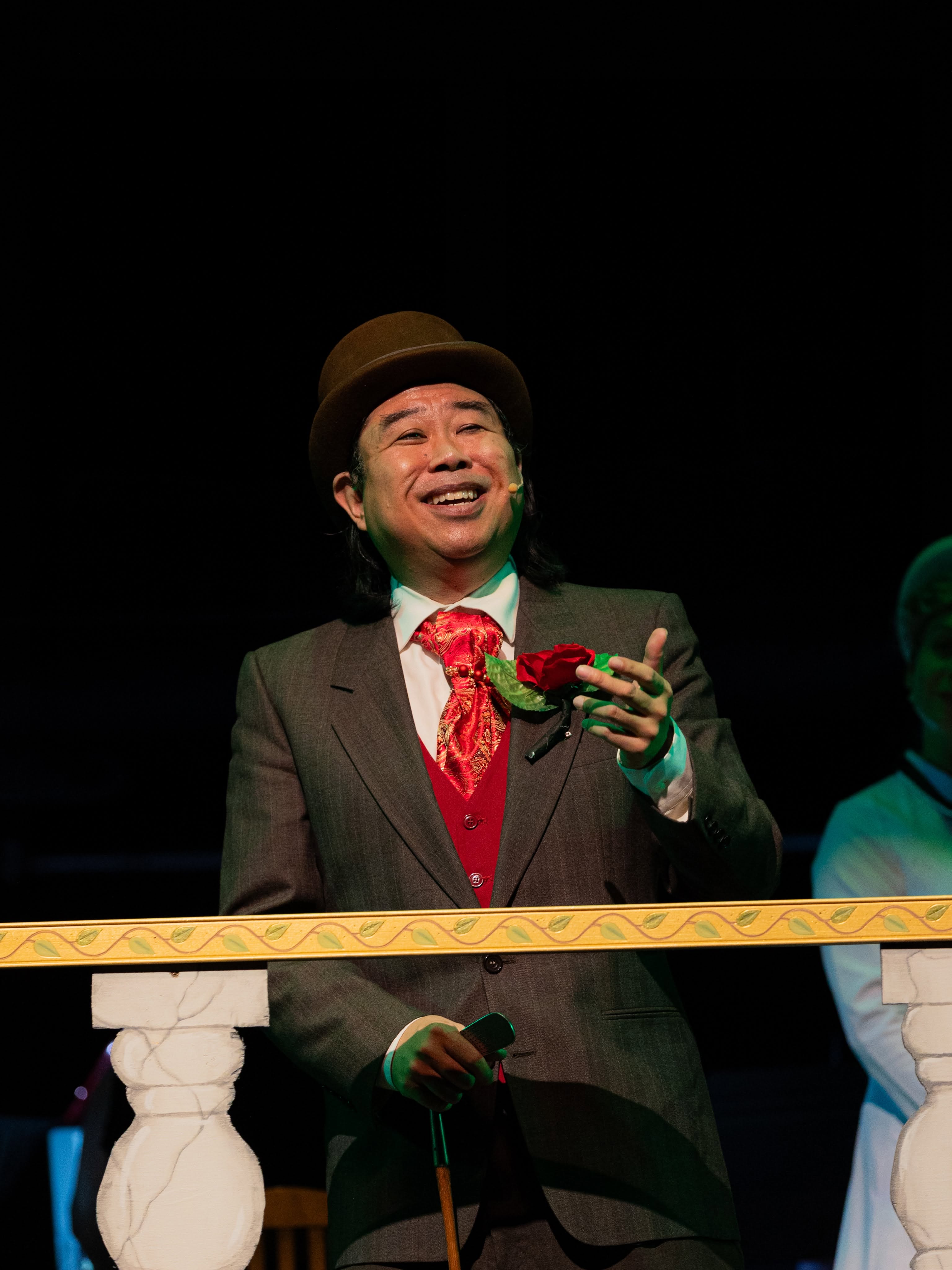
Stanley Woo is the Lord High Executioner Co-Co, in Foote in the Door’s production of the RA Shiomi adaptation of The Mikado. Photography by Kaylin Schenk, Muze Imagery

I don’t think I’d ever seen a performance of Gilbert and Sullivan’s The Mikado. I knew it was typical of the G&S oeuvre, with clever rhymes, impressive solos and duets, a large ensemble, and a setting of gratuitous Orientalism that Wikipedia describes as a “fantasy Japan”, which the original creators used as an unsubtle allegory to their own society.

Local musical theatre company A Foote in the Door is currently performing a new adaptation of The Mikado by Japanese-Canadian playwright R.A. Shiomi. Shiomi kept the ridiculous rhymes, catchy tunes, and breathtaking solos, and skipped the whole fake-Japan thing to set it directly in Edwardian England (far enough from our own society that we are comfortable laughing at them, but familiar enough that we can still wince recognizing some examples of bureaucratic tangles and corrupt loopholes.) This was a clever and effective choice, from my perspective, allowing me to enjoy the melodies and ridiculous plot without the problematic context. I probably wouldn’t have chosen to see The Mikado otherwise.

Songs I recognized immediately included the oft-parodied “Three little maids from school” (Ruth Wong-Miller, Jill Hoogewoonink, and Rachel Haverkamp, in navy uniforms with tennis rackets), and “As some day it may happen”, the one with “I have a little list”, the Lord High Executioner’s song about people who would not be missed if they were executed. This one was particularly funny in Shiomi’s updating, with Stanley Woo (of Apocalypse Kow) delivering the sentences with graphics presented by aide Chris-Tush (Aaron Schaan). The “little list” included lots of modern irritants and social crimes, and ended to audience cheers with “Alberta Separatists”.

As in Pirates of Penzance, there’s a young couple played by Brendan Smith and Ruth Wong-Miller, and some ridiculous obstacles to their marriage. Franki-Poo, or Franklin Poole, is the heir to the Mikado’s throne but currently a wandering minstrel / second trombone, having escaped the court to dodge marriage to Katy Shaw (Rachel Frey), but is now a handy target for the executioner’s need to sentence someone to beheading. And Tum-Tum – really Taylor, but nicknamed Tum-Tum for how she makes everyone’s heart pound – is the ward of the Lord High Executioner Co-Co, who wants to marry her himself. The inherent power-imbalance of older men marrying their wards in many narratives of this era is softened in this adaptation by a line where Tum-Tum sighs that noble girls aren’t free of guardianship until they are 50.

Most of the character names are wordplay from the original fake-Japanese/fake-Chinese ones, although Pooh-Bah, Lord High Everything Else, is the same as in the original. This pompous and opportunistic bureaucrat is played with relish by Scott McLeod (with Ron Long scheduled to take over later in the run). The small role of The Mikado (ruler of this land) is played by company co-founder Russ Farmer, also credited as director, set designer, and master builder. A variety of ensemble roles is filled out by the cast of 22.

I love to sit in the front at Théâtre Servus Credit Union to appreciate the costume details (Viola Park) and the live orchestra (conducted by Heidi Schwonik) – but then I have to tilt my head up to check the supertitles for some of the clever lyrics. It’s a good problem to have, for a production that’s delightful to both my eyes and my ears. The Mikado plays until November 22nd, with tickets here.

The Pirates of Penzance

Shauna Rebus, Brendan Smith, and Russ Farmer in Pirates of Penzance. Photo by Nanc Price Photography.

If you’ve ever heard of Gilbert and Sullivan – if you have even a humming familiarity with any of their work – you’ll know that the Victorian-era duo wrote wildly-popular tongue-in-cheek light opera pieces, some of which continue to be frequently-performed and alluded to in popular culture. And if you asked someone to sing one song from Gilbert and Sullivan, they’d probably attempt the first lines of “I am the very model of a modern Major-General”, an oft-parodied patter song which is from Pirates of Penzance (1879).

I’ve seen Pirates of Penzance once before – at the Stratford Festival’s Avon Theatre, on a 1985 outing with my mother, who’d admitted the year before that she appreciated me taking her to see some Shakespeare plays but what she would like even better was Gilbert and Sullivan. In those days it wasn’t easy to access a plot synopsis or lyrics ahead of time, there were definitely no supertitles/captions, and seats at the front weren’t in my budget. So I missed lots of the clever rhymes and over-the-top dialogue/intentions.

Local company Foote in the Door opened their production of Pirates of Penzance last night at Théâtre Servus Credit Union (La Cité Francophone), directed by Ron Long. I sat in the first row so I wouldn’t miss anything – and they were using supertitles for all the songs, which made it even easier to follow the preposterous premises of the plot. Frederic, a nautically-minded boy who had been accidentally apprenticed to a pirate instead of a pilot (Brendan Smith), is coming of age and being released from his indentures. But he’s got an overdeveloped sense of duty, which keeps leading him into inconvenient obligations.

Frederic looks forward to the pleasures of civilian life. His old nursery maid, Ruth (Shauna Rebus), who followed him into piracy, now hopes to catch his affections as they leave the ship, but Frederick is hoping to meet younger prettier women. These two characters were among my favourites, but the company of twenty-one performers were all fun to watch and listen to. Andrew Kwan was a delightful Major-General Stanley, father to a chorus of eight daughters including Frederick’s choice Mabel (Ruth Wong-Miller). Some of the pirates doubled as police officers, led by their sergeant Aaron Schaan in unison nightstick choreography. And one of the daughters (Eilidh Tew) doubled flexibly as a pirate! Sisters Wong-Miller and Christina O’Dell had a lovely duet in the second act. There was some fighting with fencing foils, pistols, and other found weaponry (fight director Sarah Spicer). Russ Farmer is the Pirate King. He and his hapless band display an assortment of impressive facial hair, some of it real.

The company of pirates and daughters surround Andrew Kwan, the Modern Major-General, and his Sterling Award. Photo by Nanc Price Photography.

Pirates of Penzance is playing until November 24th, with tickets available through Showpass.

A Gentleman’s Guide to Love and Murder

Kathryn Kerr, Stephen Allred, Ruth Wong-Miller, in A Gentleman’s Guide to Love and Murder. Photo Nanc Price.

My previous entry was about the Teatro la Quindicina quirky tongue-in-cheek period piece Evelyn Strange. And tonight I saw another quirky tongue-in-cheek period piece – Foote in the Door’s production of A Gentleman’s Guide to Love and Murder. This musical, by Steven Lutvak and Robert L Freedman, won several Tony awards in 2014 – I was actually in New York that spring and could have seen it, but I picked shows I’d heard of instead. And I got to see this production completely unspoiled.

A Gentleman’s Guide to Love and Murder is set in England in 1907. The premise of it is that Montague Navarro (Stephen Allred) discovers after his mother’s death that he’s distantly related to nobility, in fact being something like ninth in line to an earldom, although his mother had been disowned for marrying his late father, “a Castilian … and a musician!” All this information is provided by his mother’s old friend Miss Shingle (Nicole English), paying an unexpected visit. He sets out to meet his rich relations, hoping they will give him a job, but then temptation, ambition, and a series of very strange coincidences lead him to try benefiting more directly from being only a few deaths away from the title and the property.

His girlfriend Sibella (Kathryn Kerr) is a hilariously shallow and self-centred woman, but Montague doesn’t seem to mind, continuing to be captivated by her after she gets married. Meanwhile, he continues to meet various members of the D’Ysquith family, many of whom (all played by Russ Farmer) then meet untimely deaths. Most of them seem equally unlikeable, demonstrating various stereotypes about the turn-of-that-century English upper-class. The career do-gooder Hyacinth, seeking a novel charity that hasn’t been claimed by her friends and speaking of her prospective beneficiaries in appallingly patronizing terms, was particularly memorable. At intermission, I was thinking that I’d only seen one D’Ysquith who actually seemed nice, cousin Phoebe (Ruth Wong-Miller), but that maybe I should distrust that thought.

I thought I’d figured out where the rest of the plot would go … but it didn’t, exactly. And the plot twists of the second act delighted me.

My two favourite scenes were the ice-skating scene (who knew that graceful ensemble dancing – and some not so graceful wobbles by Asquith D’Ysquith Junior – behind some snowbank set pieces could so easily convey skating on a pond?) and the scene where Montague is entertaining both Sibella and Phoebe in different rooms of his apartment, The hallway set piece with the two doors, and the way Allred’s character uses it while he sings to play out wanting both women and trying to keep them away from each other, were just brilliant.

Set and lighting design were by Leland Stelck. My companions and I were impressed by how many set pieces shifted silently and rapidly behind the drapery to convey many different locations, particularly given that the production had relocated to Old Strathcona Performing Arts Centre on Gateway from their original performance venue three weeks ago due to the flooding at La Cité Francophone. I think the OSPAC stage is not as deep or wide, but the ensemble of eleven never looked crowded. The lighting design must have been more challenging at OSPAC, which has a relatively low ceiling and doesn’t seem to have as many lighting instruments.

We also admired the period costumes including hairdos and hats (Betty Kolodziej). The members of the ensemble (Kelsey Voelker, Shauna Rebus, Lynnéa Bartel-Nickel, Jason Duiker, Aaron Schaan, Brian Ault) played several background characters each, changing costumes and accents as needed – my favourite ensemble bit was when they were all serving at a dinner, like in an episode of Bridgerton.

The production was directed by Ron Long, with musical direction by Daniel Belland, and an orchestra of 13. The melodies were catchy with some Gilbert-and-Sullivan-esque rhymes, and strong voices among the cast.

Advance tickets to the four remaining shows (Jun 16-18 at 7:30 and Jun 18 at 2 pm) are available here and going fast. Door sales (if available) will start 45 minutes before showtime.

If you’ve already seen it, or you don’t mind being completely spoiled, this webpage reviews (and ranks) all the deaths, as staged in the original Broadway production.