Tag Archives: ami farrow

Peter Quilter’s Autumn – delightfully specific

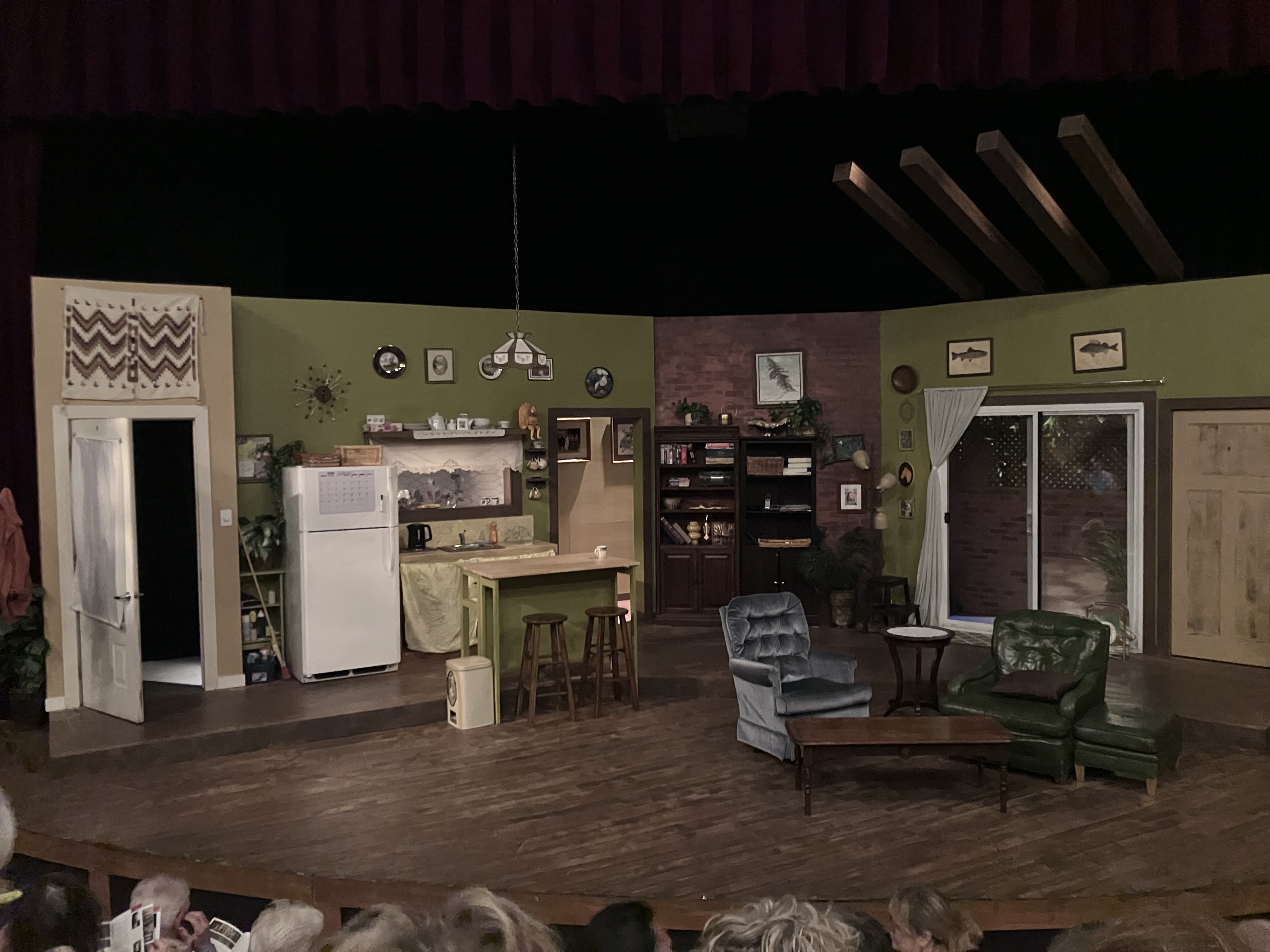
Even Gilchrist’s set for Autumn, at Shadow Theatre, with lighting by Rory Turner.

Lana Michelle Hughes’ first directing gig as the new Artistic Director of Shadow Theatre is the poignant and relatable portrait of two bickering sisters, Autumn. Not “middle-aged sisters”, because as Rose (Karen Johnson Diamond) points out, sixty is only middle-aged if you’re going to live til a hundred and twenty. Oof.

Slightly younger sister Kathryn (Cathy Derkach) arrives for a planned visit, filling up the space with suitcases and drama. Rose tidies her away “You’re in the big bedroom” and settles her down and responds with gentle snark to Catherine’s criticisms of everything, from the snacks to the wine to the plans for the garden. Catherine mostly doesn’t even listen, busy with attention-grabbing stories about her current divorce and advice Rose hasn’t asked for.

We learn that this isn’t Rose’s home – they’re meeting at their late parents’ second home or retirement cottage. Many of the specific details in the set (Even Gilchrist) now make more sense – the main room is a cozy and appealing space with exposed beams and brick, but it feels like it was decorated in the 1980s or 1990s, with two comfortable non-matching recliners, shelving units holding everything from a cassette player and tapes to a worn Trivial Pursuit game, prints on the walls and a white-board calendar on the fridge.

And they’re meeting to plan and prepare for Catherine’s daughter Imogen’s short-notice (shotgun) wedding, which they’re going to host at the house. The action takes place in the 10-day period between Catherine’s arrival and the wedding. Long enough for the sisters to poke at each other’s sore spots, and get to know more about each other’s current lives, reveal some assumptions and address some conflicts.

When you hear the basics of this story – two bickering sisters, one daughter/ niece’s arrival anticipated, a handsome young neighbour to ogle while doing yardwork – you might recall one of the plays in last year’s Shadow season, Kristen da Silva’s Where You Are, a four-hander with similar characters. But I thought the concept was rich enough and the characterizations compelling enough in Autumn that I was completely engaged, and eventually satisfied. Both performers portrayed their characters with prickly affection and amusing consistency. The costume choices (Ami Farrow) helped me get to know who they were, Kathryn in blouses and blazer, skirt or dress pants and heels, tasteful solids, but Rose in colourful drapey things and Birkenstocks, undyed hair in braids.

But unlike Where You Are, in which the audience gets to see the sisters interacting with the daughter / niece (Nikki Hulowski) and the young neighbour (Brennan Campbell), in Autumn there are only two performers on stage. Kathryn’s daughter Imogen and her fiance Daniel, and the gardener Barry, are all part of the narrative, but we don’t exactly see any of them, and that’s not a distraction. Apart from a few stage-crew hands delivering props through doors, these three characters are evoked entirely by the very specific actions and gazes of Derkach and Johnson-Diamond, with support from the lighting (Rory Turner) and sound (Lindsey Walker) atmospheres. The set includes sliding doors to the yard, with lattice-top fence behind and barely-visible greenery behind that. The lighting and the music and sound selections make it easy to believe that a wedding’s taking place in the garden, and then that the newlyweds are passing through the cottage, collecting their motorbike helmets, and heading down the driveway, as we watch the relieved mother and aunt hover on the edge of the party and send them off. The director and performers have convincingly created the non-visible elements of the story and followed them through with consistency.

There are happy endings in Autumn, the kind of resolutions that are satisfying because the imperfect characters stay who they are, just with a little more understanding of each other and self-awareness. And maybe it landed more strongly with me because I’m thinking of my own faraway siblings and niblings in my birthday week – but I enjoyed it.

Autumn is playing at the Varscona Theatre until May 24th, with tickets here.

Lives around an artist – After Mourning – Before Van Gogh

Andrew Ritchie as Vincent Van Gogh in After Mourning – Before Van Gogh. Set and light design Ami Farrow, costumes Leona Brausen. Photo Marc J Chalifoux.

If I’d been asked to do a mind-map of what I knew about Vincent Van Gogh, I would have mentioned sunflowers and madness, Starry Night, Starry Starry Night, losing his ear, eating paint, self-portraits, suicide, and not getting recognition while he was alive. I’d remember looking at the outside of the Van Gogh museum on my short visit to Amsterdam and deciding that after exploring the Rijksmuseum all morning I needed lunch more than another gallery. And I’d thank Erin Hutchison for reminding me of a couple of those in the script of her musical Regression, from last summer’s Fringe, in which Tom Blazejewicz played the spirit of Van Gogh.

Calgary playwright Michael Czuba’s After Mourning – Before Van Gogh includes the artist Vincent Van Gogh (Andrew Ritchie) as a character, but focuses more on the family members who support him, especially his brother Theo (Steven Greenfield) and his sister-in-law Joanna Bonger (Lora Brovold and Donna-Leny Hansen).

The action unfolds in a non-linear way. At first, it was very disjointed, resonating with both Theo’s and Vincent’s struggles with mental illness. Projections by Matt Schuurman convey the characters being surrounded by Vincent’s paintings, in their home and in their minds.

Vincent’s sister-in-law Joanna is portrayed by two actors, Lora Brovold and Donna-Leny Hansen. Vincent’s brother Theo had struggled to set up gallery placements and viewings for Vincent’s paintings, but after both of them die young, Joanna inherits the challenge, along with inheriting Vincent’s work in trust for her young son Vincent Willem.

Donna-Leny Hansen and Lor Brovold in After Mourning – Before Van Gogh. Set and light designAmi Farrow, costumes Leona Brausen. Photo Marc J Chalifoux.

The use of two performers to show Johanna’s narrative arc was fascinating. Brovold and Hansen have a strong resemblance, enhanced by similar body language, and their portrayal of a passionate and determined woman of another era is thoroughly satisfying.

The split wasn’t as simple as, the older portrayal is completely recollective and the younger one is active, either. Brovold’s Johanna engages with her now-grown son Vincent Willem (Andrew Ritchie), by turns protective and petulant, and is shown making decisions of how to translate and market Vincent’s letters, and which paintings to sell where. She also reminisces, talks to her deceased husband Theo, and shifts into and out of overlapping scenes with her younger self. The younger Joanna of Hansen also has her share of recollections, as her first husband Theo becomes ill soon after their marriage. While honouring his memory and Vincent’s she must raise her young son alone, support her household financially, and act as Vincent’s artistic executor to find him the recognition he deserves. The script shows her brother Dries (Fatmi Yassine El Fassi El Fihri) urging her to accept their father’s invitation to move in and be cared for – but she chooses to move to a town where she can open a boarding-house for artists.

One of the most visually-effective moments is when the grieving widow plunges a white garment into a washtub, dying her clothes black for mourning. Another effective detail is the way the older Joanna hides her arthritis-cramped hands in her shawl after a session of translation work.

But, as in the title of the play, there is more to Joanna’s character than either mourning or making Van Gogh famous. At one point she muses about all the other things she could have accomplished – she could have worked for women’s rights, advocated for women’s health – and it did not feel anachronistic, but consistent with the determined woman we saw. She is also explicit about Theo not being the only/last love of her life – even though it makes her son uncomfortable, she reminisces about her relationship with second husband Johan (El Fassi El Fihri), and about other men she’d been with in between.

I was enjoying watching the performance – at one specific point I was so captivated by the beautiful projections that I forgot there were actors on stage – but for a time I thought I wasn’t seeing enough narrative arc to recognize what would be a satisfying ending. Yet I was wrong – I’d seen the threads leading to resolution wound through the other scenes, and the ending worked for me.

After Mourning – Before Van Gogh has two co-directors, John Hudson and Lana Michelle Hughes. This production is its premiere. It runs until April 6th, and tickets are available here.