Tag Archives: cat walsh

Four Plays

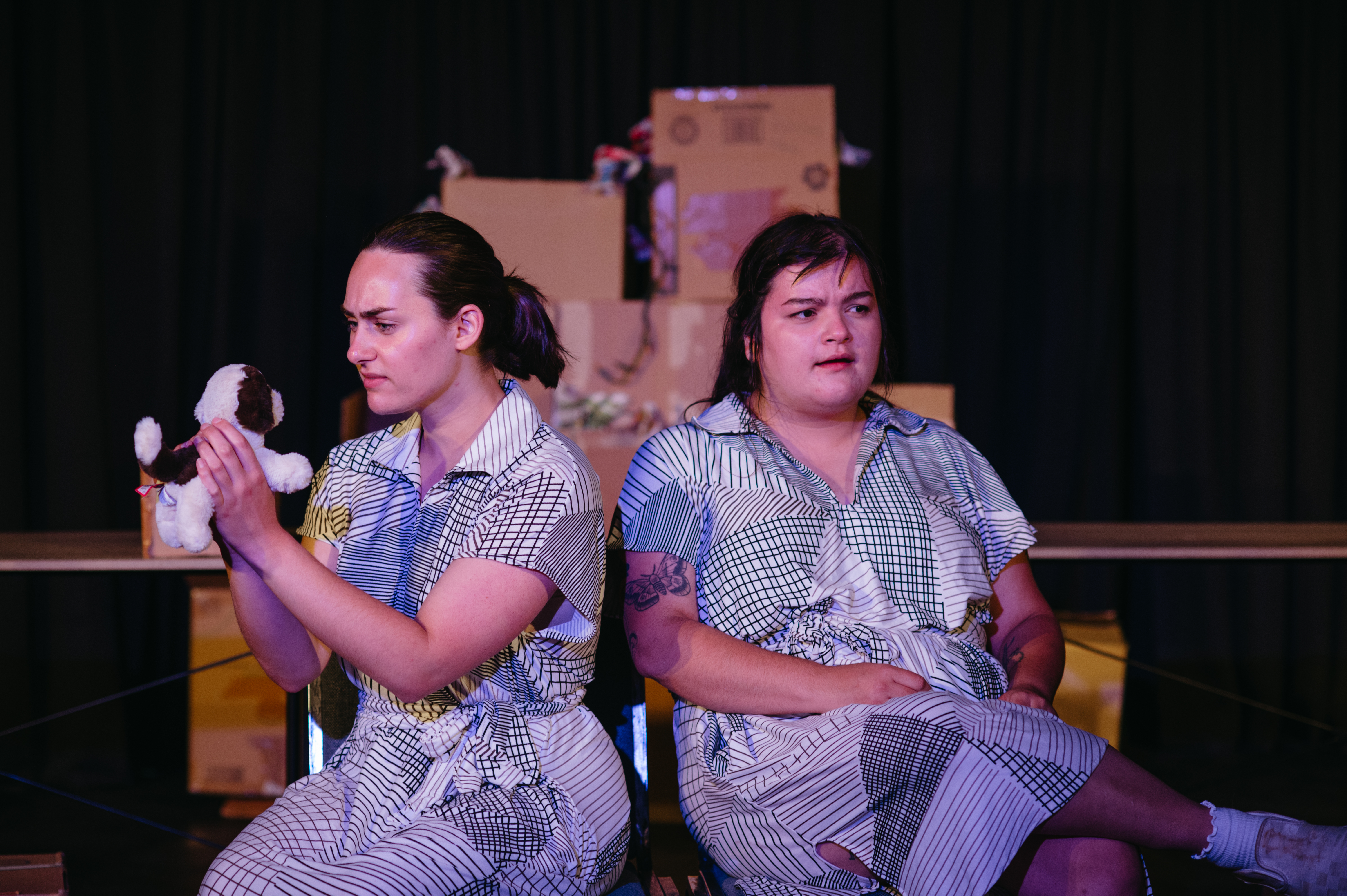
Abby Krushel and Shyanne Duquette as the two Hannah Morgans in Fetch. Photo provided.

It was odd to get several days into Fringe and realize that I hadn’t yet spent time viewing traditional multiple-actor plays, except for Matt & Ben. I missed them, while still enjoying performance art, improv, and solo shows. But now I’ve seen a few more dramas and comedies.

Fetch, by Cat Walsh, was originally a 2018 Fringe production with the playwright and Lora Brovold on stage. I didn’t see that one, The 2026 production, directed by Steven Sobolewski, stars Shyanne Duquette and Abby Krushel. The two actors burst onto the small stage of Acacia Hall in near-identical dresses, carrying identical suitcases, speaking over each other and with each other to each insist “I am Hannah Morgan.” And each begins to narrate the story of her life – one tragic, one less so – but with suspiciously similar details. Each recounts the events of a big family vacation to an amusement park – as the youngest of a big family, six-year-old Hannah resents the vacations she missed out on being born last, and the way that siblings moving out to university and on to extracurricular activities and jobs signify the end of the family-adventures era. Krushel’s Hannah recounts her grievances with the age appropriate self-centredness of a loved youngest child, while Duquette’s character drops hints of bitterness and bereavement. Were there two families in the same reality whose lives had intersected that week? Were these two Hannahs embodying different multiverses, different outcomes? The Hannahs allude to the Schrodinger’s cat paradox – a cat in a box might be either alive or dead, until the box is opened. The weirdness ratcheted up along with the excruciating tension, as horror approached. I was reminded of Walsh’s 2015 Sterling-Award-nominated script The Laws of Thermodynamics . One of my favourite bits was when Duquette’s character is reminding the audience of the required ritual of speaking to a grieving person, the I’m sorry and Thank you shifting into taking the exchange as a given. It’s very well done.
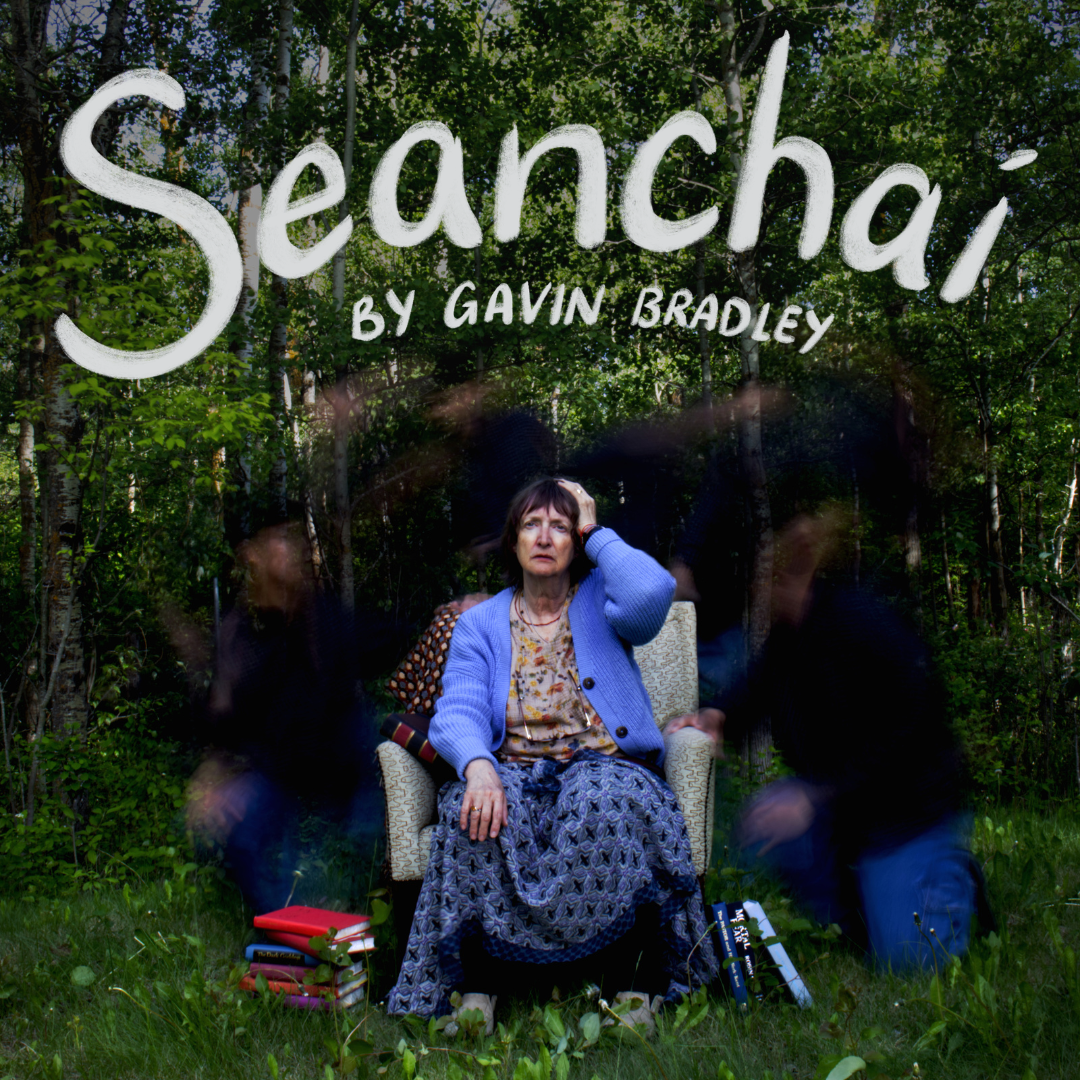
Seanchaí, by young local playwright Gavin Bradley, isn’t marked in the program as New Work – I guess because it had a successful entry at StageStruck! and the provincial one-acts festival last year. But this is its first longer run, and it’s being well received by Varscona Theatre audiences. Susan Sneath, an Edmonton Fringe artist since the festival’s first summer, plays a retired seanchaí (storyteller and oral historian in the Irish tradition), and Mark Guerrero a young person who’s been retelling the traditional stories for TikTok. The grudging respect and growing affection between the two unfold as they tell the stories to each other, correcting and challenging. Its poignant and relatable and also affectionately funny. Knowing bits of Irish language means getting to laugh at a few lines first, but definitely isn’t required to follow the story. Knowing the folklore (Cú Chulainn, Children of Lir, Fionn mac Cumhaill and the Salmon of Knowledge) is also not necessary, as both storytellers provide compelling versions. Amanda Goldberg (recent Sterling Award winner for directing Jessy Ardern’s Cyrano) directed, bringing an understated delicacy and allowing the characters to show their quirks without being stereotypes.

Another small story of a gentle interaction between two isolated characters is Being Norwegian, David Greig’s script directed by Amy De Felice at the Holy Trinity Anglican basement space. The 45-minute play is set in Sean’s (Cody Porter) barely-unpacked apartment, late at night, as he brings home new acquaintance Lisa (Clarice Eckford). Both characters have Scottish accents, but Lisa explains that her name is short for Liselotte and she’s Norwegian. And they’re both awkward. Likeably awkward. The audience is sighing in sympathy as Sean tries to find a bottle of wine and can’t find glasses. His visitor assures him that mugs are better anyway, takes a sip, and manages to communicate to the audience that the wine is terrible without letting Sean see that. Porter and Eckford are both very good at this kind of nuanced portrayal of ordinary people – I’m remembering Eckford as caregiver daughter in The Gravitational Pull of Bernice Trimble and Porter in Angry Alan, Betrayal, and others.

Queens of Romance, by Trevor Schmidt, is sillier than any of the above, and an audience favourite. Three romance writers are on a panel at a convention – the usual moderator is unavailable due to some whispered family scandal, so fan Missy (Schmidt) gamely takes the podium and the clutch of cue cards and tries to carry on. The panelists embody the range of romance-writing styles. Jason Hardwick portrays the Barbara Cartland-type Dame Nausea with smugness and pathos and dignity (but not all at once!) wearing the most over-jewelled caftan I’ve ever seen. Michelle Todd’s Janet writes about contemporary celebrity infidelities with luxurious descriptions – there are probably throbbing members in her stories. And the youngest of the writers, Karen (pronounced Karin), (Jake Tkaczyk), writes erotic suspense, with unapologetic kink and brutal imagery. Each of the writers is critical of the others’ choices, naming some of the problematic issues with women’s agency, racism, classism, transactional sex, and women feeling shame about their desires – all while conducting snappy repartee with each other and the ill-equipped moderator (and possibly with audience members). While I was admiring the pre-set before the show started, I was amused to see Schmidt’s anxious moderator character peeking out from the side curtains looking worried.
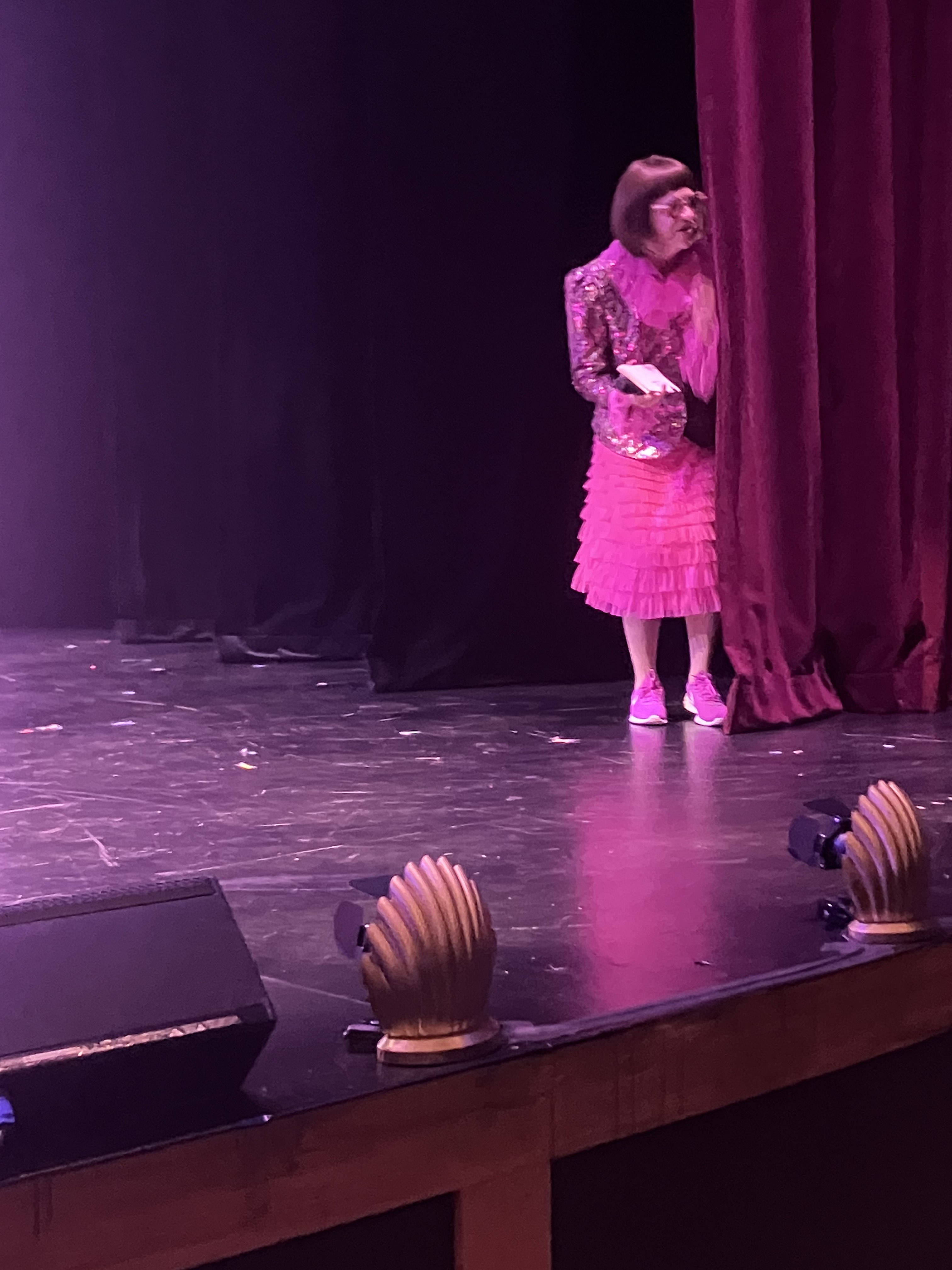
Trevor Schmidt, as Missy the moderator, peers out at audience before the show starts.

Tragedy is silly, Happiness™ is not what it seems …

Epic Tragedy is actually neither.  It’s frivolous and delightful, fun even if you don’t know the Greek-tragedy source material very well.  Gerald Osborn sets his story in a taverna in the Ancient Greece of the classic tragedies, but with thoroughly modern tropes like a first date from a dating-site match.  In the smaller roles, Eric Smith is a very feline Sphinx on the prowl, Francie Goodwin-Davies is a favourite as the Oracle, and Landon Shayne Penner shuffles anxiously as a mute slave working for taverna owner James Hamilton (Laws of Thermodynamics, With Bells On, Waiting for Bardot).  Ruby Swekla, Syrell Wilson, dale Wilson, Catherine Wenschlag, and Cat Walsh all bring extensive experience and fine comic timing to the major roles, making this fun and easy to watch.  One more show Sunday afternoon at the air-conditioned Walterdale.

Happiness™ is not easy to watch – at least, it wasn’t for me.  But it is very much worth experiencing.   Cory Thibert and Tony Adams, from Ottawa, perform as a sales/self-help duo making a product-launch presentation to the audience, with help from the technician for their presentation who was played by the technician for their venue.  The real context and the story context kept blurring like that, and it was creepy and effective, because I do want to go to a Fringe show and I do not want to go to a Forum presentation, Amway recruitment, or gospel revival meeting.  I couldn’t figure out whether to engage with the show or hide in case they were really one of the latter.  I loved it.  They have one more show on Sunday evening, at Rutherford School across the road from La Cité Francophone.

Two tales around times of disaster

It was going to be three.  I was planning to get to One Flea Spare this afternoon, the Trunk Theatre production about people quarantined during a bubonic plague, but that didn’t end up happening.  Colin MacLean’s review of that show is here. 

So the two shows I saw this weekend were Bears and The Laws of Thermodynamics.   Both of them were set around some kind of environmental disaster which wasn’t quite explained.  In Bears, it was a current or very-near-future setting, not too far from here, with oil spills and watershed damage and other familiar real or realistic problems.  In Laws of Thermodynamics, it was … pretty much the opposite of all that.  Can you say “magical realism” in an end-of-the-world story?  Nothing is explained about why the world seems to be ending, or why it is ending the way it is, and some of the things that happen really don’t fit current models of physics.  Oh, but while I’m thinking of it, there’s some magical-realism to the story of Bears too, it’s just not about the setting.

Bears is a new show written by Matthew Mackenzie, who wrote Sia.  Its short run at the PCL theatre had several sold-out houses.  It was produced by Pyretic Productions, with Patrick Lundeen credited as “Consulting Director”.  Sheldon Elter narrates the story, in the odd format of a third person narrative about Floyd while he seems to be portraying Floyd himself.  It is as if he is standing outside the person to whom the events happened, leaving it unclear whether he is actually still that person.  And that is probably not an accident.   As the story starts, Floyd is an oilpatch worker who is fleeing arrest for some kind of sabotage, heading west to the mountains and recounting memories of growing up with his Kokum (Cree for Grandma) picking berries, dancing at pow-wows, and watching the stars.  On his journey, he slips gradually from the man-made world of highways and diners to the natural world of the foothills and mountains, but continues to encounter evidence of human destruction such as dead animals, clearcutting, and avalanche.  He also experiences many delightful natural phenomena –  butterflies, chickadees, salmon, berries, and alpine-meadow flowers.

While Elter narrates the story actively as Floyd, stomping about the stage in high-visibility coveralls and work boots, he is backed up by a chorus of dance/movement artists (Alida Nyquist-Schultz, Krista Posyniak, Kate Stashko, Anastasia Maywood, Aimee Rushton)  They added visual interest and emotional intensity, with movements that were sometimes representational (I loved the churning salmon and the irritatingly-flittering butterflies), sometimes more loosely interpretive, and occasionally a more traditional unison choreography.  Bryce Kulak played and sang several clever original songs, in character and costume as the ghost of an old-time Mountie.  Lianna Makuch and Ainsley Hillyard had cameo appearances.  The simple set was made up of some jagged mountain set pieces with echoing outlines on the floor, with video projections and lighting changing with the story.   And the magical realism that I alluded to earlier – I’m not sure whether Floyd’s transformation during the voyage was real, metaphorical, or something in between, but I didn’t need to know that to appreciate the story and the message.

I was uncomfortable with the specific naming of a pipeline project and a pipeline company, but I’m okay with being uncomfortable.  Art with the power to make people squirm and think and examine cognitive dissonance and argue is a good thing.

The Laws of Thermodynamics, a new play by Cat Walsh directed by Heather Inglis, was playing in the Westbury Theatre, configured with a few rows of seats on risers close to the stage area.   I went to see it partly because Workshop West always has interesting productions and partly because Melissa Thingelstad was in it, and her characters fascinate me.  It also had James Hamilton and Julien Arnold in it, both with appearance and posture so unlike anything I’d seen them in before that I was looking through my program to see whether there was a bigger cast than I’d expected.  But no, there were just five, with Cody Porter having a large role and Paula Humby a small unspeaking one.  Theatre YES was credited alongside Workshop West Playwrights’ Theatre.

It took me quite a while to figure out what was going on.  Which was okay, I think it was supposed to.  A traveller in hazardous times (Cody Porter) has a truck breakdown,  wanders into a small town looking for help, and meets weird people who maybe aren’t what they seem.   Thingelstad is Della, a diner waitress who seems to be in charge, with a huge ring of keys.  She and Jerry (Hamilton) each confides secrets in the traveller Daniel, with instructions not to tell the other.  Arnold’s place in the remnant society is clearly on the bottom of the heap, but it takes a while to find out why.  One of the ways that the eerie approaching doom was indicated on stage was the buzzing and swaying of the big electrical-transmission poles arranged in a false-perspective series extending backwards.  I don’t know why I liked that so much, but I did.  I liked the companionate relationship between Daniel and Della that formed as the end became closer, sharing a hoarded Twinkie under useless umbrellas.

The Laws of Thermodynamics was one of those shows that would have benefited from a second viewing, I think.  It was both darker and more elliptical than Bears, and in some ways less entertaining.  But I was not disappointed in seeing Melissa Thingelstad play another strange character, and there were some funny parts in the character interactions too.

I think the next play on my schedule will be Pink Unicorn.  And maybe by then I’ll be caught up posting about shows that I saw earlier.