Tag Archives: fringe

Four Plays

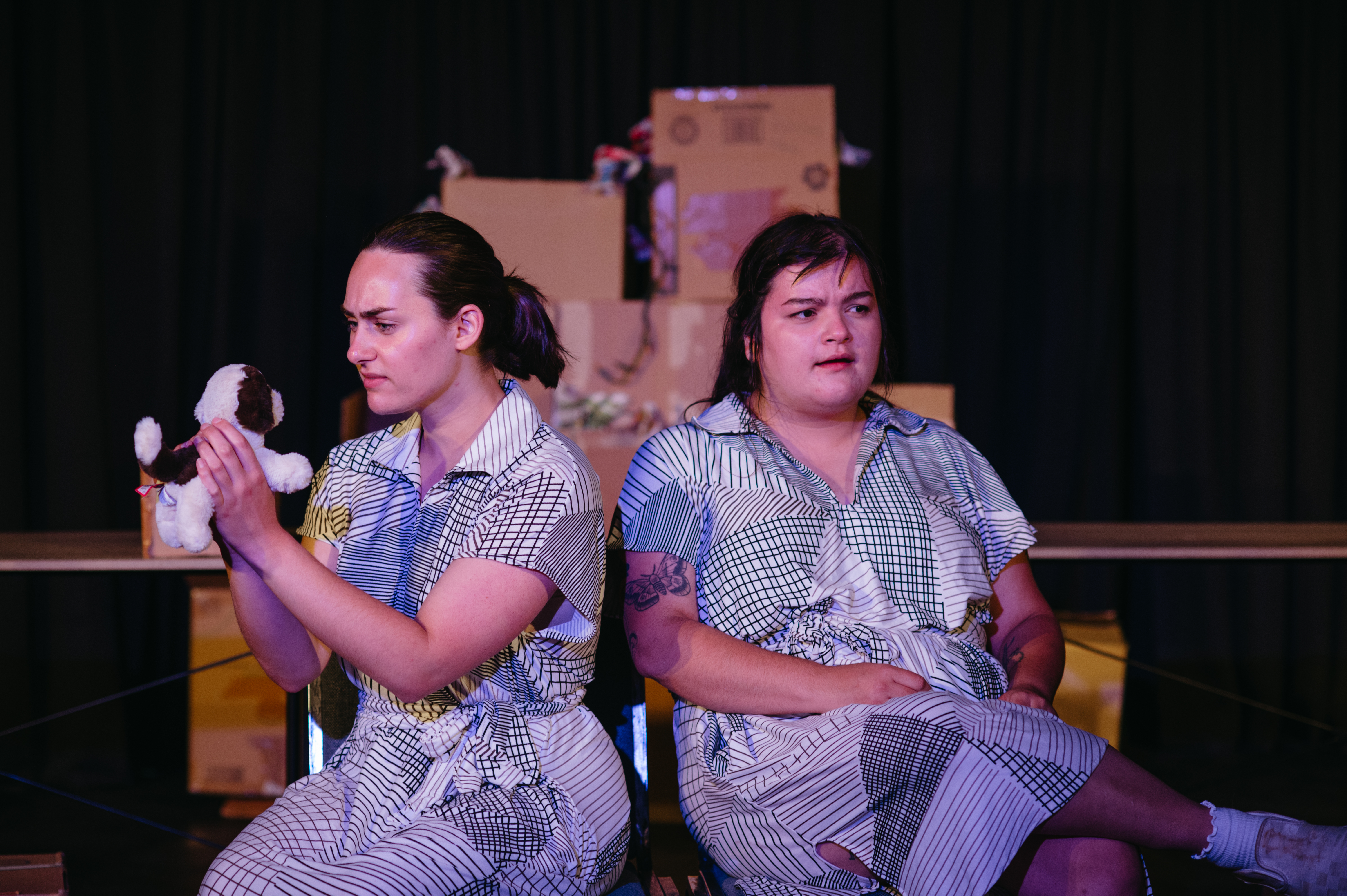
Abby Krushel and Shyanne Duquette as the two Hannah Morgans in Fetch. Photo provided.

It was odd to get several days into Fringe and realize that I hadn’t yet spent time viewing traditional multiple-actor plays, except for Matt & Ben. I missed them, while still enjoying performance art, improv, and solo shows. But now I’ve seen a few more dramas and comedies.

Fetch, by Cat Walsh, was originally a 2018 Fringe production with the playwright and Lora Brovold on stage. I didn’t see that one, The 2026 production, directed by Steven Sobolewski, stars Shyanne Duquette and Abby Krushel. The two actors burst onto the small stage of Acacia Hall in near-identical dresses, carrying identical suitcases, speaking over each other and with each other to each insist “I am Hannah Morgan.” And each begins to narrate the story of her life – one tragic, one less so – but with suspiciously similar details. Each recounts the events of a big family vacation to an amusement park – as the youngest of a big family, six-year-old Hannah resents the vacations she missed out on being born last, and the way that siblings moving out to university and on to extracurricular activities and jobs signify the end of the family-adventures era. Krushel’s Hannah recounts her grievances with the age appropriate self-centredness of a loved youngest child, while Duquette’s character drops hints of bitterness and bereavement. Were there two families in the same reality whose lives had intersected that week? Were these two Hannahs embodying different multiverses, different outcomes? The Hannahs allude to the Schrodinger’s cat paradox – a cat in a box might be either alive or dead, until the box is opened. The weirdness ratcheted up along with the excruciating tension, as horror approached. I was reminded of Walsh’s 2015 Sterling-Award-nominated script The Laws of Thermodynamics . One of my favourite bits was when Duquette’s character is reminding the audience of the required ritual of speaking to a grieving person, the I’m sorry and Thank you shifting into taking the exchange as a given. It’s very well done.
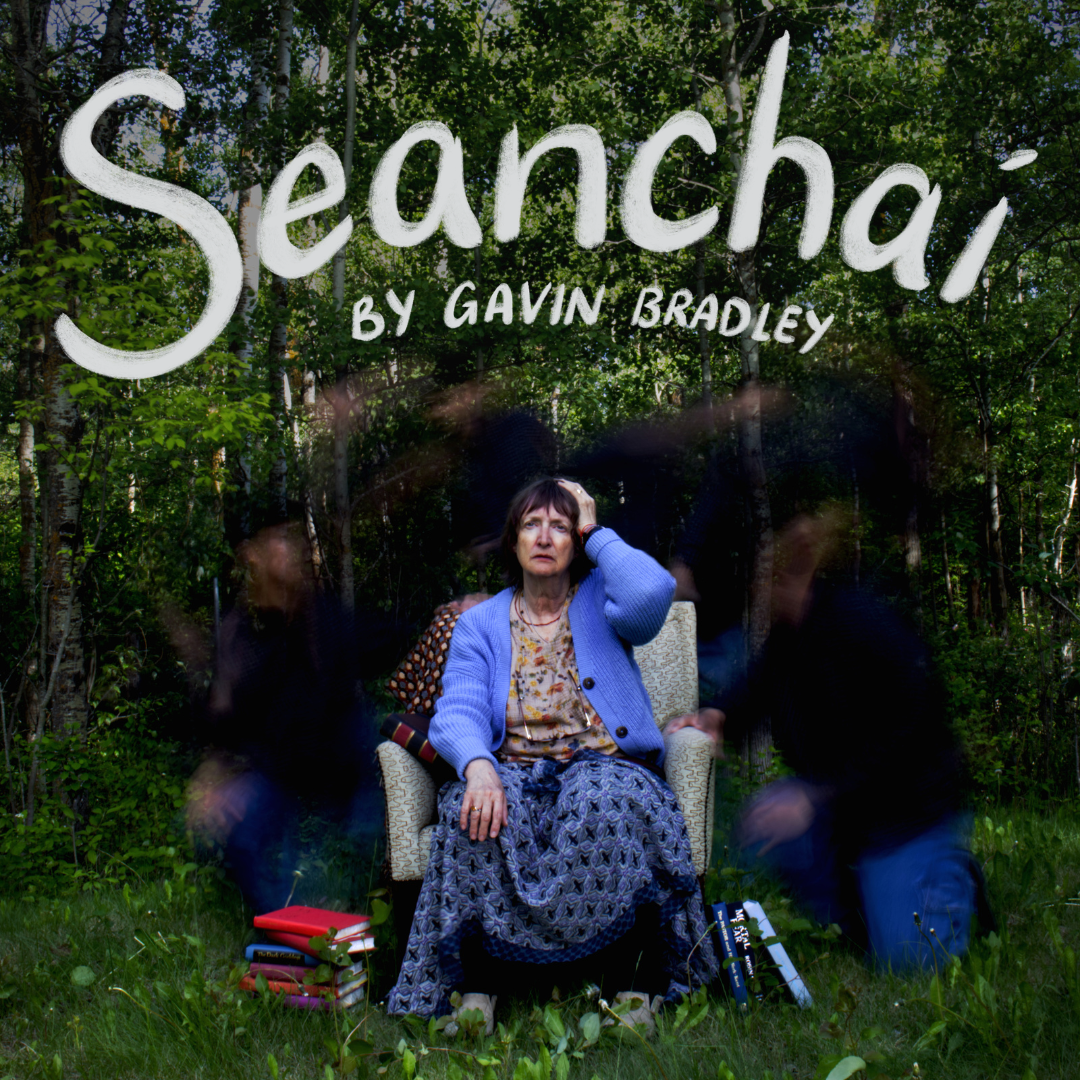
Seanchaí, by young local playwright Gavin Bradley, isn’t marked in the program as New Work – I guess because it had a successful entry at StageStruck! and the provincial one-acts festival last year. But this is its first longer run, and it’s being well received by Varscona Theatre audiences. Susan Sneath, an Edmonton Fringe artist since the festival’s first summer, plays a retired seanchaí (storyteller and oral historian in the Irish tradition), and Mark Guerrero a young person who’s been retelling the traditional stories for TikTok. The grudging respect and growing affection between the two unfold as they tell the stories to each other, correcting and challenging. Its poignant and relatable and also affectionately funny. Knowing bits of Irish language means getting to laugh at a few lines first, but definitely isn’t required to follow the story. Knowing the folklore (Cú Chulainn, Children of Lir, Fionn mac Cumhaill and the Salmon of Knowledge) is also not necessary, as both storytellers provide compelling versions. Amanda Goldberg (recent Sterling Award winner for directing Jessy Ardern’s Cyrano) directed, bringing an understated delicacy and allowing the characters to show their quirks without being stereotypes.

Another small story of a gentle interaction between two isolated characters is Being Norwegian, David Greig’s script directed by Amy De Felice at the Holy Trinity Anglican basement space. The 45-minute play is set in Sean’s (Cody Porter) barely-unpacked apartment, late at night, as he brings home new acquaintance Lisa (Clarice Eckford). Both characters have Scottish accents, but Lisa explains that her name is short for Liselotte and she’s Norwegian. And they’re both awkward. Likeably awkward. The audience is sighing in sympathy as Sean tries to find a bottle of wine and can’t find glasses. His visitor assures him that mugs are better anyway, takes a sip, and manages to communicate to the audience that the wine is terrible without letting Sean see that. Porter and Eckford are both very good at this kind of nuanced portrayal of ordinary people – I’m remembering Eckford as caregiver daughter in The Gravitational Pull of Bernice Trimble and Porter in Angry Alan, Betrayal, and others.

Queens of Romance, by Trevor Schmidt, is sillier than any of the above, and an audience favourite. Three romance writers are on a panel at a convention – the usual moderator is unavailable due to some whispered family scandal, so fan Missy (Schmidt) gamely takes the podium and the clutch of cue cards and tries to carry on. The panelists embody the range of romance-writing styles. Jason Hardwick portrays the Barbara Cartland-type Dame Nausea with smugness and pathos and dignity (but not all at once!) wearing the most over-jewelled caftan I’ve ever seen. Michelle Todd’s Janet writes about contemporary celebrity infidelities with luxurious descriptions – there are probably throbbing members in her stories. And the youngest of the writers, Karen (pronounced Karin), (Jake Tkaczyk), writes erotic suspense, with unapologetic kink and brutal imagery. Each of the writers is critical of the others’ choices, naming some of the problematic issues with women’s agency, racism, classism, transactional sex, and women feeling shame about their desires – all while conducting snappy repartee with each other and the ill-equipped moderator (and possibly with audience members). While I was admiring the pre-set before the show started, I was amused to see Schmidt’s anxious moderator character peeking out from the side curtains looking worried.
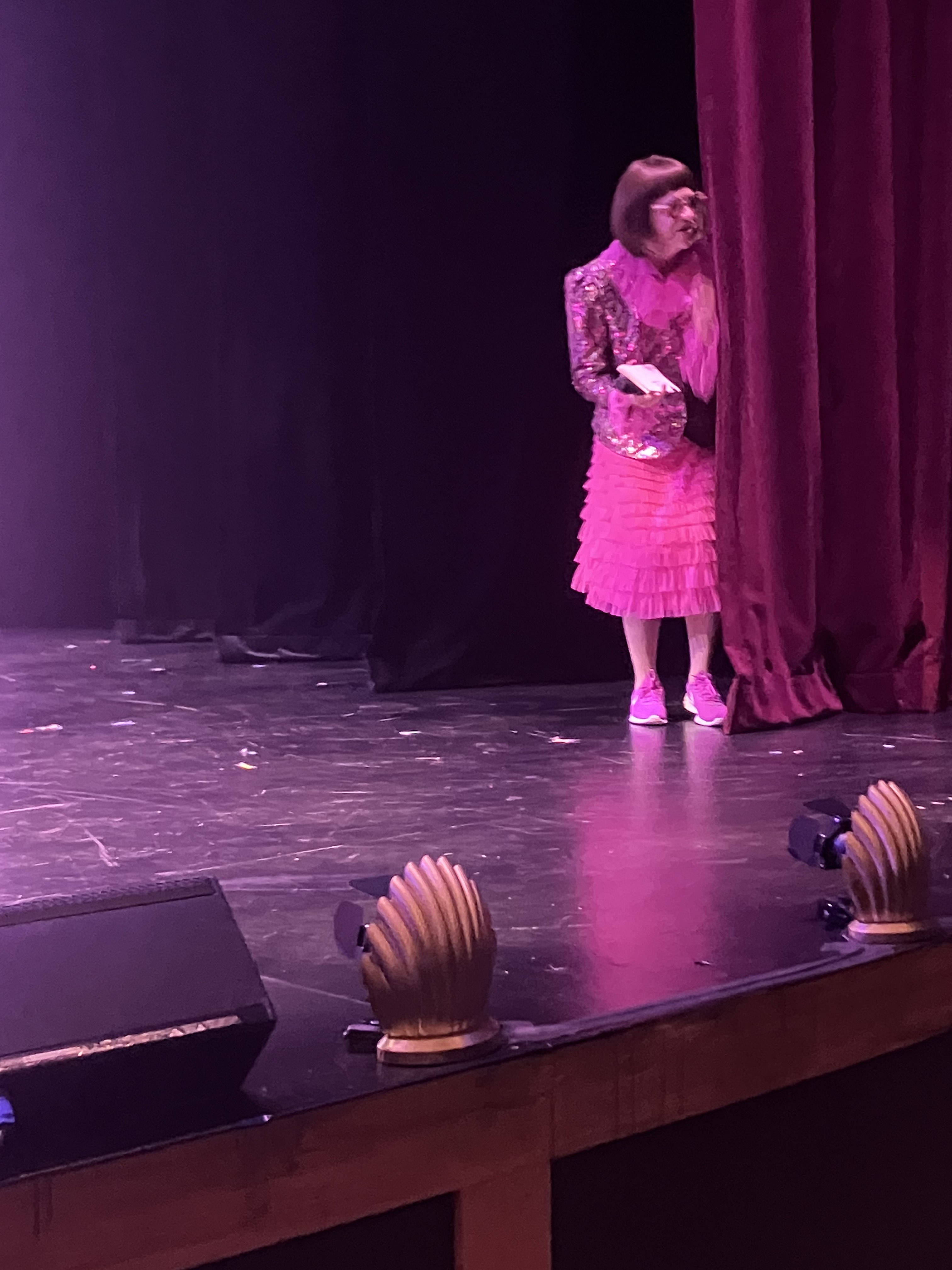
Trevor Schmidt, as Missy the moderator, peers out at audience before the show starts.

Four funny shows!

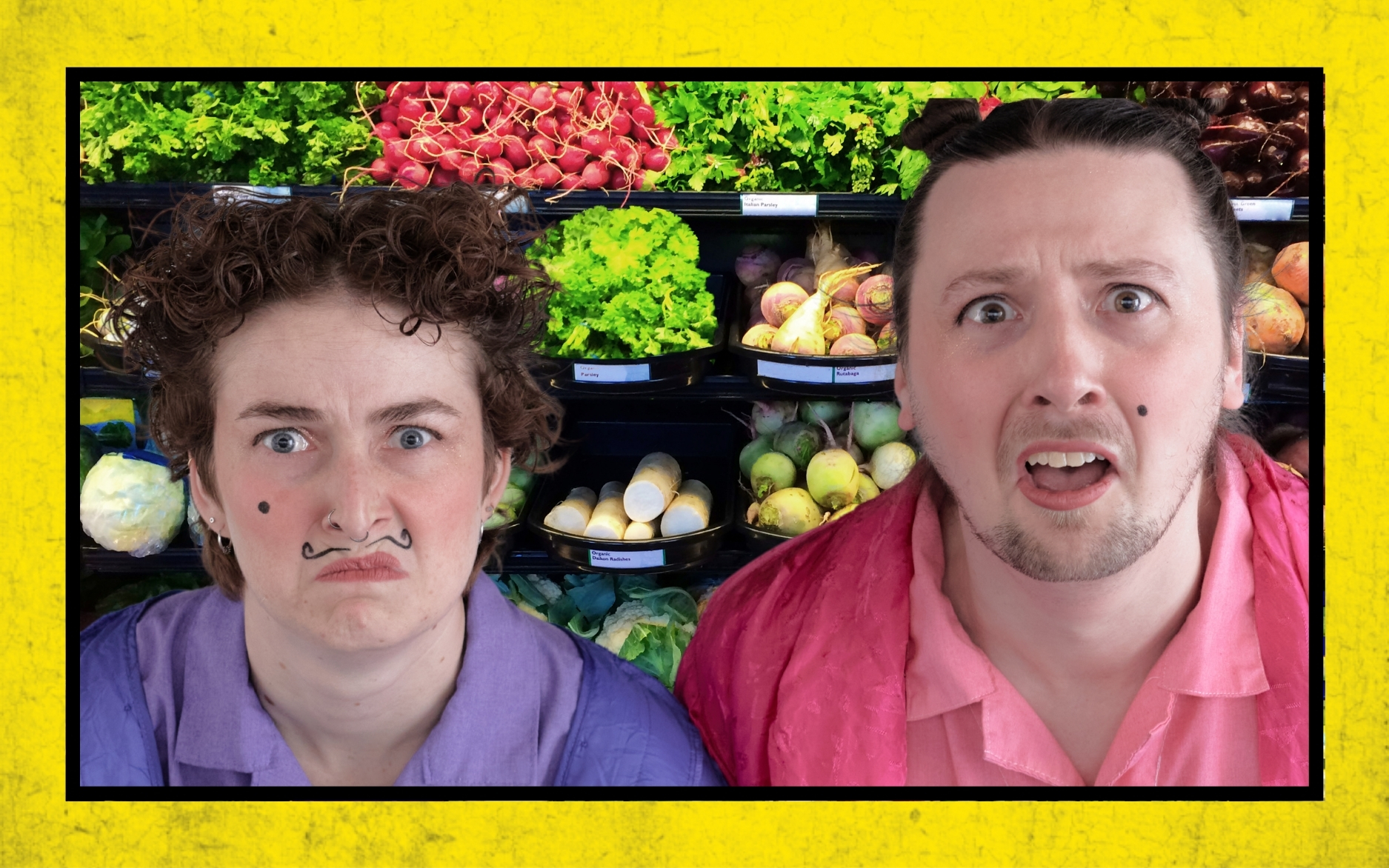
Rainier Pearl-Styles as Jeff, Nicholas Chieffo as Grundled. Photo credit Rainier Pearl-Styles and Nicholas Chieffo. Jeff & Grundled KNOW FRILLS is at Mile Zero Dance.

The next four performances I saw were all a lot of fun!

Matt & Ben was written by Mindy Kaling and Brenda Withers in 2002, imagining Matt Damon and Ben Affleck before they were famous moviemakers and actors, and it was originally performed by the two female playwrights. Local company Nacho Pals Theatre has cast Melissa Masse as Affleck and Angela James-Findlay as Damon. Their portrayals of the two buddies from South Boston are affectionate and funny. Costuming with backwards ballcaps, body language of bros and best friends, and hints of the canonical accent support the illusion without distracting.

The opening imagines the two of them trying to adapt Salinger’s Catcher in the Rye for the screen, while recounting the unexplained phenomenon of having a brand-new script drop in their laps – a script that has their bylines. The title, Good Will Hunting, is unfamiliar to them, but of course the audience recognizes it as the screenplay that won Damon and Affleck an Academy Award, for the 1997 movie that they also both acted in. Another complication in the characters’ relationship is that Damon is getting callbacks for a theatre role, but trying to hide his success from his friend. I’d read this script years ago and forgotten the details, so I was completely engaged with this performance. Afrah Collier-Potts directed, and it’s playing at Sugar Swing Ballroom.

Blackground is an improv troupe from Atlanta GA, made up of four Black performers, Josh Quinn, Swift Rice, Markis Gallashaw, and Maria (sorry didn’t catch her last name!). Their setup is that they get the audience to suggest and vote on a well-loved movie, then they show us the story of what the Black people were doing in and around the parts we know. Our audience chose Titanic. The Blackground version included Jerome, a character who’s never seen the ocean but wins a ticket in a card game, a high-born woman travelling with her father, some crew members shovelling coal to fuel the steamship (and one whose goal is to make it “steamier”), a preacher and congregation condemning the hubris of the ship-owners’ claims that not even God could sink the ship, Their transitions and tap-outs were very smooth and their show was very funny! At Rapid Fire Exchange.

Jeff & Grundled KNOW FRILLS is a clown two-hander, in which the eponymous characters try to respond to gender role policing in a grocery store. This makes a little more sense than you might think – they’re excited to go to No Frills because it’s cheaper, and then even more excited when No Frills turns into Macho Men’s Market and promises deeper discounts. But of course the performers/creators (Rainier Pearl-Styles and Nicholas Chieffo) bring a lot more nonsense to their problem-solving along the way, using some classic clowning tropes and some inspired commentary on how to be, become, or pass as a ;”real man”. Some bits I appreciated included surprise!juggling (it fit in the story and was very slick), a version of the “performers run through audience” thing, and an absolutely brilliant “audience volunteer” bit that led to everyone in the room who didn’t already know it learning along with the characters how to say motherfucker in ASL. Seriously – I looked up from forming my own fingers into the sign and saw everyone around me doing the same! Jan Henderson directed. Marquesa Dubois and Jenni Stevens provided ASL interpretation.

A Woman’s Guide to Romance Novels is a solo by Holly Brinkman of Vancouver. With a twinkle in her eye, a desk stacked with books, and a few 21st century lecture tools, she invites the audience to celebrate a genre most are already familiar with, creating new excerpts out of her head. She also has guest performers – in the one I saw, it was local burlesque performer LeTabby Lexington. Im also looking forward to seeing Trevor Schmidt’s take on this phenomenon later in the week with Queens of Romance, and I see that Between the Covers is billed as romance-novel-inspired burlesque.

Three solos!

The economics of Fringe festival touring provide motivation to create an entertaining performance with a limited number of team members. And the artistic challenge of keeping an audience engaged for an hour or so on one’s own raises the stakes for solo performers, and leaves the audience more impressed when it works. There are about 82 shows in the Fringe program that list a single cast member. But theyre not all the same!

On the Fringe opening night, I took in three solo performances.

No Die! Or: How I left Amsterdam and Almost Died in Africa – Fedor Ikelaar, Acacia Hall (venue 5) When we were recommending it to others later, I called this Storytelling and a friend called it Stand-up Comedy. I would still classify it as a storytelling performance, but I see why the performer’s natural delivery and responsiveness to the audience might lead to a description as stand-up comedy. Plus, it was funny! After a few comments about being a Dutch visitor in Canada, the performer Fedor Ikelaar launches into a long tale of travel misadventures, contextualized by the hubris of being a straight white man along with the overconfidence of a first-year anthropology student thinking he could fix the world and could make a significant difference in a short volunteer trip. In school he’s learned about the Human Development Index, so he decides to spend his summer in the country which is currently last on the list, Sierra Leone. The title is a spoiler in that he does not die. But he does wander through more misadventures than Mr. Magoo, receives significant support and care from the Sierra Leonean people he thought he was going to help, and uses his outcome an encouragement to travel more.

The Game of Bluff is Susan Jeremy’s narrative about the shuffling characters and lives of herself, her mother (a lifelong poker player), her grandmother (supporting her household as a small-time bookie), and her great grandmother (a numbers runner). The performer embodies each of these characters with distinct voice and mannerisms, and adds clarity by having the speakers address each other by name a lot. Besides the ones mentioned above, there’s her father, her mothers poker cronies, a fortune-teller, and others. It was interesting to see how she wove the thread of gambling through the multiple generations of the family, with many of them benefiting from the industry and one addict – not a viewpoint I’d seen before. Walterdale Theatre, venue 3.

Solovela was my first improv show of the festival. Diane Jorge from Miami had the half-full room in Acacia Hall laughing right from the start of her midnight performance, creating a telenovela (Latino-style soap opera) from a few questions she asked some (consenting) audience members, and some props she used to signal a shift between characters. She embraced some tropes of the genre such as having the audience recite the name of the story at commercial breaks (one of which was actually a short pitch by an artist in the audience for his own show), and showing a romantic focus on one character by having them stand over a fan blowing their hair around. There was romance, there was suspense, there was a fight (in which she performed both combatants), there was justice and happy endings. Jorge seemed relaxed and comfortable and she was very funny, from her self-deprecating asides to her characters’ physicality.

I had forgotten that it was handy to have cash on hand to donate to touring performers in exchange for show merch. All three performers had mementoes available and I wanted to support all of them. Good thing there are bank machines on the grounds!

Making Fringe unforgettable for more people

Title page of Fringe Unforgettable program book, 2026

It’s like Christmas Eve – every time I walk past the Fringe grounds I see more of the trappings up. The big schedule pillars. The food trucks. The zipped-up tents that will become the North Beer Tent and the Volunteer Patio. Huge displays of white petunias in front of the ATB Community Patio. I love to see each hint of the familiar routine, looking forward to the 11 days in August that transform my neighbourhood into the Fringe.

But I’m also noticing some things that will be different this year. Things that will make it easier for many different people to have an unforgettable Fringe.

The free Shuttle to the French Quarter is back – but this year there is also a stop by Goodwill (north side of Whyte at 101 St, handy to the West Ritchie venues of Grindstone and Sugar Swing, Mile Zero Dance,The Playhouse, Roots on Whyte, and The Faculty, and quick access to the three stages at Holy Trinity Anglican north of Whyte), and there are stops on both sides of Whyte at 96 Street (by stage 19 under Mill Creek Cafe). With a little planning, using the shuttle will make it easier to access the growing number of BYO Venues spreading out from the traditional hub at the Arts Barns. The shuttle is a pilot project this year, so I hope lots of people take it!

The Fringe ticketing web pages have more information on each show, arranged more conveniently than in the past. Looking at a hard-copy program book ($15) is still the easiest way for me to make plans. But now the website shows the creative team listing for each show, and a “plain-language” description of what to expect which is a refreshing addition to the sometimes cryptic or silly paragraphs in the program book. I like knowing whether a show team has names I recognize, and I think the plain-language descriptions will help lots of Fringe newbies and people who prefer the literal to the obscure. There’s also a quick drop-down displaying all dates and times for a show with a single click.

This year some artists are able to provide various accessibility measures for specific performances. Listings are on the Fringe website here. There may be additions to the list throughout the festival. Currently there are at least five shows offering ASL Interpretation for one performance each, and listing the names of the ASL Interpreters. Three productions offer Open Captioning of audio elements visible to all audience members. Weird Al Karaoke projects all their clever song lyrics on screen at every performance, which means less chance of missing funny bits while everyone is laughing. There are Relaxed Performance and Relaxed Environment options.

There are also three productions offering Audio Description for one performance each. An audience member who wishes to hear a spoken description of the visual aspects of the show, spoken by an off-stage describer without interrupting the show dialogue, can pick up a headset at the door of the theatre. Gwen Coburn (you might remember her from Sad Girl Songs in 2023 and a creepy-hilarious Die-Nasty drop-in), Boston-based performer whose show this year is The Importance of Being Haunted, told me that she got interested in Audio Description ”after meeting patrons who were blind or low vision and wanted to access my show” and has spent the past year training and working in AD (Audio Description) in the Boston area. Performances with Audio Description are listed below.

  • Monday, August 17th at 12pm at the ATB Westbury Theatre The Merkin Sisters #Backcombed Two wildly HILARIOUS, OUTRAGEOUS, delightfully unhinged sisters who take it to a whole new level of absurd brilliance. This jaw-dropping, laugh-until-you-can’t-breathe show will electrify your senses. A vivacious romp sending up our inner cavemen and our ultra-queens, smothered with the unique flavour of absurdity that comes from siblings surviving childhood together. 18+
  • Tuesday, August 18th at 8pm at Mile Zero Dance Stage 12 Angry Puppets 1 performer – 12 jurors – 0 clue! Rub-a-dub-dub, the Baker is dead in the tub. Now the Butcher is on trial… and what ever happened to that Candlestick Maker? A fast-paced dark comedy for adults about justice, bias… and fleece. Great for families! PG
  • Wednesday August 19th at 3:30pm at Sugar Swing Upstairs The Importance of Being Haunted A plausibly authentic vaudeville ghost show. Step into a world of theatrical spectacles, and potentially supernatural ones. Straight out of the vaudevillian tradition of humbuggery, Dr. Silkini leads a show that is equally seance and slapstick. But is any of it real? Can you contact a ghost, if you don’t believe in ghosts? Tap once for yes. PG+

So on this eve of the 2026 edition of the Edmonton International Fringe Theatre Festival, I am looking forward to the festival being better than ever for more people. Hope to see you on the grounds!

Abbreviated Fringe 2025, Fringe plans 2026

I wasn’t around much for Fringe 2025. I’d planned to spend the first weekend at a family wedding in another province, and the second weekend at friends’ wedding locally – but I did not plan that an airline labour disruption would strand me away for most of a week.

So I managed a bit of Fringing, but I didn’t make time to blog about anything I saw until later, and I’m just posting now, for completeness.

Carole of the Belles – 100% More Girls – the same writers and performers as in last year’s Mass Debating. Kristin Johnson as the take-charge member of a handbell choir and Cheryl Jameson as the trying-hard second-wife newbie, Jake Tkaczyk as timid and mysterious Carole, Billy Brown as an aged mother-in-law and Michelle Todd and Jason Hardwick rounding out the troupe of older women preparing for a Christmas recital. Nuanced as well as funny.

Giorgi of the Jungle – I’ve seen an earlier staged reading of this growing-up story by Lynda Celentano, but I really enjoyed this version, on the Sanctuary stage at Holy Trinity Anglican, as directed by Jake Tkaczyk. Natalie Czar played the Italian-immigrant mother and the three daughters were Miracle Mopera, Jason Hardwick, and Kirsten Throndson. Mopera was particularly impressive as the oldest daughter sharing her beauty-school skills and her own hard-won learning of how to fit in, to advise and defend her younger sisters. And Czar’s monologue of how similar issues had played out for her as a young immigrant woman was thought-provoking, although possibly too long.

Anne Zander is MOTHER – I loved this clown’s look at some of the indignities, challenges, and complications of giving birth and raising an infant. In classic clown fashion, she made brilliant and unexpected use of a few simple props.

The Lost Sock Rescue Society – I thought I knew what would happen in this show, from the premise of an organization created to find new owners for abandoned socks … but it had unexpected delights. Christine Lesiak and Louise Casemore treat the audience as volunteer-recruits for their sock-adoption team.

Flora and Fawna Face their Fears – Flora (Trevor Schmidt) and Fawna (Jake Tkaczyk) welcome a new friend, Fern, played by Jason Hardwick. A fun addition to the trilogy with a few pointed comments on current events. Also, a reprise of the strangely catchy theme song “Face Your Fears”.

Plays by BOTS – I’d never been to this Rapid Fire Theatre improv format, although I’d heard good things about it. The one I went to this year was in the early afternoon and was planned as kid-friendly, with the improvisers playing kids on a ridiculous adventure. (In 2026, RFT is instead doing Plays by Humans.)

Undiscovered Country – Chris Bullough at his essence.

Cabaret of Legends – Tymisha Harris celebrates great Black women musicians of the 20th century and reminds us of their context. (Back in 2026! Worth seeing!)

52 Stories – Dave Morris uses a memory-palace trick to frame some great memoir and storytelling. Also back in 2026!

And now it’s the eve of Fringe Unforgettable, the 2026 festival. My list of want-to-see is three pages long, so I’m postponing some hard decisions. Here’s an excerpt from my list.

Solovela

No Die! Or how I left Amsterdam and almost died in Africa

Game of Bluff

Blackground

Shrute and Tungsta

Queens of Romance

Being Norwegian

Sketchy Broads

Butter Chicken Odyssey

Matt and Ben

Seanchai

The Beanstock Market Crash

Rodgers and Hammerstein’s ROBOCOP the musical

Hellmark Christmas Musical Parody

Fetch

tony wrestles a stranger

Fringe Day Nine: assorted stories – but not storytelling shows.

Heading into the last weekend of Fringe, on Friday I watched three fun shows.

Verbal Tapas is a collection of poems by longtime Fringe poet and storyteller Rob Gee. Instead of scripting a fixed order, the performer handed out “menus” on the way in, with various poem titles and descriptions that sounded like restaurant-food teasers. He invited people to shout out titles, after which he might tell an anecdote of context (the time he recited a poem to two police officers in the middle of the night who had stopped him from illicit postering, the creative-writing groups he’d run as part of his work in mental-health nursing, etc) and launch into a recitation. He kept having good lines which I’d try to remember and then they went out of my head with laughing. Acacia Hall is a good venue for this kind of solo with audience connections.

Canterbury Tales has been adapted from Chaucer’s much longer Middle English original by local theatre artist Donna Call. This version has six travellers acting out each other’s stories to entertain the company, and the role-shifting is amusing. Lee-Ann Semenya plays the innkeeper who sells them drinks, proposes the storytelling competition, keeps things moving, and then covers them up with blankets for the night. I don’t know the original very well – the character names were familiar (the confident and ambitious Wife of Bath played by Amanda Stout, the Miller played as a lout by Ryan Mattila), but I didn’t remember the content of any of the stories. Other performers were Martin Stout, Zack Siezmagraff Penner, Anne-Marie Smyth, and Karen Huntley.

Field Zoology 301: Myths and Monsters is part of a series, in a campground-lecture style. Performer Shawn O’Hara, as Doctor Bradley Q. Gooseberry, welcomes his students around a campfire to teach us about cryptozoology, or the study of legendary/folkloric animals. He makes imaginative use of sketches on an overhead projector to illustrate his tales, including most of the cryptids I’d heard of and a few that were unfamiliar to me, along with some very funny narrative of personal encounters. Afterwards, the performer removes Dr. Gooseberry’s extravagant mustache from his own, to thank his contributors, including people who helped him to navigate telling stories respectfully from Indigenous sources. I would definitely see other shows in this series. This was my first glimpse of Mile Zero Dance as a Fringe venue, and an opportunity to spend time in the Happy Beer Street area of West Ritchie, which was exciting. However, I found the seats uncomfortable, and the full room too hot in last night’s warm humid weather.

Fringe Day Eight – second wind

With no volunteer shift and no stage-management duties Thursday beyond a bit of show laundry, I spent the whole day going to shows that people had recommended to me.

Emo Majok: Australian Aussie was in the intimate space of Acacia Hall. I had heard his guest piece at Late Night Cabaret the night before and was looking forward to it. The stand-up comedian weaves in anecdotes about being challenged by his 7-year-old daughter to leave a job he hates and make a career in performing, about being born in a refugee camp and migrating with his family from Ethiopia to Kenya to South Africa and then Australia, about being Black in Australia (“the Australian indigenous people were the original Black people there, until blacker people arrived”) and in other parts of the world, about being a parent, and other relatable and gently hilarious comments. Emo engages with various audience members individually, teasing a bit about a few immigrant stories and career dissatisfaction stories as well as family groupings (a 60-years-married couple had come with their grandchild, so he congratulated the couple and told the grandchild that it was good of them to spend time with their grandparents but they should get some actual friends).

HerPlease is also in a small performance space, the Nordic Studio Theatre in the Arts Barns. Solo artist Kate Tobie of Minneapolis appears wearing a large vulva costume, from which she pulls out various props while telling stories of her sexual and romantic history and providing some incidental public-service information. Her backstage assistant (not identified, but appearing for bows) is probably very busy, helping out with the various physical bits. Alongside the bigger reveals of the story, I was particularly struck by the comments about enjoying the messiness of having a body while encountering messages of shame about it. HerPlease has shows tonight (Friday) and tomorrow (Saturday) late afternoon.

What a Young Wife Ought To Know made an interesting thematic double-feature with the previous show about women’s (mostly-heterosexual) sexuality in the 21st century. The Hannah Moskovich script, last seen locally as done by Theatre Network in 2018, is tackled here by local indie company Shattered Glass Theatre, directed by Sarah Van Tassel. If you are open to watching a drama in your Fringe-going, consider this one. It is very well done, compelling and well-paced. Abigail MacDougall is breathtakingly heartbreaking as the central character Sophie, starting as a naive 15-year-old who admits she kissed the post-boy because she felt sorry for him having TB, and going through her crush on Johnny, who works at the nearby hotel stables, to marrying him, having several children despite risks to her health and very limited household money, and following through on some very difficult decisions brought about by those circumstances. She breaks the fourth wall between scenes to talk frankly to the audience, mostly directed at other married woman, to ask “what do you do?” and “what would you do?” type questions. Patrick Maloney plays Johnny, and Sarah Spicer plays Sophie’s older sister Alma, both of whom also experience sad outcomes related to their lack of reproductive choice, as a working-class couple in the 1920s.

Batman, Bob, and Bill is an original drama written by Andrew Boyd of No Tomatoes Theatre about the artists who created and developed the Batman stories. Andrew Boyd and Connor Meek play the main characters, with an ensemble of Brooke Hodgson and two more people (I couldn’t find a show program/credits). I thought the ensemble was very well used, as artists sketching in sketchbooks at the back of the stage and discarding some of the results, then shifting to play minor characters, move set pieces (rehearsal boxes with comic-book art on them), etc. It’s playing at venue 18, the Lutheran church hall across the street from Grindstone.

WINNING:Winning is described as a mostly-silent clown show, by Gordon Neill. With lots of artist assistance and no talking, the character works through some of his challenges and fears on stage, while being less compassionate towards himself than the audience is. Near the end, the character and performer merge and speak, giving some of the bigger picture of where this production came from. It was directed by Isaac Kessler (of 1-Man No-Show, etc) and was not only entertaining but moving.

An episode of Die-Nasty and a Late Night Cabaret visit made a long day, but I wouldn’t have missed any of it.

Have a great Fringe weekend!

Day Three – local artists, new stories

It’s hard to find a connecting theme for the four productions I saw today, except that they were all done by familiar local artists.

Dick Piston Hotel Detective in Prague-Nosis was, as the title suggested, a classic noir tale with a hardboiled detective narrator (Lucas Anders), an assortment of suspicious characters (Mélissa Masse, Sarah Gibson, Dan Fessenden, Dave MacKay), and an atmospheric setting cleverly suggested by description, lighting, and a few set pieces moved around to suggest different locations in the seedy Lakeview Hotel. The published script, by American playwright/television writer Jeff Goode, offers scope for over-the-top humorous character portrayals but seems to have the consistent intricate plotting of a classic noir detective story. Director John Anderson has gathered a cast of clever character actors and talented crew, familiar from Walterdale Theatre productions. ASM Adorra Sergios displays title cards before each scene, in a series of increasingly strange hats. Playing in the Sugar Swing Ballroom (main floor) space, venue .

Rob and Chris / Bobby & Tina is an adaptation of one of my favourite plays ever, Collin Doyle’s Let the Light of Day Through. The playwright adapted it to a 60-minute musical format, along with composer/music-director Matt Graham. The original 2013 production of the play, with Jesse Gervais and Lora Brovold, portrayed the awkward affection and determination of a couple who experience an awful tragedy and … not get over it, but go on. The play is partly recollective, but they act out the stories to tell them to the audience, and it is very funny except when it’s awful. Part of the power of the original experience, for me, was not knowing what they were avoiding telling, until they told it. When I heard that Kate Ryan of Plain Janes would be directing a musical adaptation for the Fringe, I was excited, but also apprehensive. What if it wasn’t as good as I remembered the play? What if the experience depended on not knowing the outcome? But it is very good. It landed differently for me because I was watching for clues, but it was still powerful. The couple (Bobby + Tina when they meet as teenagers, Rob and Chris later) are played by Garett Ross and Jenny McKillop. They do just as well showing the awkward disconnects of a new relationship and a long-term one as they do showing the way that the couple develops a shorthand of shared understandings – the scene of trying to have a role-play fantasy when each of them thinks the other wants something else was hilarious, and the ways they imitate each other’s parents to amuse each other show clearly how they’ve been allied against both sets of parents for years. Graham’s music is suitably poignant and funny and affectionate, as called for, and the simple Fringe-appropriate set design (Trent Crosby) worked. Matt Graham plays the piano live. Venue 11, Varscona Theatre.

Mass Debating was also a musical and also at the Varscona. Trevor Schmidt wrote it and cast frequent collaborators Jason Hardwick, Cheryl Jamieson, Kristin Johnston, Michelle Todd, and Jake Tkaczyk, along with himself, to play junior-high-school debate team competitors. The universality and familiarity of the junior-high-aged themes (an early song focuses on each character’s worries of “Can they tell by looking?” ) were portrayed in a setting of mid-1970s Catholic schools, so the injustices were more overt and seemingly unchangeable than a contemporary context. Although the audiences know that things will get better, the characters really don’t. This dramatic irony provides not just humour but poignant compassion. Many of the unfairnesses focus on the institutional sexism of the society and that Church, and the way that both the boys (played by Jameson, Johnston, and Todd) and the girls (played by Tkaczyk, Hardwick, and Schmidt) express them in their interactions and behaviour. The thoughtless racism of the time was also shown in the segment where Ralph Washington, the Black competitor (Michelle Todd) was required to debate the Against side, on a resolution that racial integration has hurt Catholic education. Unlike Schmidt’s recent successful contemporary story about junior high school girls, Robot Girls, this one does not tie up the plot threads with happy endings. And it shouldn’t. That left me thinking. The music was written by Mason Snelgrove, and the accompaniment is recorded. Some of the announcer’s voice-overs were hard for me to hear clearly – not quite the Charlie-Brown-teacher “wah-wah-wah” but probably funnier than I knew about.

The drag comedy troupe Guys in Disguise have a new comedy, written by Darrin Hagen and Trevor Schmidt, called Microwave Coven. It’s also set in the 1970s, in a suburb, and it starts off with three neighbourhood women in fabulous caftans (Darrin Hagen, Jake Tkaczyk, Trevor Schmidt) preparing for a visit from neighbourhood newcomer Jason Hardwick. Hardwick is adorable as naive newlywed Mary Rose, in crinoline and blonde flip. The premise of this story is less realistic than the troupe’s recent productions like Crack in the Mirror and Puck Bunnies, but the characters are just as much fun. It’s also at the Varscona.

Various remixes on Day Two

Image: Fringe 2024 poster designed by Yu-Chen (Tseng) Beliveau – drawing including universal aspects of Fringe and specifics of many previous festival themes. (You might not see the image on some phones – you might see my usual blog header of ticket stubs and the contents of my pockets.)

I fitted three more performances into a busy Friday – two productions hard to describe and also worth seeing, and one new incarnation of a Fringe tradition.

Unkl Stiv’s Looping Machine was on the program last Fringe – I saw an intriguing sample at Late Night Cabaret, but couldn’t fit it into my schedule. So I was happy to see it in the list of Fringe-lottery choices for this year, scheduled into the Yardbird Suite, venue 7. The performer, Steve Pirot, explained that before the start of the pandemic he had been performing several short spoken-word poetry pieces, and then rather than create new pieces for digital performance he decided to work on stitching together his extant work into something longer. Which is now a live non-stop piece almost an hour long. It was fascinating to listen to and watch, but very hard for me to remember details. Pirot uses rhyme and sounds as deftly as a rapper, and plays with words and meanings in ways memorable of T.S. Eliot’s “The Love Song of J. Alfred Prufrock” (which he refers to once or twice). For some of it, I let my mind drift as the echoes and reverberations washed over me. For other parts, I loved the way the sounds and concepts fitted together and tried to remember them – particularly the part about the 24-hour cat cafe – but I can’t. When I first started exploring the local theatre scene, early in the previous decade, I figured out quickly that if Steve Pirot was credited on a project, it was going to be what I called “weird theatre” – and I meant that in a good way! Steve Pirot expanded my appreciation of live performance in 2013, and this Fringe show did that again. If this might be your thing – if you’re even curious about it – try it. He also has a show for kids at this Fringe, called The Empire of Sand.

I think I was probably in the middle of the target audience for Who’s Afraid of Winnie the Pooh?, the Clevername Theatre production playing at venue 18: The FOH Pro Stage, a Lutheran-church hall across the avenue from Grindstone Theatre’s main performance space. A printed program distributed before the show provided a bit of context about the Winnie the Pooh author A.A. Milne’s life, in particular the way his real-life son Christopher Robin Milne responded to being immortalized in his father’s books as the quintessential imaginative solitary child endowing his stuffed animals with life. I had read about that history previously, but it did help to have it top-of-mind during the show.

I was also quite familiar with the tropes and plot points of both source material of this strangest of adaptations. I’d savoured the Winnie-the-Pooh short stories and poems from having them read to me, touching the Ernest Shepard pencil drawings, through watching the Disney animations with younger siblings and reading aloud with the next generation. And I’d worked on a Walterdale Theatre production of Edward Albee’s Who’s Afraid of Virginia Woolf, so I’d heard the venomous barbs and unfolding awful secrets of that script many times while operating the lighting cues, and then watched another production in the Citadel audience.

I have no idea how the Minneapolis theatre artist Alexander Gerchak ever came up with the idea of casting the storybook characters Winnie and Piglet (Thomas Buan and Stephanie Johnson) as the viciously-bonded couple like George and Martha, entertaining a young couple named Hunny (Victoria Jones, costumed as a Pooh-story honey-pot and echoing the naivete of Albee’s Honey) and Christopher (“he looks like a Mormon who collided with a haberdashery shop”, Nick Hill) who seemed to be the analogue of Nick. But it worked. Later on, references were made to other Pooh-universe characters like Eeyore, Rabbit, Owl, and Kanga. The narrative on stage had callbacks to many plot points in both canon stories, and included both absurd physical humour (instead of the many alcoholic drinks of George’s hospitality, Winnie licks out a honey jar with his hands and serves up “nectar” and “condensed milk”) and a lot of what I remember as increasing horror as I came to realize the history behind the intolerable present, highlighted by cringey lighting effects (maybe I just noticed those because of how I first encountered Albee’s work?)

After the performance, I looked them up – and found out that it’s been well received at Fringe festivals in the US. If you are familiar with both sides of the source material – whether or not you actually like either of them – you should definitely see this. It would probably also be worth seeing if you just have a rough awareness of both stories as cultural phenomena – but it was recognizing the specifics and then realizing how the stories were going to dovetail that really sold me.

Late Night Cabaret has moved, this year, from its longtime home in the Backstage Theatre (do you remember when that space acted as storage the rest of the year but was tidied up as a performance space for the few weeks of Fringe?) to a new venue offsite, the Granite Curling Club on 107 Street. The new venue is about twice the size, and the new arrangements include extra late-night trips of the historic streetcars through Old Strathcona from the Fringe grounds, and an earlier house-opening that might be serving to spread out the loud energy of the old queue that would form along the north wall of the Arts Barns every night with ticketholders vying for front-table seats and artists hoping to get free tickets. I was hesitant about whether the larger offsite space could re-create the happy community feel of the old LNC, a place where I felt completely included and safe as a solo patron but at the same time felt like I was in a dark nightclub of pulsating music at midnight, where I kept running into people I knew.

Late Night Cabaret 2024’s first show was last night. And I will definitely go back. Enough of it is the same, and a lot of it is fun. I didn’t know ahead of time that there’s a kitchen selling nachos and tacos, so I had picked up fast food – but what I saw looked awfully good. There were no risers around the edges filled with single seats, but I was able to see and hear well enough from a cabaret table partway back, and didn’t need to plan ahead about who to sit with because I ran into so many friends. As usual, there are high-energy hosts (Kelly Turner and Kevin Gillese last night), an amazing 7-piece house band and a musical guest (last night Arlo Maverick the rapper) and an assortment of guest performers and repeating features. As in previous years, Lindsay Walker curates the music, Jake Tkaczyk curates the guests, the hosts are affiliated with Rapid Fire Theatre, and the Next Act family of restaurants sponsors things.

Other Fringe checklist notes from Friday: first green onion cake, first volunteer shift in the beer tent, first time mis-remembering a schedule and getting to a venue far too early. And I spent some time trying to find an ATM on site and failing – does nobody need cash for outdoor performers any more?

Today I’m hoping to see Rob & Chris / Bobby & Tina, the Matt Graham musical adaptation of Collin Doyle’s brilliant script Let the Light of Day Through, NachoPals Theatre’s Dick Piston Hotel Detective in Prague-Nosis, as well as the newest Guys in Disguise comedy Microwave Coven and Trevor Schmidt’s musical Mass Debating. The black-comedy musical I’m working on, Regression, has a performance at 4 pm at venue 30, the Playhouse. Hope your Fringe weekend is great! Say hi if you see me!

Starting to Find my Fringe 2024

Image: Fringe 2024 poster designed by Yu-Chen (Tseng) Beliveau – drawing including universal aspects of Fringe and specifics of many previous festival themes.

This year’s Fringe theme, Find Your Fringe, highlights the concept that everyone’s Fringe is different – that there is no “wrong way to Fringe” but thousands – hundreds of thousands – of ways to Fringe, as many as there are attendees and participants.

My Fringe had a great start with a performance of the new musical I’m stage managing, Regression, at the Playhouse. Then I rushed to two more performances, in weather that went from smoky to cloudy to rainy.

Heartstrings, at the Lumos Dental Grindstone-classroom space at Whyte Avenue and 96 Street (venue 19) is a sweet improvised relationship story from Two Girls Improv of Calgary. The two performers get an audience suggestion, and then segue seamlessly into various scenes from the lifespan of a romance, not all in order, with related backstory and additional characters. I love watching this kind of long-form episodic improvised narrative, but I’m especially impressed when they can manage scene changes /character changes without an obvious “tell”. (Improv troupes who make these switches more obvious include Agent Thunder and Scratch.) The humour in the characters was inherent and gentle, and all of them were familiar, easy to relate to – even the dad who didn’t know how to dad, and the awkward inappropriately-personal church lady. There were several opportunities for characters to come out to themselves or their scene-partner, all of which were played in a natural 21st-century way. I’d like to see this troupe again.

Brother Love’s Good Time Gospel Hour was scheduled at just before midnight in the Westbury Theatre, after it had started to rain. So the audience was small, but enthusiastic (also thanks to FOH, who let us line up indoors). When we entered the performers were already “on”, interacting with patrons as if we were coming in to a revival meeting. They encouraged us to sit in the front rows where some props were placed, and they kept playing and singing something with gospel-music harmonies and words that I only gradually noticed were … well, non-traditional. The shift from pre-show into show was nearly un-detectable, as Brother Love (Noam Osband) and Sister Alice (Edna Mira Raia) welcomed us to their revival event. They also had backup musicians and a vocal chorus on stage. And their event became more and more outrageous, from declaring their motivation to raise funds (for alimonies, and for a trip to Helsinki to see Cher), to the various appeals and merchandise sales they were proposing. There were some opportunities for audience member participation, and I thought they were good at reading the audience and giving permission to decline. It’s marked PG – I think teenagers would probably enjoy it a lot but adults might squirm if their teenagers were in the room, instead of guffawing at the “I can’t believe they said that!” moments and frank discussion of sex. Apparently the show runs 75 minutes, but it is well paced and I was so caught up in it I was surprised when they cued that it was almost done.

Today I’ll be doing my first volunteer shift, maybe buying my first green onion cake, showing my artist pass on the bus for the first time this year, and enjoying Day 2 of Find Your Fringe. Hope you find yours! And if you see shows, tell people what you thought of them – in person, on whatever social media you use, on the comments below, or wherever else you hang out. One of the best things about Fringe is the way we build a communal experience, from our personal experiences. “Did you see …?” “Where were you when …?” “You really need to make time to see …!” Other blogs to check out include https://12thnight.ca/ and Finster Finds. There will be some reviews and previews at the Edmonton Journal (Check the Festivals tab, or Local Arts or Entertainment). Global TV news has an “eye-cam” on site and other features. Productions that have a St. Albert connection are covered by the St. Albert Gazette‘s arts reviewer. I’ll add more links to collections of media coverage as I find them – it shifts from year to year, and I still miss the VUE Weekly’s concerted effort to review every show within the first few days. Tag your own posts, anywhere public or semi-public, with the artists’ handles, with the Fringe’s handle, with a venue handle, to share your Fringe enthusiasms. See you on the grounds!