Tag Archives: amanda goldberg

Four Plays

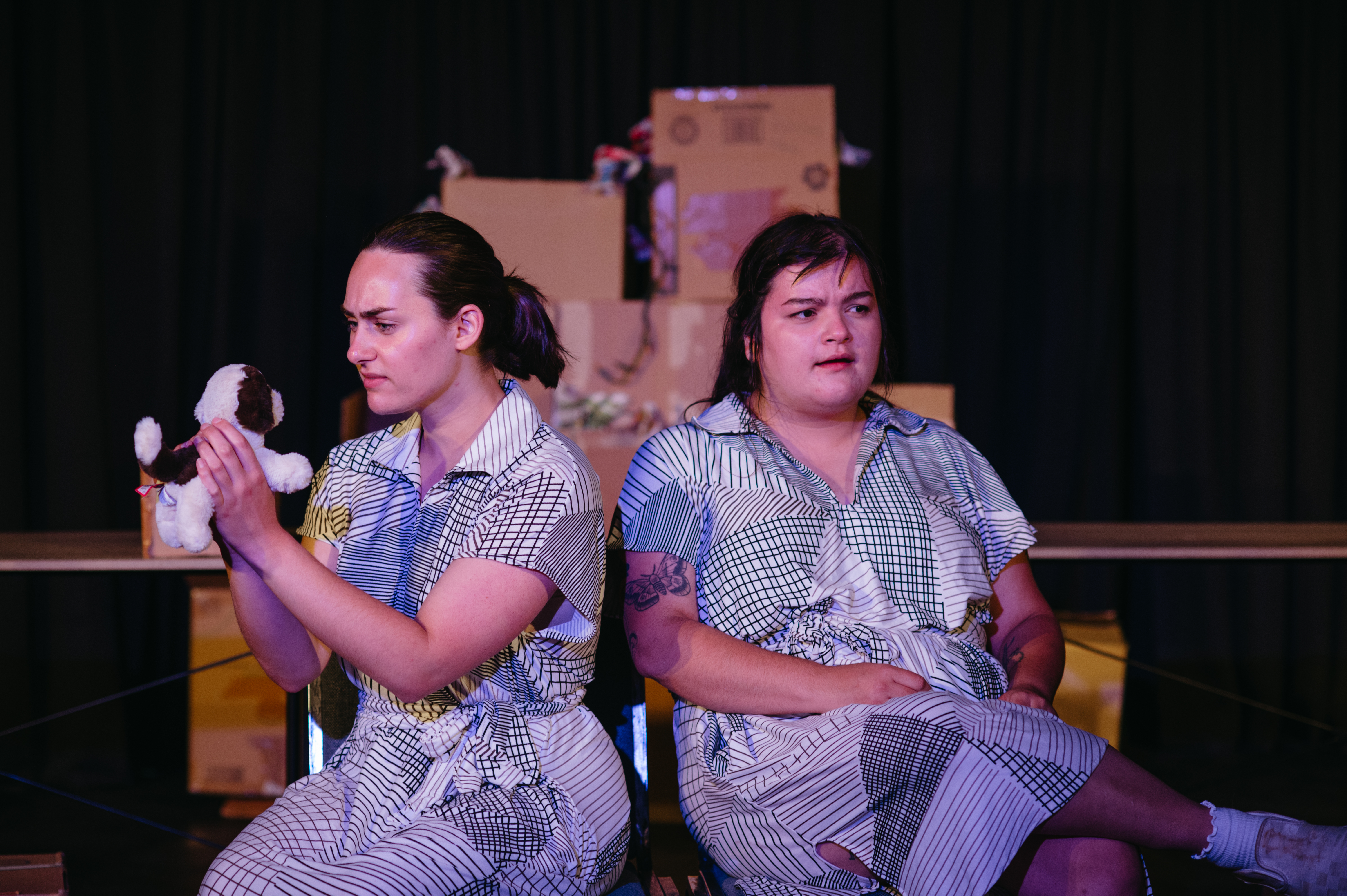
Abby Krushel and Shyanne Duquette as the two Hannah Morgans in Fetch. Photo provided.

It was odd to get several days into Fringe and realize that I hadn’t yet spent time viewing traditional multiple-actor plays, except for Matt & Ben. I missed them, while still enjoying performance art, improv, and solo shows. But now I’ve seen a few more dramas and comedies.

Fetch, by Cat Walsh, was originally a 2018 Fringe production with the playwright and Lora Brovold on stage. I didn’t see that one, The 2026 production, directed by Steven Sobolewski, stars Shyanne Duquette and Abby Krushel. The two actors burst onto the small stage of Acacia Hall in near-identical dresses, carrying identical suitcases, speaking over each other and with each other to each insist “I am Hannah Morgan.” And each begins to narrate the story of her life – one tragic, one less so – but with suspiciously similar details. Each recounts the events of a big family vacation to an amusement park – as the youngest of a big family, six-year-old Hannah resents the vacations she missed out on being born last, and the way that siblings moving out to university and on to extracurricular activities and jobs signify the end of the family-adventures era. Krushel’s Hannah recounts her grievances with the age appropriate self-centredness of a loved youngest child, while Duquette’s character drops hints of bitterness and bereavement. Were there two families in the same reality whose lives had intersected that week? Were these two Hannahs embodying different multiverses, different outcomes? The Hannahs allude to the Schrodinger’s cat paradox – a cat in a box might be either alive or dead, until the box is opened. The weirdness ratcheted up along with the excruciating tension, as horror approached. I was reminded of Walsh’s 2015 Sterling-Award-nominated script The Laws of Thermodynamics . One of my favourite bits was when Duquette’s character is reminding the audience of the required ritual of speaking to a grieving person, the I’m sorry and Thank you shifting into taking the exchange as a given. It’s very well done.
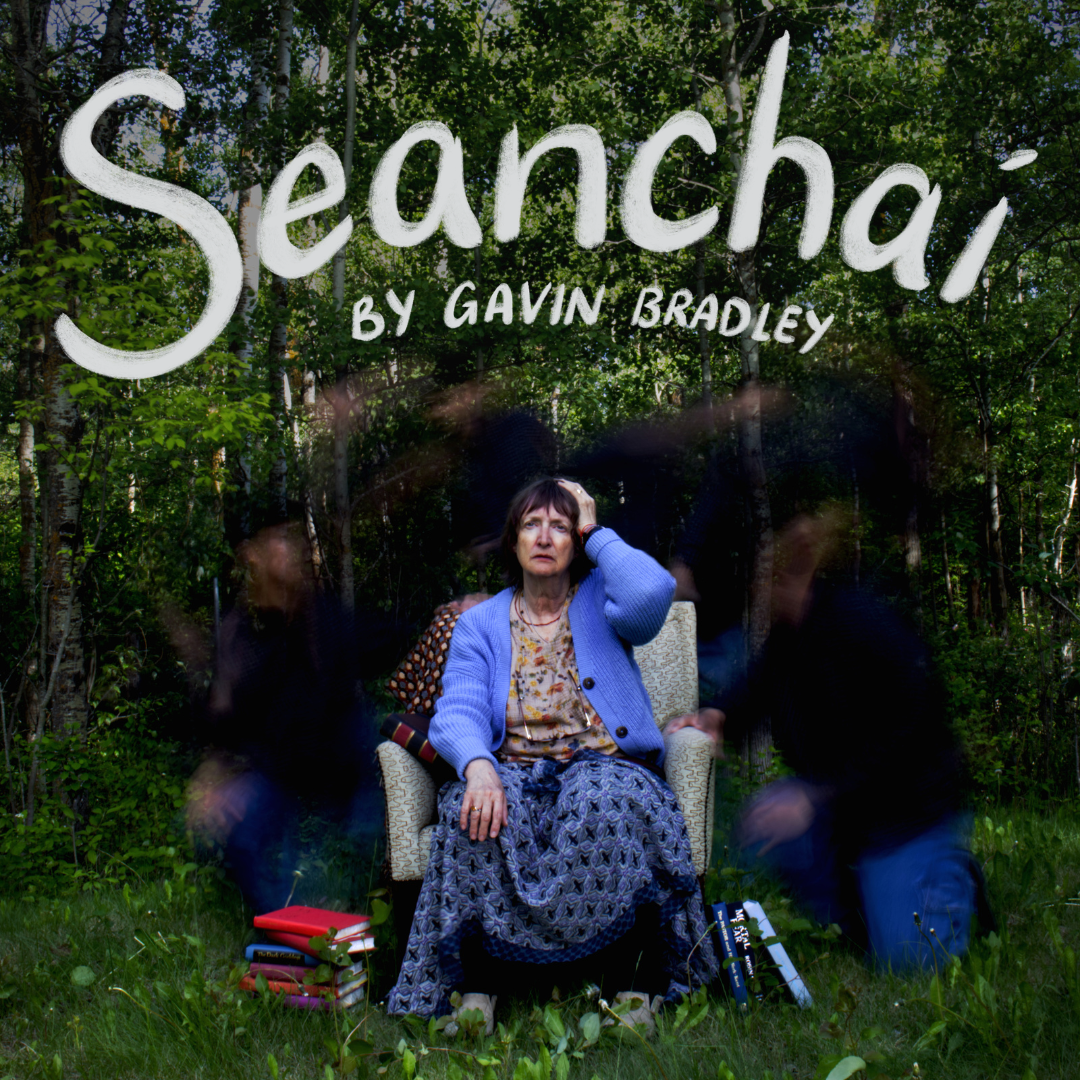
Seanchaí, by young local playwright Gavin Bradley, isn’t marked in the program as New Work – I guess because it had a successful entry at StageStruck! and the provincial one-acts festival last year. But this is its first longer run, and it’s being well received by Varscona Theatre audiences. Susan Sneath, an Edmonton Fringe artist since the festival’s first summer, plays a retired seanchaí (storyteller and oral historian in the Irish tradition), and Mark Guerrero a young person who’s been retelling the traditional stories for TikTok. The grudging respect and growing affection between the two unfold as they tell the stories to each other, correcting and challenging. Its poignant and relatable and also affectionately funny. Knowing bits of Irish language means getting to laugh at a few lines first, but definitely isn’t required to follow the story. Knowing the folklore (Cú Chulainn, Children of Lir, Fionn mac Cumhaill and the Salmon of Knowledge) is also not necessary, as both storytellers provide compelling versions. Amanda Goldberg (recent Sterling Award winner for directing Jessy Ardern’s Cyrano) directed, bringing an understated delicacy and allowing the characters to show their quirks without being stereotypes.

Another small story of a gentle interaction between two isolated characters is Being Norwegian, David Greig’s script directed by Amy De Felice at the Holy Trinity Anglican basement space. The 45-minute play is set in Sean’s (Cody Porter) barely-unpacked apartment, late at night, as he brings home new acquaintance Lisa (Clarice Eckford). Both characters have Scottish accents, but Lisa explains that her name is short for Liselotte and she’s Norwegian. And they’re both awkward. Likeably awkward. The audience is sighing in sympathy as Sean tries to find a bottle of wine and can’t find glasses. His visitor assures him that mugs are better anyway, takes a sip, and manages to communicate to the audience that the wine is terrible without letting Sean see that. Porter and Eckford are both very good at this kind of nuanced portrayal of ordinary people – I’m remembering Eckford as caregiver daughter in The Gravitational Pull of Bernice Trimble and Porter in Angry Alan, Betrayal, and others.

Queens of Romance, by Trevor Schmidt, is sillier than any of the above, and an audience favourite. Three romance writers are on a panel at a convention – the usual moderator is unavailable due to some whispered family scandal, so fan Missy (Schmidt) gamely takes the podium and the clutch of cue cards and tries to carry on. The panelists embody the range of romance-writing styles. Jason Hardwick portrays the Barbara Cartland-type Dame Nausea with smugness and pathos and dignity (but not all at once!) wearing the most over-jewelled caftan I’ve ever seen. Michelle Todd’s Janet writes about contemporary celebrity infidelities with luxurious descriptions – there are probably throbbing members in her stories. And the youngest of the writers, Karen (pronounced Karin), (Jake Tkaczyk), writes erotic suspense, with unapologetic kink and brutal imagery. Each of the writers is critical of the others’ choices, naming some of the problematic issues with women’s agency, racism, classism, transactional sex, and women feeling shame about their desires – all while conducting snappy repartee with each other and the ill-equipped moderator (and possibly with audience members). While I was admiring the pre-set before the show started, I was amused to see Schmidt’s anxious moderator character peeking out from the side curtains looking worried.
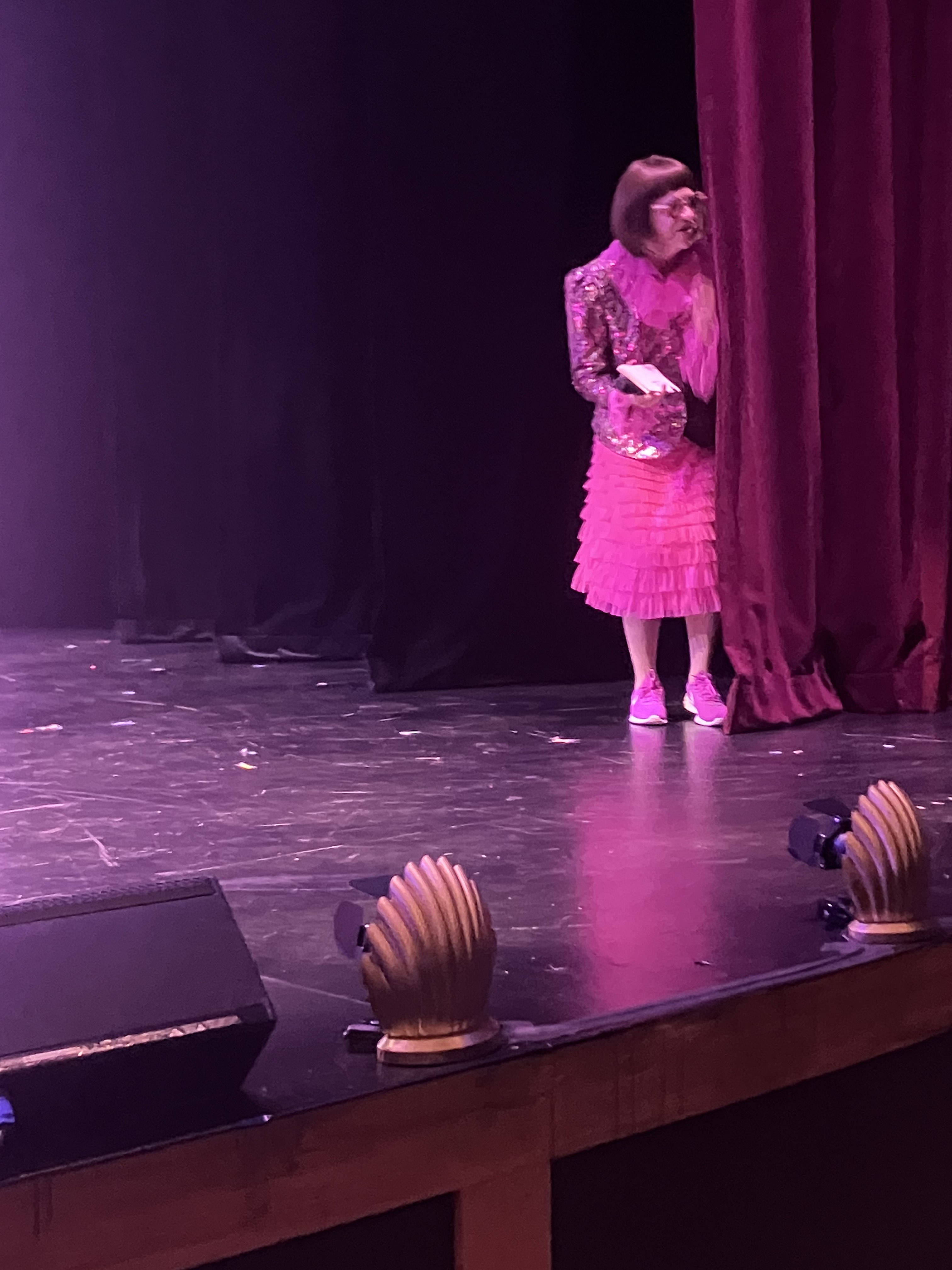
Trevor Schmidt, as Missy the moderator, peers out at audience before the show starts.

Bea, by Mick Gordon

Kristen Unruh, in Shadow Theatre’s Bea. Photo Marc Chalifoux. Costume Design Deanna Finnman, Set Design Ximena Pinilla. Lighting Design Whittyn Jason.

Publicity for the Shadow Theatre show Bea had enough warnings that I knew it would be about a young person who wants to die with dignity or on her own terms. That topic’s not for everyone, so I was glad to know that much. Bea was written by Northern Irish playwright Mick Gordon, in 2010. This production was directed by Amanda Goldberg, a recent Artistic Director Fellowship holder at Shadow Theatre.

I was intrigued to see recent BFA grads Michael Watt and Kristen Unruh on a professional stage, along with Kate Newby (she played Dorothy Parker in Fresh Hell at Shadow a couple of years ago).

The other thing I knew about the production beforehand was that the set was partially crowdsourced. I saw an appeal from set designer Ximena Pinilla for old costume jewellery, so I dropped off a bag of shiny things. The focus of the set was a bed. On one side were the trappings of medical care, with one of those wheeled over-bed tables that I’ve seen in hospitals and nursing homes. On the other side of the bed were a young woman’s personal belongings and a rack of fabulous outfits. And above — suspended above and behind the bed were big grid displays of earrings. Like a Claire’s to excess.

Kristen Unruh’s character Bea enters, dancing, singing, sprawling on the floor to read a magazine. She might be sixteen, or a decade older, but she’s clearly lively and joyful and this is her space. Then a young man in rumpled shirt and too-short tie enters nervously, holding a satchel and his CV. Ray (Michael Watt) is her new personal care assistant – or he’s interviewing for the job, it’s not quite clear. And as the other character enters, Bea gradually melts onto the bed. She’s still animated, mouthy, full of poetry and wordplay, sitting cross-legged on her bed and enjoying putting the awkward young man on the spot. They connect. And in this first meeting, she asks him to take dictation, as she speaks a letter to her mother, saying that she wishes to die and wants her mother to help her.

Bea’s mother Catherine (Kate Newby) then arrives to give Ray a sterner scrutiny and tell him the rules of employment – from “No prurience” (which he admits he needs to look up later) and “Kindness” to “No secrets” – awkward because he is already carrying one secret, the dictated letter. As Catherine, a lawyer in severe black suit, grills Ray, I become aware that Bea has collapsed immobile onto her stack of pillows. Is this how her body really is, in the time of the play? We see this contrast playing out over and over throughout the narrative – Bea dancing and active alone and sometimes with Ray, but also needing to be fed and bathed, speaking with difficulty, twitching in pain.

I found the character Bea likeable and funny and frank. I revised my age-estimate upwards when she tells an uncomfortable Ray that she hasn’t had sex for nine years and misses it. Ray is clearly on her side. He jumps into her stories and daydreams, reluctantly revealing bits of his own context.

One of the most enjoyable bits of the play, for me, is the part where Ray brings in a script for A Streetcar Named Desire, introduces the classic, and reads it / acts it out with Bea. Both Unruh and Watt are up to the physical, emotional, and vocal challenges of these roles, and I look forward to seeing each of them again.

Every time Ray is taking frivolous liberties, though, Catherine walks in and is horrified. The audience gets to expect this. It’s still funny in a rule-of-three way, but maybe it’s not all needed. I do love Kate Newby’s still body language and flat affect with horror underneath.

In a few Catherine-Bea scenes, we learn that the two of them have been on their own for several years. They love and respect each other – and Catherine does still see Bea as the playful clever girl of the solo scenes and memories, not just the patient.

So the stakes are very high, when Catherine learns of Bea’s “demand”. And in fact even higher, because they live in a place and time without MAiD (medical assistance in dying), where assisted suicide would be prosecuted as murder. So in one shocking change-of-mood scene without Bea present, Ray explains to Catherine how it should be done, if/when she chooses. Details about how to ensure that a first attempt is successful, but also details about how to present it afterwards to the police and legal authorities. Blunt, explicit, disturbing. How does young Ray know all of this and speak with authority? I can make up a backstory but it’s not in the text.

The actors were great, but the script left me with some questions. I wondered if it would have been stronger if shorter, or if the repeating cycle of visits from Ray, revelations and intimacies, judgement by Catherine, re-connection between Catherine and Bea … was all necessary to make us care about Bea and her people and to see the necessity and the anguish of her death. The illness is not named, and that was probably a better choice than giving us a specific diagnosis that we might know about. We learn that she won’t get better, but it wasn’t clear to me whether she was getting worse and whether it would eventually kill her. There were a few Canadian references sprinkled in – the story about Ray’s friend trying to hold up a CIBC and accidentally going to Kentucky Fried Chicken was not the only one, there was a reference that made me think Toronto – but there was other wording that felt natively British (Ray’s friend in that story having a nickname like Bazza or Jazzer, for example) so that distracted me.

I have not been intimately involved with a MAiD or assisted suicide situation myself, although pre-MAID I have helped to make a decision to remove life support. The practical awfulness of implementing Bea’s request, as shown on stage, definitely confirmed my belief that there are some situations in which offering MAiD would be more humane. But, as the director’s program note quotes disability dramaturg Miranda Allen, “When MAiD is available and supports for living are not, MAiD becomes problematic.” That’s not relevant to the characters on stage – for them, assisted suicide is illegal, and it seems that Catherine is financially able to support Bea in comfort and employ Ray as caregiver. But it’s an important thought for any audience member who might go away smugly distancing ourselves from the dilemma of the play. Death and life are even more messy and complicated, in real life and real death.

Bea is playing at the Varscona Theatre on 83 Avenue until February 9th. Lots to think about, and more fun than I expected. Tickets available here.