Tag Archives: cayley thomas

Request Programme – unique performances of nightly repetition

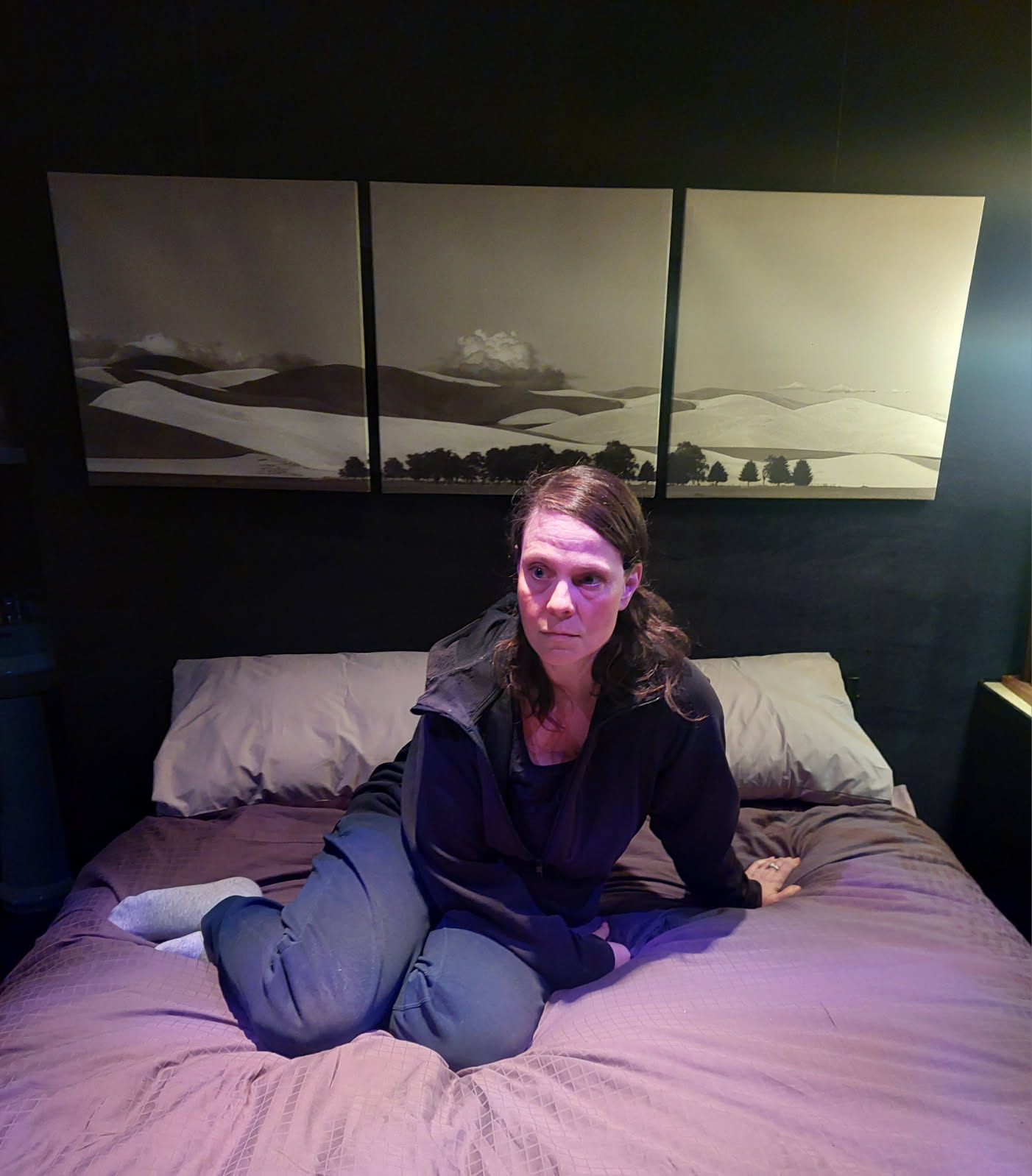
Vanessa Sabourin in Request Programme, Northern Light Theatre.

Request Programme, originally written in German in the 1970s by Franz Xaver Kroetz and translated by Katharena Hehn, takes its title from a radio show, the kind of show where a host responds to song requests sent in by audience members by playing the songs, but also by responding in compassionate, almost-intimate ways to the glimpses of regret, sadness, hope, loneliness, and humour she gets in the letters and texts. It felt very familiar, like shows I’ve heard on CBC radio, or European selections played overnight on NPR on long drives, or Join the Conversation on Now! radio. It’s a structure that supports a different show every night.

I think that Request Programme, the current Northern Light Theatre production directed by Trevor Schmidt, must have a similar blend of an underpinning routine with specifics that vary each night, making it worth watching more than once during the run. I’ve only seen it once so far – I saw it on opening night, with Vanessa Sabourin as the sole performer on stage. Each performance has a different on-stage performer, all local female actors who have worked on previous Northern Light Theatre productions. The voice of the radio host is also significant to the story but isn’t explicitly identified in the credits – I’m pretty sure the voice I heard, warm and grounded, was Nadien Chu. And the playlist of artists in the radio programme is ten Edmonton singer/songwriters, all women, each with one recent original song.

The character on stage does not speak at all. But as in many effective movement-based performances, I could tell enough about what was going on and why that I was engaged in the character’s journey, and cared about their outcome. I’ve had similar experiences with wordless or near-wordless clown and physical theatre (such as 7 Ways to Die: A Love Story, by Keltie Brown Forsyth and Alex Forsyth, or Lost ‘n’ Lost Department, by Elaine Weryshko, Jed Tomlinson, and Kristin Eveleigh, with dance (Black Hair, Blue Eyes, a piece at Expanse Festival 2014 with Ainsley Hillyard, Mat Simpson, and Liam Cody, many of the Ballet Edmonton works, or Betroffenheit (Jonathon Young, Crystal Pite), and with theatre (Small Mouth Sounds, the Jim Guedo-directed play about people at a silent yoga retreat).

A woman comes home late in the evening to a small tidy apartment in a city. The apartment reminded me of one of the self-contained apartment setups in the IKEA store – set design by Schmidt – full enough that it felt like she actually lived there, but without much that was revealing or personal. Not enough kitchen for someone who enjoys cooking or eating, no photos except for possibly one on the kitchen table that we couldn’t see, the small clothes-rack of someone who has recently started over. I thought she was probably coming home from work, because she was wearing dress shoes and clothes more formal than the ones she changes into, but her totebag also contained a few basic groceries. As she passes the evening, I had the sense that she was struggling to settle to anything – whether eating the sandwich she makes, finding something to watch on TV, making tea, reading a book, or doing a jigsaw puzzle. She didn’t seem to have any inclination to human contact either – no letters in the mail, no landline or cell phone, no computer, no waving out the window. She was going through the motions.

But she turns on the radio just in time for the nightly Request Programme, and listens to the whole thing. I could see that some of the host’s commentary and request letters landed with her, and some of the song lyrics too. In “In a While” Cayley Thomas sang of losing a brother before his 25th birthday. Lindsay Walker’s “I Won’t Give Up” is an fiercely inspiring anthem to carrying on, and Alex Dawkins’ “Pretty Girls” evoked passion and regret. A couple of times I wondered if the listener whose note the host was responding to might have been Sabourin’s character – but I thought probably she wasn’t sufficiently engaged with even that version of community. The people who were writing to the radio programme wanted someone to hear their pain, their loss, their fears – and I don’t think the woman on stage saw any point in that.

I didn’t know the details of why Sabourin’s character was so alone, so restless, so numb. But I worried about her, to the point of barely breathing near the end of the show. I grasped at hints of the character planning for the next day such as putting the leftovers in the fridge and rinsing out her knee-high stockings, but maybe those were autopilot actions. The ending did not feel inevitable but it was not a shock and was not overdrawn. I want to see another actor’s version. I don’t know how detailed the play script is – how much of a movement score or blocking is provided – but I understand that each performer had limited preparation time and possibly did not get to hear the radio show music and narration beforehand. Request Programme is fascinating and disturbing, an evocation of the spectrum between alone and lonely, between self-disciplined routine and dissociation, between surviving and … not.

Request Programme continues at the Fringe Arts Barns Studio until May 16th. Tickets are here.

The 50th season of Northern Light!

Northern Light Theatre announces their 50th-anniversary season!

Next year will be the 50th season of Northern Light Theatre, an independent company whose mandate includes bringing challenging, thought-provoking, unfamiliar, and entertaining work to Edmonton audiences, with particular attention to stories of women. Artistic Director Trevor Schmidt has a particular gift for play selection, so that a Northern Light season typically includes at least one playwright I’d never heard of, but whose work captivates me and might be relatable or disturbing or both. Schmidt is also a playwright himself, with ventures into the poignant, the macabre, and the screamingly funny.

Last year’s NLT season was themed “Making a Monster”. Schmidt’s own Monstress started the season with a disturbing gothic Frankenstein-esque tale that left me thinking I wasn’t sure who the monster was. Angry Alan, by Penelope Skinner, starred Cody Porter as an ordinary guy who gets sucked in by “men’s-rights” rhetoric, with horrible consequences. And Philip Ridley’s Radiant Vermin showed a different kind of monstrousness, but was hilarious at the same time. It was one of the most thematically-effective seasons I’ve ever seen.

This coming year is called “The F Word”, as a play on the age of fifty being unspeakable. And the three plays each have some call-back to aspects of Northern Light’s history. The first one is a remount of the award winning The Pink Unicorn, by Elise Forier Edie, which was an award-winner in the 2014-2015 season. Trevor Schmidt told me that this production will use an updated version of the script, which is shorter and more cohesive. Patricia Zentilli will play Trisha, and Schmidt promises an all-new design, with a twinkle in his eye. If you’re not familiar with The Pink Unicorn, it’s the solo narrative of Trisha, a small-town Texas woman whose daughter begins to identify as agender, genderqueer and pansexual. Trisha loves her daughter, but struggles with her community’s intolerance, in a fight she didn’t choose. In 2015, I thought it was topical and ahead of its time — in 2025, I imagine I will find it even more topical, and definitely not dated!

Before Christmas is another Trevor Schmidt original, How Patty and Joanne Won High Gold At The Grand Christmas Cup Winter Dance Competition. The excerpts read at the season-launch included Jenny McKillop as a frazzled mum looking for an activity of her own, and Leona Brausen reading as another middle-aged-tap-dancer character. It seems like it will be very funny, but also an effective reminder of community and of loneliness.

The exploration of loneliness will come to the fore in the last play of the season, Franz Xaver Kroetz’s Request Programme. Instead of presenting an excerpt from this play, the teaser given at the season-launch was a performance by singer-songwriter-guitarist Cayley Thomas (a U of A BFA Acting grad), a wistful and moving song about missing her late brother. Schmidt explained that for each performance of this play, one actor from NLT’s long roster of talented female-presenting performers will perform a character’s solitary life routine without dialogue, while a soundtrack of a radio “request programme” plays in the background. The music on the request programmme will all be from local female artists, including Cayley Thomas. Some of the actors have already been identified – Linda Grass, Holly Turner, Nadien Chu, Michelle Todd, Pat Darbasie, Sylvia Wong, Davina Stewart, Kristin Johnston, Cheryl Jameson, Melissa Thingelstad – and with a few more still to be confirmed.

Early in 2026, the NLT Board will also be hosting some kind of gala 50th-anniversary celebration, details to follow. But the F-Word season seems commemorative and celebratory enough in itself. VIP season subscriptions are currently available here at an early-bird price until July 2nd.

The Missionary Position is uncomfortable.

If you found this page while searching for advice on a sexual problem, let me pass on my best wishes for comfortable resolution, along with a link to the sexuality-information resource website Scarleteen, directed at young people but useful for anyone with questions or curiosity about sex.  This page is a good starting point, with lots of links elsewhere.  I’m sorry to detour you with my wordplay.

———————————————————————————————————————————

The Missionary Position was uncomfortable.

But I’m sure that was one of the intentions of playwright Greg MacArthur, in developing the play The Missionary Position for the U of A drama department and the BFA class of 2013.  The preview performance of this world premiere was tonight at the Studio Theatre in the Timms Centre for the Arts on campus.

It didn’t make me cry.  But it definitely made me squirm, and I got the feeling it made a lot of the audience members squirm too.  It touched on disaster tourism, international adoption, various shallow or pathological reasons people would go on a mission trip, and the potentially tragic consequences of well-intentioned badly-planned gestures.  In the play, the visitors are Canadian (from Edmonton) and the country suffering after an earthquake and tsunami is carefully not identified, but I kept thinking, This is Haiti.  This is everything the Haiti activists talk about.  And in fact, in the theatre lobby at intermission I noticed a news article about the New Life Children’s Refuge case, which had some similarities to the story of the play.

It’s a horrifying compelling story, told in alternating scenes of the past and present.  In the present, the young people are being detained in some type of prison because of something about some children, while the scenes of the past and occasional video clips shown on a screen behind the stage develop the story of what happened and why.

The storytelling is much more effective on stage than it would be in a movie.  Because in a movie, they’d have to show the children, the people living under tin and tarps, the scenery, and the jail, rather than the way the audience of the play sees these things through the narration of the visitors.  “Like little brown dolls”, a character describes the children – and without real child actors to distract us, we are limited to this disturbing exoticised view.

There was some recurring imagery, in particular several sets of allusions to water.  A memory of baptism and a newspaper photo of a dead child underwater become analogous in a creepy way.  Glowing water is used in a story about visiting Chernobyl but also in attempts to evoke magical escapism.  And sprays of water pour onto the stage when one character takes a shower, and in another scene where I’m not sure if it’s supposed to be showers, tropical rainfall, or something more darkly symbolic.

The outsider character who seems like the most reliable narrator, the one through whom we find out the truth, is Ben Gorodetsky’s embassy employee, who is distracted by cocaine and celebrities and who also seems somewhat enthralled by Lianna (Lianna Makuch), the leader of the missionary group.  His partner Angie (Angelique Panther), a translator and aid worker who’s been in the country or the region for ten years (so she should know better), has her own smaller version of the tragedy arising through badly-thought-out actions from good intentions.

At the end, the audience didn’t start clapping right away.  Maybe people were sort of stunned.  Then I heard people around me discussing whether the results of the investigation were fair and how much responsibility people should bear for their uninformed parts in other people’s crimes.  Which was probably another of the playwright’s intentions, so I’d say he succeeded.

The Missionary Position plays until February 16th.  You can get tickets at the Timms Centre box office or through Tix on the Square.