Tag Archives: dana wylie

Request Programme – unique performances of nightly repetition

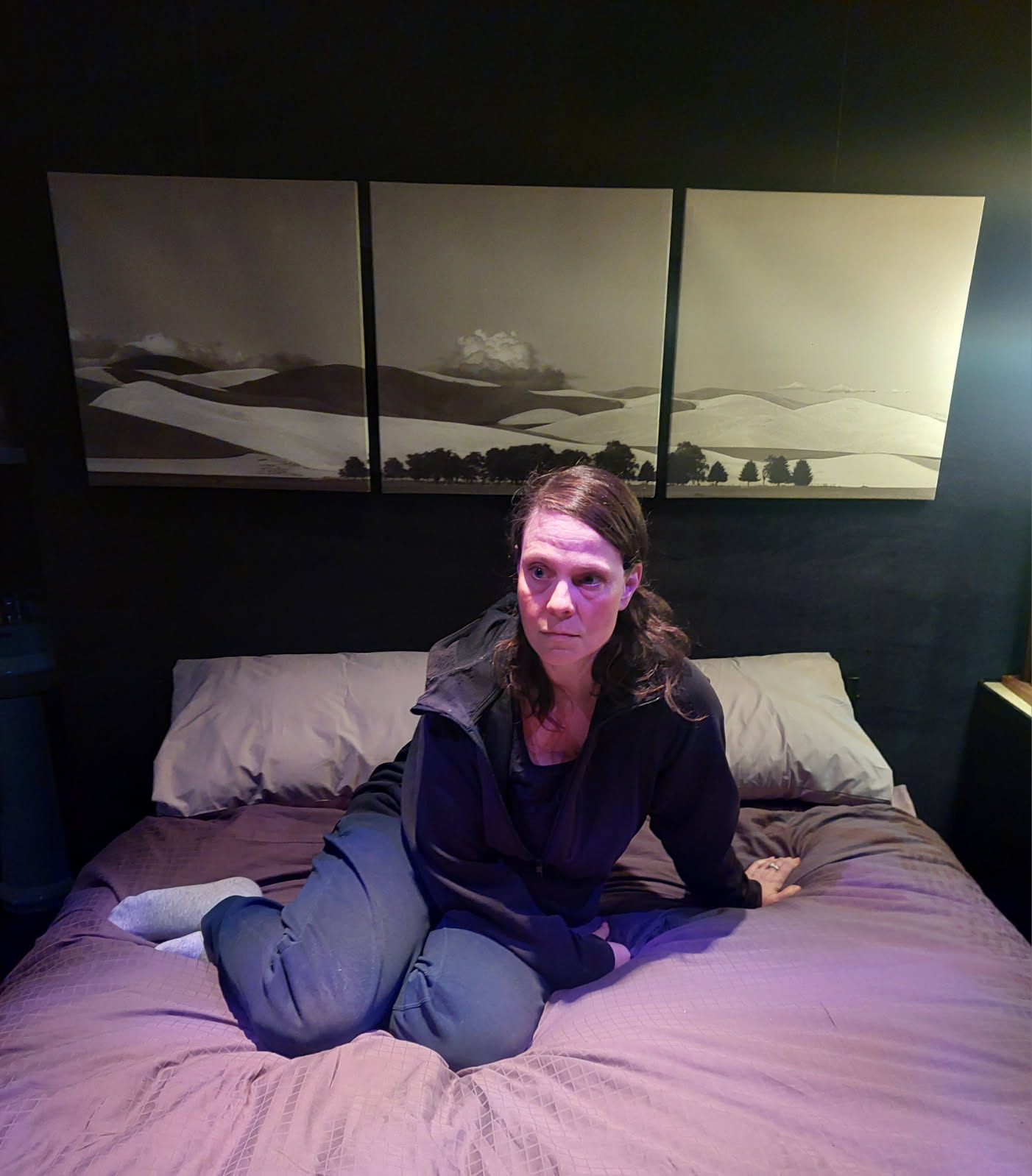
Vanessa Sabourin in Request Programme, Northern Light Theatre.

Request Programme, originally written in German in the 1970s by Franz Xaver Kroetz and translated by Katharena Hehn, takes its title from a radio show, the kind of show where a host responds to song requests sent in by audience members by playing the songs, but also by responding in compassionate, almost-intimate ways to the glimpses of regret, sadness, hope, loneliness, and humour she gets in the letters and texts. It felt very familiar, like shows I’ve heard on CBC radio, or European selections played overnight on NPR on long drives, or Join the Conversation on Now! radio. It’s a structure that supports a different show every night.

I think that Request Programme, the current Northern Light Theatre production directed by Trevor Schmidt, must have a similar blend of an underpinning routine with specifics that vary each night, making it worth watching more than once during the run. I’ve only seen it once so far – I saw it on opening night, with Vanessa Sabourin as the sole performer on stage. Each performance has a different on-stage performer, all local female actors who have worked on previous Northern Light Theatre productions. The voice of the radio host is also significant to the story but isn’t explicitly identified in the credits – I’m pretty sure the voice I heard, warm and grounded, was Nadien Chu. And the playlist of artists in the radio programme is ten Edmonton singer/songwriters, all women, each with one recent original song.

The character on stage does not speak at all. But as in many effective movement-based performances, I could tell enough about what was going on and why that I was engaged in the character’s journey, and cared about their outcome. I’ve had similar experiences with wordless or near-wordless clown and physical theatre (such as 7 Ways to Die: A Love Story, by Keltie Brown Forsyth and Alex Forsyth, or Lost ‘n’ Lost Department, by Elaine Weryshko, Jed Tomlinson, and Kristin Eveleigh, with dance (Black Hair, Blue Eyes, a piece at Expanse Festival 2014 with Ainsley Hillyard, Mat Simpson, and Liam Cody, many of the Ballet Edmonton works, or Betroffenheit (Jonathon Young, Crystal Pite), and with theatre (Small Mouth Sounds, the Jim Guedo-directed play about people at a silent yoga retreat).

A woman comes home late in the evening to a small tidy apartment in a city. The apartment reminded me of one of the self-contained apartment setups in the IKEA store – set design by Schmidt – full enough that it felt like she actually lived there, but without much that was revealing or personal. Not enough kitchen for someone who enjoys cooking or eating, no photos except for possibly one on the kitchen table that we couldn’t see, the small clothes-rack of someone who has recently started over. I thought she was probably coming home from work, because she was wearing dress shoes and clothes more formal than the ones she changes into, but her totebag also contained a few basic groceries. As she passes the evening, I had the sense that she was struggling to settle to anything – whether eating the sandwich she makes, finding something to watch on TV, making tea, reading a book, or doing a jigsaw puzzle. She didn’t seem to have any inclination to human contact either – no letters in the mail, no landline or cell phone, no computer, no waving out the window. She was going through the motions.

But she turns on the radio just in time for the nightly Request Programme, and listens to the whole thing. I could see that some of the host’s commentary and request letters landed with her, and some of the song lyrics too. In “In a While” Cayley Thomas sang of losing a brother before his 25th birthday. Lindsay Walker’s “I Won’t Give Up” is an fiercely inspiring anthem to carrying on, and Alex Dawkins’ “Pretty Girls” evoked passion and regret. A couple of times I wondered if the listener whose note the host was responding to might have been Sabourin’s character – but I thought probably she wasn’t sufficiently engaged with even that version of community. The people who were writing to the radio programme wanted someone to hear their pain, their loss, their fears – and I don’t think the woman on stage saw any point in that.

I didn’t know the details of why Sabourin’s character was so alone, so restless, so numb. But I worried about her, to the point of barely breathing near the end of the show. I grasped at hints of the character planning for the next day such as putting the leftovers in the fridge and rinsing out her knee-high stockings, but maybe those were autopilot actions. The ending did not feel inevitable but it was not a shock and was not overdrawn. I want to see another actor’s version. I don’t know how detailed the play script is – how much of a movement score or blocking is provided – but I understand that each performer had limited preparation time and possibly did not get to hear the radio show music and narration beforehand. Request Programme is fascinating and disturbing, an evocation of the spectrum between alone and lonely, between self-disciplined routine and dissociation, between surviving and … not.

Request Programme continues at the Fringe Arts Barns Studio until May 16th. Tickets are here.

Women in wartime: Stars on her Shoulders is inspiring and timely

Meegan Sweet and Gabby Bernard in Stephen Massicotte’s Stars on Her Shoulders. Photo by Marc Chalifoux.

It makes sense that Remembrance Day weekend brings theatre about World War I. But this year Edmonton playgoers are fortunate to have two world-premiere productions on local stages, both by playwrights with Alberta roots. I wrote about The Two Battles of Francis Pegahmagabow in an earlier post.

Workshop West Playwrights’ Theatre is launching its “Saints and Rebels” season with Stephen Massicotte’s play Stars on Her Shoulders, about Canadian nurses in France in 1918. It is directed by artistic producer Heather Inglis. As the play starts, two of the nurses (Hayley Moorhouse and Meegan Sweet) are also patients in a hospital, convalescing from injuries sustained when another hospital was attacked. The story of the attack and of their injuries comes out gradually, as the nurses chafe at inactivity and engage with other hospital staff (Dana Wylie as a starched Scottish Matron, Dayna Lea Hoffman’s Georgie with irrepressible optimism, and Gabby Bernard as Enid, an earnest and well-meaning newbie.)

As Stephen Massicotte pointed out at the playwright talkback earlier this week, the plot is developed through relatively long scenes. Most scenes take place in Emma and Helen’s hospital “hut” or ward, with occasional visits to the Matron’s office or other locations. As we get to know more about Emma, Helen, and the other characters, we also see changes in them. They’re all politically aware, especially Emma (Sweet), who admits to writing her first protest petition at fourteen. So they follow the progress of suffragists (“Suffragette is a slur”, Emma corrects Enid) in working for the right to vote. They point out that the initial move to allow women military personnel to vote, and the female next-of-kin of male military, was an opportunistic move by a government who needed more support for conscription. And one wryly points out that even with a more general enfranchisement,conscientious objectors and immigrants and “Indians” [sic] will still be excluded. Helen (Moorhouse) starts out very guarded, standoffish and sarcastic even with longtime friend and nursing-school classmate Emma. I enjoyed watching her moments of relaxing her guard, and ended up very moved by her pain and bravery.

Emma and Helen want to get back to work soon. Their superiors (both the Matron on stage and the unseen men writing orders) want them to take time to recover, but they also want to present Emma and Helen with medals. This turns out to be a problem, however. Since the Canadian nurses are commissioned officers, they should receive the Military Cross, but the War Office wants to give them the Military Medal, which would be appropriate for enlisted personnel. Female nurses in other jurisdictions are not officers, and acknowledging some Canadian heroines this way would encourage feminists in Britain and other allied forces to negotiate their own status. So Emma protests, and the War Office sticks to their, ahem, guns. The “stars on her shoulders” refer to the lieutenant’s insignia each woman wears, and why they matter.

There’s so much detail to chew on in this play, which wraps up in under two hours. Not too much, and it all fits well with the distinct characters and their experiences. One speech in particular is disturbingly timely this week. I cried when Sweet’s activist character Emma is warning the others that women’s rights can never be assumed permanent – they can all be taken away, and vigilance will always be necessary.

The set is arranged as an alley stage (Brian Bast), with a few rows of seats on two long sides of the convalescent ward. Unlike some alley or in-the-round productions, I didn’t feel like I was missing anything due to where I was sitting. Back rows are on risers, and everyone is close to the action.

Workshop West’s season is their first with completely Pay-What-You-Will pricing, for subscriptions as well as single tickets. Tickets are available here, and Stars on her Shoulders runs until November 17th. I’m thrilled to support this initiative as a subscriber, and I’m excited about the rest of the season too. I think it’s the first time I’ve seen a play program thank donors that include both the Department of Veterans’ Affairs, and the local LGBTQ2S+ institutions Fruit Loop and Evolution Wonderlounge.

A full Saturday at Fringe 2023

On the final weekend of Fringe, I’m in “just one more!” mood. Saturday ended up including Ken Brown’s Life After Life After Hockey, Natasha Mercado’s Tree, into a black shirt into the booth for a performance of i carry your heart with me, then the last episode of Die-Nasty and the last Late Night Cabaret.

Life After Life After Hockey was a masterclass in solo narrative, with a throughline, clear transitions, and interesting actions. The creator-performer Ken Brown takes us through the creation, performance, and lengthy touring career of his 1980s solo Life After Hockey, and about how it led to the next things in his life, with challenges and joys. There are familiar experiences and recognizable names in the hockey parts of his story, but also in the parts about becoming a theatre creator and inspiring generations of other local theatre creators through his time teaching at Macewan and afterwards. For a solo, it had a lot of special guests – but that is not a complaint at all, they were delightful. Holger Peterson playing harmonica, Dana Wylie singing and playing guitar, Edmonton’s former poet laureate Pierrette Requier reading a poem about Edmonton, etc. Stage 13, La Cité – Servus Credit Union Théâtre.

Natasha Mercado’s Tree was a charming solo about a tree who longs to be human. Lots of low-key audience participation (“now I need a babbling brook through the forest – just this side of the room”) and a bit of a twist that I thought was going to turn into The Giving Tree. (It didn’t – which is good because I can’t stand that book). A game-show “Would You Rather” explored some of the possibilities available only to humans, good and bad. Stage 7, Chianti Yardbird Suite.

Die-Nasty’s Fringe series wrapped up with a few more deaths, everyone in jail exonerated especially Liz Nicholls (Kristi Hansen) who was recognized as the Spirit of the Fringe in an inspiring song, and the traditional port-a-potty hookup between Liz and the gonzo podcaster Fisher T Johnson (Mark Meer). Die-Nasty’s fall season opens its curtain on Monday October 23rd, set in a 1920s circus sideshow, and the first one’s free! (a successful marketing ploy for many substances …)

Late Night Cabaret was crammed full of special guests, stunts, contests, and inside-jokes that include the whole Fringe community as the insiders, which is the best thing about LNC. (@lnc_yeg, as the hosts often remind us.) Last night was also the last performance ever of Zee Punterz, who have been the cabaret’s house band for more than ten years. A slideshow gave us glimpses of many of their performances and paid tribute to the late Brett Miles, saxophonist through most of that time. They ended their last set, and the night, with a great rendition of Stairway to Heaven, along with the musical guest Lindsay Walker. And then they gave us an encore. Before the lights came up and the Fringe technicians started striking the band’s set, as a reminder of what will be happening today and all through the next week, as the Fringe grounds gets returned to its usual uses as a park, an alleyway, a parking lot, a road and bike path … and the theatres go back to being rehearsal spaces and classrooms, music performance rooms, bars, dance studios, lecture halls, a Masonic hall, and … and a lot of theatres preparing for their upcoming 2023-2024 performance seasons.

But that’s for later! For today, I’ll put my lanyards back on and find my sunglasses and head out to watch some theatre before our 5 pm performance of i carry your heart with me (Stage 27, Sugar Swing Upstairs). First stop, Multi-Vs. 2 pm at Stage 11, Varscona Theatre.