Tag Archives: ellie heath

Request Programme – unique performances of nightly repetition

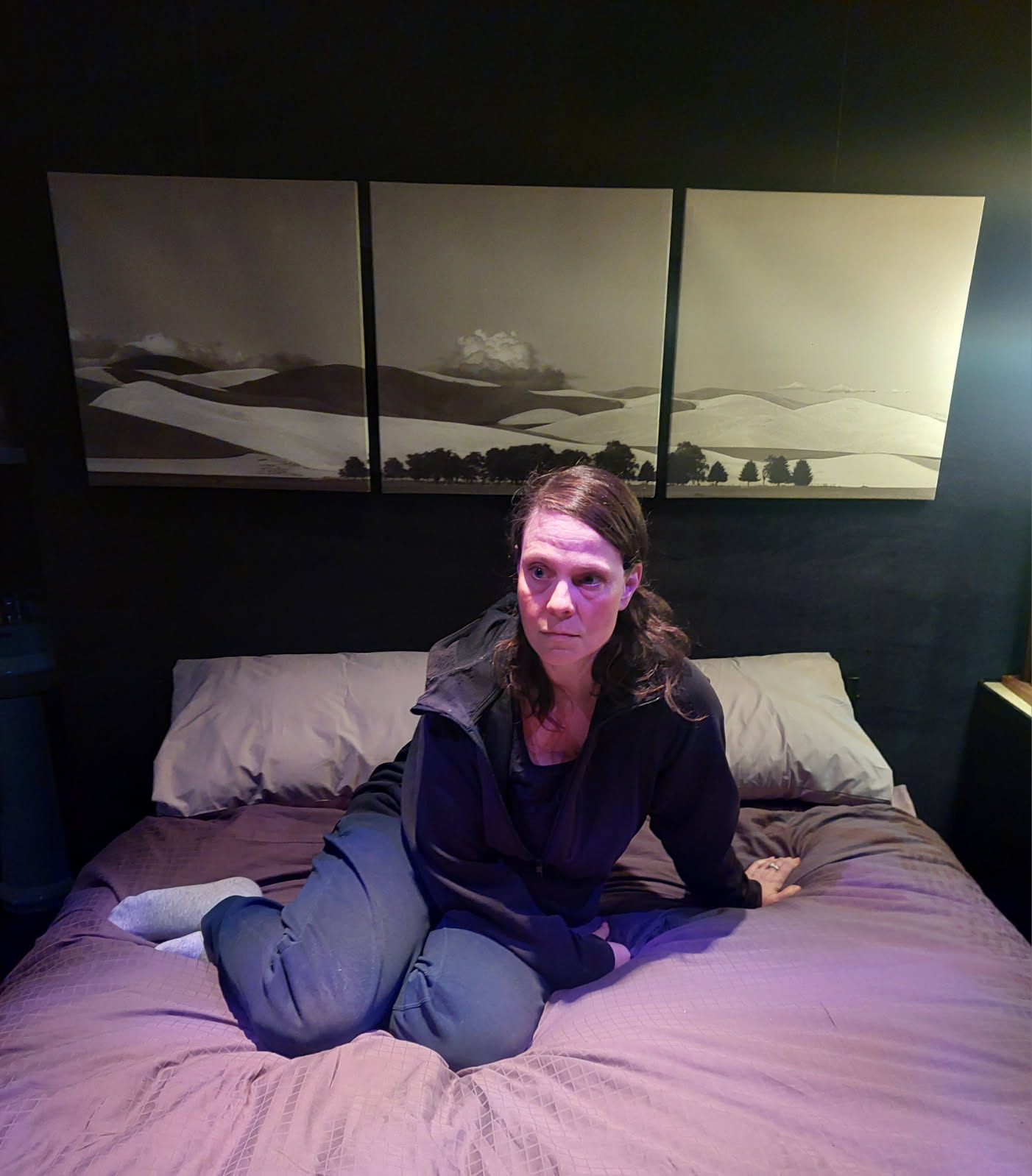
Vanessa Sabourin in Request Programme, Northern Light Theatre.

Request Programme, originally written in German in the 1970s by Franz Xaver Kroetz and translated by Katharena Hehn, takes its title from a radio show, the kind of show where a host responds to song requests sent in by audience members by playing the songs, but also by responding in compassionate, almost-intimate ways to the glimpses of regret, sadness, hope, loneliness, and humour she gets in the letters and texts. It felt very familiar, like shows I’ve heard on CBC radio, or European selections played overnight on NPR on long drives, or Join the Conversation on Now! radio. It’s a structure that supports a different show every night.

I think that Request Programme, the current Northern Light Theatre production directed by Trevor Schmidt, must have a similar blend of an underpinning routine with specifics that vary each night, making it worth watching more than once during the run. I’ve only seen it once so far – I saw it on opening night, with Vanessa Sabourin as the sole performer on stage. Each performance has a different on-stage performer, all local female actors who have worked on previous Northern Light Theatre productions. The voice of the radio host is also significant to the story but isn’t explicitly identified in the credits – I’m pretty sure the voice I heard, warm and grounded, was Nadien Chu. And the playlist of artists in the radio programme is ten Edmonton singer/songwriters, all women, each with one recent original song.

The character on stage does not speak at all. But as in many effective movement-based performances, I could tell enough about what was going on and why that I was engaged in the character’s journey, and cared about their outcome. I’ve had similar experiences with wordless or near-wordless clown and physical theatre (such as 7 Ways to Die: A Love Story, by Keltie Brown Forsyth and Alex Forsyth, or Lost ‘n’ Lost Department, by Elaine Weryshko, Jed Tomlinson, and Kristin Eveleigh, with dance (Black Hair, Blue Eyes, a piece at Expanse Festival 2014 with Ainsley Hillyard, Mat Simpson, and Liam Cody, many of the Ballet Edmonton works, or Betroffenheit (Jonathon Young, Crystal Pite), and with theatre (Small Mouth Sounds, the Jim Guedo-directed play about people at a silent yoga retreat).

A woman comes home late in the evening to a small tidy apartment in a city. The apartment reminded me of one of the self-contained apartment setups in the IKEA store – set design by Schmidt – full enough that it felt like she actually lived there, but without much that was revealing or personal. Not enough kitchen for someone who enjoys cooking or eating, no photos except for possibly one on the kitchen table that we couldn’t see, the small clothes-rack of someone who has recently started over. I thought she was probably coming home from work, because she was wearing dress shoes and clothes more formal than the ones she changes into, but her totebag also contained a few basic groceries. As she passes the evening, I had the sense that she was struggling to settle to anything – whether eating the sandwich she makes, finding something to watch on TV, making tea, reading a book, or doing a jigsaw puzzle. She didn’t seem to have any inclination to human contact either – no letters in the mail, no landline or cell phone, no computer, no waving out the window. She was going through the motions.

But she turns on the radio just in time for the nightly Request Programme, and listens to the whole thing. I could see that some of the host’s commentary and request letters landed with her, and some of the song lyrics too. In “In a While” Cayley Thomas sang of losing a brother before his 25th birthday. Lindsay Walker’s “I Won’t Give Up” is an fiercely inspiring anthem to carrying on, and Alex Dawkins’ “Pretty Girls” evoked passion and regret. A couple of times I wondered if the listener whose note the host was responding to might have been Sabourin’s character – but I thought probably she wasn’t sufficiently engaged with even that version of community. The people who were writing to the radio programme wanted someone to hear their pain, their loss, their fears – and I don’t think the woman on stage saw any point in that.

I didn’t know the details of why Sabourin’s character was so alone, so restless, so numb. But I worried about her, to the point of barely breathing near the end of the show. I grasped at hints of the character planning for the next day such as putting the leftovers in the fridge and rinsing out her knee-high stockings, but maybe those were autopilot actions. The ending did not feel inevitable but it was not a shock and was not overdrawn. I want to see another actor’s version. I don’t know how detailed the play script is – how much of a movement score or blocking is provided – but I understand that each performer had limited preparation time and possibly did not get to hear the radio show music and narration beforehand. Request Programme is fascinating and disturbing, an evocation of the spectrum between alone and lonely, between self-disciplined routine and dissociation, between surviving and … not.

Request Programme continues at the Fringe Arts Barns Studio until May 16th. Tickets are here.

Jupiter – a Colleen Murphy premiere

Ellie Heath, Brian Dooley, and Monk Northey in Colleen Murphy’s Jupiter, at Theatre Network. Set and costume design Tessa Stamp, lighting design Larissa Poho. Photo by Ian Jackson.

In comparison to Colleen Murphy’s other work that I’m familiar with, Jupiter has a happy ending. That is, not everyone is dead, and the ones who are not dead are at least speaking to each other.

Unlike in Bright Burning (published title I hope my heart burns first) or in The Society for the Destitute Presents Titus Bouffonius, or the offstage massacre that drives The December Man, the deaths discussed in Jupiter are spread over a period of more than 50 years, counting things that happened before the play started. Is it still more than one family’s share of problems and tragedies and bad luck? Maybe.

Bradley Moss directs the world premiere of Jupiter, in Theatre Network’s mainstage Nancy Power Theatre at the Roxy. The human cast is all familiar to Edmonton theatregoers: Brian Dooley, Cathy Derkach, Ellie Heath, Gabe Richardson, and Dayna Lea Hoffmann. The newcomer is Monk Northey, a large, beautiful, and well-behaved Field Retriever playing the part of family dog Axel.

There are scenes in three eras, all set in the family’s small house. The set design (Tessa Stamp) is very clever. It feels like peeking in to a private space, glimpsing the kitchen, front hall, and bedroom-hallway behind the main playing space of the small living room. The dialogue and movements were so specific that I felt like I could picture the back door and backyard and basement stairs as well. We can almost feel the sticky-oppressive heat that ramps up the frustrations.

Ellie Heath plays Emma, the daughter of Violet and Winston. She’s 16 in the first era, bursting with enthusiasm for doing science experiments and dreaming of going to med school in the big city. “Why do I have to have such weird kids?” grumbles slaughterhouse-worker dad Dooley. Seeing hints of how her life might unfold, and then seeing her 15 years later and 20 years after that was especially poignant. I’ve often seen Heath play young characters – she was Alice in the Citadel’s Through the Looking Glass, a young girl in the production of Closer directed by Keltie Brown Forsyth, a sulky teenager in Shadow’s production of Queen Lear, and a precocious teenager in one of the Die-Nasty soap-opera seasons last year. Heath’s shift from teenage-Emma to her older self, dealing with the consequences of the night of her brother’s 21st birthday, was impressive, with credible changes in voice and body language.

Violet (Derkach), Toby (Richardson), and Ava (Hoffmann) round out the family constellation, along with various pets onstage and off. Tensions are hinted at, awful things happen. Family members try to cope in the short term, and are permanently affected, as seen in the futures.

If you are a person who wants to be warned about whether specific awful things might happen or be discussed in a play, you should always ask beforehand about a Colleen Murphy play. If you would prefer watching the characters and trying to guess where the story might be going, having that chest-clenching top-of-the-roller-coaster moment of horror and “Are they actually going there?”, then don’t get spoilers. Colleen Murphy sometimes does go there. Different audience members will find different parts disturbing. And I’m not heartless and unmoved; I’m trying to preserve the surprises for people who want them.

Jupiter plays at the Roxy until April 20th, with tickets available here.

Saturday inside the Fringe, and out.

For me, it was the second Saturday of Fringe.  Our show The Big Fat Surprise closed Friday night (with another sold-out house!) so Saturday I was washing show laundry, then celebrating the parking-space win, catching some shows, lending another artist some of my furniture for a prop, eating festival food (still love that Lunchpail grilled cheese with fresh chips and classic vegetable sticks), checking in at the Lost and Found, serving drinks in the North Tent, talking to friends, and going home in the rain.

I immerse myself in Fringe while the festival is on, after being preoccupied with show prep and publicity for weeks ahead of time, so it sometimes astonishes me that other important things are happening this week outside of the Fringe bubble.  New babies were born.  Couples got married.  Birthdays were marked on Facebook and off.  Students prepared for the next grade, the next diploma, the next degree, the next challenge.  A whole Summer Olympic Games happened and I didn’t watch or read any coverage at all or knit anything for the corollary Ravellenics celebration.  The Old Strathcona Farmers’ Market shared the crowd and the parking spaces like an ordinary Saturday.  And last night I stepped into the Fringe North Beer Tent wondering about the music I was hearing, and I discovered they were using their new monitors and good speakers to share the CBC feed of the Tragically Hip’s last concert of their last tour, from the Rogers K-Rock Arena in Kingston Ontario.   While the Fringe went on outside, vendors and street performers, artists handbilling their last few shows, the High Level Trolley shuttling to downtown full of people – the tent was full of shared recognition of the Tragically Hip and of their lead singer Gord Downie, whose announcement of terminal cancer prompted the band’s decisions to tour one last summer and then retire.  I lived in Kingston for many years, and I saw the Hip’s first concert in that venue in 2008.  The CBC live feed and the social media streams reminded me how important they were and are to Kingston and to Canada and to music.  Go in peace, Gord Downie.  And Gord Sinclair, Rob Baker, Paul Langlois, and Johnny Fay.


By the second weekend of Fringe, I’ve heard lots of other people’s recommendations of what to see.  And although I try not to think of anything as a must-see, because there would be so many that I’d always feel disappointed, the recommendations helped me choose three good shows yesterday and pick up some more tickets for today.

The Fall of the House of Atreus – A very clever comic take on the ancient Greek tragedies of Euripedes, from Jessy Ardern as playwright and Corben Kushneryk as director and designer, the same team that created last Fringe’s Westbury-stage delight Harold and Vivian Entertain Guests.  Fellow BFA Acting grads Graham Mothersill, Sarah Feutl, and Morgan Grau are the Chorus telling and enacting the connected tragedies of Euripides, with all the vaguely-familiar characters – Pelops, Atreus, Iphigenia, Orestes, Clytemnestra, Helen and Paris, etc.  Simple costume elements and hand gestures helped to keep track of who was who, and found-object puppetry added interest to different ways for characters to be killed.  The energetic performers embraced the material and found humour in the grim tales.  The pace was good and it looked like fun for them as well as for the audience.  It’s now closed.

Little Orange Man – Ingrid Hansen’s charming solo show also presents gruesome stories in a very funny way, in this case through the unique voice of a girl of ten or eleven, recounting her grandfather’s Danish folk tales and recruiting the audience’s help for a dreamscape quest.  It’s held over, so after a last show tonight at 8 pm it should move easily from King Edward Academy to the larger room of the Westbury.

Nighthawk Rules – Collin Doyle’s and James Hamilton’s ten-year-old script was directed by Taylor Chadwick in Theatre Network’s new space Roxy on Gateway (the old C103).  Comfortable wide chairs around a shallow thrust stage make the venue’s legendary summer heat more bearable, as do the cold drinks on sale at the venue.  Chris W Cook (3…2…1, Criminal Genius, Sequence, Bronte Burlesque)  and Christopher Schultz (Wish) play old friends approaching 30 and floundering in their party-bro lives, Schultz’s character trying to live up to his new girlfriend’s expectations about settling down, and Cook’s character trying to hang on to the old camaraderie of drinking games and all-nighters.  I had thought already that Chris Cook was good at bringing a mix of naïveté and good intention to vulgar characters, so he was well cast in the role of Dick, and Schultz’s character Barry seems competent and grown-up only by comparison to his buddy.  I had a great deal of sympathy for the girlfriend (Ellie Heath) until we met her and she talked about her boyfriend completely as a project she had invested time in developing in order to satisfy her perfect-wedding goals, quickly flouncing out again with threats to Barry about cleaning up the apartment and getting rid of the loser friend.   The story was very funny and the resolution of some of the problems delighted me with its unexpectedness and credibility.  Nighthawk Rules has one more performance today at 4:30 pm.

I’ve got a few more drinks to pour, a few more tickets to use, a few more Festival snacks to consume, and then it’s over.  That was then, this is (still) Fringe.

Queen Lear – a play about a play

Part of the handful of theatre ticket vouchers that I acquired in the Rapid Fire Theatre Date Night auction in January was a pair of tickets to see Eugene Strickland’s Queen Lear, a Shadow Theatre production at the Varscona Theatre.  John Hudson directed, and the cast included Alison Wells as Jane, Ellie Heath as Heather, and Diana Nuttall as The Cellist.  The Cellist did not have a speaking role, but she was an active contributor to the story, as the music seemed to represent Jane’s inner thoughts and emotions.  Jane could hear the music, and sometimes it was loud enough to distract her or irritate her, even to the point of yelling “shut up!”  The Cellist also had an expressive face, showing what she was thinking about the various conversations and actions on stage.  I really enjoyed what the music and the musician added to the performance.

Jane is an actor in her 70s, who has been cast as Lear in an all-female production and who is anxious about being able to memorize her lines.  Heather is a 15yo family friend whom Jane has hired to run lines with her.  The show in which I’d seen Ellie Heath most recently, KIA Productions’ Closer,  also takes advantage of the actor’s skill at using unguarded facial expressions and casual postures to emphasize her character being younger than the others. As Heather, she’s a likeable young person with good manners but she is blunt, impatient, and uninterested in the problems of her elders.  In each scene, Jane and Heather work through a bit of the script in order, and they gradually get to knowing and trusting each other.  Heather lives with her widowed father.  Jane lives alone and is lonely and sometimes worried about being able to perform adequately in the play.

Costumes and stage dressing make a beautiful warm autumn-colours palette.  In the final scene, we see a small excerpt from the performance of Lear, with Jane in a rich gown too heavy for her and with Heather playing Cordelia, and it is so effective that it made me and my playgoing companion wish to see a whole production of King Lear with the title role being a woman.   Parts of the performance made me think about the third season of Slings and Arrows, and how easy it is to entwine the story of an aging performer with the struggles of playing King Lear.  Having it be a woman made me get it more, I think, too.

The run continues at the Varscona Theatre until March 30th.  More details are here along with a link to Tix on the Square.  It’s worth seeing, and generates lots to talk about.