Category Archives: Theatre

Nextfest!

One of the events of an Edmonton June that I had missed in previous years is Nextfest, the celebration of emerging artists in various disciplines which used to be run out of the Roxy Theatre.  There is no Roxy right now, but Nextfest continues, with more events and performances than I’ll have time to catch.  High school performers (#NextNextfest) have a full schedule at the Mercury Theatre (former Azimuth/Living room).  Some things are along 124 Street.  And the mainstage performances are in the lower-level auditorium at Faculté St-Jean on 91 Street.

I’ve seen several mainstage shows.  Evolve was a set of short dance/movement pieces, solos and bigger ensembles.

Blackout was an hour of sketch comedy and improv. The pace was quick, the characters clever, and the inclusion of recent political events spot-on.  I liked it a lot.  It reminded me of the work of Hot Thespian Action, the troupe out of Winnipeg which was at Edmonton Fringe a few years ago.

Pinniped and Other Poems was a play written by Skye Hyndman and directed by Philip Geller, a lyrical indirect piece including flashback scenes, walrus mustaches, live goldfish named x0 and y0, an intriguing set making use of twine, rope, and translucent flats, and some effective and unusual stage business.  Alex Dawkins’ demeanour and costuming portrayed a mysterious woman from the protagonist’s past, while Connor Suart, Emily Howard, and Jake Tkaczyk all seemed to be presenting aspects of the main character.  Live music was provided by Vik Chu.  From a vocal production viewpoint I was impressed by how all the performers managed the dense text with clear articulation despite wearing what looked like straw and twine all over their jaws, and particularly how Jake Tkaczyk’s character managed to sound like an old man without losing volume or clarity.  If time permits I will definitely be watching this one again because I think there is more in the text than I picked up.

Shorts is a program of five short pieces.  I’m not sure if they’re all parts of longer works in development, but at least some of them are.  Louise Large and Andrew Dool each had solo pieces, both with unconventional treatments of fourth-wall conventions.  Kali Wells’s Forms of Communication was an entertaining escapade that started from a situation anyone might find himself or herself in, and then escalated.  It reminded me of some of the scenarios in Suburban Motel.  I also appreciated the value placed on hand-knitted socks by the characters!   Liam Salmon’s Un(known) Stories was a natural-sounding chat among three friends, exploring LGBT terminology and concepts, lived experience, and respectful disagreement.  Leif Ingebrigtsen’s Echoes of a Lost King was perhaps the most ambitious project, two songs and a scene from what seemed to be a fully designed original musical about a group of D & D players and their characters on quest, with Joleen Ballandine, Gabriel Richardson, Eva Foote, and Hunter Cardinal.   All four are strong performers and musicians, but in this short piece I noticed that the music was a particularly good showcase for Gabriel Richardson’s voice.

Desirée Leverenz’s Husk is playing in a space on 124 Street just south of 111 Avenue.  The space seems to be intended as some kind of semi-institutional residence, so it has good potential for site-specific work, with an intimate stage/risers room on one side, and the opportunity to wander through various small rooms and spaces on two floors.   The piece included a couple of full-ensemble scenes with cryptic story, movement, and sound exploration, along with a more experiential session in between where audience wandered among displays interacting with the performers as much as they chose.  Philip Geller’s and Morgan Grau’s interactions were particularly compelling, eliciting audience help or response; some of the others were more distant or diorama-like.  All seemed to be isolated, and to be embracing or struggling with some aspect of fluid and mess.  I think my favourite part of this piece was when I gradually became aware that what I thought was a completely comprehensible conversation among odd characters was actually a repetition of nonsensical phrases, imbued with actor intention as in some kind of Meisner class exercises.  (I did not actually notice this right away because I think I was assuming I hadn’t heard right and my brain was filling in more comprehensible narrative.)  Other performers in this piece were Roland Meseck, Emily Howard, Sophie Gareau-Brennan,  Stuart McDougall, Connor Suart, and a couple of others I didn’t know.

Nextfest continues until tomorrow, Sunday 14 June.
Another week of Edmonton fun, mostly theatrical!

There’s lots going on in Edmonton this week too.  Yesterday, for example, the choices included the Folkfest ticket lottery at Telus Field (popular and well-organized and a sell-out again), the Edmonton Pride Festival parade (Pride events continue throughout the month), Sprouts New Play Festival for Kids (continuing this afternoon) and Nextfest, the emerging artist’s festival continuing until June 14th with music, theatre, dance, comedy, improv, film, visual arts, and more.

Most years I’m out of town for all of July and I spend June getting ready, so I’ve been missing out on lots of the Edmonton June events.  But this year I’m going to be around in July, which also means I get more of the fun of the long days of June.

Thou Art Here, the local troupe doing site-sympathetic versions of Shakespeare’s work, had a remount of last year’s successful Much Ado About Nothing at Rutherford House, the historic site preserving the residence of the first premier of Alberta .  The audience followed the actors around outdoors and indoors, upstairs and down, as the banter, schemes, betrayals and amends of the story took place.  Director Andrew Ritchie said that this play was a great choice for their company because the whole play takes place at Leonato’s house (Kris Joseph, recently seen in Vigilante).  They did some clever things including all the audience members in the story – guests at a masquerade, deputized citizens assisting the officers Dogberry (Amy Shostak) and Verges (David Barnet), wedding guests – and they also had individual audience members standing in for some of the minor roles which they hadn’t cast.  This was fun and not embarrassing.  It was an easy play for me to enjoy, because unlike some of Shakespeare’s comedies this one had the sharp-tongued woman (Beatrice, played by Gianna Vacirca) happily ending up with a man who appreciates her and gives as good as he gets (Benedick, played by Ben Stevens), and because nobody was killed to make a plot point (I’m looking at you, Winter’s Tale …).  Conflict was provided through the machinations of Don Joan (Alyson Dicey) and her henchman Borachio (Mark Vetsch), and eventually there was a happy ending for the other couple Hero (Marlee Yule) and Claudio (Hunter Cardinal).  I thought Neil Kuefler was particularly good as Don Pedro, Don Joan’s good-guy brother, although I was a little confused about why the character was using sitcom tricks to manage his friends.

Teatro La Quindicina has moved into the Arts Barns renovated Backstage space until the Varscona renovations are complete.  Their production of Anthony Shaffer’s Sleuth, with Mat Busby and Julien Arnold, directed by Stewart Lemoine, is the start of their 2015 season.  It runs until June 13th.  Blarney Productions’ season is wrapping up with A Steady Rain, by Keith Huff, directed by Wayne Paquette and performed by Jesse Gervais and John Ullyatt.  It closes today (Sunday June 7th) with a 1:30 show.  Tickets for both are available at Tix on the Square.

This week I also attended Let There Be Height, the Firefly Theatre performance of circus/aerials students and teachers.  It was enchanting and impressive, with different turns set to music and strung on a storyline of dreams and a dreamer.

I also attended the Mayfield Dinner Theatre’s production of Cabaret, which I saw on Broadway last year.  This production included some local familiar faces, Cheryl Jameson (Helga), Benjamin Wardle (Bobby), Lucas Meeuse (Hans), Chelsea Preston (Angel), Pamela Gordon (Sally Bowles) and Jeff Haslam as Ernst Ludwig, the ingratiating small-time smuggler whose unveiling as a Nazi serves as unavoidable demonstration of the perilous chasm looming before all the characters in 1930s Berlin.  The viewpoint character Clifford Bradshaw is played with convincing awkwardness and wistfulness by Aiden Desalaiz, and the Emcee is Christian Goutsis.  I thought the shocking ending was particularly well done, in a polished performance.

The Photo

The Photo is about an hour long.  I’m glad that it wasn’t longer because I was so worried about the characters that I could hardly breathe.

Elena Porter and Michael Peng stagger separately onto the stage, not quite aware of each other.  At first they both seem shocked by something that’s just happened, but their responses are different enough that the nature of the awful thing wasn’t immediately clear to me.  But the basic sad event is clarified quickly, so that one character seems to be grieving in a conventionally comprehensible way and the other is alarmingly detached from reality.  I did keep wondering in the back of my mind whether I was wrong, or whether more horrible details would come out later, but I was relieved to have my guess confirmed, and could then watch the couple cope and connect.

I don’t think I’ve seen Michael Peng and Elena Porter on stage together before, but I’ve seen both of them in challenging roles in dark or painful stories – Peng in An Accident and in The Kite Runner, Porter in The Three Sisters and in The Clean House.  And they were both good in The Photo.   Peng’s thin-lipped quiet background anguish and Porter’s sparkling surface cheer over pain suited the roles well.  The script provided enough resolution that I could breathe again, and I felt as if the two characters were beginning to understand each other’s needs and would be able to take care of themselves and each other.

I do not have personal experience of the kind of loss experienced by the characters.  I don’t think I’d recommend this play to someone who has, without offering to warn him or her, but on the other hand without knowing what to expect I found the initial scene disturbingly effective, and I don’t want to spoil that for anyone else.

The Photo is playing at C103 until May 23rd.  It’s a Theatre of the New Heart production, written by Dana Rayment and directed by Michelle Kennedy.  Advance tickets are, of course, at Tix on the Square.

The Ugly One

The Ugly One, written originally in German by Marius von Mayenberg, is currently playing at PCL Studio, a Kill Your Television production directed by Kevin Sutley.

Harsh clear lighting and a stark set (Kerem Çetinel) lead into a story with distanced and stylized dialogue, with original musical underscoring (Dave Clarke and Rhys Martin).  The premise is that Lette, a middle-aged male engineering designer (Nathan Cuckow) suddenly discovers that his colleagues and his wife (Nadien Chu) have always considered him unspeakably ugly and never mentioned it.  His wife claims not to mind, but his employer (David Ley) is about to send Lette’s assistant (Chris Bullough) to present their new product, since of course Lette’s face makes it inappropriate for him to go.  It was interesting to explore the concept of how his unattractiveness limits his opportunities with a character for whom that was a completely new concept, rather than a fact of life and society that he’d grown up with.

When a surgeon (Ley) offers Lette the opportunity to change his face, he is apprehensive but agrees.  Surgery takes place on stage, in a dental-office-type chair, with disconcerting and convincing sound effects.  The subsequent unveiling displays Lette as an unusually attractive man, with various consequences.  At this point, I was reminded of various fables and archetypes in which getting what one’s wished for destroys one’s life, like the classic horror story “The Monkey’s Paw” that we studied in high school English class.  Because it turns out to be not that simple – even getting to present the invention at a trade show brings unwanted complications.

Things get weirder and worse as the surgeon goes on to perform the surgery on others, giving them all the same handsome face as Lette, so that his popularity is temporary, his marriage and employment break down, and he finds ultimate comfort only in a disturbingly narcissistic contact. In a brilliant demonstration of theatre’s ability to convince an audience without the realistic special effects of film, Cuckow’s face, voice, and physical presentation are sufficiently different before and after the surgery to make him look homely beforehand and attractive afterwards with no external assistance that I could detect.  All the other actors in the piece play multiple characters, with subtle shifts in vocal intonation and posture making them easy to distinguish.

The Ugly One continues at the PCL Studio until May 23rd, with tickets available through the Fringe box office.

First Time Last Time

Last night was the preview of the last Shadow Theatre show at the Varscona before they close for the long-awaited renovations – the first time of the last time.

John Hudson directed Scott Sharplin’s two-hander about the relationship between two awkward diffident quirky characters, Ben (Mat Busby) and Airlea (Madeleine Suddaby).  The characters start by addressing the audience directly, explaining that they’re going to tell the story of their relationship and then getting sidetracked in questions of the definition of story and the definition of relationship.  I’ve seen Mat Busby before doing characters whose social awkwardness was part of their charm (The Jazz Mother, The Invention of Romance), and although Ben was not the same character as either of those I appreciated him in a similar way.  Airlea was the more outgoing one of the pair, more resistant to romance or commitment, but a recurring theme is her wanting him to dance and him refusing.

A succession of scenes interspersed with bits of narration to the audience shows the progression of their lives and their interactions, from the night they first meet through deciding to stay together with “no ties and no lies”, the life-milestone of friends’ weddings, and then working out what they want as the original “contract” becomes less of a good fit. Their banter starts out charming and very believable, and the deeper issues encountered later in their lives are addressed with home truth and a light touch.

Cultural referents that wrapped around the story include “The Lady, or The Tiger?” (the Frank Stockton short story), “Let’s Do It” (the Cole Porter standard), and astrology vs astronomy.  A small symbolic gesture including the audience near the end brought me to tears with its simple perfection.  First Time Last Time runs until March 29th, with advance tickets available at Tix on the Square.


Fiddler on the Roof

The Holy Trinity Players just finished a brief run of the classic musical Fiddler on the Roof, and were close to sold out.  They’re already planning to remount the show for Edmonton Fringe 2015, so you’ll have a few more chances to see this production if you missed it this weekend.  The play was directed by Morgan Kunitz with Darlene Kunitz as musical director.

Fiddler on the Roof, as you probably know, is the story of the poor dairyman Tevye in a small Jewish village in Tsarist Russia at some time period probably just before the revolution.  He and his wife Golde (Cindy Gaffney) have five daughters, some of them of marrying age but without dowries, so the parents depend on the matchmaker Yente (Gail Boutilier).  However, the younger generation makes their own choices, defying arranged-marriage traditions bit by bit (a love match!  worse, a love match with a Communist who gets sent to Siberia!  even worse, a love match with a Russian Christian and an elopement to be married by a priest!)

in this production the demanding part of Tevye is played by local lawyer Andrew Hladyshevsky.  I was especially impressed by how he made the very familiar material seem fresh and original, with delight and indignation arising equally naturally on his expressive face.  There’s a cast of about 30 people, managed smoothly on a moderately-sized stage at the front of the church sanctuary.  The sanctuary space provided for effective staging of scenes such as many households chanting the Sabbath blessings and lighting candles along all the aisles, a wedding procession up the centre aisle, a secret Christian wedding at the altar at the far (upstage) end of the sanctuary, and the exile/emigration down the aisle at the end.


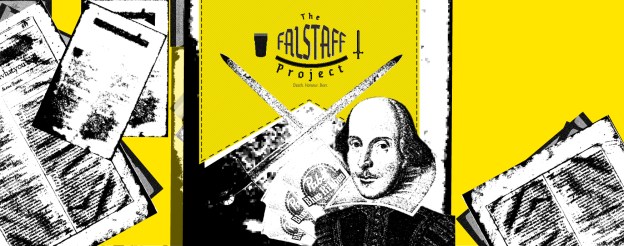
The Falstaff Project: hanging out in a bar with Thou art Here Theatre

  • Shakespeare’s Henry IV Part I is a story about the prodigal Prince Hal, the heir to the throne of his father King Henry IV.  While the king is busy fighting rebels, the Prince of Wales is carousing with disreputable companions in taverns.
  • Thou Art Here Theatre is a local company focusing on site-sympathetic and immersive adaptations of Shakespeare.
  • The Artery is a small community-driven liquor-licensed arts and music venue near downtown.  (They’re being forced to close their doors at the end of the month, but are working to find a new location and continue with their mandate.  Their fundraiser is here.)

Put these three together and you can see where it’s going:  telling the story of Henry IV Part I as seen from inside a tavern, at The Artery.  Andrew Ritchie developed the adaptation and directed the show, cleverly bringing the important bits happening outside the tavern in using multimedia – clips of breaking TV news read by the Messenger (Katie Hudson), TV interviews with the rebel Hotspur hiding out in a cellar (Ben Stevens) and with the King giving press conferences in City Hall (James MacDonald), Hal’s texts and FaceTime calls with the King.  Prince Hal (Neil Kuefler) and his friend Falstaff (Troy O’Donnell) hang out in the tavern managed by Hostess Quickly (Nancy McAlear) and her employee Francis (Ben Stevens), and their bluff sidekicks Poins (Alyson Dicey) and Bardolph (Jesse Gervais) drop in with rowdy schemes.

If you’re feeling hesitant about what you have to do as an audience member in an immersive theatre experience, this is a good one to start with.  Because basically, you can just sit in the tavern with a drink and watch the story happen around you, with no more work than twisting your neck.  Or you can get up and go get another drink, or you can engage with the players a bit more if you want.

I’m not very familiar with the source text, so I can’t tell you how the adaptation varies.  It seems to have much of the original language, but all the performers are comfortable enough with the Shakespearean text that it’s easy to follow and not distracting.  McAlear is especially natural as a timeless tavern-keeper.  Kuefler manages Prince Hal’s transition from irresponsible scamp to a smooth officer for his father with a surprising shift in body language as well as costume.  And O’Donnell was a delight as the lazy greedy opportunistic middle-aged knight Falstaff.  I got a little tired of all the fat jokes, but I guess I should take that up with Shakespeare and the audiences he was writing for.

The Falstaff Project is playing at The Artery until Sunday night – and oh! I forgot to tell you the other cool thing.  There’s music afterwards.  Different local musicians are playing after every performance, and admission to that is free with the play ticket, or $5 just for the music.  Advance tickets are here.


Vigilante: inexorable tragedy with Catalyst style

A new Catalyst Theatre production.  Their first show in the Maclab Theatre intimate thrust stage at the Citadel.  Part of the Citadel subscription series.  It didn’t matter what it was going to be about; I was going to see it for sure.

The fact that it was about the Black Donnellys of 19th century southwestern Ontario, their feuds with neighbours and their brutal mass murder, was a bonus.  I grew up in southern Ontario, and this was one of the true-crime stories that my classmates did fascinated book reports on (that and the story of Evelyn Dick and the murder of her husband even closer to home in the 1940s).  Although I hadn’t actually read The Black Donnellys, The Donnellys Must Die or James Reaney’s play cycle, I felt familiar with and connected to the story.   And with that superficial knowledge acquired as a young person, I think I probably reconciled the story in my brain as “fair” on some level – a family of outlaws commits various crimes on their law-abiding neighbours and gets murdered because of it.

But partway through last night’s first preview performance of Jonathan Christenson’s new rock musical about the family, I changed my mind.  Christenson’s version provided some sympathetic portraits of the young immigrants James and Johanna Donnelly (David Leyshon and Jan Alexandra Smith) fleeing their feuding families in Co. Tipperary, Ireland for a fresh start in Canada, discouraged and cheated in acquiring Ontario farmland, and discovering their immigrant neighbours tenacious in the grudges of the Old Country.   As in the best of Shakespeare’s tragedies, the family’s strengths (fierce loyalty to each other and determination to succeed) are also the qualities leading inevitably to their downfall.  The performance made me care about them and mourn them.

So that’s the story.  But it was a Catalyst Theatre production, with Jonathan Christenson credited as writer, director, composer, and librettist, and the Catalyst design aesthetic expressed in ragged near-colourless layers of costume by Narda McCarroll, in cold stark lighting by Beth Kates, and in the spare barn-skeleton set by Christenson and James Robert Boudreau, so it was told with style.   I’ve seen two other Catalyst productions, The Soul Collector and Nevermore: the Imaginary Life and Mysterious Death of Edgar Allen Poe (which is playing off-Broadway until the end of March).  I found Vigilante more passionate and more accessible than either of them, but still stylized and atmospheric.  Like the other two plays, much of the story is told in narration to the audience, in this case mostly by eldest son William Donnelly (Carson Nattrass).  Most of the text seems to be prose, unlike Nevermore which is full of rhyming couplets.   And there was music.  The music played by Matthew Skopyk, Morgan Gies, Emily Siobhan McCourt, Nathan Setterlund, and Kurtis Schultz had elements of screeching hard-rock guitar, frenetic Irish-dance fiddle, lyrical love-duet poetry, and persistent compelling drumming, and there was singing and movement.  I don’t have a very good memory for tunes, so I can’t recall anything well enough to sing it today, but I wish I could.   Oh, except for the repeated motif “tick…tock… goes the clock … light the lamp and lock the lock …” I loved the music, despite some occasional difficulty hearing the singers over the band in the first act.  There were also a few moments where the music, the powerful movement in boots, and the industrial shadow-lit set reminded me of the U of A’s recent Studio Theatre production of Threepenny Opera.

Neighbours and adversaries of the Donnellys were played by the same actors who also played the six sons, Nattrass (William), Scott Walters (Tommy), Kris Joseph (Daniel), Eric Moran (Robert), Lucas Meeuse (Johnny), and Benjamin Wardle as the youngest Michael.  All of the characters in the story had accents with enough Irish features to be credible yet comprehensible, consistent with growing up in an immigrant community.  The Donnelly sons also swore a lot when they were angered or when being wound up to fight by their mother.  Sometimes the modern-sounding vulgarities made audience members giggle nervously, and pulled me out of the story a bit.

The action started slowly in the first act, with William and his brothers giving an introductory narrative then Johanna and James falling in love in Ireland despite family opposition.  Things speeded up after intermission, with the family members’ doom coming closer and more unavoidable.

Vigilante is playing at the Citadel until March 29th.  Tickets are available here.  Tonight (Sunday March 8th) is the Pay What You Can performance, and I would imagine that the ticket line-up for that at the Citadel box office is forming as I write.  I liked it and I found it challenging, so I’m trying to figure out if I have time to see it again.  But on this week’s calendar I also have Fiddler on the Roof, The Falstaff Project, First Time/Last Time, and a U of A Drama production of A Winter’s Tale, and before the end of the month also Arcadia, dreamplay, and Book of Mormon.  So much theatre, so little time.

Waiting for the Parade

St Albert Theatre Troupe’s current show is Waiting for the Parade, by John Murrell, directed by Louise Large.   It’s set in Calgary during World War II, examining the lives of five women in wartime.  The set has five chairs set around the sides of the stage, each supported by some furniture and props representing the living environment for each woman.  The story unfolds in a series of vignettes and monologues.  The lighting shifts to the story being told, and the actors not involved in that scene are seated motionless and solitary in their own homes.

Not all the men in their lives are away at war, but they are all off-stage in one way or another.  What makes it more interesting is that the five women aren’t easily together as a group of friends.  Some have more in common than others.  When bossy Janet (Rhonda Kozuska) leads a group for some war-related project, the young teacher Eve (Jessica Andrews) tries hard to comply with her demands but older gloomier Margaret (Joanne Poplett) and independent-minded Catherine  (Andrea Newman) resist.   And after a while I realised that Marta (Samara von Rad), the German-Canadian woman running her father’s tailor shop while he is interned, is completely left out of the war work or the other women’s social lives.    This divide is expressed most poignantly early in the show when the group is singing the song Lili Marlene in English and Marta steps up to join in singing it in German.  “How odd.  I had forgotten it was one of theirs, first” sniffs Janet.   Later,  the other women gradually find more connection with Marta and she relaxes a bit with them, but never with Janet – the careful avoidance of a cemetery greeting at the end is sad but appropriate.

Like The Mothers or Atwood’s Penelopiad, this narrative explores the women’s version of a story that often focuses on the men’s actions.  The characters in this story end up confiding in each other about frustrations with husbands, fathers, and sons.  As the men are away or unavailable, the women’s bonds with each other are at least as significant as those within the families.  The performance ends with several of the women on a train platform waiting hopefully for Catherine’s husband to return home.  The war is over and so is this chapter.

Waiting for the Parade was directed with a light touch.  The performers found some of the humour in the character interactions without making any of them caricatures.  I was amused by Margaret’s straight-faced side comments (especially about pickles) and impressed by Marta’s never-resolved frustration with the situation she’s left in by her father.

Waiting for the Parade continues tonight and Thursday through Saturday next weekend, at the Kinsmen Korral in St Albert off Riel Drive.  Tickets are on their website here.  There is a well-stocked concession lounge available before the show and lots of parking.

The Mothers, by Nicole Moeller

Nicole Moeller’s new play The Mothers opened Thursday night and is running at the Alberta Avenue Community League until March 8th as parts of the Skirts Afire festival.   It’s a solo show performed by Annette Loiselle and directed by Glenda Sterling.  Like The Pink Unicorn, it is a story from a mother’s perspective, examining a parent’s role and responsibilities over a teenager’s choices.  Was the mother oblivious to some long-standing problem of her son?  Were the stories she told about him just ordinary stories that didn’t explain the current crisis?   Did it make a difference that she had been young and unprepared to parent?  What I liked best about this story is that the answers to those questions were not obvious.

Although the boy got himself into huge newsworthy trouble, the story on stage was the smaller story of the the mother’s life afterwards.  “Just start over,” is a recurring suggestion, but maybe she can’t and maybe she doesn’t want to.   Bit by bit, as she goes through her son’s belongings in a stark packed-up basement bedroom, she re-examines her life and her son’s life, trying to figure out how her son got to be the person he became, and whether she could have – should have – done anything differently.   Although her relationships with her husband and daughter are not smooth either, they don’t seem to be nearly as fraught as the link she’s had with her son, who’s had some of the same struggles she has.

I wondered before I went why the plural Mothers in the title, when it was going to be a solo show.  (I had similar thoughts about the drama Mothers and Sons which I saw on Broadway last year, and I ended up concluding that it was supposed to represent the universality of the story.)  But it did kind of make sense, with the narrating character Grace talking about her interactions with other mothers affected by the events, and wondering how it felt to be them.

Partway through the performance, I got wondering whether the narration was going to have a tidy or satisfying end, since it didn’t seem to follow a careful chronological order. It did end with a retelling of the son’s crisis and with the mother’s resolve to, not quite start over, but get on with the next things needed.

I identified with the mother.  I’ve never needed to deal with the kinds of decisions and consequences she was dealing with, and I’m glad I haven’t.  It would be interesting to see how this story is heard by people who would be more inclined to identify with the son.  Tickets for shows up to March 4th are available at Tix on the Square, with same-day tickets at the venue until they sell out, and during the festival weekend March 6-8 admission is by donation at the door.