Category Archives: Theatre

She Loves Me!

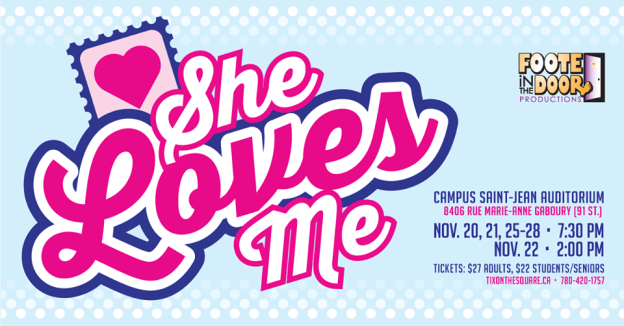
The other night I watched a musical that was new to me.  Not new to other people, She Loves Me (book by Joe Masteroff, lyrics by Sheldon Harnick, and music by Jerry Bock) first hit Broadway in 1964, and is opening again next spring.  The Hungarian play on which it’s based was also the basis for the 1998 romantic comedy movie You’ve Got Mail.

The current production, in the Amphitheatre at Faculte St Jean (across the street from La Cite), by Foote in the Door Productions, is directed by Barb Mah, with music direction by Michael Clark.  The setting, a 1930s perfume shop in Budapest, was simply evoked with shades of pink and green in backdrops, counters, and sales-staff shopcoats.  The shop seemed like the equivalent of something like The Body Shop or Lush – selling a variety of necessities and luxuries, focusing on customer experience, and doing a huge business in presents before Christmas.

As in the usual workplace-set story, there’s a cast of characters that includes a boss (James Toupin) with some unreasonable demands and prejudices, an eager-to-please errand boy (Sam Banigan), and a loyal sidekick (Dustin Berube), and in this case there’s also some sub-plot material in the affair between co-workers (Christina O’Dell and Mitch Caddick).  The story soon focuses on Georg (Russ Farmer), a senior employee mistrusted by the boss, who confides that he’s been writing letters through a lonely-hearts correspondence club to Dear Friend.

On a busy day in the shop, then, in bounces Amalia (Ruth Wong-Miller), costumed in a beautiful peacock shade of blue that stands out dramatically from the rest of the show palette, and she quickly talks herself into sales work with a very funny demonstration.  Amalia is also a member of the Lonely Hearts correspondence club, and you can guess the broad strokes of where the story goes from there.

My favourite bits of the show were some of the ensemble numbers with dancing, the stylized couples in the restaurant with the snooty waiter (Kent Sutherland), and the Twelve Days of Christmas shopping crowds in the store.  Six musicians behind the scenes provided accompaniment, atmosphere, and extra entertainment, and the singing was delightful.  Ruth Wong-Miller has a strong pleasant soprano voice and is particularly well cast in this show.  The part with her jumping on the couch in pajamas is also charming.

The last show of the run is tonight (Saturday 28 November) at 7:30.  If you haven’t seen it yet, they should have tickets available at the door, and it’s a lot of fun!

Devour Content Here / Of Love and Wheat: dustbowl drama in the dust

After Fringe and the Fringe Holdovers  – I saw Edgar Allan and In Search of Cruise Control.  They were both good.  I’ll tell you about them soon if I have time – my theatre world was quiet enough that I almost ended up going to a movie last week because I was bored.

Fortunately, the performance season is starting up again.  Next weekend Rapid Fire Theatre has four shows and Kaleido Fest has lots of interesting things on the schedule and it’s the Edmonton Burlesque Festival.

And this weekend Kristine Nutting is directing an original production in an old warehouse near the stadium.  I think the play was called Devour Content Here and it contained a play called Of Love and Wheat – but I’m not sure.  It had many of the challenges typical to mounting a production in an unconventional venue and requiring the audience to rove about – difficult acoustics, limited lighting choices, having to wait for the audience to move between scenes and being restricted in how they direct audience traffic by trying to stay in character.  An additional challenge of this space is that it is quite dusty.  Some of the audience members wore the provided dust masks, but the performers and crew did not.  I saw it on opening night and again last night.  The second night they were much more explicitly directive about showing people where to sit and stand, and they admitted fewer people, which also helped.

David Arial played a Narrator, but by the end he seemed to be part of the plot as well, with suspect motives of his own.  Or maybe he was two characters.  The ostensible setting was prairie drought dustbowl in a small town in the 1920s, but it had some mythical and fantastic elements.  The story was a little hard to follow, but fortunately a lot of it was fairytale archetype – the manipulative ambitious mother Liliette (Sarah Ormandy) wanting to make an advantageous match for her daughter (Sydney Campbell) with a visiting tycoon (Nathan Plumite), the daughter falling in love with the sewage man’s son (Steven Andrews), stories of leaving home for a better life and not succeeding, people being blackmailed or forced or tricked into various unappetizing agreements, etc.

There was a large chorus of despairing townspeople in makeup/costume/demeanour that reminded me of both bouffon and zombies, and there was a live band playing original music.  There were unexpected bits of circus-aerials performance, there were some solo songs and there were a few ensemble songs.  There were crass moments, horribly disturbing moments, ridiculously overdone and tongue-in-cheek bits, and a scene that shifted from absurd to compellingly intimate at different moments for each audience member (meaning that some people were giggling while I was nearly in tears).   And there were characters who seemed to be struck by nausea every time the word “economics” was spoken.

I liked the way that the young couple Harriet and Oscar seemed to be realistic awkward young people, surrounded by weirder-than-life characters speaking in some heightened or poetic register.  I appreciated Sarah Ormandy’s portrayal of the ambitious mother and former Chatauqua beauty queen, her jerky movements a parody of grace and her self-absorbed behaviour reminiscent of Snow White’s stepmother. (Late in the play, I thought I heard another character call her Lilith, which fitted.)  The best part of the music was the melodic motif “Come on down to the dark soul of the dustbowl, It’s the blackest place on earth”.  Other parts of the instrumental and vocal music suffered from the acoustic difficulties of the venue. 

If this sounds like your kind of thing, if you like performances that try out things that might not work, if you would rather see something original than something tidy, there is one more show Labour Day afternoon.  Doors open at 2:30.  Admission is by donation (they suggest $20 for the gainfully employed and $10 otherwise).  They provide dust masks, and some buckets and crates for patrons who don’t want to stand the whole time, and I saw them make accommodations for mobility impaired patrons.

More good plays

Assassins (the Sondheim musical) was the first musical I’ve seen at this year’s Fringe.  With a cast of ten and a musical ensemble, it’s well placed in the Westbury.  It’s a series of vignettes about everyone who assassinated or tried to assassinate a US president.  As I wasn’t familiar with many of the stories and I didn’t get a program until afterwards, I probably missed the ones in the middle – I remembered about John Wilkes Booth (Jacob Holloway), John Hinckley (Maxwell Lebeuf), and Squeaky Fromme (Emma Houghton, with Nancy Macalear as her collaborator Sara Jane Moore), and partway through I started wondering whether I’d missed the part about Lee Harvey Oswald killing President Kennedy – but that was the climax which came near the end, since I guess it’s the most memorable one for a lot of living Americans too.  Scott Shpeley, who had been playing with the musical ensemble, also turned out to be Lee Harvey Oswald.  Chris W Cook, Jeff Page, Rory Turner, and Billy Brown played other assassins I wasn’t familiar with, and Dan Rowley, and Larissa Pohoreski other characters in the ensemble.

Typhoon Judy was also a performance focused on music, with Christopher Peterson playing an aging Judy Garland, in song, in reminiscence, in flirtation with accompanist (Nick Samoil), and in four fabulous costumes.  The portrayal was credible and touching.

MAN UP! was a wonderful dance show with social commentary.  It’s being held over at the Westbury next weekend, so you have a couple more chances to see it.  Four male performers dance in high heels, powerfully, poetically, and conveying a range of emotions.  Some pieces include all four (Gregory P Caswell, Joshua Wolchansky, Jordan Sabo, CJ Rowein) and some have smaller groups or solos.  Rowein and Wolchansky’s love duet was particularly moving, as well as Wolchansky’s barefoot solo on the side stage.  Monologues and video clips provide context and discussion-starters about the limitations of conventional gender expectations (as well as allowing time for costume changes).  I was fascinated to realize afterwards that the performance had been lacking the personal flirtation aspect of burlesque dancing.

Every Fringe I see Rocket Sugar Factory, the improv duo of Jacob Banigan and Jim Libby, because they are so much fun to watch.  Along with their local accompanist Jan Randall, they are masters of crafting long-form stories and playing them out with delightful characterizations.  This year their show involves creating the pilot episode for a new television show, and the one they created in front of me, Mister Jules Verne, was something I would watch if it existed.  I love the way these two switch characters seamlessly, borrowing mannerisms and language habits, and I’m also a fan of Jim Libby’s near-corpsing, letting his delight in the game show through the characters he’s embodying.  (One of the 2 For Tea performers, James, does this as well.)

I also made time to see a new comedy, Harold and Vivian Entertain Guests, written by University of Alberta acting student Jessy Ardern.  Take the premise of Who’s Afraid of Virginia Woolf – the older couple full of malice entertaining a couple of starry-eyed naive newlyweds, and wield them as weapons in their battles with each other – and make it funny instead of horrible – and that’s the start of Harold and Vivian.  David Feehan and Kristen Padayas play the eponymous hosts, and Rebecca Ann Merkley and Eric Smith play Janet and Mike, the young couple who arrive with over-the-top optimism and PDA and gradually crack into full-on hostility as well.  Corben Kushneryk (also seen this Fringe in Who am I?…) is credited as director and designer, so he must be responsible for the delightful set conveying the reality of a starkly divided household before the show even starts.  I was especially taken with Padayas’s portrayal, the perfect pink bouffant homemaker with twitches of panic and surges of rage.   Eric Smith’s brand of pomposity and pratfall may also be seen in Death Comes to Auntie Norma (one more show, Sunday 8 pm).


Two solos and two physical duos

Mike Delamont’s Mama’s Boy was a great example of autobiographical storytelling.  He has a good natural delivery and the comic timing which enhances Scottish Drag Queen helps this kind of narrative as well.  It was a loving, respectful, realistic, painful story about growing up with an alcoholic.

James and Jamesy’s 2 for Tea was a delight.  I’d missed this playful British duo last year and now I can see why everyone was talking about them.

Beau and Aero was another physical-theatre escape, very well paced so that one turn or game led directly to the next one.  They had particularly creative explorations of balloons, and some impressive acrobatic stunts.

Both 2 For Tea and Beau and Aero incorporated some audience interaction, and they chose people who participated with initiative and humour, especially the young girl who played a cardiologist and gave her thoughts on life in 2 For Tea, and the man who bopped them with balloons in Beau and Aero.

The other solo performance I saw yesterday was Naked Ladies, by Thea Fitz-James.  After the show, the performer acknowledged that a lot of intense material had been touched on, and invited audience members who had responses to connect with her later.  I appreciated the invitation to process – it reminded me of the similar invitation at the end of a performance in a funeral home a couple of years ago, acknowledging discomfort and giving people a chance not to be alone with their thoughts.   I didn’t have anything to say at the time, and I’m not sure I do yet.  The performance jumped around to different moods and concepts, and the performer kept reminding us that all stories are edited, all memories curated.  The parts that made me most uncomfortable – and I mean that in a good way – were the parts where she was reading from her childhood diary about trying not to masturbate.  That bothered me in ways that seeing the performer naked didn’t.

Second post from the Fringe

Since I last wrote, I’ve had a Fat Franks dog, a New Asian Village butter chicken plate, a Rustixx California pizza, and a Rock Creek pear cider, so my eating-and-drinking festival experience is well under way.

I’ve also seen five more shows and done some volunteer shifts, been rained on, been too hot, and been too cold.

Seven – a dance show by a group from Victoria BC, with seven dances loosely representing the seven stages of grief. I particularly enjoyed the rhythmical unison parts of the dance, and the effect of having several helium balloons taped to the floor and lit.

God is a Scottish Drag Queen III – Mike Delamont’s latest show was exactly what I expected, and funnier than last year’s show.

Come and Go – This puppet story was set late in the age of vaudeville, and the main characters were a couple of vaudeville performers, Jim and Mabel, who disagreed about what to do next with their lives – settle down conventionally or head to Hollywood via work in burlesque.  The story had historical resonance but also touched on some familiar themes in male-female relationships.  “But what would I do there?”  “You’d be my wife”  “… and then I’d kill myself”  “With what?” Ianna Ings and Sophia Burak wrote the script and were joined in performing by Matt Newman.  Scenes with Jim and Mabel were interspersed with vaudeville-performance numbers – a singer, a dancer, a cat playing drinking-glass chimes (my favourite!) and dogs doing tricks.   Jim and Mabel also do a vaudeville-team comic routine which the writers credited to George Burns and Gracie Allen.

Subway Stations of the Cross – Ins Choi, the Toronto playwright of Kim’s Convenience, performs a solo show which starts out as a conversational narrative, explaining the different forms of his name that he’s used over the years and discussing how his family is full of preachers and his mother had hoped that would be his destiny as well.  It gradually shifted into a less realistic and more poetic mode, interpreting encounters he had on subway platforms with mythical import and Christian symbolism.  I appreciated both styles.

Tangled Up in Blue – This short (45-minute) two-hander was delightful and subtle, a contemporary glimpse of long-time friends (Spencer Jewer and Katie Fournell) and the repercussions of a brush with romantic connection.  I appreciated the playwright’s choice not to conclude predictably, and I found both characters very believable.  It reminded me a bit of last year’s Letters to Laura.

Fringe takes off

I guess I’ve been estivating along with the blog, so I haven’t had any Fringe previews.  Fortunately, other bloggers and reviewers have given me lots of suggestions, which I’ve used along with the program book (better than the Christmas catalogues from Sears and Eatons when we were kids!) to buy my first tickets.  If you’re just starting to look at what’s out there, I recommend the following pre-festival resources.

I’ve been busy working on Death Comes to Auntie Norma, which opens in the Westbury tomorrow (Saturday) evening and isn’t sold out yet.  It’s a satirical look at the dark side of the American dream, written by Zach Siezmagraff.

Last night as the grounds filled up with festivalgoers and handbilling artists and food and music and happy buzz, I caught two shows.

Second Breakfast Club, from the River City Revue burlesque troupe, was a thoroughly enjoyable burlesque show threaded along the premises of Lord of the Rings characters/archetypes in the scenario of the Breakfast Club 1980s movie about mismatched kids stuck in Saturday detention – a rebellious hobbit, an archery jock, a teacher-pleasing elf, a princess, a bearded dwarf headmaster, and a … what is Gollum anyway?  It also slipped in tongue-in-cheek nods to Harry Potter, Star Wars, and other fictional universes along the way.  Kiki Quinn is credited as playwright and performer, with Lilly Whyte, Lady de Winter, Lucie Lemay, Forbsie Flare, and Beau Creep also performing.

Pinniped and Other Poems, an evocative lyrical musing by Skye Hindeman, is playing at C103.  I saw a version of this show at Nextfest, but here at the Fringe it’s tighter, more coherent, and more visually interesting, with some fascinating stage business.  U of Alberta drama students Alexandra Dawkins, Emily Howard, Connor Suart, and Jake Tkaczyk perform, Vik Chu contributes an original score playing a piano and a violin not always in conventional ways, and Phillip Geller directs.

Today I’ll be serving customers in the South beer tent, and then seeing at least three shows.  It’s going to be cloudy and not too hot today, and it is Fringe and it will be wonderful.  Hope to see you there!

Today I

Nextfest!

One of the events of an Edmonton June that I had missed in previous years is Nextfest, the celebration of emerging artists in various disciplines which used to be run out of the Roxy Theatre.  There is no Roxy right now, but Nextfest continues, with more events and performances than I’ll have time to catch.  High school performers (#NextNextfest) have a full schedule at the Mercury Theatre (former Azimuth/Living room).  Some things are along 124 Street.  And the mainstage performances are in the lower-level auditorium at Faculté St-Jean on 91 Street.

I’ve seen several mainstage shows.  Evolve was a set of short dance/movement pieces, solos and bigger ensembles.

Blackout was an hour of sketch comedy and improv. The pace was quick, the characters clever, and the inclusion of recent political events spot-on.  I liked it a lot.  It reminded me of the work of Hot Thespian Action, the troupe out of Winnipeg which was at Edmonton Fringe a few years ago.

Pinniped and Other Poems was a play written by Skye Hyndman and directed by Philip Geller, a lyrical indirect piece including flashback scenes, walrus mustaches, live goldfish named x0 and y0, an intriguing set making use of twine, rope, and translucent flats, and some effective and unusual stage business.  Alex Dawkins’ demeanour and costuming portrayed a mysterious woman from the protagonist’s past, while Connor Suart, Emily Howard, and Jake Tkaczyk all seemed to be presenting aspects of the main character.  Live music was provided by Vik Chu.  From a vocal production viewpoint I was impressed by how all the performers managed the dense text with clear articulation despite wearing what looked like straw and twine all over their jaws, and particularly how Jake Tkaczyk’s character managed to sound like an old man without losing volume or clarity.  If time permits I will definitely be watching this one again because I think there is more in the text than I picked up.

Shorts is a program of five short pieces.  I’m not sure if they’re all parts of longer works in development, but at least some of them are.  Louise Large and Andrew Dool each had solo pieces, both with unconventional treatments of fourth-wall conventions.  Kali Wells’s Forms of Communication was an entertaining escapade that started from a situation anyone might find himself or herself in, and then escalated.  It reminded me of some of the scenarios in Suburban Motel.  I also appreciated the value placed on hand-knitted socks by the characters!   Liam Salmon’s Un(known) Stories was a natural-sounding chat among three friends, exploring LGBT terminology and concepts, lived experience, and respectful disagreement.  Leif Ingebrigtsen’s Echoes of a Lost King was perhaps the most ambitious project, two songs and a scene from what seemed to be a fully designed original musical about a group of D & D players and their characters on quest, with Joleen Ballandine, Gabriel Richardson, Eva Foote, and Hunter Cardinal.   All four are strong performers and musicians, but in this short piece I noticed that the music was a particularly good showcase for Gabriel Richardson’s voice.

Desirée Leverenz’s Husk is playing in a space on 124 Street just south of 111 Avenue.  The space seems to be intended as some kind of semi-institutional residence, so it has good potential for site-specific work, with an intimate stage/risers room on one side, and the opportunity to wander through various small rooms and spaces on two floors.   The piece included a couple of full-ensemble scenes with cryptic story, movement, and sound exploration, along with a more experiential session in between where audience wandered among displays interacting with the performers as much as they chose.  Philip Geller’s and Morgan Grau’s interactions were particularly compelling, eliciting audience help or response; some of the others were more distant or diorama-like.  All seemed to be isolated, and to be embracing or struggling with some aspect of fluid and mess.  I think my favourite part of this piece was when I gradually became aware that what I thought was a completely comprehensible conversation among odd characters was actually a repetition of nonsensical phrases, imbued with actor intention as in some kind of Meisner class exercises.  (I did not actually notice this right away because I think I was assuming I hadn’t heard right and my brain was filling in more comprehensible narrative.)  Other performers in this piece were Roland Meseck, Emily Howard, Sophie Gareau-Brennan,  Stuart McDougall, Connor Suart, and a couple of others I didn’t know.

Nextfest continues until tomorrow, Sunday 14 June.

Another week of Edmonton fun, mostly theatrical!

There’s lots going on in Edmonton this week too.  Yesterday, for example, the choices included the Folkfest ticket lottery at Telus Field (popular and well-organized and a sell-out again), the Edmonton Pride Festival parade (Pride events continue throughout the month), Sprouts New Play Festival for Kids (continuing this afternoon) and Nextfest, the emerging artist’s festival continuing until June 14th with music, theatre, dance, comedy, improv, film, visual arts, and more.

Most years I’m out of town for all of July and I spend June getting ready, so I’ve been missing out on lots of the Edmonton June events.  But this year I’m going to be around in July, which also means I get more of the fun of the long days of June.

Thou Art Here, the local troupe doing site-sympathetic versions of Shakespeare’s work, had a remount of last year’s successful Much Ado About Nothing at Rutherford House, the historic site preserving the residence of the first premier of Alberta .  The audience followed the actors around outdoors and indoors, upstairs and down, as the banter, schemes, betrayals and amends of the story took place.  Director Andrew Ritchie said that this play was a great choice for their company because the whole play takes place at Leonato’s house (Kris Joseph, recently seen in Vigilante).  They did some clever things including all the audience members in the story – guests at a masquerade, deputized citizens assisting the officers Dogberry (Amy Shostak) and Verges (David Barnet), wedding guests – and they also had individual audience members standing in for some of the minor roles which they hadn’t cast.  This was fun and not embarrassing.  It was an easy play for me to enjoy, because unlike some of Shakespeare’s comedies this one had the sharp-tongued woman (Beatrice, played by Gianna Vacirca) happily ending up with a man who appreciates her and gives as good as he gets (Benedick, played by Ben Stevens), and because nobody was killed to make a plot point (I’m looking at you, Winter’s Tale …).  Conflict was provided through the machinations of Don Joan (Alyson Dicey) and her henchman Borachio (Mark Vetsch), and eventually there was a happy ending for the other couple Hero (Marlee Yule) and Claudio (Hunter Cardinal).  I thought Neil Kuefler was particularly good as Don Pedro, Don Joan’s good-guy brother, although I was a little confused about why the character was using sitcom tricks to manage his friends.

Teatro La Quindicina has moved into the Arts Barns renovated Backstage space until the Varscona renovations are complete.  Their production of Anthony Shaffer’s Sleuth, with Mat Busby and Julien Arnold, directed by Stewart Lemoine, is the start of their 2015 season.  It runs until June 13th.  Blarney Productions’ season is wrapping up with A Steady Rain, by Keith Huff, directed by Wayne Paquette and performed by Jesse Gervais and John Ullyatt.  It closes today (Sunday June 7th) with a 1:30 show.  Tickets for both are available at Tix on the Square.

This week I also attended Let There Be Height, the Firefly Theatre performance of circus/aerials students and teachers.  It was enchanting and impressive, with different turns set to music and strung on a storyline of dreams and a dreamer.

I also attended the Mayfield Dinner Theatre’s production of Cabaret, which I saw on Broadway last year.  This production included some local familiar faces, Cheryl Jameson (Helga), Benjamin Wardle (Bobby), Lucas Meeuse (Hans), Chelsea Preston (Angel), Pamela Gordon (Sally Bowles) and Jeff Haslam as Ernst Ludwig, the ingratiating small-time smuggler whose unveiling as a Nazi serves as unavoidable demonstration of the perilous chasm looming before all the characters in 1930s Berlin.  The viewpoint character Clifford Bradshaw is played with convincing awkwardness and wistfulness by Aiden Desalaiz, and the Emcee is Christian Goutsis.  I thought the shocking ending was particularly well done, in a polished performance.

The Photo

The Photo is about an hour long.  I’m glad that it wasn’t longer because I was so worried about the characters that I could hardly breathe.

Elena Porter and Michael Peng stagger separately onto the stage, not quite aware of each other.  At first they both seem shocked by something that’s just happened, but their responses are different enough that the nature of the awful thing wasn’t immediately clear to me.  But the basic sad event is clarified quickly, so that one character seems to be grieving in a conventionally comprehensible way and the other is alarmingly detached from reality.  I did keep wondering in the back of my mind whether I was wrong, or whether more horrible details would come out later, but I was relieved to have my guess confirmed, and could then watch the couple cope and connect.

I don’t think I’ve seen Michael Peng and Elena Porter on stage together before, but I’ve seen both of them in challenging roles in dark or painful stories – Peng in An Accident and in The Kite Runner, Porter in The Three Sisters and in The Clean House.  And they were both good in The Photo.   Peng’s thin-lipped quiet background anguish and Porter’s sparkling surface cheer over pain suited the roles well.  The script provided enough resolution that I could breathe again, and I felt as if the two characters were beginning to understand each other’s needs and would be able to take care of themselves and each other.

I do not have personal experience of the kind of loss experienced by the characters.  I don’t think I’d recommend this play to someone who has, without offering to warn him or her, but on the other hand without knowing what to expect I found the initial scene disturbingly effective, and I don’t want to spoil that for anyone else.

The Photo is playing at C103 until May 23rd.  It’s a Theatre of the New Heart production, written by Dana Rayment and directed by Michelle Kennedy.  Advance tickets are, of course, at Tix on the Square.

The Ugly One

The Ugly One, written originally in German by Marius von Mayenberg, is currently playing at PCL Studio, a Kill Your Television production directed by Kevin Sutley.

Harsh clear lighting and a stark set (Kerem Çetinel) lead into a story with distanced and stylized dialogue, with original musical underscoring (Dave Clarke and Rhys Martin).  The premise is that Lette, a middle-aged male engineering designer (Nathan Cuckow) suddenly discovers that his colleagues and his wife (Nadien Chu) have always considered him unspeakably ugly and never mentioned it.  His wife claims not to mind, but his employer (David Ley) is about to send Lette’s assistant (Chris Bullough) to present their new product, since of course Lette’s face makes it inappropriate for him to go.  It was interesting to explore the concept of how his unattractiveness limits his opportunities with a character for whom that was a completely new concept, rather than a fact of life and society that he’d grown up with.

When a surgeon (Ley) offers Lette the opportunity to change his face, he is apprehensive but agrees.  Surgery takes place on stage, in a dental-office-type chair, with disconcerting and convincing sound effects.  The subsequent unveiling displays Lette as an unusually attractive man, with various consequences.  At this point, I was reminded of various fables and archetypes in which getting what one’s wished for destroys one’s life, like the classic horror story “The Monkey’s Paw” that we studied in high school English class.  Because it turns out to be not that simple – even getting to present the invention at a trade show brings unwanted complications.

Things get weirder and worse as the surgeon goes on to perform the surgery on others, giving them all the same handsome face as Lette, so that his popularity is temporary, his marriage and employment break down, and he finds ultimate comfort only in a disturbingly narcissistic contact. In a brilliant demonstration of theatre’s ability to convince an audience without the realistic special effects of film, Cuckow’s face, voice, and physical presentation are sufficiently different before and after the surgery to make him look homely beforehand and attractive afterwards with no external assistance that I could detect.  All the other actors in the piece play multiple characters, with subtle shifts in vocal intonation and posture making them easy to distinguish.

The Ugly One continues at the PCL Studio until May 23rd, with tickets available through the Fringe box office.