Author Archives: Ephemeral Pleasures

Russ Farmer as Bobby and Emily Smith as Marta. Photo credit Nanc Price.

In good Company

Russ Farmer as Bobby, Emily Smith as Marta.  Photo credits Nanc Price.

Stephen Sondheim’s 1970 musical Company shows us a group of friends in their 30s, five married couples and the single guy, Bobby (Russ Farmer in the current Foote in the Door production).

In a series of gentle vignettes, we see glimpses of each couple’s relationship and challenges.  We see that Bobby is friends with everybody, good company, as he spends time with each couple.  Harry and Sarah (Stefan Rumak and Melanie Lafleur) talk to Bobby as a way of complaining about each other’s habits (his drinking, her eating sweets).  He’s best man for Paul and Amy’s (Alan Cabral and Ruth Wong-Miller) wedding – or he would be, if they agree to get married.  Joanne (Kärin Thomas) enjoys flirting with Bobby and telling him about her past husbands while devoted present husband Larry (Joe Garreck) looks on.  Susan and Peter (Athena Gordon and Trevor J.) explain to Bobby that being divorced makes their marriage work.  Bobby smokes weed with David and Jenny (Simon Yau and Kara Little).  All of them fuss at Bobby about not being married and try to find out why he’s not married – and Bobby doesn’t seem to know either.

We also see Bobby with three love interests, naive flight attendant April (Victoria Suen, whom I last saw in Lizzie), Kathy, who’s moving away but says she would have liked to marry him (Alyssa Paterson), and Marta (Emily Smith), one of my favourite characters, who is wholeheartedly in love with New York City and with life.

And I should mention that it was fun to spot assistant director Gerald Mason playing bartender and what seemed to be a nightclub full of show orchestra members and assistant stage managers dancing in the dark.

It wasn’t the plot-heavy kind of production full of big character journeys and closure, but rather was full of lovely examples of longterm love and friendship and of people accepting who they are and being comfortable.  My favourite part was “Getting Married Today” in which Ruth Wong-Miller’s character has hilarious physical and emotional range in a wedding dress.  I also enjoyed “Side by Side by Side”, which was a great showcase of choreographer Adam Kuss’s contributions, and Bobby’s final solo “Being Alive”.  There are also many other touching and/or delightful moments which I won’t tell you about so you can discover them for yourself, with just one hint:  Trevor J. lets his hair down.

I admired how Morgan Kunitz’ direction integrated everyday smartphone use into a script from 1970 without looking anachronistic.

Company is playing at L’UniThéâtre until April 28th.  And if you haven’t been to the big auditorium at La Cité yet this season, you will be pleasantly surprised by the new audience seating, which is much more comfortable than the previous seats.

Tracey Power’s Glory!

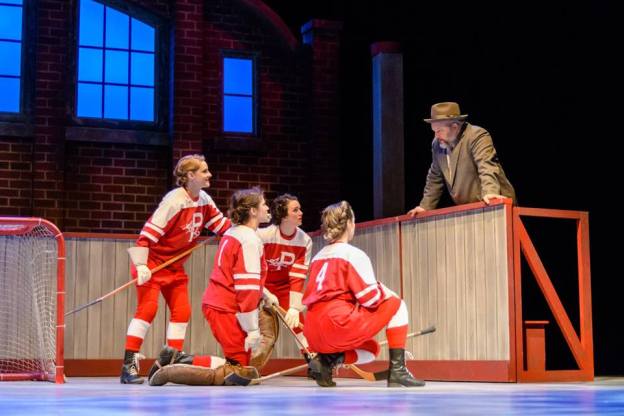
Kate Dion-Richard, Gili Roskies, Katie Ryerson, Morgan Yamada, and Kevin Corey in GLORY. Photo: Barbara Zimonick. (Set & Lights: Narda McCaroll. Costumes: Cindy Wiebe.)

When I read that Calgary’s ATP would be putting on a new play about women hockey players, and specifically the Preston Rivulettes of the 1930s, I knew I needed to go to Calgary to see it.  And I was right!

I cried a lot during the performance, because the portrayals of the young women and of their community’s responses were so familiar from my own experience of female hockey starting in the 1970s.  I felt represented, understood, and honoured.  “I’ve always wanted to play on a team!” enthuses future captain Hilda Ranscombe (Katie Ryerson).  “Girls don’t play hockey!” retorts reluctant coach Herbert Fach (Kevin Corey).

The playwright Tracey Power (Chelsea Hotel) chose two pairs of sisters, Hilda and Nellie Ranscombe (Ryerson and Edmonton’s Morgan Yamada) and Marm and Helen Schmuck (Gili Roskies and Kate Dion-Richard) to represent the players, and created interesting distinct characters with enough backstory, conflict, and connections to be compelling.  The historical background of the 1930s was essential to the story, filled in by the characters talking about their families and community and by listening to CRBC (later CBC) radio.  One player couldn’t go to university because her father’s business was struggling and her brothers had lost their jobs; another wasn’t admitted to law school because she was Jewish.

Hockey games were represented on stage in stylized choreography (Power), with different movements and music for each game.  Yamada was an agile and stubborn goaltender.  Hard shots (of imaginary pucks) had me ducking in my seat.  Set and lighting (Narda McCarroll) and costumes (Cindy Wiebe) support the storytelling.  I was particularly impressed with the rapid movement of the rink-boards pieces to become changerooms, factory workrooms, and even a baseball park.  Director James McDonald (formerly of the Citadel) and playwright Power paced the action well and kept the human stories to the forefront.

I have known of the Preston Rivulettes since I was a young hockey player and fan, looking at team photos and trophies in the old Preston Arena.  I vaguely remember meeting Hilda and Nellie much later in their lives, at a Preston Trianglettes game, and finding it hard to comprehend that forty years earlier, they had played for provincial and national championships.  In the 1970s there was no provincial or national governing body or championship for female hockey – but in the 1930s there was.   The play Glory included enough of the documented facts to make me happy as a scholar, but more importantly captured perfectly what it is like for women to play the game they love despite many obstacles.   I hope to tell some of the second-wave women’s-hockey stories on stage myself someday, and this play affirms my sense that they are worth telling.

“When we fight to win, we have a whole lot more at stake”, one of the characters in Glory says, explaining why fans find their matches exciting.  And Hilda Ranscombe finishes with a monologue daydreaming about what will happen someday, despite the loss of competitions and opponents on the eve of war.  Someday, she says to her teammates, there will be so many teams we won’t be able to play them all.  And there will be women coaches.  And women referees.  And women announcers.  And Olympic medals.

There are, Hilda, there are.  Thank you.

Glory is playing at Alberta Theatre Projects in Calgary until April 21st.


Blue Stockings, by Jessica Swale

Lucy Vogue and Aidan Thomas in Blue Stockings. Photo: Scott Henderson, Henderson Images.


Blue Stockings is set at the University of Cambridge, in 1896, and mostly at Girton, a women’s college of the university.  It follows a study group of four young women in their first year at the college, Tess (Lucy Vogue), Carolyn (Monica Lefurgey), Celia (Jocelyn Jay), and Maeve (Maggie Salopek), showing their passion for learning science, their struggles with learning to disagree with sources and defend their ideas, and their commitment to future careers in teaching, research, and medicine.  The play also shows how they are treated by faculty male and female, by their male peers, and by College staff including a chaperone (Julie Sinclair) and a maid willing to circumvent the chaperone (Rebecca Collins).

I was pleased to see the way the script touched on many issues of women’s education which were not black-and-white.  The male faculty’s attitudes ranged from enthusiastically supportive (Dave Wolkowski as physics lecturer) to pseudoscientifically condescending (Martin Stout as renowned psychiatrist).  The head of the women’s college (Elizabeth Marsh) is single-minded in her attempts to gain degree-seeking status for the young women through the university Senate and vote of members.  This cause drives her to disavow any connection with the too-radical suffragist cause and to expel a student who is needed at home because letting her stay might be used as a demonstration that women’s education hurts families.  The students also sometimes find themselves torn between their passion for study and the temptations of romance, with significant consequences.

Director Laura Ly used a cast of 19 to portray the 25 characters, and set designer Alan Westen used rotating backdrops and moving furniture to present various university settings.

If, like myself, you learned about the history of women’s university education in England through Dorothy Sayers’ wonderful 1935 novel Gaudy Night, you may be unsurprised by the women’s constant need to justify their presence, but surprised by some of the history.  Gaudy Night is set at Oxford rather than Cambridge, which explains the main difference.

Blue Stockings plays at the Walterdale Theatre until Saturday April 14th, including a matinee today.  Advance tickets are at Tix on the Square and same-day tickets are at the door.

To separate, to cling, to Cleave

One character in Elena Belyea’s new play Cleave explains the concept of words that are autoantonyms – words that have two near-opposite meanings, like screen, fast, or bound.  This gives the viewer a hint toward unpacking the play’s title, as it may refer to characters clinging together or being split apart, drawing towards new choices in their lives or detaching from unwanted ones.

Like many of my favourite stories on stage, on screen, or in library books, the narrative of Cleave shows the separate but intersecting objectives of several characters through a cusp time in their lives.  Four of the characters are part of a family, parents (Dave Horak and Elena Porter) who turn out to have their own secret unhappy histories and teenage children (Emma Houghton and Luc Tellier).  I was particularly delighted by the subtlety of Emma Houghton’s character journey, as I had misjudged her on first appearance as a sulky shallow cheerleader wheedling money out of her dad for new workout clothes in which to make an impression.

The other two characters are a new kid at school, 17 year old Aaron who is intersex and trans (Jordan Fowlie), and his therapist.  As he explains to his new therapist (Natasha Napoleao) in the first scene, he’s moved away from his parents in order to avoid the stigma of transition in a small town and in order to get the therapist’s recommendation he needs before gender-affirming surgery.  The therapy scenes provide useful exposition of the background concepts of intersex and trans lives.  Sometimes Aaron is explaining things to his therapist and sometimes she is providing vocabulary and information to the audience while connecting with Aaron.   They also give important insight into Aaron’s thoughtful sarcastic character by providing a context in which he is relatively open, compared to his careful cautious demeanour at school, with his new friend’s family, and in another situation.

I loved the scenes with the two outsider boys sitting on the school steps not quite looking at each other and not rushing into friendship.  And the wordless gestures of trust on both sides of that relationship in the final scene moved me immensely.  I can imagine happy endings in the future for at least some of the characters, but the play ends appropriately with the loose ends not all tied up.

I also want to write about another scene that horrified me and hypnotized me in ways that also thrilled me as a fan of compelling stories.  But I don’t want to spoil it for anyone else.  So I will put a brief comment about it at the end of this post.

Cleave is playing at the Backstage Theatre until Saturday April 7th.  There is an allowance of Pay-What-You-Can tickets available at the door for every performance.

Continue reading

The broken beauty of Betroffenheit

First I need to tell you that Betroffenheit has one more performance in Edmonton, this afternoon at 2, and it is not quite sold out.  Yet.

I was fortunate to be able to attend the first performance of this short local run on Friday – Good Friday, which was somewhat fitting.  As the Citadel Theatre Beyond the Stage series and the Brian Webb Dance Company joined forces to bring this Kidd Pivot/Electric Company Theatre (Vancouver) production to town, it is performed in the large auditorium of the Shoctor Theatre rather than the smaller space of the Timms Centre (like the other BWDC shows) or the Citadel Cabaret.

It is weird, disturbing, and very compelling.  Program notes and other media articles provide a little background – that the piece is a response to playwright Jonathon Young’s horrific story of personal losses.  Choreography and direction were provided by Crystal Pite.  As I am more comfortable with conventional narrative in words, I kept wishing for explicit exposition, but the performance demonstrated the nightmarish and unnamable qualities of the main character (Jonathon Young)’s tormented responses with flashing repetition of cryptic voiceover, oppressive set, sound, and lighting (Jay Gower Taylor, Owen Belton/Alessandro Juliani/Meg Roe, and Tom Visser), and a creepy vaudeville revue by supporting ensemble Christopher Hernandez, David Raymond, Cindy Salgado, Jermaine Spivey, and Tiffany Tregarthen.   About two-thirds of the way through the performance, the stark dingy-industrial room trapping the protagonist appears to collapse, and after intermission the piece resumes as a somewhat more conventional modern-dance exploration of grief and support, with the performers now dressed in simple grey workout clothing.

Memories and witnesses in Blood of Our Soil

One of the powers of live theatre is that it can educate audience members about horrible things that happened or are happening.  Sometimes people with privileged and busy lives like mine kind of missed reading about world events or unpleasant parts of history.  I’m not sure whether it’s worse nowadays, when first encounters with news might come through the filter of which stories from which sources the people on my Facebook feeds choose to link and when we get to hear about so many awful things happening that it’s easy to be distracted by the next one, or whether it was worse in the past when there was no way around mass media, nobody tweeting from war zones.

Live theatre can also be an effective way of making sense of traumatic stories experienced by parents and grandparents, placing them in context and sharing them with a wider public.  In Empire of the Son, which played earlier this year at the Citadel, the performer-creator Tetsuro Shigematsu tells some of his father’s stories, including being a Japanese child during World War II and experiencing fallout from Hiroshima (literal fallout).  In Children of God, which previews at the Citadel starting tomorrow, Corey Payette and his creative team will show us some stories of indigenous children in Canadian residential schools, and how the experience affected them and their families later.  And in Blood of Our Soil, which opened last night at the Arts Barns Westbury Theatre, playwright and performer Lianna Makuch, director Patrick Lundeen, and the Pyretic Productions team show us some details of the hardships of Ukrainian people over the last 90 years or so, in a format that felt human-scale, touching and inspiring, and also showed me how much I just don’t know about that part of the world. 

The Westbury Theatre space was arranged in a way that felt more three-dimensional and alive than I’ve ever seen it.  Stephanie Bahniuk’s design had dim dappled lighting full of mist exposing a thrust stage area crisscrossed with laundry lines above, and damaged buildings towards the back, with projections (Nicholas Mayne) showing glimpses of life through the windows.  Closer inspection revealed that the buildings all seemed to be constructed of old wooden pallets/skids.  It reminded me of the set for Irma Voth, but come to life in three dimensions instead of being flat and behind the action.

The first act follows a fairly conventional solo-narration format, with Makuch switching back and forth between a character like herself and her Baba (grandma), signalling the switch by pulling her kerchief over her hair and sometimes changing her accent.  Larissa Pohoreski provides some musical background, and the other performers Oscar Derkx, Julia Guy, Maxwell Lebeuf, and Tanya Pacholok create a chorus of expressive movement, occasional song, and joyful folk-dance.

At the end of the first act, the dying Baba tells her granddaughter to go home for her, go to her home in Ukraine.

The second act is all contemporary.  Makuch relates how the narrator travels not only to the village and house of her grandmother’s memories, but to the current war zone of Eastern Ukraine.  In this act, the other performers all represent people she gets to know in the areas touched by war, young former soldiers (Derkx and Lebeuf), Russian-speaking sisters whose brother had been killed in Kyiv participating in the Revolution of Dignity in 2014 (Pohoreski and Pacholok), and a young mother, an internally displaced person living with her small child in a hostel and longing for an apartment and a job and hope (Guy).  I found this character particularly compelling, abrupt and mistrustful, with her fierce protectiveness expanding from herself and her daughter to cover the Canadian visitor as well.  Makuch is painfully honest in showing the visitor’s naiveté and questioning her motives, which impressed me.  Suddenly I remembered the first performance in which I had ever seen her, Greg MacArthur‘s The Missionary Position, which illustrated the harm done by well-meaning misguided Canadian visitors in a place like Haiti.   The audience gets to share in the narrator’s astonishment that in an area of recent/ongoing conflict, “veteran” doesn’t fit the connotations we might have here, old men and women in Legion jackets.  She gets drunk with the young former fighters, and they tell her stories, not just stories of fighting but of how the fighting affected their relationships with women, some of them very funny.

Blood of Our Soil runs at the Arts Barns until March 9th, with tickets available here.


A week of re-views

Liz Nicholls did a great post of the year in review in Edmonton theatre.  Colin MacLean had a great post of the Best of 2017 too.

I’m not organized enough to give you a review of the year, but it occurred to me the other night that this last bit before Christmas has been a week of re-views, for me.

I watched Star Wars:  The Last Jedi.  It was fun.  Seeing Carrie Fisher in new scenes for the last time was moving.  Mark Hamill was cryptic.  Another character from the 1970s trilogy was a pleasant surprise.  I liked that for 21st-century audiences there is more than one interesting female character, and I hope that continues to be a thing.  Also, that there is more than one interesting character of colour.  It’s embarrassing that that didn’t used to be a thing.

I watched a Canada-USA women’s hockey game, the last in their exhibition series of this Olympic year.  I missed attending the first-ever international women’s tournament in 1987 in Mississauga, but I volunteered at the first IIHF Worlds in 1990, attended the World Championships in Kitchener in 1997 and in Mississauga in 2000, and was on the ice between periods with my 5-6yo hockey students for an exhibition game at Air Canada Centre in the early 2000s.   And I’ve watched or listened to broadcast Canada-US games many times over the years, usually the gold medal games.  So it was a nostalgic treat to watch the 2017-18 rosters of these powerhouses in our new Rogers Centre.  Canada’s head coach is now Laura Schuler, and I remember when she first made the national team herself.  Shannon Szabados of Sherwood Park was in net for Canada, and the backup goalie Genevieve Lacasse, like several other players on the Canadian roster, spent some time as a young player in clubs and leagues which my mother or I helped to start.  Canada won 2-1 in overtime.

And I saw lots of theatre that in various ways was re-watches.  Back to the 80s Part II, at the Mayfield, was a lot like the previous one in the series a couple of years ago – brief live versions of popular songs of the 1980s, with costume and dance, strung together with a loose plotline and skits.  This one included some music from movies and TV shows, as well as pop music remembered from MTV and radio.  Before it started, I couldn’t think what songs/artists would be left to do, but I remembered almost everything once they started playing it.

I wanted to see this year’s Christmas Carol at the Citadel because I wanted to see Julien Arnold play Scrooge (a few years ago he played Bob Cratchit), and it was lovely as usual.  Beth Graham and Jamie Williams are the Cratchits this year, and Robert Benz is great in various small roles.  The pacing was very good, too.

Two years ago, Edmonton Actors’ Theatre’s production of Jay Torrence’s Burning Bluebeard hit uncomfortably close to home, a show about a theatre fire being produced for the temporary Roxy on Gateway, only seven months after the original Roxy Theatre had burned down.  I didn’t see it last year, but this year I saw it twice, once with John Ullyatt playing the stage manager and once with director Dave Horak in that role.  This year another cast change has Brooke Leifso playing the fairy queen instead of Richelle Thoreson.  Leifso brings another level of compelling awkwardness to the role, as if her ballet slippers were on the wrong feet, and a fascinating powerful remoteness, not making eye contact with the other characters but controlling the story.   Partway through my most recent viewing, it occurred to me that Amber Lewis’s character (Fancy Clown in the program) was not introducing herself in the same ritualized documentary personification as the other characters were, each telling their own story of who they had been and what had happened on the afternoon of the fire, and asking audience members to remember them.  Lewis’s character was more of a general narrator, remote and not particularly likeable, and I began to wonder if this character was in fact a representation of fate or of something more sinister.

And I also made time in my schedule for a couple of viewings of The Best Newfoundland Christmas Pageant Ever, once on tour and once at the Varscona Theatre.  Since the last time I’d seen it, they’ve added Vicki Berg as musical director and on-stage piano player Miss Vicki.  Her character is very funny, and the recent musical additions include a haunting rendition of “Mary did you know” with a beautiful arrangement showcasing each of the performers.  My companion pointed out that the lyrics of that song made a thought-provoking contrast with the thoughts expressed by the later-in-life Mary as seen in Northern Light Theatre’s Testament of Mary earlier this season.

Which also reminds me of my Theatre Alberta present-under-the-tree – I figured it was okay to unwrap it early because it’s a library loan which I will need to return – as part of their Christmas promotion #UnderWraps, they sent me a copy of Terrence McNally’s Corpus Christi, which was so good I was teary eyed in the Next Act.  It reminded me of Testament of Mary, being tribute fiction adding complexity to the story of Christ.  It seems eminently stageable, just needing thirteen male-presenting actors and a few props, and I hope someone puts it on here.

Little Women: the musical

One of my favourite parts of the experience of watching the musical Little Women last night was remembering bits of the story as I watched it happen on stage.  I didn’t love Louisa May Alcott’s book when I first encountered it, but I still read it over and over, like many girl-identified children of my era who read faster than my parents could drive me back to the library.   The best things about the book were Jo’s tomboyish-for-the-time outspokenness and determination, the genuine affection among the different sisters each with her own flaws, and the way the new-boy-next-door (lonely, orphaned, and probably with his own variations from gender norms of the culture) was welcomed and swept into their games and projects.  My least favourite parts of the book were the parts where Jo rejects Laurie’s romantic overtures but and then changes her previous plan of staying single when she gets to know Professor Bhaer.  I didn’t like the example of best friends and equals Jo and Laurie not being romantically suited, with all the March girls ending up with an older more powerful man (Jo with the Professor, Meg with Laurie’s tutor John, and Laurie finally getting engaged to Amy, the youngest of the sisters.)

The stage-musical version (book by Allan Knee, music by Jason Howland, lyrics by Mindi Dickstein) and the Foote in the Door production currently playing at L’UniThéâtre enhance all the good things I remembered about the book and make the things I disliked less objectionable.  The sisters are wonderful together, different from each other but protective of each other and of their mother.  Alyssa Paterson is the oldest, responsible Meg, Ruth Wong-Miller is ambitious and impulsive Jo, Fiona Cain is kind frail Beth, and Natasha Mason is Amy, the whiny youngest at the start of the book who is transformed for the better when Aunt March (Stephanie Sartore) takes her to Europe and guides her into well-off cultured society, with enough money to pursue her interests.  I found it very easy to believe that Jo didn’t care about clothes and the rest of the family didn’t have money to spend on fancy ones, but I was still fascinated to see them take for granted movement in hoop skirts (including stomping  up and down stairs, sitting gracefully on the floor (Meg) and falling in a pretend tragic-death (Jo).  The costumes also fitted with a bit I remembered about Alcott herself being of dress-reform convictions and the March family not putting the girls in corsets.   Wong-Miller is well cast as Jo and has a strong singing voice.  Carolyn Ware (most recently Nettie in Carousel) is lovely as Marmee and Stephanie Sartore is very funny as both Aunt March and the boarding house landlady Mrs. Kirk.

Amy and Aunt March

Natasha Mason, as Amy, and Stephanie Sartore, as Aunt March, in Little Women. Photo credit Nanc Price.

The men in the show helped to reconcile me to the romantic pairings I had been irritated by as a teenager, too.  Stephen Allred as Laurie was an eccentric boy whose life was definitely improved when the March sisters took him in, and then a kind young man who immediately took no for an answer when Jo turned him down.   And although young me had disliked the book version of Professor Bhaer as old, boring, and bossy, Dave Smithson plays him with self-aware humour and without dominating body language.  The script says that he’s thirty-four (not so old), his literary critique of Jo’s stories seems more respectful in the stage version, and their engagement/future plan doesn’t feel like Jo abandoning her own goals for his, but as “give me a task!”-Jo moving on to a new challenge and Fritz embracing it.   Bob Klakowich is fun to watch as Laurie’s grieving and cranky grandfather transforms to shy Beth’s gentle benefactor and the proud supporter of Laurie and Amy’s wedding.  Adam Sartore’s part as John Brooke is small and less memorable, but the scene where he and Meg first meet is charming.

One pleasant surprise for me was the scenes from Jo’s imagination, in which the other actors perform as characters from her stories.  I loved how the sketches showed the maturing of her literary vision and ended up with a tale that was both credible as adventure a newspaper editor would pay for and satisfying to modern feminist sensibilities.  Fight choreography is credited to Chance Heck.

I liked the show a lot.  The pacing was good, some of the music was earworm-memorable, and the simple set (Leland Stelck’s design) worked for the various locations needed (the family parlour, Jo’s garret, the boarding house, Aunt March’s house, and outdoors. )  Trish Van Doornum directed and Daniel Belland was music director.

Little Women plays tonight, tomorrow afternoon, and Wednesday to Saturday next week (Nov 8-11) at L’UniThéâtre.  Tickets are available through both Tix on the Square and EventBrite, and there should be some at the door.

And now I think I will read the book again.

Alcott novels

The copies of Little Women and Little Men that my mother received for Christmas in 1945.

Five for one!

Laurie (Stephen Allred) pledges friendship and loyalty with the March sisters, Amy (Natasha Mason), Jo (Ruth Wong-Miller), Beth (Fiona Cain), and Meg (Alyssa Paterson). Photo credit Nanc Price.

.


Les Feluettes at Edmonton Opera

Jean-Michel Richer and Zachary Read in Les Feluettes. Photo by Nanc Price for Edmonton Opera

Edmonton Opera’s current production of Les Feluettes, a Canadian opera in French based on the play of the same name by Michel Marc Bouchard, has one more performance, this Friday October 28th.  Bouchard is also the author of the play Tom at the Farm, of which I saw a performance at the University of Alberta last season, directed by Brenley Charkow.

When I first heard of Les Feluettes and read a plot synopsis, I was dubious.  I liked the idea of increased LGBTQ representation in opera, as in any performance art, but it sounded like a very sad story.  I get a little tired of stories in which same-sex relationships or LGBTQ characters are inevitably doomed, because for a long time that’s how most LGBTQ characters were portrayed.   Maybe I’m past being desperate for representation and on to the stage of wanting a variety of representation, some of it admirable and some of it happy.

However, I attended a performance of Les Feluettes despite my misgivings, and I’m very glad I did.  The story does have a sad ending with emotional resonance, but not unusually so for opera.   And the aesthetics of the production are just gorgeous.  I’m reconciled partly because it’s good art, and partly because the tragic outcome isn’t just due to the young gay students Simon and Vallier being unable to pursue their relationship in the 1912 Roman Catholic culture of a small northern Québec town, but also due to the jealous and guilt-ridden actions of one particular classmate, who is tormented by his own attraction to Simon.   One might even look to the story of this opera as an illustration of why the Alberta government is currently in conflict with separate school authorities over curricular objectives on sexuality.   Young people who are taught to fear, hate, or deny their own sexuality and that of others can do terrible harm to themselves or others.

The opera, like the play on which it’s based, has a “play within a play” structure (and in fact, there’s actually a play within the play within the play.).  As the flashback scenes are performed by a group of prisoners for the visiting Bishop (Gordon Gietz), all the performers are male, including the chorus and supernumeraries.  Costumes appear as if they could have been constructed out of prison uniforms, draperies, and other available materials by the prisoners for the purpose of acting out this story.  Female characters in the flashbacks are played by male prisoners, and not in an inherently ridiculous way.  Baritone Dominique Côté is the mother somewhat out of touch with reality, played with kindness and pathos.  Countertenor Daniel Cabena is convincing as the young Lydie-Anne, Simon’s fiancée.  The young prisoners who portray the young Simon and the young Vallier (Zachary Read and Jean-Michel Richer) have very strong chemistry and voices that sound good together.

The plot synopsis is available on line and in the printed program.   I would have similar concerns about inviting people to a performance of Romeo and Juliet if they were not prepared for the outcome because I always find stories of the unnecessary deaths of young people upsetting.  But if you are willing to watch a sad opera, you should consider going to see this one on Friday.  Some tickets are still available here.

Letters from (and to) A Doll’s House

torvald nora

Tim Marriott, as Torvald, and Nicole English, as Nora, in A Doll’s House. Photo Kristen Finlay.

Dear Captain Awkward:

I’m worried about my old friend. I just moved to her city, and we’ve been spending time together for the first time since she got married.  Captain, I think she’s married to a Darth Vader Boyfriend.  She pretends to follow his order not to eat macaroons, but sneaks them behind his back.  When I offered to help her with some mending, she pushed me into the kitchen with the help, saying “Torvald can’t stand to see anyone sewing”.  And he totally mansplained me the other day about how knitting was an ugly low-class pastime and advised me how to do embroidery instead.  She goes along with his whims to a ridiculous extent and she thinks he’s wonderful.  Captain, what can I do?

  • (pronouns she/her). 

Dear Ask a Manager:

I don’t have good references because I made some mistakes in my past.  No charges were laid, but I was stuck using some sketchy schemes to make money for a while, until I got this entry-level job at the bank.  Now I’m keeping my record clean and looking forward to promotion.  When I found out one of my old school friends was hired as the new vice-president, I was sure this would be an advantage for me.  So I started dropping in at his office and reminiscing loudly about the things we got up to at school.  And now he says I’m being too familiar and he’s given me a written warning and a pink slip!  However, I’ve got something on his wife (see above, sketchy schemes), so I was thinking that I should just blackmail them into letting me keep my job and move up at the bank.  Nothing can go wrong with this, right?

NK


Dear Miss Manners:

As I am in chronic pain due to congenital syphilis (which my nanny told me was my father’s fault), I would like to die with dignity while I have some agency.  I don’t think my friends could handle seeing me in rough shape, so I’d like to tell them to stay away.  What’s the approved way of notifying them using visiting cards? 

Doc


From Dan Savage, Savage Love, confidential to NoNoNora:  DTMFA.

2022 update: The Savage Love archives have now moved here and do not appear to have a search function.  Dan Savage’s frequent terse advice to people in bad relationships is defined in this Wikipedia entry.


The conflicts and choices portrayed in Henrik Ibsen’s A Doll’s House, first produced in 1879, are disturbingly timely in 2017.   Alex Hawkins directed the current Walterdale Theatre Associates production to show the complexity of all the characters and the ways class and gender affect their choices. Nicole English (last seen as Mrs. Lovett in ELOPE’s Sweeney Todd) is troubling and inspiring as Nora, and the rest of the cast is strong as well (Tim Marriott as Torvald, Dave Wolkowski as Krogstad, Marsha Amanova as Christine, dale Wilson as Dr. Rank, and Leslie Caffaro as Anne Marie).   The designers worked with the restrained palette of 1879 Norway to create an atmosphere embodying both oppression and beauty, with set by Joan Heys Hawkins, costumes by Geri Dittrich, lighting by Richard Hatfield and Rebecca Cave, sound by Kiidra Duhault, and props by Alayna Hunchak.

A Doll’s House continues at the Walterdale Theatre until Saturday October 21st, 8 pm Tuesday-Saturday and 2 pm Sunday.  Same-day tickets are available at the door and advance tickets are through Tix on the Square.