Author Archives: Ephemeral Pleasures

Sweat, at the Citadel

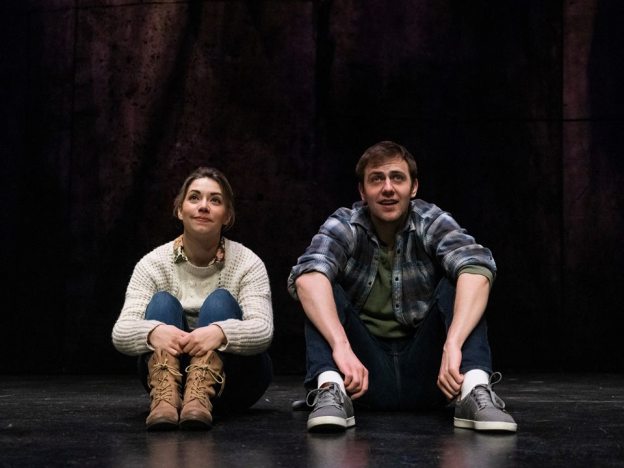
I’m at work the other day putting on high-visibility coveralls and safety boots.  And it occurs to me, I saw that on stage last night, middle-aged women matter-of-factly wearing Carhartt work trousers and boots for work without it being a joke or even worthy of comment.  And I have never seen that on stage before.

When I went to see the Citadel’s production of Sweat, the Lynn Nottage drama directed by Valerie Planche, I had not realized that the main characters, the group of co-worker/ friends disrupted when one gets promoted, were going to be women (Marci T. House, Nicole St Martin, Lora Brovold).  This confused me a bit, and then I felt a little silly, for assuming that I’d be seeing another story of men as blue-collar workers and family providers, a trope I’d accepted since childhood viewings of Archie Bunker and Fred Flintstone.  Instead, the script showed three women as the group of friends who had been working “on the line” their whole careers, expecting they’d do so until retirement.

Two of them have young-adult sons also starting their working lives at the mill, played by Andrew Creightney and Chris W Cook.  Their aspirations to work in the mill or to get away from it reminded me of conversations among people I knew when we were teenagers in a mill town.  Chris Cook is so good at portraying dead-end characters I pull for and despair for and want to shake, characters whose naivete or lack of judgement or short-sighted well-intentioned impulses lead them into big trouble.  As soon as I saw his character on stage this time (and in fact, before I recognized the actor), I was internally groaning, oh, NO, you DIDN’T. His friend Chris (Andrew Creightney) has a plan to start studying at the local community college after a summer of saving his mill-work wages, looking beyond the neighbourhood and the mill even before his mother gets promoted and sees a different future for herself.  That it doesn’t work out as well as they dream is the Steinbeck-worthy gut punch.  But this one is happening in times I remember and in places like ones I know.  Oof.  Voice-over headlines read out between scenes show us some of the bigger context, the economic and political happenings over the year 2000 that might be affecting lives in a place like Pittsburgh, and allow jumps forward in time to 2008 to show the outcomes of some of those news items and of the characters’ responses.

The script is subtle, with the outcomes not entirely predictable despite the foreshadowing, and offering some hope and humanity.  Ashley Wright plays the manager of the bar where most of the action happens, Alen Dominguez his employee, and Anthony Santiago the ex-husband of Marci House’s character Cynthia.  I appreciated the understated acknowledgements of how race and gender matter, particularly in the speech where Cynthia talks about how there is more at stake for her, applying for the supervisory position and getting it, because she is female and African-American.  The vague offstage threat of the employers looking to replace everyone with immigrant workers for less money is made immediate and personal when the other characters (and the audience) realize that Oscar (Dominguez), who has been shuffling through the bar bussing tables and cleaning up, is an immigrant whose life would be improved by getting low-paying non-union factory work.

The one thing that I was a little dissatisfied with was that I wanted to find out more about what happened to Lora Brovold’s character Jessie, but maybe that is just because I appreciate the actor’s work.

Sweat is still making me think.  It is playing at the Citadel until February 3rd.

Two storytellers facing forwards

KaldrSaga: stories and storytellers

It’s a Norse-inspired start to the dark and cold of the theatre year – from the chanting and thread-spinning witches of the Malachite Theatre production of the Scottish play being reminiscent of the Norns who control destinies in Norse mythology, to a more explicit tribute to the gods, goddesses, and other beings of the traditions in Harley Morison’s new work KaldrSaga: A Queer Tavern Drama for a Midwinter’s Night, playing at The Almanac until Jan 26th.

Nasra Adem and Jake Tkaczyk play storytelling friends Saga and Kaldr, who meet once a year at a pub midway between their homes, to tell stories together and drink and catch up.  And Saga and Kaldr then play the characters in the stories they’re telling, stories from their own history (that include encounters with gods and goddesses, giants, a magpie named Pica, and other beings), and stories of the gods.  I don’t know a lot about Norse mythology (and I’d know even less if it weren’t for the Marvel Cinematic Universe reminding me about Thor and Loki, Asgard and Midgard and Bifröst.) but it didn’t really matter – it’s just a bonus to enjoying the stories that now I can look up the names I can remember – Kvasir, Mothi, Sif, Freya.

Sometimes it appeared that the stories were part of a familiar repertoire and we saw the storytellers negotiating as part of clarifying how the game worked.  (“You started this one without me?” “I don’t want to do this one!” “The word fuckboi was not in my mother’s vocabulary!”)  Off the top, the first character to enter endowed the audience with being the pub audience waiting for stories – and this was easy, in the narrow back room of The Almanac with the performers moving back and forth between their tables and their bar (staffed during performance by their stage manager), and the audience seated along the opposite wall.  In telling the stories, they often shifted between characters, sometimes each of them taking a turn with a character as the narrative needed, using common physicality and voice to keep the continuity (like Jamie Cavanagh and Chris Cook in 3…2…1 or like Jim Libby and Jacob Banigan of Rocket Sugar Improv).  This was almost always easy to follow with their shifts of voice and physicality, and sometimes also delightful (the cats pulling Freya’s chariot, and then Freya driving the chariot).

The storytellers told the stories of how they’d met and how they’d come to be travelling.  We learned that they both identified as queer, and that they were both finding better lives on the road than the ones expected by their parents and in their home villages.  We learned how they got to be good storytellers (a deity is involved).  Kaldr, who’s left his home village because of taunts about being gay, seeks out Lofn, the goddess of forbidden love, in hopes she can make things right.  “I’m just like a marriage commissioner” she shrugs, “changing someone’s mind is harder.  For that, you need an army.”

They also told stories of the gods, often with an emphasis on queerness.  There’s a really great sequence at drag-queen open-mic night (including an original song composed by Rebecca Merkley and choreography by C.J. Rowein) And there’s a hopeful twist on how they get the aforementioned army for changing minds.

Near the end, there’s a bit that made my seat-mate and me both shiver with apprehension about what we thought was coming next … but then it didn’t seem to happen the way we were expecting, and we weren’t sure afterwards if it was just a more subtle version of the destiny hinted at, or if the more-open-ended finish suggested they were avoiding that destiny … we didn’t know, but we were both engaged with what would happen to these two likeable characters, Kaldr and Saga.

The play was a great opportunity for the actors to show us many different characters and make them distinct and interesting.  Nasra Adem is a former youth poet laureate of Edmonton.  Their storytelling benefited from the rhythms and style of their spoken-word performance, and it was great to watch their characters bantering and calling-out with joyful confidence.  Jake Tkaczyk’s acting roles have included Caliban in The Tempest, Lady Laura Lee the mysterious bridal shop owner in Don’t Frown at the Gown, a western sidekick of Pretty Boy Floyd the early 20th-century bank robber, and a badly-behaved young teenager in Best Little Newfoundland Christmas Pageant…Ever, and in KaldrSaga he created some very different characters.  One of my favourite stories was the one where a travelling carver/artist (Adem) barters with a hostile tavern owner (Tkaczyk), one carved chess piece for food and lodging.  Elise Jason was production designer – without making many changes in the bar venue, they used a few simple touches to set us into the pub of mythic storytelling, with the characters’ costumes just slightly set apart from the current norms by a bit more fur and a few more weapons.

I also loved the insertions of current cultural references (Beyoncé, Grindr, a god having not only subjects but “followers”) and cellphone use.

Tickets are available through the Cardiac Theatre website for performances to January 26th, including two performances today (Saturday Jan 12th) at 4 pm and 8 pm.

The Malachites’ Macbeth

I think I’ve probably seen more productions of the Scottish play than of any other Shakespeare play.  At Stratford I saw Maggie Smith play Lady Macbeth, and in a later Stratford production the handwashing scene was played on a starkly-lit stage covered with a large piece of white cloth that the Lady scrunched up in turmoil as she tried to erase the consequences of their actions.  I saw a production at Shakespeare on the Saskatchewan in which the young lead couple had sizzling chemistry, a Theatre Prospero version at the Thousand Faces Festival with Bobbi Goddard playing the Lady and Elliot James playing the title role, and Reneltta Arluk’s Cree adaptation Pawâkan Macbeth, in which the stakes are raised by making Kâwanihot Iskwew (the Lady Macbeth analogue) pregnant and in which Macikosisân (Macbeth) is drawn further into evil as he is possessed by the cannibal spirit Wihtiko.

Last night I saw the Malachite Theatre Collective version at Holy Trinity Anglican Church (playing until Jan 19th, tickets on EventBrite).  It was good and some things about it were great.  Directing choices by Benjamin Blyth had the witches (Monica Maddaford, Jaimi Reese, Kaleigh Richards) pacing near-silently up and down the aisles of the church observing and compelling the action, quietly keening and hissing and breathing like Darth Vader.  They also worked on a spinning wheel, and made a sort of cat’s-cradle with threads to wind up their charms.  Janine Waddell’s fight choreography included a splendid bit where young Fleance (Anna MacAuley) fights off the assassins using some credible martial-arts-type moves.  Banquo (Colin Matty) and Macduff (Sam Jeffrey) were both good, and the Banquo’s-ghost staging was disturbing.

Macbeth (Byron Martin)’s decay in the second half of the play was illustrated by his slumping on a throne too big for him.  I had some difficulty hearing/understanding him, both when he was shouting in this scene and near the start when he is speaking to the witches, to Duncan, and to his allies.   I also struggled to hear a couple of other characters speaking while facing away from the audience and into the choirloft space of the venue.  Lady Macbeth is played by Malachites’ principal Danielle LaRose.  She also directed/designed the music, eerie chanting, drumming, and Norse/Gaelic soundscapes which made hair-raising use of the acoustic properties of the venue space.   I liked the way that Lady Macbeth paced silently with her lantern through several scenes before the doctor and gentlewoman discussed her new tendency to sleepwalk.  I also liked seeing Macduff and Malcolm (Owen Bishop) play chess through what is sometimes a boring exposition of the state of the conflicts.  This production also did a good job of the heart-wrenchingly poignant scene where Lady Macduff (Monica Maddaford) and her child (in this case a daughter, Anna MacAuley) enjoy playful sass while the audience knows the assassins are coming.   Other actors for this production included Bob Greenwood, Dana Luebke, Brennan Campbell, Brann Munro, Naomi Aerlan, and Marie Boston – a big enough company to create the sensation of being surrounded when the soldiers march up the echoing wooden floors between audience pews.  There were a few places where I was confused about who the characters were, trying to figure out if they were double-cast.

Sarah Karpyshin’s set makes good use of the shape and existing furniture of the Holy Trinity sanctuary space, with one brilliant gun-on-the-mantle touch which I will not spoil.   Costumes (Dana Luebke) were simple, fighters in tunics and fur leggings and cloaks, women in simple robes, English soldiers in mail coifs and St George’s Cross tabards familiar from this company’s production of Henry V.

I usually have a hard time being convinced of the title character’s relatively quick transitions in this story from modesty to ambition to desperation, and this production was no exception.  If I went to see it again (I probably don’t have time), I would try to sit closer to the front and listen/watch closely in the early scenes.

If you have time and you like Shakespeare, or sword-and-dagger fighting, or stories of ambition and temptation and everything going wrong, then you should see Macbeth.

Christmas pleasures

It’s almost Epiphany, time for me to throw out the leftover turkey, finish the chocolate and mince tarts, unplug the tree, and get back to rehearsing and watching theatre.

But first, I want to tell you about two Christmas-ish theatre productions.  This year I didn’t see Christmas Carol, Best Little Newfoundland Christmas Pageant, or Nutcracker Suite.  You probably already know what they’re like, though.

The panto is a Christmas tradition in England and other parts of the UK, and Capitol Theatre at Fort Edmonton Park has been presenting a pantomime around Christmas for five years now.  It’s one of the few theatre productions in town that has a performances on Christmas Eve (a matinee) and between Boxing Day and New Year’s Eve, so I always like going to it while the rest of my schedule is on pause.

This year’s production of Red Riding Hood was written and directed by Dana Anderson, and featured Madelaine Knight (as Red), Jeff Halaby (as Red’s mother and grandma as well as some other characters), Aaron Macri (on-stage DJ), Melissa MacPherson in various roles, and Davina Stewart as a wonderful Big Bad Wolf villain.  It was lots of fun, with clever topical humour (the beach-boy from Accidental Beach especially) and enthusiastic audiences.

The other play I saw before Christmas was about Christmas traditions, about an engaged couple first discovering their mismatched preferences and trying to figure out how to be happy and together despite them.  Conni Massing was the writer of Oh! Christmas Tree and Brian Deedrick directed the co-production by Blunt Entertainment and Theatre of the New Heart.  Lora Brovold and Collin Doyle were perfectly cast, she embracing her overbearing Swedish family’s traditions and he preferring to avoid the whole thing.  They alternated scenes in front of a curtain (outdoors, and talking to an unseen clergyman at premarital counselling) with pulling back the curtain to reveal a living room which was decorated differently every time.  (I was impressed with the running crew!)  The ending was happy without being glib, and felt fair to me.


The other Miss Bennet, in Christmas at Pemberley

I have not always been a Jane Austen fan.  When I was young, I had some difficulty understanding irony, cutting politeness, and the dry humour of understatement, so I think my early attempts to read Pride and Prejudice and Emma probably left me missing most of the point.   A performance of Pride and Prejudice at Red Deer College a few years ago,  some Austenophile friends who shared movie versions of Pride and Prejudice and of Lost in Austen, and the PD James mystery novel Death Comes to Pemberley have given me a better appreciation of the comedy of manners style and the story of the Bennet sisters.

The current Citadel Theatre production of Miss Bennet: Christmas at Pemberley, by Lauren Gunderson and Margaret Melcon, directed by Nancy Macalear, is a lot of fun, given that I already knew the basics of the story and had wondered what happened afterwards, especially to the younger Bennet sisters.  I don’t think it would have been quite as amusing if I didn’t already know the characters. This play takes place a couple of years after the ending of Pride and Prejudice, with Jane (Emma Lalshram) and Elizabeth (Allison Edwards-Crewe) happily married to Mr Bingley (Cameron Kneteman) and Mr Darcy (Mat Hulshof), Lydia (Emma Houghton) not so happily married to Mr Wickham, Kitty off in London with some aunts and uncles and not part of this story, and Mary — middle sister Mary (Mikaela Davies), the bookish and musical one who kept butting into conversations with awkward pronouncements about facts, had at first enjoyed having her sisters away from home, because she could play the piano and read as much as she wanted, but had gradually become dissatisfied and restless, realizing that she would be expected to remain at home caring for her aging parents until they died, and then would lose her home as some distant male relative would inherit the estate.  One of the things that pleasantly surprised me about the story in this play was that the girls’ parents, Mr and Mrs Bennet, were not really part of it, but they were not dead either.  The grown sisters manage their own lives and each other’s, acknowledging their parents’ flaws affectionately and finding their own solutions.   I enjoyed seeing how the sisters still knew exactly how to irritate each other, and at the same time worried about each other and had fun together.  Like the Bennet sisters, I too have four siblings whom I don’t see very often, and this felt realistic to me.

Mary and Lydia are the interesting ones in this play – Lydia’s outrageousness made me laugh and wince and feel sorry for her, and Mary’s isolation and longing for study, travel, and kindred minds made it easy for me to identify with her.

The cast of characters was rounded out with Anne de Bourgh (Gianna Vacirca), a canonical status-conscious cousin and former fiancee of Fitzwilliam Darcy, and added character Arthur de Bourgh (Umed Amin), Anne’s own cousin who has just inherited Anne’s home Rosings after the death of her mother the awful Lady Catherine.

I was a little disappointed in the portrayal of Elizabeth and Darcy, because the conflicts between her snarkiness and his shyness-coming-across-as-rude were the most interesting feature of the original book/movies/play.  Elizabeth can still be a bit sarcastic, but she and Darcy seem almost boringly in tune with each other (except about one item of household decor).  In a couple of charming scenes, Mat Hulshof’s Darcy shares his own muddled romantic history  with the even more awkward Arthur and gives him useful advice – while Bingley’s more generic courting advice doesn’t fit at all.

I enjoyed the bits where one character complains about feeling trapped, and another character calls him or her on it, pointing out the existence of choices – especially when Arthur is griping about the burdens of inherited estate and familial expectations and Mary points out that his situation actually has much more flexibility than her own, the female side of property-entailment.

Miss Bennet:  Christmas at Pemberley continues until December 9th in the Shoctor Theatre, meaning that it overlaps with Christmas Carol in the Maclab downstairs.


Deaths and lives, a hundred years ago.

On the Remembrance Day weekend, I saw Raes Calvert and Sean Harris Oliver’s First World War play Redpatch at the Citadel.  And tonight I saw Hannah Moskovitch’s What A Young Wife Ought To Know at Theatre Network.  Both of them showed me the human consequences of historical facts that I’d already known in a more abstract sense, and I left wondering more about the unspoken hardships in my own grandparents’ lives.

Redpatch is the story of a young First Nations man (Calvert) from the west coast who enlists and is sent to fight in France.  The rest of the ensemble (Jennifer Daigle, Taran Kootenhayoo, Joel D Montgrand, Chelsea Rose, Odessa Shuquaya) play his fellow soldiers, but also his grandmother, childhood best friend, a Raven, a killer whale, etc, as the story of their war is interrupted by the older story of two boys sneaking out of school to take a canoe out on the ocean.   One of my favourite bits is where the two boys talk while drifting in a canoe, swaying gently so that I almost felt like the canoe was actually on the water.  The violence of war is presented in a stylized way, with quarterstaves used as Ross rifles and bayonets, very little actual contact, and no blood, but lighting (Brad Trenaman) and sound (James Coomber) to convey the nightmare horror of trench warfare and No-Mans-Land night raids without being so overwhelming that the text was lost.  I found this very effective.

What a Young Wife Ought To Know, directed by Marianne Copithorne, previewed tonight at the Roxy on Gateway, and plays until December 2nd.  It is set in the 1920s, among working-class Irish immigrants of the Ottawa area.  I found it heartbreaking and sweet, embarrassing and upsetting and sexy and laugh-out-loud funny, by turns.  Merran Carr-Wiggin plays the young wife of the title, starting from a teenager with no understanding of sex getting some reluctant explanations from her bolder older sister Alma (Bobbi Goddard).  We see her awkward romance with hotel stablehand Jonny (Cole Humeny), their love and pride as new parents, and then their gradual realization that expressing their love for each other physically can’t be separated from risking her life and health in childbirth, and needing to raise more children in an already-impoverished situation.  There are no easy answers – Carr-Wiggin’s Sophie tells the audience about some of the unsatisfactory options and staged scenes show us some of the others.  The direction and performances felt very compassionate to me.  The young husband weeps with frustration, not just wanting to share intimacy with his wife but wishing for more children to love, not quite grasping how awful more pregnancies would be from her perspective.   I appreciated that the plot was more nuanced than a typical mid-century narrative showing unmarried women suffering deadly consequences for their own desire or being victimized by men – one can see some similar narrative in Alma’s arc, but Sophie’s and Jonny’s story is a more complicated one that I had not really thought about much before.   I was reminded a bit of Moskovitch’s The Kaufman Kabaret, part of the U of A Studio Theatre season in 2016, but this is a much smaller-scale examination of similar issues, and I preferred it.

The set and costume design, by Tessa Stamp, conveyed the modest circumstances of the characters.  The two-story backdrop might have represented both the hotel and the tenement apartment, and a sliding door hinted at stables behind.   I will be thinking about it for a while.

Beautiful: The Carole King Musical

The Broadway Across Canada series of touring musicals makes a stop this week at the Jubilee Auditorium with Beautiful:  The Carole King Musical.

It can be described as a jukebox musical, a script written to showcase music that’s already familiar to the audience.  But it’s not like Back To The 80s: A Most Excellent Musical Adventure, a flimsy framework of time-travelling stoners reminiscing about a decade of popular music while musicians appear in a series of dramatic costumes as tribute to the varied original performers of the era, or even like Mamma Mia, an amusing fictional premise wrapped around ABBA songs that were never intended to tell one coherent story.  Instead, the songs in this production are used to advance the true story of the songwriters, Carole King, Gerry Goffin, Cynthia Weil, and Barry Mann (Sarah Bockel, Dylan S Wallach, Alison Whitehurst, and Jacob Heimer).  And it’s just a lovely modest story (book by Douglas McGrath, directed by Marc Bruni), watching Carole go from a 16 year old college student living with her mother (Suzanne Grodner) who hopes to sell one of her compositions to a music publisher (James Clow) to a successful composer collaborating with her husband on many hit songs, and then to a self-assured woman making her own way and singing her own songs.

The story starts in 1958 and ends in 1971, and it shows how things changed over that time for women, in the workplace, in music, and in marriage.  “Girls don’t write music, they teach it”, Carole’s mother tells her.  The costumes were great, gradual subtle changes in hairstyle and everyday clothing for Carole, plaid pleated skirt to loose A-line skirt to blouse and trousers, and fabulous performance outfits for the various singers and groups performing the songs.

Because, oh, the songs.  I didn’t really know, before this, how many of the pop songs in the background of my childhood were written by Carole King or by the other writers of 1650 Broadway, but I think I recognized all of them but one or two.   In those days, it seems that most pop singers didn’t write their own material, but were matched up with songs by the music publishers/recording studios.  The talented ensemble for this production had actors portraying The Drifters, The Shirelles, Little Eva, The Righteous Brothers, and so on, singing the songs written by Carole King and her colleagues.  In one scene, the lead singer of The Shirelles complains to Carole about the arrangement of the song she’s written for them being too “country” in style for Black singers who are trying for crossover appeal.  The young composer acknowledges the problem and offers to reorchestrate to give them a more elegant orchestral sound.    The performing ensembles were great, but what I liked even better was the scenes where the composers and lyricists sing the songs as themselves while trying them out in offices or at home, with hesitancy and passion and what sounded like awkward ordinary voices.  And as in the recent Citadel production Once, when they sing it makes sense that they’re singing.

My favourite songs in this production were the ones I was most familiar with beforehand, I think.  “It Might As Well Rain Until September”, “Will You Love Me Tomorrow” and especially “You’ve Got a Friend”.

The set (Derek McLane) shifted between scenes with smoothly sliding furniture and walls to create offices, a busy studio building, apartments, and a nightclub.  Walls and backdrops with interesting textural details reminded me of a Trevor Schmidt style.

I left feeling happy and uplifted, with the sense that the story had been significant enough to justify the wonderful music and general production value.   Carole King, as portrayed in this production, was a kind, humble, hardworking and compassionate person.  I felt glad that she’d persisted through the challenges in her life to find artistic satisfaction and appreciation.  And in an interview I heard this afternoon on CBC RadioActive, the performer Sarah Bockel said that she had met the real Carole King and she was just as gracious in person as the woman in the story.

Beautiful: The Carole King Musical is playing at the Northern Alberta Jubilee Auditorium until Sunday November 11th.  Tickets are at Ticketmaster.

Dirty Rotten Scoundrels, but oh so good …

The original Dirty Rotten Scoundrels was a 1988 movie with Steve Martin and Michael Caine.  I can’t remember if I ever saw it, or if I just saw the trailer in a theatre and got a general sense of it – a goofy story of con artists trying to beat each other at their shared game.

Dirty Rotten Scoundrels is also a musical, with music and lyrics by David Yazbek, who seems to have a career of making unlikely movie comedies into musicals that one would never expect, such as Full Monty and Women on the Verge of a Nervous Breakdown (Plain Jane did this one last spring but I didn’t write about it) The musical is currently being performed by the local company Foote in the Door Productions.

I didn’t really remember anything about the plot or characters of the movie when I went to see it opening night, and I decided not to listen to the soundtrack ahead of time.  It was a lot of fun this way. I could immediately pick out the character tropes (Russ Farmer as the sophisticated English con artist and Trevor J as the uncouth American one, Melanie Lafleur as a rich gullible visitor to the Mediterranean resort and Zack Siezmagraff as a crooked French police officer who reminded me of Captain Renault in Casablanca.   But the plot had a lot of twists I didn’t anticipate, and both the storyline and the general character ridiculousness had me giggling a lot.   I asked director Carolyn Waye beforehand what she’d most enjoyed about working on this production.  She said that they had all laughed a lot during rehearsals, and she couldn’t wait to watch an audience enjoy the bits they’d already had so much fun with.

I was so caught up watching the interplay of the two con artists with their various marks and allies, along with some delightful dance interludes (highlighting Megan Beaupre, Julia Stanski, Tim Lo, and Andrew Kwan) that it took me a while to realize that I hadn’t yet seen the other Foote in the Door principal, Ruth Wong-Miller.  She appears later, as Christine Colgate, the American Soap Queen.  Both scammers see Christine as an ideal target, so they decide to compete for her money, the loser to leave town.

The songs had very clever lyrics and enough changes of genre to be interesting, especially Shannon Hunt’s “Oklahoma” and the cheesy rock ballad “Love is my Legs”.  Matt Graham was musical director of a nine-piece ensemble, visible behind sets of French doors and acknowledged occasionally by the script when characters called for changes of atmosphere, but never overpowering the singers.

This show is a lot of fun.  The two hours flew by for me, and the endings were surprising and satisfying.  Foote in the Door has tackled some more serious material (Carousel) and more complex drama (Company) – but I think it’s equally impressive that they pulled off this heist of a tall tale without a hitch.

Dirty Rotten Scoundrels is playing at L’Unitheatre until November 10th.  Tickets are available through Tix on the Square

scoundrels

Trevor J, Ruth Wong-Miller, Russ Farmer, Melanie Lafleur, and Zack Siezmagraff. Photo by Nanc Price.

.

Spooky October performances 2018

I’m not managing to see everything on Edmonton stages these days, but I wish I could.  I wish I’d seen Lenin’s Embalmers at U of A Studio Theatre, or the Maggie Tree production Blood: A Scientific Romance.  From what I’ve read about them, it looks like the creepy or paranormal themes could have fit into this Hallowe’en-week blog roundup, too.

At the Walterdale Theatre, I helped work on The Triangle Factory Fire Project, a script prepared by Christopher Piehler in collaboration with Scott Alan Evans using various primary source materials, and directed here by Barbara Mah.   It was thought-provoking and disturbing, because the horrible fates of real people were depicted graphically, because the resulting legal case portrayed did not result in justice, and because the hazards of the garment industry juxtaposed with fashion advertising are not so different from their contemporary equivalents.   Watching this story play out every night as one of the booth operators, I kept cheering for some of the determined young women who lived to tell their own stories, particularly Rose Freedman (Danielle Yu), and Ethel Monick, (Stephanie Swensrude), and kept getting angry at the factory owners and their lawyer (Eric Rice, Kent Sutherland, and Matthew Bearsto).  It was a relief to close that show and watch some scary shows for fun.  

Dead Centre of Town XI has four more performances in the Blatchford hangar at Fort Edmonton Park.  This year the macabre true stories researched and written by Megan and Beth Dart of Catch the Keys all relate to air travel.  As usual, the audience members are guided through relevant settings to encounter the characters of various disasters and mysterious happenings, while super-creepy poet/narrator Colin Matty provides extra detail and atmosphere.  “If humans were intended to fly, why are they so Goddamned squishy?”, he muses.  More live-theatre than haunted-house, this annual immersive event does a great job at making the details build up the overall experience – even the ticket distribution (“boarding passes”) and the traffic-management (impersonal masked uniformed airport workers in a crowded “boarding lounge” with staticky announcements) are part of the adventure.

Dark! at Fort Edmonton is new this year, adding on food (with creepy nicknames like Bloody Balls and Skewered Rat), drinks, and adult-level haunted-house attractions.  I went to one of the haunts, and decided that I prefer the Dead Centre of Town style of horrifying imagery enhanced by narrative, to the unexplained jump-scares of Dark!

The Bone House, by Marty Chan, also has performances remaining on Tuesday and Wednesday this week.  It was also very scary in a different style again.  At first it felt like a TV or movie experience, with a forensic-psychology expert presenting an illustrated lecture about serial killers, but it became more unsettling – it was easy to involve myself into the story enough that I could imagine being in danger, but I also began to feel somewhat complicit in choosing to listen to serial-killer narratives in any medium.  Brrr.

This weekend I also managed to fit in a performance of Northern Light Theatre’s Origin of the Species, by Bryony Lavery.  With direction and set/costume design by Trevor Schmidt and performances by Kristin Johnston and Holly Turner, it uses the ridiculous premise of a contemporary archaeologist encountering a live prehistoric woman, to touch on several important themes with a subtle touch.  I particularly enjoyed the very gradual transition of the prehistoric woman Victoria (Johnston) towards modern physicality and communication, and the many ways that both characters subvert assumptions about “traditional” gender roles.

Fringe 2018 – the first half

At midweek, I’m just catching my breath long enough to sit down with my program book (my second program book, after the first had an unfortunate beer accident) and start coming to terms with not being able to see everything I want to see.

What I’ve seen so far:

Don’t Frown at the Gown – I loved this new Guys in Disguise play set in a suburban bridal salon in 1962.  The characters are charming, the conflicts between mother (Darrin Hagen) and bride (Trevor Schmidt) and between mother and best friend (Jason Hardwick), are timeless although the details are a horrifying reminder of the unexamined sexism of the world I was born into, and the salon owner Lady Laura Lee (Jake Tkaczyk) provides a cryptic example of serenity, empowerment, and hope for better things “in the very near future”.

Cult Cycle – A new musical set in a spin-bicycle exercise studio of course needs a soundtrack of original dance-beat music with catchy tunes (Composer Daniel Belland, check.)  It needs a bitingly-clever book and lyrics touching on all the catchphrases and attitudes encountered in boutique fitness as well as a plot with enough stakes to create interest, and a little bit of cheese (writers Stephen Allred, Bethany Hughes, and Seth Gilfillan, check) .  It needs a cast who can tell stories in song, sometimes while cycling at spin cadence, doing arm choreography with weights and towels, and even doing parallel-bars type gymnastics moves on a bicycle (Jaimi Reese, Mark Sinongco, Geoff Ryzuk, Nadine Veroba, Kendra Humphrey, Stephen Allred, check check check.)  It is very very funny.

Red Bastard:  Lie With Me – Eric Davis’s performance is a wonderful example of what can be done with bouffon, alternately alluring and appalling the audience, compelling us to confess embarrassing things, and challenging us to re-examine conventional assumptions of morality.

Bountiful – Rebecca Ann Merkley’s script about sister-wives in a contemporary polygamist settlement has a great balance of interpersonal frictions and cultural issues, with little touches that kept jolting me into realizing the characters were in some ways ordinary women of 2018 (Jameela McNeil’s sassy asides, Emma Wilmott’s “Cool”.)  Laura Raboud played the senior-wife leader of the group and Kayla Gorman played an awkward naive woman who reminded me a little bit of her child character in Best Little Newfoundland Christmas Pageant.  There was something especially disturbing about seeing this in sequence with Don’t Frown, with the scenes of married women trying to reassure young brides about wedding-night “responsibilities” in ways that show the audience their own unhappy memories of encounters with honeymoon sex.

Merk de Soleil – This vaudeville-esque amateur-circus revue is a very different creation from Rebecca Merkley.  It has all the variety-show tropes – a big buildup, some repeated gags, a cast of odd characters, and some underappreciated helpers (Kristina Hunszinger, Josh Travnik, Andrew Brostrom).  Lots of fun.

The Wilds – Classic Wonderheads production telling a tender story in an amusing way without any spoken words.

For Science! – Christine Lesiak’s new show doesn’t need spoken words either, although it makes good use of text in a slide-show and benefited from audience members who rushed to contribute when asked.

The Alien Baby Project – Impossible Mongoose always has something cool and weird.  This year it’s a script from Nicholas Walker Herbert performed by Jessy Ardern and directed and designed by Corben Kushneryk.  Cool and weird.

2 Queens and a Joker – Cheryl Jameson, Madelaine Knight, and Vance Avery play Mary Queen of Scots, Queen Elizabeth I, and a messenger/spy go-between.  Dangerous-feeling design by Trevor Schmidt and script by Schmidt, Darrin Hagen, and Nick Green.

What I’m working on:

All Proceeds Go To:  Jake Tkaczyk, Alex Dawkins, Sarah Karpyshin, and I bring you a much-needed updating of the concept of seven deadly sins, and explore them using various performance genres including neo-bouffon, original music by Alex Dawkins, movement, dance, and audience contributions.  OSPAC on Gateway, three more shows.

A Golden Girls Tribute: Sofie’s Wild Ride is just what the title promises – a funny and nostalgic tribute to the characters of the TV show in some new adventures and to sitcom tropes in general (script by Amanda Leblanc, cast Brian Ault, Althea Cunningham, Nicole English, Ana Fassman, Rhonda Kosuska, and Amanda Leblanc).  Every afternoon at the Billiard Club, some shows selling out.