
Tag Archives: angela james-findlay

Four funny shows!

Rainier Pearl-Styles as Jeff, Nicholas Chieffo as Grundled. Photo credit Rainier Pearl-Styles and Nicholas Chieffo. Jeff & Grundled KNOW FRILLS is at Mile Zero Dance.

The next four performances I saw were all a lot of fun!

Matt & Ben was written by Mindy Kaling and Brenda Withers in 2002, imagining Matt Damon and Ben Affleck before they were famous moviemakers and actors, and it was originally performed by the two female playwrights. Local company Nacho Pals Theatre has cast Melissa Masse as Affleck and Angela James-Findlay as Damon. Their portrayals of the two buddies from South Boston are affectionate and funny. Costuming with backwards ballcaps, body language of bros and best friends, and hints of the canonical accent support the illusion without distracting.

The opening imagines the two of them trying to adapt Salinger’s Catcher in the Rye for the screen, while recounting the unexplained phenomenon of having a brand-new script drop in their laps – a script that has their bylines. The title, Good Will Hunting, is unfamiliar to them, but of course the audience recognizes it as the screenplay that won Damon and Affleck an Academy Award, for the 1997 movie that they also both acted in. Another complication in the characters’ relationship is that Damon is getting callbacks for a theatre role, but trying to hide his success from his friend. I’d read this script years ago and forgotten the details, so I was completely engaged with this performance. Afrah Collier-Potts directed, and it’s playing at Sugar Swing Ballroom.

Blackground is an improv troupe from Atlanta GA, made up of four Black performers, Josh Quinn, Swift Rice, Markis Gallashaw, and Maria (sorry didn’t catch her last name!). Their setup is that they get the audience to suggest and vote on a well-loved movie, then they show us the story of what the Black people were doing in and around the parts we know. Our audience chose Titanic. The Blackground version included Jerome, a character who’s never seen the ocean but wins a ticket in a card game, a high-born woman travelling with her father, some crew members shovelling coal to fuel the steamship (and one whose goal is to make it “steamier”), a preacher and congregation condemning the hubris of the ship-owners’ claims that not even God could sink the ship, Their transitions and tap-outs were very smooth and their show was very funny! At Rapid Fire Exchange.

Jeff & Grundled KNOW FRILLS is a clown two-hander, in which the eponymous characters try to respond to gender role policing in a grocery store. This makes a little more sense than you might think – they’re excited to go to No Frills because it’s cheaper, and then even more excited when No Frills turns into Macho Men’s Market and promises deeper discounts. But of course the performers/creators (Rainier Pearl-Styles and Nicholas Chieffo) bring a lot more nonsense to their problem-solving along the way, using some classic clowning tropes and some inspired commentary on how to be, become, or pass as a ;”real man”. Some bits I appreciated included surprise!juggling (it fit in the story and was very slick), a version of the “performers run through audience” thing, and an absolutely brilliant “audience volunteer” bit that led to everyone in the room who didn’t already know it learning along with the characters how to say motherfucker in ASL. Seriously – I looked up from forming my own fingers into the sign and saw everyone around me doing the same! Jan Henderson directed. Marquesa Dubois and Jenni Stevens provided ASL interpretation.

A Woman’s Guide to Romance Novels is a solo by Holly Brinkman of Vancouver. With a twinkle in her eye, a desk stacked with books, and a few 21st century lecture tools, she invites the audience to celebrate a genre most are already familiar with, creating new excerpts out of her head. She also has guest performers – in the one I saw, it was local burlesque performer LeTabby Lexington. Im also looking forward to seeing Trevor Schmidt’s take on this phenomenon later in the week with Queens of Romance, and I see that Between the Covers is billed as romance-novel-inspired burlesque.
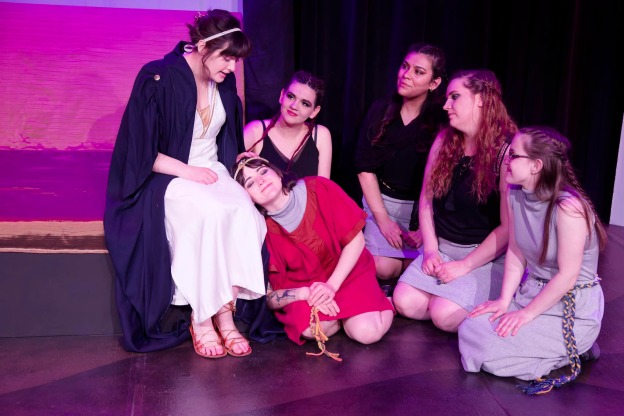
Ensemble in abstract Greek costumes: Penelope sits on the end of a bed, while an actress representing her son rests head on her knee. Four female servants listen.

The Penelopiad, one of Walterdale’s best.

Alora Bowness (Penelope), Stephanie Swensrude (Telemachus), Monica Stewart, Karla Martinez, Sarah Spicer, and Katie Corrigan, in The Penelopiad. Photo Credit: Scott Henderson, Henderson Images

The lights come up on a simple set – a bed on a platform, white hanging panels lit to effect – and a young woman walks toward the audience. Now that I’m dead, I know everything, she says. After this intriguing statement, she goes on to explain that it’s not quite true – like everything else, it’s been simplified in the version we know.

Alora Bowness is Penelope In Walterdale Theatre’s current production of The Penelopiad. She caught my interest from these first lines, and continued throughout the performance, telling and illustrating her story with humility, determination, wry humour, and willingness to acknowledge the consequences of her choices.

But The Penelopiad, adapted by Margaret Atwood from her novella in 2007, doesn’t just examine the story of Penelope, but also of her enslaved maids. The narrative unfolds in short scenes, switching between Penelope telling the story, to ensemble members acting the story, to choral/choric recitation and dance by the maids, or sailors, or even at one point a flock of ducks. The story moves smoothly and with compelling pace, as directed by Kristen M. Finlay, from Penelope’s birth to a naiad mother (Mandy Stewart) and mercurial King Icarius of Sparta (Angela James-Findlay), through her childhood, her marriage to Odysseus (Katy Yachimec-Farries), move to Ithaca, and then what happens to her through the timeframe of Odysseus long journey to Troy and then home, as first told in Homer’s Odyssey.

I had seen the Citadel production of this play in 2013, using 13 talented young artists in that year’s Citadel/Banff Centre Professional Program. The Walterdale production is funnier than I remembered, and in the intimate Walterdale space I felt more engaged with the dangers and challenges of Penelope’s situation. I loved the costumes of the current production (Alodie Larochelle design) – all the maids wearing the same fabrics in grey and black, but in silhouettes that were different for each individual, with braided rope belts in different colours. The songs and poems of Atwood’s script were set to original music, lively or lyrical or haunting as appropriate (Gibson Finlay and Kristen Finlay, composition, Sally Hunt musical director).

Three things about the plot/theme struck me hard this time around. I’ve been thinking about them for days, and I’m planning to return this week for a second viewing, after which I will think about them some more.

  • The relationship between Penelope and Odysseus is shown as nuanced and mostly positive. Classic tropes/assumptions of a girl married off to an older warrior do not hold. It is refreshing to see Odysseus gentle with his new bride and wooing her with stories, and their reunion after the many years of voyaging is equally gentle and consensual. He’s still the product of that particular patriarchal society and family, though.
  • If one focuses on Penelope, it’s a relatively happy story – she overcomes early mortal danger, learns from many mentors and supports, manages the kingdom in Odysseus’ absence, and develops a famous ruse to protect herself from impatient suitors. But Atwood’s script and Finlay’s direction keep reminding the viewer that the story of the maids is just as important. Penelope’s monologue recounting life as an unappreciated girl-child of a royal mixed-marriage is followed immediately by a chorus of maids speaking bluntly to the audience. “We too were children. We too were born to the wrong parents. Poor parents, slave parents, peasant parents, and serf parents; parents who sold us, parents from whom we were stolen.” And the story of the maids is a tragedy. They do what Penelope asks of them – and it has terrible results for them.
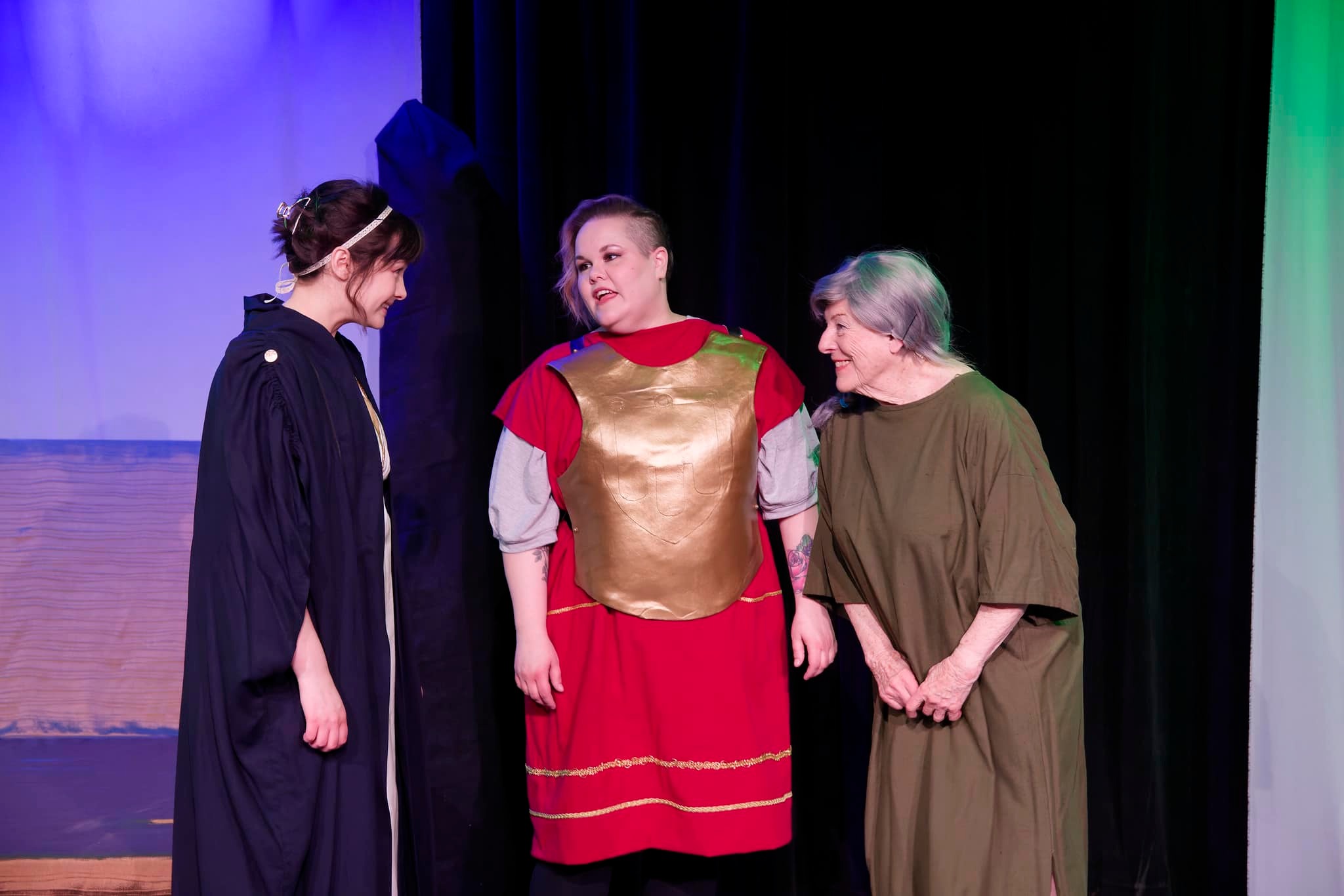
  • Those terrible results are due to some of Penelope’s strategies and choices. She acknowledges her mistakes in monologues from her afterlife. But they are also directly due to the customs and expectations of that patriarchal culture. Odysseus acts to punish them using limited information and an offensive set of assumptions. But he gets that information from his son Telemachus, a young man by then, and from his old nursemaid Eurycleia. Both actors in the Walterdale production were compelling, Stephanie Swensrude as the spoiled boy turned resentful young man and Vivien Bosley as the nurse/governess who petted and encouraged young Odysseus and then spoiled his son, turning him against his mother Penelope. I was reminded of how important it is for any society to raise boys to be compassionate and justice-seeking, and how wrong things can go when this does not happen. Unfortunately, this continues to be a timely and critical reminder. And as we move closer to Mother’s Day, I’m thinking about how the responsibility of setting the next generation on a better path should not just be placed on mothers, but on all of us.

Alora Bowness as Penelope, Katy Yachimec-Ferries as Odysseus, Vivien Bosley as Eurycleia. Photo credit Scott Henderson, Henderson Images.

Thank you, cast and team of The Penelopiad, for making me think. The Penelopiad continues at Walterdale Theatre tonight through Saturday night, with an 8 pm curtain. Tonight, Wednesday, is pay what you can night; tomorrow, Thursday May 11, is limited capacity night, for patrons who would prefer more elbow room for better air quality. Masks are recommended but not required at all performances. Advance tickets are available here; some seats will be available at the door an hour before showtime.