
Tag Archives: solo

Four funny shows!

Rainier Pearl-Styles as Jeff, Nicholas Chieffo as Grundled. Photo credit Rainier Pearl-Styles and Nicholas Chieffo. Jeff & Grundled KNOW FRILLS is at Mile Zero Dance.

The next four performances I saw were all a lot of fun!

Matt & Ben was written by Mindy Kaling and Brenda Withers in 2002, imagining Matt Damon and Ben Affleck before they were famous moviemakers and actors, and it was originally performed by the two female playwrights. Local company Nacho Pals Theatre has cast Melissa Masse as Affleck and Angela James-Findlay as Damon. Their portrayals of the two buddies from South Boston are affectionate and funny. Costuming with backwards ballcaps, body language of bros and best friends, and hints of the canonical accent support the illusion without distracting.

The opening imagines the two of them trying to adapt Salinger’s Catcher in the Rye for the screen, while recounting the unexplained phenomenon of having a brand-new script drop in their laps – a script that has their bylines. The title, Good Will Hunting, is unfamiliar to them, but of course the audience recognizes it as the screenplay that won Damon and Affleck an Academy Award, for the 1997 movie that they also both acted in. Another complication in the characters’ relationship is that Damon is getting callbacks for a theatre role, but trying to hide his success from his friend. I’d read this script years ago and forgotten the details, so I was completely engaged with this performance. Afrah Collier-Potts directed, and it’s playing at Sugar Swing Ballroom.

Blackground is an improv troupe from Atlanta GA, made up of four Black performers, Josh Quinn, Swift Rice, Markis Gallashaw, and Maria (sorry didn’t catch her last name!). Their setup is that they get the audience to suggest and vote on a well-loved movie, then they show us the story of what the Black people were doing in and around the parts we know. Our audience chose Titanic. The Blackground version included Jerome, a character who’s never seen the ocean but wins a ticket in a card game, a high-born woman travelling with her father, some crew members shovelling coal to fuel the steamship (and one whose goal is to make it “steamier”), a preacher and congregation condemning the hubris of the ship-owners’ claims that not even God could sink the ship, Their transitions and tap-outs were very smooth and their show was very funny! At Rapid Fire Exchange.

Jeff & Grundled KNOW FRILLS is a clown two-hander, in which the eponymous characters try to respond to gender role policing in a grocery store. This makes a little more sense than you might think – they’re excited to go to No Frills because it’s cheaper, and then even more excited when No Frills turns into Macho Men’s Market and promises deeper discounts. But of course the performers/creators (Rainier Pearl-Styles and Nicholas Chieffo) bring a lot more nonsense to their problem-solving along the way, using some classic clowning tropes and some inspired commentary on how to be, become, or pass as a ;”real man”. Some bits I appreciated included surprise!juggling (it fit in the story and was very slick), a version of the “performers run through audience” thing, and an absolutely brilliant “audience volunteer” bit that led to everyone in the room who didn’t already know it learning along with the characters how to say motherfucker in ASL. Seriously – I looked up from forming my own fingers into the sign and saw everyone around me doing the same! Jan Henderson directed. Marquesa Dubois and Jenni Stevens provided ASL interpretation.

A Woman’s Guide to Romance Novels is a solo by Holly Brinkman of Vancouver. With a twinkle in her eye, a desk stacked with books, and a few 21st century lecture tools, she invites the audience to celebrate a genre most are already familiar with, creating new excerpts out of her head. She also has guest performers – in the one I saw, it was local burlesque performer LeTabby Lexington. Im also looking forward to seeing Trevor Schmidt’s take on this phenomenon later in the week with Queens of Romance, and I see that Between the Covers is billed as romance-novel-inspired burlesque.
Three solos!

The economics of Fringe festival touring provide motivation to create an entertaining performance with a limited number of team members. And the artistic challenge of keeping an audience engaged for an hour or so on one’s own raises the stakes for solo performers, and leaves the audience more impressed when it works. There are about 82 shows in the Fringe program that list a single cast member. But theyre not all the same!

On the Fringe opening night, I took in three solo performances.

No Die! Or: How I left Amsterdam and Almost Died in Africa – Fedor Ikelaar, Acacia Hall (venue 5) When we were recommending it to others later, I called this Storytelling and a friend called it Stand-up Comedy. I would still classify it as a storytelling performance, but I see why the performer’s natural delivery and responsiveness to the audience might lead to a description as stand-up comedy. Plus, it was funny! After a few comments about being a Dutch visitor in Canada, the performer Fedor Ikelaar launches into a long tale of travel misadventures, contextualized by the hubris of being a straight white man along with the overconfidence of a first-year anthropology student thinking he could fix the world and could make a significant difference in a short volunteer trip. In school he’s learned about the Human Development Index, so he decides to spend his summer in the country which is currently last on the list, Sierra Leone. The title is a spoiler in that he does not die. But he does wander through more misadventures than Mr. Magoo, receives significant support and care from the Sierra Leonean people he thought he was going to help, and uses his outcome an encouragement to travel more.

The Game of Bluff is Susan Jeremy’s narrative about the shuffling characters and lives of herself, her mother (a lifelong poker player), her grandmother (supporting her household as a small-time bookie), and her great grandmother (a numbers runner). The performer embodies each of these characters with distinct voice and mannerisms, and adds clarity by having the speakers address each other by name a lot. Besides the ones mentioned above, there’s her father, her mothers poker cronies, a fortune-teller, and others. It was interesting to see how she wove the thread of gambling through the multiple generations of the family, with many of them benefiting from the industry and one addict – not a viewpoint I’d seen before. Walterdale Theatre, venue 3.

Solovela was my first improv show of the festival. Diane Jorge from Miami had the half-full room in Acacia Hall laughing right from the start of her midnight performance, creating a telenovela (Latino-style soap opera) from a few questions she asked some (consenting) audience members, and some props she used to signal a shift between characters. She embraced some tropes of the genre such as having the audience recite the name of the story at commercial breaks (one of which was actually a short pitch by an artist in the audience for his own show), and showing a romantic focus on one character by having them stand over a fan blowing their hair around. There was romance, there was suspense, there was a fight (in which she performed both combatants), there was justice and happy endings. Jorge seemed relaxed and comfortable and she was very funny, from her self-deprecating asides to her characters’ physicality.

I had forgotten that it was handy to have cash on hand to donate to touring performers in exchange for show merch. All three performers had mementoes available and I wanted to support all of them. Good thing there are bank machines on the grounds!

Andrew MacDonald-Smith Fully Commits!

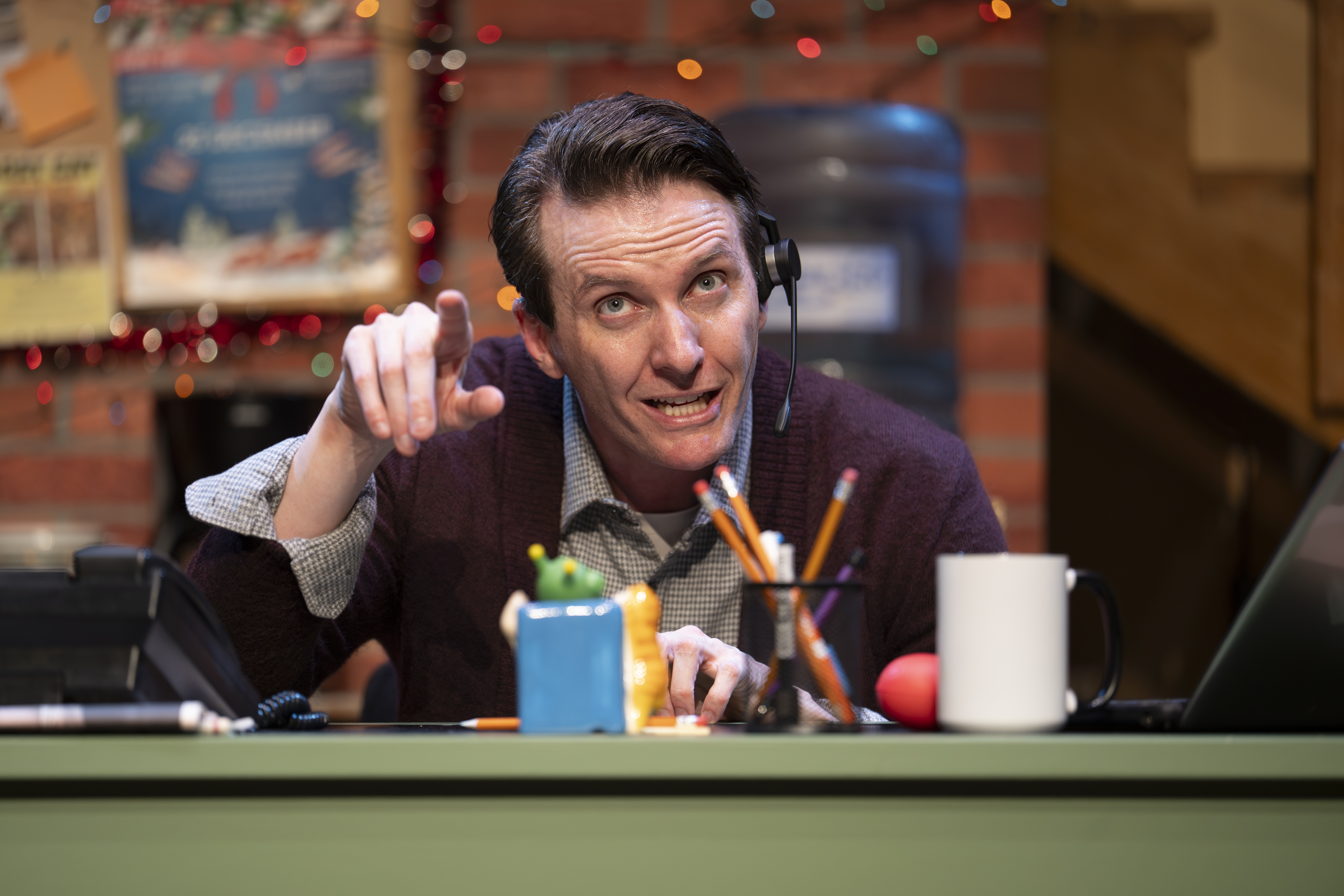
Andrew MacDonald-Smith on the phone in Fully Committed. Set Chantel Fortin, Lighting Skye Grinde.
Photography Mark J Chalifoux.

Fully Committed is the solo comedy by Becky Mode currently playing in a Teatro Live! production at the Varscona Theatre, directed by Farren Timoteo.

Andrew MacDonald-Smith plays Sam, the overworked reservation-booker at an exclusive Manhattan restaurant. The 90-minute performance covers one long December shift. Sam arrives late morning to ringing phones and crises in progress. His colleague hasn’t shown up for work, he pesters the kitchen for a staff meal, the chef and the maître d’ are refusing to take calls, he’s hoping for a callback on a theatre audition, his recently-widowed father is pressuring him to come home to Indiana for Christmas … and patrons keep calling and calling and calling, hoping for bookings, asking for changes, and complaining. The whole play is Sam on the phones – but Andrew MacDonald-Smith also plays everyone he talks to on the phone. With shifts in body and voice and accent, he creates the other side of every conversation, dozens of different characters.

Fully Committed is like an epistolary novel, or a media-fic told in text messages and Facebook chats. At first each little conversation just seems like an illustration of how Sam can’t get a moment to breathe, between the intercom with the host stand and kitchen, the hotline to the chef’s office, the headset he takes reservation calls on, and his personal cell. But like the best epistolary novels, the plot builds up from the individual calls, and many of the individuals call back. On opening night, the Varscona audience started out quiet, but then began to laugh more as they recognized some of the frequent callers.

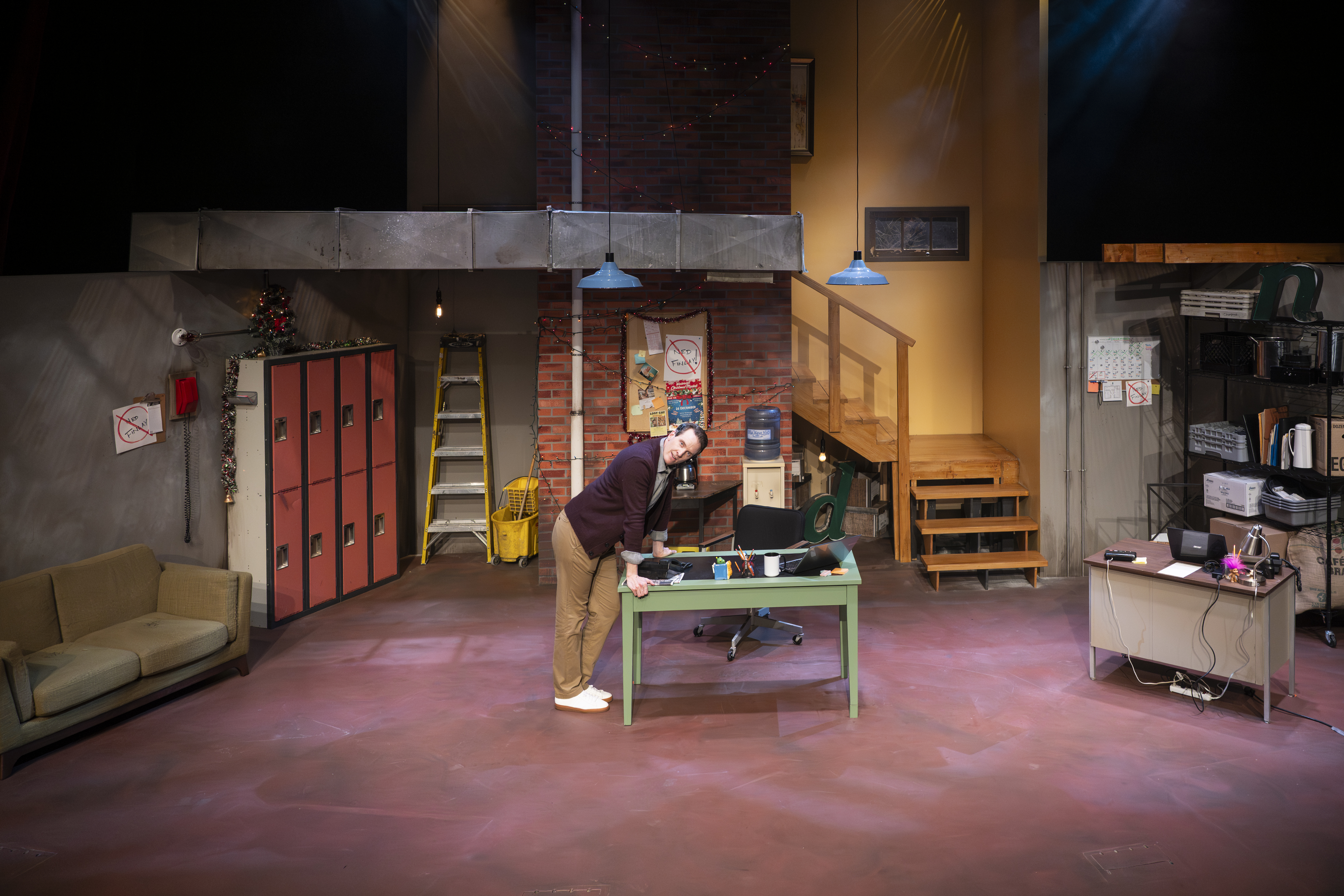
Andrew MacDonald-Smith in Fully Committed. Set Chantel Fortin, Lighting Skye Grinde.
Photography Mark J Chalifoux.

The set design, by Chantel Fortin, was brilliant. She took advantage of the high ceilings in the Varscona to create the impression of a crowded low-ceilinged basement room, with a staircase ascending at upstage centre, heating ducts over the main workspace, and ceiling beams off to the side reminiscent of those used in Autumn, as well as lots of appropriate clutter on shelving and desks. Sam uses the whole playing space energetically, with help from a wheeled office chair, even running up the stairs with a mop bucket to deal with an issue nobody else will tackle. Lighting design by Skye Grinde ensures that the office feels like a too-small too-full basement, but it is never too dark for the audience to get a sense of Sam’s environment and to see all the characters he talks to on the phone.

I saw a production of Fully Committed at Central Alberta Theatre (Red Deer) in 2022, with Ash Mercia playing the title role. So I wasn’t surprised by the character or the storyline. But Andrew MacDonald-Smith is a great fit as Sam, competent but underappreciated at this job while struggling with the rest of his life, and hilarious when he shifts to the other larger-than-life characters, from Chef and Jean-Claude the maître d’ to patrons like Carol Ann Rosenstein-Fishburn, Bryce the assistant to Gwynyth Paltrow, and the one who keeps reminding him that she’s a Senior Citizen. Interestingly, while I was engaged with watching Sam struggle to satisfy any of the people ringing him on multiple lines spread out around the stage, I forgot that the actor is tall, because Sam is so weighed down all day.

The performance runs just under 90 minutes. Resolution of many of the plot threads happens in satisfying ways that aren’t telegraphed ahead of time, but it’s still a slice-of-life reminder of the back-of-house lives unseen behind a pretentious and successful establishment. It’s very funny and it’s charming, a portfolio of ridiculousness for MacDonald-Smith and a tongue-in-cheek skewering of foodie culture, a good fit for the Teatro Live! season.

Fully Committed runs until June 21st, and it’s not fully committed (not sold out)! You can get tickets here.

The S.P.O.T.T.

Photo: Stage lit in dim blue light is covered with a big garbage can and a lot of scattered garbage.

The S.P.O.T.T. is the title of Meegan Sweet’s solo show at Sugar Swing upstairs. It’s also the aspirational title of Meegan Sweet’s character in the show, a raccoon who aspires to be the Shiniest Piece Of Trailer Trash anywhere. The playful, endearing, and sometimes crude narrator explains to the audience that their overall aspiration is to be reincarnated as a yooman bean (human being). There is a lot of entertaining audience engagement and a lot of clever use of the prop garbage on the stage, while the character works on the steps needed to reincarnate as human – learn all the skills of being human, arrange to die, get divine help. The raccoon’s gender was not indicated and that didn’t seem relevant.

On the night I went, the audience was totally sympathetic to the character, whose balance of adorable and confrontational was just right.

And then — some of the narrative breadcrumbs dropped earlier fell into place, an opportunity for reincarnation occurred (with a few gruesome effects), and the transformation of the raccoon into a strongly-gendered human left me painfully aware of some of the ways that being human is not all it’s cracked up to be. The raccoon’s opening monologue landed very differently when delivered by the incarnation on stage at the end. Which was brilliant. Meegan Sweet uses they/them pronouns, and their two portrayals have had me thinking about some consequences of gender in human society ever since.

That’s all I watched yesterday – oh, that and Late Night Cabaret, which is now on a break til Wednesday except for a promised takeover/visit to Vivianna Vardot’s Sex Party variety show at Rapid Fire on Tuesday night. Today, Monday, Regression has a dark day so I’m volunteering and then watching four shows on the main festival site. I’m packing a sunhat and a water bottle for my Glass of the Sask!

Liminality

Liminality is a solo performance by Dr. Steven Andrews, at the Grindstone Studio,a small well-appointed space underneath the Mill Creek Cafe (82 Avenue and 96 Street), entrance from 82nd Ave. (Same building as Sewing Machine Factory.) I last saw Steven Andrews in Kristine Nutting’s site-specific performance Devour Content Here in 2015.

I loved it and I don’t know why.

It’s a simple solo storytelling performance. I started to write that I hadn’t seen anything in this genre for ages, but then I realized that I’d seen quite a few solo shows online and in person since covid made close contacts and cohorts complicated – from We Had A Girl Before You, the last live indoor show I saw in 2020, to Woman Caught Unaware, which is playing at the Varscona Theatre this Fringe, and Deafy, Chris Dodd’s solo at the Backstage space. So why was this different?

Maybe what entranced me about Liminality was that it was so close to failing. The creator/performer was vulnerable, not just in telling anecdotes that purport to be about himself and his personal limitations and fears, but in performing them for paying audiences who might be expecting something more polished, funnier, or more conventionally structured with tidy connections that all fit together at the end. I kept doing the work of looking for the throughline and the callbacks. I found some but never was sure why some of the stories were included. There were a few important props and set pieces, and some sound and lighting cues helped reinforce the beats – possibly suggesting some insight or conclusion that might be drawn.

But like I said, I loved it. You might not.

Two more performances, Saturday and Sunday – and Liminality is also available online, pay what you will.

Pink Unicorn, and other samples of diversity

I loved The Pink Unicorn.  I loved its narrator Trisha (Louise Lambert), a widowed mother in a small Texas town.  And I loved seeing how I misjudged Trisha, first seeing her tailored floral outfit, big hair,  and fussy mannerisms and hearing her Texas accent, and assuming that she would be overly concerned with appearances, tradition, and approval of authority.

I was wrong!  The more I got to know about Trisha, the more I respected her and enjoyed listening to her.  Because not only did she start out with a more complex background, she grew and changed over the course of the events she recounts, starting when her daughter Jolene tells her that she wants to start high school as Jo, a person without gender, genderqueer and pansexual.  The playwright Elise Forier Edie has been very clever in creating a protagonist who is uninformed to start with but eager to learn about concepts of gender in order to understand her child.  So Trisha reports that she began to research on Wikipedia, and at first you can hear the air quotes around every phrase that comes out of her mouth, “androgyne” “LGBTQ” and “gender continuum”.   At first she doesn’t see the point of it, just gamely goes on with supporting Jo because she’s always wanted her to be able to be herself.  The audience can feel a little superior because Trisha is bewildered, but the script gives the audience lots of information along the way and brings everyone up to speed on vocabulary and concepts.  And sometimes this is very funny.  Her description of the gender continuum first has Charles Bronson at one end and Marilyn Monroe at the other, herself close to the Marilyn end and Jo somewhere in the middle, but when she explains it to someone else later in the story, she starts at the hypermasculine end with Charles Bronson, then she adds Clint Eastwood, then Hilary Clinton, then a big gap before Brad Pitt.

The performance has Trisha aware of an audience, telling the story to outsiders like us and addressing us directly.   Her occasional bad language and vulgarity is startling and delightful, because we know that she doesn’t usually use it to other people.  And when she expresses some unkind thoughts and reveals prejudices, it matters.  She knows she shouldn’t be saying mean things about fat people, lesbians, or disabled people, and she isn’t doing it to get a laugh – she just needs to admit those thoughts because her mis-judgements matter to the story.

As Jo and her friends encounter resistance to forming a Gay-Straight Alliance at school, Trisha finds herself drawn into their fight and discovers unexpected allies of her own.  I especially loved the matter-of-fact part about her alcoholic brother – the script had no glib attempt to explain his alcoholism and bad choices with past-trauma tropes, and Trisha discovers that he can still offer her meaningful support despite his sickness.   Trisha’s Biblical interpretations and Jo’s speeches about freedom and diversity are useful background for anyone who needs to argue in support of Gay-Straight Alliances or other support for diverse genders and sexualities.

Trevor Schmidt directed the play and is also credited with designing the playful pink and peach set and costume.   In the show I attended, the performer had the best line-prompt call I’ve ever seen, staying completely in character and improvising a reaction to the prompt that had the audience laughing and on her side.

The Pink Unicorn is playing until February 28th at the PCL Studio at the Arts Barns.  It is an impressive solo performance of a good script, it is a story of contemporary queer lives that has a happy ending, it is a celebration of family love and personal growth that are not in contradiction, it is enjoyable for people who are familiar with LGBTQ issues and those who are not, and it is a valuable discussion-starter that has had me thinking ever since.   Tickets are through Fringe Theatre Adventures.  If you live far enough from Edmonton that you can’t see this show and you wish you could, you can buy an electronic copy of the script here.  You can arrange performance rights through the author, whose contact information is on the same publisher’s page.