Where You Are – family frictions and affection

Coralie Cairns as Suzanne, in Where You Are. Set and lights, Daniel vanHeyst. Costumes, Leona Brausen. Photo Marc Chalifoux.

I had read Kristen Da Silva’s play Where You Are a while ago. I couldn’t remember the details, just the tensions and affections between two sisters, Glenda and Suzanne, who live together on Manitoulin Island.

In the Shadow Theatre production that opened last night at Varscona Theatre, Davina Stewart plays restrained responsible Glenda, and Coralie Cairns plays Suzanne. With help from costume designer Leona Brausen, we see immediately that Suzanne is the kind of woman who gets up in the morning with last night’s mascara all over her face and a heavy-metal t-shirt along with her pajama pants, and Glenda is someone who always protects her skin with a sunhat and matches her purse to her shoes. The by-play between the sisters shows ongoing disagreements and old troubles but also a core of caring. Suzanne can’t talk to her grown daughter Beth without starting a fight – Glenda recommends that when Beth (Nikki Hulowski) arrives for a visit, Suzanne should just whistle instead of saying anything. We can also see hints of some other unspoken troubles – not overdramatic foreshadowing, but topics that the sisters have agreed not to address. Cairns and Stewart are brilliant together, hilarious in the superficial irritations of shared life while awkward in compassion.

Glenda and Suzanne’s neighbour Patrick (Brennan Campbell) drops in with a mis-delivered newspaper. Both sisters enjoy visiting with the handsome young man – Suzanne also takes the chance to talk him into fixing their shed roof. One of the funniest moments in the whole play concerns the roofing chore, and how Patrick responds to the heat, thinking himself alone.

As I said, I’d forgotten the plot details. After working on Mark Crawford’s comedy Stag and Doe for the last few months, I was laughing out loud hearing Patrick’s left-at-the-altar story and watching him make plans to attend his ex’s wedding.

It was easy to empathize with Beth, an only child frustrated by her mother’s and aunt’s well-meaning snoopiness into not telling them anything. As the play progresses, we also see them keeping secrets from her, all of which eventually come out. I was genuinely moved watching the comedic and defensive characters manage to connect with each other in the end. It felt very real. The script’s treatment of spirituality and religion was delicate and not ridiculous.

I also loved the specific reminders of Manitoulin Island, a beautiful part of Northern Ontario – the hawberry jelly priced higher for tourists, the “bicoastal” relationship one of the neighbours has with a woman from Espanola on the mainland, the way that missing the swing bridge timing can change destiny “like the Island wanted to keep me”. And the mention of a specific Toronto hospital cued me into the nature and severity of one character’s illness, due to memories of a family member spending time there long ago. None of this context is necessary to understand and enjoy the play; it just provided extra richness to my experience.

I couldn’t remember the title of the play beforehand, but now I understand it. Home is where you are, one character tells another.

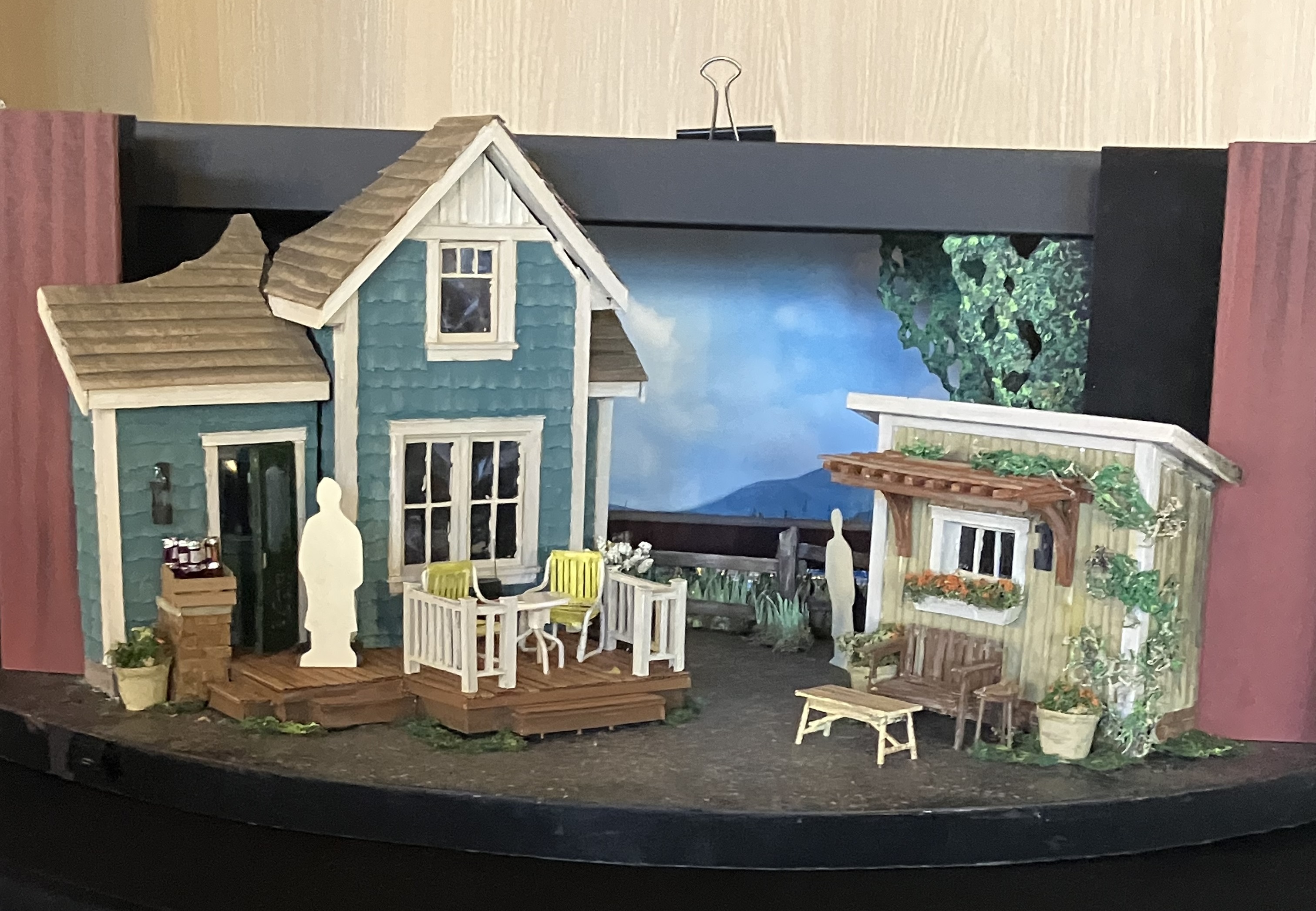
Daniel vanHeyst’s set model for Where You Are, on display in theatre lobby.

Set and lighting design are by Daniel vanHeyst. His typical attention to detail includes weathered shakes on the walls of the house, the rotating vent-stop bar at the bottom of the wooden storm windows, and lighting changes across fields throughout the day and night shown on a cyclorama. Darrin Hagen’s sound design includes many bits of original but almost-recognizable music.

Where You Are, directed by John Hudson with Lana Michelle Hughes as assistant director, is playing at Varscona Theatre until May 18th. Tickets are available here.

Intrigued by my mention earlier of Mark Crawford’s Stag and Doe? It’s playing at Walterdale Theatre until May 3 (tomorrow) with tickets here.

Radiant Vermin, hilarious and uncomfortable

Rain Matkin and Eli Yaschuk as Jill and Ollie, and Holly Turner as Miss Dee, in Radiant Vermin. Photo by Brianne Jang, BB Collective Photography.

Northern Light Theatre’s theme for their 2024-2025 season was Making a Monster. The first two plays were Trevor Schmidt’s Monstress (a gothic horror in which a Frankenstein-like scientist attempts to reanimate a dead girl but gradually appears to be more monstrous herself) and Penelope Skinner’s Angry Alan, a disturbingly-realistic portrayal of a lonely man drawn into the “men’s rights” misogynistic culture with horrifying consequences.

I was apprehensive but intrigued, to find out how the third play in the season, Philip Ridley’s Radiant Vermin, would fit into this theme. I had some guesses, but they were all wrong. And I loved being surprised. What surprised me most was that it was funny. Very funny.

An exceedingly wholesome-looking young couple, Jill and Ollie (Rain Matkin and Eli Yaschuk), address the audience with their baby, to explain about how they got their dream home and what happened there. When Jill was pregnant, they were living in a dingy flat in a crime-ridden neighbourhood, dreaming of better things for themselves and their little one. Until they get a mysterious letter and an even more mysterious visitor, Miss Dee (Holly Turner), who tells them they’ve been selected by a government department to get a free house. It’s a fixer-upper, but by renovating it they’ll start turning things around for the whole neighbourhood, and everyone will benefit. They see the house and ask about details, and a mythologically-long contract tumbles out of Miss Dee’s handbag. Everything about this screams BAD IDEA to me, from the twinkle in Miss Dee’s eye to the long golden scroll of clauses on the contract, but as soon as they sign, movers are dispatched to their old home and they move in, even before the electricity or hot water are working.

Ollie starts out confident that he can DIY the necessary renovations, but heavily-pregnant Jill is impatient. They’re both unsettled by living in an un-gentrified area. If they can see campfires of homeless people from their bare windows, can the homeless people see their vulnerable candles? Jill explains to us that she has experience of helping her mother provide charity to homeless people – that she and Ollie are good people. But they are still fearful of being targets in their good fortune. Her othering language is a little disturbing, but very familiar. But when an accident happens to a vagrant on their property, they benefit in an unexpected way. And they begin to justify it – their gain helps the neighbourhood, and nobody who mattered was hurt. By this time the characters are fully drawn – Jill’s earnestness and obliviousness, Ollie’s awkwardness and willingness to please his wife – and I felt almost complicit as they wonder about what else they could benefit from. The script builds this complicity in some direct address to the audience on benign topics, such as inviting input on whether to renovate the bathroom or the garage first.

Rain Matkin and Eli Yaschuk as Jill and Ollie, reading the letter offering them a house. Photo by Brianne Jang, BB Collective Photography.

Jill and Ollie’s house gradually gets renovated, according to the wish-list that Jill collects from magazines and catalogues. Upwardly-mobile neighbours gradually move in to the cul-de-sac, and we hear that ground’s been broken for the Never-Enough shopping mall nearby. Once all the houses are occupied, Jill and Ollie throw a garden party to mark their little son’s first birthday, with all the neighbours in attendance – and their facade of contentment and competence begins to fray, in a hilarious recounting.

I was thinking, this can’t end well. But I didn’t predict how!

The empty set (Schmidt) has a nearly-flat backdrop of a white-on-white house outline, with some harshly-shadowing sidelights. Its cleverness isn’t apparent until the show lighting (Larissa Poho) and projections (Matt Schuurman) begin to enhance it. I was fascinated about how the simple “porch” framing was used, along with shifts in light and soundscape (Chris Scott), to represent stepping from an upstairs bedroom into a staircase leading to potential danger.

The script of Radiant Vermin does have some important messages/themes, about envy and about buying in to materialistic wanting-more and about dehumanizing the have-nots, but the messages land with bouffon-esque discomfort at our own complicity. Schmidt’s production is perfectly cast. Holly Turner, most memorable as the eponymous Mary in The Testament of Mary, is hypnotically fascinating here, as the character Miss Dee needs to be, and Matkin and Yaschuk are well-matched, allowing some outrageous events to be natural character choices.

This was one of Northern Light Theatre’s most successful thematic season groupings in my memory, partly because the plays were so different. Each illuminated some facet of the question of how ordinary humans can do evil things. Each left me uncomfortable and wanting to discuss my experience with others. And each made me grateful for the community of theatregoers with whom I can share, both the roomful of audience members laughing and sighing and gasping in the moment, and the ongoing conversations like this.

Before today’s matinee, Trevor Schmidt is hosting a Director’s Circle at 1 pm. At these events, he typically discusses the motivation for choosing the play and some of the design challenges, without giving away anything about the ending. And on Thursday there’s a moderated talkback after the show – more opportunities to join in the conversation.

Trevor Schmidt and Holly Turner in a candid moment at the opening-night reception for Radiant Vermin.

Radiant Vermin continues at the Arts Barns Studio until May 3, with tickets here. Be disturbed and be delighted!

Jupiter – a Colleen Murphy premiere

Ellie Heath, Brian Dooley, and Monk Northey in Colleen Murphy’s Jupiter, at Theatre Network. Set and costume design Tessa Stamp, lighting design Larissa Poho. Photo by Ian Jackson.

In comparison to Colleen Murphy’s other work that I’m familiar with, Jupiter has a happy ending. That is, not everyone is dead, and the ones who are not dead are at least speaking to each other.

Unlike in Bright Burning (published title I hope my heart burns first) or in The Society for the Destitute Presents Titus Bouffonius, or the offstage massacre that drives The December Man, the deaths discussed in Jupiter are spread over a period of more than 50 years, counting things that happened before the play started. Is it still more than one family’s share of problems and tragedies and bad luck? Maybe.

Bradley Moss directs the world premiere of Jupiter, in Theatre Network’s mainstage Nancy Power Theatre at the Roxy. The human cast is all familiar to Edmonton theatregoers: Brian Dooley, Cathy Derkach, Ellie Heath, Gabe Richardson, and Dayna Lea Hoffmann. The newcomer is Monk Northey, a large, beautiful, and well-behaved Field Retriever playing the part of family dog Axel.

There are scenes in three eras, all set in the family’s small house. The set design (Tessa Stamp) is very clever. It feels like peeking in to a private space, glimpsing the kitchen, front hall, and bedroom-hallway behind the main playing space of the small living room. The dialogue and movements were so specific that I felt like I could picture the back door and backyard and basement stairs as well. We can almost feel the sticky-oppressive heat that ramps up the frustrations.

Ellie Heath plays Emma, the daughter of Violet and Winston. She’s 16 in the first era, bursting with enthusiasm for doing science experiments and dreaming of going to med school in the big city. “Why do I have to have such weird kids?” grumbles slaughterhouse-worker dad Dooley. Seeing hints of how her life might unfold, and then seeing her 15 years later and 20 years after that was especially poignant. I’ve often seen Heath play young characters – she was Alice in the Citadel’s Through the Looking Glass, a young girl in the production of Closer directed by Keltie Brown Forsyth, a sulky teenager in Shadow’s production of Queen Lear, and a precocious teenager in one of the Die-Nasty soap-opera seasons last year. Heath’s shift from teenage-Emma to her older self, dealing with the consequences of the night of her brother’s 21st birthday, was impressive, with credible changes in voice and body language.

Violet (Derkach), Toby (Richardson), and Ava (Hoffmann) round out the family constellation, along with various pets onstage and off. Tensions are hinted at, awful things happen. Family members try to cope in the short term, and are permanently affected, as seen in the futures.

If you are a person who wants to be warned about whether specific awful things might happen or be discussed in a play, you should always ask beforehand about a Colleen Murphy play. If you would prefer watching the characters and trying to guess where the story might be going, having that chest-clenching top-of-the-roller-coaster moment of horror and “Are they actually going there?”, then don’t get spoilers. Colleen Murphy sometimes does go there. Different audience members will find different parts disturbing. And I’m not heartless and unmoved; I’m trying to preserve the surprises for people who want them.

Jupiter plays at the Roxy until April 20th, with tickets available here.

Lives around an artist – After Mourning – Before Van Gogh

Andrew Ritchie as Vincent Van Gogh in After Mourning – Before Van Gogh. Set and light design Ami Farrow, costumes Leona Brausen. Photo Marc J Chalifoux.

If I’d been asked to do a mind-map of what I knew about Vincent Van Gogh, I would have mentioned sunflowers and madness, Starry Night, Starry Starry Night, losing his ear, eating paint, self-portraits, suicide, and not getting recognition while he was alive. I’d remember looking at the outside of the Van Gogh museum on my short visit to Amsterdam and deciding that after exploring the Rijksmuseum all morning I needed lunch more than another gallery. And I’d thank Erin Hutchison for reminding me of a couple of those in the script of her musical Regression, from last summer’s Fringe, in which Tom Blazejewicz played the spirit of Van Gogh.

Calgary playwright Michael Czuba’s After Mourning – Before Van Gogh includes the artist Vincent Van Gogh (Andrew Ritchie) as a character, but focuses more on the family members who support him, especially his brother Theo (Steven Greenfield) and his sister-in-law Joanna Bonger (Lora Brovold and Donna-Leny Hansen).

The action unfolds in a non-linear way. At first, it was very disjointed, resonating with both Theo’s and Vincent’s struggles with mental illness. Projections by Matt Schuurman convey the characters being surrounded by Vincent’s paintings, in their home and in their minds.

Vincent’s sister-in-law Joanna is portrayed by two actors, Lora Brovold and Donna-Leny Hansen. Vincent’s brother Theo had struggled to set up gallery placements and viewings for Vincent’s paintings, but after both of them die young, Joanna inherits the challenge, along with inheriting Vincent’s work in trust for her young son Vincent Willem.

Donna-Leny Hansen and Lor Brovold in After Mourning – Before Van Gogh. Set and light designAmi Farrow, costumes Leona Brausen. Photo Marc J Chalifoux.

The use of two performers to show Johanna’s narrative arc was fascinating. Brovold and Hansen have a strong resemblance, enhanced by similar body language, and their portrayal of a passionate and determined woman of another era is thoroughly satisfying.

The split wasn’t as simple as, the older portrayal is completely recollective and the younger one is active, either. Brovold’s Johanna engages with her now-grown son Vincent Willem (Andrew Ritchie), by turns protective and petulant, and is shown making decisions of how to translate and market Vincent’s letters, and which paintings to sell where. She also reminisces, talks to her deceased husband Theo, and shifts into and out of overlapping scenes with her younger self. The younger Joanna of Hansen also has her share of recollections, as her first husband Theo becomes ill soon after their marriage. While honouring his memory and Vincent’s she must raise her young son alone, support her household financially, and act as Vincent’s artistic executor to find him the recognition he deserves. The script shows her brother Dries (Fatmi Yassine El Fassi El Fihri) urging her to accept their father’s invitation to move in and be cared for – but she chooses to move to a town where she can open a boarding-house for artists.

One of the most visually-effective moments is when the grieving widow plunges a white garment into a washtub, dying her clothes black for mourning. Another effective detail is the way the older Joanna hides her arthritis-cramped hands in her shawl after a session of translation work.

But, as in the title of the play, there is more to Joanna’s character than either mourning or making Van Gogh famous. At one point she muses about all the other things she could have accomplished – she could have worked for women’s rights, advocated for women’s health – and it did not feel anachronistic, but consistent with the determined woman we saw. She is also explicit about Theo not being the only/last love of her life – even though it makes her son uncomfortable, she reminisces about her relationship with second husband Johan (El Fassi El Fihri), and about other men she’d been with in between.

I was enjoying watching the performance – at one specific point I was so captivated by the beautiful projections that I forgot there were actors on stage – but for a time I thought I wasn’t seeing enough narrative arc to recognize what would be a satisfying ending. Yet I was wrong – I’d seen the threads leading to resolution wound through the other scenes, and the ending worked for me.

After Mourning – Before Van Gogh has two co-directors, John Hudson and Lana Michelle Hughes. This production is its premiere. It runs until April 6th, and tickets are available here.

Quick takes on short runs – Keith Alessi and MacEwan

Keith Alessi, in Tomatoes Tried to Kill Me But Banjos Saved My Life

First, the one that you still have chances to see! Keith Alessi’s solo Tomatoes Tried To Kill Me But Banjos Saved My Life is playing this weekend at Gateway Theatre, as an extra to Workshop West’s subscription season. There are performances tonight (Friday night), Saturday night, and Sunday afternoon at 1:30. It looks like the Saturday show is sold out, so act quickly if you want to grab tickets to one of the others.

I’ve heard lots of solo memoir pieces, and this was one of the best. The performer/creator, Keith Alessi, is humble and authentic, with a ready store of banjo jokes to cover any time he spends re-tuning his instruments. Yes, instruments, plural. There are several on stage at top of show, but more are brought in later. His story and delivery are compelling, with more laughter than tears. Erika Conway is credited as director and producer, and is responsible for the dramaturgy that shaped the story and focused the message. Gateway Theatre, the blackbox venue home to Workshop West, is a great choice for acoustic music and storytelling with an intimate supportive audience.

A shorter version of this show appeared at Edmonton Fringe in 2018 and 2019 – I didn’t see it then so I can’t tell you how it’s been improved. But this version has an intermission, and afterwards Keith is joined on stage by Bruce Ziff (retired U of A law professor and not-retired banjo player), since as Keith explains banjo history, it lends itself to playing in jams and circles, to community and to people playing together, whatever their experience/skill levels. A timely reminder!

Tickets are $25 – and all the proceeds of the tour are divided between arts organizations and cancer charities. At this stop, the beneficiaries are Workshop West Playwrights’ Theatre (with its mandate of nurturing new Canadan plays/playwrights), and Wellspring, the set of supports for patients, survivors, and families affected by cancer. Remaining tickets are here.


Last weekend I caught another short-run show, and ever since I’ve been running into people talking about it. “Did you see Natasha, Pierre, and the Great Comet of 1812 at MacEwan?” “Wasn’t that GOOD?”

This large-scale musical by Dave Molloy hit Broadway in 2016 and won some Tony awards then. It hadn’t been done in western Canada before this production with Jim Guedo directing students in the Musical Theatre program at MacEwan University. The story comes from a segment of the Tolstoy novel War and Peace. I loved how the script acknowledges the challenges of following a large sweeping novel, with the prologue song addressing the audience, telling us to follow in the program and then introducing each character with a repeated catchphrase “Natasha is young, Sonya is good, Andrey isn’t here” and so on. I was reminded of other large-cast novels / operas / musicals where I could have used this kind of acknowledgement and clues – Les Miserables, two versions of Eugene Onegin, a lot of Shakespeare …

Set design (Daniela Masellis) and direction (Guedo) have the audience seated on two sides of a raised alley stage in the Tim Ryan Lab black-box – but the actors are not contained on that stage, or on its extensions to accommodate musicians – they use all the lobby entrances, they swish or strut or slink between cabaret tables and engage with audience members, they carry stools around the audience area and stand on them … I felt immersed in this world of 19th-century Moscow.

Lead roles are played by Lisa Kotelniski (Natasha), Matthew Gregg (Pierre), and Liam Lorrain (Anatole), with Layne Labbé a standout as Hélène in an ensemble of 14 student-performers.

I was particularly impressed by the handling of sound mixing and amplification. With fourteen singers moving around the room, including some playing instruments, and eight additional musicians located at two ends of the stage, I was always able to hear and comprehend the lyrics of the songs. Sound designer Dave Bowden and audio lead / live mix operator Alex Delaney are to be commended.

The last production in MacEwan’s mainstage series is The Prom. It plays the last weekend of March, with tickets available here.

King of the Yees

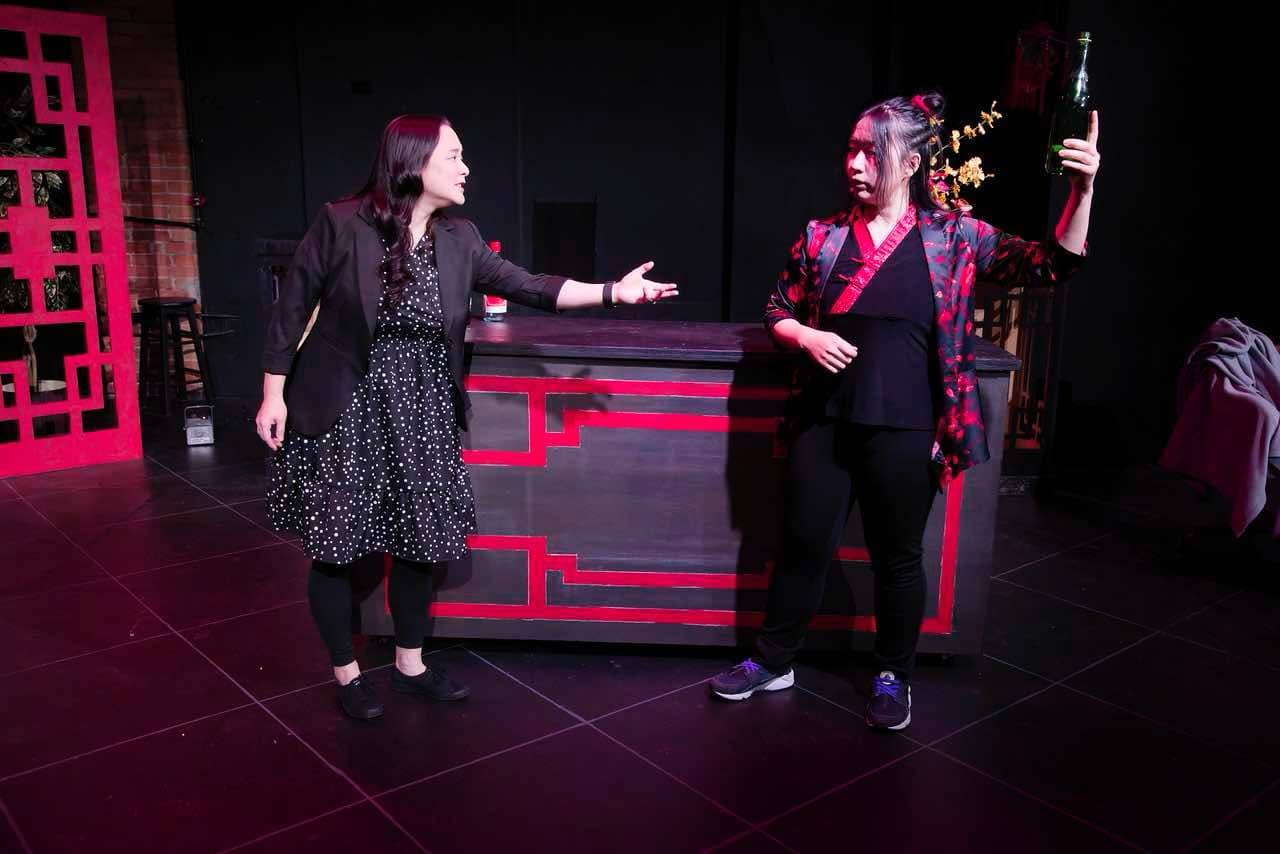
Ruth Wong-Miller and Grace Li in Walterdale Theatre’s King of the Yees, haggling as Lauren and Whiskey Seller. Photography by Scott Henderson, Henderson Images. Costumes Karin Lauderdale, Set Leland Stelck, Lighting Rebecca Cave.

I haven’t been involved with working on the latest Walterdale Theatre production, King of the Yees, so I had the fun of seeing it for the first time on opening weekend, along with a delighted audience. Barbara Mah, Walterdale’s current artistic director, directed Chinese-American playwright Lauren Yee’s somewhat-autobiographical play, with a talented cast and team of local artists.

King of the Yees is partly a familiar story about a father and daughter – a father (Stanley Woo of Apocalypse Kow) who is immersed in the clannish culture of San Francisco’s Chinatown and the Yee Family Association that he manages, and a playwright daughter (Ruth Wong-Miller of Foote in the Door and other musical theatre) who has moved on, moved away, and lost connection with her parents and their culture. I found the frustrated banter between them very funny, and also poignantly relatable, and unexpectedly moving.

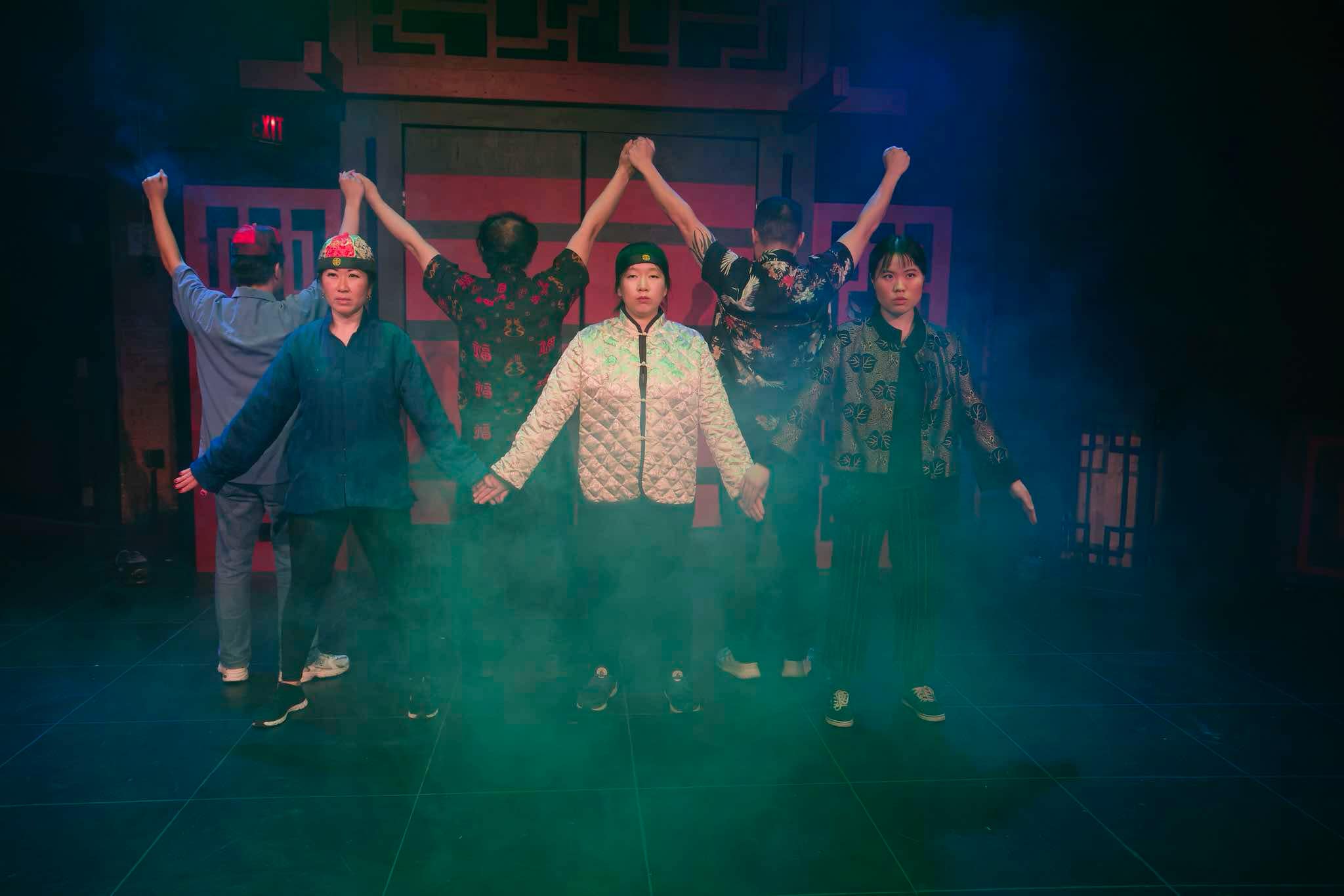
Mah’s production, and the script, also contain fantastical elements which are fun to watch and listen to, as well as bitingly-sarcastic riffs on assumptions about Asian actors by a couple of performers playing actors who have been hired to read the playwright’s work-in-progress (Kingsley Leung and Helen Massini). This is not quite as confusing as it sounds! Visual/audible spectacles include a lion dance (handlers Massini, Grace Li, Ivy Poon, Rupert Gomez) led by a Buddha Boy (Tsz Him Hymns Chu), an Erhu player (Poon), a troupe of elders doing tai chi, a flamboyant Model Ancestor (stage manager Tim Lo), and a Szechuan face changer (Massini). The beautiful set and costumes were designed by Leland Stelck and Karin Lauderdale and implemented by skilled teams of painters, stitchers, and builders.

Ensemble members Rupert Gomez, Helen Massini, Andrew Kwan, Grace Li, Kingsley Leung, and Ivy Poon form a mysterious wall, in King of the Yees. Photo Scott Henderson, Henderson Images. Set Leland Stelck, costumes Karin Lauderdale, lights Rebecca Cave.

The digital program contains some helpful and interesting contextual information that is worth reading for extra enjoyment. Some performances of King of the Yees are sold out on line, with a few tickets held back for door sales. The run continues until next Saturday, February 15th, and advance tickets are here.

There’s so much else on this weekend, too! Plan ahead!

  • Bea, at Shadow Theatre, closes Sunday
  • Angry Alan, at Northern Light Theatre, closes Saturday (tomorrow!)
  • After the Trojan Women, by Amena Shehab & Joanna Blundell, is at Backstage Theatre
  • The Citadel has Frozen and Does This Taste Funny?
  • U Alberta Studio Theatre has [Blank], by Alice Birch
  • Die-Nasty, the long-running improv soap opera on Monday nights at Varscona, is free on Feb 10th.
  • An Oak Tree, at the Aviary, produced by Theatre Yes
  • Script Salon, Sunday Feb 9th, has a reading of Linda Celentano’s Giorgi of the Jungle.

And next weekend there’s even more, all with short runs!

  • The Effect, by Lucy Prebble, at the Arts Barns Studio,
  • The Spinsters (Bigger and Badder) is in the Westbury
  • MacEwan University’s musical theatre program has Natasha, Pierre, and the Great Comet of 1812
  • The first PepperMUNT Cabaret, a production of Jake Tkaczyk’s new company MUNT Performance Association, will be at the Gateway Theatre on Saturday February 15th, at 10:30 pm – giving you enough time to see one of the shows in the above lists first! Trevor Schmidt and Mark Meer are hosting, with an assortment of talented guests, and tickets are here.

I’m not going to be able to see all of these, because I’m also busy working on Walterdale’s next show, Stag and Doe by Mark Crawford (April 23-May 3). See what you can! Maybe I will see you there!

Bea, by Mick Gordon

Kristen Unruh, in Shadow Theatre’s Bea. Photo Marc Chalifoux. Costume Design Deanna Finnman, Set Design Ximena Pinilla. Lighting Design Whittyn Jason.

Publicity for the Shadow Theatre show Bea had enough warnings that I knew it would be about a young person who wants to die with dignity or on her own terms. That topic’s not for everyone, so I was glad to know that much. Bea was written by Northern Irish playwright Mick Gordon, in 2010. This production was directed by Amanda Goldberg, a recent Artistic Director Fellowship holder at Shadow Theatre.

I was intrigued to see recent BFA grads Michael Watt and Kristen Unruh on a professional stage, along with Kate Newby (she played Dorothy Parker in Fresh Hell at Shadow a couple of years ago).

The other thing I knew about the production beforehand was that the set was partially crowdsourced. I saw an appeal from set designer Ximena Pinilla for old costume jewellery, so I dropped off a bag of shiny things. The focus of the set was a bed. On one side were the trappings of medical care, with one of those wheeled over-bed tables that I’ve seen in hospitals and nursing homes. On the other side of the bed were a young woman’s personal belongings and a rack of fabulous outfits. And above — suspended above and behind the bed were big grid displays of earrings. Like a Claire’s to excess.

Kristen Unruh’s character Bea enters, dancing, singing, sprawling on the floor to read a magazine. She might be sixteen, or a decade older, but she’s clearly lively and joyful and this is her space. Then a young man in rumpled shirt and too-short tie enters nervously, holding a satchel and his CV. Ray (Michael Watt) is her new personal care assistant – or he’s interviewing for the job, it’s not quite clear. And as the other character enters, Bea gradually melts onto the bed. She’s still animated, mouthy, full of poetry and wordplay, sitting cross-legged on her bed and enjoying putting the awkward young man on the spot. They connect. And in this first meeting, she asks him to take dictation, as she speaks a letter to her mother, saying that she wishes to die and wants her mother to help her.

Bea’s mother Catherine (Kate Newby) then arrives to give Ray a sterner scrutiny and tell him the rules of employment – from “No prurience” (which he admits he needs to look up later) and “Kindness” to “No secrets” – awkward because he is already carrying one secret, the dictated letter. As Catherine, a lawyer in severe black suit, grills Ray, I become aware that Bea has collapsed immobile onto her stack of pillows. Is this how her body really is, in the time of the play? We see this contrast playing out over and over throughout the narrative – Bea dancing and active alone and sometimes with Ray, but also needing to be fed and bathed, speaking with difficulty, twitching in pain.

I found the character Bea likeable and funny and frank. I revised my age-estimate upwards when she tells an uncomfortable Ray that she hasn’t had sex for nine years and misses it. Ray is clearly on her side. He jumps into her stories and daydreams, reluctantly revealing bits of his own context.

One of the most enjoyable bits of the play, for me, is the part where Ray brings in a script for A Streetcar Named Desire, introduces the classic, and reads it / acts it out with Bea. Both Unruh and Watt are up to the physical, emotional, and vocal challenges of these roles, and I look forward to seeing each of them again.

Every time Ray is taking frivolous liberties, though, Catherine walks in and is horrified. The audience gets to expect this. It’s still funny in a rule-of-three way, but maybe it’s not all needed. I do love Kate Newby’s still body language and flat affect with horror underneath.

In a few Catherine-Bea scenes, we learn that the two of them have been on their own for several years. They love and respect each other – and Catherine does still see Bea as the playful clever girl of the solo scenes and memories, not just the patient.

So the stakes are very high, when Catherine learns of Bea’s “demand”. And in fact even higher, because they live in a place and time without MAiD (medical assistance in dying), where assisted suicide would be prosecuted as murder. So in one shocking change-of-mood scene without Bea present, Ray explains to Catherine how it should be done, if/when she chooses. Details about how to ensure that a first attempt is successful, but also details about how to present it afterwards to the police and legal authorities. Blunt, explicit, disturbing. How does young Ray know all of this and speak with authority? I can make up a backstory but it’s not in the text.

The actors were great, but the script left me with some questions. I wondered if it would have been stronger if shorter, or if the repeating cycle of visits from Ray, revelations and intimacies, judgement by Catherine, re-connection between Catherine and Bea … was all necessary to make us care about Bea and her people and to see the necessity and the anguish of her death. The illness is not named, and that was probably a better choice than giving us a specific diagnosis that we might know about. We learn that she won’t get better, but it wasn’t clear to me whether she was getting worse and whether it would eventually kill her. There were a few Canadian references sprinkled in – the story about Ray’s friend trying to hold up a CIBC and accidentally going to Kentucky Fried Chicken was not the only one, there was a reference that made me think Toronto – but there was other wording that felt natively British (Ray’s friend in that story having a nickname like Bazza or Jazzer, for example) so that distracted me.

I have not been intimately involved with a MAiD or assisted suicide situation myself, although pre-MAID I have helped to make a decision to remove life support. The practical awfulness of implementing Bea’s request, as shown on stage, definitely confirmed my belief that there are some situations in which offering MAiD would be more humane. But, as the director’s program note quotes disability dramaturg Miranda Allen, “When MAiD is available and supports for living are not, MAiD becomes problematic.” That’s not relevant to the characters on stage – for them, assisted suicide is illegal, and it seems that Catherine is financially able to support Bea in comfort and employ Ray as caregiver. But it’s an important thought for any audience member who might go away smugly distancing ourselves from the dilemma of the play. Death and life are even more messy and complicated, in real life and real death.

Bea is playing at the Varscona Theatre on 83 Avenue until February 9th. Lots to think about, and more fun than I expected. Tickets available here.

The world of Angry Alan

Cody Porter in Northern Light Theatre’s Angry Alan. Photo by Brianne Jang of BB Collective Photography.

The posters for Angry Alan, the new production at Northern Light Theatre, portray an angry man. The character on the poster seems to be mid-rant, gesturing towards an audience with his laptop open and his mouth open. So I expected that. But when the actor in this solo show, Cody Porter, first appears frozen at the dark vom entrance to the theatre, looking at the audience apprehensively, and then walks cautiously towards the stage as an unfamiliar space, I didn’t see anger. Even as he starts to tell his story, his distracted demeanour and circumlocutions convey that he’s telling a story he doesn’t want to tell.

Roger, currently a junior manager at a Safeway store, starts with a self-deprecating anecdote he knows his listeners will relate to – checking his phone before going for a run and getting sucked into hours of clicking links and watching videos. In one of those links, he finds a video “about history”, by a man whose seductive analysis of society reassures him that life has not been fair to him, because he is a man.

I was drawn in despite myself, to Trevor Schmidt’s production of Penelope Skinner’s 2018 script Angry Alan. I expected to be frightened for myself and others, and enraged, and frustrated. But this naive guy talking about how the messages he found online were new to him and how they gave him comfort – I kind of liked him.

Roger tells us he keeps reading, and keeps watching, and signs up for mailing lists. He notices things in his own life that fit the patterns he’s told about by “Angry Alan.” At work, he’s expected to suppress his own feelings and let customers (female customers, it seems), not only express their feelings but manipulate the employees with them. This fits what Alan’s group is saying – that society expects men to pay attention to women’s feelings but not their own. Once he’s watching for this pattern, he observes that a male bagger gets fired because a female customer cries about broken eggs. Maybe he could intervene, and protest?

He tells us he has a son he doesn’t talk to often, because of divorce and custody arrangements. And, parroting the arguments of Angry Alan and other men’s-rights activists, he extrapolates that this shows a system biased in favour of women and mothers, and that feminism has “gone too far”.

In both cases, I was gripped by the apparently-logical steps from the character’s real problems to erroneous and dangerous conclusions. I found myself wanting to make noises and gestures of disgust, and I was disturbed that some in the opening-night audience were laughing. It was outrageous, but it was not ridiculous. Maybe it was a laughter of shock and discomfort.

By the time Roger is ready to talk about his discoveries to anyone else in his life, he has gone far enough into the us-vs-them world that nobody can talk him back. Roger uses the metaphor of having a Red Pill Moment, calling back to the film The Matrix where choosing to take a red pill means choosing uncomfortable revelation. He sees any challenges or disagreements as more evidence that men are oppressed. He texts his son a link to Angry Alan, sure that it will help them connect. His son responds LOL, which Roger misinterprets.

The production makes good use of projections (Amelia Chan) in showing some of the online interactions that influence Roger’s choices. We see text-message screens, emails, some real video clips of people in that culture, and the website where Roger decides to sign up for a Men’s Rights conference and then is presented with a request to donate to the cause, slickly presenting it as an opportunity to be an “insider” in the movement.

Partway through, I realized that nobody was laughing any more. The narrative was incredibly unsettling, and the portrayal was effective. Roger is so full of hope, believing that being part of this movement will bring him happiness – and the audience can see so much wrong that he’s not noticing.

After the play, over delicious snacks of the opening night reception, we talked about how people who do not feel included and understood are vulnerable to recruitment by gangs, by cults, by populist political movements, by radical extremists of all kinds. And how the groups and their recruiters use those tools intentionally. I suddenly remembered the offstage “mob” behind the doxxing and harassment of Kristin Johnston’s character in Workshop West’s production of Mob last year. It was easy to see how that lonely and struggling young man, portrayed by Graham Mothersill, would have grasped at the chance to impress other men by doing something mean.

Cody Porter, as Roger, is enraged by video clips. Photo by Brianne Jang of BB Collective Photography.

This production is a nuanced and disturbing exploration of some societal trends that I mostly try not to think about. I guess I’d like things to be black-and-white too, but they are not. Trevor Schmidt, Cody Porter, and the rest of the team have done some brilliant work to make me understand this character, and other men like him. And maybe I need to understand them, in order to help build a world that is better for everyone. I’m glad I saw it and I’m not done thinking about it.

Angry Alan is playing at the Studio in the Fringe Arts Barns, until January 23rd. Tickets are available here.

It’s A Wonderful Life, and Krampus: A New Musical

Krampus: A New Musical. Workshop West Playwrights’ Theatre / Straight Edge Theatre. Set and lights, C.M. Zuby.

One thing that It’s a Wonderful Life: A Live Radio Play and Krampus: A New Musical have in common is that I didn’t get around to posting about them until it was too late to buy tickets. It’s a Wonderful Life closed at Walterdale Theatre last week. Krampus has two more shows today at Gateway Theatre, but they are sold out for both.

It’s a Wonderful Life: A Live Radio Play, by Joe Landry, directed by Tracy Wyman, is an adaptation of the 1946 movie, with Jimmy Stewart and Donna Reed. I had never actually seen the movie, but I was familiar with the general story – a despondent man (Josh Young) considers killing himself on Christmas Eve, but is shown by an angel (Liam McKinnon) some of the ways he’s helped others, and he changes his mind. This production employs the device of the performers being actors and crew at a 1940s radio station, conducting a live broadcast. There was a lot more to look at than I had anticipated from a “radio play”, from the actions and byplay of the Foley artists (Dustin Berube and Casey Powlik) and stage manager (Rachel Whipple), to the simple but well-dressed set (Anthony Hunchak), warm cosy lighting (Pat Sirant), and 1940s costuming (Debo Gunning). I particularly appreciated the way Rob Beeston and the other actors switched among voices for the many radio characters they were playing.

It’s A Wonderful Life is known as a traditionally-sentimental and heart-warming Christmas story. But encountered fresh, I was struck by the bluntness and brutality of a story about contemplating suicide. I didn’t see any tragic flaw in George, just the consequences of trying to act with integrity in the banking sector. Making it just about the happy ending, as 80 years of collective memory seems to have done, is like forgetting that there are Nazis in The Sound of Music. Hm.

On the other hand, I did not expect Krampus to be heartwarming at all, but I ended up finding it delightfully satisfying. Steven Allred and Seth Gilfillan, the creative duo behind several Straight Edge Theatre new Fringe musicals such as Cult Cycle, wrote this musical with orchestration by Michael Clark. A version of it was successful at last year’s Fringe but I didn’t manage to see it. So I was delighted to see Workshop West Playwrights’ Theatre programming it as part of their season, of course in the December slot.

Krampus is set on Christmas Eve, in the home of a family getting ready for Christmas visitors. Ronette (Amanda Neufeld) is supervising her docile husband Douglas (Jacob Holloway) and not-docile small children Billy and Tilly (Damon Pitcher and Victoria Suen). We learn quickly that Ronette’s priority is to look good to visiting relatives, particularly her sister Courgette (like the zucchini?) The children’s old caregiver Nanny Verla (Nicole English) sweeps in with carpetbag like a gothic Mary Poppins, deploying cryptic warnings like “Magic might be BLACK!” and “Not your real parents!”

In case you aren’t aware, Krampus is a terrifying figure from European folkloric traditions with a long tongue and hairy goat-like body who appears in December, maybe with St.Nicholas, to punish naughty children. So when such a beast appears outside the windows of the family home, with thunder and a flash of light, things get dark fast.

I’m told that the script is slightly longer than the Fringe version, with two more songs and an intermission. But as in all the Straight Edge Theatre work, the sass and irreverence and pointed fun are fast-paced. And all the plot breadcrumbs are picked up. The melodies are earworm-material catchy, the musical arrangements for piano, French horn, and cello are great, and the sound mixing is good enough that none of the funny lyrics are drowned out.

The set (C.M. Zuby) and the costumes (Trevor Schmidt) are delightful, reminiscent of Dr. Seuss and of the Wicked Witch of the West (1939 movie) and every excess of modern Christmas.

It’s fair to call Krampus: a New Musical horror. But at the same time, I found something not only joyful about the story but, yes, satisfying to the point of heartwarming about the ending.

Heathers: high school is more fun to watch than experience

Scene from MacEwan University production of Heathers.
Photo Credit: Brianne Jang of BB Collective
Light Design: Heather Cornick, Set Design: Ross Nichol, Costume Design: Alison Yanota

Continuing on my recent run of seeing new productions of shows I’d seen in the past, tonight I watched opening night of the MacEwan University Musical Theatre program’s production of Heathers, by Laurence O’Keefe and Kevin Murphy, directed by Leigh Rivenbark. I saw the 1988 movie a long time ago, and the Citadel Young Musical Company production in 2016 (also directed by Leigh Rivenbark) but I didn’t remember them very well.

So I had the fun of encountering the musical almost fresh. Layne Labbe as Veronica and Jayden Leung as JD both had strong voices and compelling stage presence. Marina Mikhaylichenko was a disturbingly-mean Heather Chandler. Ashlin Turcotte (Martha, Veronica’s original best friend before her strategic social climbing) and Kara Adams (Ms. Fleming the hippie teacher) both had vocal solos that developed their characters and also demonstrated some impressive talents. It was also fascinating to watch the other ensemble members as high school students who all seemed to have distinctive characters, backstory, and connections with the others. Choreography (Courtney Arsenault) was well executed, and silhouette work behind windows was delightful.

I had forgotten how sharply satirical it was, skewering suicide-awareness campaigns, internalized homophobia, performative allyship, signing petitions without reading them, playing to the media, the misunderstood-loner-in-a-trenchcoat trope, bullying, bulimia, frenemies, and all the teenage stereotypes.

Heathers is playing at MacEwan’s Triffo Theatre all weekend. But if you don’t already have tickets, you’re probably out of luck. You might want to plan ahead to get tickets to the MacEwan production of The Prom, next March.