Category Archives: Festivals

Day Three – local artists, new stories

It’s hard to find a connecting theme for the four productions I saw today, except that they were all done by familiar local artists.

Dick Piston Hotel Detective in Prague-Nosis was, as the title suggested, a classic noir tale with a hardboiled detective narrator (Lucas Anders), an assortment of suspicious characters (Mélissa Masse, Sarah Gibson, Dan Fessenden, Dave MacKay), and an atmospheric setting cleverly suggested by description, lighting, and a few set pieces moved around to suggest different locations in the seedy Lakeview Hotel. The published script, by American playwright/television writer Jeff Goode, offers scope for over-the-top humorous character portrayals but seems to have the consistent intricate plotting of a classic noir detective story. Director John Anderson has gathered a cast of clever character actors and talented crew, familiar from Walterdale Theatre productions. ASM Adorra Sergios displays title cards before each scene, in a series of increasingly strange hats. Playing in the Sugar Swing Ballroom (main floor) space, venue .

Rob and Chris / Bobby & Tina is an adaptation of one of my favourite plays ever, Collin Doyle’s Let the Light of Day Through. The playwright adapted it to a 60-minute musical format, along with composer/music-director Matt Graham. The original 2013 production of the play, with Jesse Gervais and Lora Brovold, portrayed the awkward affection and determination of a couple who experience an awful tragedy and … not get over it, but go on. The play is partly recollective, but they act out the stories to tell them to the audience, and it is very funny except when it’s awful. Part of the power of the original experience, for me, was not knowing what they were avoiding telling, until they told it. When I heard that Kate Ryan of Plain Janes would be directing a musical adaptation for the Fringe, I was excited, but also apprehensive. What if it wasn’t as good as I remembered the play? What if the experience depended on not knowing the outcome? But it is very good. It landed differently for me because I was watching for clues, but it was still powerful. The couple (Bobby + Tina when they meet as teenagers, Rob and Chris later) are played by Garett Ross and Jenny McKillop. They do just as well showing the awkward disconnects of a new relationship and a long-term one as they do showing the way that the couple develops a shorthand of shared understandings – the scene of trying to have a role-play fantasy when each of them thinks the other wants something else was hilarious, and the ways they imitate each other’s parents to amuse each other show clearly how they’ve been allied against both sets of parents for years. Graham’s music is suitably poignant and funny and affectionate, as called for, and the simple Fringe-appropriate set design (Trent Crosby) worked. Matt Graham plays the piano live. Venue 11, Varscona Theatre.

Mass Debating was also a musical and also at the Varscona. Trevor Schmidt wrote it and cast frequent collaborators Jason Hardwick, Cheryl Jamieson, Kristin Johnston, Michelle Todd, and Jake Tkaczyk, along with himself, to play junior-high-school debate team competitors. The universality and familiarity of the junior-high-aged themes (an early song focuses on each character’s worries of “Can they tell by looking?” ) were portrayed in a setting of mid-1970s Catholic schools, so the injustices were more overt and seemingly unchangeable than a contemporary context. Although the audiences know that things will get better, the characters really don’t. This dramatic irony provides not just humour but poignant compassion. Many of the unfairnesses focus on the institutional sexism of the society and that Church, and the way that both the boys (played by Jameson, Johnston, and Todd) and the girls (played by Tkaczyk, Hardwick, and Schmidt) express them in their interactions and behaviour. The thoughtless racism of the time was also shown in the segment where Ralph Washington, the Black competitor (Michelle Todd) was required to debate the Against side, on a resolution that racial integration has hurt Catholic education. Unlike Schmidt’s recent successful contemporary story about junior high school girls, Robot Girls, this one does not tie up the plot threads with happy endings. And it shouldn’t. That left me thinking. The music was written by Mason Snelgrove, and the accompaniment is recorded. Some of the announcer’s voice-overs were hard for me to hear clearly – not quite the Charlie-Brown-teacher “wah-wah-wah” but probably funnier than I knew about.

The drag comedy troupe Guys in Disguise have a new comedy, written by Darrin Hagen and Trevor Schmidt, called Microwave Coven. It’s also set in the 1970s, in a suburb, and it starts off with three neighbourhood women in fabulous caftans (Darrin Hagen, Jake Tkaczyk, Trevor Schmidt) preparing for a visit from neighbourhood newcomer Jason Hardwick. Hardwick is adorable as naive newlywed Mary Rose, in crinoline and blonde flip. The premise of this story is less realistic than the troupe’s recent productions like Crack in the Mirror and Puck Bunnies, but the characters are just as much fun. It’s also at the Varscona.

Various remixes on Day Two

Image: Fringe 2024 poster designed by Yu-Chen (Tseng) Beliveau – drawing including universal aspects of Fringe and specifics of many previous festival themes. (You might not see the image on some phones – you might see my usual blog header of ticket stubs and the contents of my pockets.)

I fitted three more performances into a busy Friday – two productions hard to describe and also worth seeing, and one new incarnation of a Fringe tradition.

Unkl Stiv’s Looping Machine was on the program last Fringe – I saw an intriguing sample at Late Night Cabaret, but couldn’t fit it into my schedule. So I was happy to see it in the list of Fringe-lottery choices for this year, scheduled into the Yardbird Suite, venue 7. The performer, Steve Pirot, explained that before the start of the pandemic he had been performing several short spoken-word poetry pieces, and then rather than create new pieces for digital performance he decided to work on stitching together his extant work into something longer. Which is now a live non-stop piece almost an hour long. It was fascinating to listen to and watch, but very hard for me to remember details. Pirot uses rhyme and sounds as deftly as a rapper, and plays with words and meanings in ways memorable of T.S. Eliot’s “The Love Song of J. Alfred Prufrock” (which he refers to once or twice). For some of it, I let my mind drift as the echoes and reverberations washed over me. For other parts, I loved the way the sounds and concepts fitted together and tried to remember them – particularly the part about the 24-hour cat cafe – but I can’t. When I first started exploring the local theatre scene, early in the previous decade, I figured out quickly that if Steve Pirot was credited on a project, it was going to be what I called “weird theatre” – and I meant that in a good way! Steve Pirot expanded my appreciation of live performance in 2013, and this Fringe show did that again. If this might be your thing – if you’re even curious about it – try it. He also has a show for kids at this Fringe, called The Empire of Sand.

I think I was probably in the middle of the target audience for Who’s Afraid of Winnie the Pooh?, the Clevername Theatre production playing at venue 18: The FOH Pro Stage, a Lutheran-church hall across the avenue from Grindstone Theatre’s main performance space. A printed program distributed before the show provided a bit of context about the Winnie the Pooh author A.A. Milne’s life, in particular the way his real-life son Christopher Robin Milne responded to being immortalized in his father’s books as the quintessential imaginative solitary child endowing his stuffed animals with life. I had read about that history previously, but it did help to have it top-of-mind during the show.

I was also quite familiar with the tropes and plot points of both source material of this strangest of adaptations. I’d savoured the Winnie-the-Pooh short stories and poems from having them read to me, touching the Ernest Shepard pencil drawings, through watching the Disney animations with younger siblings and reading aloud with the next generation. And I’d worked on a Walterdale Theatre production of Edward Albee’s Who’s Afraid of Virginia Woolf, so I’d heard the venomous barbs and unfolding awful secrets of that script many times while operating the lighting cues, and then watched another production in the Citadel audience.

I have no idea how the Minneapolis theatre artist Alexander Gerchak ever came up with the idea of casting the storybook characters Winnie and Piglet (Thomas Buan and Stephanie Johnson) as the viciously-bonded couple like George and Martha, entertaining a young couple named Hunny (Victoria Jones, costumed as a Pooh-story honey-pot and echoing the naivete of Albee’s Honey) and Christopher (“he looks like a Mormon who collided with a haberdashery shop”, Nick Hill) who seemed to be the analogue of Nick. But it worked. Later on, references were made to other Pooh-universe characters like Eeyore, Rabbit, Owl, and Kanga. The narrative on stage had callbacks to many plot points in both canon stories, and included both absurd physical humour (instead of the many alcoholic drinks of George’s hospitality, Winnie licks out a honey jar with his hands and serves up “nectar” and “condensed milk”) and a lot of what I remember as increasing horror as I came to realize the history behind the intolerable present, highlighted by cringey lighting effects (maybe I just noticed those because of how I first encountered Albee’s work?)

After the performance, I looked them up – and found out that it’s been well received at Fringe festivals in the US. If you are familiar with both sides of the source material – whether or not you actually like either of them – you should definitely see this. It would probably also be worth seeing if you just have a rough awareness of both stories as cultural phenomena – but it was recognizing the specifics and then realizing how the stories were going to dovetail that really sold me.

Late Night Cabaret has moved, this year, from its longtime home in the Backstage Theatre (do you remember when that space acted as storage the rest of the year but was tidied up as a performance space for the few weeks of Fringe?) to a new venue offsite, the Granite Curling Club on 107 Street. The new venue is about twice the size, and the new arrangements include extra late-night trips of the historic streetcars through Old Strathcona from the Fringe grounds, and an earlier house-opening that might be serving to spread out the loud energy of the old queue that would form along the north wall of the Arts Barns every night with ticketholders vying for front-table seats and artists hoping to get free tickets. I was hesitant about whether the larger offsite space could re-create the happy community feel of the old LNC, a place where I felt completely included and safe as a solo patron but at the same time felt like I was in a dark nightclub of pulsating music at midnight, where I kept running into people I knew.

Late Night Cabaret 2024’s first show was last night. And I will definitely go back. Enough of it is the same, and a lot of it is fun. I didn’t know ahead of time that there’s a kitchen selling nachos and tacos, so I had picked up fast food – but what I saw looked awfully good. There were no risers around the edges filled with single seats, but I was able to see and hear well enough from a cabaret table partway back, and didn’t need to plan ahead about who to sit with because I ran into so many friends. As usual, there are high-energy hosts (Kelly Turner and Kevin Gillese last night), an amazing 7-piece house band and a musical guest (last night Arlo Maverick the rapper) and an assortment of guest performers and repeating features. As in previous years, Lindsay Walker curates the music, Jake Tkaczyk curates the guests, the hosts are affiliated with Rapid Fire Theatre, and the Next Act family of restaurants sponsors things.

Other Fringe checklist notes from Friday: first green onion cake, first volunteer shift in the beer tent, first time mis-remembering a schedule and getting to a venue far too early. And I spent some time trying to find an ATM on site and failing – does nobody need cash for outdoor performers any more?

Today I’m hoping to see Rob & Chris / Bobby & Tina, the Matt Graham musical adaptation of Collin Doyle’s brilliant script Let the Light of Day Through, NachoPals Theatre’s Dick Piston Hotel Detective in Prague-Nosis, as well as the newest Guys in Disguise comedy Microwave Coven and Trevor Schmidt’s musical Mass Debating. The black-comedy musical I’m working on, Regression, has a performance at 4 pm at venue 30, the Playhouse. Hope your Fringe weekend is great! Say hi if you see me!

Starting to Find my Fringe 2024

Image: Fringe 2024 poster designed by Yu-Chen (Tseng) Beliveau – drawing including universal aspects of Fringe and specifics of many previous festival themes.

This year’s Fringe theme, Find Your Fringe, highlights the concept that everyone’s Fringe is different – that there is no “wrong way to Fringe” but thousands – hundreds of thousands – of ways to Fringe, as many as there are attendees and participants.

My Fringe had a great start with a performance of the new musical I’m stage managing, Regression, at the Playhouse. Then I rushed to two more performances, in weather that went from smoky to cloudy to rainy.

Heartstrings, at the Lumos Dental Grindstone-classroom space at Whyte Avenue and 96 Street (venue 19) is a sweet improvised relationship story from Two Girls Improv of Calgary. The two performers get an audience suggestion, and then segue seamlessly into various scenes from the lifespan of a romance, not all in order, with related backstory and additional characters. I love watching this kind of long-form episodic improvised narrative, but I’m especially impressed when they can manage scene changes /character changes without an obvious “tell”. (Improv troupes who make these switches more obvious include Agent Thunder and Scratch.) The humour in the characters was inherent and gentle, and all of them were familiar, easy to relate to – even the dad who didn’t know how to dad, and the awkward inappropriately-personal church lady. There were several opportunities for characters to come out to themselves or their scene-partner, all of which were played in a natural 21st-century way. I’d like to see this troupe again.

Brother Love’s Good Time Gospel Hour was scheduled at just before midnight in the Westbury Theatre, after it had started to rain. So the audience was small, but enthusiastic (also thanks to FOH, who let us line up indoors). When we entered the performers were already “on”, interacting with patrons as if we were coming in to a revival meeting. They encouraged us to sit in the front rows where some props were placed, and they kept playing and singing something with gospel-music harmonies and words that I only gradually noticed were … well, non-traditional. The shift from pre-show into show was nearly un-detectable, as Brother Love (Noam Osband) and Sister Alice (Edna Mira Raia) welcomed us to their revival event. They also had backup musicians and a vocal chorus on stage. And their event became more and more outrageous, from declaring their motivation to raise funds (for alimonies, and for a trip to Helsinki to see Cher), to the various appeals and merchandise sales they were proposing. There were some opportunities for audience member participation, and I thought they were good at reading the audience and giving permission to decline. It’s marked PG – I think teenagers would probably enjoy it a lot but adults might squirm if their teenagers were in the room, instead of guffawing at the “I can’t believe they said that!” moments and frank discussion of sex. Apparently the show runs 75 minutes, but it is well paced and I was so caught up in it I was surprised when they cued that it was almost done.

Today I’ll be doing my first volunteer shift, maybe buying my first green onion cake, showing my artist pass on the bus for the first time this year, and enjoying Day 2 of Find Your Fringe. Hope you find yours! And if you see shows, tell people what you thought of them – in person, on whatever social media you use, on the comments below, or wherever else you hang out. One of the best things about Fringe is the way we build a communal experience, from our personal experiences. “Did you see …?” “Where were you when …?” “You really need to make time to see …!” Other blogs to check out include https://12thnight.ca/ and Finster Finds. There will be some reviews and previews at the Edmonton Journal (Check the Festivals tab, or Local Arts or Entertainment). Global TV news has an “eye-cam” on site and other features. Productions that have a St. Albert connection are covered by the St. Albert Gazette‘s arts reviewer. I’ll add more links to collections of media coverage as I find them – it shifts from year to year, and I still miss the VUE Weekly’s concerted effort to review every show within the first few days. Tag your own posts, anywhere public or semi-public, with the artists’ handles, with the Fringe’s handle, with a venue handle, to share your Fringe enthusiasms. See you on the grounds!

Summer theatre events – ephemeral and done

In July I attended two great local theatre events that I meant to post about. But in both cases, I thought … oh, I still have one more performance to see later, I can wait until I see that one last thing. And then the event was over so my recommendations wouldn’t have any immediate value, and the summer rushed on with other adventures – a trip to Jasper just before the evacuations, rehearsals for a new Fringe musical – and I haven’t written about any of the performances. So here’s a quick overview.

Found Festival, the small festival of “art in unexpected places” again included an interesting collection of hard-to-classify experiences, in corners of the neighbourhood and city that I don’t always pay attention to.

Madness and other Ghost Stories was an eerie and yet affirming evening of spooky and spirit-infused stories involving mental illness, neurodiversity, and the unexplored territory of inside one’s head. Philip Hackborn curated and hosted, in ways that clearly supported their artists’ safety and comfort. I found Calla Wright’s poetic tale particularly effective.

The Nature of Us was an installation in Queen Elizabeth Park, with sounds playing from unseen speakers, while people used the park paths on foot, on bicycles, on scooters, etc. Kevin Jesuino, Cass Bessette, and Jean Louis Bleau were the credited artists.

Lucky Charm was a progress showing for the FreshAiR artist Louise Casemore’s ongoing project, an invitation to a small audience group to attend a seance led by Harry Houdini’s widow (Casemore) and hosted by her friend/promoter (Jake Tkaczyk). I’m looking forward to seeing the full version next year.

Brick Shithouse was as close as Found Festival gets to a “mainstage” theatre presentation. It was held in a perfect space for this story, a dingy warehouse with a few rows of audience seats along one long wall, and the rest of the space configured as a rough fighting gym with camera/recording setup. Ashleigh Hicks was the author, Sarah J Culkin directed, and the performers were a stellar lineup of Mohamed Ahmed, Geoffrey Simon Brown, Alexandra Dawkins, Sophie May Healey, Jasmine Hopfe, Moses Kouyaté, and Gabriel Richardson. I loved the high energy of the piece and the way in which it quickly set up the scenario of this group of friends streaming their bouts to make money. Sam Jeffery was credited with the fight direction and intimacy direction, both of which were essential to create the intense-feeling experience for audiences while keeping the performers safe. The performances easily convinced me of the premise that the characters of various genders and sizes could fight each other effectively. And like the characters in Liam Salmon’s Subscribe or Like (WWPT, 2023), it was easy to see how they didn’t/couldn’t anticipate some of the things that might go wrong. Alex Dawkins was particularly effective and heartbreaking as a character without much to lose. In the high-energy loud performance, there were several times where I couldn’t see/hear all of the conversations and I felt like I was missing important information. Was that intentional? Maybe, but I wanted to know more. I wanted to see it again, but it was such a hot ticket I was lucky to see it once.

The other event I was looking forward to this July was Thou Art Here Theatre’s site-specific performance Civil Blood: A Treaty Story at the old fort at Fort Edmonton Park. Playwright Josh Languedoc, Thou Art Here principal Neil Kuefler, and others have been developing this concept since 2016 – telling the story of the Treaty 6 peoples through the lens of a Romeo&Juliet narrative. At Found Festival 2021, I heard a staged reading of a previous version at the River Lot 11 Indigenous Art Park off Queen Elizabeth Park Drive, and I was fascinated. This year’s production is told in and around the old fort. The company struggled with smoke and heat during rehearsal and ended up cancelling several performances. I count myself very lucky to have been able to see it twice, so I got to follow both “tracks” of the intertwining roving performance. I am always impressed when multiple-tracked roving shows are done with smooth timing and seamless stage management (Everyone We Know Will Be There: A House Party in One Act, Queen Lear is Dead), so I’m applauding stage managers Andrea Murphy and Isabelle Martinez. The audience was divided into two groups, one to follow the European characters and particularly the governor’s daughter Lily (Christina Nguyen), while the other followed the indigenous characters, especially hunter Ekah (Emily Berard). In each track, there was one character who acknowledged the presence of the audience, narrated to us, and directed us – Elena Porter as the governor’s wife Agatha Sampson, and Maria Buffalo as Takaw, an ancestor and possibly the chief’s grandmother. Eventually I realized that both these intercessors were no longer alive in the story’s timeline, so the choice made a lot of sense and also allowed smooth navigation, with the main characters never needing to cue the audience to follow.

Other performers in the 11-person company included Rebecca Bissonnette, Ivy Degagné (who was great as the young settler embracing the local culture and language – one glimpse of hope and how things could be), Doug Mertz, Cody Porter, Colby Stockdale, and Dylan Thomas-Bouchier.

The details of Civil Blood don’t match exactly with the details of Romeo and Juliet – they did match more in the 2021 version. The general concept of two houses alike in dignity, escalating tensions leading to tragedy and worse outcomes, and the passionate young person torn between the expected/appropriate romantic match and a more complicated attachment (Gabriel Richardson), were still there. I saw the two tracks more than a week apart, and I was intensely curious about the parts of the story that hadn’t been sufficiently explained on first viewing. When I attended the second time, I picked up a program and read the directors’ notes (Neil Kuefler and Mark Vetsch are credited as co-Directors this time), in which they encourage viewers to meet up at the community gathering/market after the performance and compare notes with people who saw the other track, since you can’t get the whole story from hearing one side. And – of course – what a brilliant illustration of how key this understanding is to working towards reconciliation, particularly in our Treaty relationships.

And now it’s August, and Fringe is starting in a few days. I’m stage managing the new satirical musical Regression, at the Playhouse performance space on 80th Avenue. And I’ll be volunteering in the beer tents, hosting visiting artists, and watching lots of performances. Watch this blog for notes on what I’ve seen!

Tiny Beautiful Stories

Michelle Todd, foreground, and Michael Peng, Sydney Williams, and Brett Dahl, in Tiny Beautiful Things. Photo Marc Chalifoux.

If you haven’t already seen Tiny Beautiful Things, the Shadow Theatre production of the Nia Vardalos play currently running at the Varscona, do try to fit it in before it closes on Sunday afternoon.

Tiny Beautiful Things is a set of vignettes portraying the interactions of an advice-columnist, inspired by Cheryl Strayed’s essays based on her time writing as Dear Sugar. Michelle Todd is wonderful as the writer who lands the columnist gig, giving advice from her heart and from her own messy experiences. The character seemed so warm and human and honest, folding laundry in her house wearing mismatched loungewear/pajamas (Leona Brausen costumes), that I wanted to take her home.

The rest of the ensemble (Michael Peng, Sydney Williams, and Brett Dahl) portray people who write to her, and other people in her stories such as her mother. Each of them gets a chance to play people of various ages and genders, adding to the impression that there are a lot of different correspondents. I didn’t ever feel like any of the portrayals were caricatures.

During the performance, I was reminded of several other plays I’ve seen. The first comparison was with Veda Hille, Bill Richardson, and Amiel Gladstone’s Craigslist Cantata, the series of songs and sketches about transactional connections on an internet classified-ads site, but I quickly decided that Tiny Beautiful Things was less frivolous and more thoughtful, as the interactions through an advice-column were about seeking understanding, rather than finding second-hand property, missed-connections on a commute, or a metalhead roommate for a metal house (although that one was so catchy that now it’s an earworm again).

When I realized that the conversations between Sugar and the letter-writers, often physically located at Sugar’s kitchen table or in her living room, were being done without the actors touching, and usually facing towards the audience, I remembered Duncan MacMillan’s Lungs, also directed by John Hudson for Shadow Theatre, with Elena Porter and Jake Tkaczyk as an unnamed couple recollecting the milestones in their relationship, while speaking to an unseen listener and never touching, not even in the sometimes-hot sometimes-hilarious sex scenes. And then in one of Sugar’s conversations, they do touch, and it matters.

Sugar’s advice and support, completely grounded in love, and the heartbreaking range of the ordinary people’s problems, also reminded me of a newer script which none of you have seen yet, unless you’ve been in a rehearsal hall at Walterdale Theatre during preparations for next week’s new works festival From Cradle to Stage. The festival, running May 14-19, presents three staged readings each night, for a total of nine new scripts by local playwrights. I helped select them, so I think they’re all worth seeing – but the one that came to mind yesterday when I was watching Tiny Beautiful Things was Kristen M. Finlay’s Modern Day Saints. In Finlay’s script, ordinary contemporary women struggle to do the right thing in a range of difficult and painful and familiar situations, starting from a student without enough money to pay her tuition fees dealing with unsympathetic bureaucracy. As in Tiny Beautiful Things, the glimpses of compassion and hope in the ensemble vignettes are life-affirming.

Tiny Beautiful Things starts with an electronic tone, and then another – I thought, is that a message notification? is that a piece of original music? and then I thought, Oh, there’s a Darrin Hagen sound credit, I bet it is both. And it was.

It goes without saying that it made me cry. In a good way. It also made me feel grateful for having friends to tell life stories with, and for seeing how crafting an experience into a story helps make sense of it.

Tickets for Tiny Beautiful Things are here. Tickets for Walterdale’s From Cradle to Stage festival May 14-19 are here. Modern Day Saints plays on May 17 and May 18 – but descriptions of all the new plays in the festival, by Bridgette Boyko, Donna Call, Kristen M. Finlay, Grace Li, Shawn Marshall, Madi May, Blaine Newton, Logan Sundquist, and Michael Tay are here.

Mermaid Legs

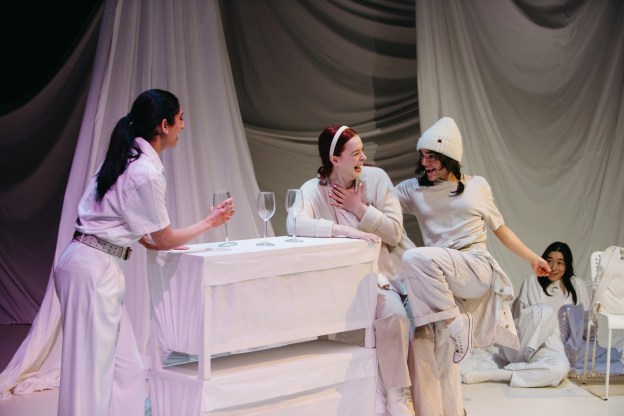
Noori Gill, Mel Bahniuk, Dayna Lea Hoffman, and Tia Ashley Kushniruk in Beth Graham’s Mermaid Legs. Photo by Brianne Jang of BB Collective Photography

When I attended the Workshop West production of Beth Graham’s play Pretty Goblins in 2018, I was struck by how well the playwright (and the actors Nadien Chu and Miranda Allen, directed by Brian Dooley) captured the relationship between two sisters, through years of growing up together, experiencing challenges (some horrific) separately, supporting and resenting and understanding and accepting. After a performance I mentioned to the playwright that some of it had reminded me of my relationship with my own sister, and she said that she didn’t have sisters herself. An earlier play by Graham, The Gravitational Pull of Bernice Trimble, also focuses on three adult siblings, and their differing roles in coping with their aging mother. Again, the relationships as shown were nuanced and easy to relate to.

Skirts Afire, the annual Edmonton women’s arts festival at several local venues this week, is hosting the world premiere of Beth Graham’s Mermaid Legs at the Gateway Theatre. It too focuses on relationships among three sisters, the older ones Scarlett (Noori Gill) and Ava (Mel Bahniuk) and much-younger Billie (Dayna Lea Hoffman). We hear enough about their parents to accept that the sisters are each other’s primary supports. But fascinatingly, in the first scene one character says that this family does not talk about feelings. They show support by problem-solving for each other, by inviting each other for supper, by keeping track of one sister’s schedule and challenging another to ask a divorced co-parent to do his share. And sometimes – that is not enough.

Direction is by Annette Loiselle, and design elements by other contributors enhance the storytelling as well: Narda McCarroll’s set design turns the black-box into a white world of fluttering sheets/wind/waves, uneven rocks, and shifting furniture. Ainsley Hillyard’s choreography for the three sisters and an ensemble of dancers (Mpoe Mogale, Alida Kendell, Tia Ashley Kushniruk) conveys everything from the weighting-down of depression and the struggling to reach through barriers of a broken connection, to the joy of dancing on a beach, alone or at a party. In one scene, tap dance conveys jarring, out-of-context, manic enthusiasm. Rebecca Cypher’s costume design has all the performers in shades of white, conveying their very different personalities in small details. Aaron Macri’s sound design with Binaifer Kapadia’s original music and Whittyn Jason’s lighting design all build the world and contribute to the message.

This play made me realize that many fictional stories about families dealing with the effects of a mood disorder are oversimplified. Sometimes movies or novels make it seem as if getting the right diagnosis, then getting the right medication, are straightforward steps leading to a happy ending — or as if flaws in those steps lead inexorably to a tragic ending.

Mermaid Legs shows that it isn’t that simple. And it shows that the identified patient isn’t the only one who needs to work at becoming healthier.

That it can show these things while being entertaining, beautiful to watch, relatable, and sometimes hilarious, is a tribute to not only the playwright but the whole team. (Oh, and when you think it’s almost over – watch for a very funny physical bit in the game of hairband-keepaway!)

Mermaid Legs is playing at Gateway Theatre (home of Workshop West Playwrights Theatre) until March 10th. Tickets, content warnings, and accessibility information are all available here.

Multi-Vs: a showcase of stage combat in an unfolding story

When I walked into the Varscona Theatre auditorium yesterday, I saw an exciting number of different objects distributed carefully about the stage. I saw some swords, some short blades, some long and short sticks, shields, and some things that didn’t look like weapons – a shoe? a backpack? It reminded me of when I entered the Citadel’s Maclab Theatre to watch their Romeo and Juliet, and from my seat beside the vom I could see swords laid out carefully in the vom hallway.

The action of Multi-Vs starts with two characters in modern/science-fictional body-armour and police-issue-type cargo pants, Nathania Bernabe and Jackie T. Hanlin. The pair are credited as playwrights, fight and movement choreographers, and performers, for this Affair of Honour production.

The start of the play is all fighting – fighting with various weapons and unarmed grappling. Dialogue and light / sound cues suggest that the two actors are shifting from one virtual-reality to another. I enjoyed not knowing at first why the switches and what their goal was, and then figuring that all out gradually as the action continued.

I don’t know enough about stage combat (or film combat, or video games, or swordplay in general …) to tell you what they were doing or tell you just how good it was. But it was very fun to watch, and very athletic. And when there appeared to be slaps or punches, they all looked real and sounded loud.

Multi-Vs has one holdover performance at the Varscona on August 29th (tomorrow.) Varscona holdovers are listed here, with a ticket link. Official Fringe holdovers at the Arts Barns are listed here. Grindstone hasn’t yet announced a holdover list, I don’t think.

  • 26 unique productions viewed and reviewed
  • 33 total performances viewed (1 more of Die-Nasty, 6 more of Late Night Cabaret)
  • 10 performances as crew
  • 12 venues attended
  • 4 volunteer shifts in the beer tents
  • 2 green onion cakes (one with sour cream, thank you PZ)
  • 0 parking tickets
  • 1 great Fringe Theatre Festival 2023!

A full Saturday at Fringe 2023

On the final weekend of Fringe, I’m in “just one more!” mood. Saturday ended up including Ken Brown’s Life After Life After Hockey, Natasha Mercado’s Tree, into a black shirt into the booth for a performance of i carry your heart with me, then the last episode of Die-Nasty and the last Late Night Cabaret.

Life After Life After Hockey was a masterclass in solo narrative, with a throughline, clear transitions, and interesting actions. The creator-performer Ken Brown takes us through the creation, performance, and lengthy touring career of his 1980s solo Life After Hockey, and about how it led to the next things in his life, with challenges and joys. There are familiar experiences and recognizable names in the hockey parts of his story, but also in the parts about becoming a theatre creator and inspiring generations of other local theatre creators through his time teaching at Macewan and afterwards. For a solo, it had a lot of special guests – but that is not a complaint at all, they were delightful. Holger Peterson playing harmonica, Dana Wylie singing and playing guitar, Edmonton’s former poet laureate Pierrette Requier reading a poem about Edmonton, etc. Stage 13, La Cité – Servus Credit Union Théâtre.

Natasha Mercado’s Tree was a charming solo about a tree who longs to be human. Lots of low-key audience participation (“now I need a babbling brook through the forest – just this side of the room”) and a bit of a twist that I thought was going to turn into The Giving Tree. (It didn’t – which is good because I can’t stand that book). A game-show “Would You Rather” explored some of the possibilities available only to humans, good and bad. Stage 7, Chianti Yardbird Suite.

Die-Nasty’s Fringe series wrapped up with a few more deaths, everyone in jail exonerated especially Liz Nicholls (Kristi Hansen) who was recognized as the Spirit of the Fringe in an inspiring song, and the traditional port-a-potty hookup between Liz and the gonzo podcaster Fisher T Johnson (Mark Meer). Die-Nasty’s fall season opens its curtain on Monday October 23rd, set in a 1920s circus sideshow, and the first one’s free! (a successful marketing ploy for many substances …)

Late Night Cabaret was crammed full of special guests, stunts, contests, and inside-jokes that include the whole Fringe community as the insiders, which is the best thing about LNC. (@lnc_yeg, as the hosts often remind us.) Last night was also the last performance ever of Zee Punterz, who have been the cabaret’s house band for more than ten years. A slideshow gave us glimpses of many of their performances and paid tribute to the late Brett Miles, saxophonist through most of that time. They ended their last set, and the night, with a great rendition of Stairway to Heaven, along with the musical guest Lindsay Walker. And then they gave us an encore. Before the lights came up and the Fringe technicians started striking the band’s set, as a reminder of what will be happening today and all through the next week, as the Fringe grounds gets returned to its usual uses as a park, an alleyway, a parking lot, a road and bike path … and the theatres go back to being rehearsal spaces and classrooms, music performance rooms, bars, dance studios, lecture halls, a Masonic hall, and … and a lot of theatres preparing for their upcoming 2023-2024 performance seasons.

But that’s for later! For today, I’ll put my lanyards back on and find my sunglasses and head out to watch some theatre before our 5 pm performance of i carry your heart with me (Stage 27, Sugar Swing Upstairs). First stop, Multi-Vs. 2 pm at Stage 11, Varscona Theatre.

Two funny shows on Friday

On Friday I caught two expressions of humour one after the other, in Yes, My Name is Mohamed Ali – Let Me Tell You a True Story, and then The Method Prix.

Mohamed Ali is my favourite kind of standup comedian – the kind whose stories all feel true, and whose delivery feels like he’s having as much fun telling them as we are having listening to them. I would definitely listen to him again. I started telling one of his anecdotes to someone later in the day and I realized that part of what made it so good was that there were seamless transitions from one story to the next – they weren’t just setup/punchline setup/punchline.

There was a part in the middle where he invited the audience to ask him questions while he had a few sips of tea from a thermos (Earl Grey, according to one answer) – and I was particularly impressed by the way he started from an audience question to telling about a series of events which all ended up connecting. Stage 4, Walterdale Theatre.

The premise of The Method Prix is that Deanna Fleischer and Brooke Sciacca are Hollywood types making a film, and enlisting the audience as clapper-board operator, craft services, makeup, auditioners, and background. All the background, I was part of a mountain range at a couple of points. Vincent Prix is a pretentious creepy cocky director, and Dylan Thruster is the … spit-take double … of a young Marlon Brando, complete with swagger, white undershirt, and open-mouthed bedroom-eye stares. Deanna Fleischer’s previous show Butt Kapinski put audience members into roles in a Raymond Chandler-esque noir detective story – I think it was in the old Armoury venue one year and I think I might have ended up being the murderer (“mow-de-wow”). This one was just as fun. Stage 17, Grindstone Theatre.

Fringe 2023 Day 8

It’s Friday morning – there are two and a half more days of Fringe shows to come. It’s foggy and smoky right now, but it’s supposed to clear up later this afternoon and be sunny with a high of 26 or 27 degrees on the weekend.

Thursday’s schedule was assorted in style, but all very good.

Lesbihonest – Laura Piccinin from Toronto delivered a one-hour standup monologue about her various comings-out and partners, her personal experience of queerness and the background of changing vocabulary and identity labelling. I loved it – and not just the parts I identified with. One particular bit of it, about meeting a schoolchild who talked matter-of-factly about being a lesbian, brought me to tears. I was reminded a bit of Kimberly Dark’s Dykeopolis in, wow, that was 2013. Stage 5, Acacia Hall.

Lia and Dor – I am so glad I fitted this into my schedule. It was lovely. Cristina Tudor, playwright and perfomer, and director Keltie Brown Forsyth shaped this original work in the small Nordic Studio blackbox with a few props and costume elements, giving the flavour of a Romanian folktale. Tudor and the other performer Alex Forsyth played several characters – a contemporary young woman Lia and her Dor, a Romanian word which “means something like longing, or wanderlust or a soul-calling. It encompasses both melancholy and joy and hope. A feeling that drives you to take a new journey, fall in love, come back home. You know this feeling, we all do. ” but also her grandparents and great-aunt, a wolf, a serpent, etc. A bit of puppetry, a bandanna becoming a kerchief, some shifts of voice and physicality, and the transitions of time and character were easy to follow. I like stories where the mythology and the current reality intersect, with characters speaking in contemporary voice along with archetypes and fantasy. I have appreciated the work of Forsyth and Brown Forsyth since first seeing 7 Ways to Die: A Love Story in 2012, and Tudor’s work was a great fit for their company K.I.A. Productions, now Vancouver-based. I’m also looking forward to seeing David Johnston’s Let’s Talk About Your Death, directed by Alex Forsyth, later this weekend.

Lady Porn – This Whizgiggling Productions threehander was written by Trevor Schmidt, and stars the same three fascinating actors as the Destination Wedding and Destination: Vegas shows of previous Fringes: Cheryl Jameson, Kristin Johnston, and Michelle Todd. The context was a woman-centric porn-film company like the ones that appeared in the 1980s. But the story was just a fascinating look at three characters who start the project with apparently-compatible ideals and goals, but each of them has different constraints and needs, leading to a series of compromises and eventually the question of have they really achieved anything different? Johnston is the producer Jill – after starting as a performer in that industry, she inherited money from a much older husband and is now the one seeking out backers and locations, moving into directing as her goal, announcing each scene with a clapper-board. Jameson’s Bonnie has been born-again as a youth pastor’s wife, returning to the industry because her husband assures him God said it was fine to get money that way for household expenses. Todd’s Denyse is a financial and commercial success as a porn actress. She’s well aware of where Jill is shading the truth or changing her plans, and doesn’t hesitate to call her out. The lights go up on Denyse reclining on a couch poolside at her mansion, regal in a bright yellow pleated dress with snapping fan. As in all Trevor Schmidt designs, the costuming conveys the period, distinguishes clearly among the characters, and blends well with other costumes and the set dressing. There was no nudity – it didn’t need it – and the casual discussion of the on-film blocking made it clear that to the characters Denyse, Bonnie, and Jill, the film is just work, nothing about themselves. More thought-provoking than the Destination plays, but equally entertaining . Stage 2, Backstage Theatre

Agent Thunder: You Only Laugh Twice, is the entertaining improvised spy story which explains why two well-groomed young men have been roaming the Fringe grounds in dinner jackets all week. Matt Ness and Michael Vetsch first brought Agent Thunder to the Fringe in 2019 I think, but I didn’t see it then. It’s a clever setup – the premise is that the shows are a series of agent-training seminars, designed to demonstrate the business to new spies (the audience) by retelling some of Agent Thunder’s past cases. In the one I saw, the audience suggestions led to “The Case of the Fast Alpaca”, but the plotline involving an alpaca of golden fleece resolved quickly and then shifted to a trip to Chile to discover why the Andean mountains were growing more quickly than classical plate tectonics would predict. As in a James Bond adventure, characters included the Director of the Service and the Lab Doctor who endowed Agent Thunder with some new gadgets, then a local guide, a mountaineer, the head of a company with evil aims, and others. Unlike in a James Bond adventure, there was no gratuitous romantic subplot, and I didn’t miss it.

Ness and Vetch practice the type of improv where the two of them switch characters frequently with a tapout, as other duos of long experience often do (Kevin Gillese and Arlen Konopaki of Scratch, Jim Libby and Jacob Banigan of Rocket Sugar Improv, etc). It’s fun to watch them maintain the character traits that they other one started, and it also keeps the story moving along since they often tap out when one has an idea for something the other character can do. Andrew Creswick provided musical accompaniment, and director Corina Dransutavicius was in the booth with near-instantaneous response of a wide range of suitable sound and lighting cues.

Going into the final weekend of The Answer is Fringe, there’s time to fit in a few more shows. Hope you see something great!