Author Archives: Ephemeral Pleasures

King of the Yees

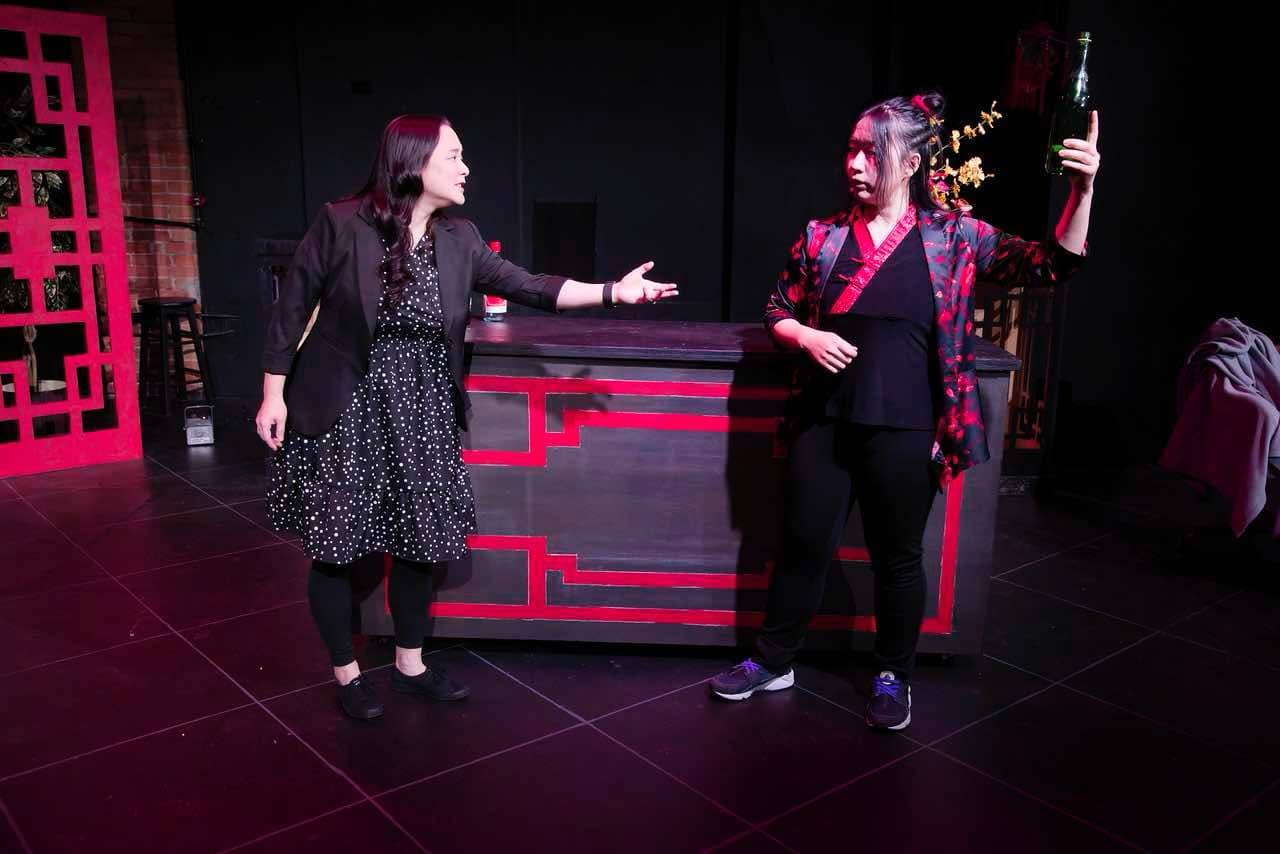
Ruth Wong-Miller and Grace Li in Walterdale Theatre’s King of the Yees, haggling as Lauren and Whiskey Seller. Photography by Scott Henderson, Henderson Images. Costumes Karin Lauderdale, Set Leland Stelck, Lighting Rebecca Cave.

I haven’t been involved with working on the latest Walterdale Theatre production, King of the Yees, so I had the fun of seeing it for the first time on opening weekend, along with a delighted audience. Barbara Mah, Walterdale’s current artistic director, directed Chinese-American playwright Lauren Yee’s somewhat-autobiographical play, with a talented cast and team of local artists.

King of the Yees is partly a familiar story about a father and daughter – a father (Stanley Woo of Apocalypse Kow) who is immersed in the clannish culture of San Francisco’s Chinatown and the Yee Family Association that he manages, and a playwright daughter (Ruth Wong-Miller of Foote in the Door and other musical theatre) who has moved on, moved away, and lost connection with her parents and their culture. I found the frustrated banter between them very funny, and also poignantly relatable, and unexpectedly moving.

Mah’s production, and the script, also contain fantastical elements which are fun to watch and listen to, as well as bitingly-sarcastic riffs on assumptions about Asian actors by a couple of performers playing actors who have been hired to read the playwright’s work-in-progress (Kingsley Leung and Helen Massini). This is not quite as confusing as it sounds! Visual/audible spectacles include a lion dance (handlers Massini, Grace Li, Ivy Poon, Rupert Gomez) led by a Buddha Boy (Tsz Him Hymns Chu), an Erhu player (Poon), a troupe of elders doing tai chi, a flamboyant Model Ancestor (stage manager Tim Lo), and a Szechuan face changer (Massini). The beautiful set and costumes were designed by Leland Stelck and Karin Lauderdale and implemented by skilled teams of painters, stitchers, and builders.

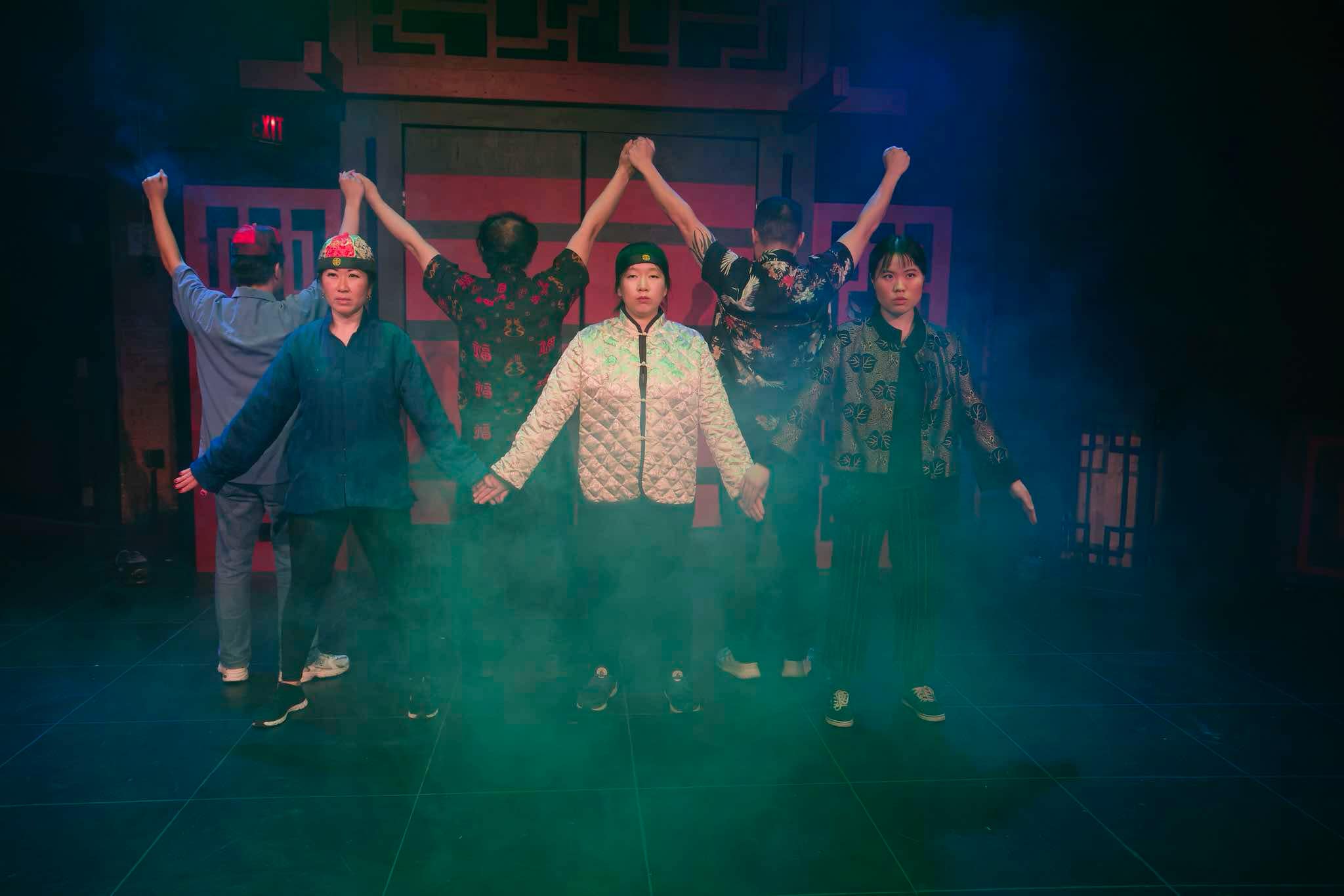
Ensemble members Rupert Gomez, Helen Massini, Andrew Kwan, Grace Li, Kingsley Leung, and Ivy Poon form a mysterious wall, in King of the Yees. Photo Scott Henderson, Henderson Images. Set Leland Stelck, costumes Karin Lauderdale, lights Rebecca Cave.

The digital program contains some helpful and interesting contextual information that is worth reading for extra enjoyment. Some performances of King of the Yees are sold out on line, with a few tickets held back for door sales. The run continues until next Saturday, February 15th, and advance tickets are here.

There’s so much else on this weekend, too! Plan ahead!

  • Bea, at Shadow Theatre, closes Sunday
  • Angry Alan, at Northern Light Theatre, closes Saturday (tomorrow!)
  • After the Trojan Women, by Amena Shehab & Joanna Blundell, is at Backstage Theatre
  • The Citadel has Frozen and Does This Taste Funny?
  • U Alberta Studio Theatre has [Blank], by Alice Birch
  • Die-Nasty, the long-running improv soap opera on Monday nights at Varscona, is free on Feb 10th.
  • An Oak Tree, at the Aviary, produced by Theatre Yes
  • Script Salon, Sunday Feb 9th, has a reading of Linda Celentano’s Giorgi of the Jungle.

And next weekend there’s even more, all with short runs!

  • The Effect, by Lucy Prebble, at the Arts Barns Studio,
  • The Spinsters (Bigger and Badder) is in the Westbury
  • MacEwan University’s musical theatre program has Natasha, Pierre, and the Great Comet of 1812
  • The first PepperMUNT Cabaret, a production of Jake Tkaczyk’s new company MUNT Performance Association, will be at the Gateway Theatre on Saturday February 15th, at 10:30 pm – giving you enough time to see one of the shows in the above lists first! Trevor Schmidt and Mark Meer are hosting, with an assortment of talented guests, and tickets are here.

I’m not going to be able to see all of these, because I’m also busy working on Walterdale’s next show, Stag and Doe by Mark Crawford (April 23-May 3). See what you can! Maybe I will see you there!

Bea, by Mick Gordon

Kristen Unruh, in Shadow Theatre’s Bea. Photo Marc Chalifoux. Costume Design Deanna Finnman, Set Design Ximena Pinilla. Lighting Design Whittyn Jason.

Publicity for the Shadow Theatre show Bea had enough warnings that I knew it would be about a young person who wants to die with dignity or on her own terms. That topic’s not for everyone, so I was glad to know that much. Bea was written by Northern Irish playwright Mick Gordon, in 2010. This production was directed by Amanda Goldberg, a recent Artistic Director Fellowship holder at Shadow Theatre.

I was intrigued to see recent BFA grads Michael Watt and Kristen Unruh on a professional stage, along with Kate Newby (she played Dorothy Parker in Fresh Hell at Shadow a couple of years ago).

The other thing I knew about the production beforehand was that the set was partially crowdsourced. I saw an appeal from set designer Ximena Pinilla for old costume jewellery, so I dropped off a bag of shiny things. The focus of the set was a bed. On one side were the trappings of medical care, with one of those wheeled over-bed tables that I’ve seen in hospitals and nursing homes. On the other side of the bed were a young woman’s personal belongings and a rack of fabulous outfits. And above — suspended above and behind the bed were big grid displays of earrings. Like a Claire’s to excess.

Kristen Unruh’s character Bea enters, dancing, singing, sprawling on the floor to read a magazine. She might be sixteen, or a decade older, but she’s clearly lively and joyful and this is her space. Then a young man in rumpled shirt and too-short tie enters nervously, holding a satchel and his CV. Ray (Michael Watt) is her new personal care assistant – or he’s interviewing for the job, it’s not quite clear. And as the other character enters, Bea gradually melts onto the bed. She’s still animated, mouthy, full of poetry and wordplay, sitting cross-legged on her bed and enjoying putting the awkward young man on the spot. They connect. And in this first meeting, she asks him to take dictation, as she speaks a letter to her mother, saying that she wishes to die and wants her mother to help her.

Bea’s mother Catherine (Kate Newby) then arrives to give Ray a sterner scrutiny and tell him the rules of employment – from “No prurience” (which he admits he needs to look up later) and “Kindness” to “No secrets” – awkward because he is already carrying one secret, the dictated letter. As Catherine, a lawyer in severe black suit, grills Ray, I become aware that Bea has collapsed immobile onto her stack of pillows. Is this how her body really is, in the time of the play? We see this contrast playing out over and over throughout the narrative – Bea dancing and active alone and sometimes with Ray, but also needing to be fed and bathed, speaking with difficulty, twitching in pain.

I found the character Bea likeable and funny and frank. I revised my age-estimate upwards when she tells an uncomfortable Ray that she hasn’t had sex for nine years and misses it. Ray is clearly on her side. He jumps into her stories and daydreams, reluctantly revealing bits of his own context.

One of the most enjoyable bits of the play, for me, is the part where Ray brings in a script for A Streetcar Named Desire, introduces the classic, and reads it / acts it out with Bea. Both Unruh and Watt are up to the physical, emotional, and vocal challenges of these roles, and I look forward to seeing each of them again.

Every time Ray is taking frivolous liberties, though, Catherine walks in and is horrified. The audience gets to expect this. It’s still funny in a rule-of-three way, but maybe it’s not all needed. I do love Kate Newby’s still body language and flat affect with horror underneath.

In a few Catherine-Bea scenes, we learn that the two of them have been on their own for several years. They love and respect each other – and Catherine does still see Bea as the playful clever girl of the solo scenes and memories, not just the patient.

So the stakes are very high, when Catherine learns of Bea’s “demand”. And in fact even higher, because they live in a place and time without MAiD (medical assistance in dying), where assisted suicide would be prosecuted as murder. So in one shocking change-of-mood scene without Bea present, Ray explains to Catherine how it should be done, if/when she chooses. Details about how to ensure that a first attempt is successful, but also details about how to present it afterwards to the police and legal authorities. Blunt, explicit, disturbing. How does young Ray know all of this and speak with authority? I can make up a backstory but it’s not in the text.

The actors were great, but the script left me with some questions. I wondered if it would have been stronger if shorter, or if the repeating cycle of visits from Ray, revelations and intimacies, judgement by Catherine, re-connection between Catherine and Bea … was all necessary to make us care about Bea and her people and to see the necessity and the anguish of her death. The illness is not named, and that was probably a better choice than giving us a specific diagnosis that we might know about. We learn that she won’t get better, but it wasn’t clear to me whether she was getting worse and whether it would eventually kill her. There were a few Canadian references sprinkled in – the story about Ray’s friend trying to hold up a CIBC and accidentally going to Kentucky Fried Chicken was not the only one, there was a reference that made me think Toronto – but there was other wording that felt natively British (Ray’s friend in that story having a nickname like Bazza or Jazzer, for example) so that distracted me.

I have not been intimately involved with a MAiD or assisted suicide situation myself, although pre-MAID I have helped to make a decision to remove life support. The practical awfulness of implementing Bea’s request, as shown on stage, definitely confirmed my belief that there are some situations in which offering MAiD would be more humane. But, as the director’s program note quotes disability dramaturg Miranda Allen, “When MAiD is available and supports for living are not, MAiD becomes problematic.” That’s not relevant to the characters on stage – for them, assisted suicide is illegal, and it seems that Catherine is financially able to support Bea in comfort and employ Ray as caregiver. But it’s an important thought for any audience member who might go away smugly distancing ourselves from the dilemma of the play. Death and life are even more messy and complicated, in real life and real death.

Bea is playing at the Varscona Theatre on 83 Avenue until February 9th. Lots to think about, and more fun than I expected. Tickets available here.

The world of Angry Alan

Cody Porter in Northern Light Theatre’s Angry Alan. Photo by Brianne Jang of BB Collective Photography.

The posters for Angry Alan, the new production at Northern Light Theatre, portray an angry man. The character on the poster seems to be mid-rant, gesturing towards an audience with his laptop open and his mouth open. So I expected that. But when the actor in this solo show, Cody Porter, first appears frozen at the dark vom entrance to the theatre, looking at the audience apprehensively, and then walks cautiously towards the stage as an unfamiliar space, I didn’t see anger. Even as he starts to tell his story, his distracted demeanour and circumlocutions convey that he’s telling a story he doesn’t want to tell.

Roger, currently a junior manager at a Safeway store, starts with a self-deprecating anecdote he knows his listeners will relate to – checking his phone before going for a run and getting sucked into hours of clicking links and watching videos. In one of those links, he finds a video “about history”, by a man whose seductive analysis of society reassures him that life has not been fair to him, because he is a man.

I was drawn in despite myself, to Trevor Schmidt’s production of Penelope Skinner’s 2018 script Angry Alan. I expected to be frightened for myself and others, and enraged, and frustrated. But this naive guy talking about how the messages he found online were new to him and how they gave him comfort – I kind of liked him.

Roger tells us he keeps reading, and keeps watching, and signs up for mailing lists. He notices things in his own life that fit the patterns he’s told about by “Angry Alan.” At work, he’s expected to suppress his own feelings and let customers (female customers, it seems), not only express their feelings but manipulate the employees with them. This fits what Alan’s group is saying – that society expects men to pay attention to women’s feelings but not their own. Once he’s watching for this pattern, he observes that a male bagger gets fired because a female customer cries about broken eggs. Maybe he could intervene, and protest?

He tells us he has a son he doesn’t talk to often, because of divorce and custody arrangements. And, parroting the arguments of Angry Alan and other men’s-rights activists, he extrapolates that this shows a system biased in favour of women and mothers, and that feminism has “gone too far”.

In both cases, I was gripped by the apparently-logical steps from the character’s real problems to erroneous and dangerous conclusions. I found myself wanting to make noises and gestures of disgust, and I was disturbed that some in the opening-night audience were laughing. It was outrageous, but it was not ridiculous. Maybe it was a laughter of shock and discomfort.

By the time Roger is ready to talk about his discoveries to anyone else in his life, he has gone far enough into the us-vs-them world that nobody can talk him back. Roger uses the metaphor of having a Red Pill Moment, calling back to the film The Matrix where choosing to take a red pill means choosing uncomfortable revelation. He sees any challenges or disagreements as more evidence that men are oppressed. He texts his son a link to Angry Alan, sure that it will help them connect. His son responds LOL, which Roger misinterprets.

The production makes good use of projections (Amelia Chan) in showing some of the online interactions that influence Roger’s choices. We see text-message screens, emails, some real video clips of people in that culture, and the website where Roger decides to sign up for a Men’s Rights conference and then is presented with a request to donate to the cause, slickly presenting it as an opportunity to be an “insider” in the movement.

Partway through, I realized that nobody was laughing any more. The narrative was incredibly unsettling, and the portrayal was effective. Roger is so full of hope, believing that being part of this movement will bring him happiness – and the audience can see so much wrong that he’s not noticing.

After the play, over delicious snacks of the opening night reception, we talked about how people who do not feel included and understood are vulnerable to recruitment by gangs, by cults, by populist political movements, by radical extremists of all kinds. And how the groups and their recruiters use those tools intentionally. I suddenly remembered the offstage “mob” behind the doxxing and harassment of Kristin Johnston’s character in Workshop West’s production of Mob last year. It was easy to see how that lonely and struggling young man, portrayed by Graham Mothersill, would have grasped at the chance to impress other men by doing something mean.

Cody Porter, as Roger, is enraged by video clips. Photo by Brianne Jang of BB Collective Photography.

This production is a nuanced and disturbing exploration of some societal trends that I mostly try not to think about. I guess I’d like things to be black-and-white too, but they are not. Trevor Schmidt, Cody Porter, and the rest of the team have done some brilliant work to make me understand this character, and other men like him. And maybe I need to understand them, in order to help build a world that is better for everyone. I’m glad I saw it and I’m not done thinking about it.

Angry Alan is playing at the Studio in the Fringe Arts Barns, until January 23rd. Tickets are available here.

It’s A Wonderful Life, and Krampus: A New Musical

Krampus: A New Musical. Workshop West Playwrights’ Theatre / Straight Edge Theatre. Set and lights, C.M. Zuby.

One thing that It’s a Wonderful Life: A Live Radio Play and Krampus: A New Musical have in common is that I didn’t get around to posting about them until it was too late to buy tickets. It’s a Wonderful Life closed at Walterdale Theatre last week. Krampus has two more shows today at Gateway Theatre, but they are sold out for both.

It’s a Wonderful Life: A Live Radio Play, by Joe Landry, directed by Tracy Wyman, is an adaptation of the 1946 movie, with Jimmy Stewart and Donna Reed. I had never actually seen the movie, but I was familiar with the general story – a despondent man (Josh Young) considers killing himself on Christmas Eve, but is shown by an angel (Liam McKinnon) some of the ways he’s helped others, and he changes his mind. This production employs the device of the performers being actors and crew at a 1940s radio station, conducting a live broadcast. There was a lot more to look at than I had anticipated from a “radio play”, from the actions and byplay of the Foley artists (Dustin Berube and Casey Powlik) and stage manager (Rachel Whipple), to the simple but well-dressed set (Anthony Hunchak), warm cosy lighting (Pat Sirant), and 1940s costuming (Debo Gunning). I particularly appreciated the way Rob Beeston and the other actors switched among voices for the many radio characters they were playing.

It’s A Wonderful Life is known as a traditionally-sentimental and heart-warming Christmas story. But encountered fresh, I was struck by the bluntness and brutality of a story about contemplating suicide. I didn’t see any tragic flaw in George, just the consequences of trying to act with integrity in the banking sector. Making it just about the happy ending, as 80 years of collective memory seems to have done, is like forgetting that there are Nazis in The Sound of Music. Hm.

On the other hand, I did not expect Krampus to be heartwarming at all, but I ended up finding it delightfully satisfying. Steven Allred and Seth Gilfillan, the creative duo behind several Straight Edge Theatre new Fringe musicals such as Cult Cycle, wrote this musical with orchestration by Michael Clark. A version of it was successful at last year’s Fringe but I didn’t manage to see it. So I was delighted to see Workshop West Playwrights’ Theatre programming it as part of their season, of course in the December slot.

Krampus is set on Christmas Eve, in the home of a family getting ready for Christmas visitors. Ronette (Amanda Neufeld) is supervising her docile husband Douglas (Jacob Holloway) and not-docile small children Billy and Tilly (Damon Pitcher and Victoria Suen). We learn quickly that Ronette’s priority is to look good to visiting relatives, particularly her sister Courgette (like the zucchini?) The children’s old caregiver Nanny Verla (Nicole English) sweeps in with carpetbag like a gothic Mary Poppins, deploying cryptic warnings like “Magic might be BLACK!” and “Not your real parents!”

In case you aren’t aware, Krampus is a terrifying figure from European folkloric traditions with a long tongue and hairy goat-like body who appears in December, maybe with St.Nicholas, to punish naughty children. So when such a beast appears outside the windows of the family home, with thunder and a flash of light, things get dark fast.

I’m told that the script is slightly longer than the Fringe version, with two more songs and an intermission. But as in all the Straight Edge Theatre work, the sass and irreverence and pointed fun are fast-paced. And all the plot breadcrumbs are picked up. The melodies are earworm-material catchy, the musical arrangements for piano, French horn, and cello are great, and the sound mixing is good enough that none of the funny lyrics are drowned out.

The set (C.M. Zuby) and the costumes (Trevor Schmidt) are delightful, reminiscent of Dr. Seuss and of the Wicked Witch of the West (1939 movie) and every excess of modern Christmas.

It’s fair to call Krampus: a New Musical horror. But at the same time, I found something not only joyful about the story but, yes, satisfying to the point of heartwarming about the ending.

Heathers: high school is more fun to watch than experience

Scene from MacEwan University production of Heathers.
Photo Credit: Brianne Jang of BB Collective
Light Design: Heather Cornick, Set Design: Ross Nichol, Costume Design: Alison Yanota

Continuing on my recent run of seeing new productions of shows I’d seen in the past, tonight I watched opening night of the MacEwan University Musical Theatre program’s production of Heathers, by Laurence O’Keefe and Kevin Murphy, directed by Leigh Rivenbark. I saw the 1988 movie a long time ago, and the Citadel Young Musical Company production in 2016 (also directed by Leigh Rivenbark) but I didn’t remember them very well.

So I had the fun of encountering the musical almost fresh. Layne Labbe as Veronica and Jayden Leung as JD both had strong voices and compelling stage presence. Marina Mikhaylichenko was a disturbingly-mean Heather Chandler. Ashlin Turcotte (Martha, Veronica’s original best friend before her strategic social climbing) and Kara Adams (Ms. Fleming the hippie teacher) both had vocal solos that developed their characters and also demonstrated some impressive talents. It was also fascinating to watch the other ensemble members as high school students who all seemed to have distinctive characters, backstory, and connections with the others. Choreography (Courtney Arsenault) was well executed, and silhouette work behind windows was delightful.

I had forgotten how sharply satirical it was, skewering suicide-awareness campaigns, internalized homophobia, performative allyship, signing petitions without reading them, playing to the media, the misunderstood-loner-in-a-trenchcoat trope, bullying, bulimia, frenemies, and all the teenage stereotypes.

Heathers is playing at MacEwan’s Triffo Theatre all weekend. But if you don’t already have tickets, you’re probably out of luck. You might want to plan ahead to get tickets to the MacEwan production of The Prom, next March.

Bright Lights in Camrose

Pre-set for Bright Lights, by Kat Sandler, at the Augustana Theatre Centre.

This week in Camrose, a production of Kat Sandler’s dark comedy Bright Lights is being performed by a University of Alberta Augustana theatre class. There is one more performance, tomorrow (Sunday November 24th) at 2 pm.

I had seen a Blarney Productions run of this play at the Edmonton Fringe 2024, directed by Luc Tellier and featuring familiar local actors Rachel Bowron, Oscar Derkx, Braden Dowler-Coltman, Mhairi Berg, and Jenny McKillop. I’d enjoyed it a lot.

The Augustana performances take place in the Augustana Theatre Centre, a former chapel now repurposed with a small proscenium stage and steeply-raked audience seating. The pre-set creates a setting in a cluttered multi-purpose/meeting room in a church, with table and chairs surrounded by the necessities of exercise groups, Sunday school classes, sign-up sheets, water jugs, and assorted overflow storage.

The first two characters to enter, Zoe (AC Capper) and Laurel (Halen Vaage), are arriving at some kind of support group – Zoe as a hesitant first-timer and Laurel as a jealous and protective insider. This gets weirder when we learn that it’s a group for people who have encountered aliens, and escalates as Zoe meets the other group members, Dave (Jack Purnell), aggressive and challenging, Wayne (Michael McCarroll) the former actor who keeps trying to apply lines from the TV series he was in, and Ross (Hung Nguyen) the smooth-talking group leader. They start out by reciting their routine group convictions – “This is a safe place.” “We believe you” – but then they immediately challenge Zoe to tell her own alien-encounter story and prove that she isn’t, as they say, a “lookie-lou”. While her story has elements familiar to them – the bright lights, the compulsion to follow, the loss of time – it also raises some questions which challenge the premise of the group. People turn on each other. Weapons come out. Truths come out … or do they? Even having seen the play several months ago, I didn’t remember all the plot twists, and I was on the edge of my seat at a few points, with one piece of theatre-magic making me shout with surprise. The pacing was very good. I could see that each character always had motivation for their behaviour. There were a couple of high-energy exchanges where I had a bit of trouble understanding characters who were shouting, but that didn’t hurt my ability to follow the story. Bright Lights was directed by course instructors Jake Tkaczyk and Kevin Sutley. Tickets are available here for tomorrow afternoon’s closing performance or at the door, $20 general admission or $5 for Augustana students.

New productions – reviews of re-viewings?

Team and coach travelling by train, in MacEwan University’s production of Tracey Power’s Glory. Photo by BB Collective.

I’ve been watching entertainment on local stages for more than ten years, so it’s not surprising that sometimes I see new productions of works I’ve already seen. Recently, I’ve seen two performances in this category, but otherwise very different: Glory, by Tracy Power, and Die Fledermaus, by Johann Strauss.

In 2018 I travelled to Calgary to see the world premiere of Tracy Power’s Glory, produced by Alberta Theatre Projects and directed by James MacDonald. I was excited to see that the students of MacEwan University’s Musical Theatre program would be tackling this play, as a story about young people pushing the boundaries of appropriate activities in the turbulent times of 1930s Canada seemed like a great fit. Amber Borotsik was a great choice as director for the movement-forward work. Her choreographic choices for learning to skate, for practising hockey strategies, and for the various important games in the narrative were less stylized and more story-coherent than in the original production, but equally fun to watch.

Izzy Deutscher was great as team captain Hilda Ranscombe, confident in sports but struggling in other parts of life. The other team members portrayed, Nellie Ranscombe (Jaysel Ann Arroyo), Marm Schmuck (Harmony B), and Helen Schmuck (Jenn Houle), were quickly distinguished as individuals, each with her own problems and quirks. The script clearly sets the action in 1930s small-town Canada, with radio news voice-overs, women’s magazine columns, and the teammates’ conversations about work in the shoe factory, missing a chance at university because father and brothers are still out of work, and being denied admission to law school because of being Jewish. Devin Estey plays rink manager and reluctant team coach Herb Fach, managing to conveying a grumpy-old-man vibe despite appearing about the same age as the players. Kevin Thomas, visible in porkpie hat and suit on the theatre’s catwalk, provided colour commentary as radio announcer for the various games.

I was particularly moved by the design feature (Scott Spidell) of having championship banners roll down after the team’s first national title win, then ending the show with the banners scrolling through the many subsequent achievements of the Preston Rivulettes, then the logos of the modern-era national championship, the first women’s world championship in Ottawa in 1990 (I still have a volunteer sweatshirt with that logo), the subsequent world and Olympic titles of Canadian teams, ending with the new logos of the six teams in the Professional Women’s Hockey League, now in their first full season. As a second-wave women’s hockey pioneer and the daughter of another one, I loved the way this tied the history together with my own experience and with current and future women’s hockey players. I was also impressed by the information and fundraising about indigenous hockey opportunities in Alberta.

Die Fledermaus was last produced at Edmonton Opera in 2014. In a conventional staging, it was humorous and enjoyable, with Julian Arnold playing the doctor who is teased about his bat costume. The 2024 production, directed by Joel Ivany, added a layer of meta-, and even more opportunities for accessible silliness, by framing it as a community theatre company rehearsing, performing, and recovering from a performance. So Act 1 is actually the company arriving at rehearsal and rehearsing Act 1, with original dialogue in English for the many interruptions and amusing interactions. I think my favourite bit of Act 1 was watching the Stage Manager (Farren Timoteo) scurrying around to deliver props to the performers just in time and almost invisibly, and crawling around the stage with strips of spike tape laid out on his sweater, so he could mark each performer’s location for delivering songs. In Act 2, at Count Orlovsky’s party, the core cast of 9 is joined by a large chorus of partygoers in masks and various shades of festive black, along with a DJ, a drag queen, and others. Most memorable was the ode to Champagne. Act 3 is called the “After-After-Party”, with the cast members waking up or staggering in, and reminiscing about the performance but actually singing all the songs of the script’s Act 3. This part was kind of confusing but I was still laughing. Soprano Jonelle Sills (Rosalinde) had a particularly impressive voice, and also memorable wigs.

Trevor Schmidt’s Monstress

Preset for Monstress

I’ve seen so much good performance in the last couple of weeks – it’s like Fringe, without the green onion cakes. I’m behind on writing it all up, and next I’m going to Pirates of Penzance.

I didn’t post about Monstress right away because it’s harder to describe than some of the other productions on local stages this month. Monstress, the first show in Northern Light Theatre’s season, left me unsettled. And I’m pretty sure it’s supposed to be unsettling. It’s a premiere written, directed, and with set and costume design by Trevor Schmidt. Lights are by Larissa Poho and sound by Dave Clarke.

Performers are Sydney Williams (The Doctor) and Julia van Dam (The Body). That gruesome and impersonal credit is consistent with what we see early on. The Doctor tells us that despite her expulsion from the school of dissection and medicine, she has been able to continue her work in understanding human life to the extent that she can bring it back after death. She is dressed and/or lit in a bottle-green colour, reminiscent of some earlier era (steampunk? Victorian? it’s not specific). At first, her monologue about whether she is actually a monster herself does not seem to apply literally – it feels atmospheric, like some type of poetic overstatement.

Then she explains that a Colonel sent her the body of his daughter Lydia Chartreuse, recently dead from a riding accident. Actor Van Dam lies immobile on a lab in the basement lab (like the eponymous Rocky of Rocky Horror, but really not). Lighting makes her skin and her bodysuit into some flat chill colour between alabaster and pale green. The Doctor then uses her knowledge and additional equipment funded by the Colonel in attempts to re-invigorate the body.

These attempts appear to be successful, in a way. The Body can move, but it/she seems to have lost adult understanding, so the Doctor must teach her, must, in a way, raise her like a child or train her like a pet. Van Dam’s slack-jawed clumsiness and naive questioning conveyed a childlike tabula rasa,

After the two of them move out of the city to rehab at the Colonel’s private country estate, Van Dam also plays the housekeeper, poised and veiled and apparently in possession of even more information than the Doctor. It seemed to me that the Body/Lydia had information about her death and her previous life, that the Doctor did not. As an audience member trying to piece together the backstory, I wanted the Doctor to ask the right questions – and she didn’t.

The situation reminded me a bit of the 2018 Northern Light production by Bryony Lavery, Origin of The Species, in which an anthropologist (Holly Turner) discovers a live prehistoric woman (Kristin Johnston) and tries to accustom her to modern life, and a bit of the NLT’s 2016 production of Wish (adapted from a Peter Goldsworthy novel by Humphrey Bower), in which a young man (Christopher Schultz) develops a relationship with a sign-language-communicating primate, Ainsley Hillyard. Many NLT productions make me ask questions about what it actually means to be human, and to be humane, by considering edge cases. Provocative and unsettling edge cases.

I began to think that the Doctor didn’t want to know more about Lydia’s past, or about what was likely to lie ahead for her. Since I could make some horrifying guesses about both, I flashed back to the Doctor’s top-of-show musings about whether she was the real monster. Because … maybe she was. Like the scientists of Jurassic Park, she was so preoccupied with whether she could, she didn’t stop to think if she should. Because she didn’t care. And by the time the play ended, my worries about Lydia were modern-day realistic horrors. My feelings about the Doctor were mixed up with far too many true stories about people who don’t have the best interests of vulnerable people at heart – are they actively evil or oblivious and negligent, and does intent even matter?

Monstress is playing at the Arts Barns Studio until November 23rd. Tickets are available here. The theme of their season is Making a Monster – and I am starting to see why.

The Pirates of Penzance

Shauna Rebus, Brendan Smith, and Russ Farmer in Pirates of Penzance. Photo by Nanc Price Photography.

If you’ve ever heard of Gilbert and Sullivan – if you have even a humming familiarity with any of their work – you’ll know that the Victorian-era duo wrote wildly-popular tongue-in-cheek light opera pieces, some of which continue to be frequently-performed and alluded to in popular culture. And if you asked someone to sing one song from Gilbert and Sullivan, they’d probably attempt the first lines of “I am the very model of a modern Major-General”, an oft-parodied patter song which is from Pirates of Penzance (1879).

I’ve seen Pirates of Penzance once before – at the Stratford Festival’s Avon Theatre, on a 1985 outing with my mother, who’d admitted the year before that she appreciated me taking her to see some Shakespeare plays but what she would like even better was Gilbert and Sullivan. In those days it wasn’t easy to access a plot synopsis or lyrics ahead of time, there were definitely no supertitles/captions, and seats at the front weren’t in my budget. So I missed lots of the clever rhymes and over-the-top dialogue/intentions.

Local company Foote in the Door opened their production of Pirates of Penzance last night at Théâtre Servus Credit Union (La Cité Francophone), directed by Ron Long. I sat in the first row so I wouldn’t miss anything – and they were using supertitles for all the songs, which made it even easier to follow the preposterous premises of the plot. Frederic, a nautically-minded boy who had been accidentally apprenticed to a pirate instead of a pilot (Brendan Smith), is coming of age and being released from his indentures. But he’s got an overdeveloped sense of duty, which keeps leading him into inconvenient obligations.

Frederic looks forward to the pleasures of civilian life. His old nursery maid, Ruth (Shauna Rebus), who followed him into piracy, now hopes to catch his affections as they leave the ship, but Frederick is hoping to meet younger prettier women. These two characters were among my favourites, but the company of twenty-one performers were all fun to watch and listen to. Andrew Kwan was a delightful Major-General Stanley, father to a chorus of eight daughters including Frederick’s choice Mabel (Ruth Wong-Miller). Some of the pirates doubled as police officers, led by their sergeant Aaron Schaan in unison nightstick choreography. And one of the daughters (Eilidh Tew) doubled flexibly as a pirate! Sisters Wong-Miller and Christina O’Dell had a lovely duet in the second act. There was some fighting with fencing foils, pistols, and other found weaponry (fight director Sarah Spicer). Russ Farmer is the Pirate King. He and his hapless band display an assortment of impressive facial hair, some of it real.

The company of pirates and daughters surround Andrew Kwan, the Modern Major-General, and his Sterling Award. Photo by Nanc Price Photography.

Pirates of Penzance is playing until November 24th, with tickets available through Showpass.

The Seafarer, at Alberta Theatre Projects

Show poster for The Seafarer at ATP, featuring Paul Gross

Full disclosure: I went to Calgary to watch ATP’s production of Conor McPherson’s play The Seafarer, just because Paul Gross is in it. I had never seen Paul Gross on stage, despite his Albertan roots and his strong reputation in Shakespearean material at Stratford. I have watched the TV comedy Slings and Arrows several times through – and if you haven’t and you like theatre, you should! as well as other video performances. He was an integral part of the film production Passchendaele, along with his U of A classmate Francis Damberger.

Anyway, the weather was good and the mezzanine seats were reasonably priced, so a friend and I headed to Calgary. I knew that Conor McPherson was an Irish playwright who wrote The Weir (which I’d never seen or read), and I figured out later that he’d also written Port Authority, which I’d seen in a local production with Cody Porter in it. I didn’t read anything else about the story or the other actors.

Given all that, I was blown away. Directed by Peter Pasyk, it was the best production of a straight play I’ve seen in ages. The ensemble of five was all very strong, especially Shaun Smyth (whom I remembered from the solo Playing with Fire: the Theo Fleury story). Four residents of a near-contemporary Irish suburban town are heading towards Christmas. The set is the cozy, cluttered, and dingy basement living-room of two sloppy and foul-mouthed brothers, Richard (Christopher Hunt), recently blinded in a dumpster-diving accident, and Sharkey (Smyth), who’s arrived back home after finishing a chauffeuring job up the coast. Their Christmas preparations are mostly about laying in enough drink for everyone who might drop in for a mince pie or a game of cards – even though Sharkey is counting his first few days of sobriety. Two neighbours are frequent guests: Ivan (David Trimble) who has the audience gasping every time he tumbles down or scurries up the stairs, and Nicky (Chirag Naik), who now lives with Sharkey’s ex-wife, Sharkey’s kids, and even Sharkey’s car, which he left with Eileen for the school run.

I felt completely caught up in the group’s misadventures and disagreements, even before Nicky brings in a mysterious stranger, Mister Lockhart (Paul Gross), well-dressed and quiet, with a large hat brim hiding his face. Nicky (who’s not entirely welcome to Sharkey himself) says that he met Mr. Lockhart in a pub, and brought him along for the Christmas Eve card games. It’s awkward.

In the intermission break, my companion and I discussed what had been revealed so far and whether we’d seen it coming. My friend had more insight than I had, but we both enjoyed trying to figure out whether and how these hapless characters would get out of their predicaments. Neither of us guessed the ending, and both of us felt satisfied with it. We had lots to talk about on the way home!

The Martha Cohen Theatre with its mezzanines and balconies and tiny multi-level lobby spaces was a great opportunity for this intimate character study. Set designer Hanne Loosen has created a cozy two-story set that feels like it continues off the stage into the cold back alley, the tiny kitchen, and the barely-functional downstairs toilet.

I still love Edmonton theatre, where I watch so many good plays I have trouble keeping up with posting – but this visit reminded me to keep Calgary and ATP on my radar too. The Seafarer has three more performances, the last tomorrow Nov 10th at 2 pm. If you’re in Calgary, or you’re up for a drive, some tickets are available here.