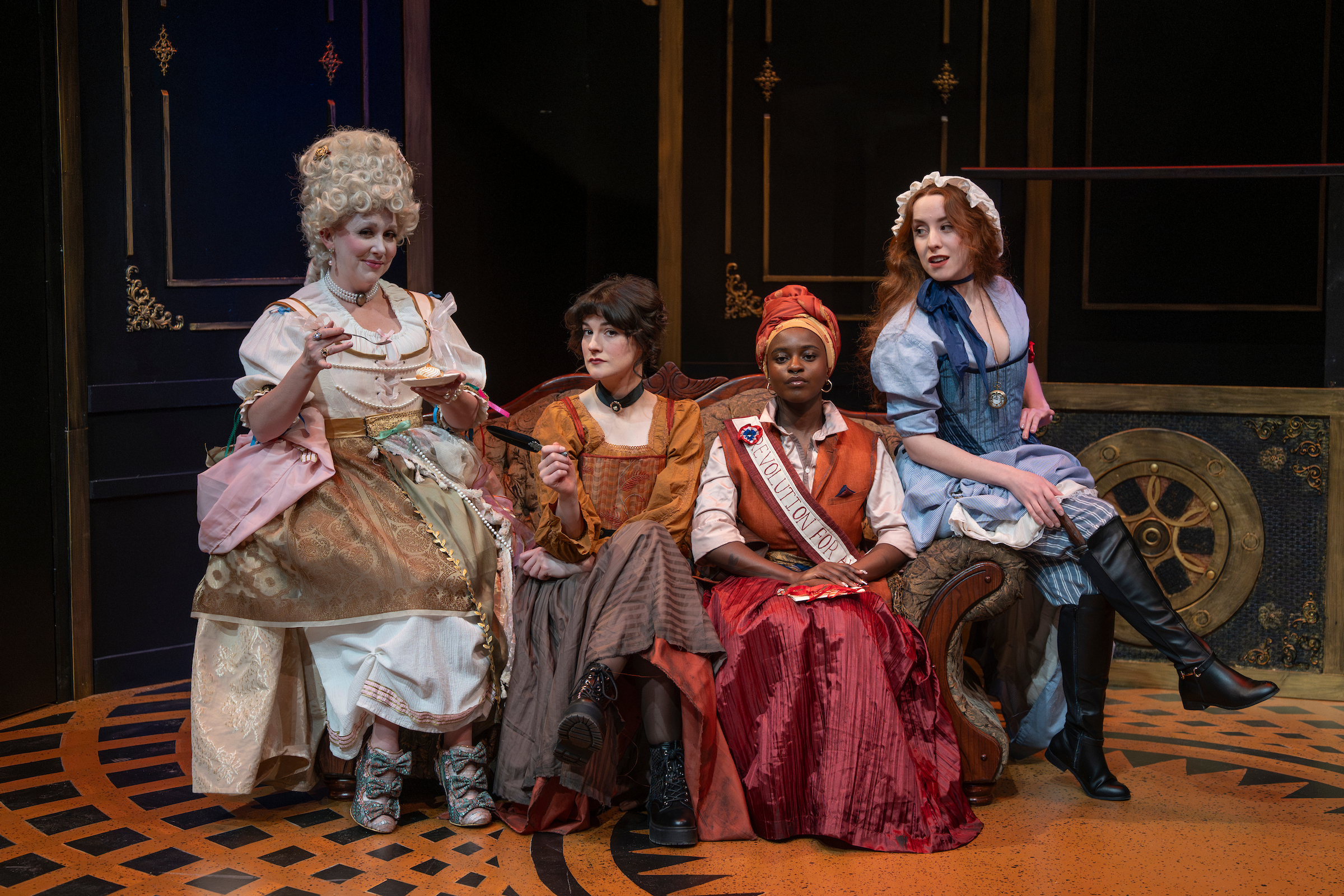
Tag Archives: darrin hagen

Northern Light’s The Pink Unicorn: hopeful and loving

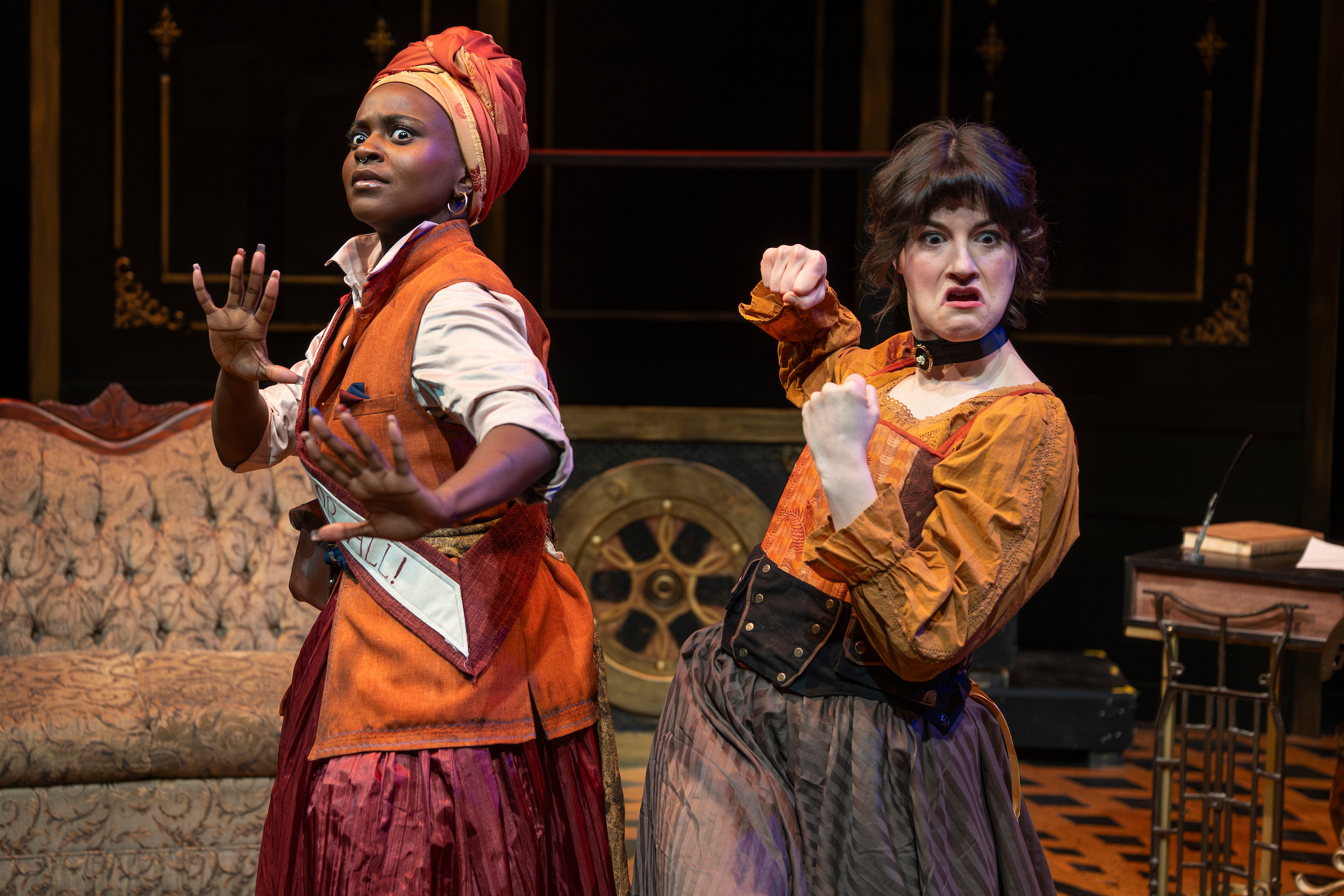
Patricia Zentilli as Trisha Lee in The Pink Unicorn. Images Brianne Jang BB Photographic. Set and costume Trevor Schmidt, lighting Larissa Poho.

The first production in Northern Light Theatre’s 50th-anniversary season is The Pink Unicorn, by Elise Forier Edie, directed and designed by Trevor Schmidt. I meant to tell you about it last week, but for some reason my blog host wasn’t letting me post pictures. So I waited, since I love the promo photos of Trisha telling her story.

And it’s so good! Patricia Zentilli plays small-town Texas mom Trisha Lee. Trisha’s been raising her only child Jolene alone since her husband Earl died when Jolene was six. Various details show that she’s always been proud of her daughter and supported her in being her unique creative self. So when Jolene tells her mom that she’s going to start high school as an agender and pansexual person, named Jo, Trisha responds as well as she can manage – helping to shop for a leather jacket, and looking up the unfamiliar terms on the internet at work. She worries a bit about whether the other kids will mistreat Jo, but reassures herself and the audience that Jo looks “real cute” in her buzzed hair and black boots. By this point I realize that it’s not just me – that the whole audience is clearly on Trisha’s side here. We might feel superior from our 2025 perspective, already knowing the vocabulary – but Trisha Lee is so easy to relate to, a loving parent trying to support and protect her kid, who’s living a life Trisha doesn’t understand.

You might remember that Northern Light produced this solo play in 2015, with Louise Lambert performing, and with Trevor Schmidt directing and designing. I think the current production brings us a more nuanced portrayal of Trisha. I was struck by her bravery, in the way she did uncomfortable things because she needed to – from her history of getting a job and carrying on as a single parent after her husband died, to her steps into activism on Jo’s behalf.

Trisha also tells the audience parts of the story that don’t reflect well on her, acknowledging that some of the thoughts are things you aren’t supposed to say. But the comments she makes without apologizing help to remind the audience that she’s still part of that particular culture, where “Latino, Hispanic, and Chicano” are all still used, and in the inner monologue we’re privy to, she always refers to Jo as “she”, not as Jo’s requested pronoun of “they”. That particular point reminded me that maybe I’m making judgements based on superficialities too. Trisha is doing so much to support her daughter and the rest of the unofficial GSA, why do I even notice the pronouns detail?

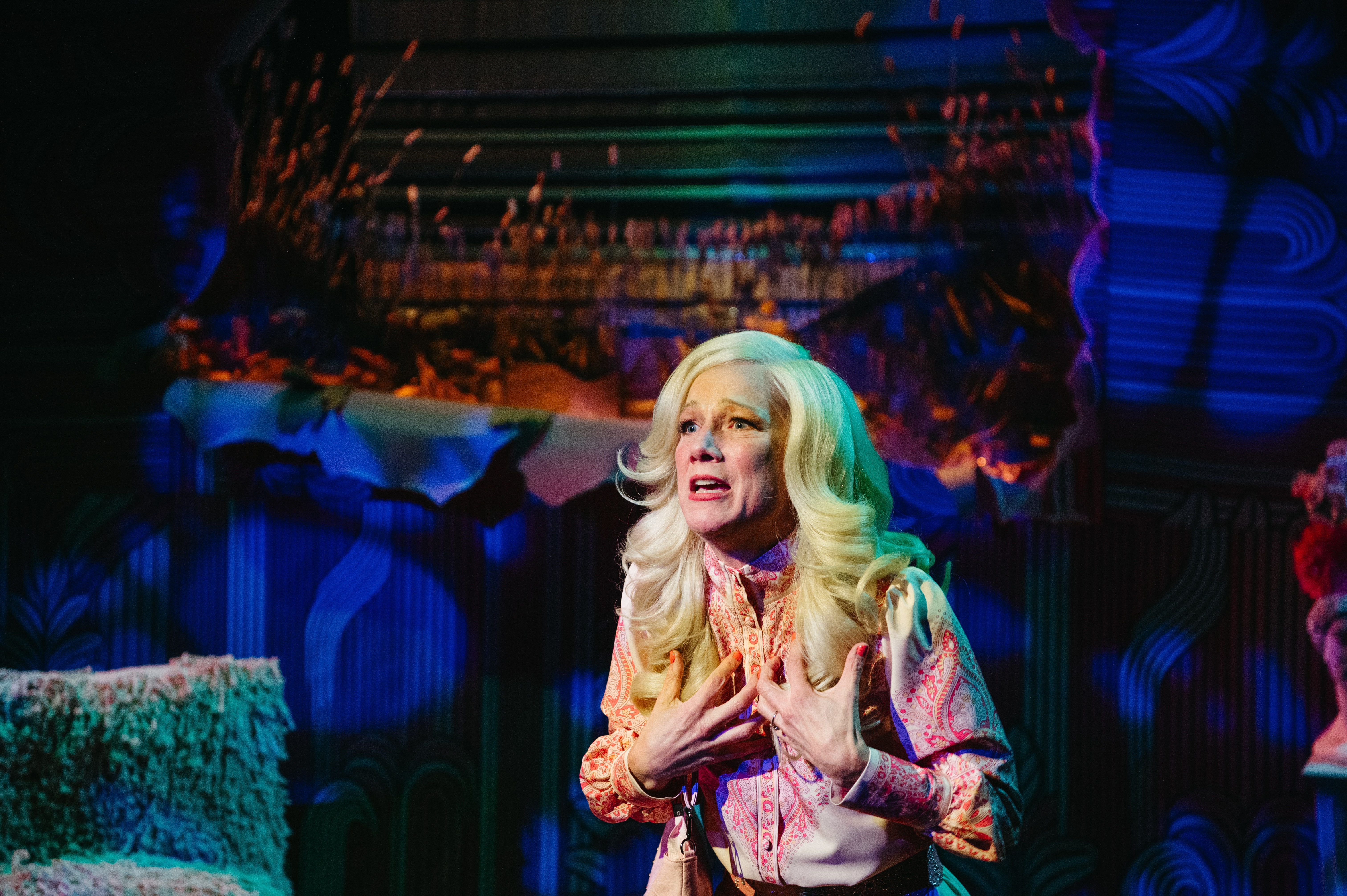
Patricia Zentilli as Trisha Lee in The Pink Unicorn. Images Brianne Jang BB Photographic. Set and costume Trevor Schmidt, lighting Larissa Poho.

The set design (Schmidt) creates the sense of a feminine living-room – even a jug of pink lemonade on the coffee table – in front of a fascinating background with dainty pink wallpaper torn open to reveal a sculptured rural landscape. Lighting (Larissa Poho) and sound (Darrin Hagen) enhance the shifts in storytelling tone and location, through a church service, a downmarket bar, and a protest in the rain. Trisha’s outfit includes boots and a silver-medallions belt over a pink patterned dress and large hair, but it feels contextual rather than caricaturistic (I’m doing a rewatch of the small-town-Texas TV show Friday Night Lights, and she’d fit in there if she wanted to).

Also – parts of it are hilarious! Zentilli is great at delivering funny lines that the character doesn’t see as funny, or doesn’t stop to enjoy. This is no surprise to anyone who’s seen her in various big-stage musicals at the Citadel or the Mayfield,

The Pink Unicorn is both provocative and hopeful. In the author interview in the show program, Forier Edie says that if she were writing it today, she might write a “scarier” version. But I loved the reminder that people’s minds can be changed, one at a time, by really listening to the people they care about. And I appreciated the call-to-action at the end, where Trisha points out to us that doing the hard thing isn’t just for people who are already good at it. I know there are lots of Jos around here, and lots of Elijah Breakenridges. And I know that not all of them have a Trisha in their corner. But Trisha’s story shows that you don’t have to be an experienced advocate to start doing the right thing for someone you care about – just do it.

The Pink Unicorn is playing at the ATB Arts Barns Studio Theatre until October 11th. Tickets are here.

Where You Are – family frictions and affection

Coralie Cairns as Suzanne, in Where You Are. Set and lights, Daniel vanHeyst. Costumes, Leona Brausen. Photo Marc Chalifoux.

I had read Kristen Da Silva’s play Where You Are a while ago. I couldn’t remember the details, just the tensions and affections between two sisters, Glenda and Suzanne, who live together on Manitoulin Island.

In the Shadow Theatre production that opened last night at Varscona Theatre, Davina Stewart plays restrained responsible Glenda, and Coralie Cairns plays Suzanne. With help from costume designer Leona Brausen, we see immediately that Suzanne is the kind of woman who gets up in the morning with last night’s mascara all over her face and a heavy-metal t-shirt along with her pajama pants, and Glenda is someone who always protects her skin with a sunhat and matches her purse to her shoes. The by-play between the sisters shows ongoing disagreements and old troubles but also a core of caring. Suzanne can’t talk to her grown daughter Beth without starting a fight – Glenda recommends that when Beth (Nikki Hulowski) arrives for a visit, Suzanne should just whistle instead of saying anything. We can also see hints of some other unspoken troubles – not overdramatic foreshadowing, but topics that the sisters have agreed not to address. Cairns and Stewart are brilliant together, hilarious in the superficial irritations of shared life while awkward in compassion.

Glenda and Suzanne’s neighbour Patrick (Brennan Campbell) drops in with a mis-delivered newspaper. Both sisters enjoy visiting with the handsome young man – Suzanne also takes the chance to talk him into fixing their shed roof. One of the funniest moments in the whole play concerns the roofing chore, and how Patrick responds to the heat, thinking himself alone.

As I said, I’d forgotten the plot details. After working on Mark Crawford’s comedy Stag and Doe for the last few months, I was laughing out loud hearing Patrick’s left-at-the-altar story and watching him make plans to attend his ex’s wedding.

It was easy to empathize with Beth, an only child frustrated by her mother’s and aunt’s well-meaning snoopiness into not telling them anything. As the play progresses, we also see them keeping secrets from her, all of which eventually come out. I was genuinely moved watching the comedic and defensive characters manage to connect with each other in the end. It felt very real. The script’s treatment of spirituality and religion was delicate and not ridiculous.

I also loved the specific reminders of Manitoulin Island, a beautiful part of Northern Ontario – the hawberry jelly priced higher for tourists, the “bicoastal” relationship one of the neighbours has with a woman from Espanola on the mainland, the way that missing the swing bridge timing can change destiny “like the Island wanted to keep me”. And the mention of a specific Toronto hospital cued me into the nature and severity of one character’s illness, due to memories of a family member spending time there long ago. None of this context is necessary to understand and enjoy the play; it just provided extra richness to my experience.

I couldn’t remember the title of the play beforehand, but now I understand it. Home is where you are, one character tells another.

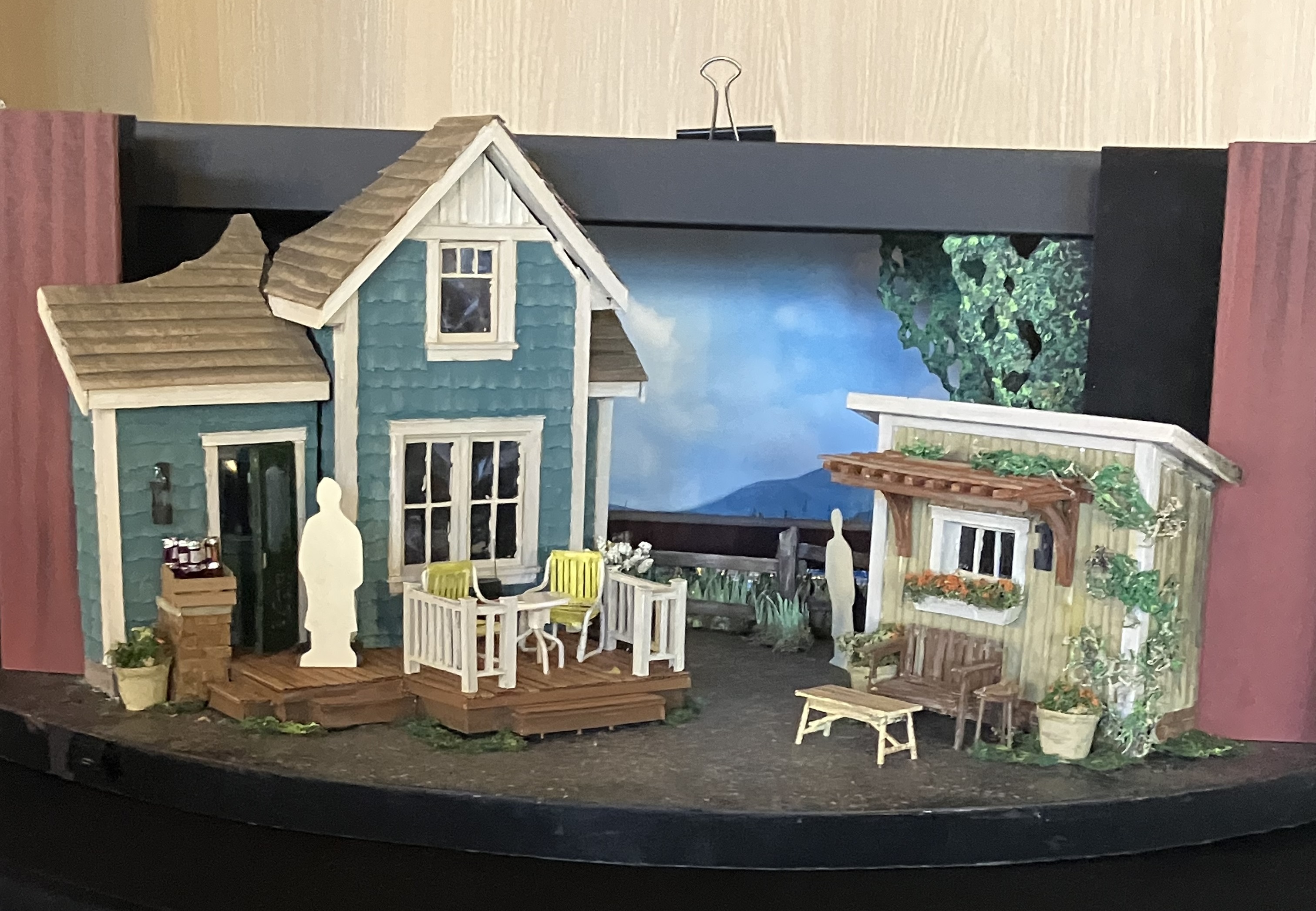
Daniel vanHeyst’s set model for Where You Are, on display in theatre lobby.

Set and lighting design are by Daniel vanHeyst. His typical attention to detail includes weathered shakes on the walls of the house, the rotating vent-stop bar at the bottom of the wooden storm windows, and lighting changes across fields throughout the day and night shown on a cyclorama. Darrin Hagen’s sound design includes many bits of original but almost-recognizable music.

Where You Are, directed by John Hudson with Lana Michelle Hughes as assistant director, is playing at Varscona Theatre until May 18th. Tickets are available here.

Intrigued by my mention earlier of Mark Crawford’s Stag and Doe? It’s playing at Walterdale Theatre until May 3 (tomorrow) with tickets here.

Jupiter – a Colleen Murphy premiere

Ellie Heath, Brian Dooley, and Monk Northey in Colleen Murphy’s Jupiter, at Theatre Network. Set and costume design Tessa Stamp, lighting design Larissa Poho. Photo by Ian Jackson.

In comparison to Colleen Murphy’s other work that I’m familiar with, Jupiter has a happy ending. That is, not everyone is dead, and the ones who are not dead are at least speaking to each other.

Unlike in Bright Burning (published title I hope my heart burns first) or in The Society for the Destitute Presents Titus Bouffonius, or the offstage massacre that drives The December Man, the deaths discussed in Jupiter are spread over a period of more than 50 years, counting things that happened before the play started. Is it still more than one family’s share of problems and tragedies and bad luck? Maybe.

Bradley Moss directs the world premiere of Jupiter, in Theatre Network’s mainstage Nancy Power Theatre at the Roxy. The human cast is all familiar to Edmonton theatregoers: Brian Dooley, Cathy Derkach, Ellie Heath, Gabe Richardson, and Dayna Lea Hoffmann. The newcomer is Monk Northey, a large, beautiful, and well-behaved Field Retriever playing the part of family dog Axel.

There are scenes in three eras, all set in the family’s small house. The set design (Tessa Stamp) is very clever. It feels like peeking in to a private space, glimpsing the kitchen, front hall, and bedroom-hallway behind the main playing space of the small living room. The dialogue and movements were so specific that I felt like I could picture the back door and backyard and basement stairs as well. We can almost feel the sticky-oppressive heat that ramps up the frustrations.

Ellie Heath plays Emma, the daughter of Violet and Winston. She’s 16 in the first era, bursting with enthusiasm for doing science experiments and dreaming of going to med school in the big city. “Why do I have to have such weird kids?” grumbles slaughterhouse-worker dad Dooley. Seeing hints of how her life might unfold, and then seeing her 15 years later and 20 years after that was especially poignant. I’ve often seen Heath play young characters – she was Alice in the Citadel’s Through the Looking Glass, a young girl in the production of Closer directed by Keltie Brown Forsyth, a sulky teenager in Shadow’s production of Queen Lear, and a precocious teenager in one of the Die-Nasty soap-opera seasons last year. Heath’s shift from teenage-Emma to her older self, dealing with the consequences of the night of her brother’s 21st birthday, was impressive, with credible changes in voice and body language.

Violet (Derkach), Toby (Richardson), and Ava (Hoffmann) round out the family constellation, along with various pets onstage and off. Tensions are hinted at, awful things happen. Family members try to cope in the short term, and are permanently affected, as seen in the futures.

If you are a person who wants to be warned about whether specific awful things might happen or be discussed in a play, you should always ask beforehand about a Colleen Murphy play. If you would prefer watching the characters and trying to guess where the story might be going, having that chest-clenching top-of-the-roller-coaster moment of horror and “Are they actually going there?”, then don’t get spoilers. Colleen Murphy sometimes does go there. Different audience members will find different parts disturbing. And I’m not heartless and unmoved; I’m trying to preserve the surprises for people who want them.

Jupiter plays at the Roxy until April 20th, with tickets available here.

Women in wartime: Stars on her Shoulders is inspiring and timely

Meegan Sweet and Gabby Bernard in Stephen Massicotte’s Stars on Her Shoulders. Photo by Marc Chalifoux.

It makes sense that Remembrance Day weekend brings theatre about World War I. But this year Edmonton playgoers are fortunate to have two world-premiere productions on local stages, both by playwrights with Alberta roots. I wrote about The Two Battles of Francis Pegahmagabow in an earlier post.

Workshop West Playwrights’ Theatre is launching its “Saints and Rebels” season with Stephen Massicotte’s play Stars on Her Shoulders, about Canadian nurses in France in 1918. It is directed by artistic producer Heather Inglis. As the play starts, two of the nurses (Hayley Moorhouse and Meegan Sweet) are also patients in a hospital, convalescing from injuries sustained when another hospital was attacked. The story of the attack and of their injuries comes out gradually, as the nurses chafe at inactivity and engage with other hospital staff (Dana Wylie as a starched Scottish Matron, Dayna Lea Hoffman’s Georgie with irrepressible optimism, and Gabby Bernard as Enid, an earnest and well-meaning newbie.)

As Stephen Massicotte pointed out at the playwright talkback earlier this week, the plot is developed through relatively long scenes. Most scenes take place in Emma and Helen’s hospital “hut” or ward, with occasional visits to the Matron’s office or other locations. As we get to know more about Emma, Helen, and the other characters, we also see changes in them. They’re all politically aware, especially Emma (Sweet), who admits to writing her first protest petition at fourteen. So they follow the progress of suffragists (“Suffragette is a slur”, Emma corrects Enid) in working for the right to vote. They point out that the initial move to allow women military personnel to vote, and the female next-of-kin of male military, was an opportunistic move by a government who needed more support for conscription. And one wryly points out that even with a more general enfranchisement,conscientious objectors and immigrants and “Indians” [sic] will still be excluded. Helen (Moorhouse) starts out very guarded, standoffish and sarcastic even with longtime friend and nursing-school classmate Emma. I enjoyed watching her moments of relaxing her guard, and ended up very moved by her pain and bravery.

Emma and Helen want to get back to work soon. Their superiors (both the Matron on stage and the unseen men writing orders) want them to take time to recover, but they also want to present Emma and Helen with medals. This turns out to be a problem, however. Since the Canadian nurses are commissioned officers, they should receive the Military Cross, but the War Office wants to give them the Military Medal, which would be appropriate for enlisted personnel. Female nurses in other jurisdictions are not officers, and acknowledging some Canadian heroines this way would encourage feminists in Britain and other allied forces to negotiate their own status. So Emma protests, and the War Office sticks to their, ahem, guns. The “stars on her shoulders” refer to the lieutenant’s insignia each woman wears, and why they matter.

There’s so much detail to chew on in this play, which wraps up in under two hours. Not too much, and it all fits well with the distinct characters and their experiences. One speech in particular is disturbingly timely this week. I cried when Sweet’s activist character Emma is warning the others that women’s rights can never be assumed permanent – they can all be taken away, and vigilance will always be necessary.

The set is arranged as an alley stage (Brian Bast), with a few rows of seats on two long sides of the convalescent ward. Unlike some alley or in-the-round productions, I didn’t feel like I was missing anything due to where I was sitting. Back rows are on risers, and everyone is close to the action.

Workshop West’s season is their first with completely Pay-What-You-Will pricing, for subscriptions as well as single tickets. Tickets are available here, and Stars on her Shoulders runs until November 17th. I’m thrilled to support this initiative as a subscriber, and I’m excited about the rest of the season too. I think it’s the first time I’ve seen a play program thank donors that include both the Department of Veterans’ Affairs, and the local LGBTQ2S+ institutions Fruit Loop and Evolution Wonderlounge.

Day Three – local artists, new stories

It’s hard to find a connecting theme for the four productions I saw today, except that they were all done by familiar local artists.

Dick Piston Hotel Detective in Prague-Nosis was, as the title suggested, a classic noir tale with a hardboiled detective narrator (Lucas Anders), an assortment of suspicious characters (Mélissa Masse, Sarah Gibson, Dan Fessenden, Dave MacKay), and an atmospheric setting cleverly suggested by description, lighting, and a few set pieces moved around to suggest different locations in the seedy Lakeview Hotel. The published script, by American playwright/television writer Jeff Goode, offers scope for over-the-top humorous character portrayals but seems to have the consistent intricate plotting of a classic noir detective story. Director John Anderson has gathered a cast of clever character actors and talented crew, familiar from Walterdale Theatre productions. ASM Adorra Sergios displays title cards before each scene, in a series of increasingly strange hats. Playing in the Sugar Swing Ballroom (main floor) space, venue .

Rob and Chris / Bobby & Tina is an adaptation of one of my favourite plays ever, Collin Doyle’s Let the Light of Day Through. The playwright adapted it to a 60-minute musical format, along with composer/music-director Matt Graham. The original 2013 production of the play, with Jesse Gervais and Lora Brovold, portrayed the awkward affection and determination of a couple who experience an awful tragedy and … not get over it, but go on. The play is partly recollective, but they act out the stories to tell them to the audience, and it is very funny except when it’s awful. Part of the power of the original experience, for me, was not knowing what they were avoiding telling, until they told it. When I heard that Kate Ryan of Plain Janes would be directing a musical adaptation for the Fringe, I was excited, but also apprehensive. What if it wasn’t as good as I remembered the play? What if the experience depended on not knowing the outcome? But it is very good. It landed differently for me because I was watching for clues, but it was still powerful. The couple (Bobby + Tina when they meet as teenagers, Rob and Chris later) are played by Garett Ross and Jenny McKillop. They do just as well showing the awkward disconnects of a new relationship and a long-term one as they do showing the way that the couple develops a shorthand of shared understandings – the scene of trying to have a role-play fantasy when each of them thinks the other wants something else was hilarious, and the ways they imitate each other’s parents to amuse each other show clearly how they’ve been allied against both sets of parents for years. Graham’s music is suitably poignant and funny and affectionate, as called for, and the simple Fringe-appropriate set design (Trent Crosby) worked. Matt Graham plays the piano live. Venue 11, Varscona Theatre.

Mass Debating was also a musical and also at the Varscona. Trevor Schmidt wrote it and cast frequent collaborators Jason Hardwick, Cheryl Jamieson, Kristin Johnston, Michelle Todd, and Jake Tkaczyk, along with himself, to play junior-high-school debate team competitors. The universality and familiarity of the junior-high-aged themes (an early song focuses on each character’s worries of “Can they tell by looking?” ) were portrayed in a setting of mid-1970s Catholic schools, so the injustices were more overt and seemingly unchangeable than a contemporary context. Although the audiences know that things will get better, the characters really don’t. This dramatic irony provides not just humour but poignant compassion. Many of the unfairnesses focus on the institutional sexism of the society and that Church, and the way that both the boys (played by Jameson, Johnston, and Todd) and the girls (played by Tkaczyk, Hardwick, and Schmidt) express them in their interactions and behaviour. The thoughtless racism of the time was also shown in the segment where Ralph Washington, the Black competitor (Michelle Todd) was required to debate the Against side, on a resolution that racial integration has hurt Catholic education. Unlike Schmidt’s recent successful contemporary story about junior high school girls, Robot Girls, this one does not tie up the plot threads with happy endings. And it shouldn’t. That left me thinking. The music was written by Mason Snelgrove, and the accompaniment is recorded. Some of the announcer’s voice-overs were hard for me to hear clearly – not quite the Charlie-Brown-teacher “wah-wah-wah” but probably funnier than I knew about.

The drag comedy troupe Guys in Disguise have a new comedy, written by Darrin Hagen and Trevor Schmidt, called Microwave Coven. It’s also set in the 1970s, in a suburb, and it starts off with three neighbourhood women in fabulous caftans (Darrin Hagen, Jake Tkaczyk, Trevor Schmidt) preparing for a visit from neighbourhood newcomer Jason Hardwick. Hardwick is adorable as naive newlywed Mary Rose, in crinoline and blonde flip. The premise of this story is less realistic than the troupe’s recent productions like Crack in the Mirror and Puck Bunnies, but the characters are just as much fun. It’s also at the Varscona.

Tiny Beautiful Stories

Michelle Todd, foreground, and Michael Peng, Sydney Williams, and Brett Dahl, in Tiny Beautiful Things. Photo Marc Chalifoux.

If you haven’t already seen Tiny Beautiful Things, the Shadow Theatre production of the Nia Vardalos play currently running at the Varscona, do try to fit it in before it closes on Sunday afternoon.

Tiny Beautiful Things is a set of vignettes portraying the interactions of an advice-columnist, inspired by Cheryl Strayed’s essays based on her time writing as Dear Sugar. Michelle Todd is wonderful as the writer who lands the columnist gig, giving advice from her heart and from her own messy experiences. The character seemed so warm and human and honest, folding laundry in her house wearing mismatched loungewear/pajamas (Leona Brausen costumes), that I wanted to take her home.

The rest of the ensemble (Michael Peng, Sydney Williams, and Brett Dahl) portray people who write to her, and other people in her stories such as her mother. Each of them gets a chance to play people of various ages and genders, adding to the impression that there are a lot of different correspondents. I didn’t ever feel like any of the portrayals were caricatures.

During the performance, I was reminded of several other plays I’ve seen. The first comparison was with Veda Hille, Bill Richardson, and Amiel Gladstone’s Craigslist Cantata, the series of songs and sketches about transactional connections on an internet classified-ads site, but I quickly decided that Tiny Beautiful Things was less frivolous and more thoughtful, as the interactions through an advice-column were about seeking understanding, rather than finding second-hand property, missed-connections on a commute, or a metalhead roommate for a metal house (although that one was so catchy that now it’s an earworm again).

When I realized that the conversations between Sugar and the letter-writers, often physically located at Sugar’s kitchen table or in her living room, were being done without the actors touching, and usually facing towards the audience, I remembered Duncan MacMillan’s Lungs, also directed by John Hudson for Shadow Theatre, with Elena Porter and Jake Tkaczyk as an unnamed couple recollecting the milestones in their relationship, while speaking to an unseen listener and never touching, not even in the sometimes-hot sometimes-hilarious sex scenes. And then in one of Sugar’s conversations, they do touch, and it matters.

Sugar’s advice and support, completely grounded in love, and the heartbreaking range of the ordinary people’s problems, also reminded me of a newer script which none of you have seen yet, unless you’ve been in a rehearsal hall at Walterdale Theatre during preparations for next week’s new works festival From Cradle to Stage. The festival, running May 14-19, presents three staged readings each night, for a total of nine new scripts by local playwrights. I helped select them, so I think they’re all worth seeing – but the one that came to mind yesterday when I was watching Tiny Beautiful Things was Kristen M. Finlay’s Modern Day Saints. In Finlay’s script, ordinary contemporary women struggle to do the right thing in a range of difficult and painful and familiar situations, starting from a student without enough money to pay her tuition fees dealing with unsympathetic bureaucracy. As in Tiny Beautiful Things, the glimpses of compassion and hope in the ensemble vignettes are life-affirming.

Tiny Beautiful Things starts with an electronic tone, and then another – I thought, is that a message notification? is that a piece of original music? and then I thought, Oh, there’s a Darrin Hagen sound credit, I bet it is both. And it was.

It goes without saying that it made me cry. In a good way. It also made me feel grateful for having friends to tell life stories with, and for seeing how crafting an experience into a story helps make sense of it.

Tickets for Tiny Beautiful Things are here. Tickets for Walterdale’s From Cradle to Stage festival May 14-19 are here. Modern Day Saints plays on May 17 and May 18 – but descriptions of all the new plays in the festival, by Bridgette Boyko, Donna Call, Kristen M. Finlay, Grace Li, Shawn Marshall, Madi May, Blaine Newton, Logan Sundquist, and Michael Tay are here.

The unseen Mob

Kristin Johnson in Mob. Photo credit Marc J Chalifoux Photography and Video.

I liked seeing Mob, currently on stage at Workshop West Playwrights’ Theatre’s Gateway Theatre, without knowing much about what to expect. Afterwards, I wanted to talk about it, but I also wanted to give more people the chance to see it similarly unspoiled.

So, if you don’t want to know what it’s about or what happens, I can still give you several reasons to see it, and then you can stop reading. Starting with the names in the credits:

  • Heather Inglis, artistic producer of Workshop West as well as director of this play, has created a coherent season of challenging work, loosely categorized under the theme Borderlands.
  • Three good performers familiar to local audiences: Kristin Johnston, and Graham Mothersill, and Davina Stewart. Each of them portrays a fascinating complex character, not entirely likeable but sometimes funny and often relatable.
  • Designers include Darrin Hagen (eerie atmospheric soundscapes and original music), Beyata Hackborn (a set that starts out with an Instagram-perfect look and turns out to be both functional and symbolic), Alison Yanota (unusual lighting that escalates the tension), and Sarah Karpyshin (iconic costume design).
  • Program credits for Jason Hardwick (choreography) and Sam Jeffery (fight and intimacy direction) provide additional clues to the content in the show and the skill level with which it will be executed.

The action starts with projections, conveying a woman, Sophie, (Johnston) driving feverishly while voices overlap and reverberate in her head. As she arrives with her suitcase at a remote bed-and-breakfast, she is greeted by Martin (Mothersill), cringingly clumsy and twitchy as he over-explains that he’s at home this time of day because he’s lost his job. The visitor stands immobile on the threshold holding her suitcase, responding to his questions but not progressing the conversation. Is she exhausted? Is she hesitant to enter? Why is she there? She’s not giving anything away. Soon Martin’s aunt Louise (Stewart) bustles in with a limp, all aging-hippie style and colourful cane, to smooth over the conversational awkwardness and remind Martin how to behave with guests. The show is described as a thriller – at first I wasn’t sure whether the characters would be realistic or more gothic, whether there would be overt or psychological violence in the isolated-country-house trope or what. I’ve also seen Johnston play a lot of disturbed and disturbing characters on stage in the past few years, from Death Trap to Destination Wedding, Baroness Bianka’s Bloodsongs to We Had a Girl Before You. But the fears explored in Mob are completely realistic and timely. Which is much scarier.

Mothersill’s portrayal of Martin often made me want to laugh – but the menace conveyed by the soundscape and the unfolding story made me feel uncomfortable about laughing – not so much that I was pitying him, but that it might be dangerous to provoke him.

The performance is a bit over an hour and a half long, with no intermission. The script (written in French by Catherine-Anne Toupin and translated by Chris Campbell) has a compelling directness with no unnecessary dialogue.

Beforehand, I wondered why a three-hander would be called Mob. Isn’t a mob a larger angry group? Then I realized that the three people on stage were not the only ones involved – that the internet posters Sophie quotes, in overlapping overwhelming torrents of abuse, are in some ways present throughout, ubiquitous and inescapable.

Mob has a short performance run, ending next Sunday afternoon, November 12th. Get your tickets soon!

Amor de Cosmos, and Puck Bunnies

It’s a little harder to find a connecting theme for these two – Amor de Cosmos: A Delusional Musical is a fantastical recounting of the biography of a not-very-famous figure from Canadian history. Puck Bunnies is a play about contemporary young women who are hangers-on of a local minorleague hockey team. One’s a new work written by Richard Kemick with music and lyrics by local singer-songwriter-actor Lindsay Walker, and the other is a remount from local playwrighting team Darrin Hagen and Trevor Schmidt.

Amor de Cosmos: A Delusional Musical is not in the printed Fringe programs because it was a late addition off the waitlist. And it’s a little hard to describe, but it’s quirky and charming. Cody Porter, who directed the show for its Toronto-Fringe run, stepped into the performing role for Edmonton, which is a treat for his fans here. I loved the way he changed characters as Walker (accompanying on keyboard and narrating some parts from newspaper headlines) flipped him different hats, with physicality, dialect, and eye-twinkles to match. The elliptical/heightened text recitation reminded me a bit of Jonathan Christenson’s work, and was delivered with such clarity that I didn’t realize until afterwards that a lot of it was iambic pentameter. The main character was born into a mining family in New Brunswick, made his way to California as a photographer, and ended up in BC as a newspaper publisher and then politician. I was fascinated by the way the writers included acknowledgements of where this character stood or would have stood on various issues of the day that now we see as injustices (e.g. Indian Act, Immigration Act) and was cracked up by a throwaway anachronism about the right of homosexuals to give blood. Stage 8: Kick Point OSPAC, in the schedule slots showing as Ruby Rocket in the printed program.

The Guys in Disguise play Puck Bunnies debuted at the Fringe in 2017, and the playwrights won Outstanding New Work Fringe at the Sterling awards that season. In this remount, Jake Tkaczyk is playing Tammy, the new mother bringing her baby to the game as a visible reminder of her claim to the team captain Cliff. Tanya, played by Trevor Schmidt, seems to be the one making the rules for the group calling themselves the Puck Bunnies – providing hair/fashion consultation, relationship advice, and decreeing who can sit where. Newcomer Tina, played with adorable well-intentioned bewilderment by Jason Hardwick, used to sit with the “loser girls” but has been invited into the clique as a replacement for someone they’re shunning. As they watch the intersquad game from the stands (the bleachers are facing the audience) we learn more about their lives and their relationships and a lot of it is troubling. As I probably wrote when I saw the original production in 2017, I knew people like this when I was growing up in hockey rinks in the 1970s, so it’s troubling to see the same “put the boys first” mentality in a setting contemporary enough to have Google and selfies and pussy hats. Like other recent scripts by this writing team or by Schmidt, there’s a layer of poking gentle fun at the characters, but underneath there are some pointed messages about society and glimpses of hope. Even for these young women with their limited outlook and unsupportive environment, by the end we see hints of how things can change for them and for the people around them. Stage 11, Varscona Theatre.

Today I’m excited about catching Lesbihonest, Lady Porn, and Agent Thunder. How about you?

Subscribe or Like – real people in the online world

Set for Subscribe or Like, design Stephanie Bahniuk.

The last event in Workshop West’s season is the world premiere production of Liam Salmon’s Subscribe or Like, directed by Kate Ryan.

On entering the Gateway Theatre’s auditorium, the audience sees a simple box set presenting a room in a small basement apartment. But it’s set on an angle, and there is no drapery backing it or surrounding it. One can’t forget that this room is on a stage – and when the lights dimmed and the play was about to start, we could see each actor entering the backstage space from the lobby, before entering the apartment’s front door as the characters. This cannot be an accident (Stephanie Bahniuk, set and costume design).

The characters living in this apartment were a young couple, Rachel (Gabby Bernard) and Miles (Geoffrey Simon Brown). He’s unemployed, trying to find work commensurate with his marketing degree instead of joining her at the coffee shop where she’s a part-time barista, and he has a toothache. Their socioeconomic situation is tacitly illustrated by the fact that the dialogue never considers taking the toothache to a dentist – he treats it with a salt-water rinse and she doesn’t comment. Miles likes to make and share “prank” videos, often involving scaring or surprising his girlfriend. She doesn’t seem to enjoy this. It’s clear that both are unhappy with their lives – it’s less clear whether they are still happy with each other.

Miles continues posting his videos on a YouTube channel, and talks about reaching enough subscribers to make money with it. Rachel co-operates – they talk about whether the stunts work better when scripted or when she is truly surprised – and then she starts adding some of her own content to the channel. They start adding viewers, likes, subscribers. They seem – if not happier, then at least more engaged – and they focus more on how to attract and keep the viewers, making some more extreme choices (including one or two that I could hardly bear to watch).

Another feature of the show’s design was the extensive use of video (Ian Jackson, multimedia design) to show or evoke online content. I think there were nine large LCD screens suspended outside the room, and sometimes the content was also projected across the walls and floor of the apartment. So “the set” is clearly not just the room in their apartment, but also … the internet? The video isn’t just clips from their YouTube channel, but some of the comments.

And this is important, because the comments affect the characters. In one disturbing but credible exchange, Miles explains to Rachel that the trope of misogynistic commenting generating more interest in the channel is a common phenomenon and a good thing for the channel.

When they talk about whether stopping the posts might be a good next step for them as people and as a couple, Miles protests that the channel matters to the viewers. “But they’re not real!“, protests Rachel.

It is very odd to be writing a blog post about this play, wondering if people will read it, and wondering if reading this post will influence them to go see the play. (See it! It’s good! It’s entertaining, it’s horrifying, and it made us stand in the parking lot for ages talking about the issues raised.) While YouTube is not my medium, I know that online communities are real. This … I was going to say corner of the blogosphere, but spheres shouldn’t have corners? … isn’t particularly interactive, but I know it’s still contributing to community. And just as I notice how many people viewed my blog post or Instagram story, liked my Facebook post, or clicked Agree on my Ravelry forum comment, I know that a playwright is a content creator too. Other artistic contributors like actors and designers are also engaged in presenting the work to the audiences in the auditorium. Part of why I blog is that I want the theatre artists to know they have moved me and made me think. And the Subscribe or Like playwright and team did.

Subscribe or Like is playing at the Gateway Theatre (formerly Roxy on Gateway, formerly C103) until June 11th. Tickets are available here.

A gay community and an era and two lives, through ten funerals

Jake Tkaczyk and Josh Travnik, as Younger Jack and Young Maurice, in 10 Funerals. Photo by Ian Jackson, Epic Photography.

Occasionally I am watching some fictional characters on stage (or on screen, or in a novel), wondering what’s going to happen to them next. And suddenly I’m astonished to realize that these characters do not even exist outside of the scenes that I am seeing. That happened to me tonight, partway through the performance of 10 Funerals, Darrin Hagen’s new play directed by John Hudson for Shadow Theatre. I wondered about some things between the scenes, and about what was going to happen after the final scenes had played out, and I had totally forgotten that these characters were not real outside of this script – because they felt so real, so believable, so irritating and stubborn, so consistently themselves throughout the 35+ years spanned by the storyline. Which is particularly impressive, because each character is played by two actors alternating. Young Maurice is played by Josh Travnik and Older Maurice is Doug Mertz, and Jake Tkaczyk and Nathan Cuckow play younger and older Jack, respectively.

One fascinating thing about watching this production is working out which young character grows into being which older one, and learning about why. Some mannerisms continue, and some of the couple’s habits and rituals and petty arguments recur. I won’t point them out, because it’s more fun to notice them.

And at the same time we are watching this particular couple through the years of their life together and the various funerals they attend together, we’re seeing the personal effects of various aspects of gay men’s lives through the last 40 years. Not just the community funerals of the early years of the AIDS crisis, but the experiences of leaving small judgemental towns for cities with their own dangers, the various relationships with families-of-origin, the issue of not having a good word to describe what they are to each other, or the legal recognition of their relationship – and also the bars, hookups, drugs, drag queens, music, and style. Oh, the style! – costume designer Leona Brausen has done an amazing job of capturing the changing fashions in clothing, hair, and facial hair over the periods, and illustrating the differences between the characters, even in the understated situations of dressing for funerals.

Parts of this play are sad. Parts of it are horrifyingly illustrative of how the injustices of our lifetime have not all gone away, but we’ve become accustomed to them. But some of the dialogue and physicality is absolutely hilarious. 10 Funerals is playing at the Varscona Theatre until May 14th – including Pay what you can, Two for one, and Safe Sunday performances. Tickets here or at the door.