Category Archives: Uncategorized

Another couple of days at the Fringe

One of the things I do at the Fringe each year is watch for the little improvements that make things run more smoothly and more fairly.  Like at Folkfest, another 30+ year tradition in Edmonton, the tweaks are small but always done to make things more fair, more convenient, and more fun.  Last year one new thing was a spinning postcard rack in the Arts Barns lobby for artists to leave their handbills on display.  It wasn’t designed ideally for that high-traffic activity, so the handbills often fell out of it, and festival director Murray Utas spent a lot of time picking up spilled handbills and sorting them to return to the rack.  This year, the rack is back, but it has been rebuilt with Plexiglas shields to allow the postcards to be seen and not fall out.  Little things like that.

This year the Playwrights Canada Press booth will be open all week, with staffing help from Concrete Theatre.  And the beer tents take debit and credit including tap, which speeds things up for the ticket sellers and for the patrons.  Little things, but little things that keep improving my favourite festival.

Marv ‘ n Berry Presents: Imagination is a sketch-comedy show performed by members of Rapid Fire Theatre, Nikki Hulowski, Quinn Contini, Mike Robertson, and Sam Stralak.  It’s very funny and occasionally surreal/weird – not quite as odd/eerie as Gossamer Obsessions was though.  Although I had heard many of their punchlines while sitting in on part of their tech rehearsal, I still laughed hard during the show, because good sketches are all about quickly conveying characters and situations which become funnier and funnier.  Not sure what was my favourite – the suburban couple auditioning to be gangsters, the fishing-trip participant with safety concerns, the board-game store …

Mormonic, the Musical  Sister Pratt, Sister Olsen, and Brother Bradshaw have turned the El Cortez basement into a meeting room to host an information session and potluck for people curious about the LDS church, complete with bad Power-Point and excellent songs.  The touch of having the slides be skewed and distorted on the screen as in pre-digital-projector days delighted me with nostalgic detail.  The script and lyrics were written by performers Amanda Neufeld and Jaimi Reese, and the music was composed by performer Daniel Belland, who plays the piano during the show but also sings and acts, which I have not seen him do before.  It is cleverly funny watching the characters’ personalities become revealed and unravelled during their presentation, and the music is appealing and sometimes catchy.

Pompeii, LA This play by Declan Greene is produced by Cardiac Theatre, with Harley Morison (director) and Jessica Glover (stage manager).  The familiar names on stage include Cody Porter, Elena Porter, James Hamilton, Nikki Hulowski, Morgan Grau, and Sam Stralak.  It’s a drama about Hollywood life, switching between scenes to show the challenges and unhappinesses for various characters, from an aging Judy Garland to a former child star trying to succeed in a disaster movie (Pompeii, it’s a metaphor and not) and a make-up artist trying to live her dream.

Prophecy This is another take on Greek tragedy written by Jessy Ardern and directed by Corbin Kushneryk, the creative team behind last year’s award-winning Fall of the House of Atreus, a Cowboy Love Story.  This one focuses on a smaller part of the stories, and on a few women characters:  tormented Cassandra, gifted (under dub-con circumstances) to see the truth and cursed not to be believed, Hecuba the proper queen and the mother of Cassandra, Paris, and Hector, and Andromache the timid and modest wife of Hector.  All characters are played by Carmen Niewenhuis, with clever smooth clues to character change in her costuming, voice, and posture.  And this one is not a funny play, although some of the design and acting is inherently funny.  It is disturbing and provocative and surprisingly topical, gory only in our imaginations, with content/trigger warnings offered in an envelope on the door rather than in a way that lessens the surprises for people who are willing to be surprised.

Shadowlands is a solo show written and performed by Savanna Harvey.  I saw a reading of this script at NextFest in June, before the performer left on her CAFF-lottery tour of five Fringe festivals, so I was excited to see it properly staged.  It’s told in alternating voices of several characters – maybe four, maybe five or six depending on how one counts.  A different prop represents each character, as in the puppetry genre referred to as object theatre – only this show is performed in the dark, with each character being represented by a different kind of light.  I don’t want to tell you much about it, because for me part of the fun of this kind of play is figuring out who/what each character is and how they are going to connect.

With Glowing Hearts:  A Canadian Burlesque Revue is just what the subtitle promises, a revue-style burlesque show with each act based on a woman or women from Canadian history.   The host is Ellen Chorley dressed as Famous Five activist Nellie McClung, and the panty zamboni (stagecrew) is Kiki Quinn dressed as a very cute beaver.  I never know whether to refer to burlesque performers by their stage names or by the names I’ve seen them listed by in other genres, but in this case both are in the program so you can figure out who is who.  Sweet Lady Night is a particularly strong singer, Scarlett Von Bomb is a great dancer, and Violette Coquette and LeTabby Lexington are experienced and talented burlesque performers.  The costumes are fabulous, the choreography is fun, and … and it was not only educational but inspiring, acknowledging the flaws of the historical characters by today’s higher standards of intersectional feminism and challenging the audience to take action.  The finale included a speech by Chorley that made me cry, and a Famous Five transition-to-the-present group dance number that had me clapping and cheering and fist-pumping.

Opera Nuova’s Carousel

Opera Nuova’s two mainstage productions this year are The Cunning Little Vixen, an opera composed by Leoš Janáček, and Carousel, the Rodgers and Hammerstein musical. 

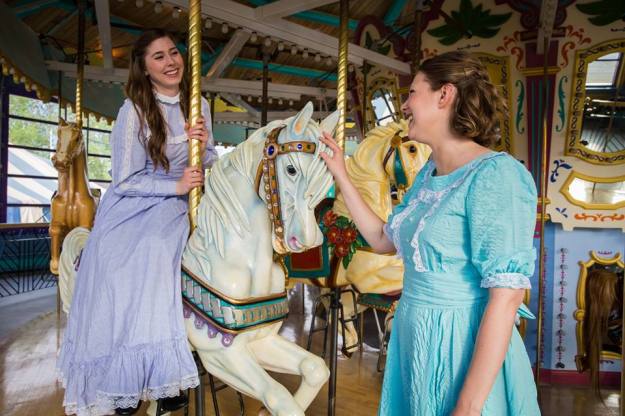
Carousel is set in a coastal village in Maine (Wikipedia says in 1873).  In the opening scenes, a touring carnival has set up outside the town, with various circus-style performers (a strong-man, dancers, a fortune teller, a juggler), carousel barker Billy Bigelow (Justin Kautz in tonight’s performance), and manager Mrs Mullin (Emily Stewart tonight).  The set includes three lovely carousel-horses, turned on a revolve during the opening waltz by members of the chorus.  (Apparently one can bid on the horses by contacting Opera Nuova before the end of the run).  Local mill girls Julie Jordan and Carrie Pipperidge (Krista Paton and Brittany Rae) visit the carousel, but the carnival manager gets jealous when Billy Bigelow pays too much attention to Julie, banning Julie from the carousel and firing Billy.  Both Paton and Rae have lovely soprano voices in the solos and duet setting up their friendship and the story.  Kautz portrays Billy as a cocky flirt, confident in his charm, but with foreshadowing of physical threat in the way he grabs Mrs. Mullin’s forearm and threatens Carrie in the first scenes.

The larger ensemble then gathers on stage for clambake preparations, and the enthusiastic “June is Bustin’ Out All Over”, featuring Olivia Barnes tonight as Nettie Fowler.   This piece is echoed later by “That Was a Real Nice Clambake”, again with delightful choreography.  In between are important scenes advancing the tragic story – Julie and Billy lose their jobs, get married, and discover Julie expecting a baby before they have any money, so Billy agrees to help his no-good friend Jigger Craigin (Nolan Kehler tonight) with a robbery scheme.

After Billy’s death (with a spectacular fall off a pier by Kautz, one of the founders of Toy Guns Dance Theatre), the scenes 15 years later focus on Billy trying to make amends to his daughter Louise (Emily Steers tonight).  Louise’s barefoot dance piece explores solitary childhood joy on the shore with hopscotch, innocent celebration with local boy Enoch Snow Jr (Jordan Sabo of Man Up dance troupe), being picked on by a group of local children and taking petty revenge by snatching one girl’s hat, and then being swept up in a group of performers, the carnival workers of the opening scenes, particularly being drawn to a young man among them.   Later, she confides in Enoch Jr that after graduation she plans to run away with them and become an actress.

One of the most disturbing scenes of the musical is when Billy, granted visibility by the heavenly guides in order to help his daughter, gets frustrated when she won’t take his gift and slaps her hand.  Louise flees to her mother, who comforts her and seems to reminisce almost wistfully about a hit that feels like a kiss.  The underscoring music hints at this being sweetly nostalgic, which is jarring against the horrifying but realistic thought that Julie’s good memories of her abusive husband might be encouraging Louise to expect no better.   The more hopeful ending is that Billy’s spirit enables Louise to take in the graduation speech about not being limited by one’s parents’ failures and not being alone.  We can’t tell whether her happy ending will continue with running away to be an actress, marrying Enoch Jr, or perhaps something better than either.

The lighting and costumes for this production create a muted palette for the modest village and mists off the sea.  Vernacular dialects (slightly different for the carnival workers and the villagers) add to the vintage down-home atmosphere.

There is one more performance of Cunning Little Vixen tomorrow night (Friday 29 June) and one more of Carousel Saturday June 30th, both at Festival Place in Sherwood Park.  Julie

carousel 1

Julie Jordan and Carrie Pipperidge at the Carousel

Tragedy is silly, Happiness™ is not what it seems …

Epic Tragedy is actually neither.  It’s frivolous and delightful, fun even if you don’t know the Greek-tragedy source material very well.  Gerald Osborn sets his story in a taverna in the Ancient Greece of the classic tragedies, but with thoroughly modern tropes like a first date from a dating-site match.  In the smaller roles, Eric Smith is a very feline Sphinx on the prowl, Francie Goodwin-Davies is a favourite as the Oracle, and Landon Shayne Penner shuffles anxiously as a mute slave working for taverna owner James Hamilton (Laws of Thermodynamics, With Bells On, Waiting for Bardot).  Ruby Swekla, Syrell Wilson, dale Wilson, Catherine Wenschlag, and Cat Walsh all bring extensive experience and fine comic timing to the major roles, making this fun and easy to watch.  One more show Sunday afternoon at the air-conditioned Walterdale.

Happiness™ is not easy to watch – at least, it wasn’t for me.  But it is very much worth experiencing.   Cory Thibert and Tony Adams, from Ottawa, perform as a sales/self-help duo making a product-launch presentation to the audience, with help from the technician for their presentation who was played by the technician for their venue.  The real context and the story context kept blurring like that, and it was creepy and effective, because I do want to go to a Fringe show and I do not want to go to a Forum presentation, Amway recruitment, or gospel revival meeting.  I couldn’t figure out whether to engage with the show or hide in case they were really one of the latter.  I loved it.  They have one more show on Sunday evening, at Rutherford School across the road from La Cité Francophone.

Upstairs and downstairs at the Fringe

Kind Hearts and Coronets – I never saw the Alec Guinness movie of the same name, but my father loved it.  The stage version, directed by Ken Brown, is playing at L’Unitheatre at La cite francophone.  John D. Huston plays the Alec Guinness roles as well as miscellaneous servants and executioners, Alex Forsyth plays Israel Rank, the man who grows up poor but knowing he’s only a few deaths from inheriting a ducal coronet, and Julia Seymour plays a variety of other characters including Israel’s love interests, mother, and jailer.  Forsyth’s smug evil leer as Israel’s plans seem to come to fruition is a disturbing delight, a different flavour of bad than characters I’d seen Forsyth play in Deadmonton, Closer, and 7 Ways to Die: A love story.  Last show today, Saturday 2:45

Bella Culpa – Amica Hunter and David Cantor of Portland are A Little Bit Off, the troupe that did the delightful Beau and Aero at last year’s Fringe.  For Bella Culpa, they’re in the Westbury, the big theatre in the Arts Barns, and their stuff is just as engaging and fun to watch in the bigger house.  The two characters in Bella Culpa are servants in a formal household, doing their work of cleaning and preparing for guests, but frequently sidetracked into playful adventures and explorations.   They make clever use of minimal props (buckets, a sponge, a duster, a table) and introduce some impressive acrobatics at beautifully unexpected moments.  They communicate their story mostly through physical expression and action, but occasionally speak a few words in French.  Their tagline describes them as “Downton Abbey meets the Three Stooges”, but I thought afterwards that one of the things I appreciated most about them was that the relationship between the characters was not hostile, not a predictable she-likes-him/he-ignores-her, and not a constant status difference like many physical-theatre/clown duos.  Worth catching (they have two more shows this weekend) and worth watching for in future.

This is Fringe!

Letters from Battle River – I went to this because it got a shoutout at the end of Annotated Autobiography of Leone McGregor, both being narratives about early women doctors in/from Alberta.  Laura Raboud plays the very energetic Dr Mary Percy, who travels from England to work for the Alberta government as a doctor in the Peace country in the 1920s.  I think indomitable would be the appropriate descriptor for this character, of rarely-flagging good cheer, delighting in her life and her work and the country and the people.   My two favourite specifics about this performance were the brilliant use of two wheeled coatracks and a chair to be all the props and set pieces, and the way of handling the racism of the time.  Early on, the character’s narrative (either a series of letters home or one very very long letter home, it’s not entirely clear) is steeped in throwaway racist assumptions about Eastern European immigrants, about First Nations and Metis inhabitants of the land, and occasionally about “Yankees”.  I found it jarring every time this likeable character used racial slurs, although I could see that she was fond of her “Russian” and “Frenchman” and “‘breed” patients and neighbours.  When she began to relate a visit to the “Indian boarding school”, I worried about whether she’d be equally cavalier about the residential school … but fortunately the playwrights had made a different choice (I do not know how much of the text came from the historical artifact letters).  Instead she said something like, it was beautifully light and airy, but of course they hated it, how could anyone like living in a dormitory when they could be curled up with family in a tent in the forest, and then she went on to muse about whether the British Empire was actually wrong to impose their way of life on indigenous peoples.  I did not feel as if the character integrity had been damaged by this viewpoint, and I was comforted that I could still find her sympathetic.

My Boyfriend’s Girlfriend – A new musical by Jamie Price (aka musician Must Be Tuesday) plays in the Telus Building.  It is impressive for a new work by young artists, a fully staged three-actor show with a storyline, songs with clever lyrics and varying melody styles, and musical accompaniment by Price on keyboard and guitar.  The narrative is probably valuable both as a demonstration of queer, polyamorous, and transgender lives for people who are not familiar with these variables, and as positive representation for people who don’t often see their lives on stage.  Just the simple stage business of a character turning away from the audience to take off a bra and put on a tank-top style binder was effective as storytelling and as education, without being enough nudity to distract.  It is hard to plot a story with those goals and show realistic problems and still make the problems solvable, but Price, director Alicia Maedel, and performers Mandi Molloy, Emanuelle Dubbeldam, and Matthew Oliver van Diepen have made a good start.  I could easily imagine this show on a bigger stage with fuller orchestration, a little less didactic and a little funnier or more dramatic, being the next Rent or Avenue Q.  Or it could just be what it is, and a lot of people will enjoy it, see themselves or their friends or family, or learn something.

A Woman of a Certain Age – This was another show full of satisfying representation, with writer/performer Wendy Froberg playing six characters, all women in their late 40s or older, with interconnected lives.  Important common thread was provided by the interactions the other women all had with esthetician Magda, each of them having different reasons for wanting to look younger or look pretty again.  Magda often tried to talk to them about other ways of resolving their problems, suggesting that youth and beauty were not a panacea, but she loses her salon job, and it’s not clear if they don’t like her attitude or her age.  The performance follows all the rules of a good multiple-character solo show, (if you don’t know what they are, this is demonstrated in The Big Fat Surprise) and I enjoyed it.

Gossamer Obsessions:  Wilt – is a set of “parable” sketches, funny and sort of delightfully weird, in a magical or not quite real way, by masters of improv Amy Shostak and Paul Blinov.   Their costumes are reminiscent of fairy-tales, and their stories hover over the abyss between ordinary life and the just plain strange.  The hour flew by.

History + storytelling = autobiography

The first show I watched from the audience at this year’s Fringe was the new work The Annotated Autobiography of Leone McGregor, by Savanna Harvey.  The performer credits for the show listed Kendra Lamothe as Leone, Savanna as The Writer, Vina Nguyen as Freud, and Heather Janzen as The Stagehand, and the performance starts with the Stagehand seated on the stage beside a box of props, putting a script up on an overhead projector and making notes on it as the narrative progressed.  This was an interesting layer, reminding me of lectures of a certain era.  Sometimes I would look at it ahead of what was happening on stage, in the same way that subtitles don’t always reveal the key points of a story at the same time as the French or foreign-language spoken dialogue does.  Sometimes the Stagehand’s presentation would prevent that by covering sections of the page with paper, and I remembered that teaching technique as well.  One page even contributed the inner dialogue of an imaginary reader in a classroom setting struggling to keep up with the text on the page.

But that was just a side thing – most of the storytelling evolved in a fairly linear and visual way, showing the life story of Leone McGregor, born in Saskatchewan early in the previous century to poor parents, attending Normal School at a young age and teaching school to raise money for university, then studying medicine as the only woman in the first medical-school class at U of Alberta, continuing to graduate school in pathology, the only medical research discipline that would offer her fellowships.  And eventually she was able to study and practice her real calling, psychotherapy.  “Until I acquired the word, how could I know what I wanted to be?” the character says.  This fits with musings earlier on, “concept without words, meaning without text, what is the point?” says the Writer, which is funny because this performance (as most) endows the non-verbal with layers of meaning.  The movement piece that expresses young Leone’s being teased and bullied and “just a game” assaulted by classmates, and its soundscape, was evocative and disturbing, as were other movement-heavy segments of the piece.

Leone’s letters (handwritten on the projections, read out by the actors) added pieces of the biography and also demonstrated the importance Leone placed on her friendships with other women, keeping in touch through her travels for career and new husband.   The samples of psychological counselling advice were odd, mostly seeming to include suggestions of resolving the problem by spending money on something – self-care, a romantic weekend, other indulgences.  I was reminded of the newspaper-advice segments of the 1960s in Shout.

I found the story satisfying, and the writing clever but not so clever it distracted me. Karlie Christie’s costuming is also worthy of mention, particularly Leone’s period-appropriate and movement-friendly outfit.  As Autobiography is playing in a BYOV space, it has more performance times than a lottery-venue show, and if this intrigues you, you should seek it out.

And now, back to the grounds!  See you at the Fringe!

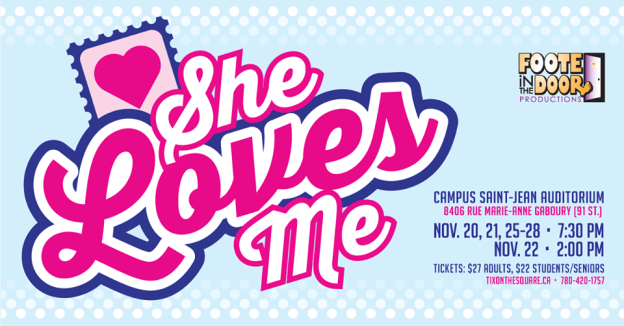
She Loves Me!

The other night I watched a musical that was new to me.  Not new to other people, She Loves Me (book by Joe Masteroff, lyrics by Sheldon Harnick, and music by Jerry Bock) first hit Broadway in 1964, and is opening again next spring.  The Hungarian play on which it’s based was also the basis for the 1998 romantic comedy movie You’ve Got Mail.

The current production, in the Amphitheatre at Faculte St Jean (across the street from La Cite), by Foote in the Door Productions, is directed by Barb Mah, with music direction by Michael Clark.  The setting, a 1930s perfume shop in Budapest, was simply evoked with shades of pink and green in backdrops, counters, and sales-staff shopcoats.  The shop seemed like the equivalent of something like The Body Shop or Lush – selling a variety of necessities and luxuries, focusing on customer experience, and doing a huge business in presents before Christmas.

As in the usual workplace-set story, there’s a cast of characters that includes a boss (James Toupin) with some unreasonable demands and prejudices, an eager-to-please errand boy (Sam Banigan), and a loyal sidekick (Dustin Berube), and in this case there’s also some sub-plot material in the affair between co-workers (Christina O’Dell and Mitch Caddick).  The story soon focuses on Georg (Russ Farmer), a senior employee mistrusted by the boss, who confides that he’s been writing letters through a lonely-hearts correspondence club to Dear Friend.

On a busy day in the shop, then, in bounces Amalia (Ruth Wong-Miller), costumed in a beautiful peacock shade of blue that stands out dramatically from the rest of the show palette, and she quickly talks herself into sales work with a very funny demonstration.  Amalia is also a member of the Lonely Hearts correspondence club, and you can guess the broad strokes of where the story goes from there.

My favourite bits of the show were some of the ensemble numbers with dancing, the stylized couples in the restaurant with the snooty waiter (Kent Sutherland), and the Twelve Days of Christmas shopping crowds in the store.  Six musicians behind the scenes provided accompaniment, atmosphere, and extra entertainment, and the singing was delightful.  Ruth Wong-Miller has a strong pleasant soprano voice and is particularly well cast in this show.  The part with her jumping on the couch in pajamas is also charming.

The last show of the run is tonight (Saturday 28 November) at 7:30.  If you haven’t seen it yet, they should have tickets available at the door, and it’s a lot of fun!

An 18+ Monday night

Last night I saw two burlesque shows and went to the Late Night Cabaret.  I guess there are some themes there.

O Manada had five dancers (all male) performing as various Canadian archetypes, in solos and larger ensemble pieces, and the hosts were a 1975-era Pierre and Maggie Trudeau.  I have misplaced my program, so I can’t tell you who the rest of this Toronto-based troupe are, but Maggie Trudeau was Morgan Norwich.  The show was fast-paced and full of topical humour leading up to a hilarious speculation that followed naturally from the premise of the show.  The performers engaged some audience members (thank you!) and were a lot of fun to watch.

Burlesque-Prov is hosted by local improviser Lee Boyes.  He introduced the two regulars of the show, Kiki Quinn (who is also in Second Breakfast Club) and LeTabby Lexington (who is also in Die-Nasty this Fringe), along with tonight’s guest performers, one called Fiona who was from out of town, and one from Man Up (his name in that show is Tres Debonair but I think he was introduced last night as Givenchy or something like that).  Kristen Welker was stage kitten in a catsuit complete with claws.  Each performer did a solo act to music selected by the audience, with some kind of theme or limitation also provided randomly.  They also had a box of props to use as they chose. I don’t have the background to know how hard this is, but it was also fun to watch.  The show ended with all performers on stage alternating short bits with high energy.

Late Night Cabaret, hosted by Amy Shostak and Julian Faid, included some sketch comedy from Hip Bang, a story from Martin Dockery, a glimpse of Release the McCrackin, another burlesque performer (C.R. Avery, who is in Some Birds Walk for the Hell of It), and some risque country songs from Shirley Gnome.

What with visiting friends in the beer tent in between shows, I almost didn’t put my ID away all evening.  And that’s not a complaint.

Fringe Sunday

Mild weather made it comfortable everywhere on site yesterday, from C103 to the beer tents.  I saw four shows for the first time, as well as working backstage at Death Comes to Auntie Norma and seeing Pinniped and Other Poems a second time.  Death Comes to Auntie Norma plays this afternoon (Monday) at 4 pm, Wednesday at 12:15, Thursday at 2:15, and closing Sunday at 8:00 pm.  The Edmonton Journal gave us 4 stars and the compliment of comparisons with classic 1980s sitcoms like Roseanne and Golden Girls.

I appreciated more of the subtle description and lyricism in Pinniped more the second time through.  Skye Hindman’s writing is epigrammatic, the erstwhile love interest (Alex Dawkins) is wry and controlled, and the three actors playing the ineffectual protagonist (Emily Howard, Connor Suart, Jake Tkaczyk) have intriguingly similar mannerisms.  Suart seems to be portraying JR Morse in the past, Tkaczyk in the present, and Howard … I’m not sure if her persona is a future one, a dream one, or simply another aspect of Morse’s self.

My favourite show so far this Fringe is Kiss Around Pass Around, a delightful solo physical theatre piece by Yanomi.  Unlike in some of the wonderful physical theatre pieces I’ve seen in the past, like Loon and 7 Ways to Die, the character in this show does speak, engaging with the audience in simple accented English to enhance the impression of being juvenile and alien “Are you human?  Are you kind?”  Music and props add to the magic of the character’s journey to find her father.

Deadmonton was written by Andy Garland and directed by David Johnston, and it is very different from the last work I’d seen from this team, the tongue-in-cheek film-noir pastiche And Then, The Lights Went Out. Deadmonton is a serious portrait of what might happen when two serial killers encounter each other, as well as a look at credible backgrounds for people who are compelled to kill.  Carmen Nieuwenhuis and Alex Forsyth are both disturbingly convincing, and the props and effects are simple enough not to pull me out of the story.  There was one supremely disturbing moment when I was excruciatingly aware of a weapon being close to hand for Gil, Forsyth’s character, willing desperately for him not to use it in that particular situation, despite the spoken text not even mentioning that possibility – which is when I realized that the story had sucked me in completely to their horrifyingly twisted reality.

Who Am I:  Unauthorized stories from the Varscona Parkade was a typical Toy Guns Dance Theatre show, unpredictable, playful, funny, and full of unlikely props.  The unusual venue – the top floor of the parking garage beside the Varscona Hotel – meant that they did less floor work than usual and there were fewer classical-dance elements, but they made very creative use of several couches.

No Belles is a storytelling show from Portland Oregon in which performers use a variety of speaking styles to tell the stories of eight women scientists, women who won Nobel prizes and women who didn’t.  The narrative style and content were something between a very good lecture (like a TED talk) and a typical Fringe storytelling, but I was riveted the whole time, and brought to tears twice.

A busy theatre weekend at the end of May.

It’s a week of wrapping up seasons, celebrating, and honouring excellence.  It’s also rehearsals or tech week for everyone who’s in Nextfest, and rehearsal for the Fringe.

And in the middle of all that, Fringe Theatre Adventures hosted another excellent workshop in their Professional Development Series yesterday.  Charles Netto and Mark Hopkins of Swallow-a-Bicycle Theatre in Calgary conducted an all-day series of experiences and conversations about found space and site-sympathetic theatre.  This is the second of the Professional Development series I’d participated in.  If the series continues next year, I recommend them strongly.

The nominees for the 2014-2015 Elizabeth Sterling Haynes awards for professional theatre in Edmonton were announced this afternoon in a smooth and speedy ceremony at the Next Act.  Mat Hulshof introduced the special award winners and Louise Lambert and Ben Stevens read the nominees.  I was able to reminisce about many wonderful shows I’d seen, and marvel about how many more good performances I must have missed, especially at the Fringe.

The Foote Theatre School’s Young Companies closed their instructional year with performances this weekend too.  I missed seeing the Young Musical Company in Chris Wynters and Jocelyn Ahlf’s new musical Measures, but I enjoyed the Young Acting Company’s performance of Robert Chafe’s Afterimage, an ensemble piece that starts out as narrative spoken to the audience by various company members, who seem to be inhabitants of a small east coast community.  This impression of a narrative chorus is continued by having all members of the company sit on chairs at the sides of the stage when not engaged in scenes.  Gradually, I discovered who was who in the story they were telling.  Kieran Dunch was Winston, a man badly burned while trying to repair a downed electrical line, Monica Lillo was the nurse Maggie, and Jasmine Zyp was Lise, who worked in the hospital laundry but seemed to be drawn to the injured man by foresight or some other unusual power.  I appreciated the way the story gradually fitted together, with Leonard (Daniel Greenways) and Connie (Kathryn Robinson) crossing paths with Lise at important points in their lives.  Aidan Burke, Clayton Plamondon, and Jade Robinson played child characters credibly without parody.  Katelyn Trieu was credited as The Storyteller, continuing the role of chorus throughout the play.  I was particularly struck by the plight of Clayton Plamondon’s character, the misfit among misfits, (like Wednesday Addams, but serious).  Brian Dooley directed.

Tonight was the first of three nights of staged readings for the Young Playwrights’ Company.  I watched Winky & Rex by Joshua Wiśniewski and Prodigy by Hayley Moorhouse.  Reading was done by local performers, Candace Berlinguette, Jason Chinn, Joel Crichton, Eva Foote, Merran Carr-Wiggin, Bobbi Goddard, and Lee Boyes.  In both scripts the dialogue flowed smoothly and provided enough scope for the readers to develop memorable characters.   I particularly appreciated the way the writing made each character sound different.  There were also some repeated catchphrases which amused the audience, “as previously stated” in Winky & Rex, and “Obviously!” in Prodigy.

Winky & Rex was a snapshot of life for three uniquely awkward young adults, two roommates and their longtime friend.  It was set shortly after the fall of the Berlin Wall.  That mattered because one character had grown up in East Germany and his father could finally travel to visit him.  I had some confusion early on about the relationship between the roommates and about what country they were living in (I thought they were in the former West Germany but later it seemed to be the USA).

The main characters in Prodigy were three Grade Eight students, angry and disappointed about the cancellation of their band program, and taking out their frustrations on their teacher (Lee Boyes).   The young people had age-appropriate lapses in judgement on big issues (the likely consequences of assassinating school officials for example) but were careful to correct each other on word usage that might hurt people’s feelings, which was charming and credible.

There are more staged readings of new work Tuesday and Wednesday of this week at 7:30 in the Club at the Citadel, pay-what-you-can admission.