Author Archives: Ephemeral Pleasures

Body 13 – “One moment you’re waiting, the next you’re 89”

Body 13 is the Canoe Festival offering from the company MT Space (Multicultural Theatre Space), of Kitchener, Ontario.   It was created by the ensemble and director Majdi Bou-Matar, and they started working on it about four years ago.

It’s an intriguing piece that kept shaking up my expectations, about what kind of story it was going to be, how the story was going to be told, and who the characters were.   The seven characters all spend time on a Canadian beach over the course of a cool-weather day, arriving as strangers but gradually interacting and making various connections.  The impression of shared public space is created early on, first in one vignette where all the performers are representing funeral attendees and then in a set of glimpses where the beach seems crowded with different odd solitary people each doing his or her own thing.  Later, the narrative focuses more on one or two people at a time, while one or two others might be still on another part of the stage.  And “doing her own thing” reminds me that one of my favourite characters in the story was Iman, played by Nada Humsi, a middle-aged woman refugee claimant from Syria.  Those phrases might evoke a picture for you, as they did for me, but I was delighted to have my assumptions shattered, as this character took off not only her headscarf (a kerchief like my mother used to wear on windy days) but her red lace brassiere, told funny stories, made fun of Canadian custom (“So we’ll talk of nothing.  Like Canadians”), and was outspoken and determined.  I was delighted by Humsi’s way of acting out her cat.

Jessalyn Broadfoot was Rae, Iman’s immigration officer, caught between her affection for Iman and her professional duty not to get involved.  Her expressions and body language showed a careful self-contained woman uncomfortable with personal disruptions on the quiet day off she’d been anticipating, and the occasional awkward moments of of a self-conscious white person dealing with neighbours of different cultures were endearing, such as her clumsy Namaste gesture at the Gujarati funeral.

While the narrative pacing of the play was fairly linear, it was often interrupted by movement and music.  Rae did a wonderful dance of helpless rage, accompanied by the composers and musicians (Nick Storring, Colin Fisher, Germaine Liu) as she thrashed her blue beach throw in defiance.  Tristan, a young man from Newfoundland, (Trevor Copp) confided that he had been subject to anxiety attacks since he was a boy at hockey camp, and this launched the two most powerful movement portions of the performance, the first an expression of Tristan’s response to a homophobic epithet on the beach, turning into his sense that he is surrounded by people picking at him, prodding him, and pointing at him while he cowers trying to get the lid off his medication.  Lighting changes and music add to the tension and anguish, and on my second viewing I found myself wincing in anticipation.  In a later part of the performance, Tristan’s anxious response first manifests in all the performers playing hockey, and a gradual shift into a set of physically intimate and blatantly-sexual encounters between and among various characters.

Assaf from Lebanon (Badih Abou Chakra), Rita from India (Pam Patel), Thomas a white Canadian (John Havens),  and Ato from Ghana (Tawiah Ben M’Carthy) turn out to be similarly intriguing characters, and not everyone turns out to be likeable.  Quirks of movement and expression – Assaf’s laugh and his wiping-a-tear gesture, Thomas’s slicking his hair back, Rita’s bearing of the chest containing her father’s ashes, Ato’s stylised jogging – helped to distinguish the individuals quickly.  The one who came to annoy me through the course of the story ended up alone, while the rest of them all found some resolution, as predicted by Ato’s early comment to Thomas trying to find a cufflink on the beach “You will find something, but you will not find what you look for.”  And then the rest of them all shed their clothes, ran behind a screen, and were seen and heard giggling and shrieking the way you do when you’re wading into cold water in the dark with your friends.

The musicians played a variety of instruments, also behind the screen, and I could not identify all of them.  Some of the lighting revealed that all the costuming was in hues of solid clear colours, each distinct.  Also, as an easily-distracted mechanical engineer, I was fascinated to observe the pattern formed when the chest of ashes (visually fine sand) was poured slowly onto a smooth surface.  In water that pattern is called “hydraulic jump“, and you can recreate it easily in a flat-bottomed sink like a stainless steel kitchen sink.  I don’t think the sand formation has the same explanation, but I don’t yet know what the explanation is.

Joel Crichton tweeted a challenge to count biblical references in the performance, and I actually didn’t notice any.  So I guess I lose the challenge, but as the character predicted, I found other things in the performance which I didn’t expect and which pleased me a lot.

Body 13 has one more performance at Canoe Festival, 1:30 Sunday at C103.  Tickets are available through Workshop West and at the door.

January speeds up

After the end-of-year break and an unrushed start to the theatre year, the calendar fills up starting this weekend.  In the meantime I’ve enjoyed watching some improv with Rapid Fire Theatre (Fridays and Saturdays at Ziedler Hall) and with Die-Nasty (Monday nights at the Varscona).

Watch this space for more about Canoe Festival:

  •  Body 13, by MT Space from Kitchener
  • Static Electric, by Mile High Dance
  • Sapientia, by out of line theatre
  • Testament, by Théâtre Archéologique
  • and some of the National Elevator Project (Theatre YES)

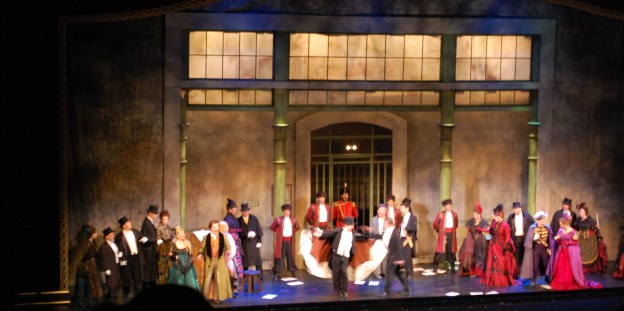
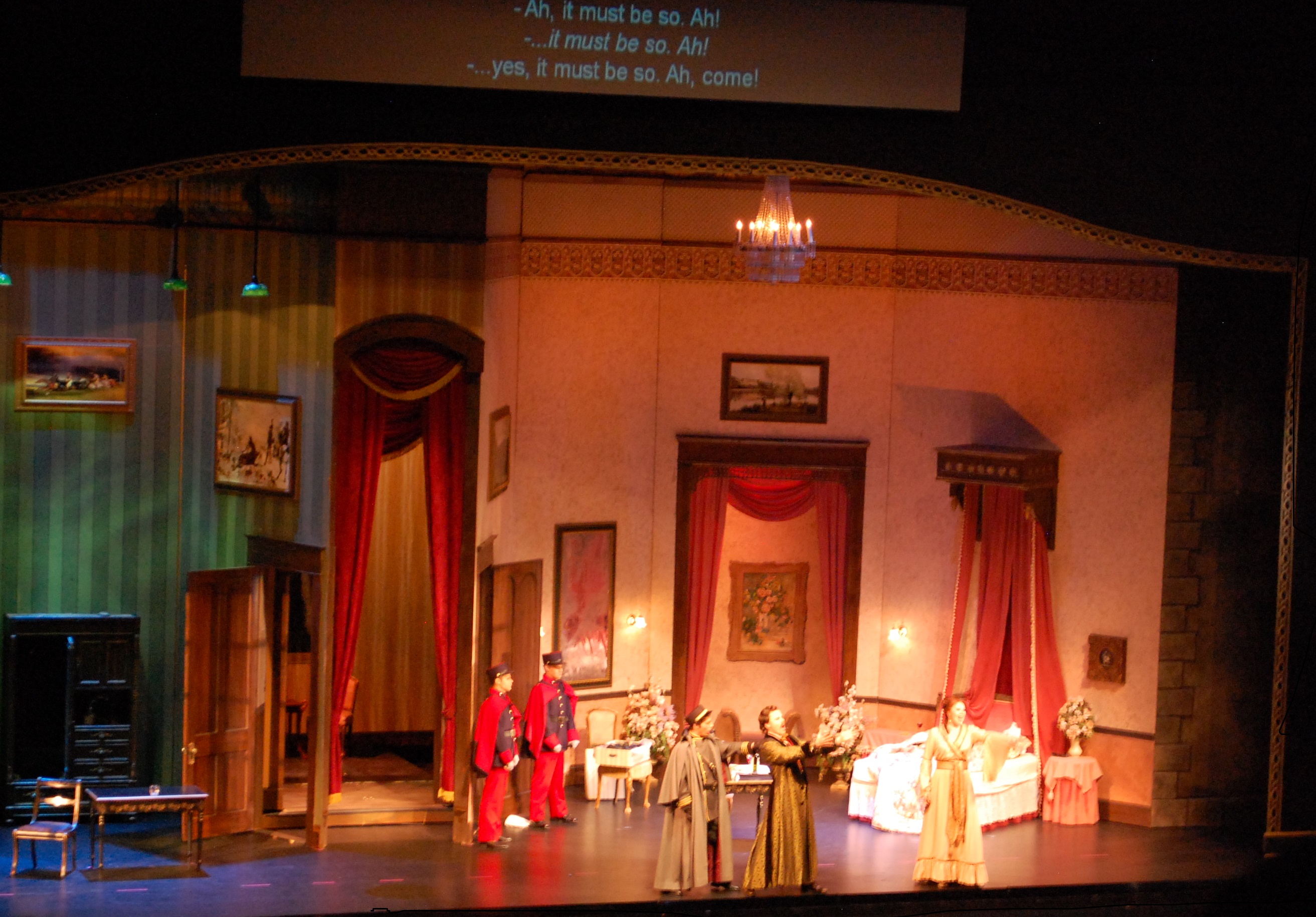
Also I’ll have some thoughts on Clybourne Park at the Citadel (previews start Saturday), Closer (opens Wednesday), die Fledermaus (opens next Friday), and the Josh Ritter concert next Friday in St. Albert.

And then we get into February, where there’s so much going on that  have some hard decisions of what I most want to see, and I’ll be getting into rehearsals for the Walterdale Theatre show that I’ll be helping out as ASM.  I guess I should probably do my laundry and my dishes and get some rest now!

Silence is powerful

Punctuate! Theatre‘s The Silence Project is an original work of theatre that takes place in almost complete silence.   There was no music before the show started, just the hushed talk of patrons getting seated in the darkened room of the TACOS space.  After a prologue with several characters chattering over top of each other and one playing a singing bowl, there were no sounds at all other than the unavoidable sounds of breathing and movement.  This made me very aware of those incidental sounds.

The five performers and creators, Julie Ferguson, Elizabeth Hobbs, Elliott James, Andréa Jorawsky, and Sheiny Satanove, combined to portray about twelve distinct characters.  The main character was wearing a silver mask with some peripheral decoration which made me think of an alien.  The others appeared with various stylized costume elements (an apron, a raggedy overcoat, a cleanroom suit, a sparkly bra) and props (a hipflask, a twinkly ball, a pocketwatch) allowing them to be distinguished.  There was also some effective use of lengths of shiny fabric to hide faces or turn bodies into non-human shapes.  It was the kind of setup which I would have classified as a modern dance piece if there had been background music … but there wasn’t.  Instead there was the rhythm of breath, and heightened awareness of the main character’s anxious and uncertain body language.

Like a modern dance piece, I started by just enjoying the shapes and wondering what I was missing, but gradually I was able to tell myself a consistent enough story that I felt as if I understood.  The repetition and patterns of encounters helped in this.  The confused isolated traveller is first unable to communicate with each of the strangers she encounters, although they all try to connect with her.  (I say “she” and “her” because the performer appeared to be female, but the character did not seem to be strongly gendered.) After the traveller receives a gift enabling her to share a language of gesture with each stranger, she encounters each of them again, learns from each of them, and communicates using the collection of gestures acquired, moving towards a climax involving the triumph of community over despair or death.

The program notes say

We follow our main character, a traveler, as she enters into a dream world in order to escape the isolation of her everyday life.  Through the use of a dream mask, she enters the world of her imagination.  On her journey she encounters a myriad of characters that represent psyche, her hopes and fears.  What will the outcome of this expedition be?  Will our traveler be able to recognize herself in each character and connect honestly in order [to] return as a whole being to her world of reality?

So I was close.

Since attending this performance, I’ve been interested to see some of its techniques echoed in my Rapid Fire Theatre improvisational theatre workshop, where we worked on the skills needed to create an environment without props, miming objects and maintaining consistency with the definitions created by our fellow players.  Similarly, in my Foote Theatre School acting class this week we produced some tableaux, moments frozen in time that could tell a story to our classmates from our facial expressions, body position, and interactions.  Both classroom experiences made me aware of how effectively the performers and show creators of The Silence Project had communicated their emotions and narrative to the audience, without dialogue, scenery, musical background, or sound effects to help them.  It worked.

One measure of how well it worked was that during the performance, I kept forgetting that the silver-faced character was wearing a neutral-expression mask, and thinking I’d seen changing expressions on a painted face.  But it was a mask, supported by very expressive eyes, head position, shoulder movement, and convincing story.  It really worked.

Edmonton Theatre 2013 – what I remember

I saw 104 theatre performances this year, counting repeats but not counting improv shows I volunteered at (about 43 of them I think).  Most of them were in Edmonton (although I also travelled to Toronto, Vancouver, Saskatoon, Red Deer, and Ryley and saw shows in all those places).  And that wasn’t even half of the available theatre here.

The best shows I saw in 2013 were Brad Fraser’s Kill Me Now, at Workshop West in September, and Collin Doyle’s Let the Light of Day Shine Through, directed by Bradley Moss at Theatre Network in the spring.   Honourable mentions would start with The Kite Runner at the Citadel.

The best student shows I saw in 2013 were The Missionary Position, the show written for the University of Alberta graduating BFA class by playwright-in-residence Greg MacArthur, Charles Mee’s Summertime done by Theatre Performance and Creation students at Red Deer College, and the Abbedam (University of Alberta student-led company) production of Tony Kushner’s Angels in America Part 1: Millennium Approaches.

The best musicals I saw locally were The Full Monty (Two One Way Tickets to Broadway) and Ride the Cyclone (Citadel).  I also enjoyed the Broadway touring production Book of Mormon in Toronto.

As for Fringe choices … I’m looking at my lists again and I loved so much of what I saw.  Grim & Fischer Rocket Sugar FactoryRiderGirl.  Dykeopolis.  Nashville Hurricane.  ScratchRent. 

My personal theatre accomplishments in 2013

  • kept studying improv with Rapid Fire Theatre
  • started studying acting at Foote Theatre School
  • competed at the Blue Chair Cafe’s Story Slam
  • served a lot of drinks and red licorice
  • stage managed a Fringe show
  • joined Theatre Alberta and started borrowing books from their amazing library
  • joined Walterdale Theatre Associates
  • was inspired by a lot of performers, directors, playwrights, arts administrators, reviewers, production crews, designers, teachers, and bigger fans than I am.

Finster Finds’ 2013 theatre retrospective is here.  I didn’t peek until after I wrote mine – it’s interesting to see where our favourites overlap, and it’s also amazing to me that there were so many good shows that she saw and I didn’t manage to get to.

What were your favourites this year?

The rest of the Fringe, 2013

The venue lottery for next year’s Edmonton Fringe shows has already been held, with the winners listed here, and other companies are setting up their BYOV (Bring Your Own Venue) arrangements before the BYOV entry deadline in February.  Wondering about what shows various companies are putting together for next summer reminded me that I never did finish posting about the shows I saw at Fringe 2013.  I guess I’m still prioritising seeing more theatre over writing up what I’ve seen. But since everything is dark from Christmas to Epiphany (except Cats at Festival Place, and it sold out before I noticed) I have a chance to get caught up.

I wrote about the shows I saw early, the solo shows, long-form improv shows, a day of stories, the one I stage-managed, and the shows exploring themes of death.  That leaves the following.

Poe and Mathews – brilliant creepy character portrayals by Brian Kuwabara and Emily Windler, ridiculous desert-island premise, fun.

Kilt Pins – this was a sweet sad unsurprising story about teenagers at a Catholic school in Ontario, with friendship and sex and family problems.  It was a contemporary setting, so I was a little disappointed to see the more-traditional story trope of “he (Morgan Grau) pushes her to have sex, she (Sarah Culkin) gives in to get affection and regrets it”.

Kayak – I don’t know why I didn’t find this one more compelling, because the concept was interesting – a woman (Christie Mawer) struggles to relate to her grown son (Justin Kautz) and his new partner the eco-activist (Emily McCourt).

Bombitty of Errors – a rap version of Comedy of Errors directed by Dave Horak.  Having read the script and seen a serious production of the play a few weeks earlier in Saskatoon, I was greatly amused to see how closely the four actors in the rap version could stick to the plot details and in some cases the actual Shakespearean lines, and still be coherent, credible, and very funny.  There was also a bit where they did some freestyle / spontaneous rhyming about audience members, which I enjoyed in part because some of it was directed at me.  The four actors were the two Antipholuses and the two Dromios, but they also played Adriana, Luciana, and any other characters needed – and it worked.

Hot Thespian Action – This sketch comedy troupe from Winnipeg (Shannon Guile, Jacqueline Loewen, Garth Merkeley, Ryan Miller, Jane Testar) made me really happy.  I can’t put my finger on why I liked their material and attitude so much.  Their timing was good and nothing was dragged out.  Their jokes didn’t feel mean-spirited or excluding, and I would not hesitate to recommend them to my progressive friends.  But that might make them sound boring, and they really weren’t.  Rutherford School isn’t the best venue, with several rows of seats on a flat gym floor making it a bit hard to see from the back especially the title cards that they used to introduce each sketch.

In the holdovers at the Westbury Theatre, I also saw three shows.

Weaksauce – this was a one-person storytelling show by Sam S Mullins about a first job working at a hockey camp, and the ups and downs of a first romance.  It was good but not great.

Jake’s Gift – this one-person show by Julia Mackey was an original fictional story of a Canadian veteran of World War II attending a reunion in Normandy, and meeting an inquisitive little local girl on the beach.  The performer’s body language and voice made charming convincing shifts to portray the little French girl, the old Canadian man, and the girl’s very proper grandmother.  The show was very well received, particularly by audience members with old enough memories to find it evocative.

Port Authority – In this story set in present-day Dublin, each of three characters told a story about a current struggle in his life.  Isaac Andrew was a young man clumsily trying to impress a female flatmate.  Cody Porter was a middle-aged man who took too long to realize that his career ambitions weren’t quite working out.  And Keiran O’Callahan was an older man who gets a mysterious package.  They all flailed unhappily, and I felt for all of them.

So that was it for From Fringe With Love.  Next up, Fringed and Confused.

A Christmas Carol at the Citadel

One of my motivations for writing up notes on what I see and posting them here during the run of the show is to encourage other people to go see the show, or to tell people enough about the show that the people who will like it will go.

But in the case of A Christmas Carol at the Citadel, I’m not sure whether I need to do that.  I had the impression that anyone in Edmonton who would like it has already seen it in previous years, and if they wanted to see it again they would already get tickets.  And when I saw it opening night, I guessed that most of the audience had seen it before, based on lots of them seeming to be anticipating the special effects that kept catching me by surprise.  I ended up seeing it closing night as well, and I can see why it’s such a perennial favourite with a long run every December.   It seemed to have a demographically diverse audience, some families with little kids, some families with older teenagers, and adults of all ages.  I wondered whether it was too intense or scary for some of the littler kids, or whether the story was familiar enough to them from other adaptations like “The Muppet Christmas Carol” and readings-aloud that they could get past the scary bits remembering that at the end Scrooge isn’t really dead and neither is Tiny Tim.

The play has a cast of 42 with a lot of the adults playing more than one character. James MacDonald was Scrooge, and he was particularly fun when he giddily realises that he has time to mend his ways and change the outcomes.  Julien Arnold was the ever-grinning Bob Cratchit, and Eric Morin was Scrooge’s nephew Fred.  Belinda Cornish did Mrs. Cratchit very well, conveying warmth and optimism while damping her usual powerful stage presence and upper-class accent enough to be convincing in the role.  Many other names on the cast list are familiar local actors and instructors at Foote Theatre School.

A lot of complicated scenery is moved quickly and smoothly on the Maclab Theatre thrust stage, much of it while our attention is distracted elsewhere.  Some magical special effects delighted me just as much on second viewing.   The ornate costumes clearly conveyed the class distinctions and the era and were fun to look at.

If you missed it this year, I’m sure it will come around again.  But in the meantime, there’s going to be lots of other great entertainment at the Citadel and around the other Edmonton stages in 2014.  I can’t wait.

Long Day’s Journey a long time ago

Discussion of Long Day’s Journey into Night overheard in the audience before a different theatre performance the same month:

“It was long.  And depressing.”

“Yes.  It was supposed to be.  So you understood it.”

The Citadel production of Eugene O’Neill’s famous work that started their 2013-2014 season starred Tom Wood as the father, Brenda Bazinet as the mother, John Ullyatt and David Patrick Flemming as the sons, and Lisa Norton as the maid.

It was set in the 1920s, in the comfortable-looking New England summer home of a middle-aged theatre director, in one of those families where nobody talks about problems directly but circles around and around the unmentionable topics, changing the subject to some problem they’d rather talk about.  One of the unmentionable problems is the younger son’s health.  Eventually they need to admit that he has tuberculosis and needs to take a cure at a sanatorium, but even that relatively blunt declaration may have been slightly lost on a few young audience members because of course they used the word “consumption” rather than tuberculosis.   The mother has another unmentionable problem, which they are coy enough about that it took me a long time to figure out that it was a painkiller addiction rather than a drinking problem.

The play was well done, and in places so credibly intense that I found it difficult to sit through.  That is probably why I didn’t finish writing it up until now.

Pageant, down home style, second try.

Last year I didn’t manage to see Best Little Newfoundland Christmas Pageant Ever at the Varscona, because I left the ticket-buying too late and the only performance I could get to was sold out and I didn’t make it up to the top of the waitlist.

This year I got closer.  I actually saw the first half of the show before looking at the clock at intermission and realizing I’d mis-calculated the time of my later-evening commitment, so I wouldn’t be able to stay til the end.  So I’ve seen half of this show, and next year it is definitely going on my booking list earlier.

Like the Christmas Carol, I got the impression that many of the patrons at this show had seen the production in previous years and were anticipating the jokes, whereas my only familiarity was with the source material.  And I suddenly realised partway through the show that the fussy little girl Alice (Lindsey Walker), the one who gets ousted from her perennial pageant role as Mary by Imogene Herdman’s (Cheryl Jameson) and her brothers’ (Graham Mothersill, Corbin Kushneryk) threats, was missing the point complaining constantly about the way their story wasn’t sticking to the traditional telling of the Nativity, so I had better throw out the little list in my head of all the ways in which this adaptation deviated from the original Barbara Robinson novel since I was missing the point in the exact same way.

Fortunately, I had this realization, or generally got caught up in the show, early enough to be enjoying it.  There was a cast of only seven, including a piano player (Jeff Black), and a little bit of amusing double-casting.  That meant that not all the canonical Herdmans were on stage, just Ralf (“with an F”), Leroy, and Imogene. But it worked out fine.

In written fiction, I am always a little slow to recognize unreliable narrators or other quirks of a first-person point-of-view character.  In the stage version, then, I was surprised to find the narrator character Beth (Kayla Gorman) a bit of a caricature, with distinctive child-like can’t-stand-still and seeming to side with Alice’s disapproval of the Herdmans.  It wasn’t at all inconsistent with the source material; I was just caught by surprise.

Compared to the novel, then, Beth’s mother the pageant director has a bigger role.  Mrs. O’Brien is played with appealing earnestness, bewildered but coping, by Natalie Czar-Gummer.  She incorporates the audience in the story as kids showing up for auditions, and then has each section sing one of the carols as shepherds, wise men, or angels.

The adaptation was originally done by  a company in Newfoundland, with a few changes to the original story like the usual director having collided with a moose, and the church being Catholic.  The performers’ accents are credible and not overdone.  It felt like an affectionate tribute to a culture where lots of Edmonton residents have roots.

Note to self:  if this plays next Christmas, buy a ticket early and block off the whole evening.

Ukelelia, echolalia, wordplay

After picking up my Sunworks turkey at the Strathcona Market, I took in another Snow Globe Festival performance this afternoon, this time Brother Platypus & Sister SuKat Go To The Sea, by Spirot with Khiara Quigley, directed by Murray Utas.

It was poetic, funny, musical, allegorical, and kind of free-associational in a similar way to other Steve Pirot/Murray Utas work, but at the same time appropriate for young audiences.  There was a story with problem and resolution, but it was not entirely plot-driven.   So, it was pretty much what I expected but at the same time enjoyably surprising.

Both performers, Sydney Gross and Steve Pirot, were playing ukeleles and singing. I’ve seen Sydney Gross behind the lights/sound boards lots of times but I don’t think I’d ever seen her on stage, but in this role she was enchantingly childlike but not childish, easy to identify with.  There was a little bit of dance, a little bit of audience participation, and wordplay for both kids (that name rings a bell!  Literally, and every time!) and adults (random apposite quotation from “The Love Song of J. Alfred Prufrock”)  There was also fantastical Matt Schuurman background video.

I’m not going to be able to catch the third show in the Snow Globe Festival, but each of the three plays has one more performance tonight.  One suggestion for Promise Productions:  next year, it would be great if people could find your schedule with fewer clicks – your website has the 2012 schedule and your Facebook event requires a bit of scrolling-down.

“Just because I’m a legend, doesn’t mean I’m not real”

The Snow Globe Festival of Children’s Theatre is happening until Saturday evening at C103 (next to the Yardbird Suite in the parking lot of the Strathcona Market).  There are three plays, and some interstitial amusements between.  The schedule allows for school groups on weekdays, and performances for the general public in the evenings and Saturday afternoon.  Two of the plays in this year’s festival are new work, Boogie Monster Club by Ben Gorodetsky and Brother Platypus & Sister SuKat Go To The Sea by Spirot with Khiara Quigley.  The third is How to Eat Like a Child, the musical based on Delia Ephron’s book.

This evening I enjoyed a performance of Boogie Monster Club, directed by Andrew Ritchie (most recently AD on Bitches and Money 1878) and featuring Ben Gorodetsky, Lianna Makuch, and Todd Houseman, all familiar faces. The premise of this show is that kids from different cultures grow up with different nightmare-monsters, and that those monsters have emigrated to Canada or moved to Edmonton following the kids they want to frighten.  Each of the performers plays an Edmonton kid about ten years old (Vovo from Ukraine, Maggie from South Africa, and Dustin from Hobbema the small mostly-Cree town south of the city), and also plays a monster (Wendigo the malevolent Cree spirit, Baba Yaga the mortar-and-pestle-flying witch, and Tikoloshe, an evil spirit from Zulu mythology that likes to bite sleeping people’s toes).  As the monsters, they wore character masks and cloaks, with appropriate body language, voice, and credible accent.  And they were quite different.  The Wendigo still had power over the child of his culture, and was noticeably the scariest of the three, with big black eyes in a blank mask.  Tikoloshe was almost cute, low to the ground and wearing something that reminded me of a costume from Cats.  And Baba Yaga, of whom I had been quite frightened when I read illustrated stories about her as a child, was hilarious in her attempts to be scarier and her mispronunciations.  I can imagine that she would have had a roomfull of ten-year-olds rolling on the floor and repeating her funny lines and gestures all day or until the teacher made them stop the peeing-my-pants action.   But the part that had me guffawing more was when she stood at the child’s bedside musing about how to be scarier and he sat up and said “You can’t monologue in here – I need my nap!”

Interestingly, the play managed happy endings for both conflicting groups, the children who wanted to banish the nightmares and the monsters who wanted to be scary again.  There was a little bit of summing up the life lessons that struck me as too heavy-handed for my taste, but was probably appropriate for the intended elementary-school audience.   It was clever and fun and had a sweet relevant message.  Tix on the Square has tickets for all three shows, but the schedule for the rest of the festival is easiest to read on Facebook.