Author Archives: Ephemeral Pleasures

Long form improv with UCB

When I asked my improv teachers for recommendations of what to see in New York City, I immediately started hearing recommendations for Upright Citizens’ Brigade, a famous long-form improv company in Chelsea (they also have a theatre in San Francisco).Some of their shows are free (after lining up), and some have advance sales.  So I bought a ticket for an early show Sunday evening called ASSSCAT 3000.  That might stand for something but I haven’t figured out what yet.

UCB has their own theatre, and they have shows every night of the week.  When I got there, there was a line for people with reservations for the show, another line for people hoping to get in if some with resservations didn’t show, and yet another lineup (before 7 pm?) for the free 9:30 show.  And the people in line looked like the people who go to see improv in Edmonton, so I felt right at home.

The performance space is below ground level, and the ceiling is a bit low, but it is otherwise an excellent space to do shows with audience connection.  There are five rows of seats on three sides of a medium-size stage.  They sell pop, Pabst Blue Ribbon, more interesting beer, and the textbook for their improv classes.  (They apparently also sell t-shirts but they were sold out this week.)

The way ASSSCAT 300 works is that a guest monologist gets a word from the audience, then tells some stories provoked by that word, and then the troupe does several scenes inspired from that monologue.  After a while the monologist tells another story, they do more scenes, they have intermission, and they do it again.

The guest monologist for the show I saw was Scott Auckerman, a self-effacing charming man with a dry wit who is a leading light in the UCB Los Angeles company.  (Imagine if David Francey the Scottish-Canadian folksinger was doing improv.)  And the evening’s host, who also participated in the scenes, was Amy Poehler (who I know as Leslie from the TV show Parks and Recreation, but she’s also been on Saturday Night Live and other comedy things I think.  (Did I mention that I was in the second row?)  When she came out to start the show, lots of people cheered and squealed, and others whipped out their cameras but she made them shut off their cameras.  So I guess it was kind of a big deal to other people that she was there too.

It was a very funny show.  It was risque without being in poor taste.  Four of the seven improvisers were women.  I didn’t catch everyone’s name in the speedy introductions, but I particularly enjoyed Tami Sagher, Shannon O’Neill, and another fellow who said he was out of practice.  I think probably Anthony Atamaniuk, and Chad Carter were also performing.  There were stories about working as a Disneyland character, applying to homeschool/college and not getting in, having a lesbian foursome, trying to date when stuck with a not-cool friend, a Disney funeral, auditioning to be a princess, a restaurant specialising in last-dates, and other amusing scenarios.

I would definitely see them again.   I’ll link their website when I get back to a more familiar computer.

Kinky Boots!

I keep meeting interesting people at the theatre, not just in Edmonton but now on Broadway too.  Tonight I enjoyed some wonderful conversation about theatre and life and as a bonus, one of the people I’d been talking to pointed out Giorgio Armani returning to his seat after intermission.

Tonight’s show was Kinky Boots.  When the movie of the same name was new, I saw it and thought that it was pleasant, but just part of that subgenre with Full Monty and Brassed Off, where plucky English working class factory workers cope in a post-industrial world, and also bore some similarity to Billy Elliot as well as Full Monty in discussing how definitions of masculinity need to change in that world.

But I followed recommendations I’d been hearing from friends and from theatregoers I met earlier in the week here, and lined up at the TKTS same-day discounts booth this afternoon to get a ticket to the musical version of Kinky Boots, book by Harvey Fierstein and lyrics and music by Cyndi Lauper.  And I was not disappointed.  I liked the musical a lot more than I liked the movie.  The two main characters, Lola (Billy Porter) and Charlie (Andy Kelso), both grew up feeling like they’d let down their fathers in wanting to be themselves, but both ended up using the skills they learned from their fathers in finding their own destinies.  I loved how the ensemble seemed credible as factory workers, men and women of a variety of ages and body types.  An article in the Playbill pointed out that the women at the factory gradually dress in brighter colours as they spend more time with Lola, which I hadn’t picked up on.  I loved how the finale at the Milan footwear show had everyone wearing different spectacular thigh-high boots.  And I loved the glimpses into design problem-solving, with problem definition (male performers need sturdier stilettos than the ones available for women), iteration (burgundy boots with a low heel are comfortable but not acceptable to the target market), group idea generation (Charlie and Lauren mostly), and prototyping.

The set was full of moving bits shifting around to be inside the factory, outside the factory, in various pubs and the drag queen nightclub, etc.  And there was some impressive use of conveyor belts.

Kinky Boots has been running on Broadway for about a year.  It won a bunch of Tony awards last year and is about to go on tour.

Having watched costumer friends struggle to assemble enough sandals to outfit the cast of Funny Thing Happened on the Way to the Forum, I’m guessing that the footwear will be one big obstacle to eventual local productions of this show.  Maybe MTI will rent the boots along with the books and orchestra scores.  Meanwhile – see it here.  It seems to be available at TKTS most days, for 40% or 50% off the face value of the tickets.


Casa Valentina, a new play by Harvey Fierstein

Casa Valentina opened this week after a few weeks of previews, at the Samuel J Friedman Theatre (Manhattan Theatre Club).  It’s been nominated for Best Play for the 2014 Tony Awards (the nominations came out a couple of days ago).

I saw it from the mezzanine, at a midweek matinee.  Many of the people sitting near me turned out to be very frequent Broadway theatregoers attending alone. “I just couldn’t live anywhere else!” “These plays would close if it weren’t for women in the audience, and women writing cheques!” Some of them had opera glasses like my grandmother’s.  They gave me lots of recommendations  and heads-ups about what else to see, where to sit for various performances, and so on.

Casa Valentina is set in 1962 at a rustic resort in the Catskills, a safe meetup spot for cross-dressing men to spend a weekend living as their “girls within”. The resort is run by George (Patrick Page) and his wife Rita (Mare Winningham, also nominated for a Tony).  George’s alter ego is Valentina.  During the play we hear that George and Rita’s marriage, the second for both, is unusual in that Rita not only knows about George’s cross-dressing but accepts it.  In an endearing scene early on, we see Rita (who runs a wig store too) helping George prepare for his transformation to Valentina to greet the guests.

The other visitors have families who don’t know or families who know but don’t accept.  The visiting activist who has served time in jail for cross-dressing (Reed Birney as Charlotte) urges them to go public, but also to improve their group’s chances of being accepted by signing affidavits to say that they are neither drag queens or homo-sexuals.  The anti-queer sentiments that he expresses assuming that they will be shared by the other characters had the 2014 audience gasping and hissing, until the line “Fifty years from now, when homosexuals are still scuttling about as the back-alley vermin of society, cross dressing will be as everyday as cigarette smoking.” at which we all cracked up laughing.  Genius.

There was also lots of audible audience sentiment (but of the “awww” kind) directed towards Jonathon/Miranda (Gabriel Ebert), a young high school teacher making a first visit to the resort and a first outing in women’s clothing outside of the basement at home.  He explains that his wife found it hilarious when he tried on her wedding gown on their honeymoon, but he didn’t think she’d laugh more than once so he never told her or showed her again. And the transformation from Jonathan to Miranda when Miranda appears for dinner isn’t nearly as impressive as Miranda’s subsequent makeover with the help of the other characters, from an awkward ashamed young woman in shapeless dress and limp shoulder-length straight hair, to a delighted fashionable confident young woman and the centre of attention.

I loved the set design for this play.  It created the impression of an old-fashioned resort with weathered wood, porches and decks and lots of stairs.  It also created the impression of lots of cozy small rooms for the guests, using some shifting staircases, the hints of eaves, and lighting on four or five mismatched dressing tables in different corners (because of course the important thing about the bedrooms at this resort isn’t as places to sleep, but as places to get dressed up and made up).

This play is making me think about a different side of LGBTQ history, but also about how oppressed and threatened people can isolate themselves from other marginalised people in an attempt to be accepted, and why that’s problematic.


Book of Mormon at the Eugene O’Neill Theatre on Broadway

Book of Mormon was the only show I’m seeing on Broadway this trip that I’d already seen.  (I’d seen the touring production when it came to Toronto last spring.)  I loved it then and I loved it here. And I’ll definitely see the Broadway Across Canada production when it comes to Edmonton next season. The dancing was even better than I’d remembered and more of the songs had interesting choreography, even Hello! right at the start.  I was amused that the little bits of product placement in the Salt Lake City backdrop still included Tim Hortons (and I wondered whether this coffee shop chain is particularly successful in a city where lots of people don’t drink coffee).  Elder Kevin Price was Nic Rouleau, Elder Arnold Cunningham was Ben Platt, and Nabulungi was Syesha Mercado.  None of them were from the original cast but the show Playbill said that they’d all played or understudied in the roles elsewhere first.  All of them were good singers, actors, and dancers, and Nic Rouleau had a really great smile too.

I also figured something out which was probably obvious to everyone else who had seen the show before.  See, after I saw it in Toronto I looked at the headshots in my program book and realised the cast didn’t include any white women – but I remembered the scene with the missionaries’ mothers and fathers seeing them off at the airport, and the Mormon-history narrative with pioneer couples.  I couldn’t figure out whether some of the Black women in the cast had done those parts with wigs and I had just seen them as white, or what.  Well, this time I paid more attention – and the white men in the chorus of missionaries also play all the white women.

Again, I loved the staging and choreography of Spooky Mormon Hell Dream, for being terrifying, original, and pointedly ridiculous, all at the same time. The flamboyant / ironic choreography of the missionaries’ chorus numbers was also one of my favourite parts of the show.  Elder Cunningham’s names for Nabulungi definitely didn’t include Nanaimo Bar this time around, so that confirms my hypothesis from Toronto that the actor must have the freedom to improvise that a bit and change from show to show.

At the show I attended, there weren’t any real missionaries outside.  But as in Toronto at one of the Mirvish theatres, there were lots of souvenirs for sale, and lots of patrons who knew the show well.  And I’ll have to check my program from that production to be sure, but I think that possibly a few of the actors from the touring production that I saw might be in the Broadway cast now.  Otherwise, it’s unusual for me (with most of my theatregoing limited to Edmonton) to be seeing a good show without recognising any of the performers.  Perhaps that will change here too, since I hope this is not my last visit to Broadway.

Mothers and Sons – a new Terrence McNally play

The playwright Terrence McNally’s credits include Kiss of the Spider Woman (on next year’s Two One Way Tickets to Broadway season schedule), Love! Valour! Compassion!, and The Full Monty.  His new play, in its first Broadway run at the Golden Theatre, is Mothers and Sons.

Tyne Daly, of TV’s Cagney and Lacey, plays a mother coming to New York to visit the former partner of her dead son.  As the story starts, Katharine (Daly) is gazing out at the view over Central Park from a charming apartment, rigidly still in fur coat and handbag, while Cal (Frederick Weller) looks out beside her.  He is slightly more at ease because it is his apartment, but you can see immediately that the two are not comfortable together.  And the painfully familiar story unfolds, with the history between them of Andre’s mother having disapproved of his life and their relationship, now wondering about connecting with Cal but still angry and grieving and, well, squeamish.  I admired McNally’s writing and Daly’s acting in showing that resolution is not simple after years of hurt, especially for stubborn people.  It seemed very credible.  Cal’s currrent husband, Will (Bobby Steggert), is significantly younger than he is, and this allowed the playwright to explore some concepts of the differences between gay men who lived through the AIDS crisis years and gay men who were born later, who expected parental support and children and marriage.  The fourth actor in this piece is Grayson Taylor, playing Cal and Will’s 6 year old son Bud, with age-appropriate candour and enthusiasm.   The fathers are thoughtful parents, careful about language and devoted to their son.  Cal and Will are both protective of each other, recalling the years of Katharine’s rejection of her son, but Will is also understandably a little jealous of his husband’s history with Andre.  And as Katharine thaws slightly in her interactions with Cal, Will, and Bud, we learn more of the complexity and unhappiness of her own history, and her wry ability to laugh at herself and occasional glimpses of bereavement allow the other characters and the audience the opportunity to forgive her to the extent they choose to.  (I had a flash of recalling Tevye in Fiddler on the Roof, having abandoned his youngest daughter after her too-outrageous choice of partner by saying he can only bend so far, then sharing eye contact with her and her husband as they are exiled.)

I was on the edge of my seat gripping my program in the dark and frequently taking off my glasses to wipe away tears of recognition, so the only line I wrote down was “Maple syrup doesn’t recognise state lines” (about one man’s family’s sugar bush in New Hampshire).  But there were lots of better ones.   Tyne Daly is amazing in this show, and the other actors are strong enough to keep up with her.  I hope it will play for a long time, and I hope it will lead to a production in Edmonton someday.   You should see this show if you like portrayals of complicated older women, troubled families, happy families, queer history, New York City, or credible children who are realistically charming. Or if you’re already a fan of Terrence McNally or any of the actors.


Avenue Q off Broadway

The musical-with-puppets Avenue Q is going to be part of next year’s Citadel Theatre season. Having just seen it off-Broadway, I’m looking forward to it even more than I had been.

It reminded me of Rent ( in being about a small community of struggling young people in New York City, but not sad), of “St. Elmo’s Fire” (being about the anomie of post-graduation), and of, well, “Sesame Street” for grownups.  This was a more effective mix than you might expect if you haven’t heard of the show.  Three of the seven performers play humans, Brian a wannabe comedian (Nick Kohn), Christmas Eve a wannabe social worker (Sala Iwamatsu), and Gary Coleman yes that Gary Coleman (Danielle K. Thomas).  The other four performers operate various Muppet-like characters, while on stage in full view mimicking their alter egos’ gestures.  Darren Bluestone plays Princeton the lead, as well as Rod who bears a distinct resemblance to Bert-from-Sesame-Street.  Veronica Kuehn plays Kate Monster the other lead.  The other two puppeteers are Maggie Lakis and Jason Jacoby.

It’s a fun show, the songs are catchy, the humour is topical and sometimes pointed (“Everyone’s a Little Bit Racist”), and the characters’ problems are very easy to identify with.

As someone who grew up with Bert and Ernie, and then who enjoyed speculating on their slashy subtext, I particularly enjoyed the subplot of Rod and his roommate Nicky, and how the writers managed to find both a happy same-sex romantic ending and a respect for non-sexual friendship.  I couldn’t think how that story would work out, and it did.

There was one bit of audience interaction that made me wish for once that I was sitting on the aisle – especially when their pass-the-hat came up with a Metrocard.

Avenue Q is playing at New World Stages, a new-looking complex of five underground performance spaces just north of Times Square on 50th Street between 8th and 9th Avenues in New York City.  There are often discount tickets at TKTS.  And it will be playing at the Citadel Theatre in Edmonton next winter.  I’ll be there for sure!


In the Heights! Scona Theatre production at the Westbury

This year’s big musical by the Strathcona (High School) Theatre Co. is In the Heights, Lin-Manuel Miranda’s creation with book by Qiara Alegria Hudes, which opened on Broadway in 2008.   It was a good choice for this company and the venue (Westbury Theatre), where a huge crowd of exuberant performers and an interesting detailed set had enough space to tell the story and the risers were filled with parents, friends, and members of the local theatre community.  The Heights refers to the north Manhattan neighbourhood of Washington Heights, a mostly-Dominican neighbourhood. The set for the Scona production had two three-story brick buildings flanking some steps and an elevated walkway at the back of the stage, then a projection screen showing views of the bridge in the background.  The main floors of the buildings were small shopfronts behind metal blinds (“grates”), a beauty salon, a bodega or convenience store, a car service (dispatched taxis) and one graffiti-marked storefront that just stayed closed.  That was never mentioned, but it added to the sense of a neighbourhood in transition.  Upstairs were windows and balconies, which usually had people hanging out of them or leaning on them or looking down from them.  My first thought on looking at the set was that it reminded me of Sesame Street, because that was the only place I’d seen that kind of streetscape as a child.  (That and my brother’s Fisher-Price village.) The main characters are introduced by the young bodega owner, Usnavi (Aidan Burke), whom I thought was a particularly strong all-around performer in this show.  Usnavi’s young cousin Sonny (James Kwak) is an amusing comic foil.  The manager and employees of the beauty salon (Siobhan Galpin, Christina Nguyen, Jade Robinson), struggling owners and ambitious worker of the car service (Kirkland Doiron, either Monica Lillo or Jocelyn Feltham and Evans Kwak), and “everyone’s abuela” Claudia (Manuela Aguerrevere) all have big enough parts that we get to know their stories.  The female lead is Nina (Olivia Aubin), daughter of the car-service family, who is returning home after her first year at Stanford University. I was also impressed by the dance moves and general stage presence of the actor playing Graffiti Pete, but there were two performers platooning in the role and no sign in the theatre telling which one we were seeing.  Either Robbie Wickins or Michael Sulyma.

There were at least 65 energetic performers in the cast as well as a pit band of 14.  This meant that there was always lots to watch, although the ensemble members did not distract from the important plot points or lead character solos.   The Latin dancing in the nightclub scene was great, and the large-crowd dancing in the song “96,000”.  Jordan Mah is credited as AD/ Assistant Choreographer.  Linette Smith directed and choreographed, and the music director was Jenn McMillan. I thought this show was an ideal choice for this company, taking advantage of not only some talented young individual performers but the depth of talent and enthusiasm allowing the director to create a joyful busy community in a high-density neighbourhood.  The story was universal enough to grasp without knowing anything else about the demographics (business owners struggle in a shifting block, city utilities are unreliable in a disrespected neighbourhood, and there is a lot of pressure on the young person who has the chance to succeed outside.)

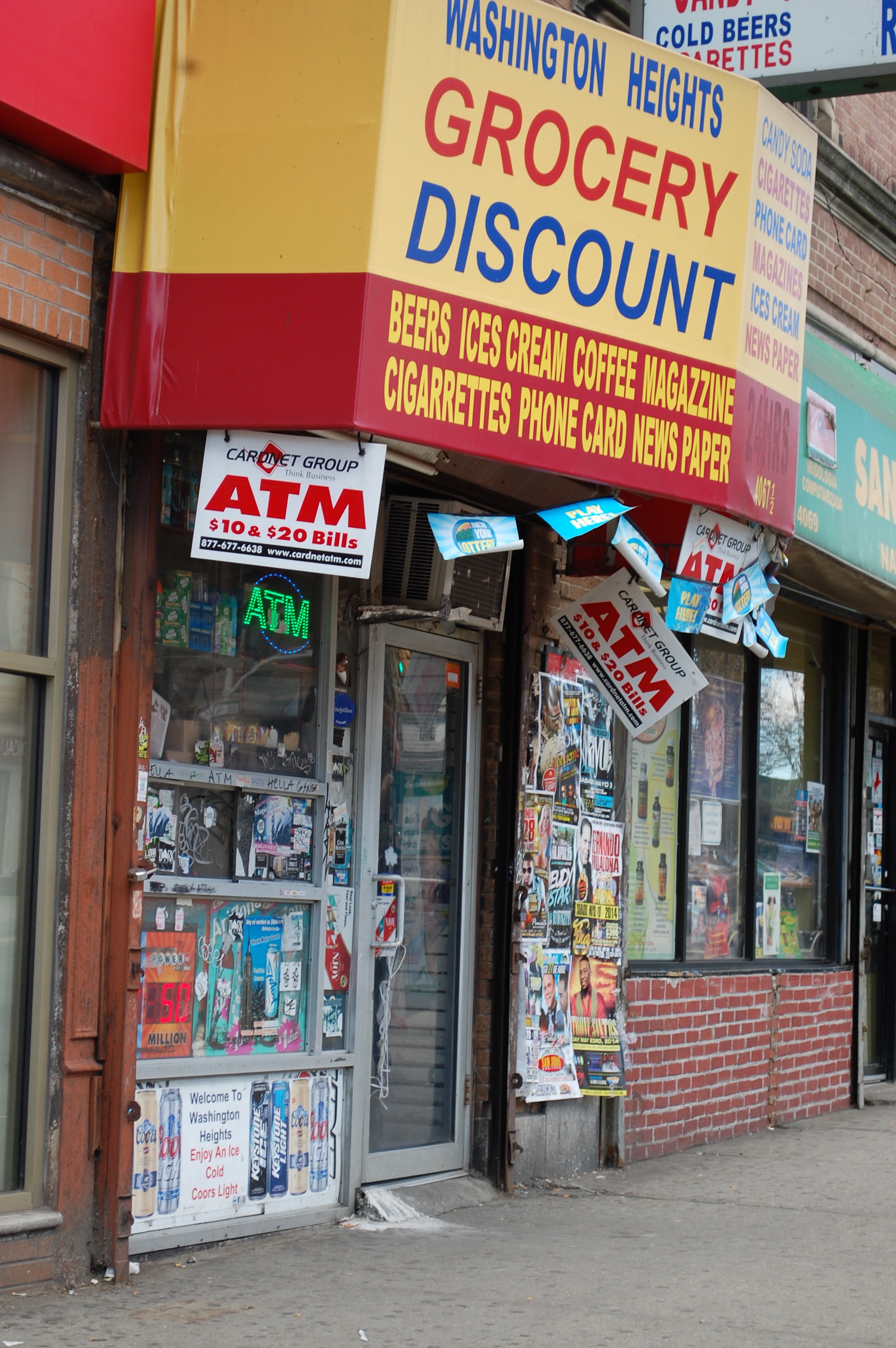
Attached are some recent photos from the real Washington Heights neighbourhood in upper Manhattan, NYC.  You can see the grates over closed stores, the convenience store, and the grey and black fire hydrants.  Don’t expect this level of background research for all my theatre reviews (especially the one set in Uganda!) but I loved having this prep for my NYC vacation and finding the connections.  And now, back to Broadway!

image image Subway to Washington Heights

Skin Deep: self-created, site-specific, scenes, stories, and sculptures

The last performance assignment on the curriculum for the 2014 graduating class in Theatre Performance and Creation at Red Deer College was to create and perform some site-specific work off campus in some space not normally used for theatre.

The class chose the Red Deer Lodge hotel, and took advantage of several different spaces around the central courtyard of the hotel, starting in the lobby and leading the audience around.  There was a general theme of self-discovery, exposure, and the choices of how much to reveal, but the various scenes and vignettes used a variety of techniques and tactics, giving the performance some flavour of a showcase of skills developed.

Continuity was maintained by having Julia Van Dam as a guide.  Although she had a challenging trickster demeanour, it was reassuring in an apparently unstructured situation to see her red-gloved figure glide up and point us to where we should go next.  After some bits in the lobby of the hotel, the audience members were led to explore various glimpses around the courtyard, fights and dances and conversations, and then directed to a murder investigation in a hotel conference room.  That was good to have early on the program, while the audience was feeling uncomfortable with what was expected, because the characters (Wayne DeAtley, Victoria Day, Chase Cownden, JP Lord, Bret Jacobs, and Julia Van Dam) were easy to identify and the narrative arc straightforward.

After that, things got weirder, but we got more comfortable with it.  Some of the scenes took place in hotel bedrooms – Jen Suter and Jessica Bordley did a powerful invocation of tormented teenage girls in a scene that I thought was probably called “So Fucking Angry”, and Brittany Martyshuk and Jake Tkaczyk had an interesting concept of speaking together in the solitude of separate rooms with the help of crackling baby-monitors.  Some happened on a balcony over our heads.   Another one seated the audience in a conference room while dancers reflected on a curtain formed Rorschach-blot-like shapes in response to a patient’s (Taylor Pfeifer) answers to a nurse (Constance Isaacs).  Dustin Funk and Tyler Johnson were two homeless people in conflict.  Richard Leurer and Megan Einarson had a particularly disturbing scene in the hotel pool.  Some of the narrative in the performance was in rhyme, and some of it was recited in chorus.  There was quite a lot of expressive movement, possibly a bit too much, and there was some stage fighting, some dance, and some good tableaux.  There was a movement scene with, I think,  Jessica Bordley, Tyler Johnson, Chase Cownden, JP Lord, and Richard Leurer, narrated in rhyme by Julia Van Dam about friendship and romance and shifting loyalties that I liked a lot.

I was impressed that all the traffic-directing was done in a very organic way and that none of the performers fell out of character at all even when the audience probably wasn’t doing what they wanted us to.  I thought that the performance might have been a bit too long or too repetitive, but in general I enjoyed it a lot.  I liked the sense of wandering around with more going on than I was able to see.  Skin Deep continues Wednesday and Thursday this week, with information available at this Facebook page. 

Ten Lost Years: Depression memories at Red Deer College

 Ten Lost Years is a book by Canadian Barry Broadfoot, a book of oral history of the Depression years, published in 1973.  It’s compelling reading, even for someone whose Depression memories and influences are second-hand or third-hand.  The initiative for the project collecting the memories and stories of older Canadians, and the title of the book, refer to Broadfoot’s observation that people didn’t tend to talk about those bad times and that they weren’t covered well in schools.

The book was also used as source material for the play Ten Lost Years by Jack Winter and Cedric Smith, first produced in Toronto in the mid-1970s.   Red Deer College’s first year Theatre Performance and Creation class performed the play last week, under the direction of instructor Tom Bradshaw.   The book of short narratives in multiple voices was translated effectively to the stage by making about half the performance short monologues, interspersed with scenes with small and large groups and a few ensemble songs.   The musical pieces, especially the opening and closing renditions of “Will the Circle Be Unbroken?” and the harmonica orchestra were effective in drawing together the disjointed individual stories to give a sense of community, whether in a small town or in a collection of transients huddling in a basement.   In the opening chorus, I was struck by the joy expressed by many of the performers, in particular Rina Pelletier.  Evan Macleod’s piano playing and singing, and Erin Pettifor’s solo of “Over the Rainbow” were also strong contributors to the performance.

All the performers played multiple characters, narrating the different stories and acting them out.  Katherine Walker, Damon Lutz, and Brock Beal evoked some middle- and upper- class characters, providing different perspectives but not without compassion.  Warren Stephens’ scene as the welfare officer reluctantly telling his new client (Michael Moore) that he’s required to surrender his liquor license was painfully effective.  Stories of rape by an employer in a desperately-needed job, and of watching a man at the end of his rope beat a child for losing the change on the way home from the corner store, were powerfully moving even though I had read the book a few days earlier and could recognize what was coming.

Other stories were humorous, affectionate portraits of struggling families and stubborn individuals getting through hard times.  Emily Cupples was amusing as the school principal, calling pupils to listen to the near-inaudible radio broadcast of the Prince of Wales abdicating.  Several scenes used the premise of radio narrative or radio drama, mostly in a good way but I thought that the living-in-an-igloo scene done as radio was just kind of odd.

One very effective directorial choice was to have Michael Moore, a non-white member of the cast, deliver the caution at the beginning about how the real people’s real words might include some expressions that we would find offensive.  And then the first time that the script included a racial slur, the characters on stage all gasped and glanced at the performer of colour in exactly the same way that the audience was doing. He repeated his caution about the real words of the time, everyone sighed, and the scene resumed.

The costumes, with muted shades of cotton and knitwear, and the authentic-looking props, were interesting to look at and valuable in maintaining the sense of the time.  I was particularly moved by looking at the piano light and the washboard, because I remember my parents using ones quite like them.  City Centre Stage is a multipurpose space which is probably primarily a movie theatre, and the production used the screen at the back of the stage to project a photo-album of relevant images.  The raised stage made the first few rows crane our necks to watch, and next time I go there I will sit farther back.

Ten Lost Years has now closed.  The Red Deer College Theatre Performance and Creation class of 2015 will be seen in next academic year’s Performance Art Series, starting in October.  The plays for next year’s series have not yet been announced.

HONK! if you love family musicals

The Ugly Duckling is the Hans Christian Anderson tale of a misfit chick raised by ducks and made to feel inferior for being different, who then matures into a graceful beautiful swan and is welcomed by a flock of other swans.  Stories of happy resolution and appreciation for young people who don’t fit in have always been in demand, although the expectations of the story tropes have changed even within my memory, as, for example, some modern viewers find the bullying in the 1960s television special “Rudolph the Red-Nosed Reindeer” to be egregiously cruel, even with some happier resolutions at the end for the red-nosed reindeer, the dentist elf, the kind abominable snow monster, and other picked-on characters.

Honk! is a musical version of the story, with music by George Stiles and book and lyrics by Anthony Drewe, which debuted in England in 2003.  And I liked this version better than previous versions I’d encountered, partly because the audience and the ugly duckling (played here by Mathew Bittroff, appropriately awkward in mismatched socks and lopsided stance) could see right from the start that the mother duck (Kayla Nickel) cared about him and admired his unusually good swimming ability, and because even when he was lost, the device of overhearing a television appeal let him see that his mother still loved him and hadn’t given up.  During the performance I got wondering whether the happy ending would still have him flying off with the flock of swans, as in the original, and I was relieved to see that after he’s both discovered himself as a swan and found his duck family, he decides to stay on the lake with the ducks and with his swan sweetie Penny (Paula Humby).  It was also nice that after some initial jokes about Drake avoiding family responsibilities and not bonding with Ugly, he stays home to take care of the ducklings and the nest while his partner Ida goes searching for Ugly, and is happy to have him return.

This version of the story has an obvious villain outside of the sibling/community bullying: a Cat, played with feline grace and predatory instincts by David Johnston of The 11 O’Clock Number and Two One-Way Tickets’ The Full Monty.  A young audience member behind me was complaining with satisfaction at intermission that he or she Didn’t Like That Cat.   I found the analogy with human would-be predators equally disturbing.  The way that the Cat concentrated on the youth who was distanced from his family and discouraged him from checking in with his mother was very similar to the grooming and luring behaviour of a child molester portrayed by Jake Tkaczyk in his original piece Play Date at Red Deer College a few weeks ago.

Johnston’s feline mannerisms were readily identifiable and very funny, particularly the way he shot his claws and caressed his astonishing facial hair.  Elisa Benzer as Turkey, and Will Mitchell as Drake and Bulldog were also particularly impressive in capturing the essence of their characters’ species in posture and movement.

In the musical, once Ugly has been separated from his family and farmyard community by the Cat and after he escapes the cat, he spends a long time searching for home and encountering various other characters – a military formation of migratory geese, a couple of domesticated pets, a bullfrog and his chorus, and a mother and daughter swan – before being found by his mother and discovered to have molted into a recognizable swan.  This gave the story more structure, and also provided opportunities for some funny characters, puns, and song/dance numbers.   Most of the cast played two or three parts.  The duckling siblings were Laena Anderson, Rachel Kent, and Lindsay Phillips, in yellow bows and shirts.  Nicole English shifted posture, demeanour, and a few costume details to distinguish between Maureen (a moorhen friend of the mother duck), Lowbutt (a domesticated chicken), and Mother Swan.

The music for the show was provided by Erik Mortimer on keyboard.  (The small child behind me commented after intermission “He’s really good!”)  The songs were pleasant and catchy and the choreography fun to watch and suitable to the characters and species.  I had trouble discerning the words in one or two of the early songs, which was irritating because the words I could make out were very clever, and I’m not sure whether the problem was tempo or balance with the keyboard.  I particularly enjoyed Kayla Nickel’s singing voice.  I think the last thing I saw her in was MacEwan’s Spring Awakening, although I may have seen her in something since.

HONK is a production of Grindstone Theatre, the people who do The 11 O’Clock Number.  It’s playing at the PCL Studio space at the Arts Barns until April 26th.  Tickets are at Tix on the Square or at the door.