Tag Archives: workshop west playwrights theatre

Quick takes on short runs – Keith Alessi and MacEwan

Keith Alessi, in Tomatoes Tried to Kill Me But Banjos Saved My Life

First, the one that you still have chances to see! Keith Alessi’s solo Tomatoes Tried To Kill Me But Banjos Saved My Life is playing this weekend at Gateway Theatre, as an extra to Workshop West’s subscription season. There are performances tonight (Friday night), Saturday night, and Sunday afternoon at 1:30. It looks like the Saturday show is sold out, so act quickly if you want to grab tickets to one of the others.

I’ve heard lots of solo memoir pieces, and this was one of the best. The performer/creator, Keith Alessi, is humble and authentic, with a ready store of banjo jokes to cover any time he spends re-tuning his instruments. Yes, instruments, plural. There are several on stage at top of show, but more are brought in later. His story and delivery are compelling, with more laughter than tears. Erika Conway is credited as director and producer, and is responsible for the dramaturgy that shaped the story and focused the message. Gateway Theatre, the blackbox venue home to Workshop West, is a great choice for acoustic music and storytelling with an intimate supportive audience.

A shorter version of this show appeared at Edmonton Fringe in 2018 and 2019 – I didn’t see it then so I can’t tell you how it’s been improved. But this version has an intermission, and afterwards Keith is joined on stage by Bruce Ziff (retired U of A law professor and not-retired banjo player), since as Keith explains banjo history, it lends itself to playing in jams and circles, to community and to people playing together, whatever their experience/skill levels. A timely reminder!

Tickets are $25 – and all the proceeds of the tour are divided between arts organizations and cancer charities. At this stop, the beneficiaries are Workshop West Playwrights’ Theatre (with its mandate of nurturing new Canadan plays/playwrights), and Wellspring, the set of supports for patients, survivors, and families affected by cancer. Remaining tickets are here.


Last weekend I caught another short-run show, and ever since I’ve been running into people talking about it. “Did you see Natasha, Pierre, and the Great Comet of 1812 at MacEwan?” “Wasn’t that GOOD?”

This large-scale musical by Dave Molloy hit Broadway in 2016 and won some Tony awards then. It hadn’t been done in western Canada before this production with Jim Guedo directing students in the Musical Theatre program at MacEwan University. The story comes from a segment of the Tolstoy novel War and Peace. I loved how the script acknowledges the challenges of following a large sweeping novel, with the prologue song addressing the audience, telling us to follow in the program and then introducing each character with a repeated catchphrase “Natasha is young, Sonya is good, Andrey isn’t here” and so on. I was reminded of other large-cast novels / operas / musicals where I could have used this kind of acknowledgement and clues – Les Miserables, two versions of Eugene Onegin, a lot of Shakespeare …

Set design (Daniela Masellis) and direction (Guedo) have the audience seated on two sides of a raised alley stage in the Tim Ryan Lab black-box – but the actors are not contained on that stage, or on its extensions to accommodate musicians – they use all the lobby entrances, they swish or strut or slink between cabaret tables and engage with audience members, they carry stools around the audience area and stand on them … I felt immersed in this world of 19th-century Moscow.

Lead roles are played by Lisa Kotelniski (Natasha), Matthew Gregg (Pierre), and Liam Lorrain (Anatole), with Layne Labbé a standout as Hélène in an ensemble of 14 student-performers.

I was particularly impressed by the handling of sound mixing and amplification. With fourteen singers moving around the room, including some playing instruments, and eight additional musicians located at two ends of the stage, I was always able to hear and comprehend the lyrics of the songs. Sound designer Dave Bowden and audio lead / live mix operator Alex Delaney are to be commended.

The last production in MacEwan’s mainstage series is The Prom. It plays the last weekend of March, with tickets available here.


The world of Angry Alan

Cody Porter in Northern Light Theatre’s Angry Alan. Photo by Brianne Jang of BB Collective Photography.

The posters for Angry Alan, the new production at Northern Light Theatre, portray an angry man. The character on the poster seems to be mid-rant, gesturing towards an audience with his laptop open and his mouth open. So I expected that. But when the actor in this solo show, Cody Porter, first appears frozen at the dark vom entrance to the theatre, looking at the audience apprehensively, and then walks cautiously towards the stage as an unfamiliar space, I didn’t see anger. Even as he starts to tell his story, his distracted demeanour and circumlocutions convey that he’s telling a story he doesn’t want to tell.

Roger, currently a junior manager at a Safeway store, starts with a self-deprecating anecdote he knows his listeners will relate to – checking his phone before going for a run and getting sucked into hours of clicking links and watching videos. In one of those links, he finds a video “about history”, by a man whose seductive analysis of society reassures him that life has not been fair to him, because he is a man.

I was drawn in despite myself, to Trevor Schmidt’s production of Penelope Skinner’s 2018 script Angry Alan. I expected to be frightened for myself and others, and enraged, and frustrated. But this naive guy talking about how the messages he found online were new to him and how they gave him comfort – I kind of liked him.

Roger tells us he keeps reading, and keeps watching, and signs up for mailing lists. He notices things in his own life that fit the patterns he’s told about by “Angry Alan.” At work, he’s expected to suppress his own feelings and let customers (female customers, it seems), not only express their feelings but manipulate the employees with them. This fits what Alan’s group is saying – that society expects men to pay attention to women’s feelings but not their own. Once he’s watching for this pattern, he observes that a male bagger gets fired because a female customer cries about broken eggs. Maybe he could intervene, and protest?

He tells us he has a son he doesn’t talk to often, because of divorce and custody arrangements. And, parroting the arguments of Angry Alan and other men’s-rights activists, he extrapolates that this shows a system biased in favour of women and mothers, and that feminism has “gone too far”.

In both cases, I was gripped by the apparently-logical steps from the character’s real problems to erroneous and dangerous conclusions. I found myself wanting to make noises and gestures of disgust, and I was disturbed that some in the opening-night audience were laughing. It was outrageous, but it was not ridiculous. Maybe it was a laughter of shock and discomfort.

By the time Roger is ready to talk about his discoveries to anyone else in his life, he has gone far enough into the us-vs-them world that nobody can talk him back. Roger uses the metaphor of having a Red Pill Moment, calling back to the film The Matrix where choosing to take a red pill means choosing uncomfortable revelation. He sees any challenges or disagreements as more evidence that men are oppressed. He texts his son a link to Angry Alan, sure that it will help them connect. His son responds LOL, which Roger misinterprets.

The production makes good use of projections (Amelia Chan) in showing some of the online interactions that influence Roger’s choices. We see text-message screens, emails, some real video clips of people in that culture, and the website where Roger decides to sign up for a Men’s Rights conference and then is presented with a request to donate to the cause, slickly presenting it as an opportunity to be an “insider” in the movement.

Partway through, I realized that nobody was laughing any more. The narrative was incredibly unsettling, and the portrayal was effective. Roger is so full of hope, believing that being part of this movement will bring him happiness – and the audience can see so much wrong that he’s not noticing.

After the play, over delicious snacks of the opening night reception, we talked about how people who do not feel included and understood are vulnerable to recruitment by gangs, by cults, by populist political movements, by radical extremists of all kinds. And how the groups and their recruiters use those tools intentionally. I suddenly remembered the offstage “mob” behind the doxxing and harassment of Kristin Johnston’s character in Workshop West’s production of Mob last year. It was easy to see how that lonely and struggling young man, portrayed by Graham Mothersill, would have grasped at the chance to impress other men by doing something mean.

Cody Porter, as Roger, is enraged by video clips. Photo by Brianne Jang of BB Collective Photography.

This production is a nuanced and disturbing exploration of some societal trends that I mostly try not to think about. I guess I’d like things to be black-and-white too, but they are not. Trevor Schmidt, Cody Porter, and the rest of the team have done some brilliant work to make me understand this character, and other men like him. And maybe I need to understand them, in order to help build a world that is better for everyone. I’m glad I saw it and I’m not done thinking about it.

Angry Alan is playing at the Studio in the Fringe Arts Barns, until January 23rd. Tickets are available here.

Women in wartime: Stars on her Shoulders is inspiring and timely

Meegan Sweet and Gabby Bernard in Stephen Massicotte’s Stars on Her Shoulders. Photo by Marc Chalifoux.

It makes sense that Remembrance Day weekend brings theatre about World War I. But this year Edmonton playgoers are fortunate to have two world-premiere productions on local stages, both by playwrights with Alberta roots. I wrote about The Two Battles of Francis Pegahmagabow in an earlier post.

Workshop West Playwrights’ Theatre is launching its “Saints and Rebels” season with Stephen Massicotte’s play Stars on Her Shoulders, about Canadian nurses in France in 1918. It is directed by artistic producer Heather Inglis. As the play starts, two of the nurses (Hayley Moorhouse and Meegan Sweet) are also patients in a hospital, convalescing from injuries sustained when another hospital was attacked. The story of the attack and of their injuries comes out gradually, as the nurses chafe at inactivity and engage with other hospital staff (Dana Wylie as a starched Scottish Matron, Dayna Lea Hoffman’s Georgie with irrepressible optimism, and Gabby Bernard as Enid, an earnest and well-meaning newbie.)

As Stephen Massicotte pointed out at the playwright talkback earlier this week, the plot is developed through relatively long scenes. Most scenes take place in Emma and Helen’s hospital “hut” or ward, with occasional visits to the Matron’s office or other locations. As we get to know more about Emma, Helen, and the other characters, we also see changes in them. They’re all politically aware, especially Emma (Sweet), who admits to writing her first protest petition at fourteen. So they follow the progress of suffragists (“Suffragette is a slur”, Emma corrects Enid) in working for the right to vote. They point out that the initial move to allow women military personnel to vote, and the female next-of-kin of male military, was an opportunistic move by a government who needed more support for conscription. And one wryly points out that even with a more general enfranchisement,conscientious objectors and immigrants and “Indians” [sic] will still be excluded. Helen (Moorhouse) starts out very guarded, standoffish and sarcastic even with longtime friend and nursing-school classmate Emma. I enjoyed watching her moments of relaxing her guard, and ended up very moved by her pain and bravery.

Emma and Helen want to get back to work soon. Their superiors (both the Matron on stage and the unseen men writing orders) want them to take time to recover, but they also want to present Emma and Helen with medals. This turns out to be a problem, however. Since the Canadian nurses are commissioned officers, they should receive the Military Cross, but the War Office wants to give them the Military Medal, which would be appropriate for enlisted personnel. Female nurses in other jurisdictions are not officers, and acknowledging some Canadian heroines this way would encourage feminists in Britain and other allied forces to negotiate their own status. So Emma protests, and the War Office sticks to their, ahem, guns. The “stars on her shoulders” refer to the lieutenant’s insignia each woman wears, and why they matter.

There’s so much detail to chew on in this play, which wraps up in under two hours. Not too much, and it all fits well with the distinct characters and their experiences. One speech in particular is disturbingly timely this week. I cried when Sweet’s activist character Emma is warning the others that women’s rights can never be assumed permanent – they can all be taken away, and vigilance will always be necessary.

The set is arranged as an alley stage (Brian Bast), with a few rows of seats on two long sides of the convalescent ward. Unlike some alley or in-the-round productions, I didn’t feel like I was missing anything due to where I was sitting. Back rows are on risers, and everyone is close to the action.

Workshop West’s season is their first with completely Pay-What-You-Will pricing, for subscriptions as well as single tickets. Tickets are available here, and Stars on her Shoulders runs until November 17th. I’m thrilled to support this initiative as a subscriber, and I’m excited about the rest of the season too. I think it’s the first time I’ve seen a play program thank donors that include both the Department of Veterans’ Affairs, and the local LGBTQ2S+ institutions Fruit Loop and Evolution Wonderlounge.

The unseen Mob

Kristin Johnson in Mob. Photo credit Marc J Chalifoux Photography and Video.

I liked seeing Mob, currently on stage at Workshop West Playwrights’ Theatre’s Gateway Theatre, without knowing much about what to expect. Afterwards, I wanted to talk about it, but I also wanted to give more people the chance to see it similarly unspoiled.

So, if you don’t want to know what it’s about or what happens, I can still give you several reasons to see it, and then you can stop reading. Starting with the names in the credits:

  • Heather Inglis, artistic producer of Workshop West as well as director of this play, has created a coherent season of challenging work, loosely categorized under the theme Borderlands.
  • Three good performers familiar to local audiences: Kristin Johnston, and Graham Mothersill, and Davina Stewart. Each of them portrays a fascinating complex character, not entirely likeable but sometimes funny and often relatable.
  • Designers include Darrin Hagen (eerie atmospheric soundscapes and original music), Beyata Hackborn (a set that starts out with an Instagram-perfect look and turns out to be both functional and symbolic), Alison Yanota (unusual lighting that escalates the tension), and Sarah Karpyshin (iconic costume design).
  • Program credits for Jason Hardwick (choreography) and Sam Jeffery (fight and intimacy direction) provide additional clues to the content in the show and the skill level with which it will be executed.

The action starts with projections, conveying a woman, Sophie, (Johnston) driving feverishly while voices overlap and reverberate in her head. As she arrives with her suitcase at a remote bed-and-breakfast, she is greeted by Martin (Mothersill), cringingly clumsy and twitchy as he over-explains that he’s at home this time of day because he’s lost his job. The visitor stands immobile on the threshold holding her suitcase, responding to his questions but not progressing the conversation. Is she exhausted? Is she hesitant to enter? Why is she there? She’s not giving anything away. Soon Martin’s aunt Louise (Stewart) bustles in with a limp, all aging-hippie style and colourful cane, to smooth over the conversational awkwardness and remind Martin how to behave with guests. The show is described as a thriller – at first I wasn’t sure whether the characters would be realistic or more gothic, whether there would be overt or psychological violence in the isolated-country-house trope or what. I’ve also seen Johnston play a lot of disturbed and disturbing characters on stage in the past few years, from Death Trap to Destination Wedding, Baroness Bianka’s Bloodsongs to We Had a Girl Before You. But the fears explored in Mob are completely realistic and timely. Which is much scarier.

Mothersill’s portrayal of Martin often made me want to laugh – but the menace conveyed by the soundscape and the unfolding story made me feel uncomfortable about laughing – not so much that I was pitying him, but that it might be dangerous to provoke him.

The performance is a bit over an hour and a half long, with no intermission. The script (written in French by Catherine-Anne Toupin and translated by Chris Campbell) has a compelling directness with no unnecessary dialogue.

Beforehand, I wondered why a three-hander would be called Mob. Isn’t a mob a larger angry group? Then I realized that the three people on stage were not the only ones involved – that the internet posters Sophie quotes, in overlapping overwhelming torrents of abuse, are in some ways present throughout, ubiquitous and inescapable.

Mob has a short performance run, ending next Sunday afternoon, November 12th. Get your tickets soon!

Subscribe or Like – real people in the online world

Set for Subscribe or Like, design Stephanie Bahniuk.

The last event in Workshop West’s season is the world premiere production of Liam Salmon’s Subscribe or Like, directed by Kate Ryan.

On entering the Gateway Theatre’s auditorium, the audience sees a simple box set presenting a room in a small basement apartment. But it’s set on an angle, and there is no drapery backing it or surrounding it. One can’t forget that this room is on a stage – and when the lights dimmed and the play was about to start, we could see each actor entering the backstage space from the lobby, before entering the apartment’s front door as the characters. This cannot be an accident (Stephanie Bahniuk, set and costume design).

The characters living in this apartment were a young couple, Rachel (Gabby Bernard) and Miles (Geoffrey Simon Brown). He’s unemployed, trying to find work commensurate with his marketing degree instead of joining her at the coffee shop where she’s a part-time barista, and he has a toothache. Their socioeconomic situation is tacitly illustrated by the fact that the dialogue never considers taking the toothache to a dentist – he treats it with a salt-water rinse and she doesn’t comment. Miles likes to make and share “prank” videos, often involving scaring or surprising his girlfriend. She doesn’t seem to enjoy this. It’s clear that both are unhappy with their lives – it’s less clear whether they are still happy with each other.

Miles continues posting his videos on a YouTube channel, and talks about reaching enough subscribers to make money with it. Rachel co-operates – they talk about whether the stunts work better when scripted or when she is truly surprised – and then she starts adding some of her own content to the channel. They start adding viewers, likes, subscribers. They seem – if not happier, then at least more engaged – and they focus more on how to attract and keep the viewers, making some more extreme choices (including one or two that I could hardly bear to watch).

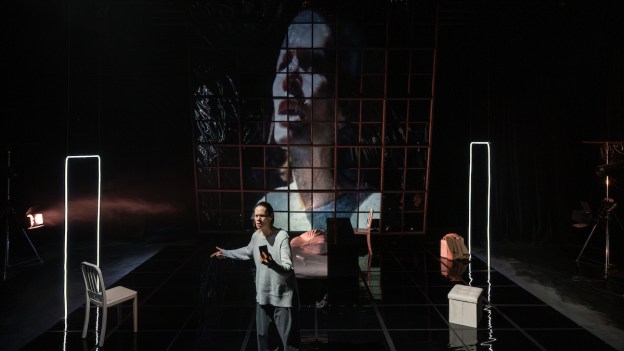
Another feature of the show’s design was the extensive use of video (Ian Jackson, multimedia design) to show or evoke online content. I think there were nine large LCD screens suspended outside the room, and sometimes the content was also projected across the walls and floor of the apartment. So “the set” is clearly not just the room in their apartment, but also … the internet? The video isn’t just clips from their YouTube channel, but some of the comments.

And this is important, because the comments affect the characters. In one disturbing but credible exchange, Miles explains to Rachel that the trope of misogynistic commenting generating more interest in the channel is a common phenomenon and a good thing for the channel.

When they talk about whether stopping the posts might be a good next step for them as people and as a couple, Miles protests that the channel matters to the viewers. “But they’re not real!“, protests Rachel.

It is very odd to be writing a blog post about this play, wondering if people will read it, and wondering if reading this post will influence them to go see the play. (See it! It’s good! It’s entertaining, it’s horrifying, and it made us stand in the parking lot for ages talking about the issues raised.) While YouTube is not my medium, I know that online communities are real. This … I was going to say corner of the blogosphere, but spheres shouldn’t have corners? … isn’t particularly interactive, but I know it’s still contributing to community. And just as I notice how many people viewed my blog post or Instagram story, liked my Facebook post, or clicked Agree on my Ravelry forum comment, I know that a playwright is a content creator too. Other artistic contributors like actors and designers are also engaged in presenting the work to the audiences in the auditorium. Part of why I blog is that I want the theatre artists to know they have moved me and made me think. And the Subscribe or Like playwright and team did.

Subscribe or Like is playing at the Gateway Theatre (formerly Roxy on Gateway, formerly C103) until June 11th. Tickets are available here.

Sneak peeks at new work

For most art, audiences don’t get to experience it until it’s “done”. Painters and sculptors don’t usually Instagram their rough sketches or let people wander around their studios. Composers don’t usually play and sing bits of their new works for lucky fans. Sometimes at a fan convention an author might read a chapter of a new book, or there might be a screening of a film trailer, but probably not an unedited reel. But theatre depends on how the text sounds when a group of actors is speaking it, and live theatre also depends on audiences responding to the text. So it’s common in play development to have a reading – maybe a private workshop with actors hired to sit around a table and read from a new script, and then maybe a reading on stage for an audience. No set and costume, no actions, no music and lights – just the voices of the characters, bringing a story to life.

The next chance to hear readings of new scripts in Edmonton is Workshop West Playwrights’ Theatre’s Springboards Festival, which runs March 22-26th at the Gateway Theatre (you might remember it as the Roxy on Gateway or C103 or the hottest Fringe venue around…). Workshop West Playwrights’ Theatre (as the name suggests) has a mandate of supporting new play development. The schedule of plays for this festival sounds exciting! Not only is there new work by established playwrights Conni Massing (The Aberhart Summer, The Invention of Love) and Stephen Massicotte (Mary’s Wedding), and award winner James Odin Wade, on Wednesday Mar 22 there are five ten-minute scripts selected from the EdmonTEN play competition, and on Sunday Mar 26th there’s a Cabaret-style sampling of work from eleven more writers, from emerging to acclaimed. Heather Inglis and Darrin Hagen are curators and dramaturges for the festival

Jake Tkaczyk, actor, performance creator, and graduate student, will be one of the performers for James Odin Wade’s new work Everyone Is Doing Fine on Thursday Mar 23rd. Jake’s experience with play readings includes working on Bright Burning, (later titled I Hope My Heart Burns First) which Colleen Murphy wrote for his graduating class, and participating in public reading events including Script Salon and Skirts Afire. I asked Jake a few questions about readings and new play development.

“As an actor, how do you benefit from participating in a private workshop reading?”

“If I know I’ll be doing a public performance, I love getting the chance to work on the script, ask the playwright to clarify their motivations, and spend more time than a normal rehearsal process. We get more chances to try things out. ”

“Why do you do staged readings for the public?”

“Play readings are a chance for the writer to really have their work understood. As an actor, I am there to service the playwright. A public reading gives the writer a chance to hear what’s landing, what does the audience find comedic or not find comedic – are there moments when the room goes still. The writer gets to hear it read and hear it heard. And without all the design elements contributing to the experience, the audience is just paying attention to the words. Does the text work in that order? Is the plot making sense? Is there anything that needs to be explained more … or less?”

As an emerging playwright myself, I’ve had the chance to experience what he describes. Earlier this month my short script Book Club 2021 was read as part of Walterdale Theatre’s From Cradle to Stage festival, along with twelve other new plays. Hearing actors read my script, and being surrounded by audience members responding to those actors, made me so grateful that theatre is a collaborative art. We need each other to share stories. _______________________________________________________________________________________

Springboards Festival runs Mar 22-26 at Gateway Theatre with performances at 7:30 every evening. Tickets for each evening are $15 in advance and pay-what-you-wish at the door.