Tag Archives: theatre

Michael Healey’s Proud

Tonight I saw a preview of theatre no. 6’s presentation of Proud.  Director Ian Leung said ahead of time that there might be technical glitches, but I didn’t notice any.   Parking around La Cité Francophone was unusually challenging, probably due to the Alberta NDP leadership debate taking place across the street at Faculté St. Jean, and afterwards I found that a cheering thought.

Proud is a story about politicians and about some parts of the political process, and about beliefs and emotions and what kind of government people want.  I hated some of what I saw on stage because I think it might be true and I don’t want it to be, and I loved how they showed it. The premise of the story started by imagining that the federal election of 2011 had generated a much larger majority for the Conservatives, if they had won seats all over Quebec by very slim margins over the NDP.  (That this is completely feasible to imagine is thoroughly depressing in itself.  See Fair Vote Canada for more.)   As the Prime Minister says addressing his newly expanded caucus, “We have broad but thin support.  If this was ice, I couldn’t recommend we play shinny on it.”   There’s a funny early scene where the Prime Minister and his Chief of Staff are examining a large seating chart of the House of Commons trying to plan who should sit where.  All one side and about half the other side are coded Conservative-blue.  There are 28 orange cards and 25 red ones, and I couldn’t be sure but I think then 4 BQ baby-blue and one green one.  That wasn’t even the point of the scene, just a fun detail I got distracted by.  The point of it was more to show the Prime Minister being petty and demanding about not wanting certain caucus members to be in his line of sight because he held grudges, and his Chief of Staff trying to find solutions that would keep his boss happy and not make any other problems.

Dave Horak was a perfect Chief of Staff, down to the low voice and the way he expected to fall on his metaphorical sword.  Brian Dooley was disturbingly good as a non-ideological Prime Minister who doesn’t make eye contact.  And Melissa Thingelstad was — I think this is my favourite role that I have seen her in so far.  She played a rookie MP from Quebec, a single mother who had been managing a St-Hubert Barbecue (cultural note: that’s a Quebec chain much like Swiss Chalet only with tarte au sucre.)   Her character had a wonderful mix of ferociousness and naiveté, sexuality and practicality and honesty and pragmatic ambition in which the Prime Minister seemed to have met his match.  “Why do you insist on mis-underestimating me?” she asked at one point.   When her character first appeared, I worried that she was going to be used as a sort of sexist shortcut and comic foil, making fun of young women in general and of the 2011-era rookie NDP MPs from Quebec like Ruth-Ellen Brossard.  But she got more interesting.

Richard Lee Hsi (formerly billed as Richard Lee, last seen in the Toy Guns Dance Theatre shows at the Fringe and in the feature film Rock Paper Dice Enter) had a small role as a character from the future being interviewed about the events of the play and about his own political aspirations.   His interview/monologue alluded to some very discouraging outcomes that would follow easily from the present-day of the play, which is not so different from our own, (a powerless consolidated Left and the Conservatives with a longest-serving Prime Minister very similar to Harper), but also gave the audiences some hopeful prospect in the way he spoke about his own ideals and ambitions.

On my way home from work, before I went to the performance, I heard a CBC Radio interview with David Moscrop, a doctoral candidate in political science at UBC.  His research focuses on the way people choose how to vote with their emotions rather than their reasoning.  This was echoed in the play, in which the Prime Minister and his Chief of Staff explain to the new MP that they address people’s feelings rather than their beliefs.

Ian Leung’s Director’s Note in the program says “save all that heavy stuff for after.  Tonight, it’s a comedy.  Enjoy!”

I did enjoy it.  I’m not sure it’s a comedy though.  I didn’t think the British TV series “House of Cards” was a comedy either.  (I haven’t seen the Netflix one with Kevin Spacey.)   I guffawed several times, and I also squirmed in my seat and winced quite a bit.  I wished it wasn’t quite so credible, but at the same time I was enthralled by the ways it was.

Proud is playing at L’Unithéâtre, La Cité Francophone, until October 19th.  Tickets are at, of course, Tix on the Square.
Fringe day 8: puppetry, drama, comedy

On the second Thursday, after my volunteer shift I saw three plays.  Around then I stopped being able to keep up with my goal of posting notes every morning about what I’d seen the night before, so I’m trying to catch up now.  Thursday’s three were all good and very different.

Who Killed Gertrude Crump is a murder-mystery, an Agatha Christie pastiche set in a country house isolated by a storm around the turn of the previous century.  Ryan Gladstone wrote and directed it.  The Fringe program lists the cast as “Tara Travis and puppets”.  Tara Travis introduces the story, as Agatha Christie, and narrates everything besides the dialogue.  She moves props, dresses the set, and operates about ten puppet characters, talking directly to the audience when the puppets aren’t talking.  Her style reminded me a bit of what Ronnie Burkett does in his shows, operating marionettes while being visible and delivering witty asides to the audience as himself, and a bit of the object theatre / found object puppetry that I saw in Sapientia at Canoe Festival.

I was a little restless at the beginning.  It was a little hard for me to see the puppets well enough to learn to distinguish them, sitting at the side in the Suzanne Thibaudeau Auditorium, and several of the characters had similar enough names that I had trouble remembering who was who.  The setup seemed predictable and not very compelling.  Then it occurred to me that I had all the same complaints about a lot of Christie’s work, and that this was actually a clever tribute. The plot then thickened, and I got to feel smart for remembering some clues and I got to enjoy missing others and getting surprised.  After it was over, the performer swore the audience members to secrecy about the plot outcome.

After supper at Cafe Bicyclette, the little bilingual-service cafe in La Cite Francophone, I went to 3…2…1, by Chris Craddock and Nathan Cuckow, starring Jamie Cavanagh and Chris W. Cook.   I loved it.  It was the most emotionally intense drama I saw at this year’s Fringe, building gradually from a scene of two young men in a garage hangout determined to get drunk and high, to the awful context and significant outcomes of their bender.  At first their excesses and rowdiness were just funny, familiar like Bob and Doug, Wayne and Garth, or Dante and Randal, with a leader (Jamie Cavanagh as Clinton) and a follower (Chris Cook as Kyle).  Their reminiscences and stories of their past youth include a third character, their friend Danny who has died, and in the flashback scenes each actor takes a turn as Danny, sometimes in quick succession, using blocking cues to show us who is speaking as Danny in a three-person conversation.  Each character has different redeeming qualities and vulnerabilities, so that we see them as more than loser-caricatures.  Clinton has some loosely-Christian spiritual convictions.  Kyle is proud of how his work at Subway involves supporting people who are trying to eat more healthily or lose weight.  Both of them come from imperfect families and are somewhat trapped in their lives.   The story gets more painful, and I was crying before the end.  Chris Cook is a great tagalong sidekick, and Jamie Cavanagh was perfectly cast in the role of Clinton, as a foulmouthed drunken jerk who turns out to be a complicated tormented tragic character at the same time.

Then I wiped my eyes, got in the car, and went to change my mood at Real Time, the comedy written by Matt Alden of Rapid Fire and directed by Alden and Katie Fournell.  Thanks to the kindness of a stranger in the refreshment tent, I was able to take a friend with me even though the show had been sold out.  Jessie McPhee and Joleen Ballandine, regular Rapid Fire improvisers and two thirds of the cast of last year’s Fringe hit Excuse me … this is the truth!,  play two mismatched young people (Jessie is Billy and Joleen is Jessica) who meet playing an online game, spend time together in person, and explore the possibilities of romance.  The actors also play other parts as needed (Billy’s British mother, Jessica’s marijuana-smoking grandfather, Jessica’s ex-boyfriend, etc, all of them funny and original).  The whole thing was just charming and funny and familiar, including the customs of on-line life of ten years ago.

Hedwig and the Angry Inch

One of the hot tickets that I paid full price for on my Broadway excursion this spring was the new production of Hedwig and the Angry Inch, with Neil Patrick Harris as Hedwig and Lena Hall as Hedwig’s second husband Yitzhak.  Neil Patrick Harris (NPH) had played the role in a West End London production a few years ago, but never on Broadway.  (You might know NPH as the actor who played the title role in Doogie Howser MD, who played himself in the Harold and Kumar movies, and who was in Dr. Horrible’s Sing-Along Blog, or the host of last year’s Tony Awards.)  I’m probably the only one who also had him confused with the guy who plays the FBI agent on White Collar, but that’s actually Tim De Kay, who looks kind of similar and is about 10 years older.   Lena Hall also has a long Broadway resume,

Hedwig and the Angry Inch is also a movie, but having seen both I think it works better as a stage musical – and it’s definitely more fun in person.  The Belasco Theatre is an intimate setting and some of the audience members sitting near me had seen the production before.  It’s a fairly short show (95 minutes or so?) without an intermission, and the character Hedwig talks or sings for almost the whole time.  The musicians performing as the Angry Inch were Justin Craig (Skszp), Matt Duncan (Jacek), Tim Mislock (Krzyzhtoff), and Peter Yanowitz (Schlatko).  Hedwig has several dramatic costume changes and manages to climb over a car gracefully wearing platform boots.

The show uses the device of Hedwig and her band talking to the audience as they do a “one night only!” musical performance, and narrate Hedwig’s history.  They keep mentioning their more successful associate Tommy Gnosis who is supposedly performing across town in a bigger venue.  And at one point Hedwig makes an aside about having been kicked out of a dive like The Jane Hotel, which is funny because the original off-Broadway run of Hedwig was in a room at that inexpensive inn, but it was even funnier to me because that is where I was staying.

I enjoyed it and I’m glad I went to see it, but it hasn’t really stuck with me very hard.  I’m not sure why not.

Fringe as a way of life

My first experience with any Fringe festival was the week I moved to Edmonton.  I got off the train with some of my stuff on a cold grey Monday morning after Folkfest, even though everyone I’d met from Edmonton had encouraged me to arrive in time for the folk music festival.  I didn’t want to wait a year to start experiencing the festive life of my new home, and fortunately I found out that there was some kind of theatre festival taking place the next weekend a few blocks from where I was living.  My first blog posts about the Fringe (they were semi-private journal entries at the time; I wasn’t publishing this blog yet) mention seeing a show recommended by a friend from Montreal Fringe, encountering handbillers, talking to strangers in the beer tent, and eating my first green onion cake.  But it probably took me until my second Fringe year to realize that one of the best things about the Fringe is that I don’t just pick the kinds of theatre experiences which sound safe and familiar.  Something about the format, where it’s possible to see lots of shows in a weekend or three in a single evening, and where none of them cost more than $15 total, lowers the perceived risk of choosing what to see.  My Fringe day wasn’t going to be wrecked if one of the performances wasn’t quite what I was looking for.  And in fact, my day was going to be more fun if all the performances were different from each other.

So I started expanding the range of what I was willing to try.   I didn’t think I liked one-person performances, but after seeing some brilliant multiple-character narratives and storytelling shows, I was hooked.  I didn’t think I liked clowns or mimes, but after watching some world-class physical theatre and Canadian Pochinko-tradition clown stories I wanted to see more.  I sought out dance shows, dramas, theatre of the absurd, musicals, and improvisational theatre.  Like music and food and drink and poetry, I discovered that I liked a lot more things than I would have guessed, and I got better at figuring out how to describe what I like and don’t like.   Eventually I fell into living the rest of the year with a Fringe mindset too.   My Broadway vacation was Fringe-like in my enthusiastic immersion, but the shows were a lot more expensive and the street food wasn’t as interesting.

Having become more involved in the year-round Edmonton theatre scene in the last couple of years, taking class, volunteering backstage and front of house, and seeing a lot of shows from a lot of companies, my decisions of what to see at the Fringe now include consideration of a lot of shows where I recognise the names in the program book, as friends, favourite directors, or performers I’ve enjoyed watching in the past.  This makes it even harder to decide what to see.

But here’s my first list.  I expect to see more, and I’ve got a long backup wish list waiting for Fringe bucks, Daily Discounts, artist comps, and/or space in my calendar.  These are the for-sures.  They’re not in priority order.  (I’m not linking any box-office pages; you can find those yourself.)

  • Camel Camel
  • Sonder – this is the one I’m producing
  • Beware Beware
  • Flora and Fawna’s Field Trip
  • Zanna, Don’t!
  • Dogfight – a Scona Alumni Theatre musical
  • The Show
  • Butt Kapinski
  • The Middle of Everywhere – this is the new show from Wonderheads, the mask troupe out of Oregon who did Loon and Grimm & Fischer
  • Harold of Galactus
  • Little Monsters – written and directed by Kristen Finlay
  • This is CANCER – I haven’t seen Bruce Horak’s show before but I’ve heard a lot about it
  • Off Book the Musical – this Rapid Fire troupe is even better at the Fringe than in a regular Saturday show
  • En anglais, s’il vous plait
  • Ask Aggie – I saw Christine Lesiak’s show last year and liked it, and I’ve heard there’s new material in it
  • Fugly
  • Rocket Sugar Factory
  • The Real Inspector Hound
  • 3… 2…1…
  • Real Time – scripted comedy by Matt Alden of Rapid Fire
  • The Story of O’s
  • Einstein
  • Scratch
  • Gordon’s Big Bald Head
  • Bible Bill
  • Fruitcake
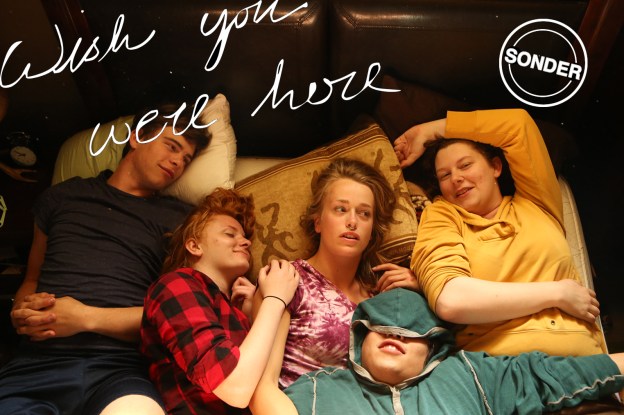
Cast of Sonder, postcard style

Sonder and the Fringe

The Edmonton International Fringe Theatre Festival is my favourite festival.   And counting down to the Fringe is like counting down to Christmas.  When I was a child, I used to ask my parents, Don’t you wish Christmas was tomorrow? Mum would sigh and Dad would grumble in their grownup ways saying that they didn’t wish Christmas was tomorrow because they weren’t ready.  I would explain that if Christmas was tomorrow they would be ready!  They didn’t buy it.

Anyway, every year as soon as Folkfest is over I start getting excited about the Fringe.  I already have my program and some show tickets, and my volunteering schedule for the beer tent.  I drove by the grounds last night and saw the barricades on some of the roads.  I’m clicking Maybe on all the Facebook events and trying to figure out how many I can see.  I’m looking forward to the parade, the food stands (especially Rustixx pizza), the out-of-town visitors, the excitement … but at the same time I’m feeling like one of those grown-ups who has a to-do list that has to happen first.

One of the things on my personal to-do list is to get caught up writing about other performances I’ve seen, so I can start the season fresh.  That will appear here in the next few days.

The other things are about getting everything ready for the new show that I’m producing, Sonder, with our company The ? Collective (you can pronounce that however you want, but we usually say “the question mark collective” – our twitter handle is @theqmcollective).  A friend and I put together a lottery entry last fall and were lucky enough to get selected to perform in a Fringe lottery venue, King Edward School.  That’s Venue 5, the elementary school, the low white building closer to the Fringe grounds, as opposed to the Academy which is the older brick building across the street.  My friend, Jake Tkaczyk, took on the roles of director and creation facilitator, gathering a small group of Red Deer College students to explore themes of interconnectedness and meaningful moments in a collaborative creation process.  The title Sonder came from the tumblr blog Dictionary of Obscure Sorrows, in which the writer, John Koenig, coins many words for interesting concepts – in this case the realization that each random passer-by is living a life as vivid and complex as one’s own.  As the work slowly took shape, Collette Radau contributed as dramaturg, Alex Boldt responded with original music and soundscapes, and all of us told and listened to many stories.

What we’ve come up with uses the techniques of performance art, movement, recitation, and narrative scenes real and surreal to show a series of moments in different people’s lives, from the everyday to the magical, funny and poignant and sometimes disturbing.   We’re excited about showing our creation to the Fringe community, and we’re also excited about experiencing the Fringe from the inside.   I’m the only one who’s been involved with a show in the past (as stage manager for WaMo Productions’ God on God 2013, 3 stars in the VUE and the Journal).  Some of the company members will be attending their first Edmonton Fringe, and I’m almost as excited about showing them the festival that made me fall in love with theatre in the first place.

But as I said at the beginning, I’ve got a to-do list between me and opening night (Thursday Aug 14th at 10 pm by the way).  The rest of our company arrives in town today, and our tech rehearsal is this afternoon.  We have posters to hang, handbills to hand out, programs to print, buttons to sell, and a parade to entertain you in (Thursday Aug 14th, 7:30 pm, Fringe grounds). We have a blog, a website, a Facebook event and page, a twitter account, and an indiegogo campaign (running til the 21st).

And we have tickets at the box offices for all our performances, $11 adult, $9 student/senior.  We’d love to see you there!

  • Thurs Aug 14th, 10 pm (opening)
  • Sun Aug 17th, 9 pm
  • Mon Aug 18th, 12:15 pm
  • Wed Aug 20th, 11:30 pm
  • Thurs Aug 21st, 4:00 pm
  • Sat Aug 23rd, 6:45 pm (closing)
Sonder cast rehearses family scene.  Erin Pettifor as the mother comforts her children (Julia Van Dam, Evan Macleod).

Sonder cast rehearses family scene. Erin Pettifor as the mother comforts her children (Julia Van Dam, Evan Macleod).

Sonder cast creates funeral vignette.  Evan Macleod as Doug the deceased.  Mourners left to right: Julia Van Dam, Emily Cupples, Tyler Johnson, Brittany Martyshuk.

Sonder cast creates funeral vignette. Evan Macleod as Doug the deceased. Mourners left to right: Julia Van Dam, Emily Cupples, Tyler Johnson, Brittany Martyshuk.

Hilda’s Yard in Rosthern, Saskatchewan

I’m aiming to be caught up on reviews or at least quick mentions by the start of the Edmonton International Fringe Theatre Festival (August 14-24, 2014), because that’s the start of my personal theatregoing year, and the anniversary of my move to Edmonton.  This year at the Fringe, besides volunteering at the beer tent, volunteering front of house for a Rapid Fire production or two, and seeing as many shows as I can fit into my schedule, I’m also going to be producing a new work.  Sonder, created and performed by The ? Collective under the direction of Jake Tkaczyk (a U of A BFA Acting student), will be playing at the King Edward Elementary School.

The most recent play I’ve attended was Norm Foster’s charming slice of 1950s family life, Hilda’s Yard, as directed by Stephen Heatley (formerly of Edmonton and now faculty at UBC) at the Station Arts Centre in Rosthern, Saskatchewan.  As a professional production by a summer company, it reminded me of the plays I used to go to at the Thousand Islands Playhouse in Gananoque when I lived in Kingston.   I hear that doing the dinner/show package at the Tea Room in the arts centre is an even better experience, but by the time I decided to attend the dinner was sold out.  So I had a tasty club sandwich at a local restaurant called Chewie’s (after the Star Wars character I think), and then enjoyed strolling through the art gallery before the show started.

Hilda’s Yard opens with the title character (Cheryl Jack) hanging laundry in her backyard, while talking to a neighbour we can’t see.  We learn that she’s relieved that her two grown children have recently moved out, and that she’s a little apprehensive about her husband planning to buy their first television set.   I thought Hilda’s character was the most interesting part of the play.  Cheryl Jack portrayed her as confident, competent, wistful, and mostly in control, and her portrayal was enhanced by some very amusing gestures and hip wiggles.  I was pleased to see that she and her husband Sam (Bruce McKay) were both looking forward to the increased opportunities for intimacy afforded by having an empty nest, rather than playing that situation for the cheap laughs of imbalance.   The complication, of course, is that both adult children soon return home, for the same kinds of reasons that are common in 21st-century boomerang kids.  Gary (Jaron Francis) has lost his pizza-delivery job in the city and is on the run from a bookie he owes money to.  Sam’s prolonged pauses as he tries to figure out what to say to his son are priceless.  Daughter Janey (Angela Kemp) shows up back home due to marital troubles.  I’d seen both Jaron Francis and Bruce McKay in last season’s Shakespeare on the Saskatchewan productions of Macbeth and Comedy of Errors.

When I read the show notes ahead of time, I assumed that the plot would focus on Gary and Janey now insisting on staying with their parents in order to watch the television.  But Norm Foster’s stories are not quite that predictable.  Although the (off-stage) television figures in the plot, it doesn’t quite work out like that.  Additional characters who show up and get invited for supper include Gary’s new girlfriend Bobbi, a jazz trombonist (Shannon Harasen) and Gary’s bookie Beverly (Matt Josdal).  Bobbi’s idiolect is noticeably different from the language used by the rest of the characters, with jazz lingo like “cat” but also in careful details like her pronunciation of “Mom” contrasting with Janey’s old-Ontario pronunciation of “Mum”. Present-day audiences are amused by any mention of the 1956 prices and wages, but also by Gary’s unrealistic schemes to make money with such unlikely products as a “baby-on-board” sign or a hula hoop.  I appreciated the light touch by director and actors throughout the play, because the story is funny enough without hitting the audience over the head.

The set (design by David Granger) portrayed a backyard like the ones of my childhood with simple clean lines – an artificial-turf lawn, a wooden-siding wall, a white picket fence with bits of weed growing between the pickets, a perfectly-recreated pulley clothesline and a wicker laundry basket, vintage lawn chairs and a credibly-dented metal garbage can.

Hilda’s Yard continues until July 27th, and is definitely worth the short drive from Saskatoon.

A few of the thousand faces

Last night a friend took me along to the Thousand Faces Festival, which explores myths from around the world in a variety of performance media.  We attended two events, a performance of Shakespeare’s Macbeth and a Mythic Poetry Brothel.

Macbeth is a familiar enough story, full of archetypes and supernatural elements and sayings that have entered common use, that it fit easily into the theme of myth.  This production was not the most compelling one I have seen, but it was fast-paced and had some good moments.  Macbeth was played by Elliot James, who I last saw as a worse-than-archetypal asshole cop in Dirt.  He had some of that character’s swagger, and not very much regret.  Bobbi Goddard, a BFA Acting student at U of A, was Lady Macbeth (while also playing in When the Rain Stops Falling this week).   Other familiar local actors were also involved – Oscar Derkx, Mat Simpson, Lianna Makuch – but there were no printed programs and the headshot display in the lobby was incomplete and didn’t identify roles.  I also don’t remember who directed it and can’t find that information anywhere today.

The Mythic Poetry Brothel, a coffee-house style event, started in the beer garden behind the Alberta Avenue community hall but migrated smoothly into the hall when the night got cool.   Local poets (including Colin Matty and Tim Mikula) read or recited their work in character as various deities, and additional entertainment was provided by MC Morgan Smith and an interesting collection of musicians and dancers.  The “Brothel” part of the event title probably referred to the opportunity to get private readings by making a donation to a poet.  Sort of like table dances I guess.

The Thousand Faces festival resumes next Friday evening.  I love living in a city which has such an assortment of arts festivals, including small ones like this with admission by donation.

Raisin in the Sun

I wanted to see this play on Broadway for two reasons.  One was that I’d seen the movie earlier this year along with watching the Citadel Theatre performance of Bruce Norris’s Clybourne Park, an intersecting story set in the same world.  The other was that Denzel Washington is in this production, in the role of Walter Lee Younger, the man of the family, the role played by a young Sidney Poitier in the movie.

Before the play started, the poem excerpt including the phrase “raisin in the sun” and the musings about dreams deferred was projected on a scrim.  And a radio interview was playing on a loop – I figured out quickly that the woman being interviewed was the playwright Lorraine Hansberry, and then I learned from the Playbill that the interviewer was Studs Terkel.

The curtain rises on the main room of a small apartment in Chicago.  Ruth Younger (Sophie Okonedo) is up and in the kitchen before the alarm goes off, and then she begins the tasks of helping her family get ready for the day.  Her small son (Bryce Clyde Jenkins) wakes groggy on the living room couch, and she hustles him into the shared bathroom across the hallway.  The set design was clever, showing the tiled hallway and bathroom door outside the door of the main set, lit in such a way that I wasn’t aware of it being part of the set until Travis scurries across the hall with his towel.  You could see the practised routine of a family in the way Ruth starts waking up her husband as soon as her son’s in the bathroom, rushing him into the bath ahead of the man down the hall, as she makes breakfasts, wraps sandwiches in waxed paper, and reminds her young sister-in-law, college-student Beneatha (Anika Noni Rose), to tidy away Travis’s bedding.   Coming from a later generation, it took me some time to figure out that Ruth actually had a job herself, because in the first scene she was all about taking care of her family.  But in fact, both Ruth and her mother-in-law Lena (LaTanya Richardson Jackson) worked as domestic help.  As we got to know the family and the routines of their lives, we also learned that Lena’s husband Walter had recently died and that they were all anticipating how the life insurance money might change their lives.

Each of them had some dreams and wishes for better life – Lena wants a garden and sunlight, Ruth wants comfort and space for her growing family, Travis wants his own bedroom, and Beneatha wants to be a doctor after embracing college student life, exploring African roots, and trying various creative pursuits like guitar lessons and horseback riding.  But Walter Lee seems to be the most unhappy with his current life, working as a chauffeur and depending on his mother’s and wife’s earnings to help pay the bills.  He yearns to be his own boss, to take care of his family and be in charge.  So of course they don’t all agree about what to do with the money.

I thought Latanya Richardson Jackson was especially strong, but the whole cast was good and balanced.  I felt like I was watching an important story and I was lucky to be seeing it with such good actors.    Many of my seat neighbours in the mezzanine were very well dressed and had bouquets to deliver at the stage door, adding to my impression that I was seeing something important.

Raisin in the Sun intersects with Clybourne Park in the part of the story where a representative of the currently all-white neighbourhood tries to dissuade the family from moving to the house Lena buys, but that is not the main focus of either play.   It was also useful to think about the second act of Clybourne Park which is set in contemporary times, showing that although people nowadays have different customs of how to talk about race, the misunderstandings and misconceptions still continue.

Avenue Q off Broadway

The musical-with-puppets Avenue Q is going to be part of next year’s Citadel Theatre season. Having just seen it off-Broadway, I’m looking forward to it even more than I had been.

It reminded me of Rent ( in being about a small community of struggling young people in New York City, but not sad), of “St. Elmo’s Fire” (being about the anomie of post-graduation), and of, well, “Sesame Street” for grownups.  This was a more effective mix than you might expect if you haven’t heard of the show.  Three of the seven performers play humans, Brian a wannabe comedian (Nick Kohn), Christmas Eve a wannabe social worker (Sala Iwamatsu), and Gary Coleman yes that Gary Coleman (Danielle K. Thomas).  The other four performers operate various Muppet-like characters, while on stage in full view mimicking their alter egos’ gestures.  Darren Bluestone plays Princeton the lead, as well as Rod who bears a distinct resemblance to Bert-from-Sesame-Street.  Veronica Kuehn plays Kate Monster the other lead.  The other two puppeteers are Maggie Lakis and Jason Jacoby.

It’s a fun show, the songs are catchy, the humour is topical and sometimes pointed (“Everyone’s a Little Bit Racist”), and the characters’ problems are very easy to identify with.

As someone who grew up with Bert and Ernie, and then who enjoyed speculating on their slashy subtext, I particularly enjoyed the subplot of Rod and his roommate Nicky, and how the writers managed to find both a happy same-sex romantic ending and a respect for non-sexual friendship.  I couldn’t think how that story would work out, and it did.

There was one bit of audience interaction that made me wish for once that I was sitting on the aisle – especially when their pass-the-hat came up with a Metrocard.

Avenue Q is playing at New World Stages, a new-looking complex of five underground performance spaces just north of Times Square on 50th Street between 8th and 9th Avenues in New York City.  There are often discount tickets at TKTS.  And it will be playing at the Citadel Theatre in Edmonton next winter.  I’ll be there for sure!


Mercy of a Storm, atmospheric and compassionate

The Northern Light Theatre / L’UniThéâtre co-production currently playing at La Cité Francophone is alternating between English performances and French performances, as Mercy of A Storm or De plein fouet dans la tempête. The original script by Jeffrey Hatcher was in English, and the translation was done by Gisele Villeneuve.  Trevor Schmidt is credited as director, with Isabelle Rousseau as assistant director and dialect coach.  I saw a performance in English.

The story is set on New Year’s Eve, 1945, in the pool house of a social club.  I had thought it was in a suburb somewhere on the Eastern Seaboard of the USA, but the Northern Light website summary has it as the smallish city of Cambria Ohio.  The two characters, in period festive dress, enter separately and seem immediately to have some secrets from each other.  It turns out that Gianna Vacirca’s character Zanovia and Brian Dooley’s character George are estranged spouses, ostensibly meeting to negotiate their divorce settlement.  I was confused at first – I thought that when Zanovia talked about slipping away from Morrie, she was referring to a current husband and was having an affair with the other character in the play.  And I didn’t immediately catch on that when George was talking about being caught between Tootie and Zanovia, he was talking about his daughter.  Part of why this was confusing was that their unconventional arrangement had Zanovia continuing to live in George’s house along with his grown daughter, while George had been away on the Continent for post-war business negotiations.

I also didn’t figure out right away that Zanovia was somewhat of an outsider in the “club” scene, having been tolerated as George’s wife but coming from a background of having been the daughter of Polish immigrants, George’s family housekeeper and her labourer husband.  Once I began to pay attention, I saw reference to class/culture differences everywhere.  Zanovia’s rant about Tootie and her friends and their silly made-up names, George calling her Zan, Morrie being the first Jewish visitor or member in the club, and so on.

While they are discussing the prospective divorce settlement, we also learn more about the history of their marriage, the role played by Tootie, and their mixed feelings about each other in the present.  They are obviously both attracted to each other, but will they get together? Will they reconcile?  The outcome is poignant and thought-provoking.

I liked this play.  It was more subtle than the previous atmospheric period drama in the Northern Light season, Bitches and Money 1878.  I don’t know the name for the decor shown on set, possibly Danish Modern, all straight lines and blond wood, but it definitely created the context of wealth and looking-forward in 1945, and the music and Matt Schuurman’s video background bits added to the film-noir mood.

Tickets for both French and English performances are available through Tix on the Square here.  The last English performance is Sunday evening March 16th.