Tag Archives: stephen allred

Back to Avenue Q

Erin Harvey as Mrs. Thistletwat in Avenue Q. Photo Nanc Price.

I’ve now seen three productions of the Robert Lopez / Jeff Marx / Jeff Whitty musical Avenue Q. I saw the Off-Broadway transfer in New York in 2014, and the Citadel Theatre production in 2015. And when I first saw the announcement that Foote in the Door would be doing it in 2024, I had no trouble remembering various catchy tunes from the show, and more trouble getting the earworms out of my head afterwards.

As I wrote after seeing it Off-Broadway, it’s like Rent crossed with St. Elmo’s Fire for audiences who grew up with Sesame Street puppetry, a combination that’s hard to picture until you’ve seen it or are familiar with the cultural phenomenon.

Ten years later, many audience members already know what to expect. The Foote in the Door production, directed by Trish Van Doornum, opened last night at Théâtre Servus Credit Union, to a full and enthusiastic house. I had wondered if some of the elements would require shock-value to be appreciated – “The Internet is for Porn”, Christmas Eve and “Everyone’s a Little Bit Racist”, and the puppet sex scene, in particular – but I thought the opening-night crowd was delighted whether or not they were caught by surprise. Christmas Eve, in the original production, sings “I coming to this country for opportunities, Tried to work in Korean deli, but I am Japanese!” and her speeches are full of comedic L-R switching and English-language-learner patterns. Those tropes are getting old – but in the Foote in the Door show, Christmas Eve is performed by Sunshine Bautista Mauricio, whose overall sass, determination, and compassion were more significant than the stereotypey trope. That early line is changed to “Tried to work in Korean deli, but I am Filipino!” (maybe she said Filipina, but I couldn’t hear clearly since the crowd was laughing and cheering). A couple of places later in the show, she says rude things to her husband in a language I don’t understand (Tagalog?) but some audience members definitely did. Those changes improved the show for me, demonstrated that it wasn’t just about entertaining white people.
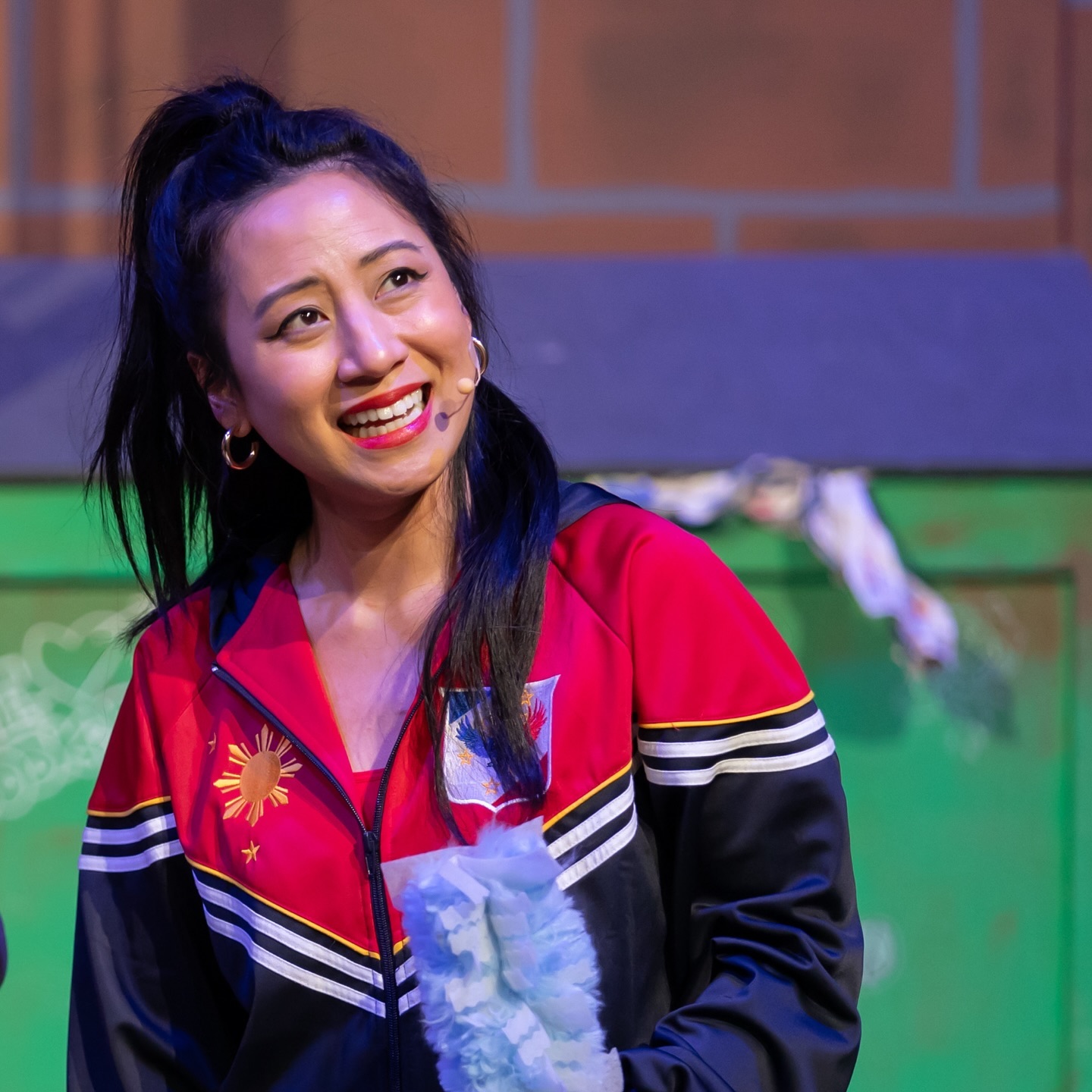
Sunshine Bautista Mauricio as Christmas Eve. Photo by Nanc Price.

The current production uses a cast of nine performers, and I was especially impressed by the work of some of the ensemble members I was less familiar with. Erin Harvey (last seen in Walterdale’s Austentatious) was a puppeteer playing Mrs. Lavinia Thistletwat, occasionally covering Kate Monster, Lucy, and a Bad Idea Bear, with a hand in Russ Farmer’s embodiment of Nicky. The scenes where Kate and Lucy interact, with Ruth Wong-Miller doing both voices, fascinated me because my eyes kept fooling me about who was talking for which puppet character. Jay Duiker, whom I remembered as the Baker in FITD’s early-2022 Into the Woods, had a strong voice and good comic timing for wannabe-standup-comic Brian. Renell Doneza (with previous credits ranging from Walterdale’s Altar Boyz to the Citadel’s Prison Dancer) embodied various ensemble characters, and watching his own physicality as a contrast to the puppet Rod’s repressed rigidity was very clever. Jayden Leung, also credited with the video montages used in the show, was the remaining ensemble puppeteer, playing various characters including part of Trekkie Monster. Lead-puppet Princeton was performed by Stephen Allred, whose FITD resume started with an insightful interpretation of Laurie in the 2017 Little Women. And the building super Gary Coleman, often played by a woman, was Malachi Short, whom you may recall from Elope’s production of Joseph and the Amazing Technicolor Dreamcoat last year. Short, Harvey, and Leung are all current students in MacEwan University’s BFA in Musical Theatre Performance, and ones to watch in future years.

Ruth Wong-Miller as Kate Monster. Photo by Nanc Price.

There’s one bit in the show where Princeton decides to collect donations to fund another character’s dream, and he motivates other characters to pass the hat running up and down the theatre aisles. When I saw it in New York, the meagre takings that they counted afterwards included a Metro card (subway pass) – I wasn’t sure if that was scripted or not. Well, last night they pulled an ARC Card (local transit pass) out of the hat, so I guess I have my answer. And then after the curtain call, company co-founder Ruth Wong-Miller told the audience that the takings from the hat-passing, plus anything else we wanted to add to the ASMs’ hats in the lobby, would be donated to the Youth Empowerment & Support Services, who operate the Youth Emergency Shelter and other programs in the neighbourhood. This struck me as a great choice, not just for being hyperlocal but for building on the sympathies for the characters in the story, who are mostly a step or two away from the outcomes of the characters in Rent but who are still young and with limited resources. (So take some money, and not just for the concession!)

Avenue Q is full of short songs with lyrics that you might not want to sing at your recital, and musical-theatre melodies and harmonies that are hard to get out of your head. All the voices were strong, and the sound-mixing was well done (which I can’t always say on opening nights). Almost all the audience members near me managed to resist checking Oiler-score updates during the show – giving us a satisfying end to the evening in more ways than just a fun performance with happy and credible futures for the various characters.

Leland Stelck has designed a functional and interesting streetscape set, in the style of Sesame Street or In the Heights, and the musical ensemble directed by Grace Huang are visible downstage and occasional participants.

Avenue Q runs until June 8th, but several performances are already sold out. Remaining tickets are available here.

A Gentleman’s Guide to Love and Murder

Kathryn Kerr, Stephen Allred, Ruth Wong-Miller, in A Gentleman’s Guide to Love and Murder. Photo Nanc Price.

My previous entry was about the Teatro la Quindicina quirky tongue-in-cheek period piece Evelyn Strange. And tonight I saw another quirky tongue-in-cheek period piece – Foote in the Door’s production of A Gentleman’s Guide to Love and Murder. This musical, by Steven Lutvak and Robert L Freedman, won several Tony awards in 2014 – I was actually in New York that spring and could have seen it, but I picked shows I’d heard of instead. And I got to see this production completely unspoiled.

A Gentleman’s Guide to Love and Murder is set in England in 1907. The premise of it is that Montague Navarro (Stephen Allred) discovers after his mother’s death that he’s distantly related to nobility, in fact being something like ninth in line to an earldom, although his mother had been disowned for marrying his late father, “a Castilian … and a musician!” All this information is provided by his mother’s old friend Miss Shingle (Nicole English), paying an unexpected visit. He sets out to meet his rich relations, hoping they will give him a job, but then temptation, ambition, and a series of very strange coincidences lead him to try benefiting more directly from being only a few deaths away from the title and the property.

His girlfriend Sibella (Kathryn Kerr) is a hilariously shallow and self-centred woman, but Montague doesn’t seem to mind, continuing to be captivated by her after she gets married. Meanwhile, he continues to meet various members of the D’Ysquith family, many of whom (all played by Russ Farmer) then meet untimely deaths. Most of them seem equally unlikeable, demonstrating various stereotypes about the turn-of-that-century English upper-class. The career do-gooder Hyacinth, seeking a novel charity that hasn’t been claimed by her friends and speaking of her prospective beneficiaries in appallingly patronizing terms, was particularly memorable. At intermission, I was thinking that I’d only seen one D’Ysquith who actually seemed nice, cousin Phoebe (Ruth Wong-Miller), but that maybe I should distrust that thought.

I thought I’d figured out where the rest of the plot would go … but it didn’t, exactly. And the plot twists of the second act delighted me.

My two favourite scenes were the ice-skating scene (who knew that graceful ensemble dancing – and some not so graceful wobbles by Asquith D’Ysquith Junior – behind some snowbank set pieces could so easily convey skating on a pond?) and the scene where Montague is entertaining both Sibella and Phoebe in different rooms of his apartment, The hallway set piece with the two doors, and the way Allred’s character uses it while he sings to play out wanting both women and trying to keep them away from each other, were just brilliant.

Set and lighting design were by Leland Stelck. My companions and I were impressed by how many set pieces shifted silently and rapidly behind the drapery to convey many different locations, particularly given that the production had relocated to Old Strathcona Performing Arts Centre on Gateway from their original performance venue three weeks ago due to the flooding at La Cité Francophone. I think the OSPAC stage is not as deep or wide, but the ensemble of eleven never looked crowded. The lighting design must have been more challenging at OSPAC, which has a relatively low ceiling and doesn’t seem to have as many lighting instruments.

We also admired the period costumes including hairdos and hats (Betty Kolodziej). The members of the ensemble (Kelsey Voelker, Shauna Rebus, Lynnéa Bartel-Nickel, Jason Duiker, Aaron Schaan, Brian Ault) played several background characters each, changing costumes and accents as needed – my favourite ensemble bit was when they were all serving at a dinner, like in an episode of Bridgerton.

The production was directed by Ron Long, with musical direction by Daniel Belland, and an orchestra of 13. The melodies were catchy with some Gilbert-and-Sullivan-esque rhymes, and strong voices among the cast.

Advance tickets to the four remaining shows (Jun 16-18 at 7:30 and Jun 18 at 2 pm) are available here and going fast. Door sales (if available) will start 45 minutes before showtime.

If you’ve already seen it, or you don’t mind being completely spoiled, this webpage reviews (and ranks) all the deaths, as staged in the original Broadway production.

Little Women: the musical

One of my favourite parts of the experience of watching the musical Little Women last night was remembering bits of the story as I watched it happen on stage.  I didn’t love Louisa May Alcott’s book when I first encountered it, but I still read it over and over, like many girl-identified children of my era who read faster than my parents could drive me back to the library.   The best things about the book were Jo’s tomboyish-for-the-time outspokenness and determination, the genuine affection among the different sisters each with her own flaws, and the way the new-boy-next-door (lonely, orphaned, and probably with his own variations from gender norms of the culture) was welcomed and swept into their games and projects.  My least favourite parts of the book were the parts where Jo rejects Laurie’s romantic overtures but and then changes her previous plan of staying single when she gets to know Professor Bhaer.  I didn’t like the example of best friends and equals Jo and Laurie not being romantically suited, with all the March girls ending up with an older more powerful man (Jo with the Professor, Meg with Laurie’s tutor John, and Laurie finally getting engaged to Amy, the youngest of the sisters.)

The stage-musical version (book by Allan Knee, music by Jason Howland, lyrics by Mindi Dickstein) and the Foote in the Door production currently playing at L’UniThéâtre enhance all the good things I remembered about the book and make the things I disliked less objectionable.  The sisters are wonderful together, different from each other but protective of each other and of their mother.  Alyssa Paterson is the oldest, responsible Meg, Ruth Wong-Miller is ambitious and impulsive Jo, Fiona Cain is kind frail Beth, and Natasha Mason is Amy, the whiny youngest at the start of the book who is transformed for the better when Aunt March (Stephanie Sartore) takes her to Europe and guides her into well-off cultured society, with enough money to pursue her interests.  I found it very easy to believe that Jo didn’t care about clothes and the rest of the family didn’t have money to spend on fancy ones, but I was still fascinated to see them take for granted movement in hoop skirts (including stomping  up and down stairs, sitting gracefully on the floor (Meg) and falling in a pretend tragic-death (Jo).  The costumes also fitted with a bit I remembered about Alcott herself being of dress-reform convictions and the March family not putting the girls in corsets.   Wong-Miller is well cast as Jo and has a strong singing voice.  Carolyn Ware (most recently Nettie in Carousel) is lovely as Marmee and Stephanie Sartore is very funny as both Aunt March and the boarding house landlady Mrs. Kirk.

Amy and Aunt March

Natasha Mason, as Amy, and Stephanie Sartore, as Aunt March, in Little Women. Photo credit Nanc Price.

The men in the show helped to reconcile me to the romantic pairings I had been irritated by as a teenager, too.  Stephen Allred as Laurie was an eccentric boy whose life was definitely improved when the March sisters took him in, and then a kind young man who immediately took no for an answer when Jo turned him down.   And although young me had disliked the book version of Professor Bhaer as old, boring, and bossy, Dave Smithson plays him with self-aware humour and without dominating body language.  The script says that he’s thirty-four (not so old), his literary critique of Jo’s stories seems more respectful in the stage version, and their engagement/future plan doesn’t feel like Jo abandoning her own goals for his, but as “give me a task!”-Jo moving on to a new challenge and Fritz embracing it.   Bob Klakowich is fun to watch as Laurie’s grieving and cranky grandfather transforms to shy Beth’s gentle benefactor and the proud supporter of Laurie and Amy’s wedding.  Adam Sartore’s part as John Brooke is small and less memorable, but the scene where he and Meg first meet is charming.

One pleasant surprise for me was the scenes from Jo’s imagination, in which the other actors perform as characters from her stories.  I loved how the sketches showed the maturing of her literary vision and ended up with a tale that was both credible as adventure a newspaper editor would pay for and satisfying to modern feminist sensibilities.  Fight choreography is credited to Chance Heck.

I liked the show a lot.  The pacing was good, some of the music was earworm-memorable, and the simple set (Leland Stelck’s design) worked for the various locations needed (the family parlour, Jo’s garret, the boarding house, Aunt March’s house, and outdoors. )  Trish Van Doornum directed and Daniel Belland was music director.

Little Women plays tonight, tomorrow afternoon, and Wednesday to Saturday next week (Nov 8-11) at L’UniThéâtre.  Tickets are available through both Tix on the Square and EventBrite, and there should be some at the door.

And now I think I will read the book again.

Alcott novels

The copies of Little Women and Little Men that my mother received for Christmas in 1945.

Five for one!

Laurie (Stephen Allred) pledges friendship and loyalty with the March sisters, Amy (Natasha Mason), Jo (Ruth Wong-Miller), Beth (Fiona Cain), and Meg (Alyssa Paterson). Photo credit Nanc Price.

.


More performance genres at Fringe 2017

Note:  I don’t know why the caption isn’t showing up on my photo.  That’s Bethany Hughes from Evil Dead talking to the audience members seated in the Splash Zone. 


Animal Farm Treatment – I have never studied, read, or seen any version of George Orwell’s novel Animal Farm, but as with Sartre’s No Exit, I had a general idea of the theme and I knew one line.  During Animal Farm Treatment, a solo show by creator/performer Alice Nelson from Calgary, I wondered how it would appear to an audience member who didn’t know the expected outcome from the original cynical parable.  The playbill said that she has a study guide to accompany her show for high school audiences.  The performer skilfully switched among several speaking characters, using different physicalities and speech patterns as well as clues of having the characters refer to each other by name, and she used a few simple props to move the story forwards.  I knew that the experiment in democracy would not end well, but I kept hoping it would.  Two more shows, Friday 2:45 and Saturday 11:30 pm.

Evil Dead – Amanda Neufeld directed this lively, funny, gory musical, which is playing at L’Unitheatre.  Bethany Hughes stage managed, and in the picture above is reassuring the audience members in the Splash Zone.  Music is a four-piece instrumental group under the direction of Daniel Belland (also seen in Mormonic at this festival).  The narrative moves quickly through the tropes of horror fiction, the college students each with his or her own incentives to vacation at a lonely cabin (Matthew Lindholm, Jaimi Reese, Nadine Veroba, Stephen Allred, Josh Travnik), the eerie woods with limited access, the intrepid explorer returning from Egypt to finish her father’s work (Neufeld), the source of local knowledge Reliable Jake (Travnik), and the demons (uncredited here because that would give away some plot).  It’s very funny, and the songs are great. The action moves quickly and it’s over in 90 minutes as advertised.  Some tickets are available for tonight’s late show.

Puck Bunnies – This is another cleverly-scripted and poignant drag comedy in the spirit of Flora and Fawna’s Field Trip with Fleurette, from Guys in Disguise.  Darrin Hagen, Trevor Schmidt, and Jason Hardwick play the girlfriends of junior/minor-league hockey hopefuls, sharing support, gossip, and relationship troubles while in the bleachers for an intra-squad scrimmage.   Tammy, Tanya, and Tina are more than silly caricatures (although I have to say that the costumes are spot-on perfect), each with her own struggles.  The dramatic-irony part (where the audience knows something a character doesn’t realize) is great.  The gentle insertion of a more feminist awareness into a culture of “support the boys at all costs”, by Hardwick’s Tina, is credible and satisfying.  I last paid attention to this culture in the mid-90s, I found it disturbing and necessary to be reminded that, despite the pussyhat, some things have not changed.   Shows Friday, Saturday, and Sunday afternoons.

You Fucking Earned It – At last year’s inaugural Edmonton Clown Festival (now renamed Play the Fool, and running Sept 28-Oct 1 2017), in a panel discussion Deanna Fleischer (aka Butt Kapinski) pointed out that traditional bouffon was criticizing the king in front of the king, and she challenged performers using bouffon techniques to ask themselves “Is the king in the room?”  There are two key points in this.  One is to punch up – make fun of the powerful instead of the powerless.  The other is that if it’s good bouffon serving its purpose, nobody in the audience should feel comfortable and safe.  At the start of the performance of You Fucking Earned It (a Naked Empire Bouffon work featuring Cara McLendon and Sabrina Wenske, directed by Nathaniel Justiniano whom you might recall from You Killed Hamlet), I wondered whether the piece would succeed at the second point for an Edmonton audience, but it definitely did.  One more show, 2:45 today (Friday).

The show I’ve been working on, How I Lost One Pound, the Musical, also has one more show this festival, at 6:30 pm today in the Rutherford Room at the Varscona Hotel.  We are not sold out at the box office and I will have some tickets available at the door as well.  I’d love to show more people this quirky funny low-key narrative about a woman at mid-life.   Lesley Carlberg’s show will also be playing at Vancouver Fringe and at Guelph Fringe in October, if you miss it here.