Tag Archives: patricia zentilli

Northern Light’s The Pink Unicorn: hopeful and loving

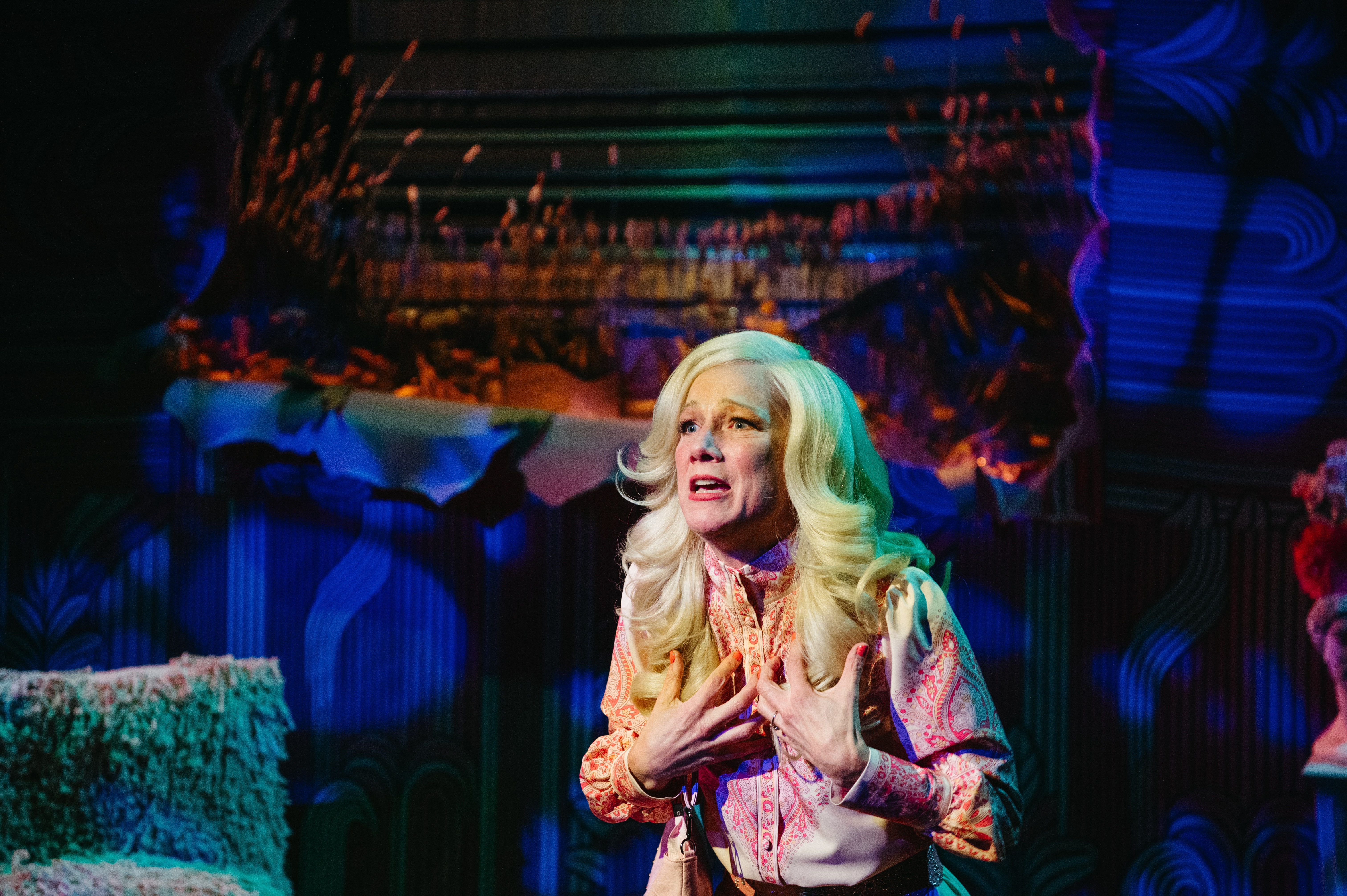
Patricia Zentilli as Trisha Lee in The Pink Unicorn. Images Brianne Jang BB Photographic. Set and costume Trevor Schmidt, lighting Larissa Poho.

The first production in Northern Light Theatre’s 50th-anniversary season is The Pink Unicorn, by Elise Forier Edie, directed and designed by Trevor Schmidt. I meant to tell you about it last week, but for some reason my blog host wasn’t letting me post pictures. So I waited, since I love the promo photos of Trisha telling her story.

And it’s so good! Patricia Zentilli plays small-town Texas mom Trisha Lee. Trisha’s been raising her only child Jolene alone since her husband Earl died when Jolene was six. Various details show that she’s always been proud of her daughter and supported her in being her unique creative self. So when Jolene tells her mom that she’s going to start high school as an agender and pansexual person, named Jo, Trisha responds as well as she can manage – helping to shop for a leather jacket, and looking up the unfamiliar terms on the internet at work. She worries a bit about whether the other kids will mistreat Jo, but reassures herself and the audience that Jo looks “real cute” in her buzzed hair and black boots. By this point I realize that it’s not just me – that the whole audience is clearly on Trisha’s side here. We might feel superior from our 2025 perspective, already knowing the vocabulary – but Trisha Lee is so easy to relate to, a loving parent trying to support and protect her kid, who’s living a life Trisha doesn’t understand.

You might remember that Northern Light produced this solo play in 2015, with Louise Lambert performing, and with Trevor Schmidt directing and designing. I think the current production brings us a more nuanced portrayal of Trisha. I was struck by her bravery, in the way she did uncomfortable things because she needed to – from her history of getting a job and carrying on as a single parent after her husband died, to her steps into activism on Jo’s behalf.

Trisha also tells the audience parts of the story that don’t reflect well on her, acknowledging that some of the thoughts are things you aren’t supposed to say. But the comments she makes without apologizing help to remind the audience that she’s still part of that particular culture, where “Latino, Hispanic, and Chicano” are all still used, and in the inner monologue we’re privy to, she always refers to Jo as “she”, not as Jo’s requested pronoun of “they”. That particular point reminded me that maybe I’m making judgements based on superficialities too. Trisha is doing so much to support her daughter and the rest of the unofficial GSA, why do I even notice the pronouns detail?

Patricia Zentilli as Trisha Lee in The Pink Unicorn. Images Brianne Jang BB Photographic. Set and costume Trevor Schmidt, lighting Larissa Poho.

The set design (Schmidt) creates the sense of a feminine living-room – even a jug of pink lemonade on the coffee table – in front of a fascinating background with dainty pink wallpaper torn open to reveal a sculptured rural landscape. Lighting (Larissa Poho) and sound (Darrin Hagen) enhance the shifts in storytelling tone and location, through a church service, a downmarket bar, and a protest in the rain. Trisha’s outfit includes boots and a silver-medallions belt over a pink patterned dress and large hair, but it feels contextual rather than caricaturistic (I’m doing a rewatch of the small-town-Texas TV show Friday Night Lights, and she’d fit in there if she wanted to).

Also – parts of it are hilarious! Zentilli is great at delivering funny lines that the character doesn’t see as funny, or doesn’t stop to enjoy. This is no surprise to anyone who’s seen her in various big-stage musicals at the Citadel or the Mayfield,

The Pink Unicorn is both provocative and hopeful. In the author interview in the show program, Forier Edie says that if she were writing it today, she might write a “scarier” version. But I loved the reminder that people’s minds can be changed, one at a time, by really listening to the people they care about. And I appreciated the call-to-action at the end, where Trisha points out to us that doing the hard thing isn’t just for people who are already good at it. I know there are lots of Jos around here, and lots of Elijah Breakenridges. And I know that not all of them have a Trisha in their corner. But Trisha’s story shows that you don’t have to be an experienced advocate to start doing the right thing for someone you care about – just do it.

The Pink Unicorn is playing at the ATB Arts Barns Studio Theatre until October 11th. Tickets are here.

The 50th season of Northern Light!

Northern Light Theatre announces their 50th-anniversary season!

Next year will be the 50th season of Northern Light Theatre, an independent company whose mandate includes bringing challenging, thought-provoking, unfamiliar, and entertaining work to Edmonton audiences, with particular attention to stories of women. Artistic Director Trevor Schmidt has a particular gift for play selection, so that a Northern Light season typically includes at least one playwright I’d never heard of, but whose work captivates me and might be relatable or disturbing or both. Schmidt is also a playwright himself, with ventures into the poignant, the macabre, and the screamingly funny.

Last year’s NLT season was themed “Making a Monster”. Schmidt’s own Monstress started the season with a disturbing gothic Frankenstein-esque tale that left me thinking I wasn’t sure who the monster was. Angry Alan, by Penelope Skinner, starred Cody Porter as an ordinary guy who gets sucked in by “men’s-rights” rhetoric, with horrible consequences. And Philip Ridley’s Radiant Vermin showed a different kind of monstrousness, but was hilarious at the same time. It was one of the most thematically-effective seasons I’ve ever seen.

This coming year is called “The F Word”, as a play on the age of fifty being unspeakable. And the three plays each have some call-back to aspects of Northern Light’s history. The first one is a remount of the award winning The Pink Unicorn, by Elise Forier Edie, which was an award-winner in the 2014-2015 season. Trevor Schmidt told me that this production will use an updated version of the script, which is shorter and more cohesive. Patricia Zentilli will play Trisha, and Schmidt promises an all-new design, with a twinkle in his eye. If you’re not familiar with The Pink Unicorn, it’s the solo narrative of Trisha, a small-town Texas woman whose daughter begins to identify as agender, genderqueer and pansexual. Trisha loves her daughter, but struggles with her community’s intolerance, in a fight she didn’t choose. In 2015, I thought it was topical and ahead of its time — in 2025, I imagine I will find it even more topical, and definitely not dated!

Before Christmas is another Trevor Schmidt original, How Patty and Joanne Won High Gold At The Grand Christmas Cup Winter Dance Competition. The excerpts read at the season-launch included Jenny McKillop as a frazzled mum looking for an activity of her own, and Leona Brausen reading as another middle-aged-tap-dancer character. It seems like it will be very funny, but also an effective reminder of community and of loneliness.

The exploration of loneliness will come to the fore in the last play of the season, Franz Xaver Kroetz’s Request Programme. Instead of presenting an excerpt from this play, the teaser given at the season-launch was a performance by singer-songwriter-guitarist Cayley Thomas (a U of A BFA Acting grad), a wistful and moving song about missing her late brother. Schmidt explained that for each performance of this play, one actor from NLT’s long roster of talented female-presenting performers will perform a character’s solitary life routine without dialogue, while a soundtrack of a radio “request programme” plays in the background. The music on the request programmme will all be from local female artists, including Cayley Thomas. Some of the actors have already been identified – Linda Grass, Holly Turner, Nadien Chu, Michelle Todd, Pat Darbasie, Sylvia Wong, Davina Stewart, Kristin Johnston, Cheryl Jameson, Melissa Thingelstad – and with a few more still to be confirmed.

Early in 2026, the NLT Board will also be hosting some kind of gala 50th-anniversary celebration, details to follow. But the F-Word season seems commemorative and celebratory enough in itself. VIP season subscriptions are currently available here at an early-bird price until July 2nd.

Another family at a cusp, in The Gravitational Pull of Bernice Trimble

Beth Graham’s play The Gravitational Pull of Bernice Trimble, directed by Bradley Moss at Theatre Network, explores a familiar family crisis time with some refreshing new thoughts.  In my adult acting classes, we’ve studied scenes from Daniel MacIvor’s Marion Bridge and from The Attic, The Pearls, and Three Fine Girls by Jennifer Brewin, Leah Cherniak, Ann-Marie Macdonald, Alisa Palmer and Martha Ross, both of which are stories about adult children who return to the family home when a parent is dying.  I’ve been through similar experiences, twice, so I can understand why such crisis times work well for a playwright, with all the characters having old baggage and resentments with each other, all stuck in a current high-stakes situation.  And because I remember what it was like sharing our childhood home with my siblings while we spent our days at the hospital and our evenings scanning through Mum’s television channels and filling up her fridge with fast-food leftovers while the neighbours’ casseroles went uneaten, stories of interesting characters going through similar struggles resonate and appeal to me.

The first exciting difference about Bernice Trimble was that the widowed mother, Bernice (Susan Gilmour, recently seen in Drowsy Chaperone and in Spamalot), was a character on stage, rather than an invalid in an offstage bedroom.  She turns out to be a fascinating character too, honest and determined and accepting of each of her children’s differences.   Having the mother on stage interacting with her children made this a rich fascinating story of earlier stages of illness and aging than the stories I alluded to in the first paragraph.  It also helped to illustrate the title.  “Gravitational pull” is the playwright’s expression for how, for better or for worse, an extended family is often drawn together by one specific person (maybe a parent or grandparent).  Astronomical metaphors were used throughout the narrative but not in a contrived way.

The story is told mostly from the viewpoint of Iris, the middle child (Clarice Eckford) on whom Bernice depends for the most difficult requests.  The narrative jumps back and forth between one later important day and a series of scenes of family members interacting over several months.  Iris frequently addresses the audience, narrating what happens between the scenes from her point of view.  The set represents both Iris’s kitchen and their mother’s.  It is generally clear which location is being presented, even without narrator Iris’s clue of setting out salt and pepper shakers every time the set is her mother’s house.   Many family traditions and customs are referred to and repeated, from Bernice’s habits of embracing her children and her endearments for them, to the rituals of family meeting and  making a classic 1960s-style casserole.  As Iris tells the story, she often uses the expression “That was that … only it wasn’t” as a transition.

The other two siblings, older sister Sarah (Patricia Zentilli) and younger brother Peter (Jason Chinn), respond to the mother’s announcement that she has Alzheimer’s disease in their own fashions, Sarah with denial and plans for second opinions and treatments, and Peter with awkward taciturn acceptance.  Sarah and Iris are also caught up by disputing who is “last to know” important family business, another familiar touch.  I thought that Peter’s small role was presented effectively and with sympathy by the playwright and the actor, because his quiet avoidance and flashes of kindness could so easily have been overplayed into humour, and they were not.

The audience gets only a single disturbing glimpse of the progression of Bernice’s illness before she enlist’s Iris’s commitment to be accessory to her suicide.  And Iris, the one who might appear least successful or least mature by some of her family ‘s measures (chatty and scattered, still single, no children, working as a temp) is the one who accepts and supports her mother’s right to make that choice, despite the pain it causes her.

I found it emotionally evocative and not manipulative, a believable portrait of a family and an illness.  The Gravitational Pull of Bernice Trimble continues at Theatre Network until November 23rd, with tickets available here.