Tag Archives: musical

Guys and Dolls – a fun production of a famous show!

Gambling scene in Guys and Dolls, with Big Jule (Connor Foy) in the centre. Photo Nanc Price Photography.

“It’s the oldest established permanent floating crap game in New York”, goes the oxymoronic Frank Loesser lyric from Guys and Dolls, building the context for a world of drifters and grifters and permanently-floating characters in a New York City neighbourhood, probably in the 1920s. I had never seen this musical before, or done any homework, so I appreciated the context!

In the current production by Foote in the Door Theatre, directed by Joyanne Rudiak at Théâtre Servus Credit Union, the action opens on a lively urban streetscape (Leland Stelck design) with various characters going about their business. We see a boxer and his trainer, some teenage fangirls chasing any possible celebrity, couples and friends, a police detective, drunk men and women, and a Salvation-Army-like uniformed mission parade, with musical instruments. As in Lin-Manuel Miranda’s In the Heights, the early scenes created a busy and interesting locality – but unlike the Washington Heights neighbourhood of Dominican-American families, the Broadway setting of Guys and Dolls isn’t about families at all.

We meet a group of gamblers (Aaron Schaan, Brad Corcoran, Madison Lalonde) and then we meet Nathan Detroit (Russ Farmer), the host of the aforementioned crap game. The presence of a trenchcoated detective (Erwin Veugelers) makes it very clear to the audience that gambling is illegal. Nathan’s longtime fiancée Miss Adelaide (Ruth Wong-Miller) is the star dancer in a nightclub nearby. But he explains to his associates that he doesn’t want to get married, while she sings her frustration with waiting for him and waiting to have a married life with children in the suburbs. “Adelaide’s Lament” is a hilarious song, of the genre where I kept trying to guess the next ridiculous rhyme. I was reminded of some lines in How to Succeed in Business Without Really Trying (also a Loesser/Swerling/Burrows creation), where Wong-Miller’s office-worker character Rosemary dreams of moving to New Rochelle (a Connecticut bedroom town).
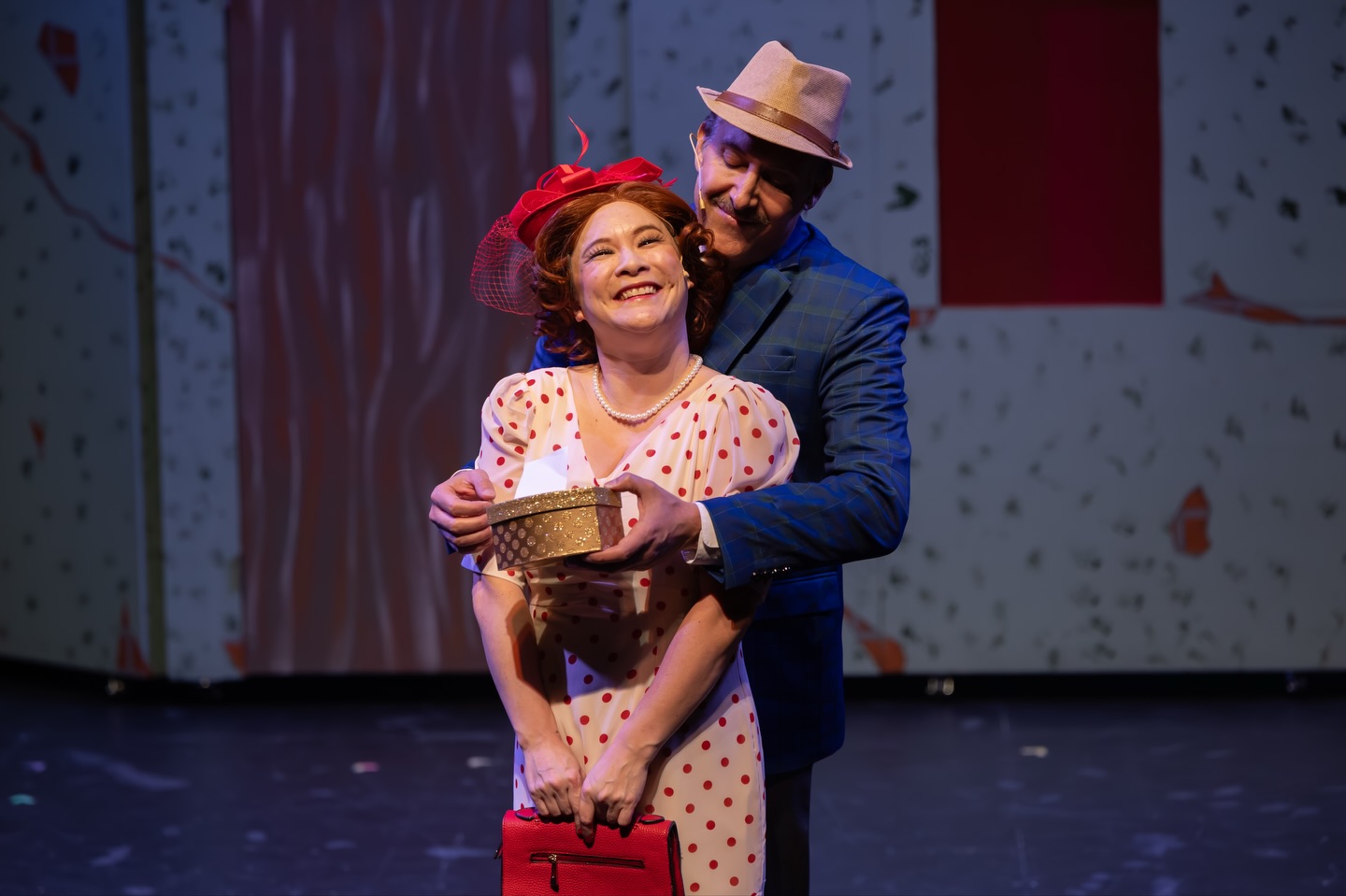
Ruth Wong-Miller (Miss Adelaide) and Russ Farmer (Nathan Detroit) in Guys and Dolls. Photo Nanc Price Photography.

A delightful contrast to this cast of ne’er-do-wells and nightlife is the presence of a mission outpost. They’re clearly a Salvation Army tribute, with red uniforms, pseudo military ranks, and a marching band (made up of Brian Ault on trombone, Eilidh Tew on clarinet, one saxophonist I didn’t recognize, and several enthusiastic percussionists). Sergeant Sarah (Kit Kroeker) seems to be in charge, but also an upperclass misfit in the rough Broadway area. Kroeker’s voice is well suited to the mix of hymn-singing, trained solo belt, and duets in her role – a pleasing contrast with Wong-Miller’s character’s nasal dialect and less forceful voice. (I’ve heard Wong-Miller sing in enough other shows that I know it was the character, not the singer!) There were opportunities for jokes about well-meaning clueless missionaries, which landed just as well in 2025.
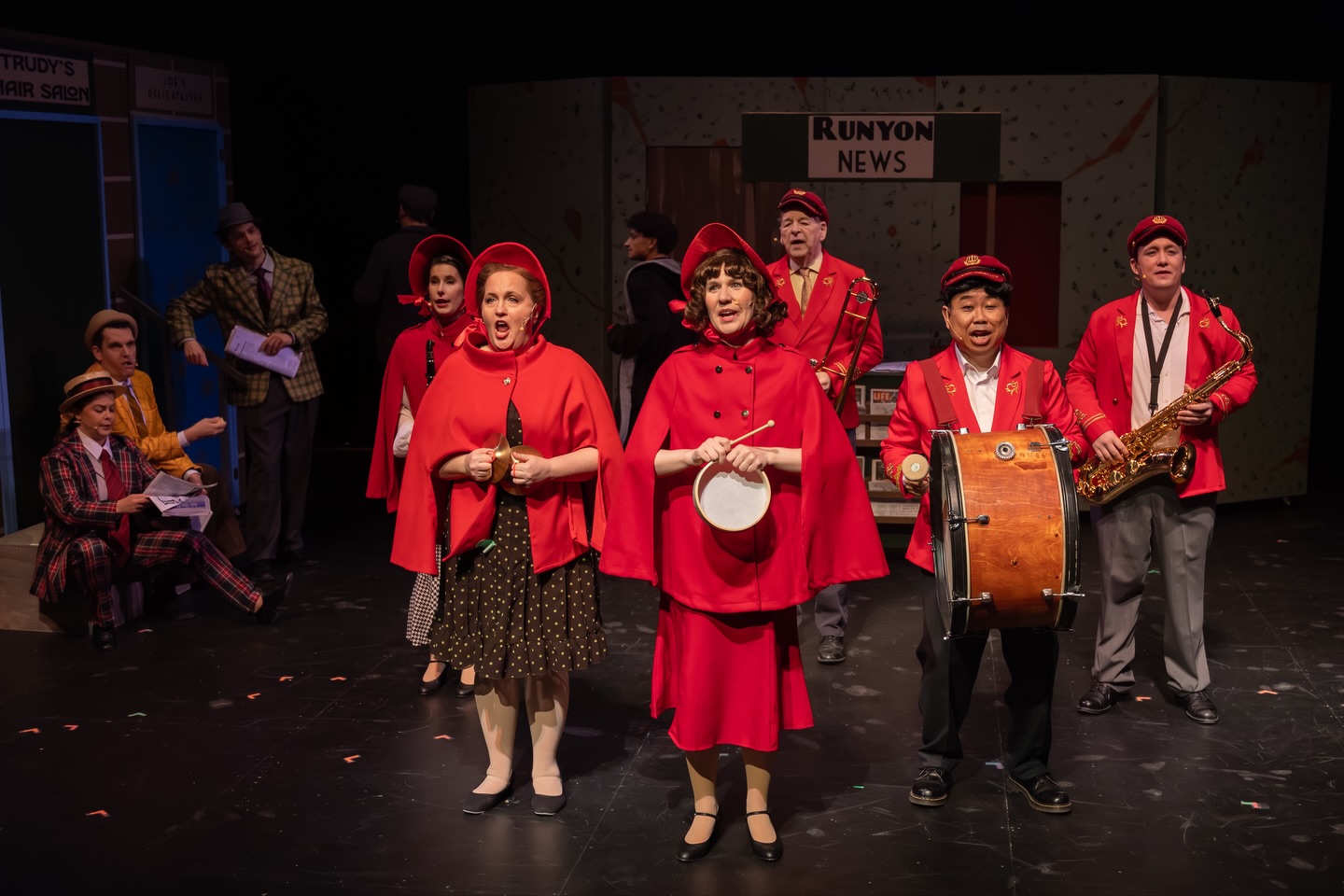
Sergeant Sarah (Kit Kroeker) and the Save a Soul Mission band, in Guys and Dolls. Photo Nanc Price Photography.

Like many traditional musicals, the story needs two couples with obstacles to romance, as well as a main plot objective (Nathan finding a new venue for his craps game). Nathan and Adelaide are one at-odds couple (see what I did there?) Sergeant Sarah is thrown together with high-stakes gambler Sky Masterson (Aidan Heaman), who tries to take her out on a bet, but then falls for her (of course!)

Some of the most fun scenes in this show are the large cast choreography filling up the big stage at Theatre Servus (Adam Kuss). I was sitting in the front row so I felt immersed (although never quite endangered) – sitting further back would probably let you appreciate the full scope of the action though! My favourite was the action at the plaza in Havana, where colourful salsa performers and restaurant customers danced joyfully and flirted and fought, while ASMs doubled as bar staff to crowd the plaza even more. Although the simulated dice-games in the sewer for “The Crapshooters’ Dance” were also great, with about 20 male-identifying characters incorporated in the action – Connor Foy and Aaron Schaan as featured dancers, and versatile ensemble members like Julia Stanski and Chelsea Makwae and Eilidh Tew just as captivating in trouser roles as in chorus-girl or “doll” roles.

Aidan Heaman, Sky Masterson, then glows in his spotlight with the classic “Luck be a Lady Tonight!”

I won’t give away the rest of the plot – suffice it to say that there are no big surprises. It turns out that for a show I didn’t know, a lot of it was already familiar songs and tropes, so it was fun to recognize them as they came up. It was also satisfying for me to recognize faces and names as people I’d worked with before, at Walterdale, for ELOPE, and for Foote in the Door. At least two of them have supported Walterdale productions in backstage roles, and maybe 10 of them onstage, and one playwright, for example.

Guys and Dolls continues at Théâtre Servus Credit Union (La Cité Francophone) until November 30th, with tickets available here. As well as a snacks-and-drinks concession, they are also selling Peace by Chocolate chocolate bars in show-themed sleeves. The chocolate is so good that I might go back tonight just to buy more!
A lovely musical about memories: Morningside Road

[Posted without imagery due to web-host issue]

Last night I was able to attend the preview performance of Morningside Road, the musical created by Mhairi Berg and Simon Abbott. It’s the first production of Shadow Theatre’s new season, and it was directed by incoming artistic director Lana Hughes.

I was enchanted. Right from entering the auditorium and seeing the set – I thought to myself, I bet that’s a Daniel van Heyst design, and I was right. The set includes a realistic homey kitchen nook with tea things and a collection of family photos, but also a more abstract area with bits of low stone wall, which becomes various outdoor city locations.

I stayed caught up in the story with three likeable characters, Elaine (contemporary Elaine was played by Maureen Rooney and Elaine of memory was played by Mhairi Berg), the Girl (Elaine’s grand-daughter, Mhairi Berg), and the Lad (Cameron Kneteman). It wasn’t the first “how my grandparents met” play that I’ve seen – Megan and Beth Dart’s Ursa Major was another memorable one – but the story was engaging and the structure worked very well, shifting between now and back-then, between a kitchen in Canada and a city street in Edinburgh. The pacing was appropriate – I never felt like a scene or a song was too long, and I appreciated the various musical callbacks and familiar riffs adding to the continuity. Partway through, I realized that part of what I was admiring was deft lighting design (Liekke den Bakker), with smooth shifts between times/locations/moods and no heavy-handed dimming of areas I was looking at. Costuming (Kat Evans) was that kind of deceptively-simple that perfectly suited the characters and setting but didn’t distract. Of course practical-grandmother Elaine would be wearing slacks and long cardigans and the same comfortable shoes that my own mother wore for years, rather than more old-fashioned housedresses and aprons, and the other performers wore vaguely-timeless outfits that weren’t out of place in 1940s Edinburgh or in the more modern scenes.

The live musical ensemble of Simon Abbott, Curtis den Otter, and Viktoria Grynenko is located upstage centre behind a screen, which worked very well for sound balance and also allowed for the actors to include them in some scenes more actively. One of the songs, That Blessèd Wedding Day, was a lively catchy community-storytelling piece with dancing, in a folk-song idiom like Great Big Sea.

Rooney’s Elaine has clearly been telling stories about her life to her granddaughter for many years. The two of them are allies, more strongly connected than the offstage daughter/mother in between. I was reminded of my own late (great-)Aunt Elaine, who came to Canada from Scotland as a war bride and remained a daily crossword-puzzle fiend well into her 90s. The motif of one person’s story becoming common property, so that the younger generation might object or correct when the grandparent tries telling the story differently (“that’s not right!”) was also familiar and fascinating. Suggestions of Elaine beginning to lose her memory / memories and executive functioning were also done with a light touch.

The music was lovely and it contributed to the storytelling and the character portrayals. I had not heard Rooney sing before, but I was very impressed.

I wasn’t able to see the version of this musical that Berg and Abbott presented at last year’s Fringe festival, so I can’t tell you how the Shadow Theatre production differs. But I was very pleased with this one – it is nuanced, affectionate, and wistful.

Running time is a bit under 2 hours – and just the length it needs to be. Tickets are available here, for the run continuing until November 6th.

Amélie: whimsical and fun!

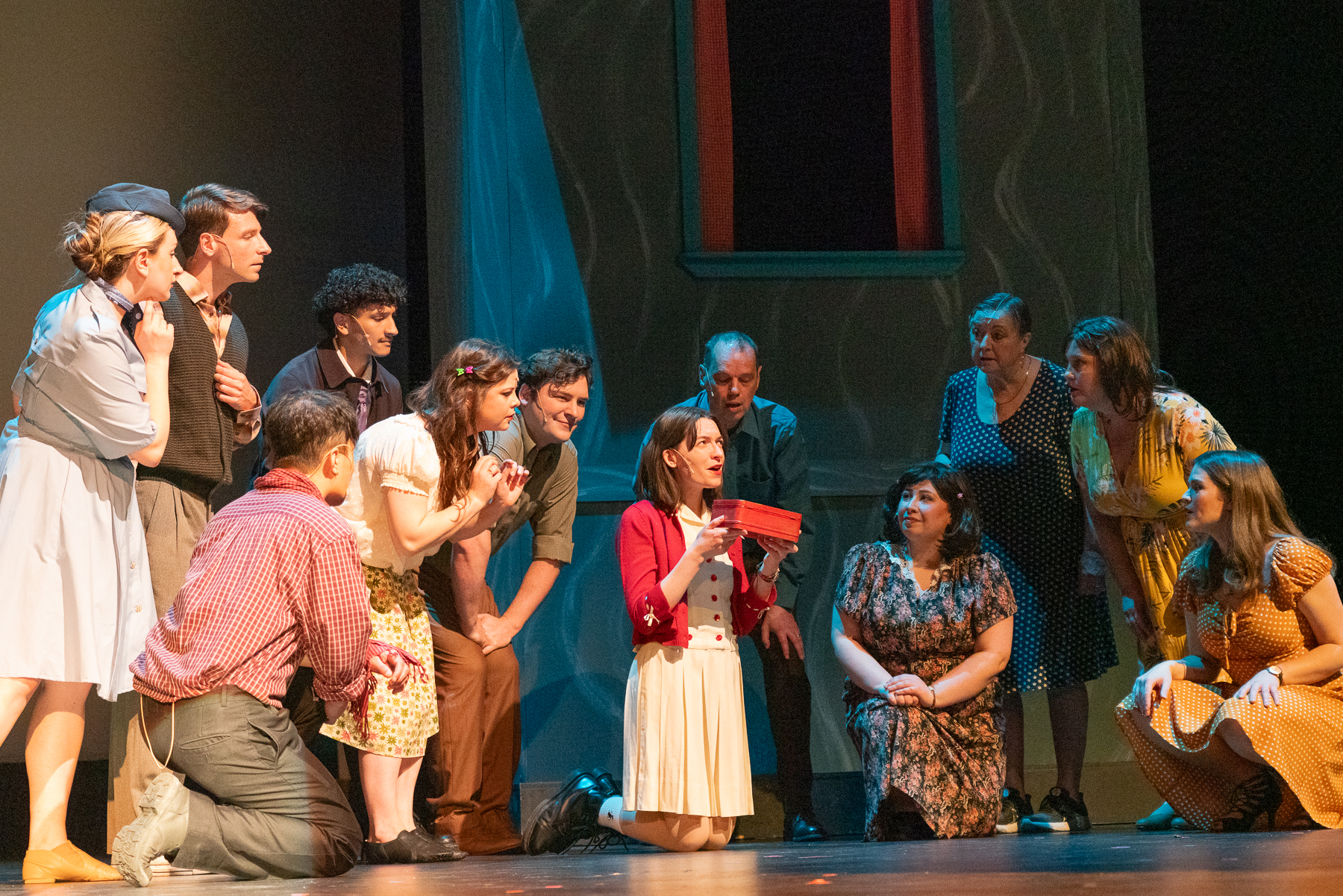
Actor on her knees holding an old red metal box, surrounded by other actors.
Lauren Upshall-Ripley, as Amelie, holds a treasure box, surrounded by friends and neighbours. Photo Kara Little.

ELOPE, the long-running local musical-theatre company, is currently performing Amelie, the musical, at the University of Alberta Timms Centre. It is quirky, delightful, and unexpected – and very well done.

Amélie, the musical (music by Daniel Messé, lyrics by Messé and Nathan Tysen and a book by Craig Lucas, is based on the 2001 French movie of the same name. I still haven’t seen the movie, so I kept laughing with surprise as the narrative unfolded.

Lauren Upshall-Ripley is perfectly cast as Amélie, the title character, a young woman whose background as an isolated child equips her with playful daydreams and fantasies. And Danika Reinhart plays 6-year-old Young Amélie, illustrating with painful poignancy how the optimistic child’s resilience shines past her fearful and repressive parents (Erwin Veugelers and Rachel Frey). The duets between Upshall-Ripley and Reinhart were particularly strong, with vocal balance and warm connection between the younger self and older self. I was reminded of the Netflix series Unbreakable Kimmy Schmidt, which also portrayed a likeable and resilient young woman in modern New York, with humour and without sentimentality.

Actor in red cardigan and simple white dress stands joyfully with outstretched arms.
Lauren Upshall-Ripley, as Amelie. Photo by Kara Little.

One quirk of the script was the way that many of the ensemble members in the 19-person cast took turns narrating the key points of Amélie’s life to the audience, with wry humour and a strong sense of community. The scenes illustrate a lively neighbourhood of Montmartre, centred around the Two Windmills Cafe, where Amélie works. Her co-workers Gina (Christy Climenhaga) and Georgette (Josephine Herbut), employer Suzanne (Judy McFerran Stelck), and other neighbours all have their own challenges and heartbreaks, but like the best workplace comedies, they’re all engaged in trying to help each other. Director Kristen Finlay has a resume full of productions where each member of a large cast has clear interesting intentions and also blends as an ensemble – 25th Annual Putnam County Spelling Bee for ELOPE, Penelopiad, Chess, The 39 Steps for Walterdale, and others.

The narrators give specific dates – of Amélie’s conception, of her mother’s death, of her move to Paris, of a day her life changed – this let me figure out how old she was at each point, but also turned out to be a clue that key events for Amélie were affected by Princess Diana’s visit to Paris and untimely death. Amélie watches television coverage of Diana’s funeral, alone in her apartment, and daydreams of being honoured like Diana. Connor Foy plays Elton John, singing “Goodbye, Amélie” at a white-lacquered grand piano and leading a sequined ensemble – the audience was screaming as the first act ended.

Amelie’s adventures involve various other neighbours and friends, but weaving through these stories we see hints of another quirky and creative outsider, Nino, played by Colin Stewart. “Who are you?” asks Nino, on the phone with Amelie. “I’m a mystery wrapped in an enigma trapped in a paradox disappearing into thin air. ” “Me too.” Will they meet up? Will it be worth it? Will it work out? We want it to.

Actor in leather jacket and cross-body satchel sings joyfully.
Colin Stewart as Nino Quincampois, in Amelie. Photo by Kara Little.

In another vignette, Amélie returns some childhood treasures to a lonely man (Dustin Berube). Berube and Upshall-Ripley’s duet, “How to Tell Time”, was one of my favourite moments.

Musical direction was provided by Sally Hunt, with eight other musicians. David Son created choreography for the ensemble that was both exciting and well-executed, and also joined the ensemble himself in a few small roles, including (hilariously) an escaping Goldfish. Debo Gunning designed costumes that supported each character, from Amélie’s artless awkwardness in shirtwaist and Doc Martens, to the more sophisticated Parisian women of the cafe and sex shop, and Elton John fabulously excessive with feathery epaulettes to his sequined jacket. The facilities and technical capabilities of the Timms Centre Main Stage were effectively used by ELOPE’s technical team (set design credit to Leland Stelck). Finlay and Son’s blocking and movement of the large cast on the deep stage never felt crowded.

Amélie is playing at the Timms Centre until Saturday July 5th. Get your tickets here.

Heathers: high school is more fun to watch than experience

Scene from MacEwan University production of Heathers.
Photo Credit: Brianne Jang of BB Collective
Light Design: Heather Cornick, Set Design: Ross Nichol, Costume Design: Alison Yanota

Continuing on my recent run of seeing new productions of shows I’d seen in the past, tonight I watched opening night of the MacEwan University Musical Theatre program’s production of Heathers, by Laurence O’Keefe and Kevin Murphy, directed by Leigh Rivenbark. I saw the 1988 movie a long time ago, and the Citadel Young Musical Company production in 2016 (also directed by Leigh Rivenbark) but I didn’t remember them very well.

So I had the fun of encountering the musical almost fresh. Layne Labbe as Veronica and Jayden Leung as JD both had strong voices and compelling stage presence. Marina Mikhaylichenko was a disturbingly-mean Heather Chandler. Ashlin Turcotte (Martha, Veronica’s original best friend before her strategic social climbing) and Kara Adams (Ms. Fleming the hippie teacher) both had vocal solos that developed their characters and also demonstrated some impressive talents. It was also fascinating to watch the other ensemble members as high school students who all seemed to have distinctive characters, backstory, and connections with the others. Choreography (Courtney Arsenault) was well executed, and silhouette work behind windows was delightful.

I had forgotten how sharply satirical it was, skewering suicide-awareness campaigns, internalized homophobia, performative allyship, signing petitions without reading them, playing to the media, the misunderstood-loner-in-a-trenchcoat trope, bullying, bulimia, frenemies, and all the teenage stereotypes.

Heathers is playing at MacEwan’s Triffo Theatre all weekend. But if you don’t already have tickets, you’re probably out of luck. You might want to plan ahead to get tickets to the MacEwan production of The Prom, next March.

The Pirates of Penzance

Shauna Rebus, Brendan Smith, and Russ Farmer in Pirates of Penzance. Photo by Nanc Price Photography.

If you’ve ever heard of Gilbert and Sullivan – if you have even a humming familiarity with any of their work – you’ll know that the Victorian-era duo wrote wildly-popular tongue-in-cheek light opera pieces, some of which continue to be frequently-performed and alluded to in popular culture. And if you asked someone to sing one song from Gilbert and Sullivan, they’d probably attempt the first lines of “I am the very model of a modern Major-General”, an oft-parodied patter song which is from Pirates of Penzance (1879).

I’ve seen Pirates of Penzance once before – at the Stratford Festival’s Avon Theatre, on a 1985 outing with my mother, who’d admitted the year before that she appreciated me taking her to see some Shakespeare plays but what she would like even better was Gilbert and Sullivan. In those days it wasn’t easy to access a plot synopsis or lyrics ahead of time, there were definitely no supertitles/captions, and seats at the front weren’t in my budget. So I missed lots of the clever rhymes and over-the-top dialogue/intentions.

Local company Foote in the Door opened their production of Pirates of Penzance last night at Théâtre Servus Credit Union (La Cité Francophone), directed by Ron Long. I sat in the first row so I wouldn’t miss anything – and they were using supertitles for all the songs, which made it even easier to follow the preposterous premises of the plot. Frederic, a nautically-minded boy who had been accidentally apprenticed to a pirate instead of a pilot (Brendan Smith), is coming of age and being released from his indentures. But he’s got an overdeveloped sense of duty, which keeps leading him into inconvenient obligations.

Frederic looks forward to the pleasures of civilian life. His old nursery maid, Ruth (Shauna Rebus), who followed him into piracy, now hopes to catch his affections as they leave the ship, but Frederick is hoping to meet younger prettier women. These two characters were among my favourites, but the company of twenty-one performers were all fun to watch and listen to. Andrew Kwan was a delightful Major-General Stanley, father to a chorus of eight daughters including Frederick’s choice Mabel (Ruth Wong-Miller). Some of the pirates doubled as police officers, led by their sergeant Aaron Schaan in unison nightstick choreography. And one of the daughters (Eilidh Tew) doubled flexibly as a pirate! Sisters Wong-Miller and Christina O’Dell had a lovely duet in the second act. There was some fighting with fencing foils, pistols, and other found weaponry (fight director Sarah Spicer). Russ Farmer is the Pirate King. He and his hapless band display an assortment of impressive facial hair, some of it real.

The company of pirates and daughters surround Andrew Kwan, the Modern Major-General, and his Sterling Award. Photo by Nanc Price Photography.

Pirates of Penzance is playing until November 24th, with tickets available through Showpass.

Day Three – local artists, new stories

It’s hard to find a connecting theme for the four productions I saw today, except that they were all done by familiar local artists.

Dick Piston Hotel Detective in Prague-Nosis was, as the title suggested, a classic noir tale with a hardboiled detective narrator (Lucas Anders), an assortment of suspicious characters (Mélissa Masse, Sarah Gibson, Dan Fessenden, Dave MacKay), and an atmospheric setting cleverly suggested by description, lighting, and a few set pieces moved around to suggest different locations in the seedy Lakeview Hotel. The published script, by American playwright/television writer Jeff Goode, offers scope for over-the-top humorous character portrayals but seems to have the consistent intricate plotting of a classic noir detective story. Director John Anderson has gathered a cast of clever character actors and talented crew, familiar from Walterdale Theatre productions. ASM Adorra Sergios displays title cards before each scene, in a series of increasingly strange hats. Playing in the Sugar Swing Ballroom (main floor) space, venue .

Rob and Chris / Bobby & Tina is an adaptation of one of my favourite plays ever, Collin Doyle’s Let the Light of Day Through. The playwright adapted it to a 60-minute musical format, along with composer/music-director Matt Graham. The original 2013 production of the play, with Jesse Gervais and Lora Brovold, portrayed the awkward affection and determination of a couple who experience an awful tragedy and … not get over it, but go on. The play is partly recollective, but they act out the stories to tell them to the audience, and it is very funny except when it’s awful. Part of the power of the original experience, for me, was not knowing what they were avoiding telling, until they told it. When I heard that Kate Ryan of Plain Janes would be directing a musical adaptation for the Fringe, I was excited, but also apprehensive. What if it wasn’t as good as I remembered the play? What if the experience depended on not knowing the outcome? But it is very good. It landed differently for me because I was watching for clues, but it was still powerful. The couple (Bobby + Tina when they meet as teenagers, Rob and Chris later) are played by Garett Ross and Jenny McKillop. They do just as well showing the awkward disconnects of a new relationship and a long-term one as they do showing the way that the couple develops a shorthand of shared understandings – the scene of trying to have a role-play fantasy when each of them thinks the other wants something else was hilarious, and the ways they imitate each other’s parents to amuse each other show clearly how they’ve been allied against both sets of parents for years. Graham’s music is suitably poignant and funny and affectionate, as called for, and the simple Fringe-appropriate set design (Trent Crosby) worked. Matt Graham plays the piano live. Venue 11, Varscona Theatre.

Mass Debating was also a musical and also at the Varscona. Trevor Schmidt wrote it and cast frequent collaborators Jason Hardwick, Cheryl Jamieson, Kristin Johnston, Michelle Todd, and Jake Tkaczyk, along with himself, to play junior-high-school debate team competitors. The universality and familiarity of the junior-high-aged themes (an early song focuses on each character’s worries of “Can they tell by looking?” ) were portrayed in a setting of mid-1970s Catholic schools, so the injustices were more overt and seemingly unchangeable than a contemporary context. Although the audiences know that things will get better, the characters really don’t. This dramatic irony provides not just humour but poignant compassion. Many of the unfairnesses focus on the institutional sexism of the society and that Church, and the way that both the boys (played by Jameson, Johnston, and Todd) and the girls (played by Tkaczyk, Hardwick, and Schmidt) express them in their interactions and behaviour. The thoughtless racism of the time was also shown in the segment where Ralph Washington, the Black competitor (Michelle Todd) was required to debate the Against side, on a resolution that racial integration has hurt Catholic education. Unlike Schmidt’s recent successful contemporary story about junior high school girls, Robot Girls, this one does not tie up the plot threads with happy endings. And it shouldn’t. That left me thinking. The music was written by Mason Snelgrove, and the accompaniment is recorded. Some of the announcer’s voice-overs were hard for me to hear clearly – not quite the Charlie-Brown-teacher “wah-wah-wah” but probably funnier than I knew about.

The drag comedy troupe Guys in Disguise have a new comedy, written by Darrin Hagen and Trevor Schmidt, called Microwave Coven. It’s also set in the 1970s, in a suburb, and it starts off with three neighbourhood women in fabulous caftans (Darrin Hagen, Jake Tkaczyk, Trevor Schmidt) preparing for a visit from neighbourhood newcomer Jason Hardwick. Hardwick is adorable as naive newlywed Mary Rose, in crinoline and blonde flip. The premise of this story is less realistic than the troupe’s recent productions like Crack in the Mirror and Puck Bunnies, but the characters are just as much fun. It’s also at the Varscona.

Back to Avenue Q

Erin Harvey as Mrs. Thistletwat in Avenue Q. Photo Nanc Price.

I’ve now seen three productions of the Robert Lopez / Jeff Marx / Jeff Whitty musical Avenue Q. I saw the Off-Broadway transfer in New York in 2014, and the Citadel Theatre production in 2015. And when I first saw the announcement that Foote in the Door would be doing it in 2024, I had no trouble remembering various catchy tunes from the show, and more trouble getting the earworms out of my head afterwards.

As I wrote after seeing it Off-Broadway, it’s like Rent crossed with St. Elmo’s Fire for audiences who grew up with Sesame Street puppetry, a combination that’s hard to picture until you’ve seen it or are familiar with the cultural phenomenon.

Ten years later, many audience members already know what to expect. The Foote in the Door production, directed by Trish Van Doornum, opened last night at Théâtre Servus Credit Union, to a full and enthusiastic house. I had wondered if some of the elements would require shock-value to be appreciated – “The Internet is for Porn”, Christmas Eve and “Everyone’s a Little Bit Racist”, and the puppet sex scene, in particular – but I thought the opening-night crowd was delighted whether or not they were caught by surprise. Christmas Eve, in the original production, sings “I coming to this country for opportunities, Tried to work in Korean deli, but I am Japanese!” and her speeches are full of comedic L-R switching and English-language-learner patterns. Those tropes are getting old – but in the Foote in the Door show, Christmas Eve is performed by Sunshine Bautista Mauricio, whose overall sass, determination, and compassion were more significant than the stereotypey trope. That early line is changed to “Tried to work in Korean deli, but I am Filipino!” (maybe she said Filipina, but I couldn’t hear clearly since the crowd was laughing and cheering). A couple of places later in the show, she says rude things to her husband in a language I don’t understand (Tagalog?) but some audience members definitely did. Those changes improved the show for me, demonstrated that it wasn’t just about entertaining white people.

Sunshine Bautista Mauricio as Christmas Eve. Photo by Nanc Price.

The current production uses a cast of nine performers, and I was especially impressed by the work of some of the ensemble members I was less familiar with. Erin Harvey (last seen in Walterdale’s Austentatious) was a puppeteer playing Mrs. Lavinia Thistletwat, occasionally covering Kate Monster, Lucy, and a Bad Idea Bear, with a hand in Russ Farmer’s embodiment of Nicky. The scenes where Kate and Lucy interact, with Ruth Wong-Miller doing both voices, fascinated me because my eyes kept fooling me about who was talking for which puppet character. Jay Duiker, whom I remembered as the Baker in FITD’s early-2022 Into the Woods, had a strong voice and good comic timing for wannabe-standup-comic Brian. Renell Doneza (with previous credits ranging from Walterdale’s Altar Boyz to the Citadel’s Prison Dancer) embodied various ensemble characters, and watching his own physicality as a contrast to the puppet Rod’s repressed rigidity was very clever. Jayden Leung, also credited with the video montages used in the show, was the remaining ensemble puppeteer, playing various characters including part of Trekkie Monster. Lead-puppet Princeton was performed by Stephen Allred, whose FITD resume started with an insightful interpretation of Laurie in the 2017 Little Women. And the building super Gary Coleman, often played by a woman, was Malachi Short, whom you may recall from Elope’s production of Joseph and the Amazing Technicolor Dreamcoat last year. Short, Harvey, and Leung are all current students in MacEwan University’s BFA in Musical Theatre Performance, and ones to watch in future years.

Ruth Wong-Miller as Kate Monster. Photo by Nanc Price.

There’s one bit in the show where Princeton decides to collect donations to fund another character’s dream, and he motivates other characters to pass the hat running up and down the theatre aisles. When I saw it in New York, the meagre takings that they counted afterwards included a Metro card (subway pass) – I wasn’t sure if that was scripted or not. Well, last night they pulled an ARC Card (local transit pass) out of the hat, so I guess I have my answer. And then after the curtain call, company co-founder Ruth Wong-Miller told the audience that the takings from the hat-passing, plus anything else we wanted to add to the ASMs’ hats in the lobby, would be donated to the Youth Empowerment & Support Services, who operate the Youth Emergency Shelter and other programs in the neighbourhood. This struck me as a great choice, not just for being hyperlocal but for building on the sympathies for the characters in the story, who are mostly a step or two away from the outcomes of the characters in Rent but who are still young and with limited resources. (So take some money, and not just for the concession!)

Avenue Q is full of short songs with lyrics that you might not want to sing at your recital, and musical-theatre melodies and harmonies that are hard to get out of your head. All the voices were strong, and the sound-mixing was well done (which I can’t always say on opening nights). Almost all the audience members near me managed to resist checking Oiler-score updates during the show – giving us a satisfying end to the evening in more ways than just a fun performance with happy and credible futures for the various characters.

Leland Stelck has designed a functional and interesting streetscape set, in the style of Sesame Street or In the Heights, and the musical ensemble directed by Grace Huang are visible downstage and occasional participants.

Avenue Q runs until June 8th, but several performances are already sold out. Remaining tickets are available here.

13 actors play clerks and customers in an old-style perfume shop

She Loves Me

A busy day in Maraczek’s Parfumerie, with Georg Nowack (Russ Farmer, downstage right) gatekeeping job applicant Amalia Balash (Ruth Wong-Miller, in cream figured dress) Photo Nanc Price Photography.

The pre-set for She Loves Me, at Théâtre Servus Credit Union (La Cité Francophone), is simple. A storefront with a bench in front of it, a backstage orchestra visible over the top. But as the stories unfold, the set (Leland Stelck) unfolds more literally, revealing the main set of a parfumerie in 1930s Budapest, and later shifting quickly to create a romantic cafe, a hospital room, and whatever else is needed. The counters, shelves, displays, and stock convey a store filled with luxuries and needs. It felt like it would be interesting to browse more closely – like going to Lush (without its overpowering mix of scents).

The show focuses on the parfumerie’s owner, Mr Maraczek (Brian Ault) and its employees (Andrew Kwan, Russ Farmer, Scott McLeod, Brendan Smith, and Christina O’Dell) along with job-applicant Amalia Balish (Ruth Wong-Miller). Like a Maeve Binchy novel, the script (Joe Masteroff) and clever direction (Melanie Lafleur) convey that all the characters have interesting stories that we want to hear more about. And not just the principal characters – the ensemble makes up a store full of recurring customers, a romantic cafe full of – romances – and other intriguing bits which I won’t tell you.

My two favourite ensemble bits of this show were “Twelve Days to Christmas” – putting a familiar retail spin on the Advent season – and the whole scene in the cafe. The cafe scene made good use of the depth of stage available to them, and with the raked auditorium seating of the Théâtre Servus, the audience could appreciate the performances upstage of the three women dining at the bar-counter and their server. Not having looked at the show program before the show started, I was surprised to see that this white-jacketed cafe server was Brendan Smith, whom I’d enjoyed on local stages since his appearance in Walterdale’s Light in the Piazza. I had been impressed by the enthusiasm and voice of the young shop delivery boy but with costuming and posture I hadn’t identified him as Smith! Other romantic couples are also enjoying drinks and dancing, and playing out their own narratives, while Amalia waits alone at a centre table for her mysterious pen-pal sweetheart. Aaron Schaan and Julia Stanski, spotted shopping together in earlier scenes, seem to have a proposal accepted. Real-life couple Trish van Doornum and Michael McDevitt are snuggling at a side table. Side flirtations are suggested in a fun dance number involving peeping from behind menu folders.

The premise of having couples meet through a newspaper Lonely Hearts Club correspondence column, getting to know each other through letters without revealing mundane life details, was updated to email for the 1998 movie You’ve Got Mail. Dating app experiences in 2023 encourage providing photos early on, so the plot-device of accidentally falling in love with a co-worker based on their text communication seems less timely, but the story is still easy to relate to.

I was pleasantly surprised at the range of sexual/romantic lives accepted among the main characters. Ilona, the woman who spends time at her lovers’ apartments (Christina O’Dell), is not vilified for it. Her co-workers as well as the audience are genuinely rooting for her to find a nice man who deserves her – or to have a nice evening at the library if that’s where she finds happiness now. Georg Nowack (Farmer) is single, so the boss assumes he must be spending his evenings at cabarets and nightclubs with a different woman every night, but no, he prefers quiet evenings at home.

I also appreciated that this story didn’t follow the trope of an independent woman being attracted to a cranky rude man despite herself, and then winning him over. Instead, Amalia is openly critical of Georg when he is being rude, only begins to appreciate him when he does something thoughtful (bringing her vanilla ice cream when she is sick), and then we see them gradually building trust and then affection over the days of a busy Christmas retail season.

White man dressed in 1930s overcoat, hat, and scarf sings joyfully.
“She Loves Me” – Russ Farmer as Georg Nowack. Photo by Nanc Price Photography

The songs and instrumental music (Sheldon Harnick, Jerry Bock) enhance the experience throughout. Elizabeth Raycroft directs an orchestra of 11, and the performers all have good songs for their voices. I particularly enjoyed “Vanilla Ice Cream” and “Try Me” and the harmony in “I Don’t Know His Name”.

Two women with ornately curled hair and form-fitting business wear wrap small presents while chatting.
Ruth Wong-Miller and Christina O’Dell in “I Don’t Know His Name”, She Loves Me 2023. Photo Nanc Price Photography

In 2015, Foote In The Door did She Loves Me as their first mainstage production ever. Since then, Broadway audiences have also had another chance to appreciate this musical, and there’s a cast recording of that 2016 Broadway production – I was delighted to discover that Christina O’Dell’s role of Ilona was played by Jane Krakowski of 30 Rock.

The company has been producing musicals ever since, at the Fringe as well as in their mainstage seasons. I attended opening night of that first production, so it was a treat to watch this one and recognize many familiar names of people who had been with the company from early days or who have joined Edmonton’s musical theatre community more recently. The deeper proscenium stage and more sharply raked seating at Théâtre Servus for this production supported different choices in directing and design to connect the audience intimately with the performers and allow interesting ensemble play. Costume choices for this production (Viola Park) were more subtle than in the 2015 show, with the parfumerie clerks mostly in well-fitting understated grey suits rather than plain green shopcoats, and glimpses of colour being added gradually, particularly in Amalia’s garments and accessories. As is current practice for many local companies now, some program information is displayed on a projection screen before the show starts, with the full program available via QR code. (I don’t have a good system for saving my online programs, the way I have boxes of hardcopy programs for everything from Fringe shows to Broadway.) And of course, in 2023 some of us attend the theatre wearing masks.

She Loves Me is playing Wed-Sat evenings and Sunday matinees until November 26th. Tickets are available here.

Two big musicals of alternate-history – Brigadoon and Hamilton!

Brigadoon ensemble. Photo by EPIC photography.

I got to watch big musicals two nights in a row last weekend, with fireworks in between. Talk about spectacle!

ELOPE is performing the Lerner and Loewe classic Brigadoon at the Westbury Theatre, running until this coming Saturday July 9th. Jon Shields is directing. With a cast of about twenty-nine and about a dozen musicians (Sally Hunt, music director), the deep Westbury stage was full but not crowded. In the story (which I vaguely knew ahead of time – I think I saw the ending of the movie once?), two young American men from 1947 (Mathew Glenn and Randall Scott MacDonald) are lost in the woods in Scotland, and discover a mysterious town from 200 years earlier. This allows for lots of local festive colour (with plaids and dancing), as they arrive on a day that two young residents of the town (Lilly Hauck and Brendan Smith) are getting married. I got distracted by trying to figure out the size of the population (were were just seeing a few of them or all of them?) and whether it was sustainable, but a more interesting question was whether everyone stuck there actually wanted to be there. Of course, the visitors are swept up in the life of the town, with one of them falling for the bride’s older sister Fiona (Christina O’Dell) and the other one being targeted by the, um, outgoing and vivid Meg (Kathleen Sera). O’Dell has a spectacular voice which is well suited to Fiona.

I only recognized one song in Brigadoon, “Almost Like Being in Love”. I enjoyed watching the interestingly diverse ensemble of villagers, and I appreciated the costuming (Julieanna Lazowski).

If you like classical large-cast musicals, you can get tickets to Brigadoon through Tix on the Square or at the door.

_________________________________________________________________________________________

The next night, I saw the Broadway Across Canada touring production (the #AndPeggy cast or third North American touring cast) of Hamilton. It is in town for a three-week run (most BAC shows are here for one week), with a rush-seat lottery operating through a phone app, which is how I was able to see it.

I do not know the US founding-fathers’ history in detail and I didn’t grow up with ownership to the story. As for Hamilton the phenomenon, I’d listened to the cast recording, read lots of articles about Lin-Manuel Miranda and his choice to cast performers of colour, and watched the Disney+ filmed version, so I had a pretty good idea what to expect.

The BAC production completely satisfied my expectations, and exceeded them. I was seated up close, so the cast of 21 on the proscenium stage felt like they were surrounding me. With multiple levels, side balconies, people drifting in and out of scenes and observing in corners, there was always lots to watch. Julius Thomas III played Alexander Hamilton, and we had understudies Milika Cherée and Charlotte Mary Wen playing sisters Eliza and Angelica Schuyler. I thought Charlotte Mary Wen was especially compelling. The actor playing King George, Rick Negron, interpreted the part quite differently from the Jonathan Groff version I’d seen filmed, losing some momentum in favour of Christopher-Walken-esque momentous pauses. But the audience still reacted strongly to him, someone near me even shouting out about it while Negron was singing. The movement in the show was great, especially the energy of a couple of ensemble numbers with no music. And the songs varied widely in genre with lots of earworm-catchy parts.

Hamilton tickets are available through Ticketmaster, for shows in Edmonton until July 10th and then in Calgary.

_____________________________________________________________________________________________

COMING UP NEXT: Walterdale Theatre’s production of Will Eno’s The Realistic Joneses opens tomorrow, Wednesday July 6th, 8 pm. I got to see a few scenes in an early rehearsal and I’m fascinated to see more of these quirky characters. Tickets directly from Walterdale online, or at the door.

A Gentleman’s Guide to Love and Murder

Kathryn Kerr, Stephen Allred, Ruth Wong-Miller, in A Gentleman’s Guide to Love and Murder. Photo Nanc Price.

My previous entry was about the Teatro la Quindicina quirky tongue-in-cheek period piece Evelyn Strange. And tonight I saw another quirky tongue-in-cheek period piece – Foote in the Door’s production of A Gentleman’s Guide to Love and Murder. This musical, by Steven Lutvak and Robert L Freedman, won several Tony awards in 2014 – I was actually in New York that spring and could have seen it, but I picked shows I’d heard of instead. And I got to see this production completely unspoiled.

A Gentleman’s Guide to Love and Murder is set in England in 1907. The premise of it is that Montague Navarro (Stephen Allred) discovers after his mother’s death that he’s distantly related to nobility, in fact being something like ninth in line to an earldom, although his mother had been disowned for marrying his late father, “a Castilian … and a musician!” All this information is provided by his mother’s old friend Miss Shingle (Nicole English), paying an unexpected visit. He sets out to meet his rich relations, hoping they will give him a job, but then temptation, ambition, and a series of very strange coincidences lead him to try benefiting more directly from being only a few deaths away from the title and the property.

His girlfriend Sibella (Kathryn Kerr) is a hilariously shallow and self-centred woman, but Montague doesn’t seem to mind, continuing to be captivated by her after she gets married. Meanwhile, he continues to meet various members of the D’Ysquith family, many of whom (all played by Russ Farmer) then meet untimely deaths. Most of them seem equally unlikeable, demonstrating various stereotypes about the turn-of-that-century English upper-class. The career do-gooder Hyacinth, seeking a novel charity that hasn’t been claimed by her friends and speaking of her prospective beneficiaries in appallingly patronizing terms, was particularly memorable. At intermission, I was thinking that I’d only seen one D’Ysquith who actually seemed nice, cousin Phoebe (Ruth Wong-Miller), but that maybe I should distrust that thought.

I thought I’d figured out where the rest of the plot would go … but it didn’t, exactly. And the plot twists of the second act delighted me.

My two favourite scenes were the ice-skating scene (who knew that graceful ensemble dancing – and some not so graceful wobbles by Asquith D’Ysquith Junior – behind some snowbank set pieces could so easily convey skating on a pond?) and the scene where Montague is entertaining both Sibella and Phoebe in different rooms of his apartment, The hallway set piece with the two doors, and the way Allred’s character uses it while he sings to play out wanting both women and trying to keep them away from each other, were just brilliant.

Set and lighting design were by Leland Stelck. My companions and I were impressed by how many set pieces shifted silently and rapidly behind the drapery to convey many different locations, particularly given that the production had relocated to Old Strathcona Performing Arts Centre on Gateway from their original performance venue three weeks ago due to the flooding at La Cité Francophone. I think the OSPAC stage is not as deep or wide, but the ensemble of eleven never looked crowded. The lighting design must have been more challenging at OSPAC, which has a relatively low ceiling and doesn’t seem to have as many lighting instruments.

We also admired the period costumes including hairdos and hats (Betty Kolodziej). The members of the ensemble (Kelsey Voelker, Shauna Rebus, Lynnéa Bartel-Nickel, Jason Duiker, Aaron Schaan, Brian Ault) played several background characters each, changing costumes and accents as needed – my favourite ensemble bit was when they were all serving at a dinner, like in an episode of Bridgerton.

The production was directed by Ron Long, with musical direction by Daniel Belland, and an orchestra of 13. The melodies were catchy with some Gilbert-and-Sullivan-esque rhymes, and strong voices among the cast.

Advance tickets to the four remaining shows (Jun 16-18 at 7:30 and Jun 18 at 2 pm) are available here and going fast. Door sales (if available) will start 45 minutes before showtime.

If you’ve already seen it, or you don’t mind being completely spoiled, this webpage reviews (and ranks) all the deaths, as staged in the original Broadway production.