Tag Archives: Martin Stout

Amadeus – according to Salieri

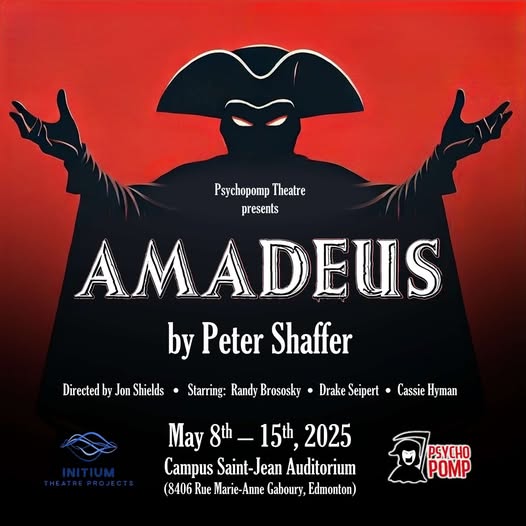
Amadeus, by Peter Shaffer, was a play (1979) before it was a movie (1985 Best Picture Oscar).

The play, in the Psychopomp Theatre production directed by Jon Shields, starts with an angelic choir singing in opera style, surrounding a very old man huddled in a wheelchair and containing a hand tremor. He is composer Antonio Salieri (Randy Brososky), the narrator and the central character in the play, despite it being named for Mozart.

Salieri rises from his chair with difficulty and calls for house lights to see the audience he is addressing. He seems to be endowing us with powers of extra-human witnessing or perhaps divine judgement – are we the choir of angels? – as he promises to tell us the story of what he did to Mozart long ago and how he’s paying for it. He speaks to us in English, but he also speaks to God in what appears to be fluent Italian.

The scene shifts – Salieri morphs to an active 30 year old – and this is when he first meets his rival, the younger composer and former child prodigy Mozart. Salieri tells us that he wanted so badly to be famous for his music that he had made bargains with God. He had the position of Court Composer to Emperor Joseph (John Evans) in Vienna. He shows the audience his servants and his “venticelli” or gentle winds, flamboyant gossips he engages to bring him the latest rumours (Andrew Mecready and Randall MacDonald). The venticelli tell him that young Mozart is coming to court, so he arranges to eavesdrop and then to be introduced. But to Salieri’s disgust, in person Wolfgang Mozart (Drake Seipert) is vulgar and annoying and self-centred. Seipert portrays Mozart with the most irritating laugh ever.

Salieri is astonished and resentful that someone so vulgar can have the gifts of music and fame that he longs for himself. The quid-pro-quo that seems to be central to his relationship with the Divine launches him into resentment and the most disturbing portrayal of artistic jealousy that I have ever seen.

Brososky’s portrayal of Salieri is brilliant. His bitterness poisons his own nature as he goes further and further in trying to harm Mozart. Mozart’s wife Constanze Weber-Mozart (Cassie Hymen) tries to protect her husband and is also affected by Salieri’s schemes.

A cast of 14 plays many ensemble roles, nobles and servants and citizens. I was fascinated to encounter references to several of Mozart’s operas I recognized, including Magic Flute, Don Giovanni, and Marriage of Figaro. Costuming (Nancy Skorobohach) conveys the excesses of the period and provides clues to class and character.

I was also fascinated to see allusions to Mozart’s character traits which I had first learned of in Erin Hutchison’s Fringe musical Regression last summer – in particular his persistent scatological humour. I’d already encountered a portrayal of Van Gogh on the Shadow Theatre stage this winter, consistent with Hutchison’s characterization, so it amuses me that the third avatar of art in the musical Regression, Willliam Shakespeare, will be on stage in Shakespeare in Love at Walterdale Theatre this summer.

Amadeus has a short run (May 8-15 only) in the auditorium at Campus St-Jean, with tickets available here. The main entrance to the building is under construction, but there is labelled access through the main entrance to an elevator.

Fringe Day Nine: assorted stories – but not storytelling shows.

Heading into the last weekend of Fringe, on Friday I watched three fun shows.

Verbal Tapas is a collection of poems by longtime Fringe poet and storyteller Rob Gee. Instead of scripting a fixed order, the performer handed out “menus” on the way in, with various poem titles and descriptions that sounded like restaurant-food teasers. He invited people to shout out titles, after which he might tell an anecdote of context (the time he recited a poem to two police officers in the middle of the night who had stopped him from illicit postering, the creative-writing groups he’d run as part of his work in mental-health nursing, etc) and launch into a recitation. He kept having good lines which I’d try to remember and then they went out of my head with laughing. Acacia Hall is a good venue for this kind of solo with audience connections.

Canterbury Tales has been adapted from Chaucer’s much longer Middle English original by local theatre artist Donna Call. This version has six travellers acting out each other’s stories to entertain the company, and the role-shifting is amusing. Lee-Ann Semenya plays the innkeeper who sells them drinks, proposes the storytelling competition, keeps things moving, and then covers them up with blankets for the night. I don’t know the original very well – the character names were familiar (the confident and ambitious Wife of Bath played by Amanda Stout, the Miller played as a lout by Ryan Mattila), but I didn’t remember the content of any of the stories. Other performers were Martin Stout, Zack Siezmagraff Penner, Anne-Marie Smyth, and Karen Huntley.

Field Zoology 301: Myths and Monsters is part of a series, in a campground-lecture style. Performer Shawn O’Hara, as Doctor Bradley Q. Gooseberry, welcomes his students around a campfire to teach us about cryptozoology, or the study of legendary/folkloric animals. He makes imaginative use of sketches on an overhead projector to illustrate his tales, including most of the cryptids I’d heard of and a few that were unfamiliar to me, along with some very funny narrative of personal encounters. Afterwards, the performer removes Dr. Gooseberry’s extravagant mustache from his own, to thank his contributors, including people who helped him to navigate telling stories respectfully from Indigenous sources. I would definitely see other shows in this series. This was my first glimpse of Mile Zero Dance as a Fringe venue, and an opportunity to spend time in the Happy Beer Street area of West Ritchie, which was exciting. However, I found the seats uncomfortable, and the full room too hot in last night’s warm humid weather.

Watching Copenhagen in 2022

image: Bob Klakowich as Niels Bohr, photo credit Scott Henderson, Henderson Images

In about 2004 I saw a production of Michael Frayn’s play Copenhagen performed in the round and directed by Caroline Baillie of Critical Stage Theatre, in the atrium of a Queen’s University building dedicated to creative ways of doing engineering education. My memory of that production is overwhelmingly of circling and cycling, re-examining a memory from various directions with the characters orbiting each other like atomic particles.

Copenhagen is now on stage at Walterdale Theatre, in a production directed by Martin Stout on a set designed by Leland Stelck. With its gently-thrust stage floor and intimate audience seating the Walterdale space provides the opportunity for a more personal encounter with the characters and their questions and uncertainties, despite the Covid precautions of the 2-meter moat and the dispersed audience.

It’s mostly a recollective piece, with re-creations and re-tellings of meetings in the early 1920s, in 1941, and in 1947. The characters say directly early on that they are now all “dead and gone”, and they also help to anchor the individual scenes/memories in time by frequently mentioning the year. The characters are Niels and Margrethe Bohr, the Danish physicist and his wife/collaborator (Bob Klakowich and Donna Call), and Werner Heisenberg, the younger German physicist (Kendrick Sims). Most of the memories are set in the Bohrs’ home in Copenhagen or on the walking paths nearby, a city that in 1941 was occupied by Germany and under constant surveillance.

Donna Call as Margrethe Bohr side-eying her husband. Photo credit Scott Henderson, Henderson Images

I was pleasantly surprised to find myself laughing out loud periodically through this performance. Klakowich and Call’s dry delivery of ironic and witty lines, Sims’ expressive eye-rolling, and particularly Call’s full-body indignation when her contributions are ignored make the most of the precise and articulate script. The opening-night audience was full of sympathy for the Bohrs’ bitterness and rage at their occupiers in general, and at Heisenberg’s clumsy attempts to re-create their earlier social connections without acknowledging the current abyss between them. “Should I have Margrethe sew a yellow star on my ski jacket?” Bohr spits out in response to his colleague’s suggestion of an excursion to Norway. Later in the play, I came to identify with Heisenberg as well, trying to do the work he cared about under a hostile and then horrific regime, trying to minimize the long-term damage to humanity and hopefully looking forward to the prospect of a future not only after the war but after the Nazi regime.

Kendrick Sims as Werner Heisenberg in one of his meetings with colleague Niels Bohr. Photo credit Scott Henderson, Henderson Images.

Stelck’s set, and the props (Debbie Tyson), costumes (Megan Reti), and multimedia design (Darrell Portz) provide effective support for the action reminiscent of 1941 but not clearly rooted in time or space, while lighting (Adam Luijks) and sound (Dylan Mackay) contribute to the shifts in mood, with one particularly chilling air-raid siren.

I kept thinking of present-day Київ (Kyiv), but I also kept thinking of conflict scenarios closer to home. And the characters of Copenhagen reminded me of resilience, of scientists and engineers asking questions about the ethics of their work, and of hope. All of which I appreciated.

Copenhagen is playing through Saturday March 19th at Walterdale Theatre in Edmonton. Mask and vaccine requirements are still in place to protect performers, audience members, and other volunteers. Tickets are available at Tix on the Square, and at the door half an hour before show time.

Blue Stockings, by Jessica Swale

Lucy Vogue and Aidan Thomas in Blue Stockings. Photo: Scott Henderson, Henderson Images.


Blue Stockings is set at the University of Cambridge, in 1896, and mostly at Girton, a women’s college of the university.  It follows a study group of four young women in their first year at the college, Tess (Lucy Vogue), Carolyn (Monica Lefurgey), Celia (Jocelyn Jay), and Maeve (Maggie Salopek), showing their passion for learning science, their struggles with learning to disagree with sources and defend their ideas, and their commitment to future careers in teaching, research, and medicine.  The play also shows how they are treated by faculty male and female, by their male peers, and by College staff including a chaperone (Julie Sinclair) and a maid willing to circumvent the chaperone (Rebecca Collins).

I was pleased to see the way the script touched on many issues of women’s education which were not black-and-white.  The male faculty’s attitudes ranged from enthusiastically supportive (Dave Wolkowski as physics lecturer) to pseudoscientifically condescending (Martin Stout as renowned psychiatrist).  The head of the women’s college (Elizabeth Marsh) is single-minded in her attempts to gain degree-seeking status for the young women through the university Senate and vote of members.  This cause drives her to disavow any connection with the too-radical suffragist cause and to expel a student who is needed at home because letting her stay might be used as a demonstration that women’s education hurts families.  The students also sometimes find themselves torn between their passion for study and the temptations of romance, with significant consequences.

Director Laura Ly used a cast of 19 to portray the 25 characters, and set designer Alan Westen used rotating backdrops and moving furniture to present various university settings.

If, like myself, you learned about the history of women’s university education in England through Dorothy Sayers’ wonderful 1935 novel Gaudy Night, you may be unsurprised by the women’s constant need to justify their presence, but surprised by some of the history.  Gaudy Night is set at Oxford rather than Cambridge, which explains the main difference.

Blue Stockings plays at the Walterdale Theatre until Saturday April 14th, including a matinee today.  Advance tickets are at Tix on the Square and same-day tickets are at the door.