Tag Archives: kristen finlay

Amélie: whimsical and fun!

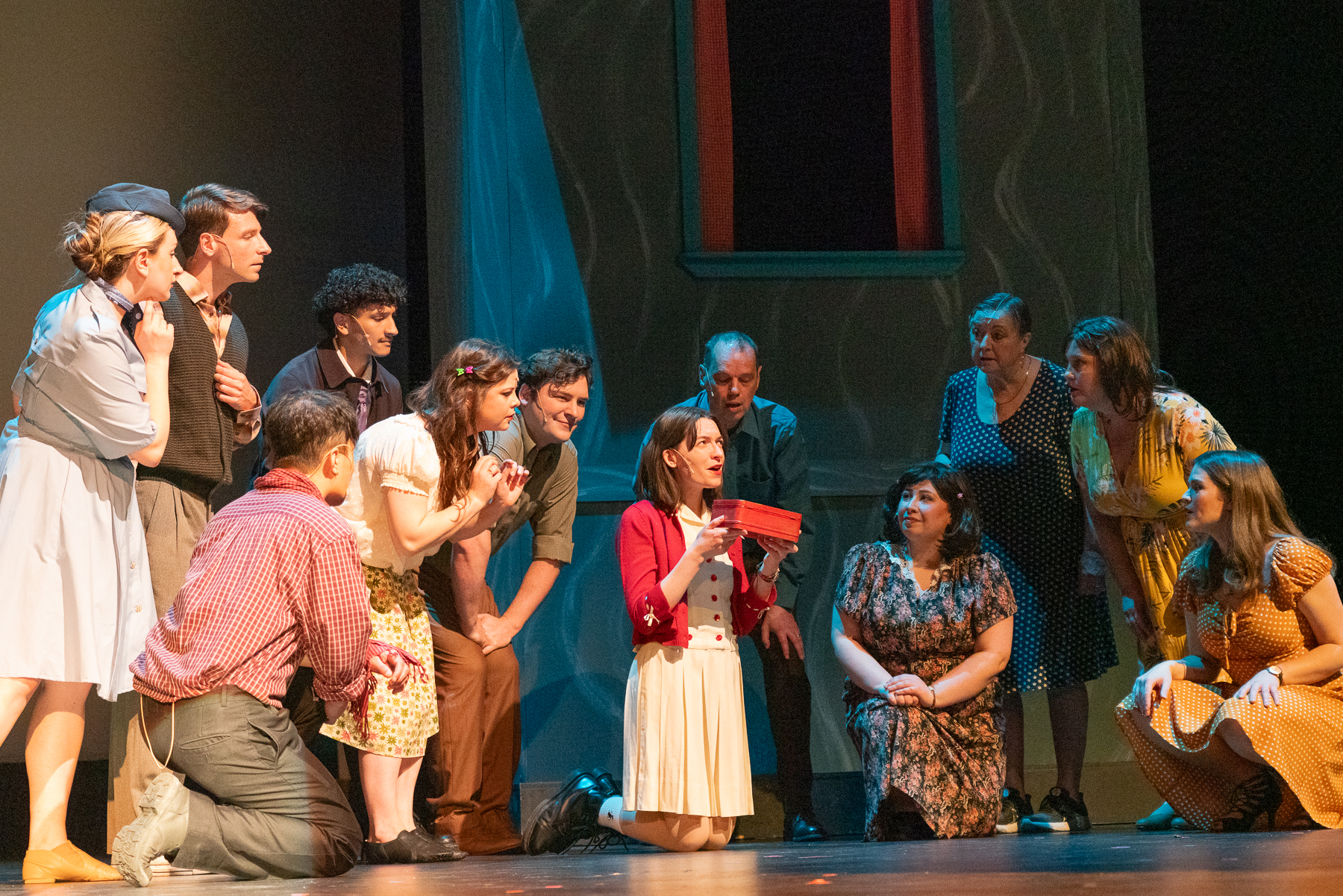
Actor on her knees holding an old red metal box, surrounded by other actors.
Lauren Upshall-Ripley, as Amelie, holds a treasure box, surrounded by friends and neighbours. Photo Kara Little.

ELOPE, the long-running local musical-theatre company, is currently performing Amelie, the musical, at the University of Alberta Timms Centre. It is quirky, delightful, and unexpected – and very well done.

Amélie, the musical (music by Daniel Messé, lyrics by Messé and Nathan Tysen and a book by Craig Lucas, is based on the 2001 French movie of the same name. I still haven’t seen the movie, so I kept laughing with surprise as the narrative unfolded.

Lauren Upshall-Ripley is perfectly cast as Amélie, the title character, a young woman whose background as an isolated child equips her with playful daydreams and fantasies. And Danika Reinhart plays 6-year-old Young Amélie, illustrating with painful poignancy how the optimistic child’s resilience shines past her fearful and repressive parents (Erwin Veugelers and Rachel Frey). The duets between Upshall-Ripley and Reinhart were particularly strong, with vocal balance and warm connection between the younger self and older self. I was reminded of the Netflix series Unbreakable Kimmy Schmidt, which also portrayed a likeable and resilient young woman in modern New York, with humour and without sentimentality.

Actor in red cardigan and simple white dress stands joyfully with outstretched arms.
Lauren Upshall-Ripley, as Amelie. Photo by Kara Little.

One quirk of the script was the way that many of the ensemble members in the 19-person cast took turns narrating the key points of Amélie’s life to the audience, with wry humour and a strong sense of community. The scenes illustrate a lively neighbourhood of Montmartre, centred around the Two Windmills Cafe, where Amélie works. Her co-workers Gina (Christy Climenhaga) and Georgette (Josephine Herbut), employer Suzanne (Judy McFerran Stelck), and other neighbours all have their own challenges and heartbreaks, but like the best workplace comedies, they’re all engaged in trying to help each other. Director Kristen Finlay has a resume full of productions where each member of a large cast has clear interesting intentions and also blends as an ensemble – 25th Annual Putnam County Spelling Bee for ELOPE, Penelopiad, Chess, The 39 Steps for Walterdale, and others.

The narrators give specific dates – of Amélie’s conception, of her mother’s death, of her move to Paris, of a day her life changed – this let me figure out how old she was at each point, but also turned out to be a clue that key events for Amélie were affected by Princess Diana’s visit to Paris and untimely death. Amélie watches television coverage of Diana’s funeral, alone in her apartment, and daydreams of being honoured like Diana. Connor Foy plays Elton John, singing “Goodbye, Amélie” at a white-lacquered grand piano and leading a sequined ensemble – the audience was screaming as the first act ended.

Amelie’s adventures involve various other neighbours and friends, but weaving through these stories we see hints of another quirky and creative outsider, Nino, played by Colin Stewart. “Who are you?” asks Nino, on the phone with Amelie. “I’m a mystery wrapped in an enigma trapped in a paradox disappearing into thin air. ” “Me too.” Will they meet up? Will it be worth it? Will it work out? We want it to.

Actor in leather jacket and cross-body satchel sings joyfully.
Colin Stewart as Nino Quincampois, in Amelie. Photo by Kara Little.

In another vignette, Amélie returns some childhood treasures to a lonely man (Dustin Berube). Berube and Upshall-Ripley’s duet, “How to Tell Time”, was one of my favourite moments.

Musical direction was provided by Sally Hunt, with eight other musicians. David Son created choreography for the ensemble that was both exciting and well-executed, and also joined the ensemble himself in a few small roles, including (hilariously) an escaping Goldfish. Debo Gunning designed costumes that supported each character, from Amélie’s artless awkwardness in shirtwaist and Doc Martens, to the more sophisticated Parisian women of the cafe and sex shop, and Elton John fabulously excessive with feathery epaulettes to his sequined jacket. The facilities and technical capabilities of the Timms Centre Main Stage were effectively used by ELOPE’s technical team (set design credit to Leland Stelck). Finlay and Son’s blocking and movement of the large cast on the deep stage never felt crowded.

Amélie is playing at the Timms Centre until Saturday July 5th. Get your tickets here.
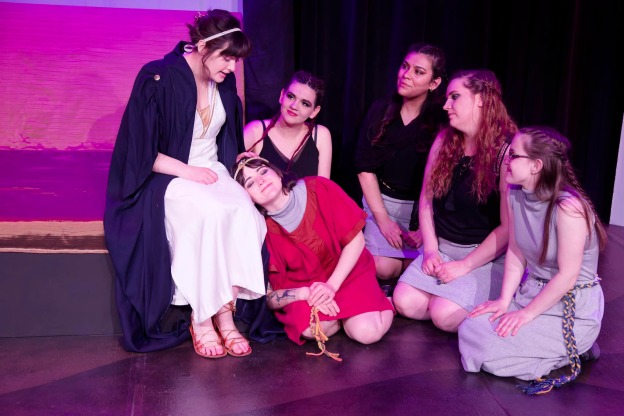
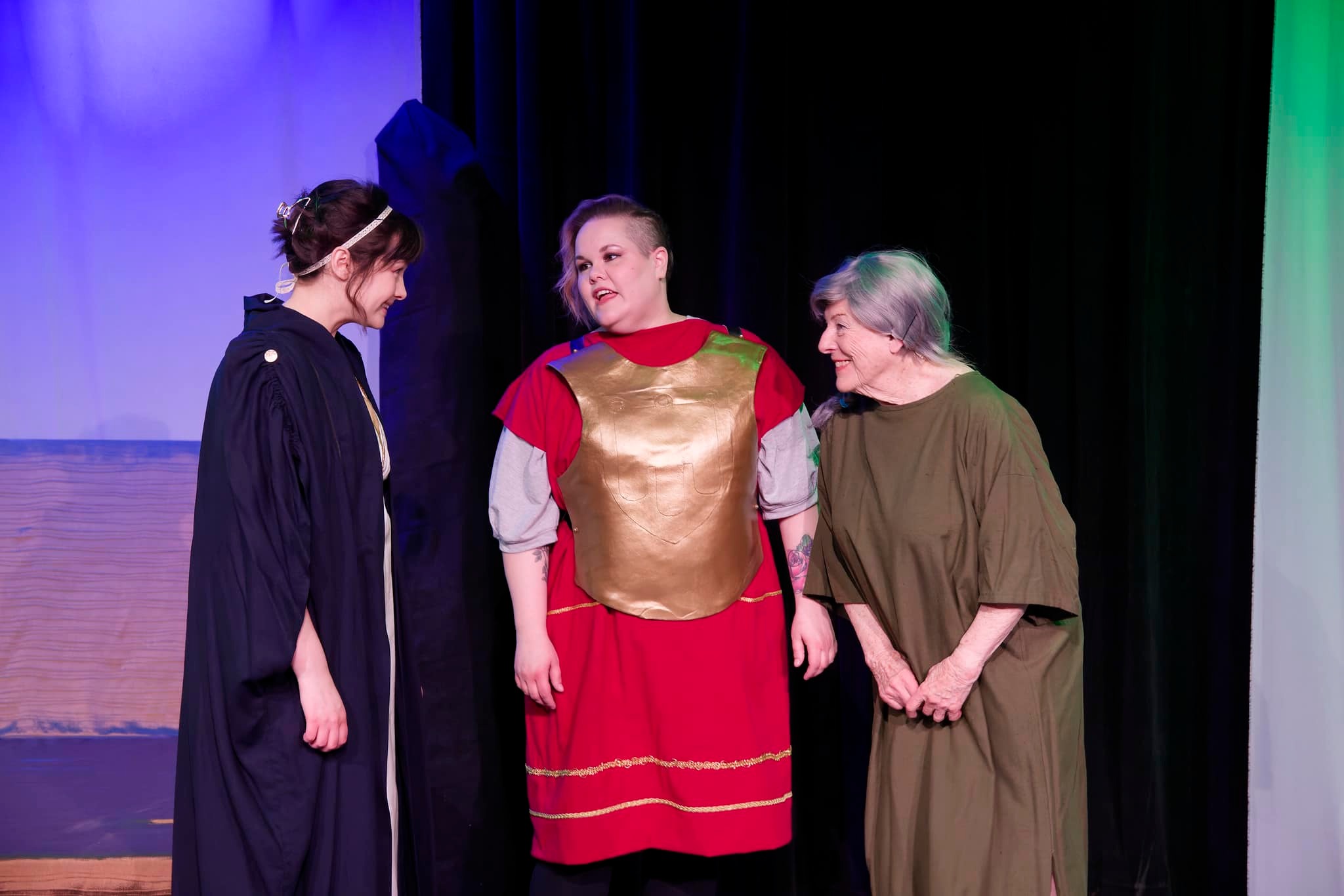
Ensemble in abstract Greek costumes: Penelope sits on the end of a bed, while an actress representing her son rests head on her knee. Four female servants listen.

The Penelopiad, one of Walterdale’s best.

Alora Bowness (Penelope), Stephanie Swensrude (Telemachus), Monica Stewart, Karla Martinez, Sarah Spicer, and Katie Corrigan, in The Penelopiad. Photo Credit: Scott Henderson, Henderson Images

The lights come up on a simple set – a bed on a platform, white hanging panels lit to effect – and a young woman walks toward the audience. Now that I’m dead, I know everything, she says. After this intriguing statement, she goes on to explain that it’s not quite true – like everything else, it’s been simplified in the version we know.

Alora Bowness is Penelope In Walterdale Theatre’s current production of The Penelopiad. She caught my interest from these first lines, and continued throughout the performance, telling and illustrating her story with humility, determination, wry humour, and willingness to acknowledge the consequences of her choices.

But The Penelopiad, adapted by Margaret Atwood from her novella in 2007, doesn’t just examine the story of Penelope, but also of her enslaved maids. The narrative unfolds in short scenes, switching between Penelope telling the story, to ensemble members acting the story, to choral/choric recitation and dance by the maids, or sailors, or even at one point a flock of ducks. The story moves smoothly and with compelling pace, as directed by Kristen M. Finlay, from Penelope’s birth to a naiad mother (Mandy Stewart) and mercurial King Icarius of Sparta (Angela James-Findlay), through her childhood, her marriage to Odysseus (Katy Yachimec-Farries), move to Ithaca, and then what happens to her through the timeframe of Odysseus long journey to Troy and then home, as first told in Homer’s Odyssey.

I had seen the Citadel production of this play in 2013, using 13 talented young artists in that year’s Citadel/Banff Centre Professional Program. The Walterdale production is funnier than I remembered, and in the intimate Walterdale space I felt more engaged with the dangers and challenges of Penelope’s situation. I loved the costumes of the current production (Alodie Larochelle design) – all the maids wearing the same fabrics in grey and black, but in silhouettes that were different for each individual, with braided rope belts in different colours. The songs and poems of Atwood’s script were set to original music, lively or lyrical or haunting as appropriate (Gibson Finlay and Kristen Finlay, composition, Sally Hunt musical director).

Three things about the plot/theme struck me hard this time around. I’ve been thinking about them for days, and I’m planning to return this week for a second viewing, after which I will think about them some more.

  • The relationship between Penelope and Odysseus is shown as nuanced and mostly positive. Classic tropes/assumptions of a girl married off to an older warrior do not hold. It is refreshing to see Odysseus gentle with his new bride and wooing her with stories, and their reunion after the many years of voyaging is equally gentle and consensual. He’s still the product of that particular patriarchal society and family, though.
  • If one focuses on Penelope, it’s a relatively happy story – she overcomes early mortal danger, learns from many mentors and supports, manages the kingdom in Odysseus’ absence, and develops a famous ruse to protect herself from impatient suitors. But Atwood’s script and Finlay’s direction keep reminding the viewer that the story of the maids is just as important. Penelope’s monologue recounting life as an unappreciated girl-child of a royal mixed-marriage is followed immediately by a chorus of maids speaking bluntly to the audience. “We too were children. We too were born to the wrong parents. Poor parents, slave parents, peasant parents, and serf parents; parents who sold us, parents from whom we were stolen.” And the story of the maids is a tragedy. They do what Penelope asks of them – and it has terrible results for them.
  • Those terrible results are due to some of Penelope’s strategies and choices. She acknowledges her mistakes in monologues from her afterlife. But they are also directly due to the customs and expectations of that patriarchal culture. Odysseus acts to punish them using limited information and an offensive set of assumptions. But he gets that information from his son Telemachus, a young man by then, and from his old nursemaid Eurycleia. Both actors in the Walterdale production were compelling, Stephanie Swensrude as the spoiled boy turned resentful young man and Vivien Bosley as the nurse/governess who petted and encouraged young Odysseus and then spoiled his son, turning him against his mother Penelope. I was reminded of how important it is for any society to raise boys to be compassionate and justice-seeking, and how wrong things can go when this does not happen. Unfortunately, this continues to be a timely and critical reminder. And as we move closer to Mother’s Day, I’m thinking about how the responsibility of setting the next generation on a better path should not just be placed on mothers, but on all of us.

Alora Bowness as Penelope, Katy Yachimec-Ferries as Odysseus, Vivien Bosley as Eurycleia. Photo credit Scott Henderson, Henderson Images.

Thank you, cast and team of The Penelopiad, for making me think. The Penelopiad continues at Walterdale Theatre tonight through Saturday night, with an 8 pm curtain. Tonight, Wednesday, is pay what you can night; tomorrow, Thursday May 11, is limited capacity night, for patrons who would prefer more elbow room for better air quality. Masks are recommended but not required at all performances. Advance tickets are available here; some seats will be available at the door an hour before showtime.

The 39 Steps at Walterdale

Bradley Bishop, Lauren Tamke, Lucas Anders, and Samantha Beck in The 39 Steps. Photo credit Scott Henderson, Henderson Images.

During the last two seasons of theatre performance in pandemic times, I’ve seen a lot of small-cast productions – which makes sense, fewer people in the rehearsal hall means less potential exposure and easier distancing – and a lot of serious themes. Which also makes sense, as our society’s had time to think about some difficult issues over the last couple of years. I even got to direct a show fitting those descriptions.

When I watched Peter Pan Goes Wrong at the Citadel last month, I realized that I’d been missing the experience of watching a large cast do ridiculous and unexpected things on stage, along with my more thought-provoking theatre-going.

With Walterdale Theatre’s current production of The 39 Steps, directed by Kristen Finlay, I got that experience. There are only six actors (Lucas Anders, Lauren Tamke, and an ensemble of four: Samantha Beck, Bradley Bishop, Liam McKinnon, Rico Pisco), but I think there are more than a hundred characters. Some of them in disguise. All of them in different costumes (Nicole English) and many of them with different accents,

As for “ridiculous and unexpected”, I kept giggling with delight at what was happening in front of me. I’d read this script before, but there was so much happening on stage besides the dialogue. Even the movement of set pieces was fun and silly. And since the action took the protagonist Richard Hannay (Lucas Anders) from his new flat in 1930s London to a West End show, taking a train to Scotland, leaping from a moving train over the Forth Rail Bridge, to a Highland croft, a misty moor, and a few other atmospheric locations, what I thought were simple set pieces (set and prop design Taylor Howell) turned out to transform into convincing backgrounds for many locations. A complex atmospheric sound design (Anne Marie Szucs) helped to set the scenes clearly and added to the humour and the suspense.

One of my favourite little details was the way I could see quickly that the curved row of rehearsal boxes was a moving train, because of the way everyone’s movements illustrated the carriage’s bumpy movement. I also loved Margaret, Tamke’s understated portrayal of a young Scottish farm wife yearning for travel and cities and the for exotic visitor Hannay, and Mister Memory (Liam McKinnon), the quirky music-hall performer answering trivia questions from his audience (ensemble members who must have slipped in to the Walterdale audience). Lucas Anders plays only one character, the protagonist Richard Hannay, but maintains the high pace (often running across the stage) and clear motivation that drives the somewhat-farfetched plot to its not-quite-predictable happy conclusion.

Liam McKinnon and Rico Pisco hunting fugitives by air, in The 39 Steps. Photo credit Scott Henderson, Henderson Images.

This story originated as a 1915 adventure novel by John Buchan, British writer and parliamentarian who later became Governor-General of Canada. My father was fascinated by Buchan, and shared his musty hardcover copies of The 39 Steps, Greenmantle, and Prester John with me. I also remember Dad showing me the 1935 Hitchcock film adaptation, and delighting in the detail of Hannay being Canadian in the movie. This stage version was written by Patrick Barlow in 2005, and it pulls from both the book and the movie as well as from many tropes and expectations of film-noir, slapstick, and early-20th-century spy thrillers to create a great parody which is very funny whether or not you already know the source material.

The 39 Steps is playing at Walterdale Theatre until Saturday May 21st. You can get advance tickets at Tix on the Square. If a performance is not sold out you can also get them at the door an hour before showtime. Masks are required, house capacity remains limited, and auditorium ventilation has HEPA filters.

Follies performers dancing, 1941 and 1971 characters

Follies, and other celebrations of theatre

Walterdale Theatre’s production of Follies, the 1971 Sondheim musical, opens tonight.  I was able to see a preview last night, and I found it touching, sometimes sad, and sometimes so funny that I couldn’t stop giggling.   As suits a show about retired showgirls, it has interesting music (under the direction of Michael Clark) a large ensemble cast, production dance numbers (choreography by Barb Mah and Alyssa Paterson), sparkly festive costumes with headpieces (Karin Lauderdale), and some beautiful solos.

The premise of the show seemed not unusual to me, the idea of middle-aged former performers reuniting before an old theatre is torn down, and reminiscing about past life.  What seemed more original about this story is the concept of the characters having shadows or ghosts or echoes of their former selves, living their 1941 lives around and in between the returnees living their 1971 lives.  In 1941, there were eight showgirls and a couple of young sailors, each identified as the earlier self of one of the 1971 characters.  As the reunion visitors catch up with each other about their lives and play out current conflicts, we see the shadows of their past selves dancing and singing and speaking about their dreams and romances and ambitions in 1941.

I can’t readily say what was my favourite part of this show.  I loved the song “Who’s That Woman”, led by Stella (Joyanne Rudiak), in which the 1971 women make it look hard to reproduce a tap number of their youth, blended with the 1941 women making it look easy.  I loved how the blue-grey playsuits of the 1941 dancers and the cold blue-tinged lighting (Brad Melrose) showed them to be memories, while the warmer palettes for the 1971 characters were often present at the same time.  I laughed hard at the over-the-top costumes for the fantasy sequences starting with “Loveland”.  I was moved by Carlotta Campion’s (Kristen M Finlay’s) triumphant solo about her existence and persistence, “I’m Still Here”.  And I was deeply disconcerted watching Ben’s (Gavin Belik’s) brash confidence in “Live, Laugh, Love” gradually crumble into a complete breakdown, while the spirits of chorus dancers flutter gaily around him as if nothing is wrong or he is a figure of fun.  Leslie Caffaro is a strong actor in the lead role of Sally and Aaron Schaan has an amusing cameo as Kevin the Waiter.

Same-day tickets are available at the door, and advance tickets through Tix on the Square.  Follies plays until Saturday July 15th.

follies 2

Monica Roberts and Leslie Caffaro play Phyllis and Sally, former roommates and rivals and friends.  Photo credit Barb Mah.


Last week the Edmonton theatre community celebrated the 2016-2017 season at the Sterling Awards Gala.  Productions taking home multiple awards included the Citadel’s Crazy for You, Edmonton Actors’ Theatre’s Stupid Fucking Bird, Theatre Network’s Irma Voth, and Impossible Mongoose’s The Fall of the House of Atreus: A Cowboy Love Story.  But as usual, the night reminded me of the wide breadth of talents and passions and visions in the Edmonton theatre scene, amateur as well as professional, and I look forward to watching and discussing many more delightful and challenging performances in the future.   As usual at the Sterlings, the script was entertaining and the tech and stage-management invisible, making the evening go quickly and amusingly.


After Found Festival was over, I was still thinking about some of the productions I’d seen, and wanted to make some additional notes.

In the Admit One show In Shoes, the viewer is guided on a quick walk around a popular block of Old Strathcona, encountering various characters who all connect in ways that become clear.  Although I had seen all the performers in other roles in the past, I was never aware of any of them until the moment at which they figuratively stepped on stage to take over from the previous actor.  It was as if they were non-playing characters on Whyte Avenue, part of the streetscape, until that moment.  This fascinated me.  It reminded me of the TV show Being Erica, and how Erica often encountered the therapist Dr. Tom on the street, appearing as a hot dog vendor or bartender or pedestrian just as she needed him.  It also reminded me of some video game – I don’t know if it’s World of Warcraft or if it’s a common custom – where everything in the environment that the player can interact with has a sort of halo outline that’s lacking in other parts of the background.

On the last day of Found Festival, I was able to attend a performance of Before The River, a roving performance along the pathways by Mill Creek. Colin Matty, Shannon Hunt, Katrusia Pohoreski, Jameela McNeil, and Liam Coady performed an eerie folkloric tale from Ukrainian tradition.


And now it’s summer!  Time for Freewill Shakespeare and the rest of the summer festivals and looking forward to Fringe.  Enjoy!


Starting the year off with a SHOUT!

Over the winter-solstice theatre dark nights I had intended to post my notes on everything I saw in December, but it didn’t seem to work that way.  I’ll work through the backlog as I can, even though the busier schedules of January and February mean that programs are piling up again.

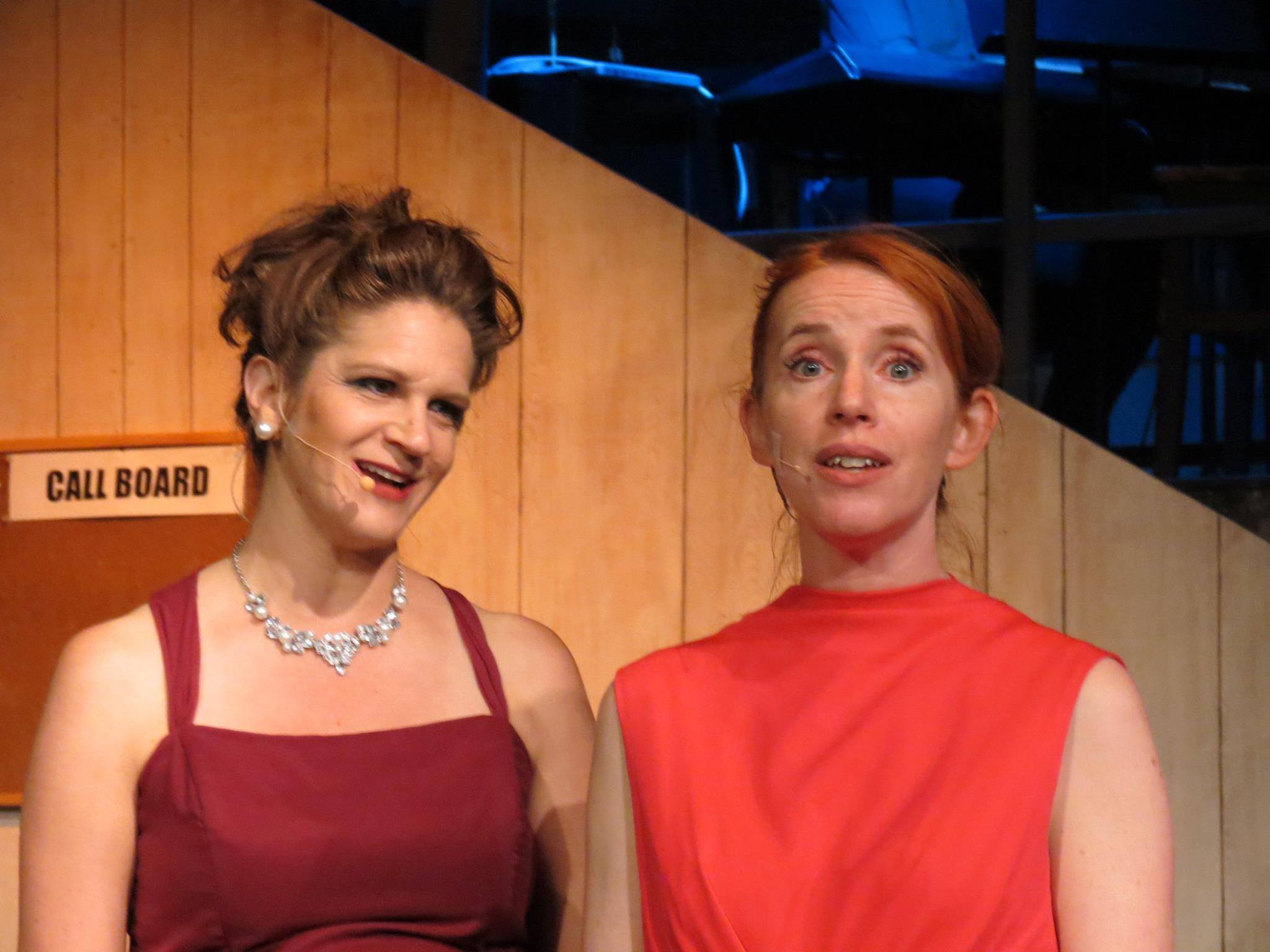
SHOUT! is a 1960s musical revue produced by Round Barns Productions, which played at C103 in early January.  Kristen Finlay directed it, and Sally Hunt was the musical director.  During the show, five young women in England (Leslie Caffaro, Nicole English, Kristen Finlay, Erin Foster-O’Riordan, Monica Roberts) move through the years from 1962 to 1970, with songs, dancing, and glimpses of their lives in that era.  They’re called “The Red Girl”, “The Orange Girl”, “The Yellow Girl” and so on, after one of those magazine-article personality quizzes (voiceover by John Dolphin), and the quick lists of traits are turned into five distinct and attractive characters by the performers.

A magazine called Shout provided a framework moving through the show, with the characters reading articles about 1960s phenomena like Twiggy, the Beatles, and the sexual revolution.  John Dolphin’s voiceovers provided assorted magazine content, and the characters also wrote letters to “Gwendolyn Holmes” a women’s-magazine advice columnist of the era (voice by Elizabeth Marsh) who responded to most problems with suggestions like cheering oneself up by getting a new hairstyle.  Much of the advice and other magazine content was terrible from a 2015 point of view (the cigarettes diet, the asbestos dress).

The music was great, mostly songs I was familiar with.  I loved the “Coldfinger” parody of the James Bond theme, “I Only Want to Be With You”, and “Shout!”, and the “You’re My World/All I See is You” medley made me cry.  And there was enough character development arc under the mostly-lighthearted show to provide satisfying outcomes for the characters “I got pregnant!”, “I got sober”, and “I got Penelope!”  Especially the one who takes over for the advice columnist.

Last day of the Fringe: House, Bible Bill, Crack

On the last day of the Fringe, things gradually became calmer and quieter all over the site except for possibly at the south beer tent.  A few artists were still handbilling for shows later in the day.  The box office lineups were small, and there seemed to be lots of sell-out houses.  I enjoyed a sit-down breakfast (an omelette, scone, and coffee) at Café Bicyclette and a grilled-cheese lunch on the patio at the Next Act, and appreciated running into friends now that we had time to talk.

I saw four shows.  One was a repeat viewing of a friend’s show that I’ve already written about.  The others were House, Bible Bill the Gospel Musical, and Crack.  And now I’m caught up, at least for the next ten hours or so until I go see Jake Hastey’s Red Wine, French Toast, and The Best Sex You’ve Ever Had as a Fringe holdover.

House is a solo play written by Canadian playwright Daniel MacIvor.  It was performed by Jon Paterson, in a relentless hammering style that immediately conveyed the character Victor’s intense angry near-obsessive nature even before he started discussing his experiences in group therapy.   He explains that some people are weird (they are born weird) and that some are fucked up (they get that way because of stuff that happens to them), and that he is just fucked up, not weird.  I would not like to have this character in my life, but I liked listening to him on stage.   As an engineer and a former engineering student and engineering educator, I was amused by the bit about Victor having wished to be an engineer because he envied the comradeship and shared pranks of groups of engineering students.

Bible Bill: the Musical, like En anglais, s’il vous plait, is a new work covering an aspect of Alberta history, sponsored by the Provincial Archives of Alberta.  Like En anglais, it showed me some history I didn’t know very well, in an easy-to-absorb personal story format.  Because I didn’t grow up in Alberta I hadn’t known very much about “Bible” Bill Aberhart and the Social Credit movement, and this show put some pieces together for me.   The performance took place in the main worship space of Holy Trinity Anglican Church, on a performance stage just outside the sanctuary/altar area.   It was set at the broadcast location of Bible Bill’s regular Sunday evening radio show, probably a church, with the various characters addressing us as the live audience.  Musical director and composer Nick Samoil played a small organ to accompany the singers and the congregational singing in which the audience was invited to join.   (Like the authentic church singing of my youth, people sang in unison, on a melody line that was pitched too high to be enjoyable for this alto.)  Kevin Mott played William Aberhart with sonorous confidence, and Laura Raboud played his supporter and friend Ernest Manning (father of Preston Manning).  Aaron Casselman was an additional narrator in the character of a radio technician, and Vanessa Wilson provided comic relief and musical entertainment as a singer engaged for the show but more accustomed to lounge singing.  I found the story and characters interesting, but I was wishing for more singing.

Crack is a new drama by Anne Marie Szucs.  It was directed by Kristen Finlay and performed at the Walterdale Theatre, which is one of my favourite Fringe venues.  Three friends gather for a weekend at a cabin to celebrate Christine (Joyce LaBriola)’s birthday.  Christine seems to be the hinge of the friendships, with Angela (Rebecca Ponting) the innocent church-going homeschooler and Pam (Anne Marie Szucs) the swearing sarcastic businesswoman both a bit jealous of Christine’s connection to the other.  As the weekend moves on and the wine bottles get emptied, the two move from distant politeness to more direct questions and criticism.    Christine and Angela both need to consider changes in their lives, and their friends’ questions and challenges help them figure out what to do.   At first I thought the actor playing Angela’s delivery was a bit stilted and monotone, but later I got to appreciate the nuances of the character’s hesitation, naïveté, kindness, and courage.  The scene where Angela leads her friends in a yoga routine, slipping naturally into a teacher role with understated authority, shifted the way I saw the character for the rest of the show.   Partway through the play, I was laughing at so many lines that were funny because they were familiar and I thought “this should be a movie!”

After Crack I took advantage of my two badges to visit the Volunteer Party and the Artist Party, and that was it.  I saw a total of 42 performances of 35 different shows, counting a couple of repeat viewings as well as watching all performances of Sonder from the audience.  I have tickets to see three holdover shows this weekend, after which I will have watched 107 theatrical performances so far in 2014.

Stories and songs

After an early performance of Sonder at King Edward School, I saw four more shows yesterday, all of them with a focus on story.

Little Monsters, written and directed by Kristen Finlay at the Walterdale Theatre, is the subtle and familiar story of a mother who is determined to do the best for her child, and how that understandable conviction can lead to some imbalance and unhappiness.  It wasn’t quite the story that I was expecting and I liked it better for that.  Erin Foster-O’Riordan was very believable as the earnest mother, not overplaying or ridiculous.  Cory Christensen and Julie Sinclair as her husband and her best friend had smaller parts in the story, but each brought his or her own issues to the encounters, as we saw gradually.  Anne-Marie Szucs played the uncompromising preschool director with intimidatingly still body language.   The Fringe-style simple set and lighting cues created an office, a living space at home, a parent-viewing room at the preschool, and a park bench.   I loved the line about the expectant mother only feeling perfect until other people knew her secret and started giving her advice.

The one thing I didn’t enjoy about the experience of watching this play had nothing to do with what was unfolding on stage.  In choosing a seat near the action, I had unwittingly chosen one that squeaked with every small shift in movement, so my seat kept making noise and nearby patrons kept looking at me.  I wish someone would either fix that seat or discourage people from sitting in it.

Sundogs, by Michaela Jeffery, directed by Louise Large, is playing in the small proscenium space of the Telus Building.  Holly Cinnamon was compelling as a slightly-out-of-control woman living alone on a farm, first encountered wearing a white cotton nightgown and rubber boots.  Police officer Mike (Evan Hall, also in Letters to Laura) and book acquisitions editor Dan (Brendan Thompson, also in Kurt Man buyer and seller of souls) each visit her to discuss some disturbing events that happened recently, and as their visits occur we find out more about her life.  Something about the sequence of the various scenes did not fall into place for me until later in the story.  I can never decide whether that pleases me as the narrative catches me by surprise and suddenly makes a different kind of sense, or whether I feel foolish for not catching on earlier.  This play had the most convincing and horrifying example of the consequences of living surrounded by clutter and hoarded possessions that I have ever heard or read, and it made me think anxiously about the boxes I’ve moved to the edges of all my rooms to make space for actors to sleep this week.  I hope to be able to see Holly Cinnamon’s original solo performance This is the kind of animal that I am later in the week.

I had not seen Bruce Horak’s This is Cancer before, although it had played at Edmonton Fringe a few years ago.  It’s … disturbing but in an aesthetically satisfying way.  Bruce Horak plays the title role in costume and makeup that are both eye-catchingly sparkly and nastily damaged.  Dave Horak (director of Fatboy and Bombitty of Errors, actor in Kill Me Now, and Bruce’s brother) plays Cancer’s stage assistant.  There is some singing.  There is a very gentle poke at the cancer-fundraising industry.  There is a chance for a few audience members to insert obituaries for dead loved ones.  There are some other forms of audience interaction some easier than others.   As with most performances that have an actor personifying something horrible like Death or the Devil, I found myself torn between liking the personification and wanting him to have a bad outcome.  I wondered how the show would manage to reconcile those, and I was moved to tears by the way the ending put the narrative on the side of life and health.  Those whose cancer connection is more recent or ongoing might have found it a bit too facile for their truth, but for me it worked well enough to start breathing easily again.  There is a short question and answer period afterwards with the performers out of costume.

Going from This is Cancer to Off Book the Musical was a bit emotionally disruptive.  But the performance of Off Book was well worth the warm stickiness of a full house at C103.   Leif Ingebrigsten accompanied on piano as Matt Alden, Amy Shostak, Hunter Cardinal, Joleen Ballandine, Vince Forcier, and Kory Matheson created and performed an hour-long musical based on audience suggestions of “a wedding” and “a discount warehouse store”, using four rehearsal boxes as the only visible props.  The main characters’ problems were both compelling and amusing.  The mayor (Matt Alden) wants to marry Mary (Joleen Ballandine) as well as winning an election, but she’s been married four times before, avoided finalising any of the divorces, and considers herself unmarriable.  Side plots involve a discount warehouse going out of business (major improv points to Hunter Cardinal who tied up that loose thread of plot right at the end when I had almost forgotten it), and a little boy (Vince Forcier) asking his parents (Amy Shostak and Kory Matheson) how to respond to a proposal he’s received on the playground.  There was a little bit of dance, and songs created in a wide range of styles including rap.   Off Book also plays frequently at the Rapid Fire Theatre Saturday night CHiMPROV longform shows during the season, but if you like musical improv you should definitely try to catch a show at the Fringe.

Proof, at the Walterdale

“She’s not my friend. She’s my sister.”

There are lots of good lines in David Auburn’s play Proof, currently playing at the Walterdale Theatre and directed by Kristen Finlay, but that was one of my favourites.  Two of the characters in the story are sisters, Catherine (Gabby Bernard) and Claire (Jessica Watson).  Catherine, the younger, had been living at home and taking care of her mentally ill father Robert until his death just before the play starts, and Claire is the successful stylish older sister who breezes in from New York City to manage things.  The tensions between them are understandable but not clichéd.

Robert (dale Wilson), seen in some flashback scenes and other devices, was a likeable character who reminded me of my own father.  He had been a mathematician and math professor.  The fourth character in the play is his protégé Hal (Jordan Ward, previously seen in The Full Monty and the Fringe show God on God).  Hal has been reading through the notebooks in Robert’s study looking for anything important or publishable that might have appeared among Robert’s graphomaniac gibberish.

All four actors portray their characters as interesting and complex.  One might assume that Claire, the conventional non-mathematician in the group, is going to be socially competent where the rest are awkward, but in the company of her sister and Hal she turns out to have her own brand of awkwardness and insensitivity, and Jessica Watson occasionally shows her as being wistful about being excluded.  Claire and her father, and then Claire and Hal, all share a kind of delight in literal thinking and wordplay-argument that is very familiar to me.  In a flashback scene, a younger Catherine tells Robert that she’s been accepted to Northwestern University and will be moving out soon to resume her studies.  He is resistant, flailing to make up various objections, but when his graduate student Hal shows up to drop off a thesis draft, Robert immediately begins bragging to Hal about Catherine’s good news and bright future, making sure that she overhears.  Another thing that impressed me about this scene was Jordan Ward’s different body language and voice as a 24-year-old student at his advisor’s home, compared to how we’d seen him in the previous scene, aged 28, talking to Catherine who is younger and without academic credentials.  As the student, he’s hunched over, hesitant, out of place, over-eager to agree with his advisor, but as the young instructor he’s got a veneer of superficial confidence and condescension.

Hal’s interactions with Catherine were fascinating and infuriating to watch throughout the play, because although they have shared interests and are attracted to each other, he reveals over and over the kinds of casually-sexist and educationally-elitist assumptions that are unfortunately not uncommon in young male academics.  For example, he asks her how old she is but responds indignantly when she asks him the same question.  He obviously thinks that her age is relevant and his isn’t, and that he is entitled to assess her credibility as a scholar.

I thought Gabby Bernard was very strong in her portrayal of the main character Catherine.  The character’s unguarded facial expressions were perfect, especially in the scene where she thinks she’s caught Hal stealing something but his backpack turns out to be empty, and in the scene where Hal tells Claire about finding some unpublished work in the study.  That scene, ending the first act, is the critical point of the play.  Catherine is standing outside of Hal’s field of view, and it’s clear that the other two characters are completely unaware of her, but the lighting designer’s choices and the actor’s stance and facial expressions of growing disbelief led me to focus on her.

As Robert, dale Wilson appears in only a few scenes.  But the scene in which he is convinced that he’s ready to resume productive mathematics after his previous bout of mental illness is heartbreaking.  He encourages Catherine to read out his draft notes and he nods with self-congratulation as she reads gently “The future of cold is infinite. The future of heat is the future of cold. The bookstores are infinite and so are never full except in September…”

The story of this play gave me lots to think about, not just about family relationships and about attitudes of men and women, but also about fields of discovery, about the fear of being too old to do good work, and about watching oneself for signs of instability. 

There are three more performances, tonight through Saturday night at the Walterdale Theatre.  Tickets are available at Tix on the Square and at the door.