Tag Archives: jake tkaczyk

Music and laughter: Scoobie Doosical and Die Nasty

On Monday at the Fringe both shows I caught were comedies. Comedies with lovely original music and clever lyrics and amusing choreography and movement. There are a lot of funny people around this festival.

Scoobie Doosical is an original musical by Rebecca Merkley, a tribute to the well-known 1970s cartoon television about the ghost-debunking gang and their Great Dane. Merkley’s company Dammitammy Productions did something similar a few years ago with River City: The Musical, parodying the Archie comic-book characters.

Live accompaniment (Yvonne Boon and Robyn Slack) enhances the lyrics both goofy and touching, and the impressive singing voices of cast Cameron Chapman, Bella King, Natalie Czar, and Andrew Cormier. Cormier plays the villain Professor Gigglepuffs (“Riggleruffs” in Scoobie’s dialect) with a flair evocative of Frank N. Furter in Rocky Horror (Picture) Show – and also plays Velma. Czar plays the villain’s sidekick/cat and also plays Daphne. (Imagine some wig-quick-changes). Chapman and King play the Shaggy and Scoobie characters, building on the source-material expectations to create lovable caricatures. The plot was also reminiscent of the source material, confusing at first but all falling into place with happy and fair resolutions. Stage 4 Walterdale Theatre, selling quickly.

Die Nasty is “an Edmonton comedy institution for 30 years” according to their program blurb. At the Fringe, the long-form improvised soap opera has an episode every night that takes place at the Fringe, with some familiar characters and some archetypical ones. The night I saw it, it was directed by Peter Brown with live music by Paul Morgan Donald, and there were 16 performers on stage, including guests Joel Taras and Jake Tkaczyk as well as Stephanie Wolfe, Jacob Banigan, Kirsten Throndson and other ensemble members. Characters I remember from previous years included Kristi Hansen’s version of Liz Nicholls, this time skating off across the grounds with Jesse Gervais’ Robin Fairweather, the tin-whistle-playing Edmonton institution. I particularly appreciated the acknowledgement of this character’s mixed reputation, and I think other audience members did too. Mark Meer’s Hunter S Thompson-esque podcaster wasn’t in the episode I saw, but his gum-chewing colleague Kalyn Miles was. The Mormon elder missionary (Jason Hardwick) was successful in converting hot dog vendor Fat Frank (Gordie Lucius), and for some reason this involved switching the missionary’s white dress shirt and nametag with the hot dog vendor’s apron. Murray Utas made an appearance (as portrayed memorably by Jake Tkaczyk). When given the directorial challenge by Brown to speak about his secret wishes, we find out (in an original musical solo then enhanced by a dancing ensemble) that Murray would really like to leave paperwork behind and perform his own Fringe autobiographical solo piece, complete with embodying three characters, the young Murray, the woman who coaches him, and … I’ve actually forgotten who the third one was, because I was laughing so hard at this point.) Die Nasty continues every night at 10 pm at Varscona Theatre, Venue 11. You do not need to have seen previous episodes to enjoy it.

Forest of Truth and Bathsheba …

Putting all the show titles in the post title makes weird mashups. Especially these two, which some from very different shared mythology cultural referents.

Forest of Truth involves the same people who brought the inspired weirdness of i’m lovin it to Fringe a few years ago, Theatre Gumbo of Japan. It’s set in a fairytale milieu with some familiar tropes, and references to characters like Cinderella, Sleeping Beauty, and Snow White. There’s a problem to solve – the Queen of the forest needs some True Love Extract to preserve/extend her beauty – and an adorable sidekick. But the unfolding action includes some parts that are very much not for children! I loved it that the plot did not stick with the Man being the romantic pursuer and the Woman wanting marriage for other reasons – the Woman was also checking out (climbing on?) several audience members as potential partners, with clearly physical intent. As in i’m lovin it, there were some visually-delightful bits with props, and a diarrhea joke. Forest of Truth would also have been funny if it were slightly less heteronormative. Venue 28, Roxy Theatre on 124 Street.

Bathsheba and the Books is a straightforwardly ridiculous comedy. I was familiar enough with the source material to find extra humour in the details, but even without, I think Aimée Beaudoin’s sex symbol of the ancient world, as costumed by Trevor Schmidt with exactly the right kind of gown to seem credibly period and suitable enhancement for the character’s … endowments … was just so fun to watch and listen to. She’s obviously in control of her world, a scholar who manages the men of the household after the death of her husband King David. Chris Fassbender and Jeff Halaby are her collaborators and servants, and Jake Tkaczyk is equally larger-than-life as her son, a young King Solomon. Directed by Davina Stewart, the pacing is good, the laughs are frequent, and the canon-consistency is left at “it coulda been”. Lots of dramatic-irony asides which are funny if you have some ideas how the Bible is treated in 21st century cultures and religions. I have to admit that I was a tiny bit distracted by the costume practicalities of how they got sparkly gold Birkenstock-type footwear. Venue 1, Westbury.

Fringe Day 2: Anatomica, rain, Late Night Cabaret

Maybe the rain should come first. It was definitely the start of a lot of conversations – where were you when the hail hit last night? what all did they shut down? how are they managing the flooding and cleanup? Friday there were no outdoor performances, on stage or in busking pitches. There was no KidsFringe, no North Beer Tent, no Wine Tent. There was a very busy and competent Squeegee Crew – I am sure they have another official name, but I always saw them with squeegees. And it kept raining.

Anatomica is Amica Hunter’s solo show. I think they said it was their first solo? I remember them from the two-handed A Little Bit Off physical theatre performances of previous Fringes, Beau and Aero, and A Grave Mistake. Anatomica was different in some ways – it was all a conversation with the audience – but it employed similar absurdities, exploring odd ways of moving and expressing the performer’s body and discussing the idea of having different kinds of bodies. The performer represents a lobster or crab at one point, and a worm at one point, both in weirdly-credible ways. There’s enough narrative thread to feel satisfying, some honest reflections on the performer’s life through the first pandemic years, and some very funny prop business that worked. (Sometimes I wonder about physical-theatre creators and their process. Do they walk through Home Depot with a shopping list but get distracted by picking up things and saying “this would make a great megaphone! this would make great nipples for a meatsuit! if I put these things together could I build a toilet-paper shooting cannon?”). I think that people who like Very Weird Theatre would like this, but also, people who don’t like Very Weird Theatre but just like stories, people who want to hear various bodily frailties represented on stage, and people who liked watching Amica and their performance partner in the earlier shows. Venue 22: Holy Trinity basement, whatever that is called.

Last night was the first Late Night Cabaret of this year’s Fringe. Joleen Ballandine and Sydney Campbell were hosting, and Zee Wee Punterz were the house band. Lots of the usual traditions, from Writers Row jokes to Free Shit giveaways, cameo glimpses of several shows in the festival all of which I want to see now, and a happy crowd coming back together. I don’t actually know the premise of Shakespeare’s Sirens so I’m not entirely sure who the characters were supposed to be who were having a gladiator-style single combat complete with dueling pasty-twirling … and I don’t know the etiquette of mentioning performer names when I’m not sure of their burlesque stage names … but let me say, that was memorable and probably unique. And I have a ticket to see it again tonight. Stage 2: Backstage Theatre.

I’m also hoping to catch Forest of Truth at the Roxy (by Theatre Gumbo, the Japanese troupe who did I’m Lovin It at King Edward School a few years ago), and Bathsheba and the Books (Journal 4-stars) at the Westbury.

A gay community and an era and two lives, through ten funerals

Jake Tkaczyk and Josh Travnik, as Younger Jack and Young Maurice, in 10 Funerals. Photo by Ian Jackson, Epic Photography.

Occasionally I am watching some fictional characters on stage (or on screen, or in a novel), wondering what’s going to happen to them next. And suddenly I’m astonished to realize that these characters do not even exist outside of the scenes that I am seeing. That happened to me tonight, partway through the performance of 10 Funerals, Darrin Hagen’s new play directed by John Hudson for Shadow Theatre. I wondered about some things between the scenes, and about what was going to happen after the final scenes had played out, and I had totally forgotten that these characters were not real outside of this script – because they felt so real, so believable, so irritating and stubborn, so consistently themselves throughout the 35+ years spanned by the storyline. Which is particularly impressive, because each character is played by two actors alternating. Young Maurice is played by Josh Travnik and Older Maurice is Doug Mertz, and Jake Tkaczyk and Nathan Cuckow play younger and older Jack, respectively.

One fascinating thing about watching this production is working out which young character grows into being which older one, and learning about why. Some mannerisms continue, and some of the couple’s habits and rituals and petty arguments recur. I won’t point them out, because it’s more fun to notice them.

And at the same time we are watching this particular couple through the years of their life together and the various funerals they attend together, we’re seeing the personal effects of various aspects of gay men’s lives through the last 40 years. Not just the community funerals of the early years of the AIDS crisis, but the experiences of leaving small judgemental towns for cities with their own dangers, the various relationships with families-of-origin, the issue of not having a good word to describe what they are to each other, or the legal recognition of their relationship – and also the bars, hookups, drugs, drag queens, music, and style. Oh, the style! – costume designer Leona Brausen has done an amazing job of capturing the changing fashions in clothing, hair, and facial hair over the periods, and illustrating the differences between the characters, even in the understated situations of dressing for funerals.

Parts of this play are sad. Parts of it are horrifyingly illustrative of how the injustices of our lifetime have not all gone away, but we’ve become accustomed to them. But some of the dialogue and physicality is absolutely hilarious. 10 Funerals is playing at the Varscona Theatre until May 14th – including Pay what you can, Two for one, and Safe Sunday performances. Tickets here or at the door.

Sneak peeks at new work

For most art, audiences don’t get to experience it until it’s “done”. Painters and sculptors don’t usually Instagram their rough sketches or let people wander around their studios. Composers don’t usually play and sing bits of their new works for lucky fans. Sometimes at a fan convention an author might read a chapter of a new book, or there might be a screening of a film trailer, but probably not an unedited reel. But theatre depends on how the text sounds when a group of actors is speaking it, and live theatre also depends on audiences responding to the text. So it’s common in play development to have a reading – maybe a private workshop with actors hired to sit around a table and read from a new script, and then maybe a reading on stage for an audience. No set and costume, no actions, no music and lights – just the voices of the characters, bringing a story to life.

The next chance to hear readings of new scripts in Edmonton is Workshop West Playwrights’ Theatre’s Springboards Festival, which runs March 22-26th at the Gateway Theatre (you might remember it as the Roxy on Gateway or C103 or the hottest Fringe venue around…). Workshop West Playwrights’ Theatre (as the name suggests) has a mandate of supporting new play development. The schedule of plays for this festival sounds exciting! Not only is there new work by established playwrights Conni Massing (The Aberhart Summer, The Invention of Love) and Stephen Massicotte (Mary’s Wedding), and award winner James Odin Wade, on Wednesday Mar 22 there are five ten-minute scripts selected from the EdmonTEN play competition, and on Sunday Mar 26th there’s a Cabaret-style sampling of work from eleven more writers, from emerging to acclaimed. Heather Inglis and Darrin Hagen are curators and dramaturges for the festival

Jake Tkaczyk, actor, performance creator, and graduate student, will be one of the performers for James Odin Wade’s new work Everyone Is Doing Fine on Thursday Mar 23rd. Jake’s experience with play readings includes working on Bright Burning, (later titled I Hope My Heart Burns First) which Colleen Murphy wrote for his graduating class, and participating in public reading events including Script Salon and Skirts Afire. I asked Jake a few questions about readings and new play development.

“As an actor, how do you benefit from participating in a private workshop reading?”

“If I know I’ll be doing a public performance, I love getting the chance to work on the script, ask the playwright to clarify their motivations, and spend more time than a normal rehearsal process. We get more chances to try things out. ”

“Why do you do staged readings for the public?”

“Play readings are a chance for the writer to really have their work understood. As an actor, I am there to service the playwright. A public reading gives the writer a chance to hear what’s landing, what does the audience find comedic or not find comedic – are there moments when the room goes still. The writer gets to hear it read and hear it heard. And without all the design elements contributing to the experience, the audience is just paying attention to the words. Does the text work in that order? Is the plot making sense? Is there anything that needs to be explained more … or less?”

As an emerging playwright myself, I’ve had the chance to experience what he describes. Earlier this month my short script Book Club 2021 was read as part of Walterdale Theatre’s From Cradle to Stage festival, along with twelve other new plays. Hearing actors read my script, and being surrounded by audience members responding to those actors, made me so grateful that theatre is a collaborative art. We need each other to share stories. _______________________________________________________________________________________

Springboards Festival runs Mar 22-26 at Gateway Theatre with performances at 7:30 every evening. Tickets for each evening are $15 in advance and pay-what-you-wish at the door.

Starting the Fringe 2022

Crack in the Mirror – This Guys in Disguise show is set at a late-1970’s Women’s Group meeting in a suburban home. Strident divorcée Ruth (Jason Hardwick) shows up at Melanie’s (Trevor Schmidt) finger-foods and wine event with earnest brochures and speeches about Gloria Steinem, but both of them are disappointed when nobody else comes except for the older, naive, Ginger (Jake Tkaczyk). I once heard Trevor Schmidt speak at a script reading and he said in his writing, he favours choosing kindness when possible – that there’s still lots of scope for conflict and interesting stories with characters who don’t set out to be mean to each other. And I didn’t realize it at the time – I was laughing too hard – but Crack in the Mirror is a good example of that. Varscona Theatre.

Meatball Séance – John Michael of Chicago’s solo show is infused with so much manic awkward energy that the themes of loss at its heart didn’t bring it down. Lots of audience participation bits, always with an option to decline. Sue Paterson stage at Campus St-Jean.

Mules – Directed by Kevin Sutley and with a good cast of actors from U of A Augustana (that’s the campus in Camrose), I bought a ticket for this because of the playwrights, Beth Graham and Daniela Vlaskalic. It was dark, it was twistedly funny in parts, and it managed to evoke some really disturbing things without actually showing any of them directly. It is a longer play (90 minutes), but I was really engaged with what was going to happen with these characters, played by Miracle Mopera, Kyra Gusdal, and Frank Dion. Walterdale Theatre.

Late Night Cabaret – I don’t make it to this Fringe midnight event very often, because I usually need some sleep more than I need a variety show with an amazing house band (Zee Punterz), amusing hosts from Rapid Fire Theatre, and glimpses of many of the Fringe artists and phenomena that I hadn’t yet had time to catch up with. But in the scaled-down masked-up Fringe of 2021, I managed to score one ticket to the limited run of Late Night Cabaret and when I walked in to the Backstage Theatre that night, its perfect blend of nightclub energy and community acceptance was something I hadn’t known I’d been missing. Last night’s hosts were Joleen Ballendine and Joey Lucius of Rapid Fire and the guest performers included Ingrid Hansen (Epidermis Circus), Tymisha Harris (Josephine, Josie & Grace) and Rachel Comeau (Josie & Grace), and Johnnie Walker (The Heterosexuals). Backstage Theatre.

White Guy on Stage Talking – I am stage-managing this, an innocent operations production with Jake Tkaczyk and Meegan Sweet. Like Tkaczyk’s previous innocent operations work, it includes a series of images and explorations devised on a theme, many of them topically pointed, excessively silly, or just absurd, and never takes itself too seriously. It’s fun to show audiences the things the performers and other creative contributors have been building. Walterdale Theatre.

This year’s Fringe has kept some of the innovations we first saw last year. The option to do paperless ticketing, and the move to one-step sales in the beer tents instead of the old get tickets here, give tickets there ritual. The bigger liquor-licensed area covering the old South Beer Tent and the whole of McIntyre Park (Gazebo Park) which eliminates a lot of the crowding/bottlenecks. The “no handbills” rule was easy last year as reducing the interactions between artists and patrons on site felt appropriate, and it eliminated a lot of paper. This year I think it’s more of a challenge – performers do need to engage to sell their shows, and it’s probably harder when there’s no tidy way of taking a card to wrap up the conversation. I’ve seen performers wandering in costume and wearing billboards and T-shirts with their QR codes.

The gravel parking lot (formerly Farmers’ Market parking, rebranded a few years ago to Theatre District parking) has increased in price to almost $20 for a full day, which will change my strategies a bit. Lots of my favourite food vendors (the wood fired pizza, the grilled cheese people, Fat Frank’s, the spaghetti in a cone, and the green onion cakes) are back, along with Native Delights (bannock burgers!) and something I need to try based on recommendations, BF Korean Chicken. Some people are wearing masks – more indoors than out, more performers than guests. There has obviously been some festival planning to eliminate pinch-points and bottlenecks and other non-intentional crowding, which is helpful in many ways other than reducing covid transmission.

Happy Fringe!

Live in Calgary!

Photo shows Chris Enright, Trevor Schmidt, and Jake Tkaczyk, in Flora and Fawna Have Beaver Fever (And So Does Fleurette!). Picture from Lunchbox Theatre Facebook, credit TBD.

J Kelly Nestruck, the theatre reviewer for The Globe and Mail, said in a recent column, “Is any theatre scene in Canada as hopping right now as the one in Calgary?

I can’t judge that, but last week I viewed performances of two of the three productions he mentions. The creators of both shows have Edmonton connections.

Flora and Fawna have Beaver Fever (and so does Fleurette!) by Darrin Hagen and Trevor Schmidt has three more shows as of this writing – two on Saturday afternoon and one Sunday Feb 5th at noon. In this Lunchbox Theatre production, Schmidt as 10-year-old Fawna is joined by Jake Tkaczyk and Chris Enright (Flora and Fleurette, respectively), in the roles played in the past by Hagen and by Brian Dooley.

This was my first time seeing a Lunchbox production. It had a full-enough-for-pandemic-comfort house for a show at noon on a weekday. The performers interact a bit with audience members in character before the show, reminiscent of a Fringe performance, and then the play starts with welcoming the audience as the new “junior probationary members” of the group started by these three awkward misfits and their mothers. There are rituals and activities and informational skits as earnest and clumsy as the girls themselves – the Naturelle Girls theme song is nearly as painful as an unfamiliar church congregation struggling through “He Who Would Valiant Be” – but interactions between the girls while they are running the meeting tell us more about the characters and their lives. I loved the running joke of saying that certain mean girls “shall not be named”, but watching Fawna take delight in actually telling on them. The version of history performed in their skits skewers both white capitalist colonialism and the ways it might be understood by 21st-century children. (“And then the Hudson’s Bay Company discovered Hudson’s Bay! What a coincidence!”)

One of the layers of entertainment in this show is that the actors deliver lots of doubles entendres, mostly about beaver(s), plus it’s just really funny to see adult men playing these 10yo girls in shapeless tunics and practical haircuts, Fawna playing with her dress, Flora slouching to be less of a target, and Fleurette eager to participate but usually cut off by her Anglophone friends.

There’s also a storyline with some suspense – what is Fawna trying to avoid talking about? – and some truly touching resolution and message, completely consistent with the character development.

Tickets for the remaining performances are available here. Lunchbox participates in the REP and takes the usual precautions.


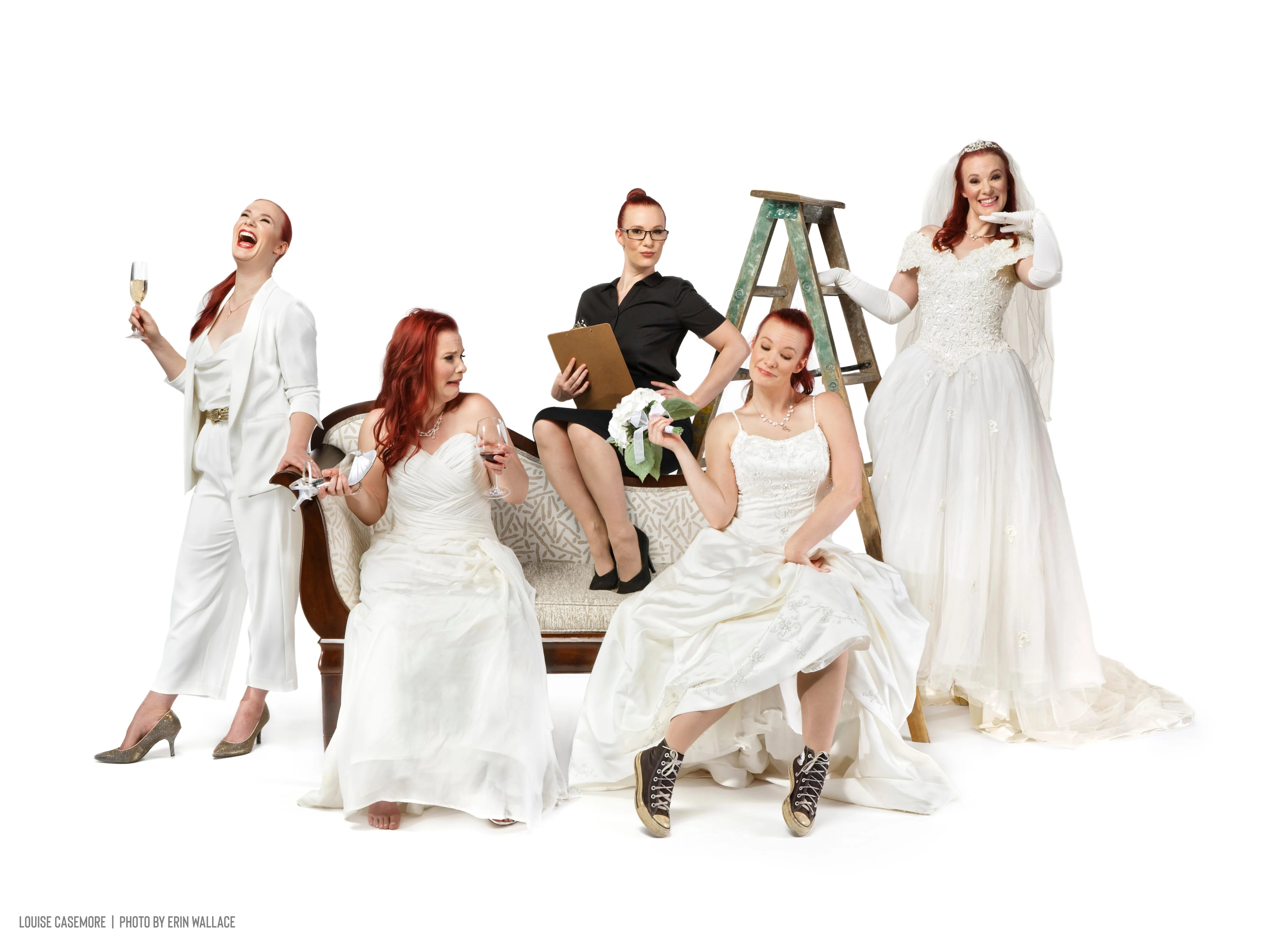
Louise Casemore in Undressed. Photo by Erin Wallace.

Alberta Theatre Projects is also in downtown Calgary, in the Arts Commons building. It’s currently hosting a run of Louise Casemore’s Undressed, an original solo performance exploring the idea of auctioning off used wedding dresses. Casemore plays the auctioneer but also embodies several of the dress donors. The auctioneer talks about various kinds of single-use and extravagant artifacts used in weddings, and says that the event tries to find new homes for as many of them as possible. Finding another couple with the same names to use leftover personalized napkins amused me, and the callback gag about herding a flock of peacocks to its new owner was also droll. I was a little puzzled about how the proceeds of the auction were intended to benefit an organization called “Zero Waste Canada” (it seems to be a real thing), but in one part of the story a woman sells one wedding dress in order to buy another, more aspirational one, and I was distracted by wondering how that worked. I liked the shy lesbian who had never expected she’d get to have a wedding.

I have been to ATP before, for Waiting for the Parade and for Glory. This time, the main level of the Martha Cohen auditorium was arranged cabaret/coffeehouse style, with seating around tables, presumably with parties seated separately. Undressed runs until February 13th, with tickets available here.

Curio Shoppe – disturbing and virtual

When we started to think about how the pandemic precautions and customs would affect our autumn traditions, some people thought about Thanksgiving, and how they could find safer alternatives to the sense of joy and connection they found in sharing a big meal with family and friends. Some people thought about Hallowe’en, what to do about the custom of children touring the neighbourhood in costume collecting candy. But I thought about Dead Centre of Town, the site-specific scary shows created by Catch the Keys, where creepy footnotes of local history are recreated and enhanced into spine-tingling ghost stories and haunting performances by Megan Dart and Beth Dart. In recent years, the productions have been held in different parts of the living-history museum Fort Edmonton Park. Colin Matty is the gravel-voiced host Wilf, providing a bare minimum of narration, and a handful of “henches” (Christine Lesiak, Adam Keefe, Vincent Forcier, et al.) lead or lure or chase the audiences from one scene to the next. The weather’s usually cold, but there’s usually a chance to warm up before or after the show at a bonfire. And I realized that this year we were going to miss out on all of that.

Dead Centre of Town has done epidemic stories before – there was the one about the young teacher (Bobbi Goddard) last seen in 1920, while walking across the High Level Bridge to quarantine herself in a Spanish Flu sanitorium. And there was the one with the scary nurse (Elisa Benzer) telling about delivering the diphtheria vaccine by airplane in the North. And someday, I’d like to see what stories this team can tell about a pandemic like ours – but not yet.

This year, the Dead Centre of Town team has a virtual / multimedia production, called Curio Shoppe. As they say in their promotions, you can participate from “the discomfort of your own home”. It’s an interactive video stream, that works similarly to the performance platform used for Vena Amoris/Fringe virtual production Tracks last spring. The audience logs in from home, watches, listens, and clicks to make some choices of which stream to follow. But you also get text messages and phone calls from the characters at appropriate points in the performance, which adds immediacy.

It’s so cool. Parts of it are seriously disturbing – the warnings at the beginning mention violence, gendered violence, gore, and swearing, and they are warranted. And parts are just intriguing. Colin Matty introduces the performance in the character of a fussy formal Curio Shoppe owner sharing some artifacts and memories, but glimpses of his less-civilized alter-ego Wilf seem to break through the surface. And head henches Christine Lesiak and Adam Keefe are also looming.

The story that’s told – at least, the story that unfolded through the choices I clicked on – starts from one of the historical horrors that’s been examined in a previous version of Dead Centre of Town, a serial-killer story. It then adds in a contemporary story (which I really hope is fictional!) and ends in an ambiguous but somewhat satisfying way. The audience member gets to see and hear various bits of documentary evidence along with atmospheric video encounters with the historical characters.

Morgan Yamada and Jake Tkaczyk play the principals and the investigators. They are supported by a chorus of ghost voices, radio interviewers, and so on.

The ticket price for Curio Shoppe, for however many household/cohort members want to cluster around a computer screen, is about the same as the single-ticket price for last year’s Dead Centre of Town XII show at Fort Edmonton Park. The producers recommend that you put on headphones, turn out your lights, and log out of distractions – but you actually don’t have to, if that way seems too scary. Curio Shoppe is playing until (of course) Hallowe’en, every night except Mondays, and you can get tickets through Eventbrite. Some performances are already sold out.

Mr Burns: a post electric play

Patrick Howarth as storyteller Gibson, Jake Tkaczyk as Sam listening. Photo provided by production. Set &  costume design Brianna Kolybaba, lighting design Tessa Stamp.

It’s hard to tell you about Mr Burns: A Post Electric Play because you haven’t seen it yet.  What I really want is to talk to someone else who’s seen it about all the cool things I noticed and figured out, and hear what they figured out that I missed.  And I want people to go see it – but to go see it without knowing any of the surprises ahead of time, because for me the surprises and the figuring-outs were part of the fun.  Anne Washburn wrote it, Andrew Ritchie directed it here as a co-production of Blarney Productions and You Are Here Theatre, and it’s playing at the Arts Barns Westbury Theatre until December 7th.

So, what can I say that will reinforce my memory, but not give everything away?

Everything means something.  Even the audience seating.  There are two intermissions, but I chose to stay immersed in the realities of the worlds we were visiting rather than make my way out to the lobby.

Communal storytelling and retelling matters.  The first act is set in the plausibly-near future, with a small group of survivors after a disaster entertaining themselves around a fire by collaborating on retellings of shared stories, especially the 1993 Simpsons episode Cape Feare.  There are lots of cultural allusions that I recognized, and some that I didn’t  but it didn’t matter.  Lots of the hints of the first act get mentioned later – which makes sense in the story and is also helpful for audience members.   It felt very natural, since I’ve been in lots of campfire conversations re-telling favourite movies and TV shows or trying to figure out the lyrics of popular songs without internet.  Many current plays and movies are successful partly because the audience already has some expectations of and history with the story.  So many seasonal adaptations of A Christmas Carol (and I have my ticket for the new David Van Belle Citadel version tonight).  The star-crossed lovers from warring factions of Romeo and Juliet, West Side Story, Shakespeare’s R & J, and whatever Shakespeare’s own story sources were.  The “Hallmark Christmas movie” trope.  Every Christmas pageant ever.  And the Simpsons itself is full of cultural callbacks and pastiche – I never think of 2001: A Space Odyssey without the image of Homer floating through a spaceship cabin chomping potato chips in Deep Space Homer.

Understated ritual is effective. Mr Burns is a post-disaster or post-apocalypse story, but it doesn’t wallow in the horror like Walking Dead or prolong the despair like Susan Beth Pfeffer’s Life As We Knew It series of young adult novels.  But there is one custom of the post-disaster world, after many deaths and the loss of mass communication, that portrays the essence of unlikely hope and longing of that time – and it too is seen in the later acts.

The Simpsons matter.   Some audience members I talked to afterwards – possibly even a few members of the company or production team – said things like “I’ve actually never seen an episode of the Simpsons” or “I’ve seen a few, but I was never a regular watcher”.  But the characters and routines of the series (1989-present) were familiar enough that everyone in the audience was laughing with recognition.   When the cartoon series first came out, I was a graduate student without cable at home.  I heard that children were prohibited from wearing Bart t-shirts to school because he modelled disrespect and intentional under-achievement – but when I was able to watch a few episodes, I thought it was wholesome and funny, just very satirical.  In the program Director’s Notes, Ritchie notes that the taboo around the show was part of what originally attracted him to it.  In the second act, set seven years after the first, the characters are rehearsing to perform escapist re-creations of pre-disaster culture that their audiences will remember and want to see – and the narrative confirms that The Simpsons is more popular/enduring material in that situation than Shakespeare.

burns2

Paula Humby, Nadien Chu, Madelaine Knight, Murray Farnell, Jake Tkaczyk. Photo provided by production. Set & costume design Brianna Kolybaba, lighting design Tessa Stamp.

Design and collaboration build the world.  Actors and directors bring it to life.  Watch for these names again.  Megan Koshka did some fabulous mask creation.  Ainsley Hillyard choreographed.  Brianna Kolybaba created brilliant sets and costumes that highlighted what found materials might have been available to the characters in those three settings, one of them reminding me subversively of the set for a particular Edmonton Opera production…  Lana Michelle Hughes provided sound design for moments of terror and humour.  Mhairi Berg’s musical direction and composition.  Sam Jeffery’s fight direction.  Tessa Stamp’s lighting design (and whoever created and executed the perfect glimpse at the very end explaining how they even had those lighting effects, just in case we got caught up in the story and forgot that there hadn’t been an electrical power grid for 80+ years by that point.)

And I haven’t even mentioned the actors yet! They are a strong ensemble of ten performers:  Nadien Chu, Murray Farnell, Kristi Hansen, Patrick Howarth, Madelaine Knight, Jenny McKillop, Paula Humby, Elena Porter, Rebecca Sadowski, Jake Tkaczyk.  I’ve seen them all on stage before – but when I was watching Mr Burns, I kept forgetting who they were, because I was so caught up in the layers of storytelling – this one’s an actor who is rehearsing as Homer, this one’s a director, now this is an actor of a later generation playing Bart as a hero in a tragic opera … Director Andrew Ritchie and Assistant Director Morgan Henderson made it work.  They all made me laugh, think, appreciate the need for art in terrible times, and leave feeling hopeful.  Which is probably their intent.

burns3

Patrick Howarth as Mr Burns / or maybe Sideshow Bob / or Archetypical Villain. Photo provided by production. Set & costume design Brianna Kolybaba, lighting design Tessa Stamp.

Advance tickets available through the Fringe, accessibility considerations including a relaxed performance on Tuesday and pay-what-you-will arrangements.  I’m definitely going back.

Have you seen it?  What did you notice that I missed?

Betrayal, by Harold Pinter

Betrayal runs in reverse order – scenes from the end of an affair to its start several years earlier.  I didn’t know very much else about it beforehand, but that bit helped.   In the first scene, Elena Porter’s character Emma and Chris W Cook’s character Jerry are meeting for a drink a couple of years after their affair ended.  They both seemed terse, brittle, understated, and careful with each other.  Was that was due to their characters, the history between them, or just some mythical British reserve? It wasn’t clear.  Within a few more scenes I’d also watched each of them interact with Emma’s husband and Jerry’s best friend Robert (Cody Porter), and I was thinking that none of them seemed very happy, with each other or in general.

But as I learned in a playwriting class, flashbacks and hints raise the stakes.  How did these people get in this unhappy situation?  I wanted to find out, and I was primed to watch for clues.  In the first scene, Emma and Jerry share news of various people who had been in each other’s lives – Robert, Jerry’s wife Judith, their respective children, other associates.  None of these people ever appears on stage, but they are all mentioned as the story rewinds back through the years, and I realized that the conversations in the first scene weren’t so much awkward time-filling as significant information about what had happened.

The various scenes take place in bars and restaurants, in Emma and Robert’s home, in a tourist hotel, and in the flat Jerry and Emma had rented for afternoon rendezvous.  Director/designer Clinton Carew has made some fascinating choices in how to use the small black-box space of the Arts Barns Studio Theatre, with furniture for each setting poised not quite out of sight in multiple legs on either side, arranged asymmetrically.  The pub table where Jerry and Emma meet in the first scene is far upstage, constrained in a narrow space far from the audience.  As the story progresses backwards in time, the scenes are played closer and closer to the audience risers.  This reminded me of this company’s production of Three Sisters several years ago, in which the family’s gradual uprooting from their family home is paralleled by the actors gradually piling up abandoned furniture upstage and moving down until they end up almost in the audience moat.

All this furniture moving takes place with the help of a character moving with precise almost fussy physicality (Jake Tkaczyk, recently seen with Elena Porter in the Shadow Theatre production of Lungs).  He turns out to be a restaurant waiter in one of the later/earlier scenes.

Costume design is by Leona Brausen.  My impression in the first few scenes is that everything is colourless grey and beige, with all the characters in trenchcoats.   But as the years rewind to happier and more vulnerable times, the palette of costuming and lighting shifts warmer as well, towards a warm master-bedroom of affection and Emma’s splendid red party frock consistent with the characters’ feelings.

I’ve seen Chris W Cook playing many characters who are well-meaning stoner bros without a future, earnest and a little stupid, shortsighted and limited in worldview – the drugged-up guy in 3…2…1 bragging about contributing to his customers’ health as a Subway sandwich artist, the young fellow in Sweat getting out of jail with the swastika neck tattoo, the drinking buddy in Nighthawk Rules trying to drag his old friend away from his grownup boring girlfriend, the wannabe-artist in The Aliens.  But in some ways his turtleneck-sporting character in Betrayal is the opposite of those – a well-spoken successful literary agent and, as one of my preview-night companions said afterwards, “a complete cad.”

The playwright Harold Pinter is known for effective use of silences in conversation “the Pinter pause”, and having seen this production I can see why.   In the stillnesses I wondered what Robert wasn’t saying, what Emma wanted to say, what Jerry was being careful about.  I found Cody Porter’s constrained facial expressions particularly compelling.  I kept wanting him to smile – I kept wanting them all to smile – but he always seemed to be in pain.

I’d like to see Betrayal again, especially to watch those beginning scenes knowing where they come from.  But once is sufficient to understand the story, to have some sympathy for the not-entirely-likeable characters, and to be challenged and entertained.  Betrayal runs until the afternoon of Sunday June 2, with tickets through Fringe.