Tag Archives: heather inglis

Fall 2025 Quick Takes

What I’ve been watching, and haven’t made time to post about:

Nicole Moeller’s WILDCAT at Workshop West Playwrights’ Theatre. The best thing about this play is the performers – Michelle Flieger and Maralyn Ryan as women a bit older than me, remembering their labour-activist past and frustrated in an increasingly-constrained present, Melissa Thingelstad as a lawyer daughter who works hard on taking care of her mum and not quite so much on figuring out what her mum wants, and Graham Mothersill as … well, as I said to a friend afterwards, Graham Mothersill pretty much has a lock on playing “nasty. ” Interesting and disturbing timely premise, with some points tweaked for the 2025 Alberta situation. I found the soundscape a bit intrusive, but that might be better for audience sitting further from the booth/back speakers. Heather Inglis directs. After a delayed start, WILDCAT‘s short run has two more shows, today (Saturday) matinee and evening, and tomorrow (Sunday Nov 9) matinee. Workshop West tickets and subscriptions continue to be 100% Pay what you will, online and in person.

25th Annual Putnam County Spelling Bee, part of the MacEwan University Music Theatre season and directed by Ellen Chorley. Like all the MacEwan shows, this one had a short run last weekend, and it sold out the Tim Ryan Theatre Lab space every night. It’s a good choice for a student show, with most of the young-adult performers playing children and a few playing adults (parents and competition staff). The set design was playful and functional, with an evocative representation of an American school gym, worn basketball-marked hardwood floor to wooden climbing frame, swinging doors full of photocopied notices, and old-school wall phone with the longest most mangled cord ever. Choreography was fun and energetic. Jack Hunting (Olive Ostrosky) and Kohen Foley (Leaf Coneybear) were particularly memorable as characters. In 2013 I saw a production of this musical by local company ELOPE. I’m a little embarrassed that I wrote in this blog at the time that I didn’t recognize the actor names, because now they’re all performers whose names would make me choose to go see something they’re in. MacEwan’s next show is Carrie: The Musical. It’s in the bigger Triffo Theatre space so some seats are still available, for Nov 26-30.

According to the Chorus was Walterdale Theatre’s October show. The Arlene Hutton script was directed by Barbara Mah, and set in the crowded female-chorus quick-change room of a Broadway theatre in the 1980s. Costumes – both the over-the-top concepts the dancers wear to perform, and the flamboyant neon warmup gear they arrive in – were splendid and funny and appropriately period, thanks to costume designer Karin Lauderdale. Walterdale’s next show is Noël Coward’s Present Laughter, directed by John Anderson, December 3-13. The talented cast includes Randy Brososky, the multi-talented actor/creator/improviser/director, along with 10 other performers, some new to Walterdale and some familiar. Advance tickets are here.

Die-Nasty is Edmonton’s long-running very-long-form improvised soap opera, this year tackling The Bible. Or rather, stories from those settings which didn’t make it into the versions we know, either the Torah or the New Testament. Die-Nasty’s company and guest performers create characters and the director (Jake Tkaczyk) gives them bare-bones scene descriptions to fill in on a moment’s notice. And somehow this turns into fascinating character development, plot points which could be excessive or nuanced or both, and moments of hilarity that are hard to describe afterwards. Last year they built a gold-rush town, complete with saloons and schoolmistress, doctor and explorers and a matriarch of many sons … Company members this year include Little Guitar Boy brothers Jason Hardwick and Lindsay Walker, who bear some resemblance to musical collaborators John&Paul as well as to various disciple origin stories, the aforementioned Randy Brososky who seems particularly suspicious, journalist Myrrh Incense (Kirsten Throndson), and others, and recent special guests have included Matt Baram and Naomi Sniecus (creator-performers of Big Stuff at the Citadel). Paul Morgan Donald provides live music and sometimes the characters sing! You don’t need to follow from the beginning, as they give recaps and character intros at the start of each show. Tickets for Die-Nasty are also 100% Pay What You Will now, at the theatre or online. Varscona Theatre, Monday nights at 7:30.

I don’t know if I’ll be able to fit in everything I want to see in November, but the list includes

Tough Guy, by Hayley Moorhouse, at the Arts Barns, two last shows today Saturday Nov 8th, advance tickets here.

Castle Spectre, an adaptation by Lauren Tamke who directed this production for her Paper Crown Theatre, at Gateway Theatre, Nov 21-30, tickets here.

Beehive the 1960s musical, at St Albert Dinner Theatre, directed by Caitlyn Tywoniuk and music direction by Dalton Terhorst, tickets here.

Teatro Live doing The 39 Steps, with Geoffrey Simon Brown as Richard Hannay, Nov 13-30.

Northern Light Theatre has a new play by Trevor Schmidt, How Patty and Joanne Won High Gold at the Grand Christmas Cup Winter Dance Competition, with Jenny McKillop and Kendra Connor, Nov 27 – Dec 13. Tickets here.

Vinyl Cafe: The Musical, at the Citadel, Nov 8 – Dec 7, tickets here.

Women in wartime: Stars on her Shoulders is inspiring and timely

Meegan Sweet and Gabby Bernard in Stephen Massicotte’s Stars on Her Shoulders. Photo by Marc Chalifoux.

It makes sense that Remembrance Day weekend brings theatre about World War I. But this year Edmonton playgoers are fortunate to have two world-premiere productions on local stages, both by playwrights with Alberta roots. I wrote about The Two Battles of Francis Pegahmagabow in an earlier post.

Workshop West Playwrights’ Theatre is launching its “Saints and Rebels” season with Stephen Massicotte’s play Stars on Her Shoulders, about Canadian nurses in France in 1918. It is directed by artistic producer Heather Inglis. As the play starts, two of the nurses (Hayley Moorhouse and Meegan Sweet) are also patients in a hospital, convalescing from injuries sustained when another hospital was attacked. The story of the attack and of their injuries comes out gradually, as the nurses chafe at inactivity and engage with other hospital staff (Dana Wylie as a starched Scottish Matron, Dayna Lea Hoffman’s Georgie with irrepressible optimism, and Gabby Bernard as Enid, an earnest and well-meaning newbie.)

As Stephen Massicotte pointed out at the playwright talkback earlier this week, the plot is developed through relatively long scenes. Most scenes take place in Emma and Helen’s hospital “hut” or ward, with occasional visits to the Matron’s office or other locations. As we get to know more about Emma, Helen, and the other characters, we also see changes in them. They’re all politically aware, especially Emma (Sweet), who admits to writing her first protest petition at fourteen. So they follow the progress of suffragists (“Suffragette is a slur”, Emma corrects Enid) in working for the right to vote. They point out that the initial move to allow women military personnel to vote, and the female next-of-kin of male military, was an opportunistic move by a government who needed more support for conscription. And one wryly points out that even with a more general enfranchisement,conscientious objectors and immigrants and “Indians” [sic] will still be excluded. Helen (Moorhouse) starts out very guarded, standoffish and sarcastic even with longtime friend and nursing-school classmate Emma. I enjoyed watching her moments of relaxing her guard, and ended up very moved by her pain and bravery.

Emma and Helen want to get back to work soon. Their superiors (both the Matron on stage and the unseen men writing orders) want them to take time to recover, but they also want to present Emma and Helen with medals. This turns out to be a problem, however. Since the Canadian nurses are commissioned officers, they should receive the Military Cross, but the War Office wants to give them the Military Medal, which would be appropriate for enlisted personnel. Female nurses in other jurisdictions are not officers, and acknowledging some Canadian heroines this way would encourage feminists in Britain and other allied forces to negotiate their own status. So Emma protests, and the War Office sticks to their, ahem, guns. The “stars on her shoulders” refer to the lieutenant’s insignia each woman wears, and why they matter.

There’s so much detail to chew on in this play, which wraps up in under two hours. Not too much, and it all fits well with the distinct characters and their experiences. One speech in particular is disturbingly timely this week. I cried when Sweet’s activist character Emma is warning the others that women’s rights can never be assumed permanent – they can all be taken away, and vigilance will always be necessary.

The set is arranged as an alley stage (Brian Bast), with a few rows of seats on two long sides of the convalescent ward. Unlike some alley or in-the-round productions, I didn’t feel like I was missing anything due to where I was sitting. Back rows are on risers, and everyone is close to the action.

Workshop West’s season is their first with completely Pay-What-You-Will pricing, for subscriptions as well as single tickets. Tickets are available here, and Stars on her Shoulders runs until November 17th. I’m thrilled to support this initiative as a subscriber, and I’m excited about the rest of the season too. I think it’s the first time I’ve seen a play program thank donors that include both the Department of Veterans’ Affairs, and the local LGBTQ2S+ institutions Fruit Loop and Evolution Wonderlounge.

The unseen Mob

Kristin Johnson in Mob. Photo credit Marc J Chalifoux Photography and Video.

I liked seeing Mob, currently on stage at Workshop West Playwrights’ Theatre’s Gateway Theatre, without knowing much about what to expect. Afterwards, I wanted to talk about it, but I also wanted to give more people the chance to see it similarly unspoiled.

So, if you don’t want to know what it’s about or what happens, I can still give you several reasons to see it, and then you can stop reading. Starting with the names in the credits:

  • Heather Inglis, artistic producer of Workshop West as well as director of this play, has created a coherent season of challenging work, loosely categorized under the theme Borderlands.
  • Three good performers familiar to local audiences: Kristin Johnston, and Graham Mothersill, and Davina Stewart. Each of them portrays a fascinating complex character, not entirely likeable but sometimes funny and often relatable.
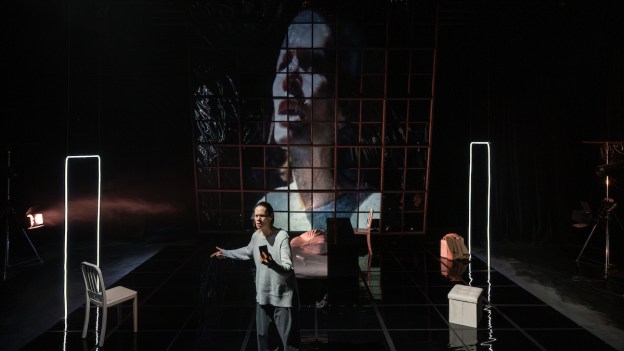
  • Designers include Darrin Hagen (eerie atmospheric soundscapes and original music), Beyata Hackborn (a set that starts out with an Instagram-perfect look and turns out to be both functional and symbolic), Alison Yanota (unusual lighting that escalates the tension), and Sarah Karpyshin (iconic costume design).
  • Program credits for Jason Hardwick (choreography) and Sam Jeffery (fight and intimacy direction) provide additional clues to the content in the show and the skill level with which it will be executed.

The action starts with projections, conveying a woman, Sophie, (Johnston) driving feverishly while voices overlap and reverberate in her head. As she arrives with her suitcase at a remote bed-and-breakfast, she is greeted by Martin (Mothersill), cringingly clumsy and twitchy as he over-explains that he’s at home this time of day because he’s lost his job. The visitor stands immobile on the threshold holding her suitcase, responding to his questions but not progressing the conversation. Is she exhausted? Is she hesitant to enter? Why is she there? She’s not giving anything away. Soon Martin’s aunt Louise (Stewart) bustles in with a limp, all aging-hippie style and colourful cane, to smooth over the conversational awkwardness and remind Martin how to behave with guests. The show is described as a thriller – at first I wasn’t sure whether the characters would be realistic or more gothic, whether there would be overt or psychological violence in the isolated-country-house trope or what. I’ve also seen Johnston play a lot of disturbed and disturbing characters on stage in the past few years, from Death Trap to Destination Wedding, Baroness Bianka’s Bloodsongs to We Had a Girl Before You. But the fears explored in Mob are completely realistic and timely. Which is much scarier.

Mothersill’s portrayal of Martin often made me want to laugh – but the menace conveyed by the soundscape and the unfolding story made me feel uncomfortable about laughing – not so much that I was pitying him, but that it might be dangerous to provoke him.

The performance is a bit over an hour and a half long, with no intermission. The script (written in French by Catherine-Anne Toupin and translated by Chris Campbell) has a compelling directness with no unnecessary dialogue.

Beforehand, I wondered why a three-hander would be called Mob. Isn’t a mob a larger angry group? Then I realized that the three people on stage were not the only ones involved – that the internet posters Sophie quotes, in overlapping overwhelming torrents of abuse, are in some ways present throughout, ubiquitous and inescapable.

Mob has a short performance run, ending next Sunday afternoon, November 12th. Get your tickets soon!

Sneak peeks at new work

For most art, audiences don’t get to experience it until it’s “done”. Painters and sculptors don’t usually Instagram their rough sketches or let people wander around their studios. Composers don’t usually play and sing bits of their new works for lucky fans. Sometimes at a fan convention an author might read a chapter of a new book, or there might be a screening of a film trailer, but probably not an unedited reel. But theatre depends on how the text sounds when a group of actors is speaking it, and live theatre also depends on audiences responding to the text. So it’s common in play development to have a reading – maybe a private workshop with actors hired to sit around a table and read from a new script, and then maybe a reading on stage for an audience. No set and costume, no actions, no music and lights – just the voices of the characters, bringing a story to life.

The next chance to hear readings of new scripts in Edmonton is Workshop West Playwrights’ Theatre’s Springboards Festival, which runs March 22-26th at the Gateway Theatre (you might remember it as the Roxy on Gateway or C103 or the hottest Fringe venue around…). Workshop West Playwrights’ Theatre (as the name suggests) has a mandate of supporting new play development. The schedule of plays for this festival sounds exciting! Not only is there new work by established playwrights Conni Massing (The Aberhart Summer, The Invention of Love) and Stephen Massicotte (Mary’s Wedding), and award winner James Odin Wade, on Wednesday Mar 22 there are five ten-minute scripts selected from the EdmonTEN play competition, and on Sunday Mar 26th there’s a Cabaret-style sampling of work from eleven more writers, from emerging to acclaimed. Heather Inglis and Darrin Hagen are curators and dramaturges for the festival

Jake Tkaczyk, actor, performance creator, and graduate student, will be one of the performers for James Odin Wade’s new work Everyone Is Doing Fine on Thursday Mar 23rd. Jake’s experience with play readings includes working on Bright Burning, (later titled I Hope My Heart Burns First) which Colleen Murphy wrote for his graduating class, and participating in public reading events including Script Salon and Skirts Afire. I asked Jake a few questions about readings and new play development.

“As an actor, how do you benefit from participating in a private workshop reading?”

“If I know I’ll be doing a public performance, I love getting the chance to work on the script, ask the playwright to clarify their motivations, and spend more time than a normal rehearsal process. We get more chances to try things out. ”

“Why do you do staged readings for the public?”

“Play readings are a chance for the writer to really have their work understood. As an actor, I am there to service the playwright. A public reading gives the writer a chance to hear what’s landing, what does the audience find comedic or not find comedic – are there moments when the room goes still. The writer gets to hear it read and hear it heard. And without all the design elements contributing to the experience, the audience is just paying attention to the words. Does the text work in that order? Is the plot making sense? Is there anything that needs to be explained more … or less?”

As an emerging playwright myself, I’ve had the chance to experience what he describes. Earlier this month my short script Book Club 2021 was read as part of Walterdale Theatre’s From Cradle to Stage festival, along with twelve other new plays. Hearing actors read my script, and being surrounded by audience members responding to those actors, made me so grateful that theatre is a collaborative art. We need each other to share stories. _______________________________________________________________________________________

Springboards Festival runs Mar 22-26 at Gateway Theatre with performances at 7:30 every evening. Tickets for each evening are $15 in advance and pay-what-you-wish at the door.

Two tales around times of disaster

It was going to be three.  I was planning to get to One Flea Spare this afternoon, the Trunk Theatre production about people quarantined during a bubonic plague, but that didn’t end up happening.  Colin MacLean’s review of that show is here. 

So the two shows I saw this weekend were Bears and The Laws of Thermodynamics.   Both of them were set around some kind of environmental disaster which wasn’t quite explained.  In Bears, it was a current or very-near-future setting, not too far from here, with oil spills and watershed damage and other familiar real or realistic problems.  In Laws of Thermodynamics, it was … pretty much the opposite of all that.  Can you say “magical realism” in an end-of-the-world story?  Nothing is explained about why the world seems to be ending, or why it is ending the way it is, and some of the things that happen really don’t fit current models of physics.  Oh, but while I’m thinking of it, there’s some magical-realism to the story of Bears too, it’s just not about the setting.

Bears is a new show written by Matthew Mackenzie, who wrote Sia.  Its short run at the PCL theatre had several sold-out houses.  It was produced by Pyretic Productions, with Patrick Lundeen credited as “Consulting Director”.  Sheldon Elter narrates the story, in the odd format of a third person narrative about Floyd while he seems to be portraying Floyd himself.  It is as if he is standing outside the person to whom the events happened, leaving it unclear whether he is actually still that person.  And that is probably not an accident.   As the story starts, Floyd is an oilpatch worker who is fleeing arrest for some kind of sabotage, heading west to the mountains and recounting memories of growing up with his Kokum (Cree for Grandma) picking berries, dancing at pow-wows, and watching the stars.  On his journey, he slips gradually from the man-made world of highways and diners to the natural world of the foothills and mountains, but continues to encounter evidence of human destruction such as dead animals, clearcutting, and avalanche.  He also experiences many delightful natural phenomena –  butterflies, chickadees, salmon, berries, and alpine-meadow flowers.

While Elter narrates the story actively as Floyd, stomping about the stage in high-visibility coveralls and work boots, he is backed up by a chorus of dance/movement artists (Alida Nyquist-Schultz, Krista Posyniak, Kate Stashko, Anastasia Maywood, Aimee Rushton)  They added visual interest and emotional intensity, with movements that were sometimes representational (I loved the churning salmon and the irritatingly-flittering butterflies), sometimes more loosely interpretive, and occasionally a more traditional unison choreography.  Bryce Kulak played and sang several clever original songs, in character and costume as the ghost of an old-time Mountie.  Lianna Makuch and Ainsley Hillyard had cameo appearances.  The simple set was made up of some jagged mountain set pieces with echoing outlines on the floor, with video projections and lighting changing with the story.   And the magical realism that I alluded to earlier – I’m not sure whether Floyd’s transformation during the voyage was real, metaphorical, or something in between, but I didn’t need to know that to appreciate the story and the message.

I was uncomfortable with the specific naming of a pipeline project and a pipeline company, but I’m okay with being uncomfortable.  Art with the power to make people squirm and think and examine cognitive dissonance and argue is a good thing.

The Laws of Thermodynamics, a new play by Cat Walsh directed by Heather Inglis, was playing in the Westbury Theatre, configured with a few rows of seats on risers close to the stage area.   I went to see it partly because Workshop West always has interesting productions and partly because Melissa Thingelstad was in it, and her characters fascinate me.  It also had James Hamilton and Julien Arnold in it, both with appearance and posture so unlike anything I’d seen them in before that I was looking through my program to see whether there was a bigger cast than I’d expected.  But no, there were just five, with Cody Porter having a large role and Paula Humby a small unspeaking one.  Theatre YES was credited alongside Workshop West Playwrights’ Theatre.

It took me quite a while to figure out what was going on.  Which was okay, I think it was supposed to.  A traveller in hazardous times (Cody Porter) has a truck breakdown,  wanders into a small town looking for help, and meets weird people who maybe aren’t what they seem.   Thingelstad is Della, a diner waitress who seems to be in charge, with a huge ring of keys.  She and Jerry (Hamilton) each confides secrets in the traveller Daniel, with instructions not to tell the other.  Arnold’s place in the remnant society is clearly on the bottom of the heap, but it takes a while to find out why.  One of the ways that the eerie approaching doom was indicated on stage was the buzzing and swaying of the big electrical-transmission poles arranged in a false-perspective series extending backwards.  I don’t know why I liked that so much, but I did.  I liked the companionate relationship between Daniel and Della that formed as the end became closer, sharing a hoarded Twinkie under useless umbrellas.

The Laws of Thermodynamics was one of those shows that would have benefited from a second viewing, I think.  It was both darker and more elliptical than Bears, and in some ways less entertaining.  But I was not disappointed in seeing Melissa Thingelstad play another strange character, and there were some funny parts in the character interactions too.

I think the next play on my schedule will be Pink Unicorn.  And maybe by then I’ll be caught up posting about shows that I saw earlier.