
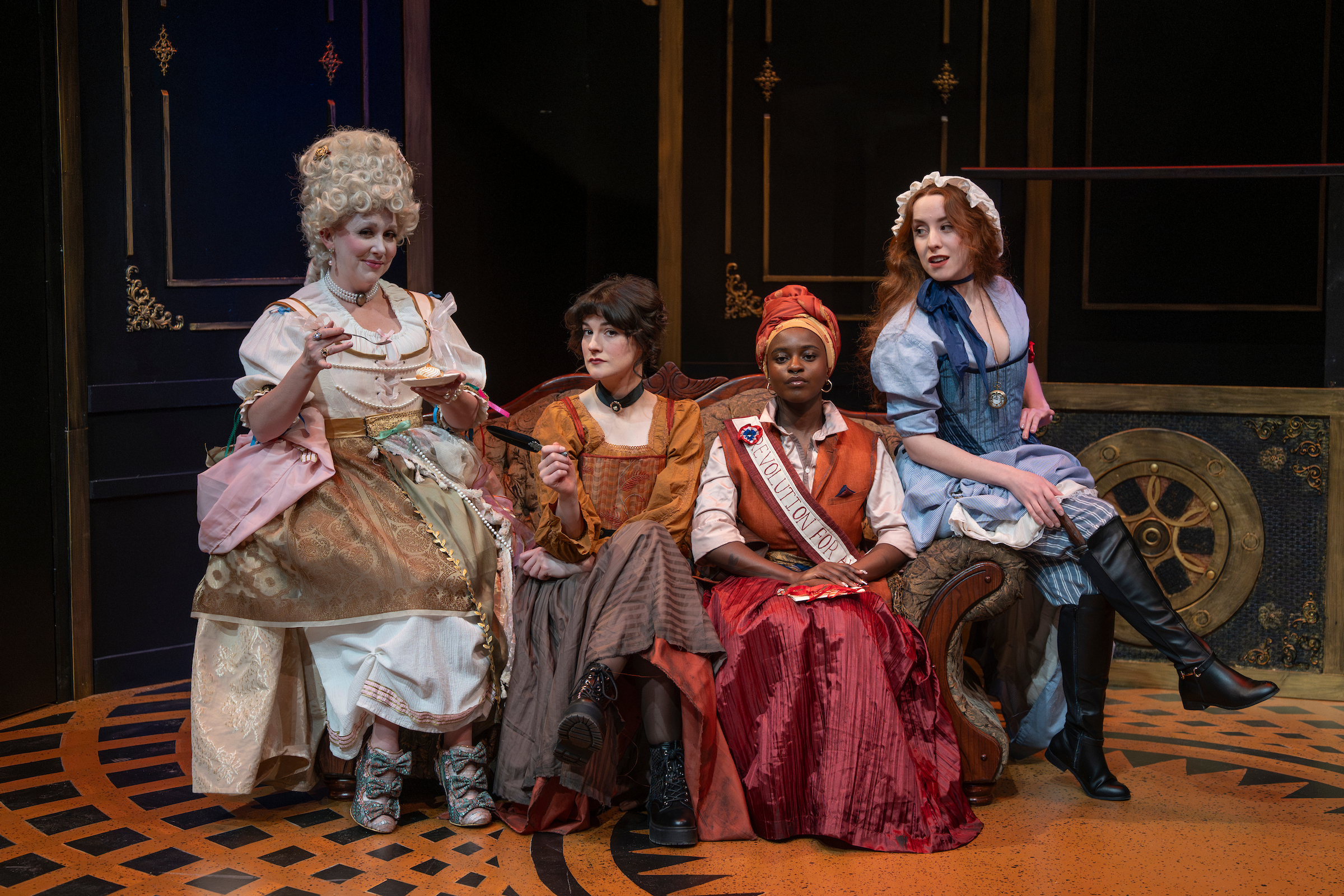
Costumes Rebecca Cypher, set Cindi Zuby, lights Ken Matthews.
Images Marc J Chalifoux Photography.
My previous knowledge of contemporary American playwright Lauren Gunderson suggested that The Revolutionists would be an inspiring feminist story based on real women in the French Revolution. It was. But it was also hilarious, absurd, fourth-wall-breaking, and full of self-referential mockery about playwrights, theatre, and the ridiculous concept of writing a musical about the French Revolution …
John Hudson directed The Revolutionists for Shadow Theatre – the founding artistic director’s last directing project before Lana Michelle Hughes takes over as Artistic Director.
The action takes place in 1793, after Marie’s husband, King Louis XVI was guillotined in January and before she met Madame Guillotine herself in the fall of that year.
The performance starts with Olympe de Gouges (Alex Dawkins), the only feminist playwright left in Paris, in her apartment, struggling to write her next play, and posturing for the audience about the hardships of being an artist and living through a revolution. Dawkins’ neo-bouffon skills serve her well in portraying a character who is not quite as important as she thinks she is, but who is very aware of her own voice.
Her first two visitors are more down-to-earth. Marianne Angelle (Kijo Gatama), activist and spy, is motivated to use the turbulent times to free her homeland of Saint Domingue (now Haiti) from the French Empire and end slavery. She wants Olympe to help her by writing pamphlets and declarations instead of plays. “What about a monologue?” negotiates Olympe. Charlotte Corday (Jacquelin Walters), younger than the others, is planning to take more specific action – she is going to assassinate the radical journalist Marat, hoping this will correct the course of the Revolution away from the Reign of Terror. And she wants Olympe to script her Last Words that she’ll be allowed to give from the scaffold before her inevitable execution.
Absurdity escalates when the next knock on the door is actually the infamous former Queen of France, Marie Antoinette, in a gown covered with bows, bustle, and other decoration, and wearing a recognizably-excessive wig. Aimée Beaudoin’s Marie is ridiculously self-centred and naive, completely unequipped to function as an ordinary citizen. She tries to get the playwright to write a play all about her. The contrast between Marie’s wishes and the other three continues throughout the play, providing a necessary levity. But they also find points of poignant connection – absent husbands, motherhood.
Early in the play we see the shadow of a guillotine over the set, reminding us that all of this is taking place in a situation of impending violence. I wondered how that mood shift would happen. I pictured scaffold speeches like Sidney Carton’s in A Tale of Two Cities (“It is a far, far better thing that I do than I have ever done. It is a far, far better rest that I go than I have ever known”). But in Gunderson’s play, the condemned burst into song, into full-voice amplified musical-theatre ballad song, which added a perfect touch of absurdity.
Costume design, illustrating the characters’ different vocations, social classes, and cultures, was by Rebecca Cypher. The constrained and ornate set was designed by Cindi Zuby, with sound by Darrin Hagen and lights by Ken Matthews.
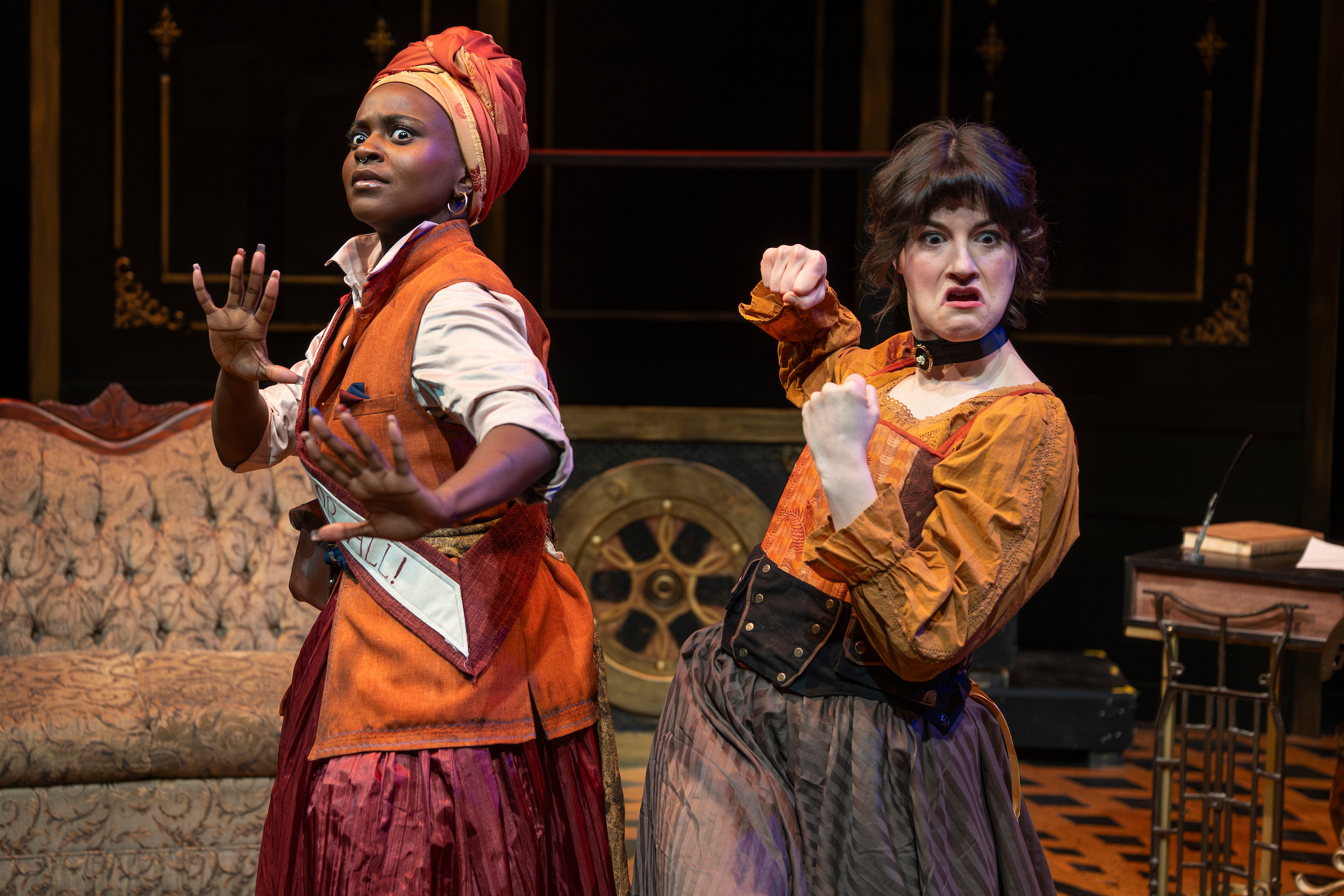
Costumes Rebecca Cypher, set Cindi Zuby, lights Ken Matthews.
Images Marc J Chalifoux Photography.
I’ve seen two other plays by American playwright Lauren Gunderson: Silent Sky, based on historical figure Henrietta Leavitt a female astronomer in the 19th and early 20th centuries, and Miss Bennet: Christmas at Pemberley, a tribute-fiction contribution to the Pride and Prejudice universe, extending the story of bookish sister Mary and finding her a sympathetic happy ending. The characters in Silent Sky clearly push against the usual options for women and for deaf people at that time. As for Christmas at Pemberley, the Austen source material already provides a sharp outside eye on the society of the time; Gunderson’s play is clever pastiche and satisfying fanservice. Both plays include male-female romances with shared interests and minimal power imbalance.
The Revolutionists is my favourite of the three, because it handles serious material but doesn’t take itself too seriously. Playing at the Varscona Theatre until April 5th, with tickets here.

 Ephemeral Pleasures