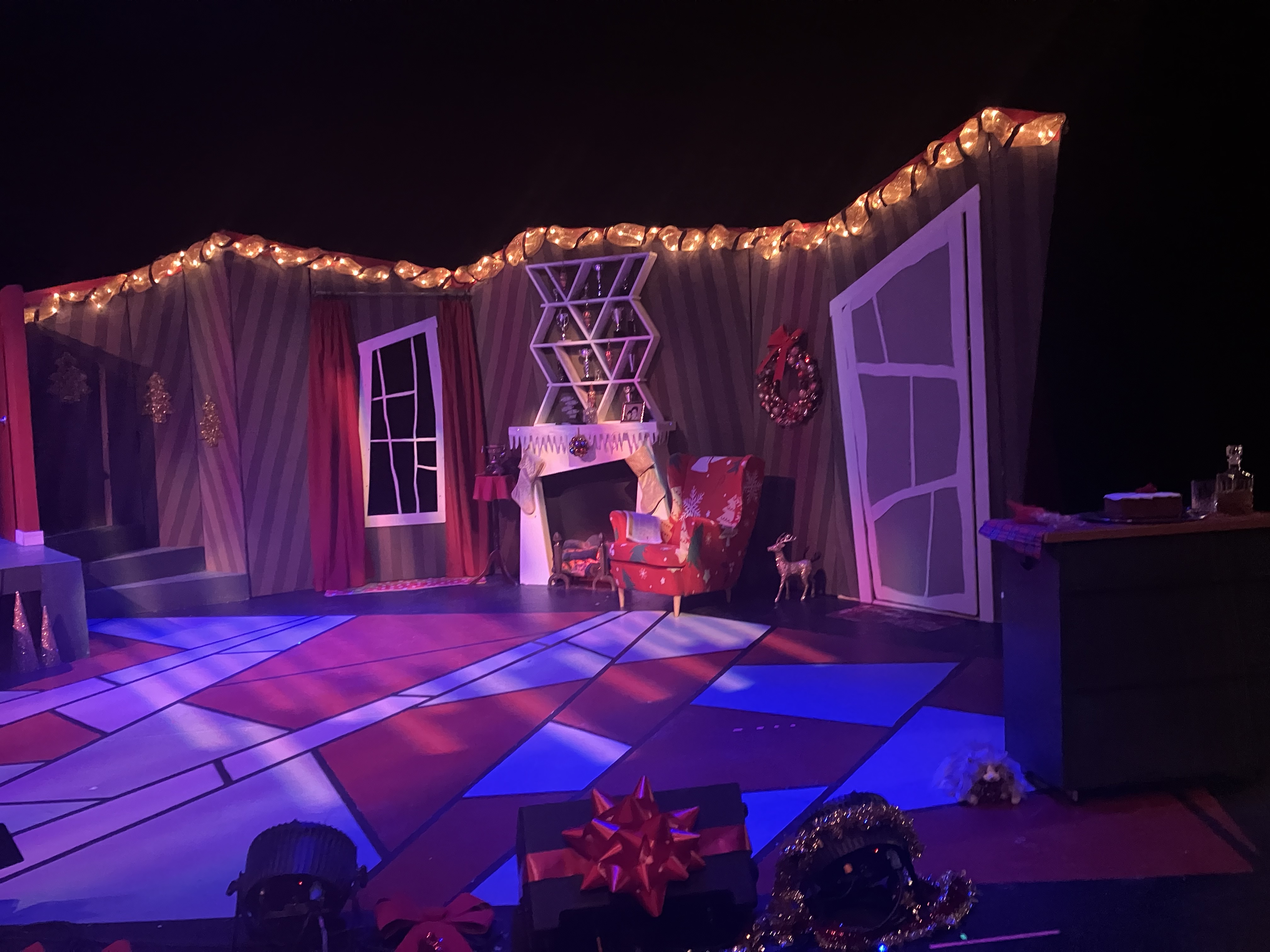
Bright Lights in Camrose

Pre-set for Bright Lights, by Kat Sandler, at the Augustana Theatre Centre.

This week in Camrose, a production of Kat Sandler’s dark comedy Bright Lights is being performed by a University of Alberta Augustana theatre class. There is one more performance, tomorrow (Sunday November 24th) at 2 pm.

I had seen a Blarney Productions run of this play at the Edmonton Fringe 2024, directed by Luc Tellier and featuring familiar local actors Rachel Bowron, Oscar Derkx, Braden Dowler-Coltman, Mhairi Berg, and Jenny McKillop. I’d enjoyed it a lot.

The Augustana performances take place in the Augustana Theatre Centre, a former chapel now repurposed with a small proscenium stage and steeply-raked audience seating. The pre-set creates a setting in a cluttered multi-purpose/meeting room in a church, with table and chairs surrounded by the necessities of exercise groups, Sunday school classes, sign-up sheets, water jugs, and assorted overflow storage.

The first two characters to enter, Zoe (AC Capper) and Laurel (Halen Vaage), are arriving at some kind of support group – Zoe as a hesitant first-timer and Laurel as a jealous and protective insider. This gets weirder when we learn that it’s a group for people who have encountered aliens, and escalates as Zoe meets the other group members, Dave (Jack Purnell), aggressive and challenging, Wayne (Michael McCarroll) the former actor who keeps trying to apply lines from the TV series he was in, and Ross (Hung Nguyen) the smooth-talking group leader. They start out by reciting their routine group convictions – “This is a safe place.” “We believe you” – but then they immediately challenge Zoe to tell her own alien-encounter story and prove that she isn’t, as they say, a “lookie-lou”. While her story has elements familiar to them – the bright lights, the compulsion to follow, the loss of time – it also raises some questions which challenge the premise of the group. People turn on each other. Weapons come out. Truths come out … or do they? Even having seen the play several months ago, I didn’t remember all the plot twists, and I was on the edge of my seat at a few points, with one piece of theatre-magic making me shout with surprise. The pacing was very good. I could see that each character always had motivation for their behaviour. There were a couple of high-energy exchanges where I had a bit of trouble understanding characters who were shouting, but that didn’t hurt my ability to follow the story. Bright Lights was directed by course instructors Jake Tkaczyk and Kevin Sutley. Tickets are available here for tomorrow afternoon’s closing performance or at the door, $20 general admission or $5 for Augustana students.

New productions – reviews of re-viewings?

Team and coach travelling by train, in MacEwan University’s production of Tracey Power’s Glory. Photo by BB Collective.

I’ve been watching entertainment on local stages for more than ten years, so it’s not surprising that sometimes I see new productions of works I’ve already seen. Recently, I’ve seen two performances in this category, but otherwise very different: Glory, by Tracy Power, and Die Fledermaus, by Johann Strauss.

In 2018 I travelled to Calgary to see the world premiere of Tracy Power’s Glory, produced by Alberta Theatre Projects and directed by James MacDonald. I was excited to see that the students of MacEwan University’s Musical Theatre program would be tackling this play, as a story about young people pushing the boundaries of appropriate activities in the turbulent times of 1930s Canada seemed like a great fit. Amber Borotsik was a great choice as director for the movement-forward work. Her choreographic choices for learning to skate, for practising hockey strategies, and for the various important games in the narrative were less stylized and more story-coherent than in the original production, but equally fun to watch.

Izzy Deutscher was great as team captain Hilda Ranscombe, confident in sports but struggling in other parts of life. The other team members portrayed, Nellie Ranscombe (Jaysel Ann Arroyo), Marm Schmuck (Harmony B), and Helen Schmuck (Jenn Houle), were quickly distinguished as individuals, each with her own problems and quirks. The script clearly sets the action in 1930s small-town Canada, with radio news voice-overs, women’s magazine columns, and the teammates’ conversations about work in the shoe factory, missing a chance at university because father and brothers are still out of work, and being denied admission to law school because of being Jewish. Devin Estey plays rink manager and reluctant team coach Herb Fach, managing to conveying a grumpy-old-man vibe despite appearing about the same age as the players. Kevin Thomas, visible in porkpie hat and suit on the theatre’s catwalk, provided colour commentary as radio announcer for the various games.

I was particularly moved by the design feature (Scott Spidell) of having championship banners roll down after the team’s first national title win, then ending the show with the banners scrolling through the many subsequent achievements of the Preston Rivulettes, then the logos of the modern-era national championship, the first women’s world championship in Ottawa in 1990 (I still have a volunteer sweatshirt with that logo), the subsequent world and Olympic titles of Canadian teams, ending with the new logos of the six teams in the Professional Women’s Hockey League, now in their first full season. As a second-wave women’s hockey pioneer and the daughter of another one, I loved the way this tied the history together with my own experience and with current and future women’s hockey players. I was also impressed by the information and fundraising about indigenous hockey opportunities in Alberta.

Die Fledermaus was last produced at Edmonton Opera in 2014. In a conventional staging, it was humorous and enjoyable, with Julian Arnold playing the doctor who is teased about his bat costume. The 2024 production, directed by Joel Ivany, added a layer of meta-, and even more opportunities for accessible silliness, by framing it as a community theatre company rehearsing, performing, and recovering from a performance. So Act 1 is actually the company arriving at rehearsal and rehearsing Act 1, with original dialogue in English for the many interruptions and amusing interactions. I think my favourite bit of Act 1 was watching the Stage Manager (Farren Timoteo) scurrying around to deliver props to the performers just in time and almost invisibly, and crawling around the stage with strips of spike tape laid out on his sweater, so he could mark each performer’s location for delivering songs. In Act 2, at Count Orlovsky’s party, the core cast of 9 is joined by a large chorus of partygoers in masks and various shades of festive black, along with a DJ, a drag queen, and others. Most memorable was the ode to Champagne. Act 3 is called the “After-After-Party”, with the cast members waking up or staggering in, and reminiscing about the performance but actually singing all the songs of the script’s Act 3. This part was kind of confusing but I was still laughing. Soprano Jonelle Sills (Rosalinde) had a particularly impressive voice, and also memorable wigs.

Trevor Schmidt’s Monstress

Preset for Monstress

I’ve seen so much good performance in the last couple of weeks – it’s like Fringe, without the green onion cakes. I’m behind on writing it all up, and next I’m going to Pirates of Penzance.

I didn’t post about Monstress right away because it’s harder to describe than some of the other productions on local stages this month. Monstress, the first show in Northern Light Theatre’s season, left me unsettled. And I’m pretty sure it’s supposed to be unsettling. It’s a premiere written, directed, and with set and costume design by Trevor Schmidt. Lights are by Larissa Poho and sound by Dave Clarke.

Performers are Sydney Williams (The Doctor) and Julia van Dam (The Body). That gruesome and impersonal credit is consistent with what we see early on. The Doctor tells us that despite her expulsion from the school of dissection and medicine, she has been able to continue her work in understanding human life to the extent that she can bring it back after death. She is dressed and/or lit in a bottle-green colour, reminiscent of some earlier era (steampunk? Victorian? it’s not specific). At first, her monologue about whether she is actually a monster herself does not seem to apply literally – it feels atmospheric, like some type of poetic overstatement.

Then she explains that a Colonel sent her the body of his daughter Lydia Chartreuse, recently dead from a riding accident. Actor Van Dam lies immobile on a lab in the basement lab (like the eponymous Rocky of Rocky Horror, but really not). Lighting makes her skin and her bodysuit into some flat chill colour between alabaster and pale green. The Doctor then uses her knowledge and additional equipment funded by the Colonel in attempts to re-invigorate the body.

These attempts appear to be successful, in a way. The Body can move, but it/she seems to have lost adult understanding, so the Doctor must teach her, must, in a way, raise her like a child or train her like a pet. Van Dam’s slack-jawed clumsiness and naive questioning conveyed a childlike tabula rasa,

After the two of them move out of the city to rehab at the Colonel’s private country estate, Van Dam also plays the housekeeper, poised and veiled and apparently in possession of even more information than the Doctor. It seemed to me that the Body/Lydia had information about her death and her previous life, that the Doctor did not. As an audience member trying to piece together the backstory, I wanted the Doctor to ask the right questions – and she didn’t.

The situation reminded me a bit of the 2018 Northern Light production by Bryony Lavery, Origin of The Species, in which an anthropologist (Holly Turner) discovers a live prehistoric woman (Kristin Johnston) and tries to accustom her to modern life, and a bit of the NLT’s 2016 production of Wish (adapted from a Peter Goldsworthy novel by Humphrey Bower), in which a young man (Christopher Schultz) develops a relationship with a sign-language-communicating primate, Ainsley Hillyard. Many NLT productions make me ask questions about what it actually means to be human, and to be humane, by considering edge cases. Provocative and unsettling edge cases.

I began to think that the Doctor didn’t want to know more about Lydia’s past, or about what was likely to lie ahead for her. Since I could make some horrifying guesses about both, I flashed back to the Doctor’s top-of-show musings about whether she was the real monster. Because … maybe she was. Like the scientists of Jurassic Park, she was so preoccupied with whether she could, she didn’t stop to think if she should. Because she didn’t care. And by the time the play ended, my worries about Lydia were modern-day realistic horrors. My feelings about the Doctor were mixed up with far too many true stories about people who don’t have the best interests of vulnerable people at heart – are they actively evil or oblivious and negligent, and does intent even matter?

Monstress is playing at the Arts Barns Studio until November 23rd. Tickets are available here. The theme of their season is Making a Monster – and I am starting to see why.

The Pirates of Penzance

Shauna Rebus, Brendan Smith, and Russ Farmer in Pirates of Penzance. Photo by Nanc Price Photography.

If you’ve ever heard of Gilbert and Sullivan – if you have even a humming familiarity with any of their work – you’ll know that the Victorian-era duo wrote wildly-popular tongue-in-cheek light opera pieces, some of which continue to be frequently-performed and alluded to in popular culture. And if you asked someone to sing one song from Gilbert and Sullivan, they’d probably attempt the first lines of “I am the very model of a modern Major-General”, an oft-parodied patter song which is from Pirates of Penzance (1879).

I’ve seen Pirates of Penzance once before – at the Stratford Festival’s Avon Theatre, on a 1985 outing with my mother, who’d admitted the year before that she appreciated me taking her to see some Shakespeare plays but what she would like even better was Gilbert and Sullivan. In those days it wasn’t easy to access a plot synopsis or lyrics ahead of time, there were definitely no supertitles/captions, and seats at the front weren’t in my budget. So I missed lots of the clever rhymes and over-the-top dialogue/intentions.

Local company Foote in the Door opened their production of Pirates of Penzance last night at Théâtre Servus Credit Union (La Cité Francophone), directed by Ron Long. I sat in the first row so I wouldn’t miss anything – and they were using supertitles for all the songs, which made it even easier to follow the preposterous premises of the plot. Frederic, a nautically-minded boy who had been accidentally apprenticed to a pirate instead of a pilot (Brendan Smith), is coming of age and being released from his indentures. But he’s got an overdeveloped sense of duty, which keeps leading him into inconvenient obligations.

Frederic looks forward to the pleasures of civilian life. His old nursery maid, Ruth (Shauna Rebus), who followed him into piracy, now hopes to catch his affections as they leave the ship, but Frederick is hoping to meet younger prettier women. These two characters were among my favourites, but the company of twenty-one performers were all fun to watch and listen to. Andrew Kwan was a delightful Major-General Stanley, father to a chorus of eight daughters including Frederick’s choice Mabel (Ruth Wong-Miller). Some of the pirates doubled as police officers, led by their sergeant Aaron Schaan in unison nightstick choreography. And one of the daughters (Eilidh Tew) doubled flexibly as a pirate! Sisters Wong-Miller and Christina O’Dell had a lovely duet in the second act. There was some fighting with fencing foils, pistols, and other found weaponry (fight director Sarah Spicer). Russ Farmer is the Pirate King. He and his hapless band display an assortment of impressive facial hair, some of it real.

The company of pirates and daughters surround Andrew Kwan, the Modern Major-General, and his Sterling Award. Photo by Nanc Price Photography.

Pirates of Penzance is playing until November 24th, with tickets available through Showpass.

The Seafarer, at Alberta Theatre Projects

Show poster for The Seafarer at ATP, featuring Paul Gross

Full disclosure: I went to Calgary to watch ATP’s production of Conor McPherson’s play The Seafarer, just because Paul Gross is in it. I had never seen Paul Gross on stage, despite his Albertan roots and his strong reputation in Shakespearean material at Stratford. I have watched the TV comedy Slings and Arrows several times through – and if you haven’t and you like theatre, you should! as well as other video performances. He was an integral part of the film production Passchendaele, along with his U of A classmate Francis Damberger.

Anyway, the weather was good and the mezzanine seats were reasonably priced, so a friend and I headed to Calgary. I knew that Conor McPherson was an Irish playwright who wrote The Weir (which I’d never seen or read), and I figured out later that he’d also written Port Authority, which I’d seen in a local production with Cody Porter in it. I didn’t read anything else about the story or the other actors.

Given all that, I was blown away. Directed by Peter Pasyk, it was the best production of a straight play I’ve seen in ages. The ensemble of five was all very strong, especially Shaun Smyth (whom I remembered from the solo Playing with Fire: the Theo Fleury story). Four residents of a near-contemporary Irish suburban town are heading towards Christmas. The set is the cozy, cluttered, and dingy basement living-room of two sloppy and foul-mouthed brothers, Richard (Christopher Hunt), recently blinded in a dumpster-diving accident, and Sharkey (Smyth), who’s arrived back home after finishing a chauffeuring job up the coast. Their Christmas preparations are mostly about laying in enough drink for everyone who might drop in for a mince pie or a game of cards – even though Sharkey is counting his first few days of sobriety. Two neighbours are frequent guests: Ivan (David Trimble) who has the audience gasping every time he tumbles down or scurries up the stairs, and Nicky (Chirag Naik), who now lives with Sharkey’s ex-wife, Sharkey’s kids, and even Sharkey’s car, which he left with Eileen for the school run.

I felt completely caught up in the group’s misadventures and disagreements, even before Nicky brings in a mysterious stranger, Mister Lockhart (Paul Gross), well-dressed and quiet, with a large hat brim hiding his face. Nicky (who’s not entirely welcome to Sharkey himself) says that he met Mr. Lockhart in a pub, and brought him along for the Christmas Eve card games. It’s awkward.

In the intermission break, my companion and I discussed what had been revealed so far and whether we’d seen it coming. My friend had more insight than I had, but we both enjoyed trying to figure out whether and how these hapless characters would get out of their predicaments. Neither of us guessed the ending, and both of us felt satisfied with it. We had lots to talk about on the way home!

The Martha Cohen Theatre with its mezzanines and balconies and tiny multi-level lobby spaces was a great opportunity for this intimate character study. Set designer Hanne Loosen has created a cozy two-story set that feels like it continues off the stage into the cold back alley, the tiny kitchen, and the barely-functional downstairs toilet.

I still love Edmonton theatre, where I watch so many good plays I have trouble keeping up with posting – but this visit reminded me to keep Calgary and ATP on my radar too. The Seafarer has three more performances, the last tomorrow Nov 10th at 2 pm. If you’re in Calgary, or you’re up for a drive, some tickets are available here.

Women in wartime: Stars on her Shoulders is inspiring and timely

Meegan Sweet and Gabby Bernard in Stephen Massicotte’s Stars on Her Shoulders. Photo by Marc Chalifoux.

It makes sense that Remembrance Day weekend brings theatre about World War I. But this year Edmonton playgoers are fortunate to have two world-premiere productions on local stages, both by playwrights with Alberta roots. I wrote about The Two Battles of Francis Pegahmagabow in an earlier post.

Workshop West Playwrights’ Theatre is launching its “Saints and Rebels” season with Stephen Massicotte’s play Stars on Her Shoulders, about Canadian nurses in France in 1918. It is directed by artistic producer Heather Inglis. As the play starts, two of the nurses (Hayley Moorhouse and Meegan Sweet) are also patients in a hospital, convalescing from injuries sustained when another hospital was attacked. The story of the attack and of their injuries comes out gradually, as the nurses chafe at inactivity and engage with other hospital staff (Dana Wylie as a starched Scottish Matron, Dayna Lea Hoffman’s Georgie with irrepressible optimism, and Gabby Bernard as Enid, an earnest and well-meaning newbie.)

As Stephen Massicotte pointed out at the playwright talkback earlier this week, the plot is developed through relatively long scenes. Most scenes take place in Emma and Helen’s hospital “hut” or ward, with occasional visits to the Matron’s office or other locations. As we get to know more about Emma, Helen, and the other characters, we also see changes in them. They’re all politically aware, especially Emma (Sweet), who admits to writing her first protest petition at fourteen. So they follow the progress of suffragists (“Suffragette is a slur”, Emma corrects Enid) in working for the right to vote. They point out that the initial move to allow women military personnel to vote, and the female next-of-kin of male military, was an opportunistic move by a government who needed more support for conscription. And one wryly points out that even with a more general enfranchisement,conscientious objectors and immigrants and “Indians” [sic] will still be excluded. Helen (Moorhouse) starts out very guarded, standoffish and sarcastic even with longtime friend and nursing-school classmate Emma. I enjoyed watching her moments of relaxing her guard, and ended up very moved by her pain and bravery.

Emma and Helen want to get back to work soon. Their superiors (both the Matron on stage and the unseen men writing orders) want them to take time to recover, but they also want to present Emma and Helen with medals. This turns out to be a problem, however. Since the Canadian nurses are commissioned officers, they should receive the Military Cross, but the War Office wants to give them the Military Medal, which would be appropriate for enlisted personnel. Female nurses in other jurisdictions are not officers, and acknowledging some Canadian heroines this way would encourage feminists in Britain and other allied forces to negotiate their own status. So Emma protests, and the War Office sticks to their, ahem, guns. The “stars on her shoulders” refer to the lieutenant’s insignia each woman wears, and why they matter.

There’s so much detail to chew on in this play, which wraps up in under two hours. Not too much, and it all fits well with the distinct characters and their experiences. One speech in particular is disturbingly timely this week. I cried when Sweet’s activist character Emma is warning the others that women’s rights can never be assumed permanent – they can all be taken away, and vigilance will always be necessary.

The set is arranged as an alley stage (Brian Bast), with a few rows of seats on two long sides of the convalescent ward. Unlike some alley or in-the-round productions, I didn’t feel like I was missing anything due to where I was sitting. Back rows are on risers, and everyone is close to the action.

Workshop West’s season is their first with completely Pay-What-You-Will pricing, for subscriptions as well as single tickets. Tickets are available here, and Stars on her Shoulders runs until November 17th. I’m thrilled to support this initiative as a subscriber, and I’m excited about the rest of the season too. I think it’s the first time I’ve seen a play program thank donors that include both the Department of Veterans’ Affairs, and the local LGBTQ2S+ institutions Fruit Loop and Evolution Wonderlounge.

Francis Pegahmagabow: more than two battles and a wry wit

Monica Gate, Julie Golosky, and Garret Smith, in The Two Battles of Francis Pegamagabow, at Shadow Theatre. Photo by Marc Chalifoux.

The Two Battles of Francis Pegahmagabow, by Neil Grahn, opened last night at Shadow Theatre. Today, November 8th, is National Indigenous Veterans’ Day. So it’s a timely opportunity to experience the story of one of them, in this world premiere directed by John Hudson and Christine Sokaymoh Frederick. I knew it was going to be about an indigenous soldier in World War One, and about the challenges he faced from racist/hostile regimes in Canada after returning home with medals, but I didn’t know much else. Garret Smith plays the eponymous Francis Pegahmagabow, and he starts the tale with military posture and heavy khaki, addressing the audience (or some other audience, it’s not clear and doesn’t matter), and explaining that the following narrative jumps around in time and we’ll have to pay attention. After that warning, I didn’t find it hard to follow.

It does jump around, with many short scenes, alternating between war scenes in and out of the trenches, and a mostly sequential series of glimpses from other important experiences in his life. There’s an ensemble of five other talented actors, each playing multiple roles with shifts in costume elements, posture, and accent: Trevor Duplessis (last seen at Shadow in Cottagers and Indians, and more recently in a reading at Workshop West’s Springboards festival), Julie Golosky (I know I’ve seen her on stage before but I can’t remember where), Monica Gate, and Ben Kuchera play military men, white bureaucrats, members of Pegahmagabow’s community (then called Parry Island Band), and various family members. The scenes where he meets and woos Eva, his future wife (Gate) despite her parents’ (Duplessis and Golosky) reluctance are especially charming. Kuchera has a continuing role as a naive fellow soldier, and disturbing ones as Indian Agents refusing Pegamagabow’s applications to the band’s loan fund, and threatening him with RCMP action if he doesn’t cease his political advocacy.

In warfare scenes, we see that Francis has hunting skills and knowledge that enable him to be an unusually effective solo sniper. We also see that his superiors want him to follow orders and rules – take a partner, go out when there’s a full moon – despite his insistence that he can do things better his own way. In conversation with the audience, he explains that being good at killing people is a terrible gift. Short vignettes allude to the available facts behind his three wartime decorations.

In wartime action, his peers and superiors show typical microaggressions (not learning to pronounce his name), but seem to accept him for his skills. After returning home, however, he encounters one frustration after another. The determination and volatility that made him an effective fighter are now employed as he becomes Chief of his Band and founder of national indigenous advocacy groups. Other members of his Band (Golosky and Gate) heckle him and suggest that he’s acting in his own interest. And his reputation of being unstable, quick to anger, or unreliable gets used against him by bureaucrats. It’s heartbreaking, except for the moments when he shows his pride in successes. When World War Two arrives, and the RCMP come knocking to enforce conscription, he and Eva send their boys away for their safety, and he adds that “None of our children ever went to residential school either”.

One of my favourite things about this script and production was the humour, especially the way Francis engages the audience on his side, allowing us to share his wry understated amusement at the predictable injustices of his life, starting with receiving a medal from the King who can’t pronounce his name. There are several moments in the script that break the fourth wall or theatre conventions – he compliments the booth crew on the nice job they did on the moon, and some other fun bits I won’t spoil. It’s not a completely happy story, but it’s told with a very light touch and Smith’s delivery makes me want to watch him in something else.

The abstract set (Cindi Zuby) provides opportunities for active scenes that feel like battlefield expeditions, like moments of comfort in trenches, like intimacy sitting together at home sharing bannock, and like meetings in offices and in convention halls. A backdrop evokes rough-torn cured hides and silhouetted landscape, and creates a surface for projections.

The Two Battles of Francis Pegahmagabow continues until November 24th, with tickets available here.

The Maids: Chilling, ambiguous, memorable

Hannah Wigglesworth and Julia Van Dam as Solange and Claire, in The Maids. Photo by Kyle Tobiasson and PoppyRose Media.

A setting of sparse hygienic extravagance is created in the basement auditorium, with a shiny-white floor, forty pairs of stiletto-heels in every imaginable colour and finish lined up against the wall, chairs that state membership in some school of architecture, and huge bunches of long-stemmed flowers surrounding the structurally-necessary concrete pillars of the room. A young woman (Hannah Wigglesworth) in modern house-cleaning garb (spotless white sneakers, baggy black jeans, yellow latex gloves, a uniform smock with pockets) rushes in with a caddy of cleaning supplies, and begins scrubbing surfaces urgently.

This is the beginning of Jean Genet’s The Maids, translated by prolific English playwright Martin Crimp, as currently performed by independent production company Putrid Brat, in the basement-level space in the Pendennis Building on Jasper just east of 97 Street. It is the kind of play where lyrical text and menacing elliptical delivery leave some matters unexplained. Some become clear later, and some … do not.

A key point is the two maids (Wigglesworth and Julia Van Dam) playing a game or enacting a “ceremony” in which one of them plays the mistress, abusing and abasing the other. The other embraces the dynamic with enthusiastic consent and a certain eroticism which becomes more uncomfortable as one recalls that the two maids are sisters.

After some of this roleplay, in which we also learn more about the mistress’s life circumstances, a timer goes off and the maids rush to restore the room and their own costumes, to be perfectly prepared for the mistress’s return. They didn’t have time to reach the climax of their “game”, which would involve killing the mistress. And it’s not clear whether that’s an actual plan, or not.

Our expectations of the mistress have been formed from the way the young women have embodied her in the game – and when Alex Dawkins stalks in wearing a drapey fur coat and a figure-hugging dress, she confirms my impression. Her character is powerful and mercurial, dangerous and compelling. She is completely caught up in her own problems and her own drama, depending on her maids as mirrors but not recognizing them as individuals. Musing on how her lover’s incarceration will affect her life, she tries on a tired-of-the-world pose, “I’m giving up clothes! I’m an old woman!” but allows her maids to coax her out of it.

The harsh lighting and occasional ambient sound in the low-ceilinged room, the stalking and pacing, the mistress shouting and the maids rolling their eyes behind her back while hinting at strangulation or poisoning, create and build a menacing atmosphere. The ambiguity between reality and shared imaginings contributes some uncertainty but doesn’t lessen the menace. The ending is not entirely clear and not entirely satisfying, but left me musing on power dynamics in a stratified society, as I checked my phone for messages from work.

The play is directed by U of A professor David Kennedy. Design elements are credited to Beyata Hackborn (costume), Even Gilchrist (scenic design), and Nick Kourtides (sound), with artistic contributions from other people familiar on the local scene. Performances continue tonight (Sunday evening) and Tuesday through Sunday evenings next week, with tickets available through Showpass.

Stranger Sings: The Parody Musical

Carly Pettit, as Barb, and Lucas Paterson, as Demigorgon, in Stranger Sings! the Parody Musical. Photo by Emily Rutledge.

To appreciate a parody, I should be familiar with the source material, I thought. So as soon as I’d booked a ticket to watch the DarkStage production of Jonathan Hogue’s Stranger Sings!: The Parody Musical this weekend, I re-upped my Netflix subscription and watched the whole first season of Stranger Things and part of the second. (then the allure of getting caught up with The Resident and Heartstopper distracted me…)

I’m glad I watched it, continuously, so I was familiar with not only all the main characters but their plot arcs in the musical. However, I did not expect that a much longer list of movie and musical source material would also help! After a while, I started trying to make a list in my head of all the references I recognized, and some that I was pretty sure were callbacks to other material but I wasn’t sure what. A version of Rainbow Connection from The Muppet Movie. A tribute to E.T. and his human friend cycle-flying across the sky in E.T. Heathers. Little Women. Gypsy. Breakfast Club. Beetlejuice. Winona Rider’s filmography in detail.

The Netflix series (2016-present) starts out as a nostalgic look at 1980s culture in a small homogeneous town starting a group of small boys on a D&D quest. Like a slightly-updated Stand By Me. But then, as in the comic-books / Amazon Prime series Papergirls, things turn science-fictional and X-Files-y. To enjoy the TV story, I kept having to ignore distracting thoughts about the handwavey pseudoscience and loose ends in the plot.

One of the things I loved about Stranger Sings!, then, was the way that the script and actions call out many of those unlikely bits in the source material. Using a folded-paper analogy to explain multiverse theory and figure out how to access a portal to the Upside Down. But Stranger Sings! points out how ridiculous this is. And the happy ending of Will’s rescue in the TV series, completely ignoring that another kid, Barb Holland, is still missing and unexplained. The musical version leans into this – Barb (Carly Pettitt), the popular girl’s less stylish sidekick, calls them all out for ignoring her while she becomes powerful in the alternate-universe and the love interest of the resident Demigorgon there. Pettitt’s voice is up to the challenge, and her characterization and physicality are spot-on.

Director David Son is a choreographer with a strong dance background, and that showed in the variety of well-done ensemble movement numbers. There was even a bit of tap! (Jack Hunting, recently seen in Walterdale’s Vanya and Sonia and Masha and Spike, and here playing the inarticulate and telekinetic child Eleven).

The cast of ten portrayed at least twice that many characters, with costumes by Debo Gunning. The four little boys in the D&D group are Will, the one who goes missing early on, played as a puppet by Melenie Reid (who also plays his mother Joyce), and Renell Doneza, Jeremey Zimmerman, and Jason Wong. I was impressed by all of them. Jeremey, convincing as a nerdy awkward 12-year-old, had been an effective Tom Collins in ELOPE’s Rent last year.

Melenie Reid, puppeteer for Will, with Renell Doneza (Justin), Jason Wong (Lucas), Liz Janzen (Nancy), and Jack Hunting (Eleven). Photo by Emily Rutledge.

Other compelling main vocal roles are played by Liz Janzen (Nancy), Melenie Reid (Will’s mother Joyce), and Brian Christensen (Nancy’s two teenage love interests, bad-boy Steve and nerdy photographer Jonathan). Connor Foy (whom I last saw in Walterdale’s Austentatious) was consistently funny as Hopper, the sheriff with a tragic past he won’t let us forget, and Lucas Paterson was an expressively flamboyant Demigorgon.

The show is performed in the intimate black-box space of the Backstage Theatre at the Arts Barns. There is a four-piece live band in the wing, under the direction of Grace Huang, and the sound mixing was good enough that I didn’t miss any of the exceedingly clever lyrics.

The music, the lyrics, and the approach to a familiar story reminded me a lot of the Grindstone Theatre / Simon Abbott&Byron Martin body of work. I’ll watch for future work from this new company.

The run of Stranger Sings! continues to October 26th, and some shows are selling out. Tickets are available here.

The Bridges of Madison County – catch it this weekend!

Vincent Roberts, Liam Lorrain, and Nicole Gaskell in The Bridges of Madison County. Photo credit @karalittlephoto.

You might be familiar with The Bridges of Madison County as a novel written by Robert James Waller in the early 1990s, or as a movie starring Meryl Streep and Clint Eastwood, mid 1990s.

It’s also a musical – book by Marsha Norman and music and lyrics by Jason Robert Brown. The local musical-theatre company ELOPE is currently performing this musical in a short run at Varscona Theatre. If it sounds interesting to you, catch it soon – it closes Saturday night.

The Bridges of Madison County is a story of love, of longings and loyalties, and overwhelmingly a re-creation of a place and time. It’s set in farm country in Iowa, mostly around one farmhouse kitchen, in the 1960s. The main character, Francesca, (Nicole Gaskell) was a war bride who met her US serviceman husband Robert (Vincent Roberts) in Naples, and has lived in Iowa ever since. They have two children, Michael, 16 and restless (Liam Lorrain), and Carolyn, probably about 14, who loves 4-H and farm life (Cassidy Galba).

After an opening solo in which Francesca tells her story of moving to the US post-war, with hat, gloves, and suitcase, with a backdrop of black-and-white slide images, the action of the musical opens with family and friends bustling around Francesca in her kitchen, before she sends her family off to show a steer at the State Fair, looking forward to a few days of privacy and quiet. The first scenes show the affectionate and busy atmosphere, the co-operative farm community and the challenges of parenting teenagers. It’s easy to sympathize with the quiet woman wanting some alone-time.

But if you know the story, you know that while Francesca’s family’s away, she unexpectedly chooses a romantic liaison. National Geographic photographer Robert (Martin Galba) stops by looking for directions. She helps him out and finds out that he’s a solitary nomad who has photographed her hometown of Naples. They talk about the longings and losses in their lives, and find feelings for each other. I’m always a bit skeptical of instant-soulmate stories (even for teenage characters like Romeo and Juliet or Maria and Tony), so I tend to get stuck on this part of the plot. But I appreciated that the writers, director, and actors did not make Francesca’s husband Robert a caricature of unsympathetic husband either. Director Cory Christensen said “It was important to show that Robert isn’t stupid and mean, that he’s a good man, likeable.”

Details are elided, reproducing the novel’s feel as a poetic interlude, four days out of normal life. But the phone keeps ringing – Francesca’s husband, accustomed to sharing daily life with his wife, Carolyn and Michael, complaining to Mom about their lives, their father, and their future plans, and her neighbour and friend Marge (Erin Foster-O-Riordan) who has guessed what’s happening. We can’t forget that Francesca has loyalties and commitments, and neither can she.

It was clear that the story could not have a happily-ever-after ending for everyone. The ending it did have was honest and credible and poignant, although shifting time to show later-life outcomes for all led to a slower-paced ending. I was impressed by how the actors playing the teenagers shifted to being credible as 5-7 years older.

I thought all of the singers were very good, particularly Nicole Gaskell in the role of Francesca. Her program bio says that she’s recently returned to Edmonton from studying and working in the UK, and I hope to see her again on Edmonton stages. There were some ensemble musical numbers near the beginning where I found it hard to make out the words, possibly due to sound balancing difficulties. Joy van de Ligt, music director, led an orchestra of seven. Morgan Smith and Avery Neufeld completed the acting ensemble.

Design choices enhanced the storytelling in many ways, particularly the lighting design of Rebecca Cave, with spectacular Iowa skyscapes and kitchen-table intimacy. The kitchen was cleverly evoked in Leland Stelck’s set design, by a few moving pieces and a chrome-edged table and chairs. Director Christensen pointed out that the corn silhouetted against the sky was actually real corn stalks, obtained from a local corn maze.

This is the first time an ELOPE show has used the Varscona Theatre venue. The auditorium is smaller than the Westbury, and more intimate than Le Théâtre Servus Credit Union, with the audience closer to the stage and warm acoustics. The company has usually been doing one large musical a year (Rent, Joseph and the Amazing Technicolor Dreamcoat), but is expanding this season by adding this short run of a smaller-cast show. Their season will continue with a production of Amelie, June 26-July 5, 2025, at the Timms Centre, U of Alberta. Kristen Finlay will direct and Sally Hunt will be music director.

Shall I draw an analogy between Francesca’s impulsive grasping at her opportunity of connection with Robert, and a recommendation to book your ticket to this short run of The Bridges of Madison County before it closes Saturday night? Perhaps not – you have no reason to hesitate, and more chance of regrets if you miss it! Saturday also has a matinee. Tickets are available here.