Category Archives: Uncategorized

Zodiac Arrest – a circus cabaret

The Westbury Theatre is the big theatre space at the Transalta Arts Barns.  I’d only ever seen it with the risers pulled out on one side and a flat proscenium stage, but the other night when I walked in, it was transformed with a few rows of seats on each of the four sides, zodiac symbols projected on a curtain on one side, and a big empty sprung floor, set up for a show by Firefly Theatre, the Edmonton troupe specialising in circus arts and physical theatre.

There were twelve performances, each introduced by patter from a costumed host evoking the characteristics of each zodiac archetype.  About half of them were arial acrobatics acts, and they were all amazing – Kadri Hansen, Lisa Feehan, Danny Gorham, Kim Precht, Meghan Watson, Kristi Wade, Annie Dugan, Michalene Giesbrecht, and Kim Precht.  The lighting, music, and costuming contributed to different moods from playful to romantic to creepy.  I don’t have any interest (or aptitude!) to attempt arial work myself, but the Firefly Theatre website has lots of information about workshops and beginner classes in their various disciplines.

Other acts included some clown performances (Candace Berlinguette and Mike Kennard), some stage magic by Billy Kidd, a dance version of the story of Ariadne (including Jamie Cavanagh as an egregiously self-absorbed Theseus), and some contortionists cum rhythmic gymnastics performers (Mackenzie Baert and Caitlin Marchak)

I thought that some of these acts dragged a bit, and that the astrological monologues were likewise too long, but on the whole I had enough awe and delight to make it a worthwhile evening.  Zodiac Arrest’s last show is tonight, Sunday at 8 pm, with tickets still available at Fringe Theatre Adventures. 

De Dutch – Dutch supper for lunch, downtown

De Dutch is a pannenkoeken house, the only one in Alberta of a BC chain. It’s open for breakfast and lunch until 3 pm, and on Pancake Day (Tuesday February 12th) it’s staying open until 8 pm.  My friend who’s lived in the Netherlands tells me that people there eat pannenkoeken at suppertime, but that the food at De Dutch is otherwise authentic enough to keep going back.

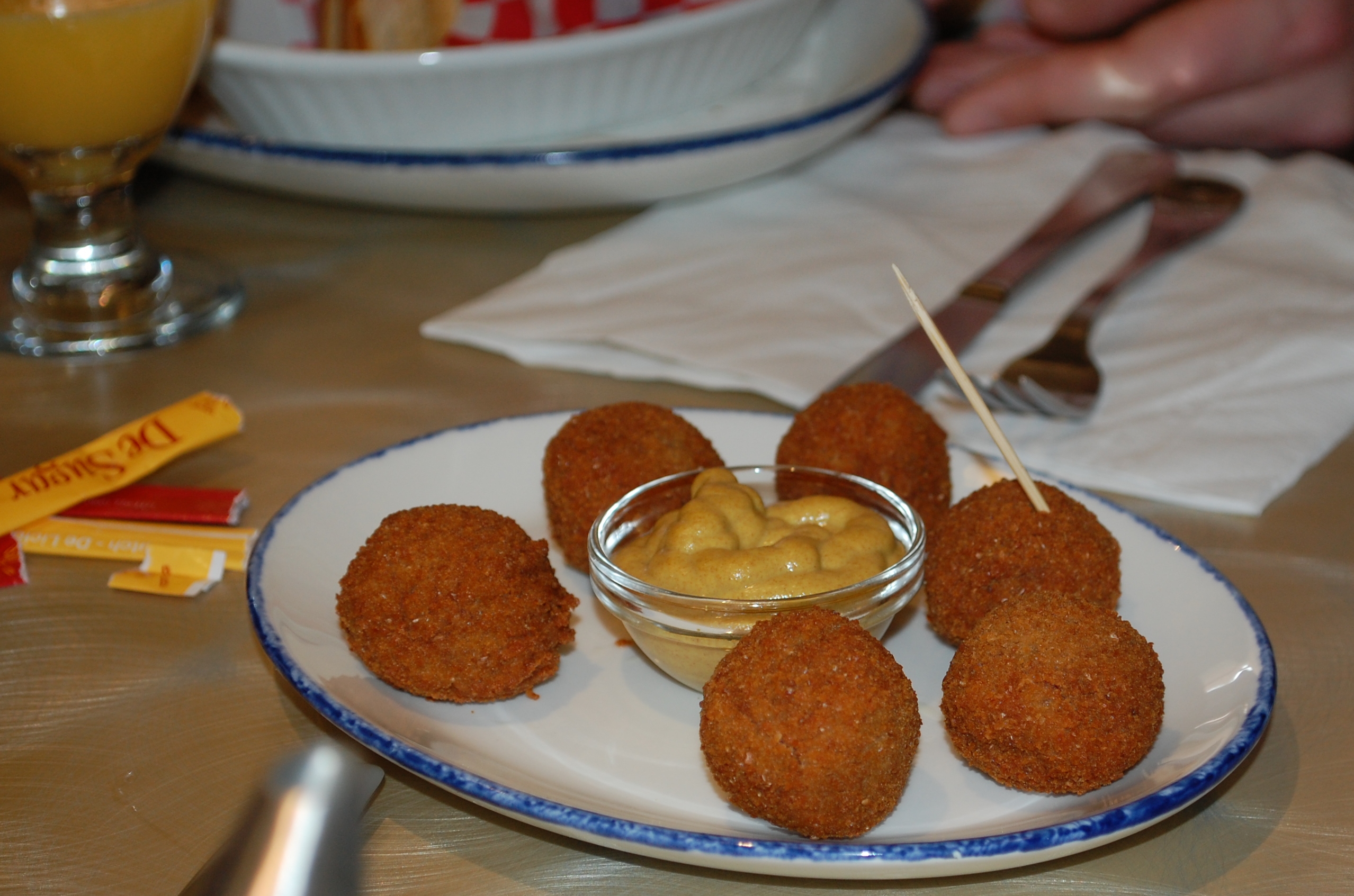
Pannenkoeken are frying-pan-sized thin pancakes with interesting toppings or batter additions – a bit like crêpes but not rolled or folded up.  I had the “Windmill”, with Edam cheese, smoked salmon, and a little dish of Hollandaise sauce to pour over it.  It was delicious, and fresh so that the pannenkoek wasn’t soggy at all, although it was a little thicker than a Breton crêpe.  And after I looked at it, I realised that the name “Windmill” was probably from the shape of the toppings.  Duh.  Some of my friends had versions with meat, with ham and eggs, or with sweet fruit toppings.  Others had tosties, which looked like interesting grilled sandwiches. One of my lunch companions said it was the best sandwich he has ever had, but to be fair I should mention that he isn’t quite four.  We also shared an order of bitterballen (singular, bitterbal) which my friend told us are a common bar snack in the Netherlands, little crunchy-breaded deepfried bites with meat-paste inside them, eaten with mustard.  They were okay as an accompaniment to lunch, but they would be great along with beer.  My bill was a little over $20 including fresh coffee with refills.

Bitterbollen (fried savoury meat-paste balls) at De Dutch

Bitterballen (fried savoury meat-paste balls) at De Dutch

Windmill pannenkoek at De Dutch

Windmill pannenkoek at De Dutch

De Dutch is at 10030 Jasper Avenue.  That’s in the block with construction, but it’s easy to get to on foot from either end of the block, or from the Central LRT station.  It’s open every day, weekdays from 7 am.

I

I hope you’re all having a great start to the new year!  I’m enjoying some fireworks set off by my neighbours, and socialising with good friends and festive refreshments.  Watch this space soon for reviews of the following.

  • Les Mis – the movie
  • Simply Supper
  • Christmas dinner – no, seriously.

Worth Doing Badly

In early 2006 I worked through the exercises in Julia Cameron’s The Artist’s Way. The exercises are designed to free people up from various things blocking them from being creative. I haven’t re-read the book since, but I recently got thinking about how many concepts from that book I am habitually or occasionally putting into my life, and about what creative explorations have illustrated those concepts in the intervening years.

  • Morning pages One of the customs advocated in the book is to start each day writing three longhand pages of stream-of-consciousness. This isn’t just a practice for writers, but something that helps anyone. I occasionally do this or something similar. It’s surprisingly hard to start the day just with handwriting before turning on the computer, but when I do it, I feel less stuck and it’s easier to then focus on tasks at hand afterwards.
  • Artist’s dates Another concept in the book (and in the author’s later works) is to periodically do things alone just for fun and art, whether it’s playing with modelling clay or going to a gallery or movie. I actually do that kind of stuff alone all the time – visiting the Muttart Conservatory is one of my favourites – and it’s funny to think about when I was doing the exercises and making that a special effort.
  • Permission to do multiple projects I didn’t realise how much better this was for me until I started quilting in 2007. If I wasn’t in the precision-focused mood for squaring up blocks and unpicking seams that weren’t right, which one project needed, I could still be productive on quilting another project or picking out fabric for a new one. Getting rid of that echo of my mother’s voice about finishing one thing before starting another or I would never finish anything turned out to be astonishingly helpful. I realised that the same thing worked in my teaching work, in my camp planning work, and in tidying the house, and when I wrote a story with multiple viewpoints for NaNoWriMo, I often jumped to the next character’s narration when stuck on one, and then went back to fill in later.
  • Clearing up to clear space for creativity At the same time, Julia Cameron also suggested various exercises about clearing out projects or possessions that we weren’t enjoying. One exercise was to go through dresser drawers and make decisions. Another was to pull out hibernated projects and either finish them or find a way to dispose of or repurpose them. I was surprised to find how empowering this was – I didn’t get rid of very many projects, but the ones I did made it seem easier and more enjoyable to finish others. Using this principle, when I got seriously into knitting after moving here, I dug out all the old partly-done knitting projects and all the yarn, got rid of a few things and found ways to finish almost everything. Ravelry helps motivate me with project tracking, and once or twice a year I make a point of finishing up hibernating projects, and feeling a huge accomplishment. Tidying up physical spaces has a similar effect, in giving me freedom to think about other space-needy projects. I had cleaners in a couple of weeks ago, so my living-space floors have been empty and vacuumed. And I’m pretty sure that’s one of the factors that freed me up to explore the large-scale patchwork artwork project that is currently consuming me.
  • Taking risks pays off   Another factor that set me up to start this project was doing an improv-theatre workshop with Rapid Fire Theatre. It felt very risky to start with, but I could feel myself thriving in it and taking lessons home from it every week. A job application and interview I did partway through the course didn’t feel nearly as scary as they might have, and not getting the job didn’t devastate me. And the initial concept of the current art project popped into my head a few hours before our end-of-course performance, when I was feeling a little anxious and mostly excited about having become that kind of adventurous.
  • Learning techniques helps too  In improv, in quilt design, in learning to work with colours, and so on, learning the tricks and skills of the discipline gives me the background to be both more confident and more successful. Which brings me to one of my key philosophies nowadays,
  • Anything worth doing is worth doing badly I was a cautious controlled child, afraid to fail and hesitant to stand out. I mostly did the activities that my parents were interested in and thought we were good at – they strongly supported my Conservatory piano lessons as long as I was willing to continue, but were neutral to discouraging about goofing-around composing and about any of the practices that would have led me to be a social piano player, like playing by ear or sight-reading. I remember expressing some wistful envy about my cousins’ experiences at art camp and being told “[OurSurnames] aren’t good at art”, which meant that of course they’d keep paying for the clarinet rental instead of letting me try the oil-painting elective at school when everyone else got to pick a new elective. As a teenager I wrote some fiction privately, and daydreamed about being a Gordon-Korman-style prodigy, but never considered any steps along that way like taking writing classes in university or finding a critique group – by the time I was in Grade 13 I’d so strongly internalised the idea that I couldn’t afford to pursue that kind of impractical dream that the only way I could daydream about it was to put in the story that I was somehow instantly good enough to be published. Instead, of course, I went off to engineering school, put the 10 000 words of story-in-progress in a box, and did not consider myself a writer again for more than twenty years.

I’ve come to realise in recent years that although maybe some kids had more chances to explore things they weren’t naturally good at, adults typically don’t. Adults know what they’re likely to be good at, and they keep doing it or they try out related things. My friend Shaav commented recently that there was no place for adults to learn about science unless they were scientists. I pointed out that it was exactly the same about art. We like the idea of letting kids try everything, but we aren’t quite as eager to try everything ourselves, and if we do, we look for clues to see if we’re good enough to continue. And the more I embrace opportunities to try new things and to pursue things I’m interested in whether or not I am any good at them, the happier I am and the more creative I am. Anything worth doing is worth doing badly.

Jack Layton memorial

Yesterday I went to a candlelight memorial thing for Jack Layton, on the steps of the Legislature.

Edmonton note for readers from elsewhere: it seems that pretty much anything important with lots of people happens on the steps of the legislature. They are big sandstone steps. The City Hall doesn’t have nearly as big a gathering place, and it’s filled up with wading-fountain and there isn’t a high spot to speak from. I’ve been to the steps of the Leg for speeches during a charity walk, and on Canada Day, and I’ve been invited to lots more rallies and things and not gone. Oddly, I’ve never actually been inside the legislature. Also, when I first moved here, I thought “The Ledge” was some geographic formation on the hillside of the river valley, not the riverside buildings and parkland of the seat of provincial government. Fortunately I figured it out without betraying my ignorance.

I went with a couple of knitting friends, and I wore my orange sweater. There were lots of people there – the paper said thousands. The formal part had several important local NDP people, including a well-loved former provincial party leader and a U of A student. There was a really good social-justice choir, but we didn’t sing O Canada. I thought it was almost perfect – not too long, mostly inclusive, funny bits and celebration and lots of repetition of the Jack Layton quotes and common sayings (I’d forgotten how much the roll-up-our-sleeves was iconic). Our MP Linda Duncan was obviously very sad and close to choking up, but she managed that well enough not to make people uncomfortable either way. Afterwards, people left their candles and other shrine-gifts and wrote chalk messages on the steps, but I didn’t stay.

The one thing I’d have done differently if I were a speechwriter with time to think about it would be to make sure there was more explicit inclusion of people who might not see themselves as NDP but who wanted to honour Jack’s contributions and be part of carrying on a progressive agenda – I wondered, sometimes, what some of the looking-forward hints in the speeches would sound like to someone whose loyalties were Liberal or Green or old-school red Tory (although they might have voted for Linda or Lewis or Ray federally and Rachel provincially), whether they’d sound too partisan or excluding.

It occurred to me later that the candlelight memorial rally thing last night in memory of Jack Layton was entirely secular, unless the Sanskrit poem was more religious than Aditya Rao’s translation sounded. How much my subcultures of choice and our Canadian society have changed during my lifetime – it didn’t feel like anything was missing without any mention of afterlife or prayer, and I didn’t even notice that until sometime today. For me, I feel a lot more strongly about religion being private and consensual than about grief being private, so almost any mention thereof would have felt inappropriate in that context, and I’m really glad that none of the speakers stuck it in. And I know nothing about Mr. Layton’s own religious background or current preferences, any more than I know whether he was legally married as opposed to common-law married, because that has never mattered to me and it hasn’t been obvious in anything I’ve read. (NOTE, this does not mean that you should tell me anything about their marital status; I like not knowing.)  I imagine it would not be that way in the USA.

I don’t really like riding my bike at night in a crowd on the High Level bridge. (I prefer it to the descent and ascent needed to cross at the other bridges.) But there was something really neat about being part of that crowd coming and going, the exuberant kids and quieter adults, the flecks of orange ahead and behind, and then just riding home on Sask Drive which has almost no traffic due to the construction, looking across at the river and downtown, appreciating the warm night, and thinking what a great place this is to live.