Category Archives: Uncategorized

It’s A Wonderful Life, and Krampus: A New Musical

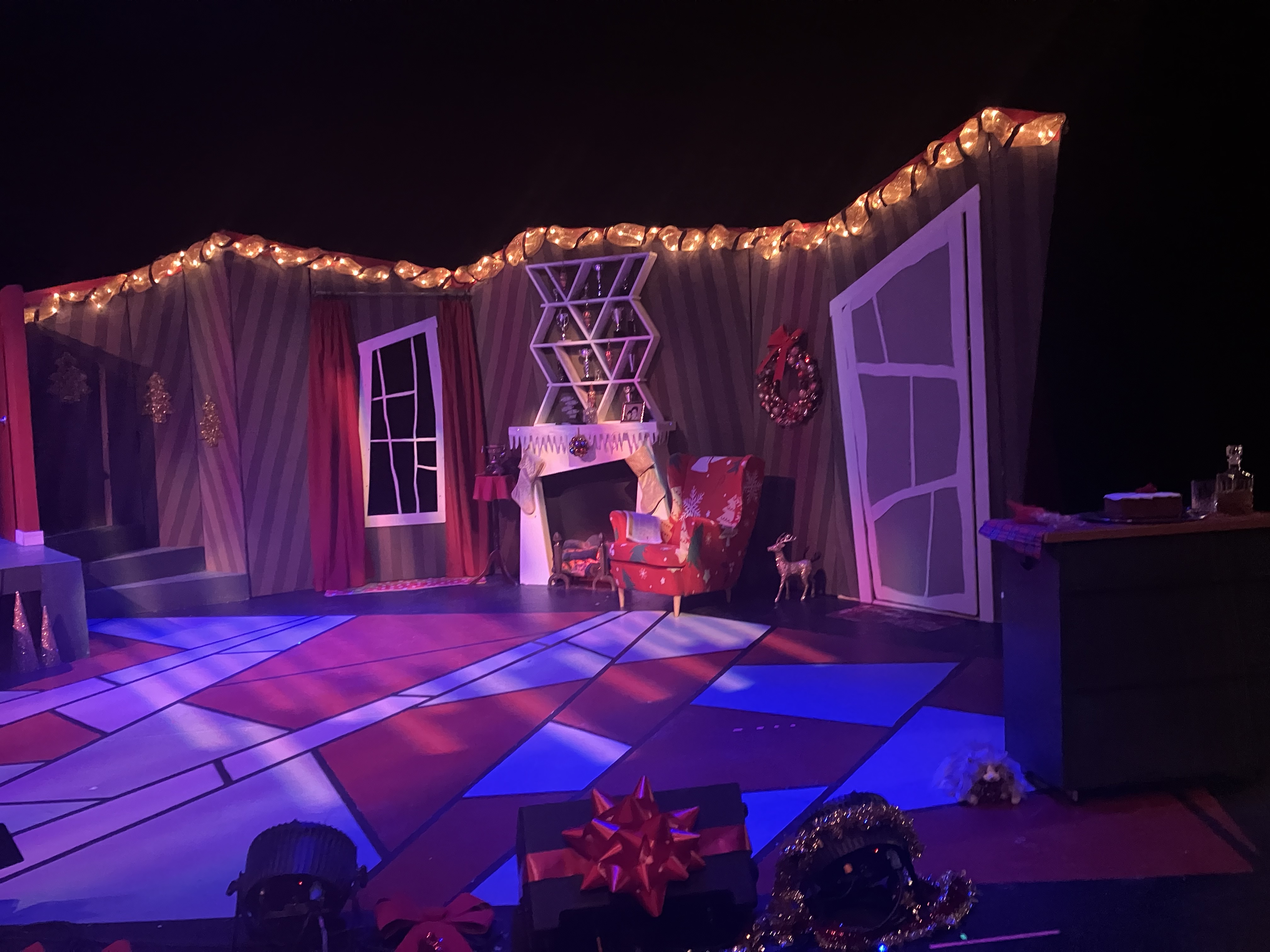
Krampus: A New Musical. Workshop West Playwrights’ Theatre / Straight Edge Theatre. Set and lights, C.M. Zuby.

One thing that It’s a Wonderful Life: A Live Radio Play and Krampus: A New Musical have in common is that I didn’t get around to posting about them until it was too late to buy tickets. It’s a Wonderful Life closed at Walterdale Theatre last week. Krampus has two more shows today at Gateway Theatre, but they are sold out for both.

It’s a Wonderful Life: A Live Radio Play, by Joe Landry, directed by Tracy Wyman, is an adaptation of the 1946 movie, with Jimmy Stewart and Donna Reed. I had never actually seen the movie, but I was familiar with the general story – a despondent man (Josh Young) considers killing himself on Christmas Eve, but is shown by an angel (Liam McKinnon) some of the ways he’s helped others, and he changes his mind. This production employs the device of the performers being actors and crew at a 1940s radio station, conducting a live broadcast. There was a lot more to look at than I had anticipated from a “radio play”, from the actions and byplay of the Foley artists (Dustin Berube and Casey Powlik) and stage manager (Rachel Whipple), to the simple but well-dressed set (Anthony Hunchak), warm cosy lighting (Pat Sirant), and 1940s costuming (Debo Gunning). I particularly appreciated the way Rob Beeston and the other actors switched among voices for the many radio characters they were playing.

It’s A Wonderful Life is known as a traditionally-sentimental and heart-warming Christmas story. But encountered fresh, I was struck by the bluntness and brutality of a story about contemplating suicide. I didn’t see any tragic flaw in George, just the consequences of trying to act with integrity in the banking sector. Making it just about the happy ending, as 80 years of collective memory seems to have done, is like forgetting that there are Nazis in The Sound of Music. Hm.

On the other hand, I did not expect Krampus to be heartwarming at all, but I ended up finding it delightfully satisfying. Steven Allred and Seth Gilfillan, the creative duo behind several Straight Edge Theatre new Fringe musicals such as Cult Cycle, wrote this musical with orchestration by Michael Clark. A version of it was successful at last year’s Fringe but I didn’t manage to see it. So I was delighted to see Workshop West Playwrights’ Theatre programming it as part of their season, of course in the December slot.

Krampus is set on Christmas Eve, in the home of a family getting ready for Christmas visitors. Ronette (Amanda Neufeld) is supervising her docile husband Douglas (Jacob Holloway) and not-docile small children Billy and Tilly (Damon Pitcher and Victoria Suen). We learn quickly that Ronette’s priority is to look good to visiting relatives, particularly her sister Courgette (like the zucchini?) The children’s old caregiver Nanny Verla (Nicole English) sweeps in with carpetbag like a gothic Mary Poppins, deploying cryptic warnings like “Magic might be BLACK!” and “Not your real parents!”

In case you aren’t aware, Krampus is a terrifying figure from European folkloric traditions with a long tongue and hairy goat-like body who appears in December, maybe with St.Nicholas, to punish naughty children. So when such a beast appears outside the windows of the family home, with thunder and a flash of light, things get dark fast.

I’m told that the script is slightly longer than the Fringe version, with two more songs and an intermission. But as in all the Straight Edge Theatre work, the sass and irreverence and pointed fun are fast-paced. And all the plot breadcrumbs are picked up. The melodies are earworm-material catchy, the musical arrangements for piano, French horn, and cello are great, and the sound mixing is good enough that none of the funny lyrics are drowned out.

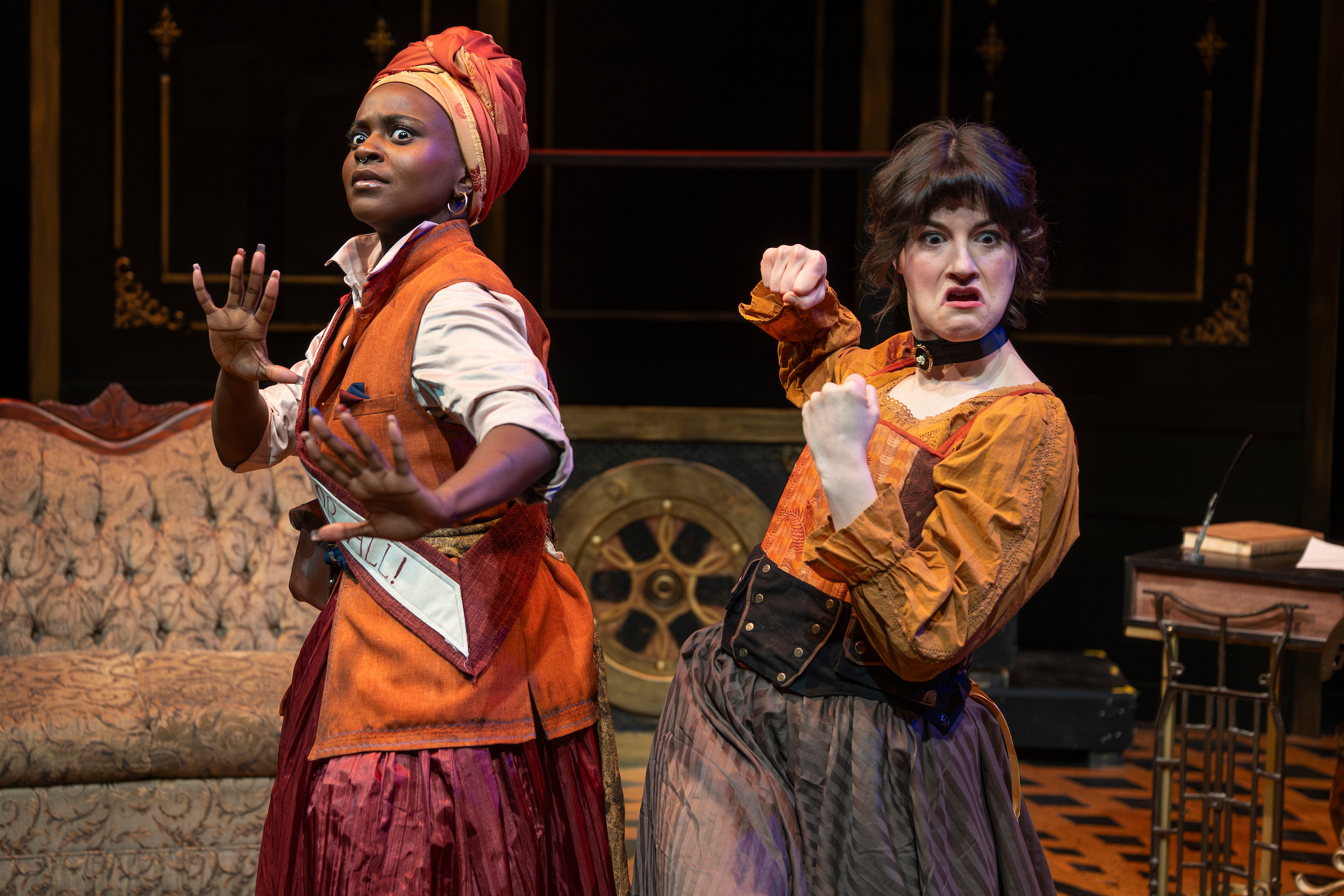
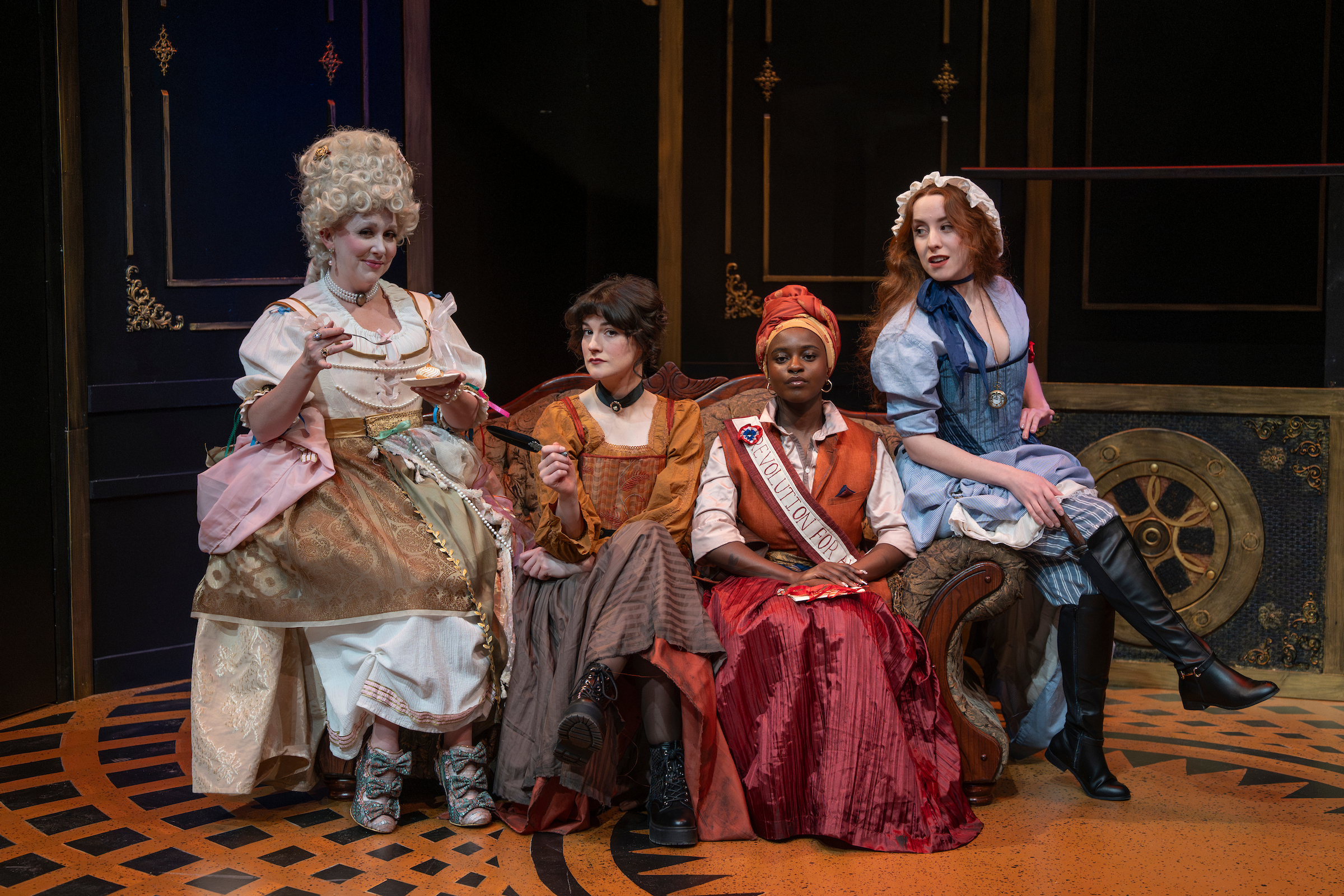
The set (C.M. Zuby) and the costumes (Trevor Schmidt) are delightful, reminiscent of Dr. Seuss and of the Wicked Witch of the West (1939 movie) and every excess of modern Christmas.

It’s fair to call Krampus: a New Musical horror. But at the same time, I found something not only joyful about the story but, yes, satisfying to the point of heartwarming about the ending.

New productions – reviews of re-viewings?

Team and coach travelling by train, in MacEwan University’s production of Tracey Power’s Glory. Photo by BB Collective.

I’ve been watching entertainment on local stages for more than ten years, so it’s not surprising that sometimes I see new productions of works I’ve already seen. Recently, I’ve seen two performances in this category, but otherwise very different: Glory, by Tracy Power, and Die Fledermaus, by Johann Strauss.

In 2018 I travelled to Calgary to see the world premiere of Tracy Power’s Glory, produced by Alberta Theatre Projects and directed by James MacDonald. I was excited to see that the students of MacEwan University’s Musical Theatre program would be tackling this play, as a story about young people pushing the boundaries of appropriate activities in the turbulent times of 1930s Canada seemed like a great fit. Amber Borotsik was a great choice as director for the movement-forward work. Her choreographic choices for learning to skate, for practising hockey strategies, and for the various important games in the narrative were less stylized and more story-coherent than in the original production, but equally fun to watch.

Izzy Deutscher was great as team captain Hilda Ranscombe, confident in sports but struggling in other parts of life. The other team members portrayed, Nellie Ranscombe (Jaysel Ann Arroyo), Marm Schmuck (Harmony B), and Helen Schmuck (Jenn Houle), were quickly distinguished as individuals, each with her own problems and quirks. The script clearly sets the action in 1930s small-town Canada, with radio news voice-overs, women’s magazine columns, and the teammates’ conversations about work in the shoe factory, missing a chance at university because father and brothers are still out of work, and being denied admission to law school because of being Jewish. Devin Estey plays rink manager and reluctant team coach Herb Fach, managing to conveying a grumpy-old-man vibe despite appearing about the same age as the players. Kevin Thomas, visible in porkpie hat and suit on the theatre’s catwalk, provided colour commentary as radio announcer for the various games.

I was particularly moved by the design feature (Scott Spidell) of having championship banners roll down after the team’s first national title win, then ending the show with the banners scrolling through the many subsequent achievements of the Preston Rivulettes, then the logos of the modern-era national championship, the first women’s world championship in Ottawa in 1990 (I still have a volunteer sweatshirt with that logo), the subsequent world and Olympic titles of Canadian teams, ending with the new logos of the six teams in the Professional Women’s Hockey League, now in their first full season. As a second-wave women’s hockey pioneer and the daughter of another one, I loved the way this tied the history together with my own experience and with current and future women’s hockey players. I was also impressed by the information and fundraising about indigenous hockey opportunities in Alberta.

Die Fledermaus was last produced at Edmonton Opera in 2014. In a conventional staging, it was humorous and enjoyable, with Julian Arnold playing the doctor who is teased about his bat costume. The 2024 production, directed by Joel Ivany, added a layer of meta-, and even more opportunities for accessible silliness, by framing it as a community theatre company rehearsing, performing, and recovering from a performance. So Act 1 is actually the company arriving at rehearsal and rehearsing Act 1, with original dialogue in English for the many interruptions and amusing interactions. I think my favourite bit of Act 1 was watching the Stage Manager (Farren Timoteo) scurrying around to deliver props to the performers just in time and almost invisibly, and crawling around the stage with strips of spike tape laid out on his sweater, so he could mark each performer’s location for delivering songs. In Act 2, at Count Orlovsky’s party, the core cast of 9 is joined by a large chorus of partygoers in masks and various shades of festive black, along with a DJ, a drag queen, and others. Most memorable was the ode to Champagne. Act 3 is called the “After-After-Party”, with the cast members waking up or staggering in, and reminiscing about the performance but actually singing all the songs of the script’s Act 3. This part was kind of confusing but I was still laughing. Soprano Jonelle Sills (Rosalinde) had a particularly impressive voice, and also memorable wigs.

Fringe Day Nine: assorted stories – but not storytelling shows.

Heading into the last weekend of Fringe, on Friday I watched three fun shows.

Verbal Tapas is a collection of poems by longtime Fringe poet and storyteller Rob Gee. Instead of scripting a fixed order, the performer handed out “menus” on the way in, with various poem titles and descriptions that sounded like restaurant-food teasers. He invited people to shout out titles, after which he might tell an anecdote of context (the time he recited a poem to two police officers in the middle of the night who had stopped him from illicit postering, the creative-writing groups he’d run as part of his work in mental-health nursing, etc) and launch into a recitation. He kept having good lines which I’d try to remember and then they went out of my head with laughing. Acacia Hall is a good venue for this kind of solo with audience connections.

Canterbury Tales has been adapted from Chaucer’s much longer Middle English original by local theatre artist Donna Call. This version has six travellers acting out each other’s stories to entertain the company, and the role-shifting is amusing. Lee-Ann Semenya plays the innkeeper who sells them drinks, proposes the storytelling competition, keeps things moving, and then covers them up with blankets for the night. I don’t know the original very well – the character names were familiar (the confident and ambitious Wife of Bath played by Amanda Stout, the Miller played as a lout by Ryan Mattila), but I didn’t remember the content of any of the stories. Other performers were Martin Stout, Zack Siezmagraff Penner, Anne-Marie Smyth, and Karen Huntley.

Field Zoology 301: Myths and Monsters is part of a series, in a campground-lecture style. Performer Shawn O’Hara, as Doctor Bradley Q. Gooseberry, welcomes his students around a campfire to teach us about cryptozoology, or the study of legendary/folkloric animals. He makes imaginative use of sketches on an overhead projector to illustrate his tales, including most of the cryptids I’d heard of and a few that were unfamiliar to me, along with some very funny narrative of personal encounters. Afterwards, the performer removes Dr. Gooseberry’s extravagant mustache from his own, to thank his contributors, including people who helped him to navigate telling stories respectfully from Indigenous sources. I would definitely see other shows in this series. This was my first glimpse of Mile Zero Dance as a Fringe venue, and an opportunity to spend time in the Happy Beer Street area of West Ritchie, which was exciting. However, I found the seats uncomfortable, and the full room too hot in last night’s warm humid weather.

Four-Show Fringe Monday

James and Jamesy in Easy as Pie: Performers Aaron Malkin and Alastair Knowles have entertained Fringe artists for several years. In the opening of this year’s show Easy as Pie, the two are preparing to fulfill a longtime dream of performing as clowns, putting on costumes and reviewing the order of bits in their turn. Unlike much classic physical comedy, the characters James and Jamesy do talk to each other, but they also make great use of amusing actions and creative props and effects. The performances are in the Westbury Theatre, and the scale is large enough to work in the large full auditorium.

Local Diva: The Danielle Smith Diaries is also in the Westbury, on a large bare stage with one chair used as a prop. The script, by Liam Salmon, had a previous production five years ago, but some topical/timely material has been added to acknowledge the ways in which life has gotten more worrying since then. Performer Zachary Parsons-Lozinski strides in and self-introduces as drag queen / “drag thing” Tragidean, here to recount the events leading up to their current court case. Parsons-Lozinski owns the stage, pacing, pirouetting, posing, telling stories of growing up gay in small town Alberta, then finding community in gay bars and fulfillment in drag performance, while periodically erupting in rants about current events and homophobic and destructive actions.

I’ve seen and read previous solos with an angry narrator building up the story of provocation to some consequences. I think one about an angry man was by Daniel MacIvor, but Donna Orbits the Moon by Ian August, that Northern Light did last season, was about an angry/grieving middle-aged woman who had done some apparently-illogical things, and I’m pretty sure I’ve seen others. In this story, Tragidean’s provocations are both personal and systemic. The personal stories – high school ridicule, thoughtless micro-aggressions of young adults – were smaller and quieter, with the all-out chair-throwing rage reserved for ways in which they see their world being destroyed (timely examples including genocide in Palestine, wildfires in Jasper, and various recent provincial-government attitudes and policies). The character’s eventual eruption over a personal offence appears hugely disproportionate without knowing what else they have to be angry about. And I’m still not sure what I think about that.

Ink Addicted is a solo storytelling performance by Chris Trovador of Orlando, a tattoo artist turned comedian/actor. It was genuine and entertaining. The scenes on stage are interspersed with recorded video of him playing his parents and other characters, and interviewing other tattoo artists and clients. He starts by asking the audience which of us have tattoos and to the others, why not – and then people responded eagerly to the participation bits in his story. He incorporates rap, poetry, music, and a gradual reveal of some of his own tattoos. The unfamiliar specifics of his story (his Puerto Rican mother going from hating tattoos to getting permanent makeup and becoming his chief marketer, disrespectful customer demands) were told in a way that made them easy to relate to. Walterdale Theatre.

I also caught a couple of nights of Die-Nasty. The improv-soap-opera troupe, enhanced by several familiar performers for the Fringe edition, plays every night at 10 pm at the Varscona Theatre, in a story set at the Fringe and populated with Fringe-related characters. Each performance starts with a monologue by that night’s director (Jake Tkaczyk or Peter Brown) which is often laugh-out-loud funny on its own, and musical accompaniment is provided by the amazing Paul Morgan Donald. As in previous years, Kristi Hansen portrays reviewer Liz Nicholls, but this year she has an estranged sister, Whiz Nicholls (Lindsay Walker). Other characters include politicians campaigning for Mayor of the Fringe, the staff of the massage tent, classically trained actors with ‘Downton Abbey accents’, a lounge singer (Jacob Banigan), an improviser from Toronto, a sheriff (Tom Edwards), Kids-Fringe leader Alyson Dicey (Kirsten Throndson), Rachel Notley (Shannon Blanchet), Murray Utas (Randy Brososki), and several others. Guests I’ve seen included Isaac Kessler (directing WINNING:Winning this year and with a memorable Fringe-comedy resume) and Patty Stiles (former Rapid Fire artistic director). The pace is quick and the energy is high, and it doesn’t matter if you don’t know what happened to date. The 60-minute show goes quickly and there’s usually a large and responsive crowd. Oh, and the merch: for $10 they are selling soap. Really nice soap.

Charcoal sketch of a person's back torso. They have shadows showing overlapping flesh at their shoulder and waist level.

Hot ticket Tuesday: five strong shows

On Tuesday i carry your heart with me was dark (that’s Michelle Martin’s intimate and musical story of family and resilience). It’s back on tomorrow at Sugar Swing Ballroom Upstairs at 7:45 pm.

So I had the chance to fit in five shows that have been getting good buzz, and I was not disappointed in any of them.

Tiger Lady. This play by Dead Rabbits Theatre out of the UK drew the audience in immediately to its setting of a travelling circus in the 1930s in the USA, with ensemble members in trenchcoats with musical instruments engaging with the entering audience members. Their accents were appropriate to the characters and era – occasionally a little hard for me to understand but adding to the atmosphere. I was reminded of the Edmonton instance of the musical Hadestown, with its workers’ chorus and storytelling musicians, and I was reminded several times of kristine nutting’s Devour Content Here: Of Love and Wheat. A young woman escapes her Presbyterian aunties to follow the circus, discovering a vocation as tiger tamer and a human love with another circus worker. The characters are a bit archetypical, but not stereotypical – the dancer has agency and supports Mabel, the animal handler Louis confides “I’d want to marry you, if I swung that way”. Some beautiful and impressive acrobatics, puppetry, and excellent use of the large Westbury stage and lighting instruments. Stage 1, Westbury Theatre.

Breaking Bard. Another talented ensemble, this one seven young improvisers from Vancouver creating a Shakespearean tragedy complete with iambic pentameter which sometimes even rhymed, from a couple of audience suggestions (“arrogant” and “mountains”). Right from the land acknowledgement’s nod to improvised Shakespeare being the most colonial of choices, to the spoken prologue delivered in rhyming couplets by alternating pairs of performers, I was delighted. As another playgoer and I discussed afterwards, they touched on all kinds of Shakespearean tropes and plot devices that we hadn’t even realized were classic. The main characters (the arrogant Lord Peckington and his betrothed Olivia) each had a best friend/supporter, who also end up pairing up. There were shepherds who gave us some backstory about life around the mountain lord’s domain, mountain elves playing tricks like the fairies in Midsummer Night’s Dream, and Mountain Men miners trying to protect their territory and livelihood. Partway through I remembered that they had promised us a tragedy and wondered if they would follow through, but oh they sure did. Clever and entertaining. Stage 4, Walterdale Theatre.

muse: an experiment in storytelling and life drawing. Someone I met in another lineup told me that for her it was a calming experience in a rushed day. Two other people told me I would like it, though one of them is a trained visual artist. I am not. But I showed up where the assistants were handing out charcoal and sketching pads, and the performer Cameryn Moore told us to leave the chairs where they were so everyone could have elbow room. Then she disrobed (literally – she had a great satin robe!) and performed a series of poses as she would do when modelling for a life-drawing class. Once she was holding longer poses, she told some of her story of how she got into modelling for art classes and how it affected her, and the Fringe audience asked questions as we drew. Apparently artists and life-drawing classes are excited about drawing diverse bodies such as Cameryn’s plus-sized middle-aged one. At the end, there was an optional “gallery” with our work on the floor to show each other and our muse. This was a surprisingly profound experience for me. I do not know which was more empowering, the reminder that it is okay for me to draw, or the reminder that it is okay for me to enjoy my own body the way it is. I loved that the other audience members were un-self-conscious enough, or at least quiet enough, that I didn’t hear other people’s self-deprecation or embarrassment about being bad at drawing. (Like in exercise classes – some of them have a culture of commenting on one’s own inadequacy, and some really don’t, and the latter is refreshing.) Stage 5, Acacia Hall.

Charcoal sketch of a person's back torso. They have shadows showing overlapping flesh at their shoulder and waist level.
Drawing of Cameryn Moore, muse, by Louise Mallory, posted by permission of both.

Old God. Alex Jones-Trujillo prances onto the stage in an ornate jesterish outfit and pantomime whiteface, poking gentle fun at audience members and giving a character backstory so vague that it sets them up to do anything. Which the character then pretty much does. Some of it is crude, some of it is thought-provoking, some of it is delightful physical theatre, and all of it is funny. The performer steps out of character. Literally – they had explained earlier that the decorative floor lighting bounds the “stage” for “theatre”, so when he steps out of it and takes off his headcovering, he becomes Alex the performer speaking to the audience rather than Old God the character. Both of them are great – creators of discomfort in the best bouffon traditions, but including the audience in the laughter and agreement. Stage 20, The Sewing Machine Factory. (This is a Fringe Shuttle stop, if you’re en route to or from La Cite. )

Sweet Jesus (the gospel according to felt). I did not know before this that filmmaker, director, and actor Randy Brososky was also a puppeteer – but he’s a good one! His Jesus was in the Muppet tradition, with one hand manipulating his head/mouth and the other embodying one of his arms. It was easy to watch the puppet instead of the puppeteer, and interact with him – because there are a lot of conversations with audience members. He even shook my hand! I was completely engaged with this narrative and I didn’t disagree with any of the things he said. His version of Jesus was in the tradition of angrily overturning the ripoff merchants’ tables – he swore a lot, but it seemed to me he was swearing about the right things. The present-day parables were great, including the subtle detail that all the characters in them had non-Anglo names or (for the ones represented by Barbie dolls) were non-white. Stage 29. Lorne Cardinal Theatre at The Roxy.

After the accident: Sea Wall and Flicker

Yesterday’s plays both explored the aftermath of awful accidents, in very different styles.

Sea Wall is a solo play written by Simon Stephens and directed by Belinda Cornish. Jamie Cavanagh’s character slowly enters his kitchen, turns off the room’s air conditioning, puts on the kettle, and begins telling the audience about the events of his life that left a hole through his stomach, as he puts it. There were no lighting shifts or sound effects that I noticed, no props except for the tea makings. And we were silent and on the edge of our seats for the whole 45 minutes. In a few lines each, the character describes three significant family members and his relationships with all of them. The shift to telling about a particular event is subtle. And none of it – his joy, his pain, his questions about God and the universe – is any louder or more external than it needs to be. Brilliant. Venue 34, Roots on Whyte building, elevator access.

Flicker, a new script by Shawn Marshall, shows what happens to a young hockey prospect (Ike Williams) after a car accident. The story is not linear, the ensemble players (Riley Smith, Michaela Demeo, Carys Jones, Angie Bustos) all seem to be playing James’ memories and parts of his psyche, and it uses the symbol of a buzzing flickering lightbulb to jump from memory to memory. One of them reminded me disturbingly of Cylon Six in Battlestar Galactica, the Tricia Helfer character. The direction makes good use of the whole wide stage at Sugar Swing Ballroom Upstairs. My favourite bit was the father-son fishing trip with an awkward sex-talk agenda. Venue 27, Sugar Swing Ballroom Upstairs. Air conditioning, bar, no elevator but advance access for anyone needing extra time on the stairs.

Calendar full of performance, again

Before the pandemic started, I would often have so many theatre events on my wishlist that I’d have to iterate with my calendar to fit in everything I wanted to see. Like keeping the Fringe energy year-round.

Three years into a more careful and frugal era, I’m looking at a calendar again and thinking about everything I want to see in the next three weeks. I’d love to fit in everything — but this time, I probably won’t. Still, though, it’s worth sharing the exciting list with you, because maybe you’ll want to see the same things. Or different things. Or at least read about plays that you won’t be able to see.

A Hundred Words for Snow – this afternoon I’m going to the matinee of this Northern Light Theatre production. Trevor Schmidt directed and designed this solo to be performed by Dana Lea Hoffman (recently the principal performer in Shadow Theatre’s production of Karen Hines’ All the Little Animals I Have Eaten.) It was written by Tatty Hennessy of the UK. As usual for a Northern Light show, the teaser glimpses of design elements and character on line are intriguing. Tickets here. Masks are required at all performances.

10 Funerals – Shadow Theatre had programmed this new Darrin Hagen play before the pandemic started, and it’s finally going to meet audiences later this week. It’s the story of a gay couple who meet in the 1980s, told through the funerals they attend together through the years, so it documents the milestones in a relationship and in gay culture. I get the impression it’s going to be funny and poignant. Opens Thursday April 27th. Tickets here. Shadow Theatre has adopted Safe Sundays – the matinee performances are limited to 60% house capacity, masks are required, and vaccination is recommended.

The Penelopiad – Walterdale Theatre is tackling this Margaret Atwood play, adaptation of her novel, feminist adaptation of Homer’s Odyssey from the point of view of Penelope, the wife who stays home. An ensemble of 14 performers portrays Penelope and a chorus of her maids, but also portrays all the other characters in her story – her family and household, her suitors, her son, her husband … In this production directed by Kristen M. Finlay, there is original music, and a set design by Joan Hawkins. Opens Wednesday May 3rd. Tickets here. The second Thursday of the run, May 11th, is reduced-capacity night – with about 65% of the seats for sale, this should allow elbow room comfort and improved air quality for audience members.

A Grand Night for SingingFoote in the Door‘s season wraps up with a short run of this Rodgers and Hammerstein 2014 musical revue. Opens Thursday May 11th at Théâtre at La Cité Francophone. Tickets here.

Die-Nasty – this very-long-form improvised soap-opera is continuing last year’s custom of breaking their season into three shorter shows. I saw the first night of the current one, Doctors, and was intrigued by the possibilities of stories in a hospital struggling with budget cuts (re-washing surgical sponges?) and incompetence (leaving the sponges in the patients?) and an administrator (Stephanie Wolfe) planning to take the hospital private. The story runs every Monday night until May 29th at Varscona Theatre. Tickets here.

First Métis Man of Odesa, Prison Dancer, Collider Festival – the Citadel Theatre season wraps up witth a focus on new works celebrating various cultures. Collider is a new-works festival with some workshops and discussions and staged readings. Citadel tickets are here. Collider information is here. Each Citadel production this season has one masks-required performance.

25th Annual Putnam County Spelling Bee – Grindstone Theatre’s production of this popular musical is running until at Faculté St-Jean. Tickets here.

Sexual Misconduct of the Middle Classes – Theatre Network opens this Hannah Moskovich play April 25th, with Gianna Vacirca and John Ullyatt. Tickets here.

So, what are you going to watch?

An evening of laughter at Fringe 2022

This evening I took in three Fringe performances, all of which made me laugh a lot.

1-Man No-Show – Isaac Kessler’s performance starts before it starts, with the performer on headset walking through the audience talking to the technicians and to the audience members, and shifts smoothly into recognizing the large roster of other Fringe performers in the audience “And even Mark Meer!” and asking some unanswerable questions about the nature of theatre. “A swamp!” The “high art” promised is illuminated, and many other original and unpredictable bits had me laughing. There was a lot of audience input, and I couldn’t tell how much of the show was improvising responses and how much was something that happens every show. It made me want to go back and find out. One more show on Sunday, at the Yardbird Suite.

Jesus Teaches Us Things, a Dammitammy production, starts with Pastor Greg (Adam Keefe) taking attendance of the audience as if we are attending a children’s Sunday School class, until substitute teacher Jesus (Rebecca Merkley) blasts in to take over. Things happen very quickly from then on, including several unique adaptations of popular songs performed by Merkley (He will, he will, save you! / clap clap stomp to the tune/accompaniment of We Will Rock You, for example), a crafts segment, an ask-me-anything, at least two miracles and an exorcism, some brilliant ad-libs, and a response to Pastor Greg’s appeal for tithes and donations that involves overturning tables and some canon-consistent messaging about giving privately rather than showing off. Two more shows at the Sue Patterson Theatre, Campus St-Jean.

Underbelly is described in the program as a “surrealist physical comedy”. Nayana Fielkov’s odd character starts off taking a shower behind a discreet curtain, emerges to coax the audience into song without speaking comprehensibly, has a short-lived romance with a bathrobe, engages some other effects that were so convincing I was sure a second performer was going to emerge, and uses various other tricks and collaborations to tell a story. So much fun. Walterdale Theatre, last show Sunday 6:30 pm.

My schedule today includes our last performance of White Guy on Stage Talking (2:45 pm, Walterdale Theatre), and fitting in a few more to watch. Happy Fringing, all!

Quick notes on more Fringe 2022

Epidermis Circus – Ingrid Hansen’s inspired physical theatre is kind of like object puppetry that takes advantage of various body parts that fit in front of a webcam/document camera. But more importantly, it is funny, delightful, and a little bit gross, an hour that flew by. Luther Centre.

Fags in Space – Before the curtain time, we see two characters (played by Sheldon Stockdale and Braden Butler) rushing around their living room getting ready to host a party. As the play starts they are responding to a question from an imaginary guest at their housewarming/Christmas party, “how did you two meet anyway?” The couple’s answers, acting out the key parts of the story along with all the bumps in the road (“that’s when he ghosted me”, “and then you were seeing Devin”, “It took me ages to figure out that you were studying astronomy and not astrology, and by then I had looked up our signs”), take up the rest of the play. Liam Salmon’s script has credible dialogue and enough resolution for a lot of happy sighs in the audience and a few tears. Walterdale Theatre.

Donna Carnivora’s Killer Party – This one also has an intriguing pre-set on stage before the show starts, including party hats in the front row and something else around the auditorium. I wondered what I was getting into. (In a good way). The performer uses a lot of flirtatious audience interaction, an occasional dash of French, a bit of music, and a lot of blood, to deliver a high-energy creepy funny performance. Walterdale Theatre.

Die-Nasty – This Fringe classic very-long-form improv runs each night through the Fringe, with some characters returning from previous years (Kristi Hansen’s Liz Nicholls, Mark Meer’s Fisher T Johnson gonzo journalist) and some of them new delights, especially Jesse Gervais’ Robin, the shirtless rollerskating recorder player. (Robin, like a sign of spring). Varscona Theatre.

I’ll Have Another – Rebecca Bissonette is credited as playwright, director, and a cast member in this three-hander about bridesmaids who don’t know each other, until they’re all stuck in a wine-cellar at a wedding and they start comparing notes about the bride. Ridiculous and satisfying. Sewing Machine Factory, 96 Street and Whyte.

The Heterosexuals – Johnnie Walker (Redheaded Stepchild) lives up to the tease of his Late Night Cabaret rant in a show that’s part satirical subversion and part insightful memoir about separating and integrating the “Johnnie” and “other-Johnnie” parts of himself, other-Johnnie being the grunge-loving heterosexual-passing part that got him through high school. Luther Centre.

Blueberries are Assholes – TJ Dawe’s tightly-connected monologue full of entertaining facts and oddities led to a surprisingly-insightful conclusion or challenge to the audience. Holy Trinity Sanctuary space.

Destination: Vegas – Same team as last year’s Destination Wedding (playwright Trevor Schmidt, cast Kristin Johnston, Michelle Todd, and Cheryl Jameson) but different characters – these ones a mismatched team of grocery-store workers who take a trip to Las Vegas together rather than lose vacation days. Various complications and dangers ensue. And although much of the story is told in retrospective narrative, it’s never entirely clear how it ends up. Westbury.

A Life, With Surprises (and Songs) – This musical memoir by Brian Ault might be flying under your radar, but is worth making time for. It was charming, humble and funny (like the performer), and also included several of Brian’s original songs from different genres. There is one more show, Saturday afternoon. Acacia Hall.

I saw Crack in the Mirror again – because it’s subtle as well as funny. And I’ve been to Late Night Cabaret a couple more times too, because I love the sense of community. And it’s almost time to head to the site again and see a few more shows people are recommending – 1-Man No-Show and Jesus Teaches Us Things, to start with.

White Man on Stage Talking has one more performance, Saturday at 2:45 at Walterdale.

Evelyn Strange at Teatro

Oscar Derkx and Gianna Vacirca, in Evelyn Strange. Photo credit Marc J Chalifoux Photography and Video

It doesn’t take me long to say yes when a friend offers me a ticket to opening of a Stewart Lemoine play at Teatro la Quindicina. I didn’t read anything about it ahead of time, though a glance at the program told me that Evelyn Strange was first performed in 1995, and that Shannon Blanchet, this production’s director, had played the title role in a 2006 production at Teatro.

The curtains open on a box at the opera. The Metropolitan Opera in NYC, in 1955. So it’s ornate and private and expensive — and somehow set designer Chantel Fortin and lighting designer Narda McCarroll make it feel like that, with just a few pieces that get slid away to become something else in the next scene.

The occupants of the luxury box are Nina Farrar, whose sophistication and snark are a perfect fit for Belinda Cornish, and her husband’s earnest young employee Perry Spangler (Oscar Derkx), tidy and respectful in Clark-Kent-esque glasses. Perry explains that Nina’s husband Henry gave him the ticket because he was tied up, charging him to keep Nina company and see her safely to her commuter train. And which opera is it that neither of them really wanted to see? Siegfried, a five-hour segment of Wagner’s Ring Cycle. (By the way, Sing Faster: the Stagehands’ Ring Cycle is a fascinating 1-hour documentary video, if you can find it.)

Evelyn Strange is a great example of Stuart Lemoine’s work and why Teatro does it well. The opening situation has unexplained threads, but the details and characters that appear next don’t resolve those questions but create others. The dialogue and action is amusing but never predictable. Jesse Gervais is Perry’s pushy colleague, poking into Perry’s secrets and holding his own. The eponymous confused woman who slips into the opera box after the lights go down, and slips away again before intermission, is Gianna Vacirca.

Things get odder. Some things seem to fall into place but other things are hinted. Settings like a publishing sub-editor’s office, an automat vending-machine restaurant, a hotel suite, Grand Central Station, and a bachelor’s apartment provide glimpses of mid-century modern chic, with a few well-selected details. Vacirca’s character, Miss Strange, claims to have no memory of her past – which would explain her, um, strange behaviour, assuming she’s now telling the truth.

There is a missing husband, a double-booked hotel room, evidence of trenchcoats and opera tickets and a $20 bill – in some plays, the details might never all fall into place and from other playwrights the hints would all be so obvious that we could figure out the outcomes at intermission. But not with Stewart Lemoine. At intermission my friend and I chatted about some of the possible explanations – we were right about some and wrong about others. And when the play ended, a patron behind us read out the list of predictions he’d jotted down at intermission to note how many of them he’d gotten right. It was that kind of play, like an elegant jigsaw puzzle.

And speaking of elegant, the 1950s-era costumes were designed by Leona Brausen. And speaking of jigsaw puzzle, one of the questions I had afterwards was “what did she have under that? and why didn’t it fall off?”

There are so many Stewart Lemoine plays that I haven’t yet seen, that I don’t want to use superlatives like “best”. But this production is most entertaining, with the directing and acting adding to a very clever script.

Evelyn Strange is running at the Varscona Theatre until June 12th. Tickets are available here and at the door. Masks are required when not eating or drinking – the usual list of refreshments including red licorice and Bloom cookies is available from the cheerful artistic associates staffing the lobby booth.