Category Archives: Theatre

A Grand Weekend for Singing!

A Grand Night for Singing ensemble, in evening dress. Photo Nanc Price Photography.

Continuing my festive week of attending performances, tonight I went to opening night of Foote in the Door’s production of the Rogers and Hammerstein musical celebration A Grand Night For Singing. Ten familiar musical-theatre performers, along with an orchestra of seven, presented about 35 songs from the mid-20th-century writing/composing team. The simple staging and costumes allowed the focus to remain on the singing, and the singing was great. From solos like “Love, Look Away”, sung by Brendan Smith, or “It’s Me” sung by Christina O’Dell, to playful group numbers like “Honey Bun” and beautiful group harmonies in “Some Enchanted Evening” and “Everything’s Up to Date in Kansas City”, all the singers used the music to tell stories and evoke emotions.

The songs in Grand Night For Singing, which was first performed on Broadway in 1993, come from about eleven different stage or screen musicals. Oddly, the only one I’ve seen live is Carousel – in the Foote in the Door production and as done by Opera Nuova. There is one song from The Sound of Music (as well as a few familiar riffs in the overture), which I’ve seen on television. Despite this, I recognized a lot of the songs! And even the ones I didn’t recognize were fun to listen to and watch.

The performance felt shorter than the 2-hour estimate in the program, with very smooth shifts between songs and performers (director/choreographer Katie Hayes). The Foote in the Door ensemble is made up of Jason Duiker, Kathryn Kroeker, Melanie Lafleur, Christina O’Dell, Aaron Schaan, Brendan Smith, David Son, and Kelsey Volker, along with company principals Russ Farmer and Ruth Wong-Miller.

A Grand Night for Singing has a short run, May 11-14 with 7:30 evening shows and Saturday/Sunday matinees at 2 pm, at La Cité Francophone.

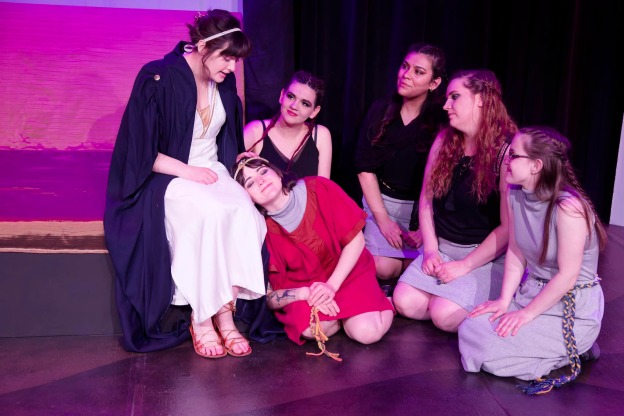
Ensemble in abstract Greek costumes: Penelope sits on the end of a bed, while an actress representing her son rests head on her knee. Four female servants listen.

The Penelopiad, one of Walterdale’s best.

Alora Bowness (Penelope), Stephanie Swensrude (Telemachus), Monica Stewart, Karla Martinez, Sarah Spicer, and Katie Corrigan, in The Penelopiad. Photo Credit: Scott Henderson, Henderson Images

The lights come up on a simple set – a bed on a platform, white hanging panels lit to effect – and a young woman walks toward the audience. Now that I’m dead, I know everything, she says. After this intriguing statement, she goes on to explain that it’s not quite true – like everything else, it’s been simplified in the version we know.

Alora Bowness is Penelope In Walterdale Theatre’s current production of The Penelopiad. She caught my interest from these first lines, and continued throughout the performance, telling and illustrating her story with humility, determination, wry humour, and willingness to acknowledge the consequences of her choices.

But The Penelopiad, adapted by Margaret Atwood from her novella in 2007, doesn’t just examine the story of Penelope, but also of her enslaved maids. The narrative unfolds in short scenes, switching between Penelope telling the story, to ensemble members acting the story, to choral/choric recitation and dance by the maids, or sailors, or even at one point a flock of ducks. The story moves smoothly and with compelling pace, as directed by Kristen M. Finlay, from Penelope’s birth to a naiad mother (Mandy Stewart) and mercurial King Icarius of Sparta (Angela James-Findlay), through her childhood, her marriage to Odysseus (Katy Yachimec-Farries), move to Ithaca, and then what happens to her through the timeframe of Odysseus long journey to Troy and then home, as first told in Homer’s Odyssey.

I had seen the Citadel production of this play in 2013, using 13 talented young artists in that year’s Citadel/Banff Centre Professional Program. The Walterdale production is funnier than I remembered, and in the intimate Walterdale space I felt more engaged with the dangers and challenges of Penelope’s situation. I loved the costumes of the current production (Alodie Larochelle design) – all the maids wearing the same fabrics in grey and black, but in silhouettes that were different for each individual, with braided rope belts in different colours. The songs and poems of Atwood’s script were set to original music, lively or lyrical or haunting as appropriate (Gibson Finlay and Kristen Finlay, composition, Sally Hunt musical director).

Three things about the plot/theme struck me hard this time around. I’ve been thinking about them for days, and I’m planning to return this week for a second viewing, after which I will think about them some more.

  • The relationship between Penelope and Odysseus is shown as nuanced and mostly positive. Classic tropes/assumptions of a girl married off to an older warrior do not hold. It is refreshing to see Odysseus gentle with his new bride and wooing her with stories, and their reunion after the many years of voyaging is equally gentle and consensual. He’s still the product of that particular patriarchal society and family, though.
  • If one focuses on Penelope, it’s a relatively happy story – she overcomes early mortal danger, learns from many mentors and supports, manages the kingdom in Odysseus’ absence, and develops a famous ruse to protect herself from impatient suitors. But Atwood’s script and Finlay’s direction keep reminding the viewer that the story of the maids is just as important. Penelope’s monologue recounting life as an unappreciated girl-child of a royal mixed-marriage is followed immediately by a chorus of maids speaking bluntly to the audience. “We too were children. We too were born to the wrong parents. Poor parents, slave parents, peasant parents, and serf parents; parents who sold us, parents from whom we were stolen.” And the story of the maids is a tragedy. They do what Penelope asks of them – and it has terrible results for them.
  • Those terrible results are due to some of Penelope’s strategies and choices. She acknowledges her mistakes in monologues from her afterlife. But they are also directly due to the customs and expectations of that patriarchal culture. Odysseus acts to punish them using limited information and an offensive set of assumptions. But he gets that information from his son Telemachus, a young man by then, and from his old nursemaid Eurycleia. Both actors in the Walterdale production were compelling, Stephanie Swensrude as the spoiled boy turned resentful young man and Vivien Bosley as the nurse/governess who petted and encouraged young Odysseus and then spoiled his son, turning him against his mother Penelope. I was reminded of how important it is for any society to raise boys to be compassionate and justice-seeking, and how wrong things can go when this does not happen. Unfortunately, this continues to be a timely and critical reminder. And as we move closer to Mother’s Day, I’m thinking about how the responsibility of setting the next generation on a better path should not just be placed on mothers, but on all of us.

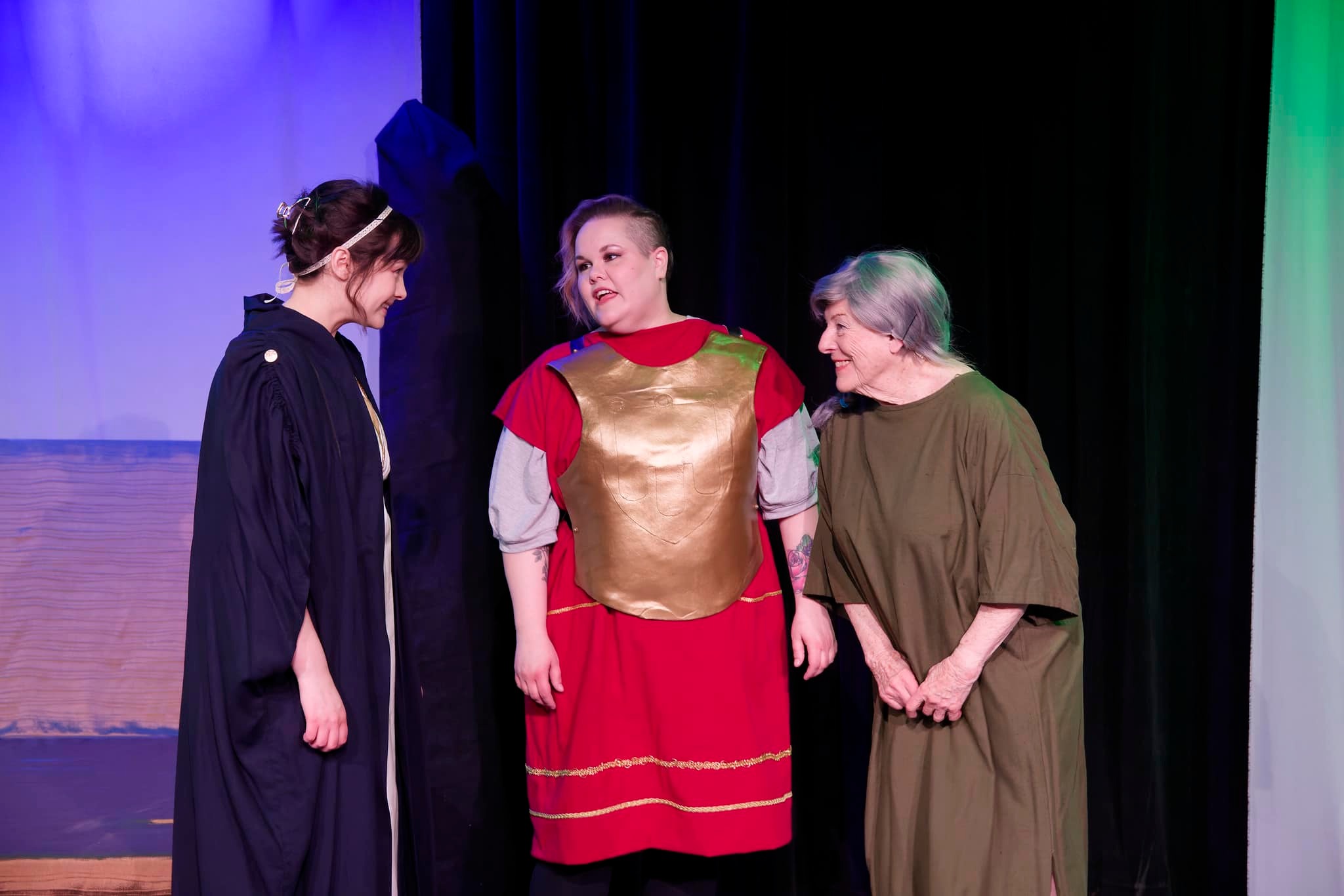
Alora Bowness as Penelope, Katy Yachimec-Ferries as Odysseus, Vivien Bosley as Eurycleia. Photo credit Scott Henderson, Henderson Images.

Thank you, cast and team of The Penelopiad, for making me think. The Penelopiad continues at Walterdale Theatre tonight through Saturday night, with an 8 pm curtain. Tonight, Wednesday, is pay what you can night; tomorrow, Thursday May 11, is limited capacity night, for patrons who would prefer more elbow room for better air quality. Masks are recommended but not required at all performances. Advance tickets are available here; some seats will be available at the door an hour before showtime.

A gay community and an era and two lives, through ten funerals

Jake Tkaczyk and Josh Travnik, as Younger Jack and Young Maurice, in 10 Funerals. Photo by Ian Jackson, Epic Photography.

Occasionally I am watching some fictional characters on stage (or on screen, or in a novel), wondering what’s going to happen to them next. And suddenly I’m astonished to realize that these characters do not even exist outside of the scenes that I am seeing. That happened to me tonight, partway through the performance of 10 Funerals, Darrin Hagen’s new play directed by John Hudson for Shadow Theatre. I wondered about some things between the scenes, and about what was going to happen after the final scenes had played out, and I had totally forgotten that these characters were not real outside of this script – because they felt so real, so believable, so irritating and stubborn, so consistently themselves throughout the 35+ years spanned by the storyline. Which is particularly impressive, because each character is played by two actors alternating. Young Maurice is played by Josh Travnik and Older Maurice is Doug Mertz, and Jake Tkaczyk and Nathan Cuckow play younger and older Jack, respectively.

One fascinating thing about watching this production is working out which young character grows into being which older one, and learning about why. Some mannerisms continue, and some of the couple’s habits and rituals and petty arguments recur. I won’t point them out, because it’s more fun to notice them.

And at the same time we are watching this particular couple through the years of their life together and the various funerals they attend together, we’re seeing the personal effects of various aspects of gay men’s lives through the last 40 years. Not just the community funerals of the early years of the AIDS crisis, but the experiences of leaving small judgemental towns for cities with their own dangers, the various relationships with families-of-origin, the issue of not having a good word to describe what they are to each other, or the legal recognition of their relationship – and also the bars, hookups, drugs, drag queens, music, and style. Oh, the style! – costume designer Leona Brausen has done an amazing job of capturing the changing fashions in clothing, hair, and facial hair over the periods, and illustrating the differences between the characters, even in the understated situations of dressing for funerals.

Parts of this play are sad. Parts of it are horrifyingly illustrative of how the injustices of our lifetime have not all gone away, but we’ve become accustomed to them. But some of the dialogue and physicality is absolutely hilarious. 10 Funerals is playing at the Varscona Theatre until May 14th – including Pay what you can, Two for one, and Safe Sunday performances. Tickets here or at the door.

A Hundred Words for Snow is lovely

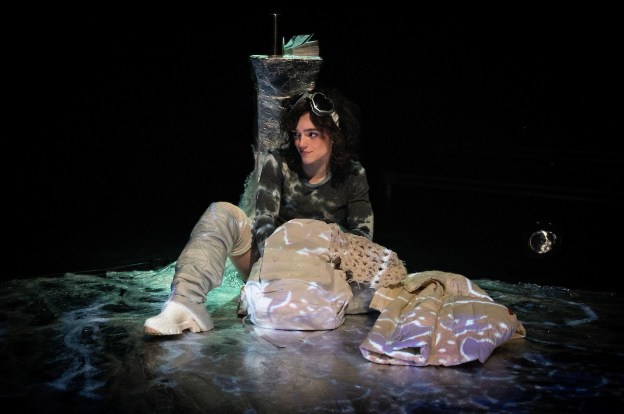
Dayna Lea Hoffman in A Hundred Words for Snow. Photo by Epic Photography

I’m not sure what adjectives to use to describe the current Northern Light Theatre production. Because I don’t want to diminish its significance and power if I call it charming, satisfying, thoughtful, or delightful. But it is all of those things, too.

Tatty Hennessy’s script is a more realistic narrative than many of the works Northern Light brings us. Its 15yo narrator (Dayna Lea Hoffman) is Rory, a recently-bereaved 15yo Londoner, relating her experiences and observations in a tone both unique and familiar. After her father’s funeral, she notes the problem of her father’s ashes being in an urn on the kitchen table and her mother being disinclined to do anything about this immediately – so she gets the idea of taking the urn on an adventure that the father, a geography teacher and armchair explorer, had daydreamed about with her and fantasy-planned in a notebook. Of course! She will borrow her mother’s credit card and go scatter the ashes at the North Pole – this makes complete sense to her.

As you should expect from a Northern Light show, brilliantly-executed design elements enhance the narrative. Alison Yanota is credited as production designer, taking care of set, costume, and lighting. Matt Schuurman designed projections on the floor, and Daniela Fernandez was sound designer. Trevor Schmidt directed. The performance is done in the round – I picked a side randomly and did not feel like there was any advantage to being on any side.

The script said some things about grief and about growing up that I am still thinking about. In particular, the concept of trying on grief responses to find what felt appropriate. I also really appreciated that the writer didn’t punish the teenage girl for not thinking things through and for trusting the people she met. As I think I’ve mentioned before in this blog, I’m tired of stories where teenage girls (and, by extension, the audience) are “taught a lesson” by having their risk-taking and initiative result in disasters, whether physical, social, sexual, or legal. Rory’s quest didn’t work the way she’d thought it should – but it still worked out.

Northern Light Theatre requires its patrons to wear masks in the Fringe Studio Theatre – and in the performances I’ve attended this season I’ve seen 100% compliance with this. The play runs until Saturday May 6th, and tickets are available here. I recommend it highly.

Sneak peeks at new work

For most art, audiences don’t get to experience it until it’s “done”. Painters and sculptors don’t usually Instagram their rough sketches or let people wander around their studios. Composers don’t usually play and sing bits of their new works for lucky fans. Sometimes at a fan convention an author might read a chapter of a new book, or there might be a screening of a film trailer, but probably not an unedited reel. But theatre depends on how the text sounds when a group of actors is speaking it, and live theatre also depends on audiences responding to the text. So it’s common in play development to have a reading – maybe a private workshop with actors hired to sit around a table and read from a new script, and then maybe a reading on stage for an audience. No set and costume, no actions, no music and lights – just the voices of the characters, bringing a story to life.

The next chance to hear readings of new scripts in Edmonton is Workshop West Playwrights’ Theatre’s Springboards Festival, which runs March 22-26th at the Gateway Theatre (you might remember it as the Roxy on Gateway or C103 or the hottest Fringe venue around…). Workshop West Playwrights’ Theatre (as the name suggests) has a mandate of supporting new play development. The schedule of plays for this festival sounds exciting! Not only is there new work by established playwrights Conni Massing (The Aberhart Summer, The Invention of Love) and Stephen Massicotte (Mary’s Wedding), and award winner James Odin Wade, on Wednesday Mar 22 there are five ten-minute scripts selected from the EdmonTEN play competition, and on Sunday Mar 26th there’s a Cabaret-style sampling of work from eleven more writers, from emerging to acclaimed. Heather Inglis and Darrin Hagen are curators and dramaturges for the festival

Jake Tkaczyk, actor, performance creator, and graduate student, will be one of the performers for James Odin Wade’s new work Everyone Is Doing Fine on Thursday Mar 23rd. Jake’s experience with play readings includes working on Bright Burning, (later titled I Hope My Heart Burns First) which Colleen Murphy wrote for his graduating class, and participating in public reading events including Script Salon and Skirts Afire. I asked Jake a few questions about readings and new play development.

“As an actor, how do you benefit from participating in a private workshop reading?”

“If I know I’ll be doing a public performance, I love getting the chance to work on the script, ask the playwright to clarify their motivations, and spend more time than a normal rehearsal process. We get more chances to try things out. ”

“Why do you do staged readings for the public?”

“Play readings are a chance for the writer to really have their work understood. As an actor, I am there to service the playwright. A public reading gives the writer a chance to hear what’s landing, what does the audience find comedic or not find comedic – are there moments when the room goes still. The writer gets to hear it read and hear it heard. And without all the design elements contributing to the experience, the audience is just paying attention to the words. Does the text work in that order? Is the plot making sense? Is there anything that needs to be explained more … or less?”

As an emerging playwright myself, I’ve had the chance to experience what he describes. Earlier this month my short script Book Club 2021 was read as part of Walterdale Theatre’s From Cradle to Stage festival, along with twelve other new plays. Hearing actors read my script, and being surrounded by audience members responding to those actors, made me so grateful that theatre is a collaborative art. We need each other to share stories. _______________________________________________________________________________________

Springboards Festival runs Mar 22-26 at Gateway Theatre with performances at 7:30 every evening. Tickets for each evening are $15 in advance and pay-what-you-wish at the door.

Fringe 2022: Just a few more!

I left my final weekend mostly open because I didn’t know if I’d have much energy and enthusiasm left, but I ended up wanting to fit in more shows I’d heard or read about. And I don’t regret it. All of these are now closed, of course, but some may have future runs at other festivals or elsewhere.

The Bender – Corine Demas’ three-hander about a grieving middle-aged woman (Demas) and her short-lived relationship with a much younger trans man (Kai Hall) she meets through a poetry-reading group (“Open hearts, open minds”). The third cast member, Steven Darnell, plays another poet, and amusingly also plays all the hookups the couple find on dating sites. I liked that the playwright didn’t aim for a conventional ending with any of the characters together. Acacia Hall.

The Truth – Adam Bailey is a Fringe-circuit regular, from Ontario. His fast-paced solo examined the concept of truth through anecdotes from his own life, from LGBTQ2S+ history, and from addiction-recovery research vs addiction-recovery ritual, among others, and it was entertaining to listen to.

A Grave Mistake – The physical-comedy duo A Little Bit Off, with Amica Hunter and David Cantor, first hit Edmonton with Beau & Aero a few years ago, which was great, so I knew it would be worth going to the Gateway Theatre in the heat to see them. Their closing performance started with David explaining that Amica was ill and unable to perform, but that with some adaptations, Carly Pokoradi from Juliet: A Revenge Comedy would be filling in on book to give us a segment of the play, and then any remaining time would be filled with some “variety show” by other Fringe artists. So although I didn’t get to see A Grave Mistake in its entirety, I got to see a couple of brilliant artists do a suprisingly-good pick-up performance, with its highlight being the physical business of the swindlers’ seance. I also got to see some other amusing excerpts, similar to Late Night Cabaret bits, from Keith Brown, Paul Strickland, Ingrid Hansen with Nayana Fielkov, and – I’m sorry, I can’t remember who else. I would definitely go to see A Grave Mistake again. Yet this experience was a classic illustration of the ephemeral pleasure of being one of the people in the “room where it happens” for live theatre. Gateway Theatre. (And a note that sweltering-heat notwithstanding, I love that this venue is still being used, and is back to being a lottery venue.)

Pressure – Amanda Samuelson’s three-hander had a progress showing or staged read or something at Nextfest in the spring, but I didn’t get to see it then. I didn’t make it up to the new Roxy Theatre to see it this week until the last day of the festival, but I’m very glad I did. It’s the best new drama I’ve seen this Fringe. Sydney Williams plays the central character Grace, struggling with depression, anxiety, feelings of being an imposter as a playwright and as an adult, and residual hurt from being abandoned by her father. Grace’s sometime-partner Ricky (Meegan Sweet) and Grace’s mother (Sue Huff) don’t always know how to support her, and have their own conflicting needs, but mean well and worry about her. It was refreshing to see the mother-daughter interactions being so nuanced, without the mother being a caricature of misunderstanding or a villain – her support was more than tuna noodle casseroles, and it was satisfying to see Grace managing to reach out to her mother for help. I liked the scene-framing of negative snarky horoscope projections, and I noticed the different underscoring and lighting for therapist conversations and for negative self-talk vs the real-time conversations on stage, but I was occasionally a little confused about the time lapses and flashbacks between scenes. Lorne Cardinal Theatre at the Roxy.

Absolute Magic – Keith Brown’s stage-magic show, sold out at the Backstage Theatre, was a great way to wrap up the festival. He makes very good use of multiple closeup cameras to make close-up magic with cards and other small props come alive for a full room. I was pretty close, and I still have no idea how any of it was done, and I loved it. The performer had smooth, natural, consensual interactions with many audience members, not just the ones close to the table but some from further back in the risers. I appreciated that his methods of identifying audience members to invite participation didn’t assume gender. I liked his stories, which came out of shows he’d done and people he’d met, things he’d learned during the pandemic, and so on. They didn’t feel glib and a couple of them truly inspired me. Backstage Theatre.

I also went to the year’s last edition of Late Night Cabaret, a festive and joyful celebration of the Fringe and the artists and community. The more times I attend LNC the more I like it. I feel welcomed and included, and I love getting to sit and experience good music – including the preshow – and a fast-moving sampler of Fringe entertainment with shared jokes and short encounters with different performers. I also like having the salient details about each artist’s show posted on the video screen.

So, that wrapped up my Fringe 2022. I might see some holdovers later this week, but the last show laundry is done and it’s time to get caught up on the rest of life and start getting ready for Walterdale’s 2022-2023 season.

Highlights and improvements of the 2022 Fringe:

  • The expanded liquor-licensed area and the paperless-option ticketing systems introduced for last year’s small-scale festival worked great for this bigger event.
  • Same with the no-tickets single-transaction drinks ordering in the beer tents.
  • No paper handbills – I saw good and bad parts of this, but on balance I liked it.
  • Water dispensers around site
  • Community Care Team watching out for unhoused and vulnerable people who might be impacted by the festival
  • Ticket pricing displayed inclusive of the Fringe operations surcharge, so there are no surprises.

See you next year!

Starting the Fringe 2022

Crack in the Mirror – This Guys in Disguise show is set at a late-1970’s Women’s Group meeting in a suburban home. Strident divorcée Ruth (Jason Hardwick) shows up at Melanie’s (Trevor Schmidt) finger-foods and wine event with earnest brochures and speeches about Gloria Steinem, but both of them are disappointed when nobody else comes except for the older, naive, Ginger (Jake Tkaczyk). I once heard Trevor Schmidt speak at a script reading and he said in his writing, he favours choosing kindness when possible – that there’s still lots of scope for conflict and interesting stories with characters who don’t set out to be mean to each other. And I didn’t realize it at the time – I was laughing too hard – but Crack in the Mirror is a good example of that. Varscona Theatre.

Meatball Séance – John Michael of Chicago’s solo show is infused with so much manic awkward energy that the themes of loss at its heart didn’t bring it down. Lots of audience participation bits, always with an option to decline. Sue Paterson stage at Campus St-Jean.

Mules – Directed by Kevin Sutley and with a good cast of actors from U of A Augustana (that’s the campus in Camrose), I bought a ticket for this because of the playwrights, Beth Graham and Daniela Vlaskalic. It was dark, it was twistedly funny in parts, and it managed to evoke some really disturbing things without actually showing any of them directly. It is a longer play (90 minutes), but I was really engaged with what was going to happen with these characters, played by Miracle Mopera, Kyra Gusdal, and Frank Dion. Walterdale Theatre.

Late Night Cabaret – I don’t make it to this Fringe midnight event very often, because I usually need some sleep more than I need a variety show with an amazing house band (Zee Punterz), amusing hosts from Rapid Fire Theatre, and glimpses of many of the Fringe artists and phenomena that I hadn’t yet had time to catch up with. But in the scaled-down masked-up Fringe of 2021, I managed to score one ticket to the limited run of Late Night Cabaret and when I walked in to the Backstage Theatre that night, its perfect blend of nightclub energy and community acceptance was something I hadn’t known I’d been missing. Last night’s hosts were Joleen Ballendine and Joey Lucius of Rapid Fire and the guest performers included Ingrid Hansen (Epidermis Circus), Tymisha Harris (Josephine, Josie & Grace) and Rachel Comeau (Josie & Grace), and Johnnie Walker (The Heterosexuals). Backstage Theatre.

White Guy on Stage Talking – I am stage-managing this, an innocent operations production with Jake Tkaczyk and Meegan Sweet. Like Tkaczyk’s previous innocent operations work, it includes a series of images and explorations devised on a theme, many of them topically pointed, excessively silly, or just absurd, and never takes itself too seriously. It’s fun to show audiences the things the performers and other creative contributors have been building. Walterdale Theatre.

This year’s Fringe has kept some of the innovations we first saw last year. The option to do paperless ticketing, and the move to one-step sales in the beer tents instead of the old get tickets here, give tickets there ritual. The bigger liquor-licensed area covering the old South Beer Tent and the whole of McIntyre Park (Gazebo Park) which eliminates a lot of the crowding/bottlenecks. The “no handbills” rule was easy last year as reducing the interactions between artists and patrons on site felt appropriate, and it eliminated a lot of paper. This year I think it’s more of a challenge – performers do need to engage to sell their shows, and it’s probably harder when there’s no tidy way of taking a card to wrap up the conversation. I’ve seen performers wandering in costume and wearing billboards and T-shirts with their QR codes.

The gravel parking lot (formerly Farmers’ Market parking, rebranded a few years ago to Theatre District parking) has increased in price to almost $20 for a full day, which will change my strategies a bit. Lots of my favourite food vendors (the wood fired pizza, the grilled cheese people, Fat Frank’s, the spaghetti in a cone, and the green onion cakes) are back, along with Native Delights (bannock burgers!) and something I need to try based on recommendations, BF Korean Chicken. Some people are wearing masks – more indoors than out, more performers than guests. There has obviously been some festival planning to eliminate pinch-points and bottlenecks and other non-intentional crowding, which is helpful in many ways other than reducing covid transmission.

Happy Fringe!

The Realistic Joneses: absurdity with kindness

Christoff Lundgren, Colleen Allen, Zack Siezmagraff, and Brooke Hodgson in The Realistic Joneses. Photo by Scott Henderson, Henderson Images.

Good storytelling often starts in the middle, and doesn’t explain everything right away.

The Realistic Joneses, a play by Will Eno currently on stage at Walterdale Theatre, does this brilliantly. A married couple sits in their backyard, having a frustrating conversation. Jennifer (Colleen Allen) tries to find more verbal connection with her spouse Bob (Zack Siezmagraff), and he bats away all the metaphorical volleys. “Why don’t we ever talk?” “We talked last week. About Belgium.”

A crash of garbage cans offstage turns out not to be raccoons but in fact the lively new neighbours John and Pony (Christoff Lundgren and Brooke Hodgson), bearing wine. This interrupts the previous non-conversation and introduces new levels of awkwardness. All of this is very funny and strangely familiar. Each character has practised routines of social behaviour, from John’s joking gestures and one-liners and Pony’s sidekick perkiness to Jennifer’s urge to fill silences with chatter.

In this script, there is a lot of playing with words, fumbling for words, and using words to distract and deflect. Some characters were keeping secrets, secrets that mattered. Some characters hinted at hardships, past and present. But these characters are not people who would explain things to each other, and not explaining to the audience is part of what makes this play so intriguing. There is some opening-up, some revealing and regretting, and a moving and hopeful ending.

The actors and director (John Anderson) convinced me early on that each character had some urgent needs driving him or her forward, strong motivations that were conveyed indirectly but compellingly. They almost never asked each other directly for anything, but each character had consistent intention and every scene was necessary towards each character’s goals. I was so involved with figuring out the characters that it was only afterwards I was able to think about the actors and their preparation, realizing that these portrayals happened because the actors understood the characters’ intentions and knew how to express them.

I was particularly taken with Zack Siezmagraff’s portrayal of a character who starts off cranky-awkward and becomes somewhat more transparent, never unlikeable but often frustrating. I could hear other members of the audience also being so engaged with whether Bob was saying the wrong thing that there were a lot of gasps and sighs and head-shaking around me.

As you might already know if you’ve listened to me talk about plays or tv shows I’ve seen, I love stories where the people are in difficult or sad situations but the characters are so consistently themselves that the dialogue is very funny. So The Realistic Joneses just hits the spot for me.

I also appreciated the mountain skyline in the set design (Joan Hawkins), the overall subtle sound design (Shawn Pallier), and one particular lighting effect which I won’t give away (Richard Hatfield).

The Realistic Joneses is running at Walterdale Theatre until Saturday July 16th, 2022. Tonight is 2-for-1 night, and next Wednesday (July 13) is Pay-What-You-Can night. Advance tickets are available through Walterdale’s website (no extra service charges), and walk-up tickets will be available at the door.

Two big musicals of alternate-history – Brigadoon and Hamilton!

Brigadoon ensemble. Photo by EPIC photography.

I got to watch big musicals two nights in a row last weekend, with fireworks in between. Talk about spectacle!

ELOPE is performing the Lerner and Loewe classic Brigadoon at the Westbury Theatre, running until this coming Saturday July 9th. Jon Shields is directing. With a cast of about twenty-nine and about a dozen musicians (Sally Hunt, music director), the deep Westbury stage was full but not crowded. In the story (which I vaguely knew ahead of time – I think I saw the ending of the movie once?), two young American men from 1947 (Mathew Glenn and Randall Scott MacDonald) are lost in the woods in Scotland, and discover a mysterious town from 200 years earlier. This allows for lots of local festive colour (with plaids and dancing), as they arrive on a day that two young residents of the town (Lilly Hauck and Brendan Smith) are getting married. I got distracted by trying to figure out the size of the population (were were just seeing a few of them or all of them?) and whether it was sustainable, but a more interesting question was whether everyone stuck there actually wanted to be there. Of course, the visitors are swept up in the life of the town, with one of them falling for the bride’s older sister Fiona (Christina O’Dell) and the other one being targeted by the, um, outgoing and vivid Meg (Kathleen Sera). O’Dell has a spectacular voice which is well suited to Fiona.

I only recognized one song in Brigadoon, “Almost Like Being in Love”. I enjoyed watching the interestingly diverse ensemble of villagers, and I appreciated the costuming (Julieanna Lazowski).

If you like classical large-cast musicals, you can get tickets to Brigadoon through Tix on the Square or at the door.

_________________________________________________________________________________________

The next night, I saw the Broadway Across Canada touring production (the #AndPeggy cast or third North American touring cast) of Hamilton. It is in town for a three-week run (most BAC shows are here for one week), with a rush-seat lottery operating through a phone app, which is how I was able to see it.

I do not know the US founding-fathers’ history in detail and I didn’t grow up with ownership to the story. As for Hamilton the phenomenon, I’d listened to the cast recording, read lots of articles about Lin-Manuel Miranda and his choice to cast performers of colour, and watched the Disney+ filmed version, so I had a pretty good idea what to expect.

The BAC production completely satisfied my expectations, and exceeded them. I was seated up close, so the cast of 21 on the proscenium stage felt like they were surrounding me. With multiple levels, side balconies, people drifting in and out of scenes and observing in corners, there was always lots to watch. Julius Thomas III played Alexander Hamilton, and we had understudies Milika Cherée and Charlotte Mary Wen playing sisters Eliza and Angelica Schuyler. I thought Charlotte Mary Wen was especially compelling. The actor playing King George, Rick Negron, interpreted the part quite differently from the Jonathan Groff version I’d seen filmed, losing some momentum in favour of Christopher-Walken-esque momentous pauses. But the audience still reacted strongly to him, someone near me even shouting out about it while Negron was singing. The movement in the show was great, especially the energy of a couple of ensemble numbers with no music. And the songs varied widely in genre with lots of earworm-catchy parts.

Hamilton tickets are available through Ticketmaster, for shows in Edmonton until July 10th and then in Calgary.

_____________________________________________________________________________________________

COMING UP NEXT: Walterdale Theatre’s production of Will Eno’s The Realistic Joneses opens tomorrow, Wednesday July 6th, 8 pm. I got to see a few scenes in an early rehearsal and I’m fascinated to see more of these quirky characters. Tickets directly from Walterdale online, or at the door.

A Gentleman’s Guide to Love and Murder

Kathryn Kerr, Stephen Allred, Ruth Wong-Miller, in A Gentleman’s Guide to Love and Murder. Photo Nanc Price.

My previous entry was about the Teatro la Quindicina quirky tongue-in-cheek period piece Evelyn Strange. And tonight I saw another quirky tongue-in-cheek period piece – Foote in the Door’s production of A Gentleman’s Guide to Love and Murder. This musical, by Steven Lutvak and Robert L Freedman, won several Tony awards in 2014 – I was actually in New York that spring and could have seen it, but I picked shows I’d heard of instead. And I got to see this production completely unspoiled.

A Gentleman’s Guide to Love and Murder is set in England in 1907. The premise of it is that Montague Navarro (Stephen Allred) discovers after his mother’s death that he’s distantly related to nobility, in fact being something like ninth in line to an earldom, although his mother had been disowned for marrying his late father, “a Castilian … and a musician!” All this information is provided by his mother’s old friend Miss Shingle (Nicole English), paying an unexpected visit. He sets out to meet his rich relations, hoping they will give him a job, but then temptation, ambition, and a series of very strange coincidences lead him to try benefiting more directly from being only a few deaths away from the title and the property.

His girlfriend Sibella (Kathryn Kerr) is a hilariously shallow and self-centred woman, but Montague doesn’t seem to mind, continuing to be captivated by her after she gets married. Meanwhile, he continues to meet various members of the D’Ysquith family, many of whom (all played by Russ Farmer) then meet untimely deaths. Most of them seem equally unlikeable, demonstrating various stereotypes about the turn-of-that-century English upper-class. The career do-gooder Hyacinth, seeking a novel charity that hasn’t been claimed by her friends and speaking of her prospective beneficiaries in appallingly patronizing terms, was particularly memorable. At intermission, I was thinking that I’d only seen one D’Ysquith who actually seemed nice, cousin Phoebe (Ruth Wong-Miller), but that maybe I should distrust that thought.

I thought I’d figured out where the rest of the plot would go … but it didn’t, exactly. And the plot twists of the second act delighted me.

My two favourite scenes were the ice-skating scene (who knew that graceful ensemble dancing – and some not so graceful wobbles by Asquith D’Ysquith Junior – behind some snowbank set pieces could so easily convey skating on a pond?) and the scene where Montague is entertaining both Sibella and Phoebe in different rooms of his apartment, The hallway set piece with the two doors, and the way Allred’s character uses it while he sings to play out wanting both women and trying to keep them away from each other, were just brilliant.

Set and lighting design were by Leland Stelck. My companions and I were impressed by how many set pieces shifted silently and rapidly behind the drapery to convey many different locations, particularly given that the production had relocated to Old Strathcona Performing Arts Centre on Gateway from their original performance venue three weeks ago due to the flooding at La Cité Francophone. I think the OSPAC stage is not as deep or wide, but the ensemble of eleven never looked crowded. The lighting design must have been more challenging at OSPAC, which has a relatively low ceiling and doesn’t seem to have as many lighting instruments.

We also admired the period costumes including hairdos and hats (Betty Kolodziej). The members of the ensemble (Kelsey Voelker, Shauna Rebus, Lynnéa Bartel-Nickel, Jason Duiker, Aaron Schaan, Brian Ault) played several background characters each, changing costumes and accents as needed – my favourite ensemble bit was when they were all serving at a dinner, like in an episode of Bridgerton.

The production was directed by Ron Long, with musical direction by Daniel Belland, and an orchestra of 13. The melodies were catchy with some Gilbert-and-Sullivan-esque rhymes, and strong voices among the cast.

Advance tickets to the four remaining shows (Jun 16-18 at 7:30 and Jun 18 at 2 pm) are available here and going fast. Door sales (if available) will start 45 minutes before showtime.

If you’ve already seen it, or you don’t mind being completely spoiled, this webpage reviews (and ranks) all the deaths, as staged in the original Broadway production.