Category Archives: Theatre

Cabaret

Listening to the musical soundtrack from a show evokes vivid memories of the show, sometimes more than expected.  That is why, after my trip to various US destinations this spring, I was sitting on a full airplane back to Edmonton, but I feel like I’m sitting in a theatre, specifically the Kit Kat Club Studio 54, swept into the world of Cabaret, and the nightclub in 1930s Berlin while the prospect of Nazi power loomed like the Nightwatch on Babylon 5.   This was not the most comfortable mood to be in on an airplane, but it was a wonderful show and I wanted to remember it as fully as I could.

The musical Cabaret was the last show I saw on my trip to New York City.  it opened recently with Alan Cumming (currently in the TV drama The Good Wife) as the Emcee, Michelle Williams as Sally Bowles, and Bill Heck as the viewpoint character American novelist Cliff Bradshaw.  The poignant and tragic glimpses of ordinary people going about their lives ignoring or worrying about or unaware of the political and social shifts during what we know is the time immediately before World War II create a compelling story.  You can’t raise the narrative stakes much higher.  The plot line about Fraulein Schneider, the landlady, and about her late-in-life suitor Herr Schultz, a Jewish fruit seller, was particularly heartbreaking.  The Emcee’s speeches and songs addressing the imaginary cabaret audience give an impression of self-conscious parody of depravity, but the other narrative between the songs, like Sally Bowles’ matter-of-fact acknowledgement that various members of the chorus had male and female lovers, just felt like a way of illustrating that the culture of that time and place wasn’t very different from our own.

The front rows of the orchestra and balcony sections in the theatre were all set up like little cabaret tables, with candle lights.  In the parts of the musical set during cabaret performances, the little table lights lit up, so that even though I was sitting in a cheaper seat I felt part of an intimate live performance.  The Club space at the Citadel feels similar, so I imagine I’ll recall Cabaret the next time I go to a show there.  The male ushers for the performance were not entirely clothed, adding to the impression of arriving somewhere exotic and slightly daring.   Before the show started, the orchestra musicians were wandering around and warming up on stage, before settling in to their platform above the main part of the stage.

Both Alan Cumming and Michelle Williams will be replaced by other performers for the extended run of this show.  While I loved seeing Alan Cumming in this role, the show would be good even without them.

Hedwig and the Angry Inch

One of the hot tickets that I paid full price for on my Broadway excursion this spring was the new production of Hedwig and the Angry Inch, with Neil Patrick Harris as Hedwig and Lena Hall as Hedwig’s second husband Yitzhak.  Neil Patrick Harris (NPH) had played the role in a West End London production a few years ago, but never on Broadway.  (You might know NPH as the actor who played the title role in Doogie Howser MD, who played himself in the Harold and Kumar movies, and who was in Dr. Horrible’s Sing-Along Blog, or the host of last year’s Tony Awards.)  I’m probably the only one who also had him confused with the guy who plays the FBI agent on White Collar, but that’s actually Tim De Kay, who looks kind of similar and is about 10 years older.   Lena Hall also has a long Broadway resume,

Hedwig and the Angry Inch is also a movie, but having seen both I think it works better as a stage musical – and it’s definitely more fun in person.  The Belasco Theatre is an intimate setting and some of the audience members sitting near me had seen the production before.  It’s a fairly short show (95 minutes or so?) without an intermission, and the character Hedwig talks or sings for almost the whole time.  The musicians performing as the Angry Inch were Justin Craig (Skszp), Matt Duncan (Jacek), Tim Mislock (Krzyzhtoff), and Peter Yanowitz (Schlatko).  Hedwig has several dramatic costume changes and manages to climb over a car gracefully wearing platform boots.

The show uses the device of Hedwig and her band talking to the audience as they do a “one night only!” musical performance, and narrate Hedwig’s history.  They keep mentioning their more successful associate Tommy Gnosis who is supposedly performing across town in a bigger venue.  And at one point Hedwig makes an aside about having been kicked out of a dive like The Jane Hotel, which is funny because the original off-Broadway run of Hedwig was in a room at that inexpensive inn, but it was even funnier to me because that is where I was staying.

I enjoyed it and I’m glad I went to see it, but it hasn’t really stuck with me very hard.  I’m not sure why not.

Fringe as a way of life

My first experience with any Fringe festival was the week I moved to Edmonton.  I got off the train with some of my stuff on a cold grey Monday morning after Folkfest, even though everyone I’d met from Edmonton had encouraged me to arrive in time for the folk music festival.  I didn’t want to wait a year to start experiencing the festive life of my new home, and fortunately I found out that there was some kind of theatre festival taking place the next weekend a few blocks from where I was living.  My first blog posts about the Fringe (they were semi-private journal entries at the time; I wasn’t publishing this blog yet) mention seeing a show recommended by a friend from Montreal Fringe, encountering handbillers, talking to strangers in the beer tent, and eating my first green onion cake.  But it probably took me until my second Fringe year to realize that one of the best things about the Fringe is that I don’t just pick the kinds of theatre experiences which sound safe and familiar.  Something about the format, where it’s possible to see lots of shows in a weekend or three in a single evening, and where none of them cost more than $15 total, lowers the perceived risk of choosing what to see.  My Fringe day wasn’t going to be wrecked if one of the performances wasn’t quite what I was looking for.  And in fact, my day was going to be more fun if all the performances were different from each other.

So I started expanding the range of what I was willing to try.   I didn’t think I liked one-person performances, but after seeing some brilliant multiple-character narratives and storytelling shows, I was hooked.  I didn’t think I liked clowns or mimes, but after watching some world-class physical theatre and Canadian Pochinko-tradition clown stories I wanted to see more.  I sought out dance shows, dramas, theatre of the absurd, musicals, and improvisational theatre.  Like music and food and drink and poetry, I discovered that I liked a lot more things than I would have guessed, and I got better at figuring out how to describe what I like and don’t like.   Eventually I fell into living the rest of the year with a Fringe mindset too.   My Broadway vacation was Fringe-like in my enthusiastic immersion, but the shows were a lot more expensive and the street food wasn’t as interesting.

Having become more involved in the year-round Edmonton theatre scene in the last couple of years, taking class, volunteering backstage and front of house, and seeing a lot of shows from a lot of companies, my decisions of what to see at the Fringe now include consideration of a lot of shows where I recognise the names in the program book, as friends, favourite directors, or performers I’ve enjoyed watching in the past.  This makes it even harder to decide what to see.

But here’s my first list.  I expect to see more, and I’ve got a long backup wish list waiting for Fringe bucks, Daily Discounts, artist comps, and/or space in my calendar.  These are the for-sures.  They’re not in priority order.  (I’m not linking any box-office pages; you can find those yourself.)

  • Camel Camel
  • Sonder – this is the one I’m producing
  • Beware Beware
  • Flora and Fawna’s Field Trip
  • Zanna, Don’t!
  • Dogfight – a Scona Alumni Theatre musical
  • The Show
  • Butt Kapinski
  • The Middle of Everywhere – this is the new show from Wonderheads, the mask troupe out of Oregon who did Loon and Grimm & Fischer
  • Harold of Galactus
  • Little Monsters – written and directed by Kristen Finlay
  • This is CANCER – I haven’t seen Bruce Horak’s show before but I’ve heard a lot about it
  • Off Book the Musical – this Rapid Fire troupe is even better at the Fringe than in a regular Saturday show
  • En anglais, s’il vous plait
  • Ask Aggie – I saw Christine Lesiak’s show last year and liked it, and I’ve heard there’s new material in it
  • Fugly
  • Rocket Sugar Factory
  • The Real Inspector Hound
  • 3… 2…1…
  • Real Time – scripted comedy by Matt Alden of Rapid Fire
  • The Story of O’s
  • Einstein
  • Scratch
  • Gordon’s Big Bald Head
  • Bible Bill
  • Fruitcake
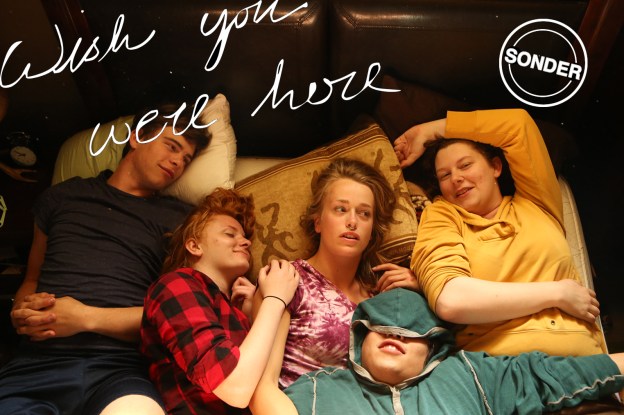
Cast of Sonder, postcard style

Sonder and the Fringe

The Edmonton International Fringe Theatre Festival is my favourite festival.   And counting down to the Fringe is like counting down to Christmas.  When I was a child, I used to ask my parents, Don’t you wish Christmas was tomorrow? Mum would sigh and Dad would grumble in their grownup ways saying that they didn’t wish Christmas was tomorrow because they weren’t ready.  I would explain that if Christmas was tomorrow they would be ready!  They didn’t buy it.

Anyway, every year as soon as Folkfest is over I start getting excited about the Fringe.  I already have my program and some show tickets, and my volunteering schedule for the beer tent.  I drove by the grounds last night and saw the barricades on some of the roads.  I’m clicking Maybe on all the Facebook events and trying to figure out how many I can see.  I’m looking forward to the parade, the food stands (especially Rustixx pizza), the out-of-town visitors, the excitement … but at the same time I’m feeling like one of those grown-ups who has a to-do list that has to happen first.

One of the things on my personal to-do list is to get caught up writing about other performances I’ve seen, so I can start the season fresh.  That will appear here in the next few days.

The other things are about getting everything ready for the new show that I’m producing, Sonder, with our company The ? Collective (you can pronounce that however you want, but we usually say “the question mark collective” – our twitter handle is @theqmcollective).  A friend and I put together a lottery entry last fall and were lucky enough to get selected to perform in a Fringe lottery venue, King Edward School.  That’s Venue 5, the elementary school, the low white building closer to the Fringe grounds, as opposed to the Academy which is the older brick building across the street.  My friend, Jake Tkaczyk, took on the roles of director and creation facilitator, gathering a small group of Red Deer College students to explore themes of interconnectedness and meaningful moments in a collaborative creation process.  The title Sonder came from the tumblr blog Dictionary of Obscure Sorrows, in which the writer, John Koenig, coins many words for interesting concepts – in this case the realization that each random passer-by is living a life as vivid and complex as one’s own.  As the work slowly took shape, Collette Radau contributed as dramaturg, Alex Boldt responded with original music and soundscapes, and all of us told and listened to many stories.

What we’ve come up with uses the techniques of performance art, movement, recitation, and narrative scenes real and surreal to show a series of moments in different people’s lives, from the everyday to the magical, funny and poignant and sometimes disturbing.   We’re excited about showing our creation to the Fringe community, and we’re also excited about experiencing the Fringe from the inside.   I’m the only one who’s been involved with a show in the past (as stage manager for WaMo Productions’ God on God 2013, 3 stars in the VUE and the Journal).  Some of the company members will be attending their first Edmonton Fringe, and I’m almost as excited about showing them the festival that made me fall in love with theatre in the first place.

But as I said at the beginning, I’ve got a to-do list between me and opening night (Thursday Aug 14th at 10 pm by the way).  The rest of our company arrives in town today, and our tech rehearsal is this afternoon.  We have posters to hang, handbills to hand out, programs to print, buttons to sell, and a parade to entertain you in (Thursday Aug 14th, 7:30 pm, Fringe grounds). We have a blog, a website, a Facebook event and page, a twitter account, and an indiegogo campaign (running til the 21st).

And we have tickets at the box offices for all our performances, $11 adult, $9 student/senior.  We’d love to see you there!

  • Thurs Aug 14th, 10 pm (opening)
  • Sun Aug 17th, 9 pm
  • Mon Aug 18th, 12:15 pm
  • Wed Aug 20th, 11:30 pm
  • Thurs Aug 21st, 4:00 pm
  • Sat Aug 23rd, 6:45 pm (closing)
Sonder cast rehearses family scene.  Erin Pettifor as the mother comforts her children (Julia Van Dam, Evan Macleod).

Sonder cast rehearses family scene. Erin Pettifor as the mother comforts her children (Julia Van Dam, Evan Macleod).

Sonder cast creates funeral vignette.  Evan Macleod as Doug the deceased.  Mourners left to right: Julia Van Dam, Emily Cupples, Tyler Johnson, Brittany Martyshuk.

Sonder cast creates funeral vignette. Evan Macleod as Doug the deceased. Mourners left to right: Julia Van Dam, Emily Cupples, Tyler Johnson, Brittany Martyshuk.

Hilda’s Yard in Rosthern, Saskatchewan

I’m aiming to be caught up on reviews or at least quick mentions by the start of the Edmonton International Fringe Theatre Festival (August 14-24, 2014), because that’s the start of my personal theatregoing year, and the anniversary of my move to Edmonton.  This year at the Fringe, besides volunteering at the beer tent, volunteering front of house for a Rapid Fire production or two, and seeing as many shows as I can fit into my schedule, I’m also going to be producing a new work.  Sonder, created and performed by The ? Collective under the direction of Jake Tkaczyk (a U of A BFA Acting student), will be playing at the King Edward Elementary School.

The most recent play I’ve attended was Norm Foster’s charming slice of 1950s family life, Hilda’s Yard, as directed by Stephen Heatley (formerly of Edmonton and now faculty at UBC) at the Station Arts Centre in Rosthern, Saskatchewan.  As a professional production by a summer company, it reminded me of the plays I used to go to at the Thousand Islands Playhouse in Gananoque when I lived in Kingston.   I hear that doing the dinner/show package at the Tea Room in the arts centre is an even better experience, but by the time I decided to attend the dinner was sold out.  So I had a tasty club sandwich at a local restaurant called Chewie’s (after the Star Wars character I think), and then enjoyed strolling through the art gallery before the show started.

Hilda’s Yard opens with the title character (Cheryl Jack) hanging laundry in her backyard, while talking to a neighbour we can’t see.  We learn that she’s relieved that her two grown children have recently moved out, and that she’s a little apprehensive about her husband planning to buy their first television set.   I thought Hilda’s character was the most interesting part of the play.  Cheryl Jack portrayed her as confident, competent, wistful, and mostly in control, and her portrayal was enhanced by some very amusing gestures and hip wiggles.  I was pleased to see that she and her husband Sam (Bruce McKay) were both looking forward to the increased opportunities for intimacy afforded by having an empty nest, rather than playing that situation for the cheap laughs of imbalance.   The complication, of course, is that both adult children soon return home, for the same kinds of reasons that are common in 21st-century boomerang kids.  Gary (Jaron Francis) has lost his pizza-delivery job in the city and is on the run from a bookie he owes money to.  Sam’s prolonged pauses as he tries to figure out what to say to his son are priceless.  Daughter Janey (Angela Kemp) shows up back home due to marital troubles.  I’d seen both Jaron Francis and Bruce McKay in last season’s Shakespeare on the Saskatchewan productions of Macbeth and Comedy of Errors.

When I read the show notes ahead of time, I assumed that the plot would focus on Gary and Janey now insisting on staying with their parents in order to watch the television.  But Norm Foster’s stories are not quite that predictable.  Although the (off-stage) television figures in the plot, it doesn’t quite work out like that.  Additional characters who show up and get invited for supper include Gary’s new girlfriend Bobbi, a jazz trombonist (Shannon Harasen) and Gary’s bookie Beverly (Matt Josdal).  Bobbi’s idiolect is noticeably different from the language used by the rest of the characters, with jazz lingo like “cat” but also in careful details like her pronunciation of “Mom” contrasting with Janey’s old-Ontario pronunciation of “Mum”. Present-day audiences are amused by any mention of the 1956 prices and wages, but also by Gary’s unrealistic schemes to make money with such unlikely products as a “baby-on-board” sign or a hula hoop.  I appreciated the light touch by director and actors throughout the play, because the story is funny enough without hitting the audience over the head.

The set (design by David Granger) portrayed a backyard like the ones of my childhood with simple clean lines – an artificial-turf lawn, a wooden-siding wall, a white picket fence with bits of weed growing between the pickets, a perfectly-recreated pulley clothesline and a wicker laundry basket, vintage lawn chairs and a credibly-dented metal garbage can.

Hilda’s Yard continues until July 27th, and is definitely worth the short drive from Saskatoon.

Wonderful Town!

Wonderful Town, a 1953 musical with music by Leonard Bernstein, is this year’s Citadel Theatre Young Musical Company performance, directed by Bridget Ryan with musical direction by Sally Hunt.

It’s a silly fluffy large-cast show with lots of mistaken identities and misunderstandings, goofy characters, delightful period costumes, and a happy ending.  The setting is New York City’s Greenwich Village in the 1930s, with a mix of young people, artists and performers, prostitutes, and immigrants living in the inexpensive apartments of the area. The premise was actually quite similar to Avenue Q.

The story opens with a tour guide in straw boater (Adam Houston) showing some tourists the sights and inhabitants of Christopher Street, Washington Square, and nearby areas.  This device allows many of the cast to be briefly introduced while setting the scene in a song.  Then the main characters, sisters Ruth (Zia Mizera) and Eileen (Sydney Williams) from Columbus Ohio, arrive with their suitcases, looking for an apartment and hoping to make their names in writing and in show business, respectively.  Landlord and painter Mrs Appopolis (Michelle Diaz) rents them a tiny basement apartment, shown on stage with twin beds cunningly pulling out of a backdrop, and a window grate at street level opening on an outside staircase.  We learn quickly that older sister Ruth is the practical outspoken one, but both of them are quickly overwhelmed with the big city, the apartment shaking with detonations for subway construction, men looking for the prostitute previous tenant (Phoebe Davis), drunks peering in the grate or unzipping to urinate through it.  This sets up the lovely song “Ohio”, in which they express their homesickness while rhyming the name of the state with “Why,oh why oh,”  I was particularly charmed because I used to live in Columbus.

Ruth sends out her writing to editors (Roland Meseck, Eugene Kwon, Michelle Diaz) and tries to get work in journalism, while Eileen mostly seems to spend her time meeting “boys” (Bryce Stewart, Adam Houston, etc).  Ruth’s wry song “One Hundred Easy Ways To Lose a Man”, acknowledging that her competence, bluntness, and unwillingness to dissemble are disadvantages in dating, is possibly not quite as true today as it was sixty years ago when the song was written, but it’s still familiar and the song is a good exposition of Ruth’s character, putting the audience on her side.  Neighbours Wreck and Helen (Daniel Greenways and Bridget Lyne) are an unmarried couple whose plans to conceal their cohabitation when Helen’s mother (Phoebe Davis) visits are also slightly dated to a modern audience but still humorously familiar.

In classic musical theatre structure, the first act ended with plot complications and an uptempo song and dance number with lots of cast members in it.  Ruth is tricked into believing she has an assignment to interview some Brazilian naval cadets for a human interest story, but the sailors (Houston, Kwon, Davis, Taylor Paskar, Diaz, Lyne) just break into an enthusiastic and uncontrollable conga line which lands in Ruth and Eileen’s apartment and gets Eileen arrested for disturbing the peace.

As the second act opens, Eileen is in custody in a station full of police officers with Irish accents, all charmed and all convinced she is Irish.   After a few more twists and turns, everyone has happy endings – Ruth finds both requited love and journalistic employment, and Eileen is a hit singing in a nightclub.

Most of the performers are cast in several roles, showing their versatility.  The only characters that I had a little trouble distinguishing were Bryce Stewart’s Valenti (the nightclub promoter) and Chick Clark (the newspaperman).  Zia Mizera and Sydney Williams were very good together as the contrasting but loyal sisters.


The Inspector General – ridiculously topical

The Citadel Theatre’s Young Acting Company show this spring is The Inspector General, as translated/adapted by Michael Chemers in 2010 from the 1836 Nikolai Vasilyevich Gogol Russian original.   A report of the 2010 production mentions that many references to local Pittsburgh politics were incorporated.

This production, directed by Dave Horak, is said to be set in the city of Edmoronto, and it is enhanced by references that are sometimes generally Canadian and sometimes specifically Edmontonian.   It’s satirical and broadly comedic and I laughed a lot.  The mayor of Edmoronto (Eric Smith) is both corrupt and incompetent.  Most of the cast play officials in his administration (to use those terms loosely), from the City Controller (Marie Mavko, organized and imposing) down to the Co-chairs of the Emergency Crisis Centre, Frick and Frack (Philip Geller and Matt Ness, a hilarious slapstick pair in bowler hats and confused expressions).  The Mayor’s ambitious wife (Morgan Donald) was previously “dancing at the Moulin Spooge”.  The mayor’s surly cynical art-student daughter (Courtney Wutzke) was one of my favourite characters, because her portrayal of disaffected text-speaking young person was spot-on but she was actually a more complex character as well.

The main plot premise is that the mayor and administration find out that some kind of government inspector is arriving incognito from Ottawa, and they are worried about getting in trouble.   So when they hear that someone has been staying at a hotel in town for two weeks, they conclude he must be the inspector, and they descend on him with excuses and bribes.  But of course the visitor (Nico Ouellette) is actually a drifter and minor civil servant, with his equally hapless travelling companion Zippo (Lauren Derman).  When he catches on that the city officials haven’t landed in his hotel room to arrest them but to pay court to him and try to influence him, he smoothly begins to take advantage of the situation, stuffing the bribes in his pockets and drinking the mayor’s brandy. “Everything he says means something else”, says one of the officials, explaining all his behaviour in light of seeing him as the undercover inspector.

The comedy dictum “rule of three”, meaning to find humour in slightly varying repetitions, is well incorporated here by the writer, translator, and director.  Each of the mayor’s cronies and associates (Mavko, Hayley Moorhouse, Chayla Day, Eva Foote, Alex Dawkins, Marc Ludwig, Ness, and Geller) has his or her own distinct character traits and motivation, all interesting and funny.  Each of them has amusing stage business, a unique attempt to bribe, a funny way of arranging his or her chair for a business meeting.  Eric Smith’s mayor character was not exactly likeable but engaging, and his frenzied dance number near the end was delightful.  Niko Ouellette was a crowd favourite as the scoundrel they assume is the inspector.   I also enjoyed Chayla Day’s understated portrayal of the Mormon liquor-store owner and president of the Chamber of Commerce, and the subtle humour in her costuming and lines.

The short run of The Inspector General is complete, and the Young Musical Company’s show finishes tonight.  The Young Playwriting Company has staged readings Tuesday and Wednesday.  The old Citadel website had bios of the Young Company participants.  I’m disappointed that the new one doesn’t, because I liked getting to know the names of some of the talented emerging artists to watch out for around the Edmonton theatre scene in future.


The Genius Code, from Surreal SoReal Theatre

The concept of The Genius Code intrigued me – putting different audience members into the viewpoint of different characters, by giving them headphones.   I am fascinated by the idea of piecing together the truths of different people’s experiences.  It’s easy to do and fairly common in written fiction.  And I’ve seen movies and tv shows where a scene is shown from one character’s viewpoint, maybe with some voice-over retrospective narration, and then repeated from another character’s viewpoint and voice with a very different impression.  It’s also doable on stage, although harder – it might be a fun improv game for experienced players.

But in The Genius Code, the writer and director (Jon Lachlan Stewart) doesn’t control which of the viewpoints an audience member chooses.  And in attending one performance, you only get one viewpoint – you can’t switch.  This performance-art choice leads to some fascinating differences in audience experience.

When the audience is wearing headphones, the lighting design has the house quite dark, and the logistics of cable management mean that the audience members tend to sit still.  I think that mostly people aren’t listening to the same commentary as their neighbours.  And the audiences for the two performances I’ve attended have been unusually quiet while we were wearing headphones.  Mostly, the characters’ inner thoughts were heard in one set of headphones only, and the conversations taking place on stage were transmitted by floor mics to all three sets of headphones.  But even when all of us were hearing the conversation, I thought the audience wasn’t very responsive.  I kept wanting to sigh and smile and gasp and chuckle and wince in recognition, but somehow the awareness of being surrounded by a room full of people listening quietly in headphones made me hesitate.   Later in the show, there’s a part where we’re instructed to take the headphones off.  The house lights came partway up, the story continued unamplified, and the audience immediately became more responsive.  This fascinated me, and I wondered if it was disconcerting to the actors when we were quieter.

Technically, I was relieved and impressed that the headphones thing worked.  I never heard any sound bleeding over from the other feeds, either in the full house of opening night when I was surrounded by people listening to different feeds or on the preview night when I had empty seats next to me.   Soundscapes (Aaron Macri and Jonathan Krawchuk) and video backgrounds projected on an unusual surface (Matt Schuurman) added to the atmosphere and provided more information.

I’ve attended two performances and listened to two points of view.  I’m planning to return one night next week to listen to the third one.  Listening to the second one made me re-think some opinions I’d formed during the first show, and then wonder whether the assumptions that led me to those opinions were unfair.  Things kept surprising me during the second show, things that I know rationally must have happened the same way both times but for some reason I didn’t remember them clearly.

The characters in the story are Sky (Jamie Cavanagh), Gyl (Laura Metcalfe), and Gene aka DJ Genius Code (Cole Humeny).  As the story starts, Gene has just brought his two friends together, and as they seem to hit it off, they agree to let Gene record all their conversations.  This is a convenient explanation allowing Gene to move about the stage adjusting microphones so that the audience will hear the conversations through our headphones, but it is also important in showing how Gene relates to the other two.  It provides some important plot movement, and the option to re-play or re-mix the recordings also gives some interesting framework.  The phrase “Let’s start again” is used several times during the performance, usually in a sense of “let’s play this recording again from the top” but in other senses as well.  And in fact, sometimes in life and relationships, sometimes one cannot just start again.

My first impressions of Gyl were that she’s a wacky outspoken young woman, talented and attractive.  Sky struck me as a glib provocative young man who enjoys playing with words and is also accustomed to being desirable.  And Gene was a puzzle.  Humeny plays the character with near-flat affect and an immobile face, usually looking down or to one side rather than making eye contact with his friends.  Costume/Set Designer Cory Sincennes has dressed him in a hooded shirt a bit too big for him with sleeves too long, making him look small and not in control (a very different impression than when I saw him as an enlisted Marine in A Few Good Men).  There were scenes of credible friendship and affection.  There were a couple of intensely erotic sequences of dialogue and movement, one of which turns disturbingly into a fight scene (choreography credit Ainsley Hillyard).

I had not seen any of Jon Lachlan Stewart’s work before, but now I will make a point of seeing anything else available.  I’d seen all the performers at least once – Metcalfe as the grasping sister-in-law in The Three Sisters, Humeny in Ride, Strike!, and a minor role in Clybourne Park as well as in A Few Good Men, and Cavanagh in several plays and improv shows over the last couple of years, starting with Sexual Perversity in Chicago and most recently Romeo and Juliet.

As I said, I’ve seen two viewpoints and I plan to return for the third.  I wondered whether it was fair to post about it before seeing the third side, but I want to encourage more people to see it, It’s playing until Sunday June 8th at C103, the theatre in the Strathcona Market parking lot.  And I imagine many theatregoers will see it only once, but will compare notes afterwards with other people about the versions they saw and what they thought.

I liked it.  There was one thing that I found unsatisfying, I found myself wanting to put the headphones back on and hear more about how things were unfolding later from my character’s POV.  I don’t really know why this bugged me – maybe because it felt asymmetric not finishing the way we started, or maybe because I liked the internal-monologue parts, or what.  And I guess the private-to-shared transition is part of how this story needs to get told – medium being the message and all that – but I kept wanting there to be a headphones ending.  I hope it was a legitimate artistic choice rather than some decision to put the audiences back into their comfort zones – because when I go to theatre I don’t mind being out of my comfort zone.  (SLIGHTLY out of my comfort zone.  That does not mean I sit on the aisle at a bouffon show.)

Citadel season ends with Make Mine Love

The first thing that made me happy about attending the Citadel Theatre production of Tom Wood’s new comedy Make Mine Love – no wait, the second one, after a visit with my season-ticket companion and a glass of red wine in the lobby – was recognising names in the program.  There were ten actors on stage, and I had seen all of them in other shows.  As well, there were many familiar names credited with performing or working on the video bits, including Patrick Lundeen and Lianna Makuch, Braydon Dowler-Coltman and Andrea Rankin.

And after that?  Well, there was Rebecca Northan.  As far as I’m concerned, Rebecca Northan makes this show.  The plot is fun, the other characters are amusing (especially those played by Mark Meer, Jana O’Connor, and Julien Arnold), the special effects are … I don’t know if they are simple or complicated, but there were several things that are seen in old-time movies but never or rarely seen on stage, except for here.  For example, there was a scene set on a train … and someone clinging to the side of the train and slipping backwards, one window at a time.  With the help of some video clips, there was a car chase scene with gunfire and the car spinning around.  The costumes, sets, and accents built the environments of New York City and Hollywood in 1938.  And the great love story of two movie stars, (John Ullyatt and Rebecca Northan) has some not quite predictable details, most of which were improvements.    But Rebecca Northan was great, and great fun.

Now I will note a few of those details, so don’t read further if you’d like to be surprised.  (I do – which is why I try to go to previews).

It is refreshing indeed to have the powerful demanding leading-lady turn out to be actually competent, not just in acting but in other skills like fixing cars.

The storyline about how she only gets to be friends with him because she thinks he is gay … it was a little weird how the writer had to find expressions for that which sounded period, but also sounded cute and not offensive to modern ears.  I did not entirely buy how quickly she forgave him for the layers of deception, but, hey, whatever.

I liked the subplot about the dancer (Alex McCooeye, who was in Spamalot) teaching the starlet (Lisa Norton, who was in Penelopiad) how to tell a story in her singing.  It was believable and satisfying.

And I liked the tiny romantic bit with a same sex couple (Sarah Machin Gale and Jana O’Connor) which was not played for laughs.  After spending most of my vacation budget on Broadway shows, I noticed that there seemed to be a lot more queer and genderqueer men in the shows I was watching, than there were women of non-standard sexuality or gender expression.  So it was nice to come home and see two women together on stage at the Citadel.

Make Mine Love continues until June 1st at the Shoctor Theatre (the big auditorium at the Citadel).  It’s not great theatre but it’s good fun, and especially enjoyable if, like me, you like watching Rebecca Northan.


A few of the thousand faces

Last night a friend took me along to the Thousand Faces Festival, which explores myths from around the world in a variety of performance media.  We attended two events, a performance of Shakespeare’s Macbeth and a Mythic Poetry Brothel.

Macbeth is a familiar enough story, full of archetypes and supernatural elements and sayings that have entered common use, that it fit easily into the theme of myth.  This production was not the most compelling one I have seen, but it was fast-paced and had some good moments.  Macbeth was played by Elliot James, who I last saw as a worse-than-archetypal asshole cop in Dirt.  He had some of that character’s swagger, and not very much regret.  Bobbi Goddard, a BFA Acting student at U of A, was Lady Macbeth (while also playing in When the Rain Stops Falling this week).   Other familiar local actors were also involved – Oscar Derkx, Mat Simpson, Lianna Makuch – but there were no printed programs and the headshot display in the lobby was incomplete and didn’t identify roles.  I also don’t remember who directed it and can’t find that information anywhere today.

The Mythic Poetry Brothel, a coffee-house style event, started in the beer garden behind the Alberta Avenue community hall but migrated smoothly into the hall when the night got cool.   Local poets (including Colin Matty and Tim Mikula) read or recited their work in character as various deities, and additional entertainment was provided by MC Morgan Smith and an interesting collection of musicians and dancers.  The “Brothel” part of the event title probably referred to the opportunity to get private readings by making a donation to a poet.  Sort of like table dances I guess.

The Thousand Faces festival resumes next Friday evening.  I love living in a city which has such an assortment of arts festivals, including small ones like this with admission by donation.