Category Archives: Theatre

Upstairs and downstairs at the Fringe

Kind Hearts and Coronets – I never saw the Alec Guinness movie of the same name, but my father loved it.  The stage version, directed by Ken Brown, is playing at L’Unitheatre at La cite francophone.  John D. Huston plays the Alec Guinness roles as well as miscellaneous servants and executioners, Alex Forsyth plays Israel Rank, the man who grows up poor but knowing he’s only a few deaths from inheriting a ducal coronet, and Julia Seymour plays a variety of other characters including Israel’s love interests, mother, and jailer.  Forsyth’s smug evil leer as Israel’s plans seem to come to fruition is a disturbing delight, a different flavour of bad than characters I’d seen Forsyth play in Deadmonton, Closer, and 7 Ways to Die: A love story.  Last show today, Saturday 2:45

Bella Culpa – Amica Hunter and David Cantor of Portland are A Little Bit Off, the troupe that did the delightful Beau and Aero at last year’s Fringe.  For Bella Culpa, they’re in the Westbury, the big theatre in the Arts Barns, and their stuff is just as engaging and fun to watch in the bigger house.  The two characters in Bella Culpa are servants in a formal household, doing their work of cleaning and preparing for guests, but frequently sidetracked into playful adventures and explorations.   They make clever use of minimal props (buckets, a sponge, a duster, a table) and introduce some impressive acrobatics at beautifully unexpected moments.  They communicate their story mostly through physical expression and action, but occasionally speak a few words in French.  Their tagline describes them as “Downton Abbey meets the Three Stooges”, but I thought afterwards that one of the things I appreciated most about them was that the relationship between the characters was not hostile, not a predictable she-likes-him/he-ignores-her, and not a constant status difference like many physical-theatre/clown duos.  Worth catching (they have two more shows this weekend) and worth watching for in future.

This is Fringe!

Letters from Battle River – I went to this because it got a shoutout at the end of Annotated Autobiography of Leone McGregor, both being narratives about early women doctors in/from Alberta.  Laura Raboud plays the very energetic Dr Mary Percy, who travels from England to work for the Alberta government as a doctor in the Peace country in the 1920s.  I think indomitable would be the appropriate descriptor for this character, of rarely-flagging good cheer, delighting in her life and her work and the country and the people.   My two favourite specifics about this performance were the brilliant use of two wheeled coatracks and a chair to be all the props and set pieces, and the way of handling the racism of the time.  Early on, the character’s narrative (either a series of letters home or one very very long letter home, it’s not entirely clear) is steeped in throwaway racist assumptions about Eastern European immigrants, about First Nations and Metis inhabitants of the land, and occasionally about “Yankees”.  I found it jarring every time this likeable character used racial slurs, although I could see that she was fond of her “Russian” and “Frenchman” and “‘breed” patients and neighbours.  When she began to relate a visit to the “Indian boarding school”, I worried about whether she’d be equally cavalier about the residential school … but fortunately the playwrights had made a different choice (I do not know how much of the text came from the historical artifact letters).  Instead she said something like, it was beautifully light and airy, but of course they hated it, how could anyone like living in a dormitory when they could be curled up with family in a tent in the forest, and then she went on to muse about whether the British Empire was actually wrong to impose their way of life on indigenous peoples.  I did not feel as if the character integrity had been damaged by this viewpoint, and I was comforted that I could still find her sympathetic.

My Boyfriend’s Girlfriend – A new musical by Jamie Price (aka musician Must Be Tuesday) plays in the Telus Building.  It is impressive for a new work by young artists, a fully staged three-actor show with a storyline, songs with clever lyrics and varying melody styles, and musical accompaniment by Price on keyboard and guitar.  The narrative is probably valuable both as a demonstration of queer, polyamorous, and transgender lives for people who are not familiar with these variables, and as positive representation for people who don’t often see their lives on stage.  Just the simple stage business of a character turning away from the audience to take off a bra and put on a tank-top style binder was effective as storytelling and as education, without being enough nudity to distract.  It is hard to plot a story with those goals and show realistic problems and still make the problems solvable, but Price, director Alicia Maedel, and performers Mandi Molloy, Emanuelle Dubbeldam, and Matthew Oliver van Diepen have made a good start.  I could easily imagine this show on a bigger stage with fuller orchestration, a little less didactic and a little funnier or more dramatic, being the next Rent or Avenue Q.  Or it could just be what it is, and a lot of people will enjoy it, see themselves or their friends or family, or learn something.

A Woman of a Certain Age – This was another show full of satisfying representation, with writer/performer Wendy Froberg playing six characters, all women in their late 40s or older, with interconnected lives.  Important common thread was provided by the interactions the other women all had with esthetician Magda, each of them having different reasons for wanting to look younger or look pretty again.  Magda often tried to talk to them about other ways of resolving their problems, suggesting that youth and beauty were not a panacea, but she loses her salon job, and it’s not clear if they don’t like her attitude or her age.  The performance follows all the rules of a good multiple-character solo show, (if you don’t know what they are, this is demonstrated in The Big Fat Surprise) and I enjoyed it.

Gossamer Obsessions:  Wilt – is a set of “parable” sketches, funny and sort of delightfully weird, in a magical or not quite real way, by masters of improv Amy Shostak and Paul Blinov.   Their costumes are reminiscent of fairy-tales, and their stories hover over the abyss between ordinary life and the just plain strange.  The hour flew by.

History + storytelling = autobiography

The first show I watched from the audience at this year’s Fringe was the new work The Annotated Autobiography of Leone McGregor, by Savanna Harvey.  The performer credits for the show listed Kendra Lamothe as Leone, Savanna as The Writer, Vina Nguyen as Freud, and Heather Janzen as The Stagehand, and the performance starts with the Stagehand seated on the stage beside a box of props, putting a script up on an overhead projector and making notes on it as the narrative progressed.  This was an interesting layer, reminding me of lectures of a certain era.  Sometimes I would look at it ahead of what was happening on stage, in the same way that subtitles don’t always reveal the key points of a story at the same time as the French or foreign-language spoken dialogue does.  Sometimes the Stagehand’s presentation would prevent that by covering sections of the page with paper, and I remembered that teaching technique as well.  One page even contributed the inner dialogue of an imaginary reader in a classroom setting struggling to keep up with the text on the page.

But that was just a side thing – most of the storytelling evolved in a fairly linear and visual way, showing the life story of Leone McGregor, born in Saskatchewan early in the previous century to poor parents, attending Normal School at a young age and teaching school to raise money for university, then studying medicine as the only woman in the first medical-school class at U of Alberta, continuing to graduate school in pathology, the only medical research discipline that would offer her fellowships.  And eventually she was able to study and practice her real calling, psychotherapy.  “Until I acquired the word, how could I know what I wanted to be?” the character says.  This fits with musings earlier on, “concept without words, meaning without text, what is the point?” says the Writer, which is funny because this performance (as most) endows the non-verbal with layers of meaning.  The movement piece that expresses young Leone’s being teased and bullied and “just a game” assaulted by classmates, and its soundscape, was evocative and disturbing, as were other movement-heavy segments of the piece.

Leone’s letters (handwritten on the projections, read out by the actors) added pieces of the biography and also demonstrated the importance Leone placed on her friendships with other women, keeping in touch through her travels for career and new husband.   The samples of psychological counselling advice were odd, mostly seeming to include suggestions of resolving the problem by spending money on something – self-care, a romantic weekend, other indulgences.  I was reminded of the newspaper-advice segments of the 1960s in Shout.

I found the story satisfying, and the writing clever but not so clever it distracted me. Karlie Christie’s costuming is also worthy of mention, particularly Leone’s period-appropriate and movement-friendly outfit.  As Autobiography is playing in a BYOV space, it has more performance times than a lottery-venue show, and if this intrigues you, you should seek it out.

And now, back to the grounds!  See you at the Fringe!

@tension

The last theatrical presentation I attended that made such a strong connection between the medium and the message was The Genius Code, a Jon Lachlan Stewart creation exploring the concepts of recording interactions and replaying them and hearing individual viewpoints.

@tension is a new work, a collaborative creation of director Vlady Peychoff, performers Emma Houghton, Eric Smith, Sarah Ormandy, and Connor Suart, and dramaturg Savanna Harvey.   The performance was introduced by playing video clips on multiple screens, mostly clips from familiar TV shows about some aspect of the internet, texting, computer gaming, and so on.  While these clips were playing – sometimes different ones on different screens or the same ones with timelag – the performers were moving about the space not interacting with each other or speaking.  I’m not quite sure where the prologue stopped and the vignettes or live clips began, and I guess it’s because of my background in conventional theatre that I even looked for that structure.   Gradually four characters were introduced, Eevee, Alexa, Dennis, and Bill.  I realized later that each character had been identified by showing his or her browser history and some of the thought processes behind it, along with a recurring trick of having different people speak the one character’s words, sometimes without expression (this made me think about the difficulties of not having tone cues in text).   Various facets of each character were then illustrated using one- or two-person scenes and symbolically represented by animation of dragging various symbols or icons to each person’s folder on a desktop.  There were also several expressive movement bits with effective soundscape.  My favourite parts were an extended video sequence reminscent of PostSecret, where a long series of confessions of the form “They found out …” were shown and narrated, culminating in repetition of “They found me”, and the one scene in which all four characters meet in the same physical space, an exceptionally awkward party.  In that scene, the traditional ice-breaker strategies of delivering an official speech, drinking heavily, and playing truth or dare were supplemented by selfie-taking and by opening up a laptop to resume a game with other people who weren’t there, and then we saw some after-party text messages building connection between two of the characters and making a date.  The scene where one of the characters briefly misplaces a cell phone felt distressingly familiar.  And parts of it are hilarious.

The piece has narrative threads but they aren’t obvious.  There is a lot to see and hear and things that happen too quickly to grasp.  This too is McLuhanesque, just like the initial voiceover bits showing distracted people with multiple browser tabs and searches.  The props and tech details worked without being disruptive or distracting.


@tension is playing tomorrow and Friday at 7:30 pm, and tomorrow at 2 pm, at the Second Playing Space n the Timms Centre on the University of Alberta campus.  While admission is free, the creators are using a kickstarter campaign to try to cover expenses.

Rough Magic

A little over ten years ago, on February 5th 2006, when I was living in Kingston Ontario, I wrote these notes about a play I’d just seen.   I didn’t record the names of the actors or the director, but I wrote about it because the themes of creativity and aging were speaking to me in my own life.


In the evening, I bundled up in the cold wind and light snow pellets, heading out to the bank machine 7 blocks away and back towards the newly-renovated performance space which is only 3.5 blocks from home to see the play Rough Magic, by John Lazarus, a local drama professor and playwright. The space, formerly a big Masonic Hall which looks like an old Presbyterian church, is simple and functional, with about 80 movable chairs, a simple thrust stage, good acoustics, and appealing lighting. There were only 4 of us in the audience, on a cold Sunday night while the Superbowl of American football was on television.

I loved the play, and I also loved the intimacy of being so close to it. The play concerned two actors in a movie version of The Tempest being filmed in the Caribbean in the 1950s, and also included the romantic partner of each actor. One actor was older, English, gay, and a classical Shakespearean stage actor (inspired by Sir John Gielgud), and the other was young, American, nominally straight, and a “method” actor. He was inspired by Marlon Brando. The older actors were professionals, and the younger two were undergraduates. It was funny, and in parts very sexy, and it had interesting things to say about acting and relationships and movies and Shakespeare, as well as the problems of being queer in the 1950s. The older actor starts out struggling to make dramatic sense of Prospero’s speech about abjuring his powers and breaking his staff, but as the play progresses he considers the potential benefits of retiring while still successful, and ends up being in sympathy with Prospero. Meanwhile, we learned that his partner had left a career as a set designer partly because of a drinking problem and partly to follow the actor, but now wants to pursue his creative talents again. All of these were familiar themes to me.

I have a thing about not making standing ovations routine, so I didn’t stand, but the lights were up and I didn’t hide that I was wiping my eyes. On the way out, I realized that one of my three fellow theatre-goers was the playwright. I wondered how it must feel to be watching one’s work come to life and watching some people appreciate it. I marvelled at how hard it must be to tell a whole story just through dialogue and action and to let other people do the telling. Then I remembered the teenage campers at our camp in 2004, roaring with laughter at the skit I wrote for the staff to perform on the last night, and in a small way, I understood.

The other mysterious island

The Island was the main setting of the 2000s-decade JJ Adams tv show LOST.  It didn’t have a name.  Groups of attractive castaways found themselves on its shores, explored, encountered mysterious others, and were threatened and assisted by unexplained supernatural phenomena.  And the 5-season series had an epilogue or attempt at explanation that I never did understand.

And so, Shakespeare’s The Tempest.  Un-named island.  Old castaways, new castaways split up in the crash, magic and supernatural elements, backstory and old enmities, and a quick wrapup that I wasn’t quite sure about.

Until this weekend, I don’t think I’d actually seen a full production of The Tempest anywhere.  I’d known something about it because of references in other stories, notably the children’s book Roller Skates (Ruth Sawyer’s 1937 Newbery Medal winner) and the Robertson Davies classic Tempest-Tost and more recently John Lazarus’s play Rough Magic.  I’ve read the play, I’ve seen part of the movie version with Helen Mirren as Prospera (it’s on Netflix), and I’m familiar enough with it to recognize the same plot used in Forbidden Planet (the 1956 science fiction film mentioned in the Rocky Horror Picture Show theme song).

The production I saw this weekend was at the University of Alberta, directed by Ian Leung and featuring the actors of the penultimate year of the BFA Acting program.  (It’s got performances today, Sunday at 2pm and 7:30 pm, if I get this posted in time.)  Jaimi Reese plays Prosperine, usurped Duke of Milan, magic-user, and mother to Miranda.  Miranda is double-cast. I watched both Emma Houghton’s and Sarah Culkin’s interpretations of the isolated teenager, Culkin’s more dreamy and Houghton’s more sulky, and enjoyed seeing two versions of the girl’s first glimpses of the eligible young prince Ferdinand (Marc Ludwig).  The king’s (Jacob Holloway’s) wise old counselor Gonzales (Chayla Day) and the king’s sibling Bastiana (Emily Howard) were both switched from male characters of the traditional script, Gonzalo and Sebastian.   Having Bastiana be female added a convincing nuance of attraction to the snickering and scheming with Antonio (Jordan Buhat), Prosperine’s usurper brother.  The sequence where the two of them slouch on the auditorium stairs, muttering cynically about everything Gonzales says, was particularly good.

Prosperine has used her magic to compel two slaves, Ariel (Sarah Ormandy) and Caliban (Jake Tkaczyk), until her epilogue speech sets both of them free.   Tkaczyk’s Caliban was hunched over, growling and cowering and resentful like a larger version of Gollum.  I pitied Caliban and I was afraid of him and was amused by him.  In his version of the story, Prosperine and her daughter had nurtured him and taught him and then later began to exploit him harshly as a slave.  In Prosperine’s version, Caliban had been a trusted member of the household until he attempted sexual assault on young Miranda, and his bad treatment since then was a consequence of that.   I was reminded of the colonialist/xenophobic trope of needing to protect white daughters from the uncontrolled urges of savage others.  But Caliban’s salacious gesture and leer made me shudder and look away, convinced of his evil intent and unrepentance.

But the one who caught me by surprise was Ariel.  Somehow, the representations I’d encountered in the past led me to picture Ariel as sort of ethereal, a graceful gowned being singing gently, the young Griselda Webster in Tempest-Tost.  But this Ariel was a different sort 0f non-human.  Ormandy’s portrayal never let me forget for a minute that the spirit was powerful beyond her master Prosperine, gentle only by choice, and beyond human sentiment.  Her awkward postures, standing on one leg, never pointing her toes, and her blue morphsuit costume and face paint helped to place her more in the tradition of Puck than of Tinkerbell.  And her singing was strikingly powerful.

Stephano and Trincula (Philip Geller and Alex Dawkins), part of the king’s retinue who get separated from the rest of the ship’s company in the cast and spend most of the play sharing a butt of sack with Caliban, are the Shakespearean version of comic relief. Their first entrances, where Trincula discovers Caliban hiding from the storm under a tarp and decides that he must be a fish because of his smell, and then when Stephano sees both Trincula and Caliban with their feet sticking out from the tarp and concludes that they’re a four-footed monster, are particularly well done.  It is easy to see that students in the U of A BFA Acting program get a good grounding in the skills of clowning and physical theatre.

I loved the first scene, the choreography of the sailors and passengers aboard the ship.  I have been on sailboats in rough weather (and on a tall ship in calm weather) and I found it a convincing portrayal of struggling to work and hang on as the decks lurched and the sails flapped.  The simple staging customary for Corner Stage shows was sufficient to support good performances.  A few well-chosen design details stood out memorably (especially Prosperine’s ornate and heavy magical cloak) as I still remember the chilling shadow of the cross on the stage floor two years ago in Merchant of Venice when Shylock is forced by the court to give up his religion and abandon his Torah.  Like Merchant of Venice, some aspects of the story are uncomfortable for me as a 21st-century feminist trying to be conscious of colonialism and patriarchy (a parent’s investment in a daughter’s virginity is super-creepy, for example) but the language and imagery and character studies make it worth being uncomfortable.

Sunday April 10th, Corner Stage (second floor) in the Fine Arts Building at U of Alberta, 2 pm and 7:30 pm, admission by donation.



Memories of Leonard Cohen

When I was in Grade 9, our English teacher played us some vinyl records with some Canadian poet/songwriters singing their stuff.  Buffy Sainte-Marie.  Leonard Cohen.  I didn’t like either of them as singers and I thought only teachers and other grownups would like that kind of music.

When I was taking Grade 12 English, we did a unit on Canadian poets and each group had to do a presentation on a modern Canadian poet.  My group studied James Reaney, who is clever but not especially accessible.  (Local theatre-connections:  he’s also a playwright, having written a trilogy about the infamous Donnelly family also featured in Jonathan Christensen’s Vigilante, and the writer of the Alice Through the Looking Glass adaptation that’s coming to the Citadel this spring.)  Another group studied Leonard Cohen.  Their presentation included one of his more sexually-themed works, which led our English teacher to a passionate defence of the subject matter as both appropriate subject for poetic celebration and a joyful part of an intimate relationship.  This was probably the best sex-ed lesson I had in school ever.

I really don’t know how I learned the tune for Cohen’s “Hey that’s no way to say goodbye” (it’s easy to learn because it’s very repetitive).  I used to sing it, mostly to myself, when I was an undergrad, and I had the words written up on my bedroom wall.

And then Cohen wrote for Jennifer Warnes (Famous Blue Raincoat, First We Take Manhattan), and sang with Suzanne Vega (whose own lyrics spoke to me with painful poetic truth in the late 80s), and then the Jeff Buckley Hallelujah turned out to be actually a Leonard Cohen song which everyone seemed to know and love and argue about, and I have no idea when it happened, but Leonard Cohen was actually cool.

So cool that now there’s a theatrical staging of his words and music, created by Tracey Power for Firehall Arts Centre in Vancouver and now touring to the Citadel Theatre in Edmonton, Chelsea Hotel.  The seven performers all sang and played instruments.  Jonathan Gould seemed to be playing Cohen, and the others (Rachel Aberle, Steve Charles, Sean Cronin, Christina Cuglietta, Benjamin Elliott, Tracey Power) seemed to be the voices in his head, the women in his memory, and his alter-egos.  I particularly enjoyed the performance of Suzanne, and the two versions of Hallelujah.

Other performances this season (Back to the 80s at the Mayfield, BOOM at the Citadel) have celebrated the music and pop culture of my lifetime, but tonight’s encounter withe Leonard Cohen’s music brought back different memories, because at the time I didn’t think the music was popular or know it was going to be important.

Chelsea Hotel continues at the Citadel to February 13th.

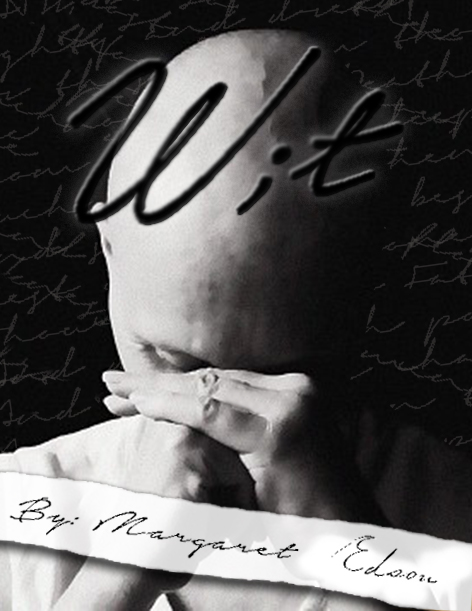
W;t at the Walterdale

The drama W;t  (pronounced like Wit), opened tonight at the Walterdale Theatre.  I have been fond of that play since I worked on a scene from it in a Citadel acting class a couple of years ago.  The current production, directed by Anne-Marie Szucs, is wonderful.  As long as you are not in a life situation where watching someone on a stage dying from cancer would be too difficult, I will recommend this production to you.

Mary-Ellen Perley is wonderful as Dr. Vivian Bearing, the 50-year-old academic and Donne scholar who has cancer, “late-stage metastatic ovarian cancer”.   She is detached and wry, angry, lonely, thoughtful, blunt, and eventually in anguish, and it felt real to me.

The script (by Margaret Edson, and with a Pulitzer prize) and the direction and design of this production show what it’s like to be whisked around from test to test, technician to technician to research fellow, in a hospital.  The ensemble players (Kingsley Leung, Sarah Van Tassel, Macalan Boniec-Jedras, Katelyn Trieu), dressed in matching scrubs and clean sneakers, whisk various pieces of apparatus around the stage, deliver Dr. Bearing to each test by wheelchair, and speak a few rote sentences each time, all the while moving at high speed and never making eye contact with Dr. Bearing or with each other.   Glimpses of humanity in the medical setting are provided by her oncologist (dale Wilson) and by the nurse Susie (Bethany Hughes).   Her one visitor in the hospital is her old graduate supervisor Dr. Ashcroft (Syrell Wilson), also seen in a flashback scene showing Vivian as a driven undergraduate and Dr. Ashcroft as both academically demanding and encouraging the student Vivian to seek out balanced life.

Two particularly telling scenes late in the story and late in the progression of Vivian’s illness are conversations she has in her hospital room with Susie and with the research fellow Jason (Mark Drelich).  To Jason, she acknowledges that like him, she’s always been more interested in research than in people.   It is clear to the audience that Vivian now wants more human connection than people like Jason are giving, but she does not criticize him directly or expect him to change, or nor does she express any regrets for her own choices.   Susie is on night shift when Vivian wants someone to talk to.  Susie brings the conversation around to the prognosis and the hard decisions about end-of-life choices.   And in one of the most unguarded moments, Vivian asks, child-like, whether Susie will still take care of her until the end.

And the end is … the end.  Messy and unfair and ugly – until it isn’t.


Playing at the Walterdale until Saturday the 12th, 8 pm Tues-Sat and 2 pm Sunday, advance tickets at Tix on the Square and same-day tickets at the theatre unless they sell out.  Which they might.


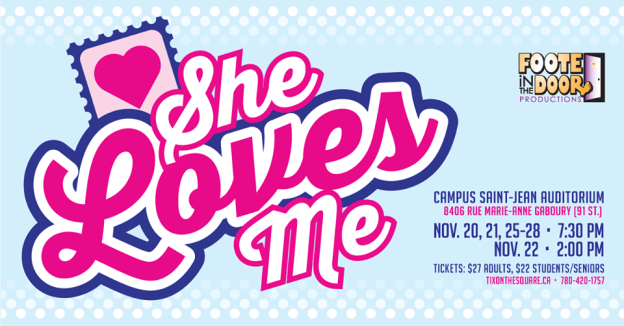
She Loves Me!

The other night I watched a musical that was new to me.  Not new to other people, She Loves Me (book by Joe Masteroff, lyrics by Sheldon Harnick, and music by Jerry Bock) first hit Broadway in 1964, and is opening again next spring.  The Hungarian play on which it’s based was also the basis for the 1998 romantic comedy movie You’ve Got Mail.

The current production, in the Amphitheatre at Faculte St Jean (across the street from La Cite), by Foote in the Door Productions, is directed by Barb Mah, with music direction by Michael Clark.  The setting, a 1930s perfume shop in Budapest, was simply evoked with shades of pink and green in backdrops, counters, and sales-staff shopcoats.  The shop seemed like the equivalent of something like The Body Shop or Lush – selling a variety of necessities and luxuries, focusing on customer experience, and doing a huge business in presents before Christmas.

As in the usual workplace-set story, there’s a cast of characters that includes a boss (James Toupin) with some unreasonable demands and prejudices, an eager-to-please errand boy (Sam Banigan), and a loyal sidekick (Dustin Berube), and in this case there’s also some sub-plot material in the affair between co-workers (Christina O’Dell and Mitch Caddick).  The story soon focuses on Georg (Russ Farmer), a senior employee mistrusted by the boss, who confides that he’s been writing letters through a lonely-hearts correspondence club to Dear Friend.

On a busy day in the shop, then, in bounces Amalia (Ruth Wong-Miller), costumed in a beautiful peacock shade of blue that stands out dramatically from the rest of the show palette, and she quickly talks herself into sales work with a very funny demonstration.  Amalia is also a member of the Lonely Hearts correspondence club, and you can guess the broad strokes of where the story goes from there.

My favourite bits of the show were some of the ensemble numbers with dancing, the stylized couples in the restaurant with the snooty waiter (Kent Sutherland), and the Twelve Days of Christmas shopping crowds in the store.  Six musicians behind the scenes provided accompaniment, atmosphere, and extra entertainment, and the singing was delightful.  Ruth Wong-Miller has a strong pleasant soprano voice and is particularly well cast in this show.  The part with her jumping on the couch in pajamas is also charming.

The last show of the run is tonight (Saturday 28 November) at 7:30.  If you haven’t seen it yet, they should have tickets available at the door, and it’s a lot of fun!

Devour Content Here / Of Love and Wheat: dustbowl drama in the dust

After Fringe and the Fringe Holdovers  – I saw Edgar Allan and In Search of Cruise Control.  They were both good.  I’ll tell you about them soon if I have time – my theatre world was quiet enough that I almost ended up going to a movie last week because I was bored.

Fortunately, the performance season is starting up again.  Next weekend Rapid Fire Theatre has four shows and Kaleido Fest has lots of interesting things on the schedule and it’s the Edmonton Burlesque Festival.

And this weekend Kristine Nutting is directing an original production in an old warehouse near the stadium.  I think the play was called Devour Content Here and it contained a play called Of Love and Wheat – but I’m not sure.  It had many of the challenges typical to mounting a production in an unconventional venue and requiring the audience to rove about – difficult acoustics, limited lighting choices, having to wait for the audience to move between scenes and being restricted in how they direct audience traffic by trying to stay in character.  An additional challenge of this space is that it is quite dusty.  Some of the audience members wore the provided dust masks, but the performers and crew did not.  I saw it on opening night and again last night.  The second night they were much more explicitly directive about showing people where to sit and stand, and they admitted fewer people, which also helped.

David Arial played a Narrator, but by the end he seemed to be part of the plot as well, with suspect motives of his own.  Or maybe he was two characters.  The ostensible setting was prairie drought dustbowl in a small town in the 1920s, but it had some mythical and fantastic elements.  The story was a little hard to follow, but fortunately a lot of it was fairytale archetype – the manipulative ambitious mother Liliette (Sarah Ormandy) wanting to make an advantageous match for her daughter (Sydney Campbell) with a visiting tycoon (Nathan Plumite), the daughter falling in love with the sewage man’s son (Steven Andrews), stories of leaving home for a better life and not succeeding, people being blackmailed or forced or tricked into various unappetizing agreements, etc.

There was a large chorus of despairing townspeople in makeup/costume/demeanour that reminded me of both bouffon and zombies, and there was a live band playing original music.  There were unexpected bits of circus-aerials performance, there were some solo songs and there were a few ensemble songs.  There were crass moments, horribly disturbing moments, ridiculously overdone and tongue-in-cheek bits, and a scene that shifted from absurd to compellingly intimate at different moments for each audience member (meaning that some people were giggling while I was nearly in tears).   And there were characters who seemed to be struck by nausea every time the word “economics” was spoken.

I liked the way that the young couple Harriet and Oscar seemed to be realistic awkward young people, surrounded by weirder-than-life characters speaking in some heightened or poetic register.  I appreciated Sarah Ormandy’s portrayal of the ambitious mother and former Chatauqua beauty queen, her jerky movements a parody of grace and her self-absorbed behaviour reminiscent of Snow White’s stepmother. (Late in the play, I thought I heard another character call her Lilith, which fitted.)  The best part of the music was the melodic motif “Come on down to the dark soul of the dustbowl, It’s the blackest place on earth”.  Other parts of the instrumental and vocal music suffered from the acoustic difficulties of the venue. 

If this sounds like your kind of thing, if you like performances that try out things that might not work, if you would rather see something original than something tidy, there is one more show Labour Day afternoon.  Doors open at 2:30.  Admission is by donation (they suggest $20 for the gainfully employed and $10 otherwise).  They provide dust masks, and some buckets and crates for patrons who don’t want to stand the whole time, and I saw them make accommodations for mobility impaired patrons.