Category Archives: Music

The Bridges of Madison County – catch it this weekend!

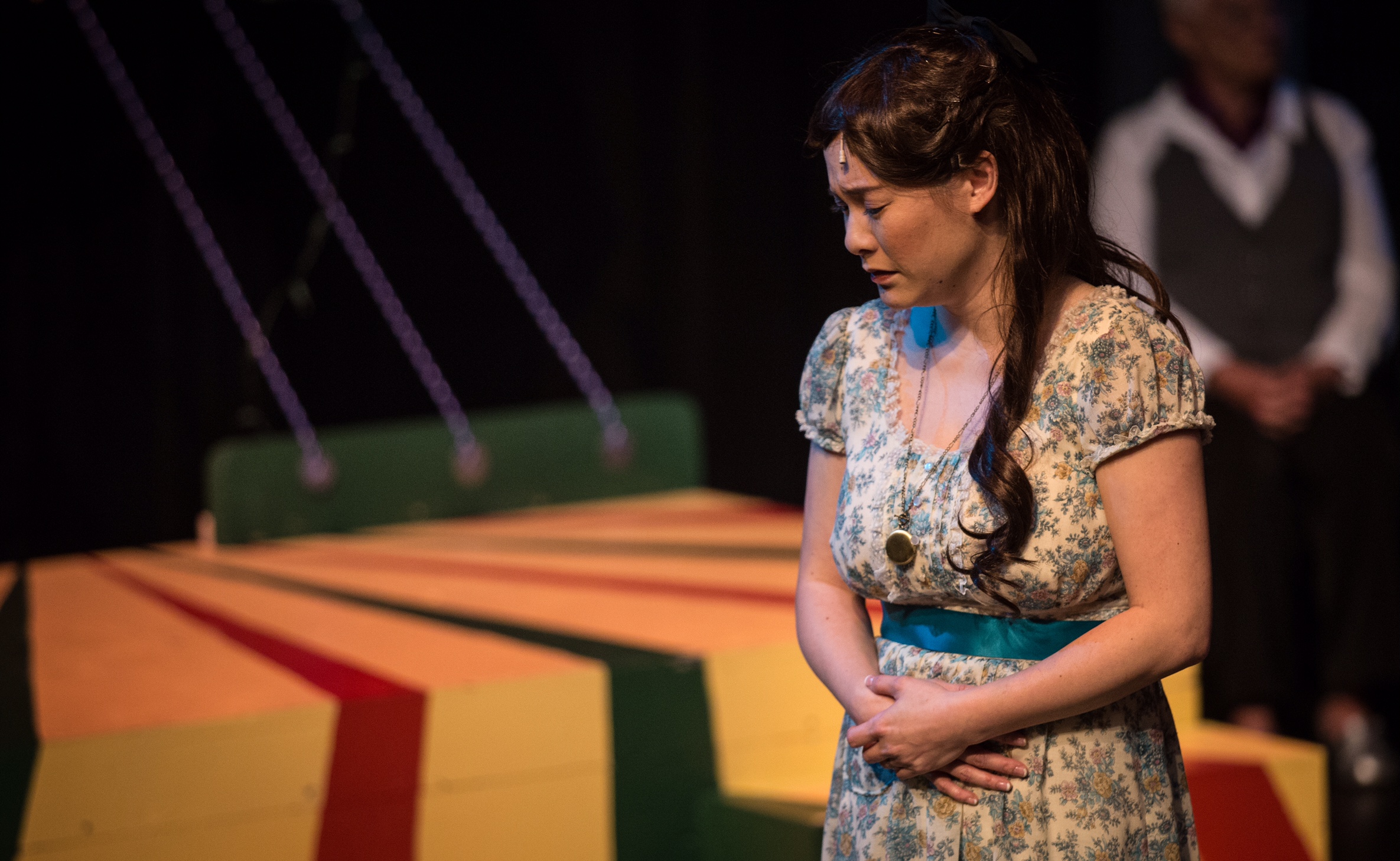
Vincent Roberts, Liam Lorrain, and Nicole Gaskell in The Bridges of Madison County. Photo credit @karalittlephoto.

You might be familiar with The Bridges of Madison County as a novel written by Robert James Waller in the early 1990s, or as a movie starring Meryl Streep and Clint Eastwood, mid 1990s.

It’s also a musical – book by Marsha Norman and music and lyrics by Jason Robert Brown. The local musical-theatre company ELOPE is currently performing this musical in a short run at Varscona Theatre. If it sounds interesting to you, catch it soon – it closes Saturday night.

The Bridges of Madison County is a story of love, of longings and loyalties, and overwhelmingly a re-creation of a place and time. It’s set in farm country in Iowa, mostly around one farmhouse kitchen, in the 1960s. The main character, Francesca, (Nicole Gaskell) was a war bride who met her US serviceman husband Robert (Vincent Roberts) in Naples, and has lived in Iowa ever since. They have two children, Michael, 16 and restless (Liam Lorrain), and Carolyn, probably about 14, who loves 4-H and farm life (Cassidy Galba).

After an opening solo in which Francesca tells her story of moving to the US post-war, with hat, gloves, and suitcase, with a backdrop of black-and-white slide images, the action of the musical opens with family and friends bustling around Francesca in her kitchen, before she sends her family off to show a steer at the State Fair, looking forward to a few days of privacy and quiet. The first scenes show the affectionate and busy atmosphere, the co-operative farm community and the challenges of parenting teenagers. It’s easy to sympathize with the quiet woman wanting some alone-time.

But if you know the story, you know that while Francesca’s family’s away, she unexpectedly chooses a romantic liaison. National Geographic photographer Robert (Martin Galba) stops by looking for directions. She helps him out and finds out that he’s a solitary nomad who has photographed her hometown of Naples. They talk about the longings and losses in their lives, and find feelings for each other. I’m always a bit skeptical of instant-soulmate stories (even for teenage characters like Romeo and Juliet or Maria and Tony), so I tend to get stuck on this part of the plot. But I appreciated that the writers, director, and actors did not make Francesca’s husband Robert a caricature of unsympathetic husband either. Director Cory Christensen said “It was important to show that Robert isn’t stupid and mean, that he’s a good man, likeable.”

Details are elided, reproducing the novel’s feel as a poetic interlude, four days out of normal life. But the phone keeps ringing – Francesca’s husband, accustomed to sharing daily life with his wife, Carolyn and Michael, complaining to Mom about their lives, their father, and their future plans, and her neighbour and friend Marge (Erin Foster-O-Riordan) who has guessed what’s happening. We can’t forget that Francesca has loyalties and commitments, and neither can she.

It was clear that the story could not have a happily-ever-after ending for everyone. The ending it did have was honest and credible and poignant, although shifting time to show later-life outcomes for all led to a slower-paced ending. I was impressed by how the actors playing the teenagers shifted to being credible as 5-7 years older.

I thought all of the singers were very good, particularly Nicole Gaskell in the role of Francesca. Her program bio says that she’s recently returned to Edmonton from studying and working in the UK, and I hope to see her again on Edmonton stages. There were some ensemble musical numbers near the beginning where I found it hard to make out the words, possibly due to sound balancing difficulties. Joy van de Ligt, music director, led an orchestra of seven. Morgan Smith and Avery Neufeld completed the acting ensemble.

Design choices enhanced the storytelling in many ways, particularly the lighting design of Rebecca Cave, with spectacular Iowa skyscapes and kitchen-table intimacy. The kitchen was cleverly evoked in Leland Stelck’s set design, by a few moving pieces and a chrome-edged table and chairs. Director Christensen pointed out that the corn silhouetted against the sky was actually real corn stalks, obtained from a local corn maze.

This is the first time an ELOPE show has used the Varscona Theatre venue. The auditorium is smaller than the Westbury, and more intimate than Le Théâtre Servus Credit Union, with the audience closer to the stage and warm acoustics. The company has usually been doing one large musical a year (Rent, Joseph and the Amazing Technicolor Dreamcoat), but is expanding this season by adding this short run of a smaller-cast show. Their season will continue with a production of Amelie, June 26-July 5, 2025, at the Timms Centre, U of Alberta. Kristen Finlay will direct and Sally Hunt will be music director.

Shall I draw an analogy between Francesca’s impulsive grasping at her opportunity of connection with Robert, and a recommendation to book your ticket to this short run of The Bridges of Madison County before it closes Saturday night? Perhaps not – you have no reason to hesitate, and more chance of regrets if you miss it! Saturday also has a matinee. Tickets are available here.

Starting to Find my Fringe 2024

Image: Fringe 2024 poster designed by Yu-Chen (Tseng) Beliveau – drawing including universal aspects of Fringe and specifics of many previous festival themes.

This year’s Fringe theme, Find Your Fringe, highlights the concept that everyone’s Fringe is different – that there is no “wrong way to Fringe” but thousands – hundreds of thousands – of ways to Fringe, as many as there are attendees and participants.

My Fringe had a great start with a performance of the new musical I’m stage managing, Regression, at the Playhouse. Then I rushed to two more performances, in weather that went from smoky to cloudy to rainy.

Heartstrings, at the Lumos Dental Grindstone-classroom space at Whyte Avenue and 96 Street (venue 19) is a sweet improvised relationship story from Two Girls Improv of Calgary. The two performers get an audience suggestion, and then segue seamlessly into various scenes from the lifespan of a romance, not all in order, with related backstory and additional characters. I love watching this kind of long-form episodic improvised narrative, but I’m especially impressed when they can manage scene changes /character changes without an obvious “tell”. (Improv troupes who make these switches more obvious include Agent Thunder and Scratch.) The humour in the characters was inherent and gentle, and all of them were familiar, easy to relate to – even the dad who didn’t know how to dad, and the awkward inappropriately-personal church lady. There were several opportunities for characters to come out to themselves or their scene-partner, all of which were played in a natural 21st-century way. I’d like to see this troupe again.

Brother Love’s Good Time Gospel Hour was scheduled at just before midnight in the Westbury Theatre, after it had started to rain. So the audience was small, but enthusiastic (also thanks to FOH, who let us line up indoors). When we entered the performers were already “on”, interacting with patrons as if we were coming in to a revival meeting. They encouraged us to sit in the front rows where some props were placed, and they kept playing and singing something with gospel-music harmonies and words that I only gradually noticed were … well, non-traditional. The shift from pre-show into show was nearly un-detectable, as Brother Love (Noam Osband) and Sister Alice (Edna Mira Raia) welcomed us to their revival event. They also had backup musicians and a vocal chorus on stage. And their event became more and more outrageous, from declaring their motivation to raise funds (for alimonies, and for a trip to Helsinki to see Cher), to the various appeals and merchandise sales they were proposing. There were some opportunities for audience member participation, and I thought they were good at reading the audience and giving permission to decline. It’s marked PG – I think teenagers would probably enjoy it a lot but adults might squirm if their teenagers were in the room, instead of guffawing at the “I can’t believe they said that!” moments and frank discussion of sex. Apparently the show runs 75 minutes, but it is well paced and I was so caught up in it I was surprised when they cued that it was almost done.

Today I’ll be doing my first volunteer shift, maybe buying my first green onion cake, showing my artist pass on the bus for the first time this year, and enjoying Day 2 of Find Your Fringe. Hope you find yours! And if you see shows, tell people what you thought of them – in person, on whatever social media you use, on the comments below, or wherever else you hang out. One of the best things about Fringe is the way we build a communal experience, from our personal experiences. “Did you see …?” “Where were you when …?” “You really need to make time to see …!” Other blogs to check out include https://12thnight.ca/ and Finster Finds. There will be some reviews and previews at the Edmonton Journal (Check the Festivals tab, or Local Arts or Entertainment). Global TV news has an “eye-cam” on site and other features. Productions that have a St. Albert connection are covered by the St. Albert Gazette‘s arts reviewer. I’ll add more links to collections of media coverage as I find them – it shifts from year to year, and I still miss the VUE Weekly’s concerted effort to review every show within the first few days. Tag your own posts, anywhere public or semi-public, with the artists’ handles, with the Fringe’s handle, with a venue handle, to share your Fringe enthusiasms. See you on the grounds!

Carousel: a musical to think about

Foote in the Door Productions has taken another big step with their latest production, Rodgers and Hammerstein’s 1945 classic Carousel.  Their first mainstage show was She Loves Me, a light workplace romance with a spunky determined shopgirl heroine.  Their second mainstage show was How to Succeed in Business Without Really Trying last fall, a lighthearted 1960s look at corporate-workplace problems such as sexual harassment, nepotism, and the Peter principle, with the spunky determined officegirl’s happy ending being the suburban-homemaking wife to her upwardly-mobile sweetheart Ponty.

But Carousel covers tougher material, and includes some bits that are harder for modern audiences to deal with.  This post contains spoilers.  It’s mostly set in 1917, in a small town in Maine where the men mostly fish for a living and the women have jobs too, like working in a textile mill, or working at the inn owned by Nettie (Carolyn Ware).  Protagonist Julie Jordan (Ruth Wong-Miller) and her friend Carrie Pipperidge (Natasha Mason) are millworkers, constrained to live in the millgirls’ dorm and follow chaperonage and curfew rules to keep their jobs.

Julie1ftd

Ruth Wong-Miller, as Julie Jordan, in Foote in the Door’s production of Carousel. (Nanc Price Photography)

Contrasting with this orderly and rigid culture is the carnival life, with manager Mrs Mullin (Rebecca Bissonette), carousel barker Billy Bigelow (Russ Farmer) and assorted non-speaking midway performers.  Billy and Julie meet each other, and then linger chatting on a bench despite both of them losing their jobs for the dalliance.  The speed and inevitability of these consequences seemed unconvincing to me as a modern audience member accustomed to more workplace rights.   Julie is fired because she defies the mill owner’s offer to drive her back to the dorm before curfew and Billy is fired by the carnival manager who is jealous of whatever unspecified relationship she has with him.  Both of these firings seemed to happen before either character knew the other one well enough to judge beyond some degree of attraction – and both of them have attitudes of “nobody tells me what to do!” that cause them trouble.   And that sets in motion one of those tragic unstoppable trajectories – they’re stuck together because of losing their livelihoods and accommodations, he is unsuccessful getting work, she gets pregnant, he gets drawn into a criminal plan in order to provide for his family, etc.  Farmer’s Billy is not a classic hero at all – he’s shortsighted (gambling away the criminal takings before they even do the crime), cocky with women, and stubborn (unwilling to take work on a fishing boat), still defiant after death as a soul in the afterlife.  He’s ill-equipped for adult life, his schemes don’t work, and he kills himself rather than go to jail.  His own outcome follows directly from his bad qualities and the culture he’s in, and his afterlife redemption only comes after his second attempt to give his daughter Louise (Megan Beaupre) a better chance than he had.

The part that was most uncomfortable for me was that Billy hits Julie, and she excuses or accepts it.  The hitting took place off stage.  We learn when Julie confides in her friend, and then the other women overhear and make sure everyone knows.  Everyone who responds to Julie lets her know it’s not appropriate and she didn’t deserve it, and Carrie challenges her when she makes excuses for Billy.  So after Billy dies and we see Julie carrying on, working with her cousin Nettie to run the former inn as a boarding house and raising her daughter, I’m thinking this is the best possible solution in fiction, anyway, because I don’t want to see her getting abused on an ongoing basis and I don’t believe he could reform.  But then when the heavenly powers (Pauline Farmer and Shauna Rebus) give Billy a day on earth to take care of “unfinished business” his first attempt to reach his daughter and inspire her ends in him losing his temper and slapping her hand.  The audience, like Louise, is horrified.  Perhaps she has not been raised with violence and the cycle has been broken.  However, when Louise tells her mother about the slap that “felt like a kiss”, Julie, reminiscing, says “It is possible, dear, for someone to hit you, hit you hard and have it not hurt at all.”  Does Louise take this as her mother’s encouragement to accept relationship violence?  Is Julie at risk of accepting abuse in a future relationship?  Is the pattern doomed to continue?  I desperately want to believe all the answers are no. but after the performance ended I had to go walking in the rain by myself instead of standing around in opening-night crowds in the lobby, so I could think.  I thought about how hard it is to change abusive patterns of behaviour, and I thought about what a good job director Mary-Ellen Perley and her cast and team had done, to make me that disturbed.

More subtle commentaries on the prevailing attitudes and the patriarchal culture come from Julie’s friend Carrie.  It’s clear that she’s marrying for love as well as marrying up, when she introduces her fiance Mr. Enoch Snow (Rory Turner).  He’s full of plans for expanding his fleet of fishing boats and expanding his household to include a wife and many children.  She’s thrilled with her handsome beau, but he’s quick to judge her as unvirtuous when he surprises her with scoundrel Jigger Craigin (Morgan Smith), without hearing her side or considering her character of naive kind enthusiasm.  And in the 1945 scenes at the end, she tells Julie “If I had more sense I wouldn’t have had nine children.”  Natasha Mason’s Carrie is a gentle reminder that the “proper” path for women in that town was also lacking in autonomy and flawed by modern ideals.

Carrie ftd

Natasha Mason, as Carrie, in Foote in the Door’s production of Carousel (Nanc Price Photography)

Foote in the Door is partnering with WIN House, the local domestic abuse shelter.  Brochures with information on the issue and the organization are available at the show, and donations are solicited from the audience afterwards.

My favourite songs in this production were Nettie singing “You’ll Never Walk Alone”, and Billy’s “The Highest Judge of All” which had a particularly interesting orchestral accompaniment.

Foote in the Door has also taken a practical step with this production, across the street from the auditorium of Faculté St-Jean to the bigger stage of L’UniThéâtre at La Cité.  This facility gives them better lighting options, and the space for a fifteen piece orchestra as well as a large active ensemble.  Carousel runs this weekend and next week, closing Saturday June 24th.  Advance tickets are available through Tix on the Square, same-day and weekend tickets at the door until they sell out.


More good plays

Assassins (the Sondheim musical) was the first musical I’ve seen at this year’s Fringe.  With a cast of ten and a musical ensemble, it’s well placed in the Westbury.  It’s a series of vignettes about everyone who assassinated or tried to assassinate a US president.  As I wasn’t familiar with many of the stories and I didn’t get a program until afterwards, I probably missed the ones in the middle – I remembered about John Wilkes Booth (Jacob Holloway), John Hinckley (Maxwell Lebeuf), and Squeaky Fromme (Emma Houghton, with Nancy Macalear as her collaborator Sara Jane Moore), and partway through I started wondering whether I’d missed the part about Lee Harvey Oswald killing President Kennedy – but that was the climax which came near the end, since I guess it’s the most memorable one for a lot of living Americans too.  Scott Shpeley, who had been playing with the musical ensemble, also turned out to be Lee Harvey Oswald.  Chris W Cook, Jeff Page, Rory Turner, and Billy Brown played other assassins I wasn’t familiar with, and Dan Rowley, and Larissa Pohoreski other characters in the ensemble.

Typhoon Judy was also a performance focused on music, with Christopher Peterson playing an aging Judy Garland, in song, in reminiscence, in flirtation with accompanist (Nick Samoil), and in four fabulous costumes.  The portrayal was credible and touching.

MAN UP! was a wonderful dance show with social commentary.  It’s being held over at the Westbury next weekend, so you have a couple more chances to see it.  Four male performers dance in high heels, powerfully, poetically, and conveying a range of emotions.  Some pieces include all four (Gregory P Caswell, Joshua Wolchansky, Jordan Sabo, CJ Rowein) and some have smaller groups or solos.  Rowein and Wolchansky’s love duet was particularly moving, as well as Wolchansky’s barefoot solo on the side stage.  Monologues and video clips provide context and discussion-starters about the limitations of conventional gender expectations (as well as allowing time for costume changes).  I was fascinated to realize afterwards that the performance had been lacking the personal flirtation aspect of burlesque dancing.

Every Fringe I see Rocket Sugar Factory, the improv duo of Jacob Banigan and Jim Libby, because they are so much fun to watch.  Along with their local accompanist Jan Randall, they are masters of crafting long-form stories and playing them out with delightful characterizations.  This year their show involves creating the pilot episode for a new television show, and the one they created in front of me, Mister Jules Verne, was something I would watch if it existed.  I love the way these two switch characters seamlessly, borrowing mannerisms and language habits, and I’m also a fan of Jim Libby’s near-corpsing, letting his delight in the game show through the characters he’s embodying.  (One of the 2 For Tea performers, James, does this as well.)

I also made time to see a new comedy, Harold and Vivian Entertain Guests, written by University of Alberta acting student Jessy Ardern.  Take the premise of Who’s Afraid of Virginia Woolf – the older couple full of malice entertaining a couple of starry-eyed naive newlyweds, and wield them as weapons in their battles with each other – and make it funny instead of horrible – and that’s the start of Harold and Vivian.  David Feehan and Kristen Padayas play the eponymous hosts, and Rebecca Ann Merkley and Eric Smith play Janet and Mike, the young couple who arrive with over-the-top optimism and PDA and gradually crack into full-on hostility as well.  Corben Kushneryk (also seen this Fringe in Who am I?…) is credited as director and designer, so he must be responsible for the delightful set conveying the reality of a starkly divided household before the show even starts.  I was especially taken with Padayas’s portrayal, the perfect pink bouffant homemaker with twitches of panic and surges of rage.   Eric Smith’s brand of pomposity and pratfall may also be seen in Death Comes to Auntie Norma (one more show, Sunday 8 pm).


Life, Death, and the Blues

Before I went to the preview show of Life, Death, and the Blues, I had difficulty describing what it was going to be like, despite reading the various posters and previews.  All I knew was that it was going to have music in it and it was going to have Raoul Bhaneja in it.  And since I still remember being impressed by Raoul Bhaneja’s One-Man Hamlet at Edmonton Fringe in 2008, I knew I wanted to see what the artist was up to now.

And afterwards, my companions and I agreed that it had been different than we expected, and thought-provoking and enjoyable.  I had lots of blues music in it – played and sung by Raoul Bhaneja and his band (Chris Banks, Tom Bona, Jake Chisholm), by Divine Brown, near the end of the show by featured guest, local blues artist Kat Danser, and at intermission by local trio Old Jack Tap.  The featured “Legends” during the show are different every night, and so are the intermission Youth Blues Challenge acts.

The backbone of the show was narrative, by Raoul Bhaneja about how he’d explored the blues genre throughout his life, and by both Bhaneja and Brown about the history and geography of the blues in general.  And what I loved most about the show was the head-on way the conversation addressed the issues of racial prejudice and assumptions, stereotypes and privilege, the difficulty of not being complicit and the “magical Negro” myth, all involved in having white people and people of other ethnicities exploring the history of the blues (mostly developed by and for African-Americans in the USA).  As a self-identified beige person, (he was born in England to an Indian father and Irish mother, and seems to have grown up attending private school and travelling with diplomatic-service parents who settled in Canada), Bhaneja told some of his own stories of encountering biases and overcoming challenges due to his colour and ethnicity.  But Brown, a Black Canadian woman, called him out repeatedly on his whitesplaining, reminding him that these experiences did not qualify him to speak for African-Americans or justify calling himself a blues insider.   She also pointed out that it’s not really appropriate for people of other ethnicities to criticize Black communities for not being quick to embrace retro movements and nostalgic preservation of times of unhappy memory.  She points out that even his childhood travel adventure to Egypt and the pyramids represented the death of many slaves.  Even though it was a scripted show written by Bhaneja, I was happy to see the aspects which might have been problematic being identified by Brown, a confident talented Black female performer.  The banter between the two of them also illustrated and challenged the expectations of sexual tension in the blues – and then the jam session with local blues performer Kat Danser shook that up some more, both in the way she glossed over Bhaneja’s glib flirtation and then in her performance of the Ma Rainey song, “Prove it on Me”, a 1928 celebration of butch culture and lesbian romance.

Early in the show, Bhaneja mentioned a hip-hop harmonica player from Montreal, Bad News Brown (Paul Frappier).  The “Death” part of the title became explicit late in the performance when he talked about Bad News Brown’s death from apparently-random violence on a Montreal street, four years ago that night.   The next song was a version of Jim Croce’s Bad Bad Leroy Brown, which the band had played in the first act, but with lyrics paying tribute to Bad News Brown.

Another noteworthy bit was Bhaneja singing a Hindu song about the Indus river that he’d learned from his father, Nale Alakh Je, accompanied by his upright-bass player Chris Banks, and with Divine Brown singing an English translation in harmony.

Life, Death, and the Blues continues in the Citadel Theatre Club space until March 1st, with tickets available here.  And then, Vigilante!

Superheroes and amazing drums

Between my beer tent shift and getting ready for Sonder’s evening show, I fitted in two performances Sunday afternoon.

Harold of Galactus is a longform improv show with local improv stars Chris Craddock and Mark Meer.  (“Harold” is the name of a common thematic longform improv structure, and Galactus is a comic-book character).   In the show I saw, the performers asked an audience member for the name of a comic-book superhero, and a front-row fan said he’d once made up one called Mortar.  Chris and Mark then had a brief conversation on stage about comic-book tropes and how they might play out for a superhero called Mortar, and then created a series of scenes and stories about the character and how he’d be portrayed in the different eras of comics, from 1942 to near-contemporary.  This let the audience have the fun of noticing all the quirks of Golden Age comic stories (“Is Hitler a hero because he killed Hitler?  But he also killed the guy who killed Hitler!”) and the tropes of more recent comic-book storytelling  (a sidekick who is invincible but nervous, very few women except the occasional supervillain, a league of criminals, and so on), bouncing between eras and landing at a satisfying resolution just before the time was up.  I love watching improv partners who have played together for a long time, because they pick up on each other’s cues so smoothly they seem to be telepathic.  Later in the week I have tickets for Rocket Sugar Factory (Jacob Banigan and Jim Libby) and for Scratch (Arlen Konopaki and Kevin Gillese), so I will get to admire that some more.  Chris Craddock occasionally fell out of character to grin at what was happening, which did not distract me from the story and just added to the sense of the performers having fun that is a mark of good improv. Fun and clever.

Then I managed to slip out quickly, dodge crowds, and get from Strathcona Library to King Edward School in 15 minutes to see Godzilla vs. Led Zeppelin, an hour-long performance of taiko drumming from Fubuki Daiko, an ensemble of four amazing drummers from Winnipeg, Hiroshi Koshiyama, Bruce Robertson, Naomi Guilbert, and Giselle Mak.  They were as exciting to watch as they were to listen to, and the show I saw was sold out.


Sonder’s next show is today, Monday at 12:15 pm, and the next one after that is Wednesday at 11:30 pm, both at Venue #5, King Edward School.


2 Pianos, 4 Hands, lots of characters

A trombonist friend told us that anyone who’d ever taken music lessons should try to see 2 Pianos 4 Hands in its run at the Citadel.  I saw it in the first preview Saturday night, and I agree.  Ted Dykstra and Richard Greenblatt wrote the play and perform in it.  This is their last tour with the show.

The stage is empty except for two shiny Yamaha grand pianos, two coatracks, and two large picture frames in which are projected occasional stylized images indicating changes of scene.

The show starts with the two pianists entering in tailcoats, saluting the audience, then sitting down to play a duet.  Then follows a hilarious set of disagreements and negotiations about who gets which piano, who gets which piano bench, and when they start, all conducted completely in silence.

The tailcoats then come off as the performance moves forward in a series of vignettes about the characters growing up playing the piano.  Each actor played the other’s parents and piano teachers, and in a particularly funny scene they addressed the audience as the session chair and adjudicator for a Kiwanis Music Festival session.  The two boys also interacted as duet partners and as competitors in some scenes.  I particularly enjoyed recognising many of the specifics they referred to – Royal Conservatory exams, Kiwanis festival – and even recognised at least two of the lesson books they were using as props.  Illustrations of general music-lesson memories about parents prodding the child to practice and about teachers’ contradictory advice were also amusing.

I admired the way they showed similarities in the two characters’ alternating scenes, but still made them distinctive people.  The characters and the performers had the same names, so one might imagine strong threads of autobiography.  When Richard Greenblatt’s character was being taught by a nun, who used “Father, Son, and Holy Ghost” as a mnemonic for three notes, he corrected her under his breath with a three-word Hebrew phrase.  When the two boys were teenagers, each of them had a teacher who motivated him by telling him that girls would be attracted to a certain style of playing arpeggios (two opposite styles).

The vignettes continue as the two young men explore various ways of using their musicianship, and ends with them putting the tailcoats back on and finishing the duet they started the show with.

At intermission of the performance I saw, theatregoers all around us were talking about their own memories of musical childhoods, and we were too.  Friends who hadn’t taken music lessons as children said that they’d enjoyed the performance but knew they’d missed some of the inside jokes.  2 Pianos 4 Hands plays at the Citadel until November 17th.

Edmonton Folkfest 2013

I’m a relative newcomer to Edmonton Folkfest, having only been to four of them (I first moved to Edmonton on the Monday morning after Folkfest 2008.)

Every year the folkfest people tinker with some aspects of the festival to make the well-run thoughtful weekend even better for more people.  Some of those little changes are easy to be grateful for right away – for example, the closing of Stage 4 in order to give good sound quality on Stages 3 and 5, and leaving the Stage 4 area as a place to enjoy shade and relative quiet in a loud busy weekend, and moving the lower tarp lottery to behind the Muttart Conservatory where there is also grass, shade, and a little space to spread out and make a bit of noise early in the morning.

But sometimes the little changes are harder to get used to.  This year, I was disappointed in the new location for the bike lockup.

I love the Folkfest arrangements for a lighted supervised bike parking area with claim checks.  Since I worked out a cycling route to get from my home in Ritchie to the Folkfest site without challenging hills or busy streets, I’ve almost always gone to Folkfest by bike.  It has always seemed easier to me than learning where to park nearby and carrying my chair and other gear to and from the parking, or travelling by bus also with a significant amount of walking-uphill-with-chair.    But with the bike lockup at the Bennett Centre, just outside the main entrance, it was never quite big enough and getting out of there in the dark through the congestion of the taxi stand was always challenging.  So this year the bike lockup was set up on top of a hill behind the Muttart Conservatory – near the top of the Stage 6 viewing area, but of course there are some fences in between.  It’s a great setup.  Except that with my limited energy, I have to walk the bike up the final hill and rest before unpacking my gear, and then I have to walk most of a kilometer to the gate (1.2 km total from the bike corral to Stage 6) carrying my stuff, and at the end of the night there’s an uphill walk again.  And I can’t do it.  Not and have fun all day and have energy to dance.   I still love the idea of biking to Folkfest, but on Saturday and Sunday I took taxis.

Once I got in the gate, everything was great.  Interesting tasty food, good friends, musicians both familiar to me and unfamiliar, and good weather as long as I stayed.  (I didn’t stay long enough on Sunday night to encounter the thunderstorm.)   My favourite new musical discoveries of the weekend were Good for Grapes, from Surrey BC, and The Head and The Heart, from Seattle.  I also loved dancing to Delhi2Dublin (whom I’ve heard at previous Edmonton Folkfests and at Blue Skies in rural Ontario) and I loved being swept into memories by Bruce Cockburn’s voice in his mainstage show.

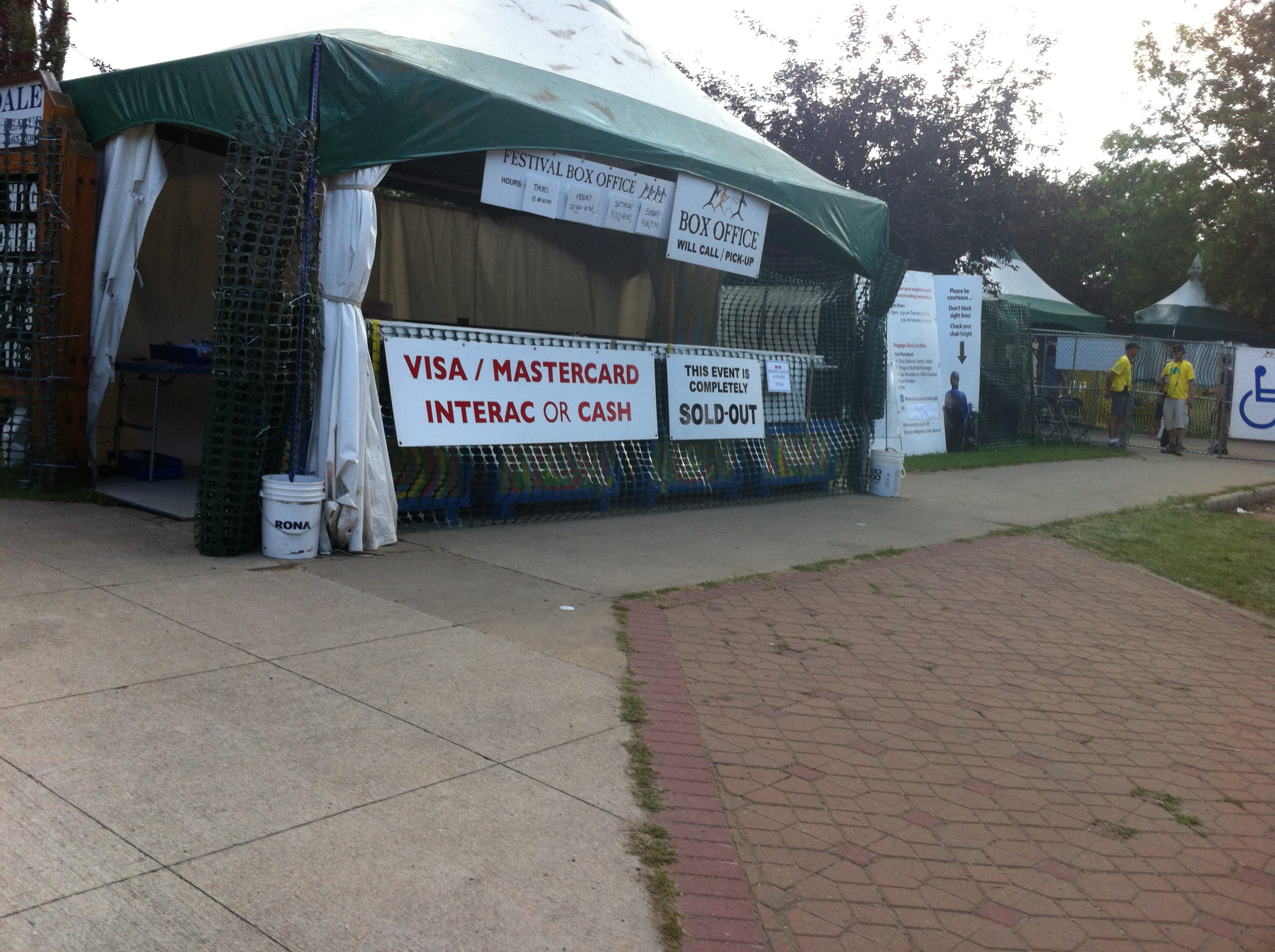
Photos: Sean MacKeighan of Good for Grapes, dancer and singer of Niyaz, box office with their job done.

good for grapes 6 dervish 2 box office done

More photos:  Makana, Langhorne Slim

makana langhorne slim 3

Zodiac Arrest – a circus cabaret

The Westbury Theatre is the big theatre space at the Transalta Arts Barns.  I’d only ever seen it with the risers pulled out on one side and a flat proscenium stage, but the other night when I walked in, it was transformed with a few rows of seats on each of the four sides, zodiac symbols projected on a curtain on one side, and a big empty sprung floor, set up for a show by Firefly Theatre, the Edmonton troupe specialising in circus arts and physical theatre.

There were twelve performances, each introduced by patter from a costumed host evoking the characteristics of each zodiac archetype.  About half of them were arial acrobatics acts, and they were all amazing – Kadri Hansen, Lisa Feehan, Danny Gorham, Kim Precht, Meghan Watson, Kristi Wade, Annie Dugan, Michalene Giesbrecht, and Kim Precht.  The lighting, music, and costuming contributed to different moods from playful to romantic to creepy.  I don’t have any interest (or aptitude!) to attempt arial work myself, but the Firefly Theatre website has lots of information about workshops and beginner classes in their various disciplines.

Other acts included some clown performances (Candace Berlinguette and Mike Kennard), some stage magic by Billy Kidd, a dance version of the story of Ariadne (including Jamie Cavanagh as an egregiously self-absorbed Theseus), and some contortionists cum rhythmic gymnastics performers (Mackenzie Baert and Caitlin Marchak)

I thought that some of these acts dragged a bit, and that the astrological monologues were likewise too long, but on the whole I had enough awe and delight to make it a worthwhile evening.  Zodiac Arrest’s last show is tonight, Sunday at 8 pm, with tickets still available at Fringe Theatre Adventures. 

Les Misérables (in all media except the novel)

I don’t have very many name-dropping theatrical-performance memories to brag about.  I saw CATS! in Toronto – but I think everyone who lived within a day’s drive and who could afford it saw CATS! in Toronto.  I saw an outdoor performance of The Importance of Being Earnest directed by Linda Carson, but that won’t mean anything to you if you’re not from Kitchener-Waterloo.  I once saw Maggie Smith do a powerful Lady Macbeth at the Stratford Festival (Ontario.)  And I saw Les Misérables in the London West End production, about 9 months after it opened.

I had never read the novel in French or in English and I didn’t have ready access to Wikipedia-type plot summaries before going to the musical, so I didn’t know much about the story or characters ahead of time.  The part that hit me hardest on that first viewing was the story of Éponine’s one-sided crush on Marius and how she struggles with facilitating Marius’s romance with Cosette.  Unfortunately, that was a familiar dynamic to me in my own life at the time.

When I saw a preview of the movie version a few weeks ago, I knew I would want to see it.  So I pre-ordered the highlights album of the movie from iTunes, and didn’t discover until after it had arrived that the highlights didn’t include “Do You Hear The People Sing?” (the song I remembered most clearly from the stage production, due to performing it in an ensemble at camp once) and some other important songs.  Still, though, I listened to the album several times before going to the movie.  That familiarity made it easier for me to take in the story and the acting, without being distracted by differences from another version of the songs.

It’s a long movie.  But unlike The Hobbit, I didn’t think any of it dragged out.  It moved compellingly from event to event and it was easy to see how one thing led to the next.  At the end of it I was exhausted, inarticulate, and out of Kleenex.  Both my cinema companions are insightful theatregoers with more knowledge of the stage show than I had, so I need to credit our discussions (in between the sniffles) for helping me articulate some of the observations below.

The story of Éponine (Samantha Barks) was still very sad, but this time around I didn’t see it as the main story.  This time, I had more interest in the story of Jean Valjean (Hugh Jackman)’s struggles to start over and to do the right thing, and even the parallel between his feelings about the Cosette (Amanda Seyfried)/Marius (Eddie Redmayne) romance and Éponine’s feelings.  Everyone who reviews this film comments on Anne Hathaway’s moving performance as Fantine, and I agree.  I liked Russell Crowe (Javert)’s singing voice a lot, but I didn’t find Javert as interesting a character as Valjean.

The colour palette of the film was noticeably limited.  It started from the blue and red and colourless tones of the French flag, echoed by uniforms of guards and prisoners, and continued almost completely in that colourway, with occasional golden lighting.  There was no green at all in the whole film except for some dark-green uniform jackets in one scene.  The venal innkeepers the Thénardiers (Sacha Baron Cohen and Helena Bonham Carter) had somewhat more gaudy tones, which went along with the playful mood-switch of their song “Master of the House”.  M. Thénardier reminded me bizarrely of Frank N. Furter played by Tim Curry in Rocky Horror Picture Show, which was distracting.  For sheer eye-candy, Anne Hathaway and Aaron Tveit (Enjolras) were the loveliest to look at.  I recognised Aaron Tveit’s voice as that of Gabe from the Broadway recording of “Next to Normal”.

In the movie, the puniness of the barricade and the futility of the students’ rebellion were horrifyingly obvious, and the song “Empty Chairs at Empty Tables”, sung by Marius in the empty ruined tavern where his friends used to gather, was heartbreaking.  The movie showed the scale of the rebellion and devastation in a way that the symbolic sets of the stage show could not.

It’s still playing all over, and it doesn’t need IMAX or Real3D to feel real.