Tag Archives: walterdale

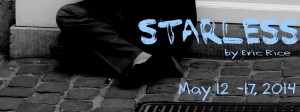
Starless, by Eric Rice

This year’s selection for Walterdale Theatre’s From Cradle to Stage new plays project was one longer work instead of a series of one-acts, Eric Rice’s work Starless.  I saw it tonight, and I found it unexpectedly moving.  So much so that I had trouble articulating questions at the talkback after the show.

That is a compliment.   I guess it’s a compliment to share among the writer, the dramaturge Tracy Carroll, the director Marsha Amanova, and several of the cast members.

Starless is a story about two homeless people, Ralph (Mark Anderako) and Mary (Monica Maddaford), and the people they interact with during one difficult day, a police constable (Dave Wolkowski), a boy (Carter Hockley), a blog reporter (Stephanie O’Neill), an artist/art-vendor (Jim Zalcik), a priest (Zalcik), and a landlord (Wolkowski).  The title refers to an advantage of sleeping outdoors over sleeping under a roof, that outdoors you can see the stars.  Ralph, the main character, seemed both credible and interesting – physically frail, foulmouthed, dirty, cynical, but at the same time having a clear sense of fairness and a tendency to poetic metaphor.  The audience never finds out Ralph’s whole backstory, because he’s not someone who would tell any of the people he encounters that day, and as his love Mary says (approximately – I stopped taking notes), “We don’t tell those stories.  Those were just things that happened.  We just tell the story that ends with living happily ever after.”

The set was simple but evocative of various outdoor locations – a park, a church doorstep, a coffee shop patio, the back of a low-rent apartment building.  Stage lighting is still a mystery to me, so I was astonished to realize at intermission that the floor was actually not green; it was just lit that way during the park scenes.  The music at intermission and after the show (Don Henley’s “Starry Starry Night” and a familiar cover of the Beatles’ “Let It Be”) was just perfect, fitting the story and the mood with emotionally familiar song, and I don’t remember now whether there was pre-show music or not.   I also appreciated the artist’s painting representing a monochrome version of Van Gogh’s Starry Night (“I call it Van Gogh misplaces his palette”), recalling my recent visit to the original work in New York City’s Museum of Modern Art (MoMA).

Maddaford and Hockley also played characters with enough depth to be intriguing and their own personal challenges.   Maddaford played Mary with an appealing serenity and some native shrewdness, and it eventually turned out to be easy to see why she and Ralph were together.  Hockley had great facial expressions when he was listening, very believable for a kid who is accustomed to be on the edges of adult conversations that he might disagree with or worry about.  His speaking was occasionally difficult to follow, although I’m not sure whether he was too fast, too quiet, or just not making his words distinct.

The minor character who most caught my attention was Jim Valcik’s artist, identified in the program as Vendor, a glib and self-absorbed painter who jumps to assure Ralph he can identify with him but doesn’t listen to him.  “Chaos and bars?  Yep, that was our art-student life; it was great!”

Starless is playing at the Walterdale through Saturday night, 8 pm curtain.  Advance tickets  are at Tix on the Square (listed as From Cradle to Stage), and also available at the door.  Thursday is 2-for-1 night.

Amazing things happened on the way to the Forum

This winter I have been helping with the Walterdale Theatre production of the Stephen Sondheim musical comedy A Funny Thing Happened on the Way to the Forum.  I’d never been involved with a large production or a Walterdale show before, and it’s been an amazingly educational and enriching experience for me.  I watched the directors and actors figure out the character arcs and stakes.  I watched the ensemble learn the choreography and marvelled at how well it fit the characters.   I learned to tape out a floor, to be “on book” for people learning lines, and to work out what props had to be where when.

There are so many aspects that have to fit together – so many skillsets that are all needed – so many creators and crafters and collaborators, all taking their jobs seriously but having a lot of fun making a very funny show.  Director and choreographer Adam Mazerolle-Kuss (current artistic director of the Walterdale) and the actors on the stage (eighteen of them!) have generated a set of appealing interesting characters who go through a funny story full of complicated twists and turns, with lots of opportunities for silliness, choreography, and memorable Sondheim songs.   I can’t pick a favourite character or favourite moment, because there are so many parts that make me laugh or smile every time (I don’t have favourite brothers or favourite students, either.  Even if some of them are reading here.)  Music director Brian Christensen and seven other talented musicians provide accompaniment.

During the rehearsal period, one of my favourite things about being ASM was getting to the theatre early and turning on some lights to see what delightful details had been added by the set builders and painters, designers and props master since the last time I was there.   And then the lighting effects began to be added in, and I don’t even know how that works but it became even more magical.

There is an apocryphal quotation about laws and sausages being products one should avoid seeing the production of.  I can tell you now that based on my experience on the crew of A Funny Thing Happened on the Way to the Forum, theatre is not like that at all.  The more I watched this show being built and helped to contribute to it, the more impressed I was with what we were creating, and the more I fell in love with theatre.  So I have two recommendations for you.  First, buy a ticket to Forum and come watch.  And second, if you like watching theatre, think about getting more involved.  Lots of theatre companies need volunteers for taking tickets and selling Twizzlers.  Community theatres like the Walterdale offer opportunities for involvement with productions.  Every theatre I know of needs money and needs word-of-mouth advertising of shows.  Take improv class! Take acting class! Take singing lessons!  Take dance lessons!  Try stand-up comedy!  Try storytelling!  Write a script and get it workshopped!  Edmonton has opportunities for adult novices to do all of the above.

A Funny Thing Happened on the Way to the Forum opens Wednesday April 2nd and runs until Saturday April 12th, after a free preview for students with student ID on Tuesday April 1st (that’s today!).  Evening shows are at 8 pm, and the Sunday matinee is at 2 pm. You can get to the Walterdale Theatre easily on the #4 bus or park nearby (the pay lot for Strathcona Market always has space, but you might luck out with a nearer parking meter.  You can get tickets at Tix on the Square or at the door.

    20140326-A-Funny-Thing-34  20140326-A-Funny-Thing-20

Photo credits to Douglas Stewart.  On the left, Kelsey Visscher as Hysterium and Kyle Thulien as Pseudolus, on the right Jordan Ward as Senex.


Proof, at the Walterdale

“She’s not my friend. She’s my sister.”

There are lots of good lines in David Auburn’s play Proof, currently playing at the Walterdale Theatre and directed by Kristen Finlay, but that was one of my favourites.  Two of the characters in the story are sisters, Catherine (Gabby Bernard) and Claire (Jessica Watson).  Catherine, the younger, had been living at home and taking care of her mentally ill father Robert until his death just before the play starts, and Claire is the successful stylish older sister who breezes in from New York City to manage things.  The tensions between them are understandable but not clichéd.

Robert (dale Wilson), seen in some flashback scenes and other devices, was a likeable character who reminded me of my own father.  He had been a mathematician and math professor.  The fourth character in the play is his protégé Hal (Jordan Ward, previously seen in The Full Monty and the Fringe show God on God).  Hal has been reading through the notebooks in Robert’s study looking for anything important or publishable that might have appeared among Robert’s graphomaniac gibberish.

All four actors portray their characters as interesting and complex.  One might assume that Claire, the conventional non-mathematician in the group, is going to be socially competent where the rest are awkward, but in the company of her sister and Hal she turns out to have her own brand of awkwardness and insensitivity, and Jessica Watson occasionally shows her as being wistful about being excluded.  Claire and her father, and then Claire and Hal, all share a kind of delight in literal thinking and wordplay-argument that is very familiar to me.  In a flashback scene, a younger Catherine tells Robert that she’s been accepted to Northwestern University and will be moving out soon to resume her studies.  He is resistant, flailing to make up various objections, but when his graduate student Hal shows up to drop off a thesis draft, Robert immediately begins bragging to Hal about Catherine’s good news and bright future, making sure that she overhears.  Another thing that impressed me about this scene was Jordan Ward’s different body language and voice as a 24-year-old student at his advisor’s home, compared to how we’d seen him in the previous scene, aged 28, talking to Catherine who is younger and without academic credentials.  As the student, he’s hunched over, hesitant, out of place, over-eager to agree with his advisor, but as the young instructor he’s got a veneer of superficial confidence and condescension.

Hal’s interactions with Catherine were fascinating and infuriating to watch throughout the play, because although they have shared interests and are attracted to each other, he reveals over and over the kinds of casually-sexist and educationally-elitist assumptions that are unfortunately not uncommon in young male academics.  For example, he asks her how old she is but responds indignantly when she asks him the same question.  He obviously thinks that her age is relevant and his isn’t, and that he is entitled to assess her credibility as a scholar.

I thought Gabby Bernard was very strong in her portrayal of the main character Catherine.  The character’s unguarded facial expressions were perfect, especially in the scene where she thinks she’s caught Hal stealing something but his backpack turns out to be empty, and in the scene where Hal tells Claire about finding some unpublished work in the study.  That scene, ending the first act, is the critical point of the play.  Catherine is standing outside of Hal’s field of view, and it’s clear that the other two characters are completely unaware of her, but the lighting designer’s choices and the actor’s stance and facial expressions of growing disbelief led me to focus on her.

As Robert, dale Wilson appears in only a few scenes.  But the scene in which he is convinced that he’s ready to resume productive mathematics after his previous bout of mental illness is heartbreaking.  He encourages Catherine to read out his draft notes and he nods with self-congratulation as she reads gently “The future of cold is infinite. The future of heat is the future of cold. The bookstores are infinite and so are never full except in September…”

The story of this play gave me lots to think about, not just about family relationships and about attitudes of men and women, but also about fields of discovery, about the fear of being too old to do good work, and about watching oneself for signs of instability. 

There are three more performances, tonight through Saturday night at the Walterdale Theatre.  Tickets are available at Tix on the Square and at the door. 

From Cradle to Stage: new short works at the Walterdale

Meeting up with an actor friend and going to an evening of short theatre at the Walterdale Playhouse on a warm spring evening reminded me of the Fringe festival.  Except for a few details like the parking lot being nearly empty, and  there being no food vendors or crowds or street performers.  Oh, and in August I love the air conditioning in the Walterdale, but in May I ended up a bit underdressed, just too involved in the story in front of me to fish out my jacket from under my seat.

From Cradle to Stage is a festival of new short plays, a tradition at the Walterdale.  Playwrights make submissions earlier in the season, and the winners then work with dramaturges (is that the plural?) to develop the scripts for production in May.  This year’s event had two plays, “The Ugly Spot” by Lisa Lorentz-Gilroy and “Exposure” by Stephen Allred, Bethany Hughes, and Jessie McPhee.

“The Ugly Spot” showed a brief encounter between two young strangers who had both come to the same isolated place (the Ugly Spot of the title) for solitude.  As you might expect, they are both indignant and defensive about having to share the bit of public land that they’d thought of as private.  But because this is a play rather than real life, they don’t both get up and leave; they stay and communicate enough that we find out interesting things about both of them.  Chance Heck and Cayley McConaghy both portray unhappy lonely twitchy young people.  There was one apparent inconsistency in the related backstory that distracted me disproportionately, but I won’t write it here since it might not bother you the same way.  On the other hand, the ending was done in a more subtle way than I had expected, leaving some things for the audience to know and a character left not knowing.  I thought that was the strongest thing about the writing.

“Exposure” was a more complex portrayal, as you would expect from the longer running time (55 minutes vs 25 minutes).  There was some similarity in plot device with “The Ugly Spot”.  One or two of the people tweeting about the shows thought this juxtaposition was effective; I thought it was unfortunate.  It made the second one easier to guess and it stretched my tolerance for coincidence a bit past credulity.  The premise of this show was three different characters, each struggling with a debilitating fear, encountering each other in an inpatient treatment program and moving towards healing in their interactions with each other.  There were no counsellors or other staff members of the facility shown on stage, although there were a couple of voiceover announcements and the characters referred to their assignments and therapy-group exercises.  As the program blurb said, “sometimes it’s the people you meet there, not the program, that allows you to move forward”.  I might quibble with the grammar, but the story was effective in demonstrating how troubled people who are motivated to change can help each other.

Early on, the characters are not yet interacting with each other – we learn about their thoughts through alternating monologues with each sitting on a straight chair facing forwards.  Each of the three characters has a different set of body language for portraying his or her state of fear and avoidance – Eric (Morgan D. D. Refshauge)’s twitchiness, Anna (Sarah Culkin)’s continual chatter, and most compellingly Will (Sam Banagan)’s demeanour of completely avoiding eye contact with anyone while actually sitting front and centre facing the audience.  As the story progresses and the characters begin to reach out to each other, we see each of them begin to drop these mechanisms, relaxing a bit and then retreating a bit when challenged.  Eric seemed to recover a bit too easily for me to believe, but I found all of them likeable intelligent people and I wanted them to succeed.  There were glimpses of affectionate humour all through what was in some ways a disturbing story.  As a long-time digital immigrant, I was pleased to see Internet-friendship not being portrayed as pathological in itself, although it had been part of at least one character’s coping tools.

The plays run every night until Saturday, with tickets at Tix on the Square or at the door.  And I’d love to know what you thought of them too.

Two theatre adventures in Old Strathcona

The big ticket for my week was opening night of Martin Crimp’s adaptation of Molière’s The Misanthrope, at the Walterdale Playhouse, directed by Janine Waddell Hodder.

It was going to be my first encounter with Molière, so I picked up a copy of an English translation of the text in a used book store to prepare, and I used Wikipedia to learn that Molière was a 17th century writer of comedy, so working about a century later than Shakespeare and Cervantes.  I looked at the cast of characters, started reading, and was dismayed to realise a few pages in that it was not only written in poetry lines like Shakespeare but it rhymed.  Application to internet resources confirmed that it rhymed in the original too.  I don’t know why this annoyed me, since I am fond of rhyme in a stage-musical context.  But it did.  Anyway, I read the first couple of acts before going to see the play.

This was my first time attending anything at the Walterdale other than Fringe shows.  It has comfortable seats on risers on two sides of a biggish thrust stage, and good acoustics.

I thought the play was very funny, and it probably would have been funnier for someone with a more intimate knowledge of the source text.  For one thing, the dialogue (some of it possibly a different Molière translation than I’d read, and some of it completely modern) was in the same kind of rhyme and metre used in the source text.  The actors – especially Brennan MacGregor who played Alceste – did a great job phrasing the long speeches for sense rather than emphasising the metre.  In the first scene, Alceste and his sidekick John (Zachary Parsons-Lozinski) were talking very quickly, which was part of the humour but it took a bit more effort to follow.  Some of the rhymes were gratuitous enough to be inherently funny:  boring and Andy Warhol drawing, for example, which works as a rhyme in the sort of Estuary English that character was using.  The characters had a variety of English and American accents consistent with their origins (with a little bit of French and a minor character something else – maybe Northern Irish?), and I thought the accents were well done, enhancing the story rather than detracting from it.

In the Molière story, the main character Alceste (the eponymous misanthrope) insists he prefers blunt direct speech, but he is in love with a woman named Célimène, who says cutting things to everyone but only behind their backs.  One early scene illustrating Alceste’s character has him and his sidekick Philinte listening to a bad poem someone else has written about Célimène, and then Alceste telling the writer how crap it is.

In the version I saw, Alceste is a modern-day playwright in London, and the catty woman he’s in love with is Jennifer (Afton Rentz), an American movie star.  The equivalent critique scene involves a drama critic (Bill Roberts) who begs Alceste to listen to a play he has written – well, more like a draft, a scene, notes for a scene.  It’s awful, of course.  Bill Roberts’ delivery is painfully good, and Alceste and John’s different ways of responding are very funny.  Jennifer’s naïve repetition of good lines at her friends’ expense goes bad in the way a more media-savvy person would expect, and wacky hijinks ensue.

One of the funniest things about this play was the way that every now and then there would be some allusion to Molière or the 17th century, culminating in everyone except Alceste showing up at the end in period costume for a party, while delivering the lines that worked equally well in the movie start’s hotel suite and in the French court.

It was also thought-provoking for me because I’m definitely not a person like Alceste who enjoys delivering blunt critique directly, and I don’t like receiving it either.  I’m more like John, preferring a world where people are kind to each other first. This probably makes me not a very interesting reviewer, especially since I admire people who take creative risks in public so much that I just want to be a fangirl.  Is it possible to be kind in person without being cutting in private?  Sometimes sharing the good lines is hard to resist, so does that make me like Jennifer?   Food for thought.

As you can see from my example, you don’t need to know very much about the original play to enjoy the adaptation and pick up on some of the inside jokes.  The Misanthrope is playing at the Walterdale Playhouse until December 15th, tickets at Tix on the Square.  Also, the program says it’s 3 hours long – that’s a typo; it’s about 2 hours with intermission.

—-

My other new theatregoing experience this week was that I went to Die-Nasty for the first time.  Die-Nasty is a very-long-form improv show at the Varscona Theatre: a season-long soap-opera with an installment every Monday night.  This year it’s a Tennessee-Williams’-flavoured story of the lives of interconnected families in the Deep South, which leads itself easily to parody.  Most of the audience seemed to be regulars, familiar with the characters and the routine of the show, and many of them had season passes with reserved seats.  There was a brief summary of story-to-date in the program, and each character got a brief monologue to introduce himself or herself before the action got going.  And there were lots of odd characters, similar to stock characters of that setting but with enough specifics to be original.  There was one line with a possible interpretation in poor enough taste to disturb me (calibration – this rarely happens for me at improv performances), but in general it was just silly.  I couldn’t work out how much of it was planned ahead of time – the narrator would introduce each scene or vignette like “meanwhile, back at the Beaumont plantation, the lawyer has some bad news”, and then the actors would do that scene.

A bonus for Edmonton theatregoers is the number of familiar faces on the stage, including Peter Brown of the CBC, Donovan Workun, Leona Brausen, Mark Meer, Matt Alden, and others.  Die-Nasty tickets are also available at Tix on the Square, with performances every Monday (except Christmas Eve and New Year’s Eve).