Tag Archives: rebecca cave

King of the Yees

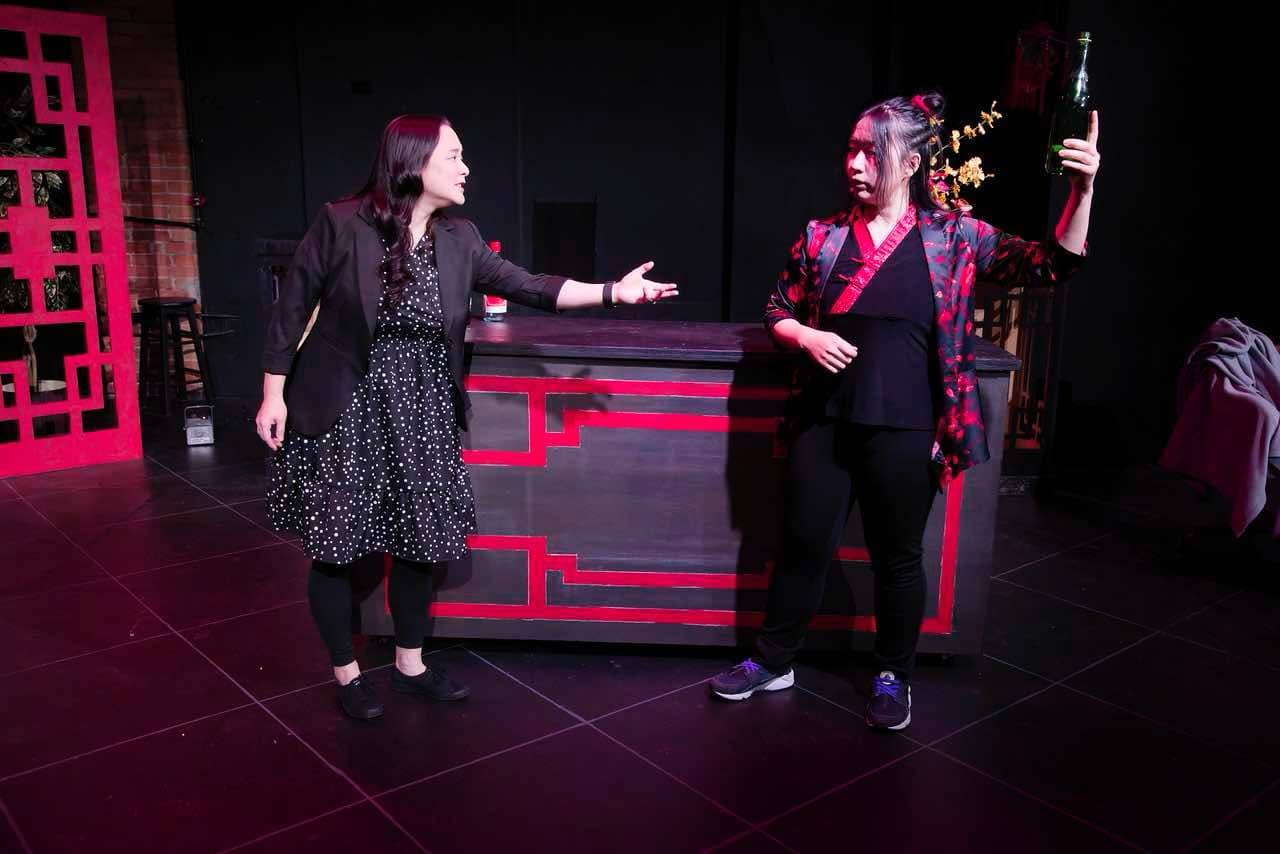
Ruth Wong-Miller and Grace Li in Walterdale Theatre’s King of the Yees, haggling as Lauren and Whiskey Seller. Photography by Scott Henderson, Henderson Images. Costumes Karin Lauderdale, Set Leland Stelck, Lighting Rebecca Cave.

I haven’t been involved with working on the latest Walterdale Theatre production, King of the Yees, so I had the fun of seeing it for the first time on opening weekend, along with a delighted audience. Barbara Mah, Walterdale’s current artistic director, directed Chinese-American playwright Lauren Yee’s somewhat-autobiographical play, with a talented cast and team of local artists.

King of the Yees is partly a familiar story about a father and daughter – a father (Stanley Woo of Apocalypse Kow) who is immersed in the clannish culture of San Francisco’s Chinatown and the Yee Family Association that he manages, and a playwright daughter (Ruth Wong-Miller of Foote in the Door and other musical theatre) who has moved on, moved away, and lost connection with her parents and their culture. I found the frustrated banter between them very funny, and also poignantly relatable, and unexpectedly moving.

Mah’s production, and the script, also contain fantastical elements which are fun to watch and listen to, as well as bitingly-sarcastic riffs on assumptions about Asian actors by a couple of performers playing actors who have been hired to read the playwright’s work-in-progress (Kingsley Leung and Helen Massini). This is not quite as confusing as it sounds! Visual/audible spectacles include a lion dance (handlers Massini, Grace Li, Ivy Poon, Rupert Gomez) led by a Buddha Boy (Tsz Him Hymns Chu), an Erhu player (Poon), a troupe of elders doing tai chi, a flamboyant Model Ancestor (stage manager Tim Lo), and a Szechuan face changer (Massini). The beautiful set and costumes were designed by Leland Stelck and Karin Lauderdale and implemented by skilled teams of painters, stitchers, and builders.
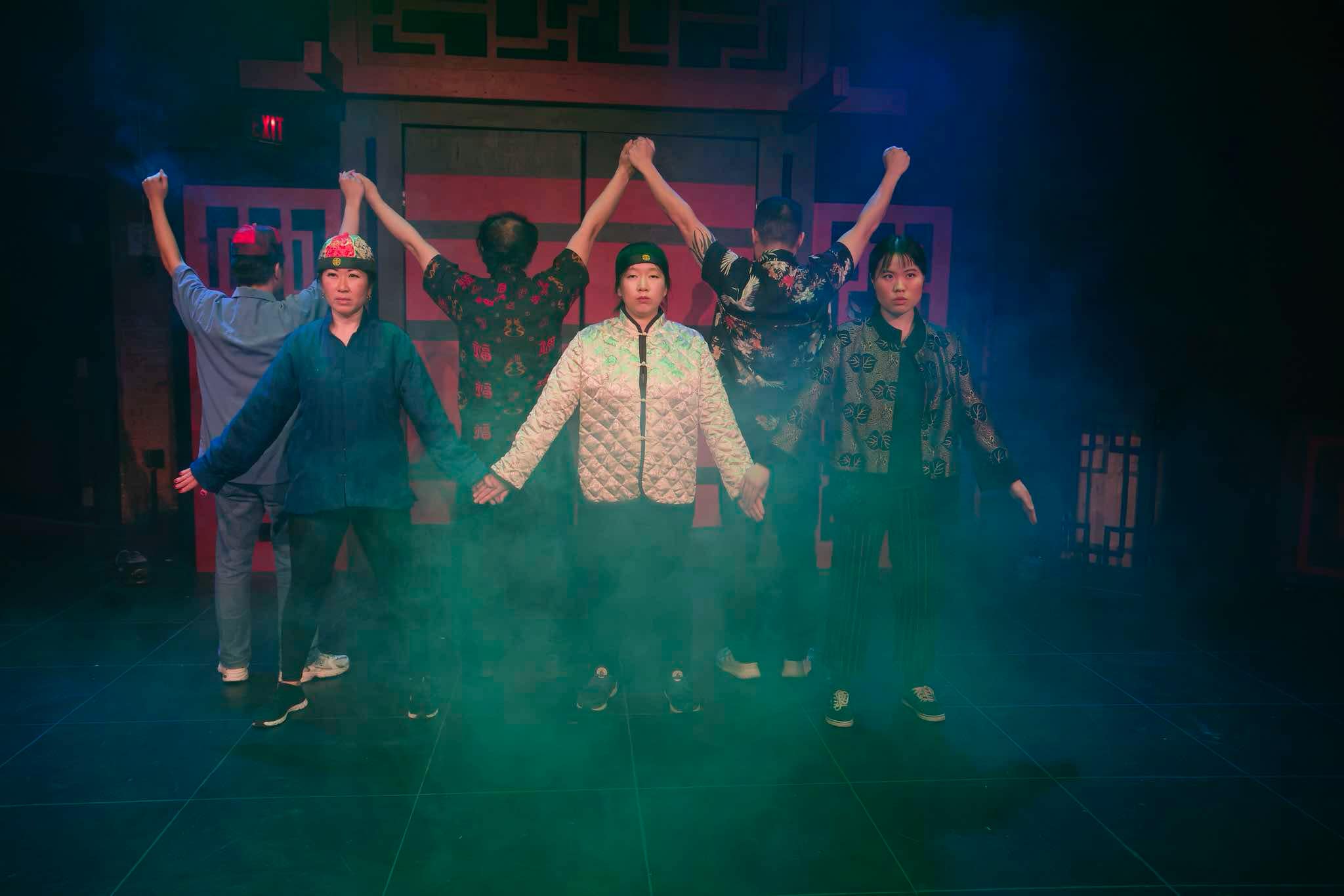
Ensemble members Rupert Gomez, Helen Massini, Andrew Kwan, Grace Li, Kingsley Leung, and Ivy Poon form a mysterious wall, in King of the Yees. Photo Scott Henderson, Henderson Images. Set Leland Stelck, costumes Karin Lauderdale, lights Rebecca Cave.

The digital program contains some helpful and interesting contextual information that is worth reading for extra enjoyment. Some performances of King of the Yees are sold out on line, with a few tickets held back for door sales. The run continues until next Saturday, February 15th, and advance tickets are here.

There’s so much else on this weekend, too! Plan ahead!

  • Bea, at Shadow Theatre, closes Sunday
  • Angry Alan, at Northern Light Theatre, closes Saturday (tomorrow!)
  • After the Trojan Women, by Amena Shehab & Joanna Blundell, is at Backstage Theatre
  • The Citadel has Frozen and Does This Taste Funny?
  • U Alberta Studio Theatre has [Blank], by Alice Birch
  • Die-Nasty, the long-running improv soap opera on Monday nights at Varscona, is free on Feb 10th.
  • An Oak Tree, at the Aviary, produced by Theatre Yes
  • Script Salon, Sunday Feb 9th, has a reading of Linda Celentano’s Giorgi of the Jungle.

And next weekend there’s even more, all with short runs!

  • The Effect, by Lucy Prebble, at the Arts Barns Studio,
  • The Spinsters (Bigger and Badder) is in the Westbury
  • MacEwan University’s musical theatre program has Natasha, Pierre, and the Great Comet of 1812
  • The first PepperMUNT Cabaret, a production of Jake Tkaczyk’s new company MUNT Performance Association, will be at the Gateway Theatre on Saturday February 15th, at 10:30 pm – giving you enough time to see one of the shows in the above lists first! Trevor Schmidt and Mark Meer are hosting, with an assortment of talented guests, and tickets are here.

I’m not going to be able to see all of these, because I’m also busy working on Walterdale’s next show, Stag and Doe by Mark Crawford (April 23-May 3). See what you can! Maybe I will see you there!

The Bridges of Madison County – catch it this weekend!

Vincent Roberts, Liam Lorrain, and Nicole Gaskell in The Bridges of Madison County. Photo credit @karalittlephoto.

You might be familiar with The Bridges of Madison County as a novel written by Robert James Waller in the early 1990s, or as a movie starring Meryl Streep and Clint Eastwood, mid 1990s.

It’s also a musical – book by Marsha Norman and music and lyrics by Jason Robert Brown. The local musical-theatre company ELOPE is currently performing this musical in a short run at Varscona Theatre. If it sounds interesting to you, catch it soon – it closes Saturday night.

The Bridges of Madison County is a story of love, of longings and loyalties, and overwhelmingly a re-creation of a place and time. It’s set in farm country in Iowa, mostly around one farmhouse kitchen, in the 1960s. The main character, Francesca, (Nicole Gaskell) was a war bride who met her US serviceman husband Robert (Vincent Roberts) in Naples, and has lived in Iowa ever since. They have two children, Michael, 16 and restless (Liam Lorrain), and Carolyn, probably about 14, who loves 4-H and farm life (Cassidy Galba).

After an opening solo in which Francesca tells her story of moving to the US post-war, with hat, gloves, and suitcase, with a backdrop of black-and-white slide images, the action of the musical opens with family and friends bustling around Francesca in her kitchen, before she sends her family off to show a steer at the State Fair, looking forward to a few days of privacy and quiet. The first scenes show the affectionate and busy atmosphere, the co-operative farm community and the challenges of parenting teenagers. It’s easy to sympathize with the quiet woman wanting some alone-time.

But if you know the story, you know that while Francesca’s family’s away, she unexpectedly chooses a romantic liaison. National Geographic photographer Robert (Martin Galba) stops by looking for directions. She helps him out and finds out that he’s a solitary nomad who has photographed her hometown of Naples. They talk about the longings and losses in their lives, and find feelings for each other. I’m always a bit skeptical of instant-soulmate stories (even for teenage characters like Romeo and Juliet or Maria and Tony), so I tend to get stuck on this part of the plot. But I appreciated that the writers, director, and actors did not make Francesca’s husband Robert a caricature of unsympathetic husband either. Director Cory Christensen said “It was important to show that Robert isn’t stupid and mean, that he’s a good man, likeable.”

Details are elided, reproducing the novel’s feel as a poetic interlude, four days out of normal life. But the phone keeps ringing – Francesca’s husband, accustomed to sharing daily life with his wife, Carolyn and Michael, complaining to Mom about their lives, their father, and their future plans, and her neighbour and friend Marge (Erin Foster-O-Riordan) who has guessed what’s happening. We can’t forget that Francesca has loyalties and commitments, and neither can she.

It was clear that the story could not have a happily-ever-after ending for everyone. The ending it did have was honest and credible and poignant, although shifting time to show later-life outcomes for all led to a slower-paced ending. I was impressed by how the actors playing the teenagers shifted to being credible as 5-7 years older.

I thought all of the singers were very good, particularly Nicole Gaskell in the role of Francesca. Her program bio says that she’s recently returned to Edmonton from studying and working in the UK, and I hope to see her again on Edmonton stages. There were some ensemble musical numbers near the beginning where I found it hard to make out the words, possibly due to sound balancing difficulties. Joy van de Ligt, music director, led an orchestra of seven. Morgan Smith and Avery Neufeld completed the acting ensemble.

Design choices enhanced the storytelling in many ways, particularly the lighting design of Rebecca Cave, with spectacular Iowa skyscapes and kitchen-table intimacy. The kitchen was cleverly evoked in Leland Stelck’s set design, by a few moving pieces and a chrome-edged table and chairs. Director Christensen pointed out that the corn silhouetted against the sky was actually real corn stalks, obtained from a local corn maze.

This is the first time an ELOPE show has used the Varscona Theatre venue. The auditorium is smaller than the Westbury, and more intimate than Le Théâtre Servus Credit Union, with the audience closer to the stage and warm acoustics. The company has usually been doing one large musical a year (Rent, Joseph and the Amazing Technicolor Dreamcoat), but is expanding this season by adding this short run of a smaller-cast show. Their season will continue with a production of Amelie, June 26-July 5, 2025, at the Timms Centre, U of Alberta. Kristen Finlay will direct and Sally Hunt will be music director.

Shall I draw an analogy between Francesca’s impulsive grasping at her opportunity of connection with Robert, and a recommendation to book your ticket to this short run of The Bridges of Madison County before it closes Saturday night? Perhaps not – you have no reason to hesitate, and more chance of regrets if you miss it! Saturday also has a matinee. Tickets are available here.

Day Three – local artists, new stories

It’s hard to find a connecting theme for the four productions I saw today, except that they were all done by familiar local artists.

Dick Piston Hotel Detective in Prague-Nosis was, as the title suggested, a classic noir tale with a hardboiled detective narrator (Lucas Anders), an assortment of suspicious characters (Mélissa Masse, Sarah Gibson, Dan Fessenden, Dave MacKay), and an atmospheric setting cleverly suggested by description, lighting, and a few set pieces moved around to suggest different locations in the seedy Lakeview Hotel. The published script, by American playwright/television writer Jeff Goode, offers scope for over-the-top humorous character portrayals but seems to have the consistent intricate plotting of a classic noir detective story. Director John Anderson has gathered a cast of clever character actors and talented crew, familiar from Walterdale Theatre productions. ASM Adorra Sergios displays title cards before each scene, in a series of increasingly strange hats. Playing in the Sugar Swing Ballroom (main floor) space, venue .

Rob and Chris / Bobby & Tina is an adaptation of one of my favourite plays ever, Collin Doyle’s Let the Light of Day Through. The playwright adapted it to a 60-minute musical format, along with composer/music-director Matt Graham. The original 2013 production of the play, with Jesse Gervais and Lora Brovold, portrayed the awkward affection and determination of a couple who experience an awful tragedy and … not get over it, but go on. The play is partly recollective, but they act out the stories to tell them to the audience, and it is very funny except when it’s awful. Part of the power of the original experience, for me, was not knowing what they were avoiding telling, until they told it. When I heard that Kate Ryan of Plain Janes would be directing a musical adaptation for the Fringe, I was excited, but also apprehensive. What if it wasn’t as good as I remembered the play? What if the experience depended on not knowing the outcome? But it is very good. It landed differently for me because I was watching for clues, but it was still powerful. The couple (Bobby + Tina when they meet as teenagers, Rob and Chris later) are played by Garett Ross and Jenny McKillop. They do just as well showing the awkward disconnects of a new relationship and a long-term one as they do showing the way that the couple develops a shorthand of shared understandings – the scene of trying to have a role-play fantasy when each of them thinks the other wants something else was hilarious, and the ways they imitate each other’s parents to amuse each other show clearly how they’ve been allied against both sets of parents for years. Graham’s music is suitably poignant and funny and affectionate, as called for, and the simple Fringe-appropriate set design (Trent Crosby) worked. Matt Graham plays the piano live. Venue 11, Varscona Theatre.

Mass Debating was also a musical and also at the Varscona. Trevor Schmidt wrote it and cast frequent collaborators Jason Hardwick, Cheryl Jamieson, Kristin Johnston, Michelle Todd, and Jake Tkaczyk, along with himself, to play junior-high-school debate team competitors. The universality and familiarity of the junior-high-aged themes (an early song focuses on each character’s worries of “Can they tell by looking?” ) were portrayed in a setting of mid-1970s Catholic schools, so the injustices were more overt and seemingly unchangeable than a contemporary context. Although the audiences know that things will get better, the characters really don’t. This dramatic irony provides not just humour but poignant compassion. Many of the unfairnesses focus on the institutional sexism of the society and that Church, and the way that both the boys (played by Jameson, Johnston, and Todd) and the girls (played by Tkaczyk, Hardwick, and Schmidt) express them in their interactions and behaviour. The thoughtless racism of the time was also shown in the segment where Ralph Washington, the Black competitor (Michelle Todd) was required to debate the Against side, on a resolution that racial integration has hurt Catholic education. Unlike Schmidt’s recent successful contemporary story about junior high school girls, Robot Girls, this one does not tie up the plot threads with happy endings. And it shouldn’t. That left me thinking. The music was written by Mason Snelgrove, and the accompaniment is recorded. Some of the announcer’s voice-overs were hard for me to hear clearly – not quite the Charlie-Brown-teacher “wah-wah-wah” but probably funnier than I knew about.

The drag comedy troupe Guys in Disguise have a new comedy, written by Darrin Hagen and Trevor Schmidt, called Microwave Coven. It’s also set in the 1970s, in a suburb, and it starts off with three neighbourhood women in fabulous caftans (Darrin Hagen, Jake Tkaczyk, Trevor Schmidt) preparing for a visit from neighbourhood newcomer Jason Hardwick. Hardwick is adorable as naive newlywed Mary Rose, in crinoline and blonde flip. The premise of this story is less realistic than the troupe’s recent productions like Crack in the Mirror and Puck Bunnies, but the characters are just as much fun. It’s also at the Varscona.