Tag Archives: nikki hulowski

Where You Are – family frictions and affection

Coralie Cairns as Suzanne, in Where You Are. Set and lights, Daniel vanHeyst. Costumes, Leona Brausen. Photo Marc Chalifoux.

I had read Kristen Da Silva’s play Where You Are a while ago. I couldn’t remember the details, just the tensions and affections between two sisters, Glenda and Suzanne, who live together on Manitoulin Island.

In the Shadow Theatre production that opened last night at Varscona Theatre, Davina Stewart plays restrained responsible Glenda, and Coralie Cairns plays Suzanne. With help from costume designer Leona Brausen, we see immediately that Suzanne is the kind of woman who gets up in the morning with last night’s mascara all over her face and a heavy-metal t-shirt along with her pajama pants, and Glenda is someone who always protects her skin with a sunhat and matches her purse to her shoes. The by-play between the sisters shows ongoing disagreements and old troubles but also a core of caring. Suzanne can’t talk to her grown daughter Beth without starting a fight – Glenda recommends that when Beth (Nikki Hulowski) arrives for a visit, Suzanne should just whistle instead of saying anything. We can also see hints of some other unspoken troubles – not overdramatic foreshadowing, but topics that the sisters have agreed not to address. Cairns and Stewart are brilliant together, hilarious in the superficial irritations of shared life while awkward in compassion.

Glenda and Suzanne’s neighbour Patrick (Brennan Campbell) drops in with a mis-delivered newspaper. Both sisters enjoy visiting with the handsome young man – Suzanne also takes the chance to talk him into fixing their shed roof. One of the funniest moments in the whole play concerns the roofing chore, and how Patrick responds to the heat, thinking himself alone.

As I said, I’d forgotten the plot details. After working on Mark Crawford’s comedy Stag and Doe for the last few months, I was laughing out loud hearing Patrick’s left-at-the-altar story and watching him make plans to attend his ex’s wedding.

It was easy to empathize with Beth, an only child frustrated by her mother’s and aunt’s well-meaning snoopiness into not telling them anything. As the play progresses, we also see them keeping secrets from her, all of which eventually come out. I was genuinely moved watching the comedic and defensive characters manage to connect with each other in the end. It felt very real. The script’s treatment of spirituality and religion was delicate and not ridiculous.

I also loved the specific reminders of Manitoulin Island, a beautiful part of Northern Ontario – the hawberry jelly priced higher for tourists, the “bicoastal” relationship one of the neighbours has with a woman from Espanola on the mainland, the way that missing the swing bridge timing can change destiny “like the Island wanted to keep me”. And the mention of a specific Toronto hospital cued me into the nature and severity of one character’s illness, due to memories of a family member spending time there long ago. None of this context is necessary to understand and enjoy the play; it just provided extra richness to my experience.

I couldn’t remember the title of the play beforehand, but now I understand it. Home is where you are, one character tells another.
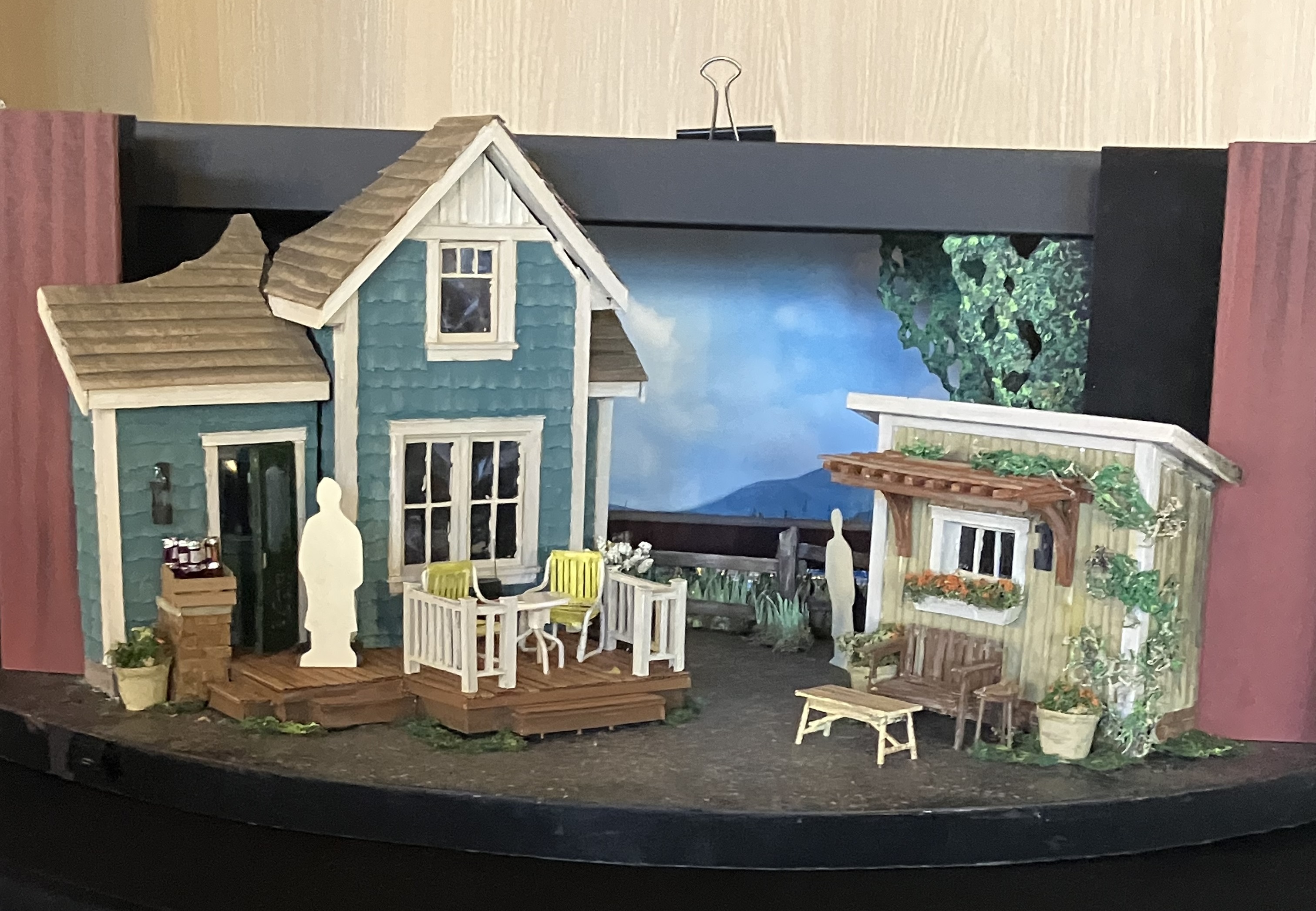
Daniel vanHeyst’s set model for Where You Are, on display in theatre lobby.

Set and lighting design are by Daniel vanHeyst. His typical attention to detail includes weathered shakes on the walls of the house, the rotating vent-stop bar at the bottom of the wooden storm windows, and lighting changes across fields throughout the day and night shown on a cyclorama. Darrin Hagen’s sound design includes many bits of original but almost-recognizable music.

Where You Are, directed by John Hudson with Lana Michelle Hughes as assistant director, is playing at Varscona Theatre until May 18th. Tickets are available here.

Intrigued by my mention earlier of Mark Crawford’s Stag and Doe? It’s playing at Walterdale Theatre until May 3 (tomorrow) with tickets here.

Day Seven – sketch comedy, improv, and magic

Sketchy Broads: Choosing the Bear is a sketch-comedy show written by five local multidisciplinary comedians: Nikki Hulowski, Lindsay Walker, Kristen Welker, Jules Balluffi, performers, and Jennie Emms, who is in the booth as stage manager and appears in one cameo bit. My favourite sketch comedy shows are the ones with so many funny bits that they don’t linger on any of them, just – punchline! boom – and then a lighting shift and segue into a different scenario with different characters. Sketchy Broads did this very well. There were some sketches in which they performed male characters, and some in which they were women dealing with men (offstage or onstage). There was also one very funny small child character. There was laugh-out-loud silliness, there was a recurring bit about a har-har eavesdropper taking conversation out of context, and there was a surprisingly-poignant scene set at an anti-feminist convention.

Let’s Go to the Phones is an improvised radio call-in show by the Irrelevant Show crowd, in the Spotlight Cabaret restaurant. The performance I saw had Peter Brown hosting and familiar comedian/improvisers Cody Porter, Dave Clarke, Donovan Workun, and Chris Borger alternating as guest experts and circulating through the audience with microphones for the questions. Peter Brown started by getting topics from the audience, as mundane as possible, and the ones we ended up with were “how to pair your bluetooth devices” and “coffee grounds”. The pace of this kind of show is slower, giving the performers opportunities for developing odd characters and successfully recreating the call-in show atmosphere.

Yesterday I also watched Keith Brown’s magic show 100% Wizard. The magic / illusions were impressive and mysterious, and Keith Brown connects with audiences in a relaxed and respectful way. He used lots of audience volunteers, including some younger ones. I don’t think he did any of the same things he’s done in previous shows – and if he did, I didn’t mind. With use of the large monitors on either side of the stage to enhance the audience view, and one video camera for a closeup of his hands in some bits, the performance worked very well for the large cabaret-seating room of the Sea Change Granite Club venue which is also hosting the Late Night Cabaret this year.

Four-Show Fringe Monday

James and Jamesy in Easy as Pie: Performers Aaron Malkin and Alastair Knowles have entertained Fringe artists for several years. In the opening of this year’s show Easy as Pie, the two are preparing to fulfill a longtime dream of performing as clowns, putting on costumes and reviewing the order of bits in their turn. Unlike much classic physical comedy, the characters James and Jamesy do talk to each other, but they also make great use of amusing actions and creative props and effects. The performances are in the Westbury Theatre, and the scale is large enough to work in the large full auditorium.

Local Diva: The Danielle Smith Diaries is also in the Westbury, on a large bare stage with one chair used as a prop. The script, by Liam Salmon, had a previous production five years ago, but some topical/timely material has been added to acknowledge the ways in which life has gotten more worrying since then. Performer Zachary Parsons-Lozinski strides in and self-introduces as drag queen / “drag thing” Tragidean, here to recount the events leading up to their current court case. Parsons-Lozinski owns the stage, pacing, pirouetting, posing, telling stories of growing up gay in small town Alberta, then finding community in gay bars and fulfillment in drag performance, while periodically erupting in rants about current events and homophobic and destructive actions.

I’ve seen and read previous solos with an angry narrator building up the story of provocation to some consequences. I think one about an angry man was by Daniel MacIvor, but Donna Orbits the Moon by Ian August, that Northern Light did last season, was about an angry/grieving middle-aged woman who had done some apparently-illogical things, and I’m pretty sure I’ve seen others. In this story, Tragidean’s provocations are both personal and systemic. The personal stories – high school ridicule, thoughtless micro-aggressions of young adults – were smaller and quieter, with the all-out chair-throwing rage reserved for ways in which they see their world being destroyed (timely examples including genocide in Palestine, wildfires in Jasper, and various recent provincial-government attitudes and policies). The character’s eventual eruption over a personal offence appears hugely disproportionate without knowing what else they have to be angry about. And I’m still not sure what I think about that.

Ink Addicted is a solo storytelling performance by Chris Trovador of Orlando, a tattoo artist turned comedian/actor. It was genuine and entertaining. The scenes on stage are interspersed with recorded video of him playing his parents and other characters, and interviewing other tattoo artists and clients. He starts by asking the audience which of us have tattoos and to the others, why not – and then people responded eagerly to the participation bits in his story. He incorporates rap, poetry, music, and a gradual reveal of some of his own tattoos. The unfamiliar specifics of his story (his Puerto Rican mother going from hating tattoos to getting permanent makeup and becoming his chief marketer, disrespectful customer demands) were told in a way that made them easy to relate to. Walterdale Theatre.

I also caught a couple of nights of Die-Nasty. The improv-soap-opera troupe, enhanced by several familiar performers for the Fringe edition, plays every night at 10 pm at the Varscona Theatre, in a story set at the Fringe and populated with Fringe-related characters. Each performance starts with a monologue by that night’s director (Jake Tkaczyk or Peter Brown) which is often laugh-out-loud funny on its own, and musical accompaniment is provided by the amazing Paul Morgan Donald. As in previous years, Kristi Hansen portrays reviewer Liz Nicholls, but this year she has an estranged sister, Whiz Nicholls (Lindsay Walker). Other characters include politicians campaigning for Mayor of the Fringe, the staff of the massage tent, classically trained actors with ‘Downton Abbey accents’, a lounge singer (Jacob Banigan), an improviser from Toronto, a sheriff (Tom Edwards), Kids-Fringe leader Alyson Dicey (Kirsten Throndson), Rachel Notley (Shannon Blanchet), Murray Utas (Randy Brososki), and several others. Guests I’ve seen included Isaac Kessler (directing WINNING:Winning this year and with a memorable Fringe-comedy resume) and Patty Stiles (former Rapid Fire artistic director). The pace is quick and the energy is high, and it doesn’t matter if you don’t know what happened to date. The 60-minute show goes quickly and there’s usually a large and responsive crowd. Oh, and the merch: for $10 they are selling soap. Really nice soap.

More to see on local stages this weekend and beyond

First, you have three more chances to see Flop! before it closes Sunday evening May 28th. If you haven’t yet been to a show at Rapid Fire Theatre’s permanent home, Rapid Fire Exchange on 83rd Avenue, this is a great reason to check out the venue. Ron Pederson and Ashley Botting bring an inspired variation on the musical-theatre-improv genre which uses the framing of two performers unexpectedly being stuck without script, lyrics, set, or costumes, just a musician (Erik Mortimer), so they call for audience suggestions and build a musical on the fly. Like skilled stage magicians, they increase the entertainment value of what they’re doing by making it look hard, sometimes stepping out of character between scenes to work out what to do next. I’m accustomed to improv troupes who appear to do impossible things easily – Rapid Fire’s own Off Book: The Musical, Gordon’s Big Bald Head – and I loved the extra layer of entertainment in seeing Pederson and Botting acting being terrible at something they are actually brilliant at. I hadn’t seen Ashley Botting on stage before – except in her recent guest appearance in Die-Nasty’s current improv drama Doctors – and she is delightful. Tickets for Flop! and future Rapid Fire shows are available here.

Boy Trouble, the new two-performer version of Mac Brock’s script, has two more performances in the Studio space at the Fringe Arts Barns, this afternoon at 2 pm, and this evening (which is showing as sold out on line.) I haven’t been able to see this one yet but I loved the solo version of it which inspired this retelling, at NextFest 2019 and then again at Fringe 2019.

Prison Dancer at the Citadel closes tomorrow afternoon. The performance this afternoon (Saturday May 27 at 1:30 pm) is the last audience-masks-required performance of the Citadel season. Tickets are available here.

Several years ago I attended a staged reading at the APN Script Salon of a new play called Anahita’s Republic, about women’s lives in contemporary Iran. Even in a music-stands reading in a plain meeting room, the script grabbed my attention and shook up some of my assumptions, so I was excited to see it fully staged. The company AuTash Productions, and playwriting team Hengameh E. Rice, have had two full productions – a recent one at Toronto’s Factory Theatre directed by Brenley Charkow, and this one directed by Brian Dooley, with a completely different cast and creative team. Roya Yazdanmehr is compelling as the eponymous Anahita, a woman who runs the family business and weathy household according to her own rules. From the first scene, when she strides in after a swim, applying lotion to bare legs, and then responds to her brother/business-partner (Yassine El Fassi El Fihri as Cyrus) who is pleading for money for his children’s activities, she did not fit my assumptions about how women live in that particular regime. But their history, and its effect on them, unfolds more slowly, making it more shocking to imagine this woman as a militant 16yo beside her late mother in a crowd of protesters. The next character who enters is a woman in a chador, Omid (Jennie George), but once again, my first assumptions about her life were wrong. Michael Peng plays Omid’s father, business associate of Cyrus and Anahita. Late in the play, when they are all in a situation with no good solutions, Anahita talks about different kinds of freedom and about how nobody is really free. Their situation has a resolution, but it’s not ideal. The play made me want to see more complex stories like this, coming out of a context I don’t know well but not limited by it. Program notes and vocabulary are provided through a QR code, and a large display timeline about event’s relevant to women in Iran on the lobby wall – including both mandatory “unveiling”, with enforcement, and mandatory “veiling”, also with brutal enforcement.

Tickets to Anahita’s Republic, playing until June 4th at the Fringe Backstage, are available here.

In a complete change of mood, last night I attended the opening performance of Elyne Quan’s Listen, Listen! as part of the Teatro Live! season. I giggled so much that another audience member commented to me and my companion about it at intermission.

Farron Timoteo plays a mall bookstore worker passionate about selecting background music, Nadien Chu plays a customer who objects to the music, and Nikki Hulowski and Alex Ariate play a hilarious collection of ensemble characters in the bookstore workplace. The play is set in 1986, which means that the sound designers (director Belinda Cornish and stage manager Frances Bundy) got to use all the catchy tunes of that era, costume designer Leona Brausen, fresh from designing for 10 Funerals, with half its scenes in that era, got to evoke memories of women’s soft-tie business blouses, asymmetrical hairstyles for young people, and leather ties, and the playwright got to stick in lots of dramatic-irony jokes about how people in 1986 expected the future to go.

Like many of Stuart Lemoine’s works performed by Teatro, this play was an affectionate portrayal of quirky characters, plot-driven but with lots of scope for entertaining character business. It was a lot of fun. Tickets are here.

Other theatre events coming up – I may not make it to all of them, but I’m noting them here for you –

Helen, the Euripedes comedy about Helen of Troy directed by Amy de Felice outdoors at the Queen Elizabeth Planetarium, runs to June 4th.

CHUMP, by Sue Goberdhan, is “about growing, grieving, and being Guyanese”. It is being workshopped and will have one public performance at the Fringe Studio June 11.

Nextfest, the annual festival of and for emerging artists, runs June 1-11.

The Sterling Awards nominations will be announced at 5 pm on June 5th at the Arts Barns, and winners will be celebrated at a more affordable event than the pre-pandemic Mayfield galas, also at the Arts Barns on Monday June 26th.

Walterdale Theatre’s 2023-2024 season launch event will also be held June 5th – doors at 7 pm, event at 8 pm.

And … in August it will be Fringe! Fringe 42: The Answer. (Do you know where your towel is?)

Fringe 2017 – the last weekend

A Beautiful View – Perry Gratton directed Nikki Hulowski and Samantha Jeffreys in this Daniel MacIvor script, a lovely celebration of a hard-to-label relationship between two women. “You have to be very organized to be bisexual”, the one explains to herself/the audience while deciding not to follow up on an unexpected sexual encounter.   There are a lot of segments where a character speaks facing the audience – sometimes they are alternating in a conversation with each other as retold to the audience.  I don’t know how much of that is in MacIvor’s script, but I think I remember a lot of it in a play Gratton directed several years ago at Fringe, Letters to Laura.  The ending was … well, there was enough foreshadowing that the not-entirely-explicit awful/sad ending must have actually happened.  But I wish it hadn’t, since I really liked both characters.  They were quite different from each other, but there were things I identified with in both of them.  (A Beautiful View has one holdover performance on Thursday.)

Late Night Cabaret – Late Night Cabaret is an Edmonton Fringe tradition.  It happens at midnight, every night of the Fringe except the last Sunday when things wrap up early.  I only went to it once this year, but it wasn’t hard to pick up on the ongoing jokes and routines.  Hosts Amy Shostak and Julian Faid have guests from other shows every night as well as the very talented house band Ze Punterz.  The Backstage Theatre sells out with happy artists, volunteers, and dedicated fringegoers extending their evening and building community.  It runs about an hour and a half with an intermission, and I think maybe the bar stays open during the show.  Some people go to it every night.

Multiple Organism – This piece by Vancouver’s Mind of a Snail troupe (Chloe Ziner and Jessica Gabriel) was the most original and creative work I saw at this year’s Fringe, and I liked it a lot.  It made extensive use of unusual projection techniques.  Some of it was a little gross, but not gratuitously so.

Rivercity: The musical  – Rebecca Merkley wrote and directed this new musical which seems to be an homage to the Archie-comics characters without quite borrowing their names.   It’s full of amusing quick-changes for double&triple-cast actors, silly puns, and cartoon-inspired sound effects (especially the wind-up-and-dash running starts of red-headed Andrews (Molly MacKinnon), which sounded like the Road Runner or something).  In between, though, there were some touching and serious solos for various characters, particularly for the viewpoint character Bee (Vanessa Wilson) and for the Jughead-like Jonesy (Josh Travnik, also multiply-cast in Evil Dead).   The cast of four (Kristin Johnston plays Reggie and the principal among others) covers too many characters to count.  Live music is provided by Scott Shpeley and Chris Weibe, wearing Josie-and-the-Pussycats-style cat-ears. 

Tempting – Erin Pettifor and Franco Correa are a psychic and a sceptic in Ashleigh Hicks’ new script.  When the audience enters the Westbury Theatre auditorium, the large stage has been made into a cozy cluttered studio-space for psychic Alaura (Pettifor).  She is puttering about doing yoga poses in a disjointed distracted way and making tea.  At first it is not clear why Adam is dropping in before business hours, and it is also not clear why Alaura is so immediately adversarial.  Those things do become clear – Adam’s girlfriend Constance is a client, and Adam wants Alaura to recant the advice (or prediction, or support) she gave Constance in a decision Adam doesn’t like.   The problem as described is interesting – Constance is dying and in pain and wants to pursue medically-assisted death, which Alaura supports and Adam doesn’t.  But I don’t really feel compassionate for either of the characters on stage, as I find out more about their motivations and connections to Constance, and I found the ending unsatisfying. 


I think I saw 28 performances this Fringe (one a repeat) and I might see a couple more at holdovers this week.

Threepenny Opera

Until this week, I don’t think I’d seen a musical as part of the University of Alberta Studio Theatre series.  (I’ve seen a musical on that stage, Strike!, but it was produced by a different company.)   Bertolt Brecht’s The Threepenny Opera, playing this week and next, was directed by Brian Deedrick the opera conductor.

I didn’t know much about it beforehand, and on the preview night there were no programs so I didn’t get the advantage of Director’s Notes and other context explanations.  I also didn’t think to find out how long it would be and whether there would be an intermission.  (It is long.  There is an intermission.  Counting the intermission it runs close to 3 hours.)  And with the house filling up, I didn’t take time to read the bios posted outside the auditorium.  At the intermission I fumbled to look up who was who, and I discovered that the 2015 BFA class had been reinforced with Mark Vetsch (Grindstone Theatre, last seen at the Studio Theatre in Love’s Labours Lost), Lily Climenhaga (whose name I saw in the credits for the script of Orestes 2.0), and Neil Kuefler (BFA 2014).

There were two songs in this show that were familiar to me, the “Pirate Jenny” one (sung by Nikki Hulowski) and “Mack the Knife”.  The jazz standard “Mack the Knife” was written by Kurt Weill for the original 1928 production, although I have to admit that I learned it first through the McDonald’s Mac Tonight commercials in the late 1980s.  And there were a lot of familiar tropes.  When I left the theatre, I was thinking I could describe it as Cabaret crossed with, hmm, some kind of comic gangster king story, like the one in Anything Goes maybe.   But that’s not quite right, because the sense of impending danger from an imminent corrupt regime was not quite the same as in Cabaret, it was more like a critique of the capitalist kyriarchy or something.   The sense of familiarity in much of the story is illustrated in the very long list of recognizable character/plot elements on the TVTropes page for Threepenny Opera.

The main character or anti-hero or whatever, Macheath (Hunter Cardinal) doesn’t appear early in the show.  The buildup adds to the sense of danger and mistrust around the man, who could so easily have become more simply ridiculous in yellow kid gloves and spats.   If I remember correctly, the show opens with the police commissioner Brown (Max Lebeuf) singing a song in German, then a couple of street singers (Natalie Davidson and Zvonimir Rac) talking and singing to the audience about the premise of the show as an opera for beggars and put on by beggars, and about the characters of Macheath the womanizing boss of the underworld, and Peachum (Joe Perry) who runs a business managing (franchising, almost) troupes of beggars.

We then meet Peachum, his drunken wife (Bobbi Goddard), and his daughter Polly (Kabriel Lilly), and observe the extremely cynical hiring and instruction of a new beggar (Dylan Parsons).  Plot conflicts begin to arise as Polly elopes to marry Macheath.  I generally don’t like the gangster’s-girlfriend stereotype with the high-nasal Brooklyn-baby-girl voice and curled blonde hair (like Lesley Ann Warren’s character in Victor Victoria), but Lilly’s version of Polly moves past the stereotype.   Peachum directs the police commissioner to arrest Macheath, but as they are old friends he wants Macheath to escape.  And Macheath misses chances to escape because he keeps stopping to visit his other romantic attachments, including his previous girlfriend Jenny (Hulowski), the commissioner’s daughter Lucy (Morgan Yamada), and a houseful of prostitutes (I don’t know whether the prostitutes were all female but a couple of them were cross-cast, or whether one or two of the prostitutes he’s visiting were male.)

The whole thing takes place around the time of a coronation (I think probably Queen Victoria), and in the end Mack is rescued from the gallows by a deus ex machina in the person of an imperial messenger descending from the sky (Dylan Parsons).

The beggars’-opera premise is reinforced by the costuming, in which each character seems to be wearing a few symbolic costume elements thrown over some approximately-period undergarments and shoes.  This led to some odd gender-presentation combinations.  The beggars’ rags given to Parsons’ character Filch are a beautifully layered concoction of ragged strips of weighted cloth.  Many of the male characters wear jackets without shirts, sometimes with collar and tie.  Cardinal’s Macheath has a disturbingly villanous mustache.   Lighting was generally harsh and cold – maybe that’s part of what reminded me of Cabaret.  Characters not in the scene were often seated on the various platform levels around the edge of the stage, and backlit motionless.

Music for the performance is provided by a small excellent jazz orchestra under the direction of Peter Dala.  Apart from the songs I mentioned above, I particularly enjoyed a solo by Morgan Yamada as Lucy, one of Macheath’s later songs that had a Les Mis-reminiscent anguish and resonance to it, and a few group dance numbers.

Threepenny Opera continues until February 14th, with tickets at Tix on the Square.

Loveplay, a speedy trip through a history of sex

Moira Buffini’s Loveplay opened last Thursday as part of the University of Alberta Studio Theatre series, directed by faculty member Jan Selman.  I saw it the night before opening along with a very responsive preview crowd, full of sighs and squeals of delight and “Awww”s and “you owned him girl!“s, and I thought it was a lot of fun.

The play showcases ten vignettes of some kind of sexual or romantic interaction, taking place at the same location at different times in history, from Roman Britain to the present.  Each scene starts with some kind of title card introducing the era, in some format consistent with the design (the Roman Britain one looked like chiseled stone).  The six performers in the show (Nikki Hulowski, Maxwell Theodore Lebeuf, Kabriel Lilly, Dylan Parsons, Zvonimir Rac, and Morgan Yamada) each played multiple roles, as well as assisting the running crew with transitions.

I appreciated the playwright’s choice to include a glimpse of sexual assault but not to make it either the first or the last story.  In a particularly disturbing Dark Ages scene, three men (Lebeuf, Parsons, and Rac) discuss the woman they are consecutively assaulting (Lilly) in chillingly dehumanized terms, and after they leave her for dead she howls in solitary anguish, conveying the impression of hopelessness with no expectation of revenge or justice.  The performers in this scene balance the horrific situation with the ordinary dialogue sensitively.

The most light-hearted scenes in the narrative are those of the Renaissance (1584) and the Age of Innocence (1969), both of which include Hulowski and Rac playing a couple of long duration.  The Renaissance scene opens with Lebeuf and Hulowski declaiming heightened dialogue about their true love, which turns out to be rehearsal of a playwright (Rac)’s autobiographical work-in-progress.  This offers lots of amusing opportunity for humour about the creative process, about 16th century theatre, and about the trajectory of a romantic relationship between a young woman and her tutor.  The Age of Innocence scene is about a young couple attempting to host some kind of free-love drop-in encounter for the first time and getting cold feet, while their guests (Parsons and Lilly) seek relief from their relationship ennui.

Various other scenes explore power imbalances in sexual relationships (Yamada as governess in Lebeuf’s 1823 household, Parsons as an artisan hired by Enlightenment-era scientist Lilly to satisfy her curiosity about the male form) and prostitution (Yamada’s two prostitute characters both seem to be independent businesswomen taking charge in their relationships with their clients).

More hopeful resolutions are seen in The Age of Empire (1898) and The Age of Excess (contemporary).  In The Age of Empire, two men who had been friends as boys find new connection and “the birth of love” despite one being an artist and the other a married vicar.  The Age of Excess is set in the office of a matchmaker (Lilly) who is preparing to introduce some clients despite her own romantic difficulties – her girlfriend/assistant (Hulowski) is angry with her for being unwilling to commit, and flirting with the clients in response.  One of the clients (Parsons) embodies all the worst characteristics of entitlement and pickupartistry, from putting down the woman he’s meeting to whining “It’s not fair, why wasn’t she like that with me?”  Yet the two clients who hit it off immediately and leave together (Yamada and Lebeuf) do so having each disclosed some aspects of their difficult history (she’s a divorcée and single parent; he’s a recovering alcoholic), so as an audience member I was left with the message that learning from mistakes and being open can lead to mutual happy relationships.

Throughout the journey through history, we encounter many observations on sexual politics and relationships that have relevance to current life.  A character in the Renaissance comments on the perceived difference between a lover’s kiss and that of a wife, as “what you bestow and what I own.”  A cloistered nun in the New Millennium (1099) scene wonders “why would a man choose such a life?”  A later character mentions that there is no insult like “man-whore”, that what is an insult for a woman translates to “lover” for a man.

The simple set focuses on a sharply raked square platform, representing the square of land through the ages.  Some of the set elements (walls, platforms) appeared for only one scene; others were seen later as ruins.  Characters in the various eras made reference to previous uses or buildings, sometimes with dramatic irony (the Roman soldier is building a latrine, which the Dark Ages characters then assume must have been some type of temple).

Loveplay is light-hearted but not lightweight.  Considering it along with the playwright’s Gabriel, I am looking forward to seeing her Blavatsky’s Tower cast with the other performers in the graduating BFA class at the end of this month.  Loveplay continues until this Saturday, with tickets available at the door and at Tix on the Square.

Frenetic Dreamtime, an evening of clown play

The University of Alberta’s BFA Acting class of 2015 will be on the Studio Theatre stage starting with Moira Buffini’s Loveplay at the end of October.  But you can see them tonight (Saturday) in an evening of original clown turns called Frenetic Dreamtime.

I went to the preview Thursday night at the Timms Centre’s Second Playing Space.  Each of the ten class members had a character who did a turn, mostly solos but sometimes helping each other out.  The show was hosted by a character played by Maxwell Lebeuf.  As the audience enters, this character is seated at a dressing table facing away from the audience, doing makeup and getting in to nose and costume.   It was a bit unsettling to find it hard to distinguish the pre-show time where it was appropriate for us to chat with each other, send text messages, and knit (okay, I was probably the only one who wanted to knit) and the time when the show had started so respect would require us to observe silently.

Max’s character introduced each act by title and character name.  The custom of short clown turns each having a title, often involving wordplay, suddenly reminded me of classic animated cartoon style.   Because I don’t know all the members of the Class of 2015 by sight and because their CVs aren’t on the Drama department website yet, I can’t be certain which performers did what.  If you are reading this and you want to let me know, please feel free to email or post a comment on the entry.  But I think my favourites were the nesting hen laying eggs, the apprehensive mountain climber (Dylan Parsons), and the would-be bride of “White Wedding”.  All of these stories had an entertaining mix of some familiar emotions and some inventive physical expression of the narrative.  The ensemble worked together smoothly to set up quickly for each act, and I was particularly impressed by this because a few of the acts involved making a mess on the floor.

The show ended with Maxwell Lebeuf’s character singing a cabaret-style version of Gloria Gaynor’s “I Will Survive”, and the nine other clowns doing a choreographed dance as backup.  That was a lot of fun too.

Frenetic Dreamtime has one more show tonight at 7:30 pm at the Timms Centre Second Playing Space.  Seating is limited (although they might bring out more chairs if there’s a bigger crowd).  Admission is free, and there’s an opportunity to donate to either or both of the Drama Department bursary fund and the class of 2015 audition tour.

Lysistrata

Unlike the eponymous Three Sisters of Chekov’s play, the women in Lysistrata band together and take some control over the circumstances of their lives.  After watching The Three Sisters last night, I watched the U of A Drama production of Lyistrata this afternoon and found the contrast satisfying.

It is also ridiculously funny and outrageously crude.

The adaptation from Aristophanes’ original was by Robert Brustein.  Jeff Page (recently of RDC, where he directed Comedy of Errors this fall) directed.  The cast members were from the BFA Acting class of 2015, and the play was performed on the Corner Stage of the U of A Fine Arts Building, an interesting intimate space with steep carpeted risers and higher-level performance areas around the outside of the room.  I was particularly amused by the characterisations of Lampito the Spartan woman (Nikki Hulowski), Penelope wife of Odysseus (Morgan Yamada), and by the comic timing and stage business of Kinesias (Hunter Cardinal).  The title role of Lysistrata was played with contrasting gravitas by Natalie Davidson, and I am particularly looking forward to seeing her act in more serious material in future.

The Facebook invitation to the event promised “free”, “fun, laughs, and phalluses”, and the play lived up to its billing.  When the audience entered the room, most of the cast was dancing around the room with glee and abandon to electronic dance music, wearing costumes of ancient Greece.  They then gathered on stage and dedicated the auditorium to Dionysus “with its original name, the Thrust Stage”.   The ending of the play was somewhat surprising to me, but I was still chuckling when I left.