Tag Archives: musical

Book of Mormon (the musical) was as good as I’d hoped.

When I lived in Kingston Ontario, one of my associates developed a theory that he called the Chez Piggy effect.  Chez Piggy was one of the best restaurants in town, (and by all accounts it still is!)  The food was creative and delicious, the service usually impeccable, and the atmosphere casual enough that people who didn’t go to “fancy restaurants” often would be able to feel comfortable.   But my associate had the theory that Chez Piggy didn’t completely deserve its fabulous reputation – he said that since so many of the people who went there were going to mark an occasion (anniversary, graduation, etc), they were unlikely to express any criticism of the actual food or service because they were inclined to make good memories and not “ruin the occasion” by voicing any displeasure to their server at the time or to each other afterwards.

I didn’t actually agree with him about Chez Piggy, since I had never had poor food or poor service there, but I saw his point in general.   When I go to a lot of trouble and expense to attend something, I probably am less inclined to pay attention to its flaws.

With all of that as a circuitous disclaimer, I want to say that my first impressions of the Toronto/Mirvish production of the musical Book of Mormon were entirely positive.  I saw it on Saturday – actually I saw two performances back-to-back and I loved it more the second time through.

Book of Mormon is a story about two Mormon missionaries arriving in Uganda, and how the interaction changes both the missionaries and the Ugandans.  It’s also about faith versus works (and comes down hard on the Pope Francis side that being a good person matters more than believing all the right things).  It’s about North American / Global North views of Africa as the homogeneous themepark of Lion King.  It’s about boys trying to please their fathers, and families trying to cope in horrible situations, and metaphors versus miracles.

I am quite familiar with the soundtrack, but knew almost nothing about how the story progressed between the songs and bits of conversation on the original-cast album, and nothing at all about what I would see on stage.   So I had a general sense of plot and pacing, but there were several key points which did not become clear until I was watching the actual show.  Unlike many musical productions, the program for this one did not list the songs.

Being familiar with the lyrics meant that I wasn’t always laughing at things the rest of the audience laughed at.  Some of them laughed at swearing just because it was swearing, every time.   There’s quite a bit of swearing in the show, and we hear it as shocking because the young missionaries are shocked by it.  The alternatives-to-swearing employed by the missionaries (“Oh-Em-Gosh”, for example) sounded credible to me and were generally not played for laughs.

I was completely delighted by the dancing.  The big production number to “Spooky Mormon Hell Dream” said some original things about Hell and was creepy and funny without being ridiculous.   A historical pageant included acting out the effects of dysentery on Joseph Smith and his fellow migrants, which was just barely not too graphic for my comfort and thus hilarious.  And I loved the elder-missionaries chorus showing their flashier sides in “Man Up” and “Turn It Off!”  I am a big fan of ironic choreography that uses all the familiar gestures of 20th century stage shows in parodic ways, and Book of Mormon had lots of them – jazz hands, top hats, tap dancing, exaggerated marching, pelvic thrusts, and other bits that I don’t have the words for but have been seeing since I was a small child watching song-and-dance shows on television.

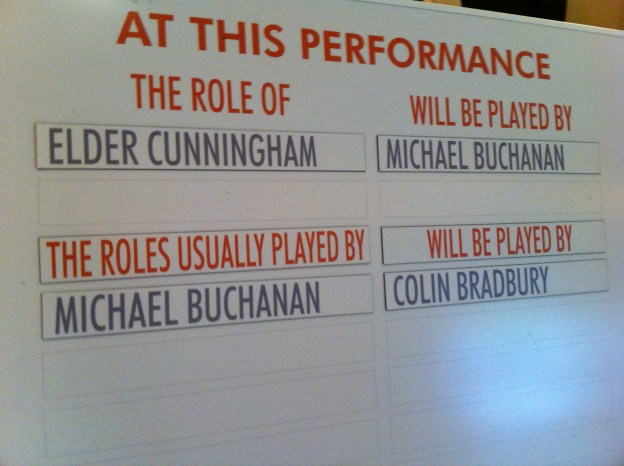
In the Saturday shows, the role of Elder Cunningham (the bumbling fanboy missionary) was played by standby Michael Buchanan rather than the usual actor Christopher John O’Neill.   The other headliners Mark Evans (Elder Price, the cocky missionary with the rockstar reputation who chokes) and Samantha Marie Ware (Nabulungi, Ugandan convert and love-interest) were performing in their usual roles.   On first viewing, I didn’t really distinguish among the Ugandan people in the story except for Nabulungi and her father (I’m not sure if he was some kind of village authority; he was the person the missionaries had been told to report to.)  Seeing it again, I saw the doctor, the man called Motumbo (whose identifying motivation is disturbing enough that I won’t repeat it here out of context), and the teacher, as well as the warlord called the General and his supporters – but except for Nabulungi the villagers are not well characterised.  Neither are the other missionaries, except for Elder McKinley (Grey Henson).

I felt uncomfortable about a few of the ways that Nabulungi, the female lead, was diminished into comedy.  There’s a running gag about Elder Cunningham, for all his crush on her, being unable to remember her name and substituting all kinds of inappropriate long words –  Nala (like in Lion King), Neosporin, Jon Bon Jovi, Nanaimo Bar, and so on.  (I’m almost positive that he didn’t say Nanaimo Bar in the afternoon show just in the evening one, so the actor may have been riffing somewhat spontaneously in the late shows of the run).   She buys a typewriter which she calls a “texting device”, and then the plot advances through her writing notes to people which she refers to as texting.  This made me feel like it was making fun of a developing-world young woman’s wish to be modern and her misunderstanding of technology and terminology.   Near the end, there’s a miscommunication plot point about her having assumed that accepting baptism would lead to her getting to emigrate to Salt Lake City with the missionaries (Sal Tlay Ka Siti, as the title of her solo is spelled). I started to be annoyed at this being another shortcut joke making fun of the naïve village girl, but some of my discomfort was redeemed for me in the way all the other villagers immediately began explaining to her that they’d always known that the religious stories were all metaphors, and had accepted the religion knowing that.  This was also a tidy way of reconciling the canonical Mormon stories with Elder Cunningham’s creative and useful extemporaneous versions, saying that the details really don’t matter very much.

The sound balance was just about perfect, from where I was sitting.  There was a small live orchestra which never overpowered the singers.  The lighting was effective and usually unobtrusive.  The scenery was fun to look at but not overly complicated or distracting.  A few things were moved by the actors (turning a door as they walked around it to indicate changing from an outdoor to indoor scene) but mostly things moved invisibly.  For the scene when the new missionaries arrive in Uganda totally overwhelmed, the visuals bring this out very well, with lots of crowded buildings, and rocks making a busy cluttered setting while the villagers go about their daily chores all over the stage, including one character dragging a dead donkey behind him, its head bobbing bloodily.

The story and the characters worked very well for me, partly because over the course of the story everyone changes, some of them quite against their will but all in a way that I saw as positive.  I wondered ahead of time if I would find it difficult to accept the premise of the story without needing to ignore inconsistency with my own beliefs.  In fact I was pleasantly surprised that after a lot of pointed criticism of that specific implementation of religion and evangelism earlier in the play, the general resolution was approximately humanist in a way that I didn’t find troubling or dramatically inconsistent.

Book of Mormon closed in Toronto after last weekend, but the tour continues.   I would definitely see it again if an opportunity I could afford arose.   Or possibly one that I couldn’t, after I finish paying for this trip.

Spelling Bee

The 25th Annual Putnam County Spelling Bee is an unwieldy name for a musical, but everything else about this Elope production went smoothly.   Kristen Finlay was the director.  The names and faces of the cast were mostly unfamiliar to me, but I haven’t been around the Edmonton musical-theatre scene very long so that isn’t a negative sign.

The story involves six junior-high-school-age children (played by adult actors Mark Sinongeo, Kristin Johnston, Curtis Knecht, Meredith Honda, Nadine Veroba, and John Evans) competing on stage in a spelling bee, their families, and the people managing the spelling bee.  For extra fun, four adult audience members were recruited in the lobby beforehand to be extra competitors.  The treatment was generally lighthearted, but there was also a consistent message about the difference between young people following their own passions and eccentric interests, and children being pushed or promoted by their families.   At the end of the show, each character tells the audience where his or her life has taken him or her since the time of the spelling bee, and each of them has a satisfying outcome.

My favourite character was Mitch (Kate Wylie), a contest support worker with a fairly small role.   The most impressive portrayals, In my opinion, were by John Evans (Leaf) and Nadine Veroba (Olive).  The choreography (Jake Hastey) was fun to watch and the live music  (musical director Sally Hunt and three additional musicians) was catchy, although not sufficiently so for me to be humming it two weeks later.

The 25th Annual Putnam County Spelling Bee continues tonight (Thursday), tomorrow (Friday), and Saturday.  Tickets are available at the door and at Tix on the Square.

Anything Goes!

Before last night, I would have said that the Westbury Theatre at the Transalta Arts Barns had a large stage.  That was before I saw Strathcona Theatre’s performance of Anything Goes, which left me with the impression that the stage was just barely large enough for the cast of 50+ (I tried to count a couple of times, but they kept dancing!)  A clever stage design evoked the multiple decks, spiral staircases, and porthole-covered swinging doors of an Art Deco cruise liner, while also providing space for the pit musicians to play on an upper deck.  Last night’s preview show played to a full house, and since many of the family, friends, and fans of Strathcona Theatre got there earlier than I did, I was grateful for being able to watch some of the action as well as musicians not so far down from where I was sitting.

Early in the show, I thought that Sydney Williams, playing the nightclub singer and former evangelist Reno Sweeney, was dominating the show as a strong singer with good stage presence.  Adam Houston, as Billy Crocker, seemed a bit outmatched at first, with a difficult first song, but he hit his stride quickly and was more convincing later in the show.  The audience was particularly delighted with David Unsworth as Lord Evelyn Oakleigh when he broke out of his rather predictable exaggerated-aristocracy role late in the show (you can’t miss it).  I will definitely keep an eye out for this young actor in future productions.

The lyrics and music of this classic show (first staged in … with several revivals and revisions since) are by Cole Porter.  A few of the songs were quite familiar, especially “You’re the Top” and “I get a Kick Out of You”.   P.G. Wodehouse (also known for Jeeves and Wooster) had a hand in the book, and you can tell.   There were love triangles, gangsters, mistaken identities, tap-dancing sailors, an exceptionally well-behaved live dog in the cast (credited as Teddy Gorman), evangelists, missionaries, and converts, puns, innuendoes, and assorted happy endings.   When two or three actors were speaking or singing, there were often many other characters on the edges of the stage doing things that were interesting but not distracting, adding to the sense that more was happening than we could watch.

I was a little uncomfortable with the portrayals of the two Chinese converts Luke and John (James Kwak and Spencer Lloyd), complete with Mao jackets and the stereotypical accents common in fictional portrayals of the early 20th century, and the later adoption of “Chinese” disguises by other characters.  I’m not sure why the humorous portrayal of the English aristocrat didn’t disturb me the same way.   Maybe it felt a bit like blackface.   I would not be surprised if it had been toned down from Broadway versions, though.

Linette Smith is Director and Choreographer, and Stephen Delano is Musical Director.  There were a few technical glitches in this first preview performance – some sound balancing or sound cuing that was a bit slow, and one door that came off its hinges distractingly – but nothing that should interfere with the audience’s appreciation during the run of the show.  It continues until Saturday night at the Westbury Theatre, with tickets available at Tix on the Square .

Two fun shows I forgot to write about, or, a Blind Date with Billy Elliot

In February I went to Rebecca Northan’s show Blind Date at the Club/Rice space at the Citadel Theatre.  I giggled a lot, but I guess I didn’t have anything pressing to say about it and it slipped out of the posting queue of my brain.  Like a real blind date, it was unexpected, occasionally awkward and embarrassing, and kind of sweet.

The show played last year around Valentine’s Day as well.  The concept is that the main character, named Mimi, asks someone from the audience to participate in the play as her date.  In the performance I saw, the participant was a very good sport and amusing fellow named Travis.  There were also several minor characters; I can’t find my program to give proper credits but my notes say they were played by Jamie and Christian.

I think it might be a fun show to see more than once, to see how much it varies with a different participant.  It would also be fun to do gender-flipped or with a same-sex date.

In late March, I saw the Broadway Across Canada production of Billy Elliot at the Jubilee Auditorium.  I was lucky that I hadn’t got an opening-night ticket, as the first night performance got cancelled due to some of the trucks of properties got delayed at the border due to the snowstorm.  The production travels with four actors taking turns as Billy, and two as Michael.  We saw Mitchell Tobin (age 12) as Billy.  The movie Billy Elliot, which came before the musical, overlaps in my memory with The Full Monty, Brassed Off!, and Kinky Boots as a genre of late 1990s-early 2000s comedies about working class people in England coping with hard financial times in creative ways – and the musical is the same story with an Elton John score.  (That reminds me – am I the only person entertained by the bizarrely detailed genre categories that Netflix comes up with as it tries to work out what else I’d like to watch based on what I’ve seen so far?)

The show was polished, fun, and touching.  There was at least as much wooden-chair choreography as in a production of Spring Awakening.  In one particularly surreal dance number, there was a chorus of striking miners and a chorus of police with riot shields, sharing the stage with a crowd of little girl ballet dancers.  The miners’-families Christmas party scene included some puppets like the Spitting Image political-caricatures.

I was disturbed that I had no recollection of the miners’ strike portrayed in the show at the time it was happening, even though background reading for the show illustrated its monstrous import in destroying coal mining in Britain.  And although the show illustrates the excitement and determination of the new strikers, and the persistence and sacrifice as they held out, later history showed their efforts to be as heartbreakingly futile as those of the 1832 Paris Uprising shown in the plot events of Les Misérables.

Ride the Cyclone!

I saw Ride the Cyclone last weekend in a preview show.  I wanted to watch it again before writing it up, but I also wanted to post fast to encourage other people to see it if it sounds like their kind of thing.  So I’ll make some notes now, but also figure out whether the budget and the calendar can manage seeing it again later in the run.

By that you can conclude that I liked it, but that it wasn’t simple.

Ride the Cyclone is a new musical, by the company Atomic Vaudeville out of Victoria BC.  It’s written by Jacob Richmond and Brooke Maxwell, and directed by Britt Small and Jacob Richmond.  The premise is that six teenage members of a school choir have been killed in a rollercoaster accident just before the show starts.  The characters are actually dead, but they each get to sing in a competition to win a fresh start.  These six songs, plus conversations in between and some other ensemble numbers, make up a fast-paced 90-minute show.  One of the most fun things about the show is the wide variation in genre of the songs, with accompanying dance, costume-changes, and props, from gangsta rap to Ukrainian folkdance.  I’m pretty sure that if I was more intimately familiar with the canon of musical theatre I might have picked out homages to lots of styles, writers, or specific shows – as it was, I was giggling away at the part that reminded me of Tim Curry in Rocky Horror (Picture) Show, and was touched by the bits that reminded me of “Journey to the Heaviside Layer” in Cats.

The writing and the actors were good at making the characters different from one another and all interesting.  Shortcut characterizations were apparent from the start:  the gay boy (Kholby Wardell), the would-be gangsta (Jameson Matthew Parker), the kid with elbow crutches (Elliott Loran), the fat sidekick (Kelly Hudson), the perky achiever (Rielle Braid), and the mystery Jane Doe (Sarah Jane Pelzer), each wearing Catholic-school uniforms but instantly distinguishable in how they wore them.  But as the show progressed, each of the characters became more interesting and likeable and the ways they reacted to each other also changed.  The main reason I don’t watch the TV show Glee (despite the fun music) is that when I did watch I found the characters flat and predictable, fitting various stereotypes about teenagers and teachers that I don’t find either true or helpful.  But even within the limitations of a short musical performance, I thought these six characters became real and intriguing.  Kelly Hudson’s song made me cry.  Sarah Jane Pelzer’s performance as Jane Doe, the girl nobody remembered, was enhanced by a fascinatingly awkward physicality – nothing as obvious as a limp, but just a sense from her walk and gestures that she wasn’t quite connected to her body.

The narrative says interesting things about the trope of every kid being somehow a misfit with his or her own troubles, but it also shows some of the complexity behind the trope of growing up in a dead-end town.

A seventh character, represented by Carey Wass in voice and James Insell in puppetry, was the carnival fortune-telling machine who acted as the sort of MC for the show.

A four-piece musical ensemble accompanied them and contributed to the moods and the exploration of musical genres.  In the first few songs the music was a bit too loud for me to hear the lyrics, but this problem was corrected later.  There were also some video bits, most notable of which was projected not onto a backdrop screen but onto a white circular folkloric skirt extended by the character who was wearing it.

Ride the Cyclone is playing at the Maclab Theatre in the Citadel until March 10th.  Tickets are available through the Citadel box office.

Legally Blonde – the musical

Continuing in this opening week for a variety of different performance genres, Thursday’s ticket was for a Moxy B production of Legally Blonde the Musical, at the Westbury Theatre.  The director was Marion Brenner, a drama teacher at Ross Sheppard Senior High.

It’s a lightweight upbeat show with some very catchy songs – I still have “Omigod you guys!” stuck in my head a day later – some funny lines, and a satisfying happy ending.  The strongest singers and actors in the cast were Emily Smith particularly in the role as Paulette the Boston hairstylist who dreams of Ireland, Brooklyn Rowe (the main character Elle), Aaron Schaan as Emmet the law-school TA of working-class background, and Elise Dextrase (Brooke the accused in the murder trial, Pilar the sorority sister).  And Scott Boerefyn was hilarious in the small role of the UPS Guy.

The music was recorded, and sometimes distractingly loud.

There’s one more show, Saturday night.

January playbill

I’d noticed before that sometimes food businesses with a holiday rush sometimes close for vacation in January – bakeries, restaurants, vendors at Strathcona Farmers’ Market.  But I’d never noticed before this year that theatres and performance spaces might also be dark at the start of the year.  It seems a little counterintuitive that there isn’t much to watch between Christmas and New Years, when people with academic schedules might have time off and be done their pre-Christmas to-do lists, but it does make sense for performers to take a break after New Year’s, when it’s cold and dark and the viewing public might be feeling frugal or unsociable.

Both Rapid Fire Theatre and Die-Nasty were dark between Christmas and New Year’s, but then jumped right back in to their weekly entertainments.  Rapid Fire is now filling up Ziedler Hall for many of their Friday-night and Saturday-night shows, so fans should buy tickets on line or line up early.

Other companies have been in rehearsal, meaning that several shows are opening this week.  The new Canadian opera Svadba, in Serbian with English subtitles, is playing at C103, the space formerly known as Catalyst Theatre.  Azimuth Theatre previews Free-man on the land at the Roxy starting Tuesday (tickets here).  A Clown Double Bill opens Tuesday at The TACOS Space in that awkward bit of neighbourhood that nobody can decide whether to call Ritchie, CPR Irvine, or “you know, behind Wunderbar, there” (tickets through Tix on the Square). Westbury Theatre, Transalta Arts Barns, welcomes the musical Legally Blonde starting Wednesday.

Deep Freeze Festival wraps up (see what I did there) today, Ice on Whyte sparkles in a couple of weeks, and ForkFest fills up January.  So if you’ve been hibernating the last couple of weeks, it’s  time to bundle up and check out what’s happening in Edmonton entertainment.

Les Misérables (in all media except the novel)

I don’t have very many name-dropping theatrical-performance memories to brag about.  I saw CATS! in Toronto – but I think everyone who lived within a day’s drive and who could afford it saw CATS! in Toronto.  I saw an outdoor performance of The Importance of Being Earnest directed by Linda Carson, but that won’t mean anything to you if you’re not from Kitchener-Waterloo.  I once saw Maggie Smith do a powerful Lady Macbeth at the Stratford Festival (Ontario.)  And I saw Les Misérables in the London West End production, about 9 months after it opened.

I had never read the novel in French or in English and I didn’t have ready access to Wikipedia-type plot summaries before going to the musical, so I didn’t know much about the story or characters ahead of time.  The part that hit me hardest on that first viewing was the story of Éponine’s one-sided crush on Marius and how she struggles with facilitating Marius’s romance with Cosette.  Unfortunately, that was a familiar dynamic to me in my own life at the time.

When I saw a preview of the movie version a few weeks ago, I knew I would want to see it.  So I pre-ordered the highlights album of the movie from iTunes, and didn’t discover until after it had arrived that the highlights didn’t include “Do You Hear The People Sing?” (the song I remembered most clearly from the stage production, due to performing it in an ensemble at camp once) and some other important songs.  Still, though, I listened to the album several times before going to the movie.  That familiarity made it easier for me to take in the story and the acting, without being distracted by differences from another version of the songs.

It’s a long movie.  But unlike The Hobbit, I didn’t think any of it dragged out.  It moved compellingly from event to event and it was easy to see how one thing led to the next.  At the end of it I was exhausted, inarticulate, and out of Kleenex.  Both my cinema companions are insightful theatregoers with more knowledge of the stage show than I had, so I need to credit our discussions (in between the sniffles) for helping me articulate some of the observations below.

The story of Éponine (Samantha Barks) was still very sad, but this time around I didn’t see it as the main story.  This time, I had more interest in the story of Jean Valjean (Hugh Jackman)’s struggles to start over and to do the right thing, and even the parallel between his feelings about the Cosette (Amanda Seyfried)/Marius (Eddie Redmayne) romance and Éponine’s feelings.  Everyone who reviews this film comments on Anne Hathaway’s moving performance as Fantine, and I agree.  I liked Russell Crowe (Javert)’s singing voice a lot, but I didn’t find Javert as interesting a character as Valjean.

The colour palette of the film was noticeably limited.  It started from the blue and red and colourless tones of the French flag, echoed by uniforms of guards and prisoners, and continued almost completely in that colourway, with occasional golden lighting.  There was no green at all in the whole film except for some dark-green uniform jackets in one scene.  The venal innkeepers the Thénardiers (Sacha Baron Cohen and Helena Bonham Carter) had somewhat more gaudy tones, which went along with the playful mood-switch of their song “Master of the House”.  M. Thénardier reminded me bizarrely of Frank N. Furter played by Tim Curry in Rocky Horror Picture Show, which was distracting.  For sheer eye-candy, Anne Hathaway and Aaron Tveit (Enjolras) were the loveliest to look at.  I recognised Aaron Tveit’s voice as that of Gabe from the Broadway recording of “Next to Normal”.

In the movie, the puniness of the barricade and the futility of the students’ rebellion were horrifyingly obvious, and the song “Empty Chairs at Empty Tables”, sung by Marius in the empty ruined tavern where his friends used to gather, was heartbreaking.  The movie showed the scale of the rebellion and devastation in a way that the symbolic sets of the stage show could not.

It’s still playing all over, and it doesn’t need IMAX or Real3D to feel real.

Next to Normal

I knew I wanted to see Next to Normal as soon as a friend in California recommended it last year.  So when I saw that it was part of the Citadel Theatre’s 2012-13 season I bought a pair of tickets right away, thinking that for this show I’d probably want company.  Unfortunately a cascade of complications overcame all my would-be companions, and I ended up going by myself to the last show of the run.  I thought it was great.  I’d been listening to the Broadway recording for a few months, before the show.  When it looked like I wasn’t going to have company, I decided to protect my emotions by reading the plot summary on Wikipedia.  I don’t know whether I regret that choice.

My general impression of the set was shiny.  Shiny, and the opposite of cozy.  The play was set in Seattle, so sometimes there were shimmery metallic representations of rainfall seen out the windows.  Most of the scenes were in and around a two-story house designed by an architect, and the rest were in medical settings, so it made sense that the framework was all shiny metal trusses (probably they were polished aluminum and lit to look like chromium) and the furniture was all glass, chrome, and black leather.  When I noticed the lighting, it was on the blue side.  There was a shock-therapy scene emphasised by flashing lights which didn’t seem at all out of place in the rest of the set and lighting.   What we saw before the play started was magical – it appeared to be a lighted house far away in a field of stars, and then somehow it looked like that faraway house became the stage set.

I was prepared for the story to be powerful and disturbing.  But it was also much funnier than I expected.  The protagonist Diana, played by Kathryn Akin, was witty, angry, and very likeable.  The actor’s timing and body language showed the character in a wide range of mental, biochemical, and emotional states.  Her daughter Natalie was also easy to identify with, while the Henry character was mostly a humorous contrast and distraction.  I found the husband more self-serving than sympathetic, which certainly made the story more interesting than if he had fitted that stereotype of patient spouse.

The narrative moved quickly, with very short songs and lots of echoes and reprises, and not much dialogue between them.  The voices and orchestra were good and well-balanced.

The performance at the Citadel Theatre was a co-production with Theatre Calgary, directed by Ron Jenkins.

Spring Awakening: two local productions

This year I’ve seen two local productions of  Spring Awakening, the Duncan Sheik/Steven Sater Broadway musical based on Frank Wedekind’s 1891 stage play.  I know there was a Citadel Young Company production last year, but I didn’t see that. I haven’t seen or read the original play, but I’m going to get the script from our library and read it.  I saw the Strathcona Alumni Company production at the Fringe festival, and then the Grant MacEwan Theatre Arts production in early November directed by Jim Guedo.

It’s interesting, seeing two productions so close together and comparing them.  The sets, staging, and dance moves were very similar.  One thing that’s bothered me since encountering the play for the first time at the Fringe was how much the story seemed focused on the two main male characters, Melchior and Moritz, rather than the main female character, Wendla.  But after seeing the MacEwan production, I had a more balanced impression.  I don’t know if it was because the actor playing Wendla in the MacEwan production, Kayla Nickel, was stronger, or whether there were some directorial choices involved, but I was more comfortable with that aspect of the MacEwan production.

When I first saw the Fringe production, not knowing the story ahead of time, I felt like parts of it dragged a bit.  This second viewing was at an advantage for me, then, because this time around it felt like a stark compelling series of events rushing to some awful conclusions.  And I was better able to take in some nuances, because I wasn’t quite as busy being shocked.  For example, in the scene about disclosure of child abuse I hadn’t noticed before that the abuse-victim and the abuse-survivor finish the song together in a way that feels like support and solidarity, the only possible way to make that bit at least somewhat hopeful.

I didn’t find the Moritz character quite as likeable in the MacEwan production as I did in the Strathcona Alumni one, but I don’t know why.