Scene from MacEwan University production of Heathers. Photo Credit: Brianne Jang of BB Collective Light Design: Heather Cornick, Set Design: Ross Nichol, Costume Design: Alison Yanota
Continuing on my recent run of seeing new productions of shows I’d seen in the past, tonight I watched opening night of the MacEwan University Musical Theatre program’s production of Heathers, by Laurence O’Keefe and Kevin Murphy, directed by Leigh Rivenbark. I saw the 1988 movie a long time ago, and the Citadel Young Musical Company production in 2016 (also directed by Leigh Rivenbark) but I didn’t remember them very well.
So I had the fun of encountering the musical almost fresh. Layne Labbe as Veronica and Jayden Leung as JD both had strong voices and compelling stage presence. Marina Mikhaylichenko was a disturbingly-mean Heather Chandler. Ashlin Turcotte (Martha, Veronica’s original best friend before her strategic social climbing) and Kara Adams (Ms. Fleming the hippie teacher) both had vocal solos that developed their characters and also demonstrated some impressive talents. It was also fascinating to watch the other ensemble members as high school students who all seemed to have distinctive characters, backstory, and connections with the others. Choreography (Courtney Arsenault) was well executed, and silhouette work behind windows was delightful.
I had forgotten how sharply satirical it was, skewering suicide-awareness campaigns, internalized homophobia, performative allyship, signing petitions without reading them, playing to the media, the misunderstood-loner-in-a-trenchcoat trope, bullying, bulimia, frenemies, and all the teenage stereotypes.
Heathers is playing at MacEwan’s Triffo Theatre all weekend. But if you don’t already have tickets, you’re probably out of luck. You might want to plan ahead to get tickets to the MacEwan production of The Prom, next March.
Team and coach travelling by train, in MacEwan University’s production of Tracey Power’s Glory. Photo by BB Collective.
I’ve been watching entertainment on local stages for more than ten years, so it’s not surprising that sometimes I see new productions of works I’ve already seen. Recently, I’ve seen two performances in this category, but otherwise very different: Glory, by Tracy Power, and Die Fledermaus, by Johann Strauss.
In 2018 I travelled to Calgary to see the world premiere of Tracy Power’s Glory, produced by Alberta Theatre Projects and directed by James MacDonald. I was excited to see that the students of MacEwan University’s Musical Theatre program would be tackling this play, as a story about young people pushing the boundaries of appropriate activities in the turbulent times of 1930s Canada seemed like a great fit. Amber Borotsik was a great choice as director for the movement-forward work. Her choreographic choices for learning to skate, for practising hockey strategies, and for the various important games in the narrative were less stylized and more story-coherent than in the original production, but equally fun to watch.
Izzy Deutscher was great as team captain Hilda Ranscombe, confident in sports but struggling in other parts of life. The other team members portrayed, Nellie Ranscombe (Jaysel Ann Arroyo), Marm Schmuck (Harmony B), and Helen Schmuck (Jenn Houle), were quickly distinguished as individuals, each with her own problems and quirks. The script clearly sets the action in 1930s small-town Canada, with radio news voice-overs, women’s magazine columns, and the teammates’ conversations about work in the shoe factory, missing a chance at university because father and brothers are still out of work, and being denied admission to law school because of being Jewish. Devin Estey plays rink manager and reluctant team coach Herb Fach, managing to conveying a grumpy-old-man vibe despite appearing about the same age as the players. Kevin Thomas, visible in porkpie hat and suit on the theatre’s catwalk, provided colour commentary as radio announcer for the various games.
I was particularly moved by the design feature (Scott Spidell) of having championship banners roll down after the team’s first national title win, then ending the show with the banners scrolling through the many subsequent achievements of the Preston Rivulettes, then the logos of the modern-era national championship, the first women’s world championship in Ottawa in 1990 (I still have a volunteer sweatshirt with that logo), the subsequent world and Olympic titles of Canadian teams, ending with the new logos of the six teams in the Professional Women’s Hockey League, now in their first full season. As a second-wave women’s hockey pioneer and the daughter of another one, I loved the way this tied the history together with my own experience and with current and future women’s hockey players. I was also impressed by the information and fundraising about indigenous hockey opportunities in Alberta.
Die Fledermaus was last produced at Edmonton Opera in 2014. In a conventional staging, it was humorous and enjoyable, with Julian Arnold playing the doctor who is teased about his bat costume. The 2024 production, directed by Joel Ivany, added a layer of meta-, and even more opportunities for accessible silliness, by framing it as a community theatre company rehearsing, performing, and recovering from a performance. So Act 1 is actually the company arriving at rehearsal and rehearsing Act 1, with original dialogue in English for the many interruptions and amusing interactions. I think my favourite bit of Act 1 was watching the Stage Manager (Farren Timoteo) scurrying around to deliver props to the performers just in time and almost invisibly, and crawling around the stage with strips of spike tape laid out on his sweater, so he could mark each performer’s location for delivering songs. In Act 2, at Count Orlovsky’s party, the core cast of 9 is joined by a large chorus of partygoers in masks and various shades of festive black, along with a DJ, a drag queen, and others. Most memorable was the ode to Champagne. Act 3 is called the “After-After-Party”, with the cast members waking up or staggering in, and reminiscing about the performance but actually singing all the songs of the script’s Act 3. This part was kind of confusing but I was still laughing. Soprano Jonelle Sills (Rosalinde) had a particularly impressive voice, and also memorable wigs.
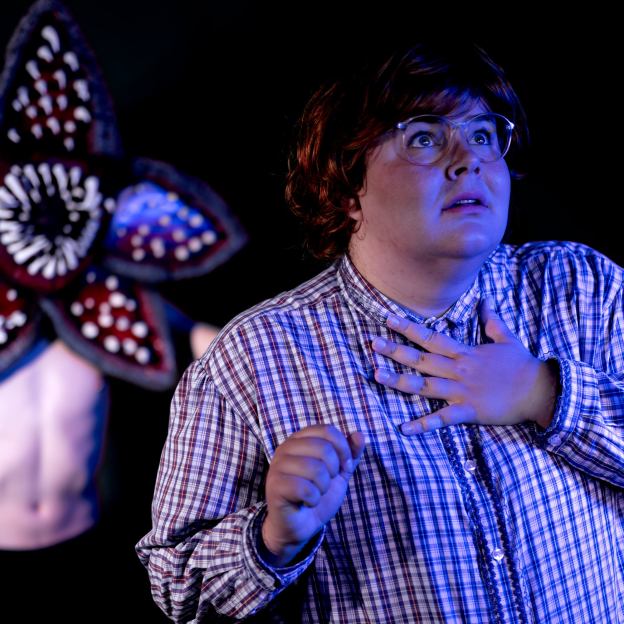
Carly Pettit, as Barb, and Lucas Paterson, as Demigorgon, in Stranger Sings! the Parody Musical. Photo by Emily Rutledge.
To appreciate a parody, I should be familiar with the source material, I thought. So as soon as I’d booked a ticket to watch the DarkStage production of Jonathan Hogue’s Stranger Sings!: The Parody Musical this weekend, I re-upped my Netflix subscription and watched the whole first season of Stranger Things and part of the second. (then the allure of getting caught up with The Resident and Heartstopper distracted me…)
I’m glad I watched it, continuously, so I was familiar with not only all the main characters but their plot arcs in the musical. However, I did not expect that a much longer list of movie and musical source material would also help! After a while, I started trying to make a list in my head of all the references I recognized, and some that I was pretty sure were callbacks to other material but I wasn’t sure what. A version of Rainbow Connection from The Muppet Movie. A tribute to E.T. and his human friend cycle-flying across the sky in E.T. Heathers. Little Women. Gypsy. Breakfast Club. Beetlejuice. Winona Rider’s filmography in detail.
The Netflix series (2016-present) starts out as a nostalgic look at 1980s culture in a small homogeneous town starting a group of small boys on a D&D quest. Like a slightly-updated Stand By Me. But then, as in the comic-books / Amazon Prime series Papergirls, things turn science-fictional and X-Files-y. To enjoy the TV story, I kept having to ignore distracting thoughts about the handwavey pseudoscience and loose ends in the plot.
One of the things I loved about Stranger Sings!, then, was the way that the script and actions call out many of those unlikely bits in the source material. Using a folded-paper analogy to explain multiverse theory and figure out how to access a portal to the Upside Down. But Stranger Sings! points out how ridiculous this is. And the happy ending of Will’s rescue in the TV series, completely ignoring that another kid, Barb Holland, is still missing and unexplained. The musical version leans into this – Barb (Carly Pettitt), the popular girl’s less stylish sidekick, calls them all out for ignoring her while she becomes powerful in the alternate-universe and the love interest of the resident Demigorgon there. Pettitt’s voice is up to the challenge, and her characterization and physicality are spot-on.
Director David Son is a choreographer with a strong dance background, and that showed in the variety of well-done ensemble movement numbers. There was even a bit of tap! (Jack Hunting, recently seen in Walterdale’s Vanya and Sonia and Masha and Spike, and here playing the inarticulate and telekinetic child Eleven).
The cast of ten portrayed at least twice that many characters, with costumes by Debo Gunning. The four little boys in the D&D group are Will, the one who goes missing early on, played as a puppet by Melenie Reid (who also plays his mother Joyce), and Renell Doneza, Jeremey Zimmerman, and Jason Wong. I was impressed by all of them. Jeremey, convincing as a nerdy awkward 12-year-old, had been an effective Tom Collins in ELOPE’s Rent last year.
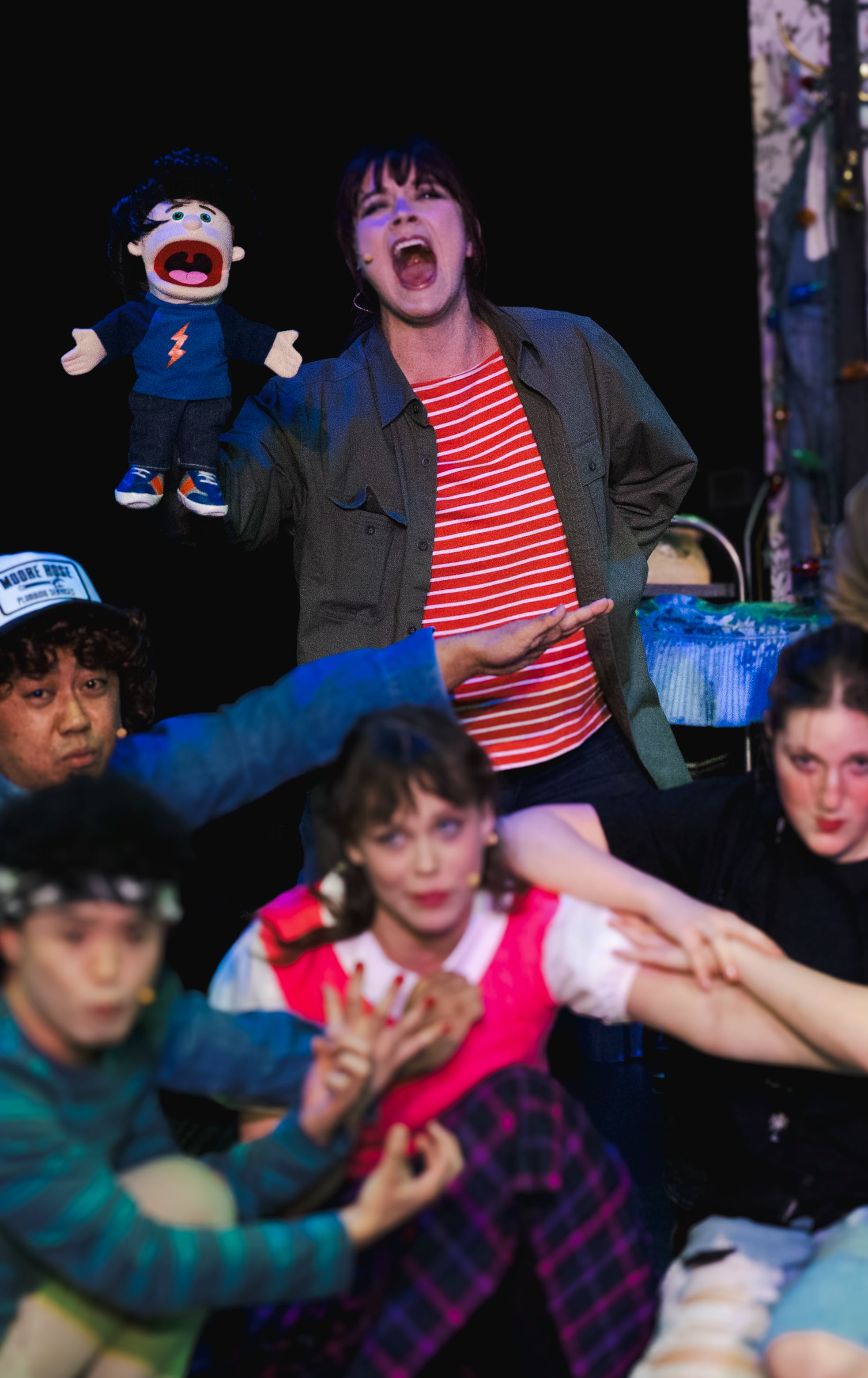
Melenie Reid, puppeteer for Will, with Renell Doneza (Justin), Jason Wong (Lucas), Liz Janzen (Nancy), and Jack Hunting (Eleven). Photo by Emily Rutledge.
Other compelling main vocal roles are played by Liz Janzen (Nancy), Melenie Reid (Will’s mother Joyce), and Brian Christensen (Nancy’s two teenage love interests, bad-boy Steve and nerdy photographer Jonathan). Connor Foy (whom I last saw in Walterdale’s Austentatious) was consistently funny as Hopper, the sheriff with a tragic past he won’t let us forget, and Lucas Paterson was an expressively flamboyant Demigorgon.
The show is performed in the intimate black-box space of the Backstage Theatre at the Arts Barns. There is a four-piece live band in the wing, under the direction of Grace Huang, and the sound mixing was good enough that I didn’t miss any of the exceedingly clever lyrics.
The music, the lyrics, and the approach to a familiar story reminded me a lot of the Grindstone Theatre / Simon Abbott&Byron Martin body of work. I’ll watch for future work from this new company.
The run of Stranger Sings! continues to October 26th, and some shows are selling out. Tickets are available here.
My mother was very fond of Gilbert and Sullivan. She and I went together to the Stratford Festival a few times, to see Iolanthe, and I think Pirates of Penzance. The next year I thought I was giving her an extra treat by getting tickets to Hamlet. (Later that season I also got to see Rosencrantz and Guildenstern are Dead, in repertory with the same cast.) But on the way home, she confessed with embarrassment that she hadn’t enjoyed the Shakespearean tragedy as much, and for the next Mother’s Day could we please go to another Gilbert and Sullivan operetta? For her, it seemed that watching Shakespeare was a virtuous duty, and watching Gilbert and Sullivan was such a guilty pleasure that she didn’t deserve it, even as a gift. That seemed odd to me, even for a former high school English teacher, because I already had the idea that theatre should be fun, just like books and movies and other ways of telling stories.
A similar confusion of duty and pleasure lies at the heart of Patience, the Gilbert and Sullivan operetta running until Sunday night (Jun 11) at Capitol Theatre in Fort Edmonton Park. Patience, a naive and earnest milkmaid, has so little experience of love (“only for a great-aunt” she says, when asked by one of the chorus of lovesick ladies) that from observing the pining chorus and hearing that love is unselfish, she comes up with the idea that if it’s joyful and pleasurable it isn’t true love. Therefore, it is more virtuous for her to marry a man she detests.
This odd interpretation leads to various nearly-implausible repercussions for all the characters’ romantic aspirations, but of course this being a Gilbert and Sullivan work, almost everyone ends up happily paired at the end.
There are many other ways this production, directed by Robert Herriot and conducted by Kathleen Lohrenz Gable, is an admirable example of what Gilbert and Sullivan were known for. There is a large chorus of ladies and of Dragoon Guards, and lots of romantic happy endings. There are long verses of rapid rhyming iambic feet as clever as rap lyrics, there are ridiculous characters with preposterous motivations, and there are opportunities to show off some very impressive voices.
Of particular note are the singing of Patience (possibly Charlotte Stewart-Juby, soprano, in the performance I saw), and the comedic portrayals of Meghan Goguen (mezzo-soprano) as Lady Jane and Justin Kautz (baritone, better known locally as one of the principals in Toy Guns Dance Theatre) as Reginald Bunthorpe. Timothy Carter (tenor) was also delightful as Archibald Grosvenor.
Justin Kautz as Reginald Bunthorpe, garlanded by two of the lovesick maidens.
The chorus of “twenty lovelorn maidens” – actually about fifteen, which probably didn’t distract anyone else except me – was delightfully costumed in faux-Hellenic draperies in a pastel rainbow of shades, striking a series of expressive aesthetic poses in attempts to emulate and attract flamboyant poet/poseur Reginald. I giggled a lot during this show, starting with the maidens’ first entrance. Later in the play the robes and art-book poses are repeated in an even funnier way. Good use was made of the various entrances to the auditorium, which helped make the proscenium-stage space more intimate. Musical accompaniment was provided by one pianist, Kerry Agnew.
Opera Nuova’s festival of opera and musical theatre continues over the next two weeks with performances of Tchaikovsky’s Eugene Onegin, Leoš Janáček’s The Cunning Little Vixen, and the Rogers and Hammerstein musical Carousel as well as some other concerts and master classes. Performances occur in various venues around the city and with a range of prices, allowing more audience members to attend.




 Ephemeral Pleasures