Tag Archives: mukonzi muskoki

The Maids: Chilling, ambiguous, memorable

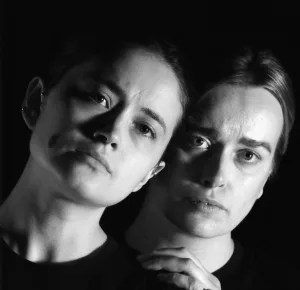
Hannah Wigglesworth and Julia Van Dam as Solange and Claire, in The Maids. Photo by Kyle Tobiasson and PoppyRose Media.

A setting of sparse hygienic extravagance is created in the basement auditorium, with a shiny-white floor, forty pairs of stiletto-heels in every imaginable colour and finish lined up against the wall, chairs that state membership in some school of architecture, and huge bunches of long-stemmed flowers surrounding the structurally-necessary concrete pillars of the room. A young woman (Hannah Wigglesworth) in modern house-cleaning garb (spotless white sneakers, baggy black jeans, yellow latex gloves, a uniform smock with pockets) rushes in with a caddy of cleaning supplies, and begins scrubbing surfaces urgently.

This is the beginning of Jean Genet’s The Maids, translated by prolific English playwright Martin Crimp, as currently performed by independent production company Putrid Brat, in the basement-level space in the Pendennis Building on Jasper just east of 97 Street. It is the kind of play where lyrical text and menacing elliptical delivery leave some matters unexplained. Some become clear later, and some … do not.

A key point is the two maids (Wigglesworth and Julia Van Dam) playing a game or enacting a “ceremony” in which one of them plays the mistress, abusing and abasing the other. The other embraces the dynamic with enthusiastic consent and a certain eroticism which becomes more uncomfortable as one recalls that the two maids are sisters.

After some of this roleplay, in which we also learn more about the mistress’s life circumstances, a timer goes off and the maids rush to restore the room and their own costumes, to be perfectly prepared for the mistress’s return. They didn’t have time to reach the climax of their “game”, which would involve killing the mistress. And it’s not clear whether that’s an actual plan, or not.

Our expectations of the mistress have been formed from the way the young women have embodied her in the game – and when Alex Dawkins stalks in wearing a drapey fur coat and a figure-hugging dress, she confirms my impression. Her character is powerful and mercurial, dangerous and compelling. She is completely caught up in her own problems and her own drama, depending on her maids as mirrors but not recognizing them as individuals. Musing on how her lover’s incarceration will affect her life, she tries on a tired-of-the-world pose, “I’m giving up clothes! I’m an old woman!” but allows her maids to coax her out of it.

The harsh lighting and occasional ambient sound in the low-ceilinged room, the stalking and pacing, the mistress shouting and the maids rolling their eyes behind her back while hinting at strangulation or poisoning, create and build a menacing atmosphere. The ambiguity between reality and shared imaginings contributes some uncertainty but doesn’t lessen the menace. The ending is not entirely clear and not entirely satisfying, but left me musing on power dynamics in a stratified society, as I checked my phone for messages from work.

The play is directed by U of A professor David Kennedy. Design elements are credited to Beyata Hackborn (costume), Even Gilchrist (scenic design), and Nick Kourtides (sound), with artistic contributions from other people familiar on the local scene. Performances continue tonight (Sunday evening) and Tuesday through Sunday evenings next week, with tickets available through Showpass.

New local work from diverse perspectives

Edmonton Fringe is a great place to discover new work by local artists. The program (2021: the digital listings on the Fringe website) flags new work and indicates the hometown of the producing company (2021: they’re almost all local or nearby this year, with very few touring artists).

Yesterday I saw three new works by local artists, One Song, Chanzo, and Deafy. All of them were fictional narratives in various genres, and all of them benefited from the lived experiences of the creators.

One Song was advertised as a staged read or workshop performance of a new musical, but was significantly more polished than that description suggessts. Daniel Belland (composer and co-lyricist) played keyboard to accompany the four singer/actors, Jaimi Reese, Manny Agueriverre, Ceris Backstrom, and Josh Travnik. The actors carried scripts but moved through the story and knew the music well. The mood of the story reminded me a bit of Dear Evan Hansen – kind young people getting themselves into believable awkward difficulties, well-meaning adults on the sidelines being vulnerable themselves. Jaimi Reese is spot-on as the wise and feisty single mother to a young lesbian (Agueriverre) with an open door/ear for her daughter’s best friend (Travnik) – even before the song Not This I was thinking the mother probably had her own interesting story. Ceris Backstrom plays three of the mother’s friends, brought in (consensually) to provide some queer perspectives beyond the mother’s own expertise. Backstrom’s acting was good, distinguishing between music-nerd Paul in bow-tie, drag-queen Toast, and lesbian AIDS activist Jen. All of them provided some LGBTQ+ context and incidental education (the QR-code-accessed show program provided some footnotes for audience members curious about some of the details). Agueriverre and Travnik’s characters are about fourteen. Through them we explore some nuances of sexuality-coming-out decisions without the high-stakes consequences of bullying or romance, with a clear message of everyone getting to make their own choice of how/when to share this news. Calla Wright wrote the script and co-wrote the lyrics.

The melodies and accompaniment were interesting, melodic, and in a modern-musical-theatre vein. The duet between Reese and Agueriverre late in the show was particularly strong. I thought there was a bit too much info-dump from Backstrom’s characters, but at the same time I appreciated learning a bit more about LGBTQ+ musicians and activists.

Chanzo is a play written by local playwright, dramaturg, graduate student, and director Mukonzi Musyoki. The title character (David Shingai Madawo) returns from Canada to Kenya after his father’s death, without warning his sister (Onika Henry) that he’s bringing his white Canadian girlfriend Charlotte (Jasmine Hopfe) with him. Henry’s character Bezo speaks many of her lines in Swahili, but no translation is needed to see that she is furious with her brother and the situation and full of contempt for who she thinks Charlotte is. Predictable conflicts ensue and secrets come out. The characters were compelling and I longed for them to understand each other and come to a good resolution. Yet as a viewer I was also satisfied with the more ambiguous ending of the script. One thread of the plot was familiar from a scene written by Musyoki and performed by Madawo in the late-2020 roving theatre piece Here There Be Night.

Deafy is a solo show written and performed by Chris Dodd, directed by Ashley Wright, with choreography by Ainsley Hillyard. It’s told in a mix of spoken English, ASL, and supertitles/captions. The character Nathan Jesper, on an informational speaking tour about being Deaf, decides to abandon his usual lecture script and tell stories about communication. Many of the stories are amusing anecdotes about how he and his friends get by in a hearing-centric world – the one about his friends helping him take his drivers’-license road test is particularly funny while still disappointing me with how unhelpful the bureaucracy is. The stories gradually begin to focus on his search for belonging, in a world where he is too deaf or in a group where he is not Deaf enough, as the choreography, music (Dave Clarke), and arguments with the unseen captioner escalate to express his increasing distress. As with the Swahili in Chanzo, I didn’t feel I was missing too much because I don’t understand ASL.