Tag Archives: matt schuurman

Radiant Vermin, hilarious and uncomfortable

Rain Matkin and Eli Yaschuk as Jill and Ollie, and Holly Turner as Miss Dee, in Radiant Vermin. Photo by Brianne Jang, BB Collective Photography.

Northern Light Theatre’s theme for their 2024-2025 season was Making a Monster. The first two plays were Trevor Schmidt’s Monstress (a gothic horror in which a Frankenstein-like scientist attempts to reanimate a dead girl but gradually appears to be more monstrous herself) and Penelope Skinner’s Angry Alan, a disturbingly-realistic portrayal of a lonely man drawn into the “men’s rights” misogynistic culture with horrifying consequences.

I was apprehensive but intrigued, to find out how the third play in the season, Philip Ridley’s Radiant Vermin, would fit into this theme. I had some guesses, but they were all wrong. And I loved being surprised. What surprised me most was that it was funny. Very funny.

An exceedingly wholesome-looking young couple, Jill and Ollie (Rain Matkin and Eli Yaschuk), address the audience with their baby, to explain about how they got their dream home and what happened there. When Jill was pregnant, they were living in a dingy flat in a crime-ridden neighbourhood, dreaming of better things for themselves and their little one. Until they get a mysterious letter and an even more mysterious visitor, Miss Dee (Holly Turner), who tells them they’ve been selected by a government department to get a free house. It’s a fixer-upper, but by renovating it they’ll start turning things around for the whole neighbourhood, and everyone will benefit. They see the house and ask about details, and a mythologically-long contract tumbles out of Miss Dee’s handbag. Everything about this screams BAD IDEA to me, from the twinkle in Miss Dee’s eye to the long golden scroll of clauses on the contract, but as soon as they sign, movers are dispatched to their old home and they move in, even before the electricity or hot water are working.

Ollie starts out confident that he can DIY the necessary renovations, but heavily-pregnant Jill is impatient. They’re both unsettled by living in an un-gentrified area. If they can see campfires of homeless people from their bare windows, can the homeless people see their vulnerable candles? Jill explains to us that she has experience of helping her mother provide charity to homeless people – that she and Ollie are good people. But they are still fearful of being targets in their good fortune. Her othering language is a little disturbing, but very familiar. But when an accident happens to a vagrant on their property, they benefit in an unexpected way. And they begin to justify it – their gain helps the neighbourhood, and nobody who mattered was hurt. By this time the characters are fully drawn – Jill’s earnestness and obliviousness, Ollie’s awkwardness and willingness to please his wife – and I felt almost complicit as they wonder about what else they could benefit from. The script builds this complicity in some direct address to the audience on benign topics, such as inviting input on whether to renovate the bathroom or the garage first.

Rain Matkin and Eli Yaschuk as Jill and Ollie, reading the letter offering them a house. Photo by Brianne Jang, BB Collective Photography.

Jill and Ollie’s house gradually gets renovated, according to the wish-list that Jill collects from magazines and catalogues. Upwardly-mobile neighbours gradually move in to the cul-de-sac, and we hear that ground’s been broken for the Never-Enough shopping mall nearby. Once all the houses are occupied, Jill and Ollie throw a garden party to mark their little son’s first birthday, with all the neighbours in attendance – and their facade of contentment and competence begins to fray, in a hilarious recounting.

I was thinking, this can’t end well. But I didn’t predict how!

The empty set (Schmidt) has a nearly-flat backdrop of a white-on-white house outline, with some harshly-shadowing sidelights. Its cleverness isn’t apparent until the show lighting (Larissa Poho) and projections (Matt Schuurman) begin to enhance it. I was fascinated about how the simple “porch” framing was used, along with shifts in light and soundscape (Chris Scott), to represent stepping from an upstairs bedroom into a staircase leading to potential danger.

The script of Radiant Vermin does have some important messages/themes, about envy and about buying in to materialistic wanting-more and about dehumanizing the have-nots, but the messages land with bouffon-esque discomfort at our own complicity. Schmidt’s production is perfectly cast. Holly Turner, most memorable as the eponymous Mary in The Testament of Mary, is hypnotically fascinating here, as the character Miss Dee needs to be, and Matkin and Yaschuk are well-matched, allowing some outrageous events to be natural character choices.

This was one of Northern Light Theatre’s most successful thematic season groupings in my memory, partly because the plays were so different. Each illuminated some facet of the question of how ordinary humans can do evil things. Each left me uncomfortable and wanting to discuss my experience with others. And each made me grateful for the community of theatregoers with whom I can share, both the roomful of audience members laughing and sighing and gasping in the moment, and the ongoing conversations like this.

Before today’s matinee, Trevor Schmidt is hosting a Director’s Circle at 1 pm. At these events, he typically discusses the motivation for choosing the play and some of the design challenges, without giving away anything about the ending. And on Thursday there’s a moderated talkback after the show – more opportunities to join in the conversation.

Trevor Schmidt and Holly Turner in a candid moment at the opening-night reception for Radiant Vermin.

Radiant Vermin continues at the Arts Barns Studio until May 3, with tickets here. Be disturbed and be delighted!

Lives around an artist – After Mourning – Before Van Gogh

Andrew Ritchie as Vincent Van Gogh in After Mourning – Before Van Gogh. Set and light design Ami Farrow, costumes Leona Brausen. Photo Marc J Chalifoux.

If I’d been asked to do a mind-map of what I knew about Vincent Van Gogh, I would have mentioned sunflowers and madness, Starry Night, Starry Starry Night, losing his ear, eating paint, self-portraits, suicide, and not getting recognition while he was alive. I’d remember looking at the outside of the Van Gogh museum on my short visit to Amsterdam and deciding that after exploring the Rijksmuseum all morning I needed lunch more than another gallery. And I’d thank Erin Hutchison for reminding me of a couple of those in the script of her musical Regression, from last summer’s Fringe, in which Tom Blazejewicz played the spirit of Van Gogh.

Calgary playwright Michael Czuba’s After Mourning – Before Van Gogh includes the artist Vincent Van Gogh (Andrew Ritchie) as a character, but focuses more on the family members who support him, especially his brother Theo (Steven Greenfield) and his sister-in-law Joanna Bonger (Lora Brovold and Donna-Leny Hansen).

The action unfolds in a non-linear way. At first, it was very disjointed, resonating with both Theo’s and Vincent’s struggles with mental illness. Projections by Matt Schuurman convey the characters being surrounded by Vincent’s paintings, in their home and in their minds.

Vincent’s sister-in-law Joanna is portrayed by two actors, Lora Brovold and Donna-Leny Hansen. Vincent’s brother Theo had struggled to set up gallery placements and viewings for Vincent’s paintings, but after both of them die young, Joanna inherits the challenge, along with inheriting Vincent’s work in trust for her young son Vincent Willem.

Donna-Leny Hansen and Lor Brovold in After Mourning – Before Van Gogh. Set and light designAmi Farrow, costumes Leona Brausen. Photo Marc J Chalifoux.

The use of two performers to show Johanna’s narrative arc was fascinating. Brovold and Hansen have a strong resemblance, enhanced by similar body language, and their portrayal of a passionate and determined woman of another era is thoroughly satisfying.

The split wasn’t as simple as, the older portrayal is completely recollective and the younger one is active, either. Brovold’s Johanna engages with her now-grown son Vincent Willem (Andrew Ritchie), by turns protective and petulant, and is shown making decisions of how to translate and market Vincent’s letters, and which paintings to sell where. She also reminisces, talks to her deceased husband Theo, and shifts into and out of overlapping scenes with her younger self. The younger Joanna of Hansen also has her share of recollections, as her first husband Theo becomes ill soon after their marriage. While honouring his memory and Vincent’s she must raise her young son alone, support her household financially, and act as Vincent’s artistic executor to find him the recognition he deserves. The script shows her brother Dries (Fatmi Yassine El Fassi El Fihri) urging her to accept their father’s invitation to move in and be cared for – but she chooses to move to a town where she can open a boarding-house for artists.

One of the most visually-effective moments is when the grieving widow plunges a white garment into a washtub, dying her clothes black for mourning. Another effective detail is the way the older Joanna hides her arthritis-cramped hands in her shawl after a session of translation work.

But, as in the title of the play, there is more to Joanna’s character than either mourning or making Van Gogh famous. At one point she muses about all the other things she could have accomplished – she could have worked for women’s rights, advocated for women’s health – and it did not feel anachronistic, but consistent with the determined woman we saw. She is also explicit about Theo not being the only/last love of her life – even though it makes her son uncomfortable, she reminisces about her relationship with second husband Johan (El Fassi El Fihri), and about other men she’d been with in between.

I was enjoying watching the performance – at one specific point I was so captivated by the beautiful projections that I forgot there were actors on stage – but for a time I thought I wasn’t seeing enough narrative arc to recognize what would be a satisfying ending. Yet I was wrong – I’d seen the threads leading to resolution wound through the other scenes, and the ending worked for me.

After Mourning – Before Van Gogh has two co-directors, John Hudson and Lana Michelle Hughes. This production is its premiere. It runs until April 6th, and tickets are available here.

A Hundred Words for Snow is lovely

Dayna Lea Hoffman in A Hundred Words for Snow. Photo by Epic Photography

I’m not sure what adjectives to use to describe the current Northern Light Theatre production. Because I don’t want to diminish its significance and power if I call it charming, satisfying, thoughtful, or delightful. But it is all of those things, too.

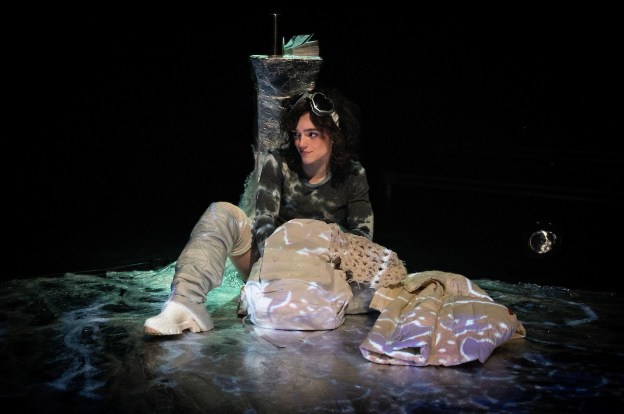
Tatty Hennessy’s script is a more realistic narrative than many of the works Northern Light brings us. Its 15yo narrator (Dayna Lea Hoffman) is Rory, a recently-bereaved 15yo Londoner, relating her experiences and observations in a tone both unique and familiar. After her father’s funeral, she notes the problem of her father’s ashes being in an urn on the kitchen table and her mother being disinclined to do anything about this immediately – so she gets the idea of taking the urn on an adventure that the father, a geography teacher and armchair explorer, had daydreamed about with her and fantasy-planned in a notebook. Of course! She will borrow her mother’s credit card and go scatter the ashes at the North Pole – this makes complete sense to her.

As you should expect from a Northern Light show, brilliantly-executed design elements enhance the narrative. Alison Yanota is credited as production designer, taking care of set, costume, and lighting. Matt Schuurman designed projections on the floor, and Daniela Fernandez was sound designer. Trevor Schmidt directed. The performance is done in the round – I picked a side randomly and did not feel like there was any advantage to being on any side.

The script said some things about grief and about growing up that I am still thinking about. In particular, the concept of trying on grief responses to find what felt appropriate. I also really appreciated that the writer didn’t punish the teenage girl for not thinking things through and for trusting the people she met. As I think I’ve mentioned before in this blog, I’m tired of stories where teenage girls (and, by extension, the audience) are “taught a lesson” by having their risk-taking and initiative result in disasters, whether physical, social, sexual, or legal. Rory’s quest didn’t work the way she’d thought it should – but it still worked out.

Northern Light Theatre requires its patrons to wear masks in the Fringe Studio Theatre – and in the performances I’ve attended this season I’ve seen 100% compliance with this. The play runs until Saturday May 6th, and tickets are available here. I recommend it highly.

The Genius Code, from Surreal SoReal Theatre

The concept of The Genius Code intrigued me – putting different audience members into the viewpoint of different characters, by giving them headphones.   I am fascinated by the idea of piecing together the truths of different people’s experiences.  It’s easy to do and fairly common in written fiction.  And I’ve seen movies and tv shows where a scene is shown from one character’s viewpoint, maybe with some voice-over retrospective narration, and then repeated from another character’s viewpoint and voice with a very different impression.  It’s also doable on stage, although harder – it might be a fun improv game for experienced players.

But in The Genius Code, the writer and director (Jon Lachlan Stewart) doesn’t control which of the viewpoints an audience member chooses.  And in attending one performance, you only get one viewpoint – you can’t switch.  This performance-art choice leads to some fascinating differences in audience experience.

When the audience is wearing headphones, the lighting design has the house quite dark, and the logistics of cable management mean that the audience members tend to sit still.  I think that mostly people aren’t listening to the same commentary as their neighbours.  And the audiences for the two performances I’ve attended have been unusually quiet while we were wearing headphones.  Mostly, the characters’ inner thoughts were heard in one set of headphones only, and the conversations taking place on stage were transmitted by floor mics to all three sets of headphones.  But even when all of us were hearing the conversation, I thought the audience wasn’t very responsive.  I kept wanting to sigh and smile and gasp and chuckle and wince in recognition, but somehow the awareness of being surrounded by a room full of people listening quietly in headphones made me hesitate.   Later in the show, there’s a part where we’re instructed to take the headphones off.  The house lights came partway up, the story continued unamplified, and the audience immediately became more responsive.  This fascinated me, and I wondered if it was disconcerting to the actors when we were quieter.

Technically, I was relieved and impressed that the headphones thing worked.  I never heard any sound bleeding over from the other feeds, either in the full house of opening night when I was surrounded by people listening to different feeds or on the preview night when I had empty seats next to me.   Soundscapes (Aaron Macri and Jonathan Krawchuk) and video backgrounds projected on an unusual surface (Matt Schuurman) added to the atmosphere and provided more information.

I’ve attended two performances and listened to two points of view.  I’m planning to return one night next week to listen to the third one.  Listening to the second one made me re-think some opinions I’d formed during the first show, and then wonder whether the assumptions that led me to those opinions were unfair.  Things kept surprising me during the second show, things that I know rationally must have happened the same way both times but for some reason I didn’t remember them clearly.

The characters in the story are Sky (Jamie Cavanagh), Gyl (Laura Metcalfe), and Gene aka DJ Genius Code (Cole Humeny).  As the story starts, Gene has just brought his two friends together, and as they seem to hit it off, they agree to let Gene record all their conversations.  This is a convenient explanation allowing Gene to move about the stage adjusting microphones so that the audience will hear the conversations through our headphones, but it is also important in showing how Gene relates to the other two.  It provides some important plot movement, and the option to re-play or re-mix the recordings also gives some interesting framework.  The phrase “Let’s start again” is used several times during the performance, usually in a sense of “let’s play this recording again from the top” but in other senses as well.  And in fact, sometimes in life and relationships, sometimes one cannot just start again.

My first impressions of Gyl were that she’s a wacky outspoken young woman, talented and attractive.  Sky struck me as a glib provocative young man who enjoys playing with words and is also accustomed to being desirable.  And Gene was a puzzle.  Humeny plays the character with near-flat affect and an immobile face, usually looking down or to one side rather than making eye contact with his friends.  Costume/Set Designer Cory Sincennes has dressed him in a hooded shirt a bit too big for him with sleeves too long, making him look small and not in control (a very different impression than when I saw him as an enlisted Marine in A Few Good Men).  There were scenes of credible friendship and affection.  There were a couple of intensely erotic sequences of dialogue and movement, one of which turns disturbingly into a fight scene (choreography credit Ainsley Hillyard).

I had not seen any of Jon Lachlan Stewart’s work before, but now I will make a point of seeing anything else available.  I’d seen all the performers at least once – Metcalfe as the grasping sister-in-law in The Three Sisters, Humeny in Ride, Strike!, and a minor role in Clybourne Park as well as in A Few Good Men, and Cavanagh in several plays and improv shows over the last couple of years, starting with Sexual Perversity in Chicago and most recently Romeo and Juliet.

As I said, I’ve seen two viewpoints and I plan to return for the third.  I wondered whether it was fair to post about it before seeing the third side, but I want to encourage more people to see it, It’s playing until Sunday June 8th at C103, the theatre in the Strathcona Market parking lot.  And I imagine many theatregoers will see it only once, but will compare notes afterwards with other people about the versions they saw and what they thought.

I liked it.  There was one thing that I found unsatisfying, I found myself wanting to put the headphones back on and hear more about how things were unfolding later from my character’s POV.  I don’t really know why this bugged me – maybe because it felt asymmetric not finishing the way we started, or maybe because I liked the internal-monologue parts, or what.  And I guess the private-to-shared transition is part of how this story needs to get told – medium being the message and all that – but I kept wanting there to be a headphones ending.  I hope it was a legitimate artistic choice rather than some decision to put the audiences back into their comfort zones – because when I go to theatre I don’t mind being out of my comfort zone.  (SLIGHTLY out of my comfort zone.  That does not mean I sit on the aisle at a bouffon show.)

Ukelelia, echolalia, wordplay

After picking up my Sunworks turkey at the Strathcona Market, I took in another Snow Globe Festival performance this afternoon, this time Brother Platypus & Sister SuKat Go To The Sea, by Spirot with Khiara Quigley, directed by Murray Utas.

It was poetic, funny, musical, allegorical, and kind of free-associational in a similar way to other Steve Pirot/Murray Utas work, but at the same time appropriate for young audiences.  There was a story with problem and resolution, but it was not entirely plot-driven.   So, it was pretty much what I expected but at the same time enjoyably surprising.

Both performers, Sydney Gross and Steve Pirot, were playing ukeleles and singing. I’ve seen Sydney Gross behind the lights/sound boards lots of times but I don’t think I’d ever seen her on stage, but in this role she was enchantingly childlike but not childish, easy to identify with.  There was a little bit of dance, a little bit of audience participation, and wordplay for both kids (that name rings a bell!  Literally, and every time!) and adults (random apposite quotation from “The Love Song of J. Alfred Prufrock”)  There was also fantastical Matt Schuurman background video.

I’m not going to be able to catch the third show in the Snow Globe Festival, but each of the three plays has one more performance tonight.  One suggestion for Promise Productions:  next year, it would be great if people could find your schedule with fewer clicks – your website has the 2012 schedule and your Facebook event requires a bit of scrolling-down.