Tag Archives: leland stelck

Guys and Dolls – a fun production of a famous show!

Gambling scene in Guys and Dolls, with Big Jule (Connor Foy) in the centre. Photo Nanc Price Photography.

“It’s the oldest established permanent floating crap game in New York”, goes the oxymoronic Frank Loesser lyric from Guys and Dolls, building the context for a world of drifters and grifters and permanently-floating characters in a New York City neighbourhood, probably in the 1920s. I had never seen this musical before, or done any homework, so I appreciated the context!

In the current production by Foote in the Door Theatre, directed by Joyanne Rudiak at Théâtre Servus Credit Union, the action opens on a lively urban streetscape (Leland Stelck design) with various characters going about their business. We see a boxer and his trainer, some teenage fangirls chasing any possible celebrity, couples and friends, a police detective, drunk men and women, and a Salvation-Army-like uniformed mission parade, with musical instruments. As in Lin-Manuel Miranda’s In the Heights, the early scenes created a busy and interesting locality – but unlike the Washington Heights neighbourhood of Dominican-American families, the Broadway setting of Guys and Dolls isn’t about families at all.

We meet a group of gamblers (Aaron Schaan, Brad Corcoran, Madison Lalonde) and then we meet Nathan Detroit (Russ Farmer), the host of the aforementioned crap game. The presence of a trenchcoated detective (Erwin Veugelers) makes it very clear to the audience that gambling is illegal. Nathan’s longtime fiancée Miss Adelaide (Ruth Wong-Miller) is the star dancer in a nightclub nearby. But he explains to his associates that he doesn’t want to get married, while she sings her frustration with waiting for him and waiting to have a married life with children in the suburbs. “Adelaide’s Lament” is a hilarious song, of the genre where I kept trying to guess the next ridiculous rhyme. I was reminded of some lines in How to Succeed in Business Without Really Trying (also a Loesser/Swerling/Burrows creation), where Wong-Miller’s office-worker character Rosemary dreams of moving to New Rochelle (a Connecticut bedroom town).
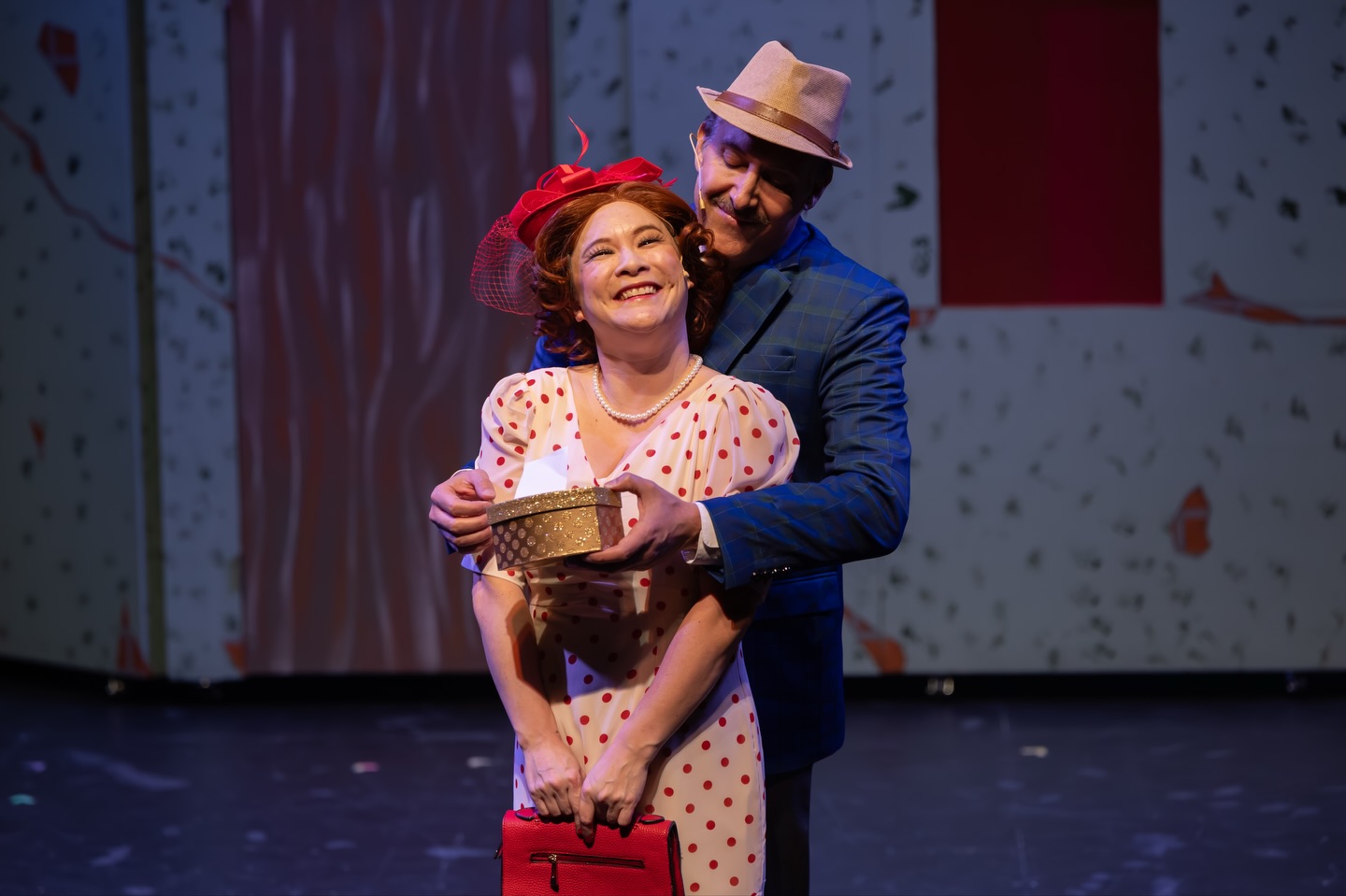
Ruth Wong-Miller (Miss Adelaide) and Russ Farmer (Nathan Detroit) in Guys and Dolls. Photo Nanc Price Photography.

A delightful contrast to this cast of ne’er-do-wells and nightlife is the presence of a mission outpost. They’re clearly a Salvation Army tribute, with red uniforms, pseudo military ranks, and a marching band (made up of Brian Ault on trombone, Eilidh Tew on clarinet, one saxophonist I didn’t recognize, and several enthusiastic percussionists). Sergeant Sarah (Kit Kroeker) seems to be in charge, but also an upperclass misfit in the rough Broadway area. Kroeker’s voice is well suited to the mix of hymn-singing, trained solo belt, and duets in her role – a pleasing contrast with Wong-Miller’s character’s nasal dialect and less forceful voice. (I’ve heard Wong-Miller sing in enough other shows that I know it was the character, not the singer!) There were opportunities for jokes about well-meaning clueless missionaries, which landed just as well in 2025.
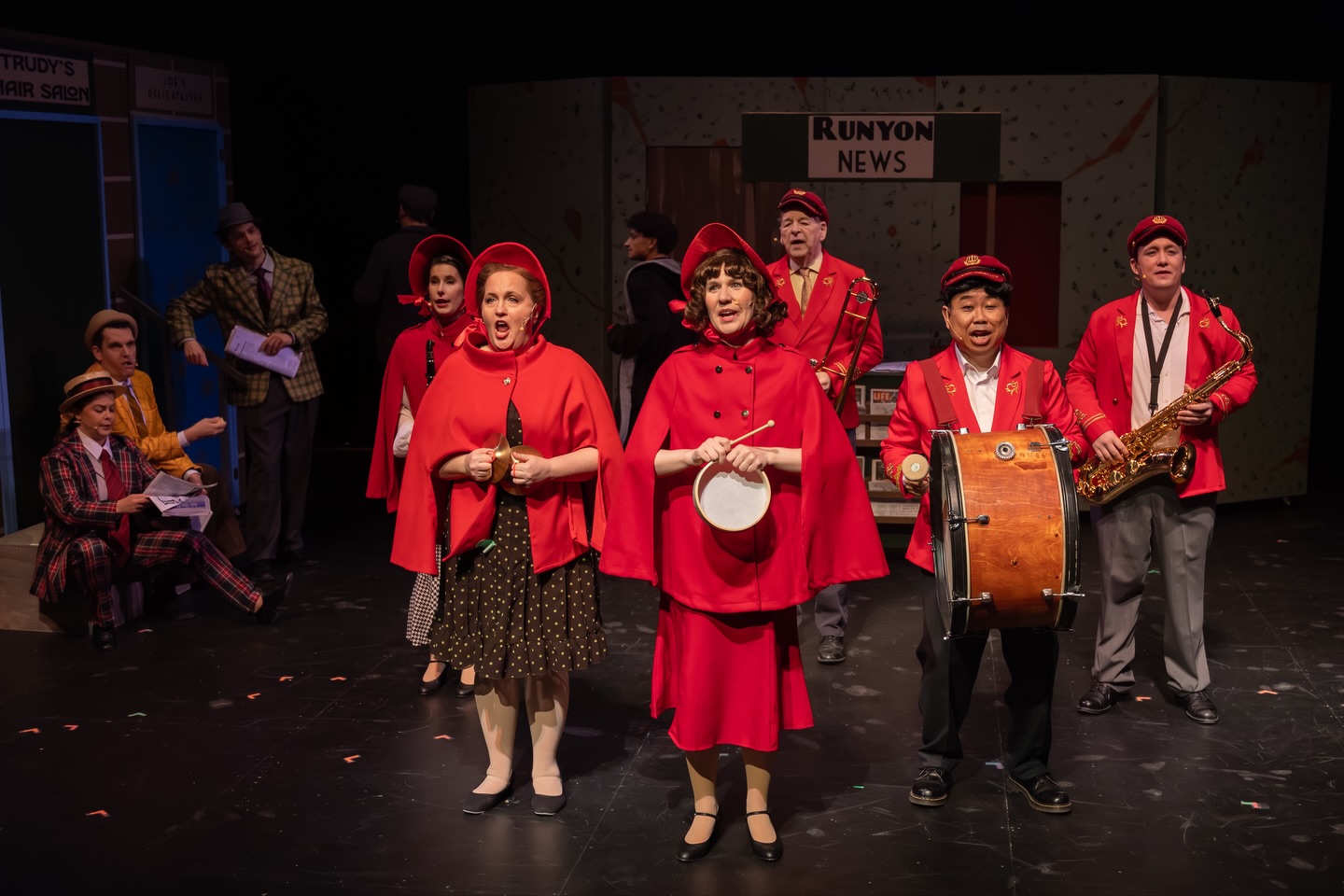
Sergeant Sarah (Kit Kroeker) and the Save a Soul Mission band, in Guys and Dolls. Photo Nanc Price Photography.

Like many traditional musicals, the story needs two couples with obstacles to romance, as well as a main plot objective (Nathan finding a new venue for his craps game). Nathan and Adelaide are one at-odds couple (see what I did there?) Sergeant Sarah is thrown together with high-stakes gambler Sky Masterson (Aidan Heaman), who tries to take her out on a bet, but then falls for her (of course!)

Some of the most fun scenes in this show are the large cast choreography filling up the big stage at Theatre Servus (Adam Kuss). I was sitting in the front row so I felt immersed (although never quite endangered) – sitting further back would probably let you appreciate the full scope of the action though! My favourite was the action at the plaza in Havana, where colourful salsa performers and restaurant customers danced joyfully and flirted and fought, while ASMs doubled as bar staff to crowd the plaza even more. Although the simulated dice-games in the sewer for “The Crapshooters’ Dance” were also great, with about 20 male-identifying characters incorporated in the action – Connor Foy and Aaron Schaan as featured dancers, and versatile ensemble members like Julia Stanski and Chelsea Makwae and Eilidh Tew just as captivating in trouser roles as in chorus-girl or “doll” roles.

Aidan Heaman, Sky Masterson, then glows in his spotlight with the classic “Luck be a Lady Tonight!”

I won’t give away the rest of the plot – suffice it to say that there are no big surprises. It turns out that for a show I didn’t know, a lot of it was already familiar songs and tropes, so it was fun to recognize them as they came up. It was also satisfying for me to recognize faces and names as people I’d worked with before, at Walterdale, for ELOPE, and for Foote in the Door. At least two of them have supported Walterdale productions in backstage roles, and maybe 10 of them onstage, and one playwright, for example.

Guys and Dolls continues at Théâtre Servus Credit Union (La Cité Francophone) until November 30th, with tickets available here. As well as a snacks-and-drinks concession, they are also selling Peace by Chocolate chocolate bars in show-themed sleeves. The chocolate is so good that I might go back tonight just to buy more!
Amélie: whimsical and fun!

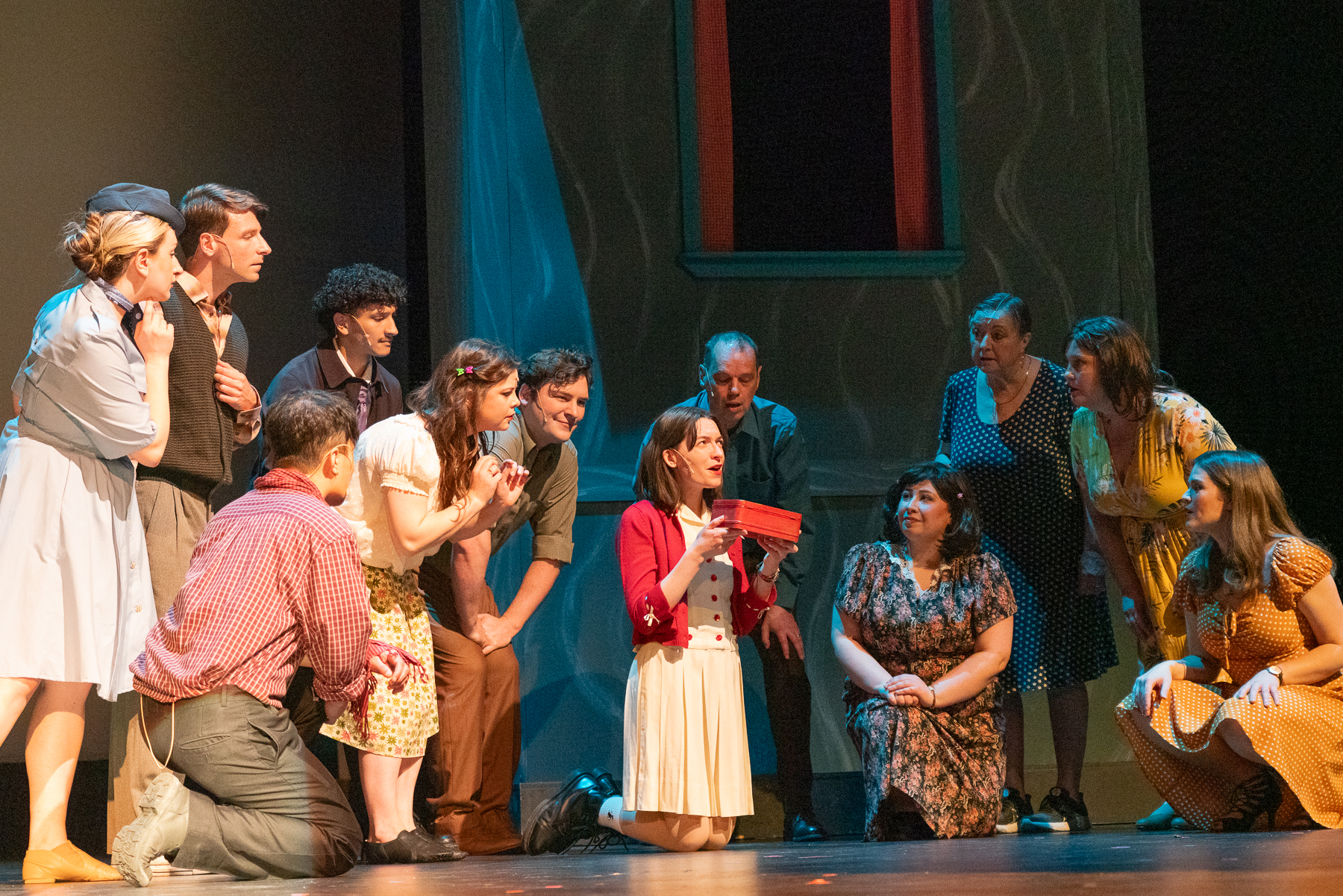
Actor on her knees holding an old red metal box, surrounded by other actors.
Lauren Upshall-Ripley, as Amelie, holds a treasure box, surrounded by friends and neighbours. Photo Kara Little.

ELOPE, the long-running local musical-theatre company, is currently performing Amelie, the musical, at the University of Alberta Timms Centre. It is quirky, delightful, and unexpected – and very well done.

Amélie, the musical (music by Daniel Messé, lyrics by Messé and Nathan Tysen and a book by Craig Lucas, is based on the 2001 French movie of the same name. I still haven’t seen the movie, so I kept laughing with surprise as the narrative unfolded.

Lauren Upshall-Ripley is perfectly cast as Amélie, the title character, a young woman whose background as an isolated child equips her with playful daydreams and fantasies. And Danika Reinhart plays 6-year-old Young Amélie, illustrating with painful poignancy how the optimistic child’s resilience shines past her fearful and repressive parents (Erwin Veugelers and Rachel Frey). The duets between Upshall-Ripley and Reinhart were particularly strong, with vocal balance and warm connection between the younger self and older self. I was reminded of the Netflix series Unbreakable Kimmy Schmidt, which also portrayed a likeable and resilient young woman in modern New York, with humour and without sentimentality.

Actor in red cardigan and simple white dress stands joyfully with outstretched arms.
Lauren Upshall-Ripley, as Amelie. Photo by Kara Little.

One quirk of the script was the way that many of the ensemble members in the 19-person cast took turns narrating the key points of Amélie’s life to the audience, with wry humour and a strong sense of community. The scenes illustrate a lively neighbourhood of Montmartre, centred around the Two Windmills Cafe, where Amélie works. Her co-workers Gina (Christy Climenhaga) and Georgette (Josephine Herbut), employer Suzanne (Judy McFerran Stelck), and other neighbours all have their own challenges and heartbreaks, but like the best workplace comedies, they’re all engaged in trying to help each other. Director Kristen Finlay has a resume full of productions where each member of a large cast has clear interesting intentions and also blends as an ensemble – 25th Annual Putnam County Spelling Bee for ELOPE, Penelopiad, Chess, The 39 Steps for Walterdale, and others.

The narrators give specific dates – of Amélie’s conception, of her mother’s death, of her move to Paris, of a day her life changed – this let me figure out how old she was at each point, but also turned out to be a clue that key events for Amélie were affected by Princess Diana’s visit to Paris and untimely death. Amélie watches television coverage of Diana’s funeral, alone in her apartment, and daydreams of being honoured like Diana. Connor Foy plays Elton John, singing “Goodbye, Amélie” at a white-lacquered grand piano and leading a sequined ensemble – the audience was screaming as the first act ended.

Amelie’s adventures involve various other neighbours and friends, but weaving through these stories we see hints of another quirky and creative outsider, Nino, played by Colin Stewart. “Who are you?” asks Nino, on the phone with Amelie. “I’m a mystery wrapped in an enigma trapped in a paradox disappearing into thin air. ” “Me too.” Will they meet up? Will it be worth it? Will it work out? We want it to.

Actor in leather jacket and cross-body satchel sings joyfully.
Colin Stewart as Nino Quincampois, in Amelie. Photo by Kara Little.

In another vignette, Amélie returns some childhood treasures to a lonely man (Dustin Berube). Berube and Upshall-Ripley’s duet, “How to Tell Time”, was one of my favourite moments.

Musical direction was provided by Sally Hunt, with eight other musicians. David Son created choreography for the ensemble that was both exciting and well-executed, and also joined the ensemble himself in a few small roles, including (hilariously) an escaping Goldfish. Debo Gunning designed costumes that supported each character, from Amélie’s artless awkwardness in shirtwaist and Doc Martens, to the more sophisticated Parisian women of the cafe and sex shop, and Elton John fabulously excessive with feathery epaulettes to his sequined jacket. The facilities and technical capabilities of the Timms Centre Main Stage were effectively used by ELOPE’s technical team (set design credit to Leland Stelck). Finlay and Son’s blocking and movement of the large cast on the deep stage never felt crowded.

Amélie is playing at the Timms Centre until Saturday July 5th. Get your tickets here.

King of the Yees

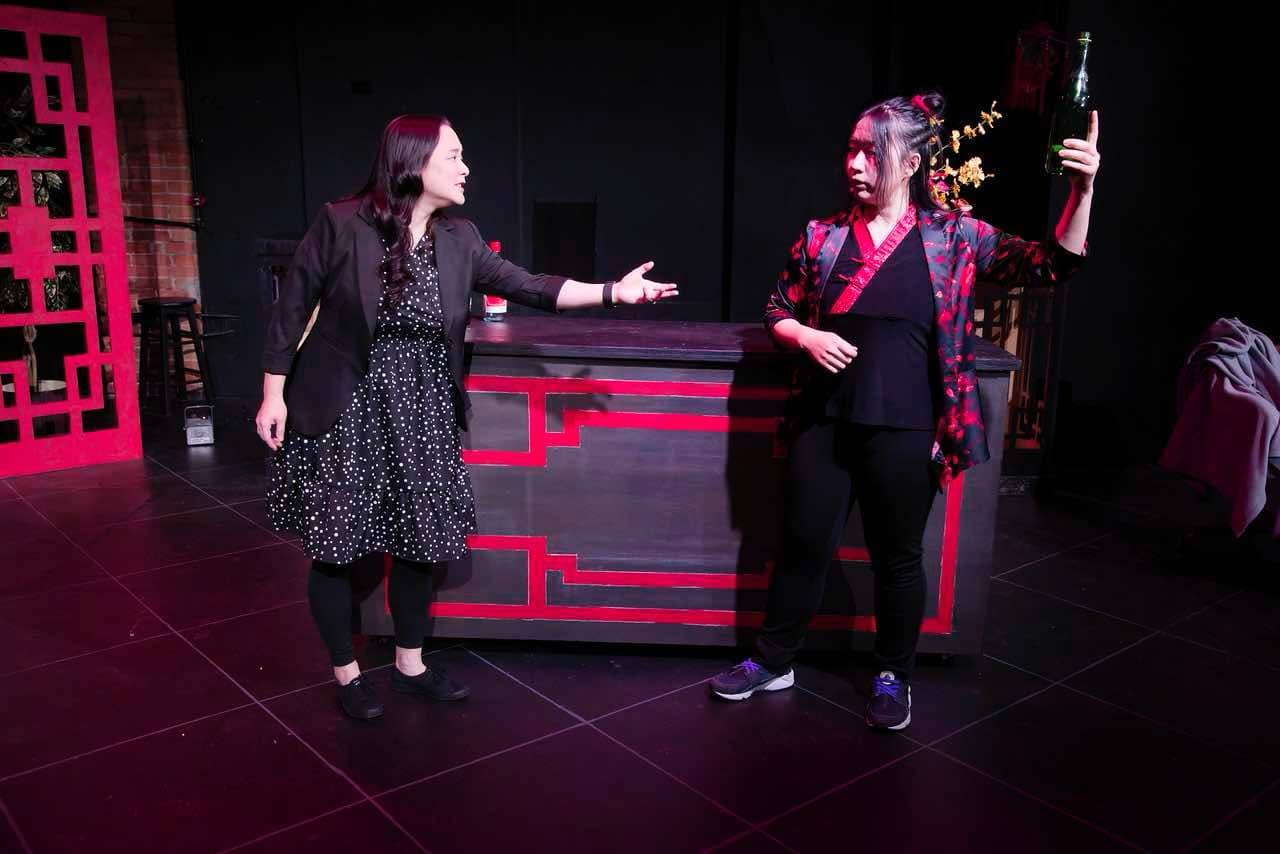
Ruth Wong-Miller and Grace Li in Walterdale Theatre’s King of the Yees, haggling as Lauren and Whiskey Seller. Photography by Scott Henderson, Henderson Images. Costumes Karin Lauderdale, Set Leland Stelck, Lighting Rebecca Cave.

I haven’t been involved with working on the latest Walterdale Theatre production, King of the Yees, so I had the fun of seeing it for the first time on opening weekend, along with a delighted audience. Barbara Mah, Walterdale’s current artistic director, directed Chinese-American playwright Lauren Yee’s somewhat-autobiographical play, with a talented cast and team of local artists.

King of the Yees is partly a familiar story about a father and daughter – a father (Stanley Woo of Apocalypse Kow) who is immersed in the clannish culture of San Francisco’s Chinatown and the Yee Family Association that he manages, and a playwright daughter (Ruth Wong-Miller of Foote in the Door and other musical theatre) who has moved on, moved away, and lost connection with her parents and their culture. I found the frustrated banter between them very funny, and also poignantly relatable, and unexpectedly moving.

Mah’s production, and the script, also contain fantastical elements which are fun to watch and listen to, as well as bitingly-sarcastic riffs on assumptions about Asian actors by a couple of performers playing actors who have been hired to read the playwright’s work-in-progress (Kingsley Leung and Helen Massini). This is not quite as confusing as it sounds! Visual/audible spectacles include a lion dance (handlers Massini, Grace Li, Ivy Poon, Rupert Gomez) led by a Buddha Boy (Tsz Him Hymns Chu), an Erhu player (Poon), a troupe of elders doing tai chi, a flamboyant Model Ancestor (stage manager Tim Lo), and a Szechuan face changer (Massini). The beautiful set and costumes were designed by Leland Stelck and Karin Lauderdale and implemented by skilled teams of painters, stitchers, and builders.

Ensemble members Rupert Gomez, Helen Massini, Andrew Kwan, Grace Li, Kingsley Leung, and Ivy Poon form a mysterious wall, in King of the Yees. Photo Scott Henderson, Henderson Images. Set Leland Stelck, costumes Karin Lauderdale, lights Rebecca Cave.

The digital program contains some helpful and interesting contextual information that is worth reading for extra enjoyment. Some performances of King of the Yees are sold out on line, with a few tickets held back for door sales. The run continues until next Saturday, February 15th, and advance tickets are here.

There’s so much else on this weekend, too! Plan ahead!

  • Bea, at Shadow Theatre, closes Sunday
  • Angry Alan, at Northern Light Theatre, closes Saturday (tomorrow!)
  • After the Trojan Women, by Amena Shehab & Joanna Blundell, is at Backstage Theatre
  • The Citadel has Frozen and Does This Taste Funny?
  • U Alberta Studio Theatre has [Blank], by Alice Birch
  • Die-Nasty, the long-running improv soap opera on Monday nights at Varscona, is free on Feb 10th.
  • An Oak Tree, at the Aviary, produced by Theatre Yes
  • Script Salon, Sunday Feb 9th, has a reading of Linda Celentano’s Giorgi of the Jungle.

And next weekend there’s even more, all with short runs!

  • The Effect, by Lucy Prebble, at the Arts Barns Studio,
  • The Spinsters (Bigger and Badder) is in the Westbury
  • MacEwan University’s musical theatre program has Natasha, Pierre, and the Great Comet of 1812
  • The first PepperMUNT Cabaret, a production of Jake Tkaczyk’s new company MUNT Performance Association, will be at the Gateway Theatre on Saturday February 15th, at 10:30 pm – giving you enough time to see one of the shows in the above lists first! Trevor Schmidt and Mark Meer are hosting, with an assortment of talented guests, and tickets are here.

I’m not going to be able to see all of these, because I’m also busy working on Walterdale’s next show, Stag and Doe by Mark Crawford (April 23-May 3). See what you can! Maybe I will see you there!

The Pirates of Penzance

Shauna Rebus, Brendan Smith, and Russ Farmer in Pirates of Penzance. Photo by Nanc Price Photography.

If you’ve ever heard of Gilbert and Sullivan – if you have even a humming familiarity with any of their work – you’ll know that the Victorian-era duo wrote wildly-popular tongue-in-cheek light opera pieces, some of which continue to be frequently-performed and alluded to in popular culture. And if you asked someone to sing one song from Gilbert and Sullivan, they’d probably attempt the first lines of “I am the very model of a modern Major-General”, an oft-parodied patter song which is from Pirates of Penzance (1879).

I’ve seen Pirates of Penzance once before – at the Stratford Festival’s Avon Theatre, on a 1985 outing with my mother, who’d admitted the year before that she appreciated me taking her to see some Shakespeare plays but what she would like even better was Gilbert and Sullivan. In those days it wasn’t easy to access a plot synopsis or lyrics ahead of time, there were definitely no supertitles/captions, and seats at the front weren’t in my budget. So I missed lots of the clever rhymes and over-the-top dialogue/intentions.

Local company Foote in the Door opened their production of Pirates of Penzance last night at Théâtre Servus Credit Union (La Cité Francophone), directed by Ron Long. I sat in the first row so I wouldn’t miss anything – and they were using supertitles for all the songs, which made it even easier to follow the preposterous premises of the plot. Frederic, a nautically-minded boy who had been accidentally apprenticed to a pirate instead of a pilot (Brendan Smith), is coming of age and being released from his indentures. But he’s got an overdeveloped sense of duty, which keeps leading him into inconvenient obligations.

Frederic looks forward to the pleasures of civilian life. His old nursery maid, Ruth (Shauna Rebus), who followed him into piracy, now hopes to catch his affections as they leave the ship, but Frederick is hoping to meet younger prettier women. These two characters were among my favourites, but the company of twenty-one performers were all fun to watch and listen to. Andrew Kwan was a delightful Major-General Stanley, father to a chorus of eight daughters including Frederick’s choice Mabel (Ruth Wong-Miller). Some of the pirates doubled as police officers, led by their sergeant Aaron Schaan in unison nightstick choreography. And one of the daughters (Eilidh Tew) doubled flexibly as a pirate! Sisters Wong-Miller and Christina O’Dell had a lovely duet in the second act. There was some fighting with fencing foils, pistols, and other found weaponry (fight director Sarah Spicer). Russ Farmer is the Pirate King. He and his hapless band display an assortment of impressive facial hair, some of it real.

The company of pirates and daughters surround Andrew Kwan, the Modern Major-General, and his Sterling Award. Photo by Nanc Price Photography.

Pirates of Penzance is playing until November 24th, with tickets available through Showpass.

The Bridges of Madison County – catch it this weekend!

Vincent Roberts, Liam Lorrain, and Nicole Gaskell in The Bridges of Madison County. Photo credit @karalittlephoto.

You might be familiar with The Bridges of Madison County as a novel written by Robert James Waller in the early 1990s, or as a movie starring Meryl Streep and Clint Eastwood, mid 1990s.

It’s also a musical – book by Marsha Norman and music and lyrics by Jason Robert Brown. The local musical-theatre company ELOPE is currently performing this musical in a short run at Varscona Theatre. If it sounds interesting to you, catch it soon – it closes Saturday night.

The Bridges of Madison County is a story of love, of longings and loyalties, and overwhelmingly a re-creation of a place and time. It’s set in farm country in Iowa, mostly around one farmhouse kitchen, in the 1960s. The main character, Francesca, (Nicole Gaskell) was a war bride who met her US serviceman husband Robert (Vincent Roberts) in Naples, and has lived in Iowa ever since. They have two children, Michael, 16 and restless (Liam Lorrain), and Carolyn, probably about 14, who loves 4-H and farm life (Cassidy Galba).

After an opening solo in which Francesca tells her story of moving to the US post-war, with hat, gloves, and suitcase, with a backdrop of black-and-white slide images, the action of the musical opens with family and friends bustling around Francesca in her kitchen, before she sends her family off to show a steer at the State Fair, looking forward to a few days of privacy and quiet. The first scenes show the affectionate and busy atmosphere, the co-operative farm community and the challenges of parenting teenagers. It’s easy to sympathize with the quiet woman wanting some alone-time.

But if you know the story, you know that while Francesca’s family’s away, she unexpectedly chooses a romantic liaison. National Geographic photographer Robert (Martin Galba) stops by looking for directions. She helps him out and finds out that he’s a solitary nomad who has photographed her hometown of Naples. They talk about the longings and losses in their lives, and find feelings for each other. I’m always a bit skeptical of instant-soulmate stories (even for teenage characters like Romeo and Juliet or Maria and Tony), so I tend to get stuck on this part of the plot. But I appreciated that the writers, director, and actors did not make Francesca’s husband Robert a caricature of unsympathetic husband either. Director Cory Christensen said “It was important to show that Robert isn’t stupid and mean, that he’s a good man, likeable.”

Details are elided, reproducing the novel’s feel as a poetic interlude, four days out of normal life. But the phone keeps ringing – Francesca’s husband, accustomed to sharing daily life with his wife, Carolyn and Michael, complaining to Mom about their lives, their father, and their future plans, and her neighbour and friend Marge (Erin Foster-O-Riordan) who has guessed what’s happening. We can’t forget that Francesca has loyalties and commitments, and neither can she.

It was clear that the story could not have a happily-ever-after ending for everyone. The ending it did have was honest and credible and poignant, although shifting time to show later-life outcomes for all led to a slower-paced ending. I was impressed by how the actors playing the teenagers shifted to being credible as 5-7 years older.

I thought all of the singers were very good, particularly Nicole Gaskell in the role of Francesca. Her program bio says that she’s recently returned to Edmonton from studying and working in the UK, and I hope to see her again on Edmonton stages. There were some ensemble musical numbers near the beginning where I found it hard to make out the words, possibly due to sound balancing difficulties. Joy van de Ligt, music director, led an orchestra of seven. Morgan Smith and Avery Neufeld completed the acting ensemble.

Design choices enhanced the storytelling in many ways, particularly the lighting design of Rebecca Cave, with spectacular Iowa skyscapes and kitchen-table intimacy. The kitchen was cleverly evoked in Leland Stelck’s set design, by a few moving pieces and a chrome-edged table and chairs. Director Christensen pointed out that the corn silhouetted against the sky was actually real corn stalks, obtained from a local corn maze.

This is the first time an ELOPE show has used the Varscona Theatre venue. The auditorium is smaller than the Westbury, and more intimate than Le Théâtre Servus Credit Union, with the audience closer to the stage and warm acoustics. The company has usually been doing one large musical a year (Rent, Joseph and the Amazing Technicolor Dreamcoat), but is expanding this season by adding this short run of a smaller-cast show. Their season will continue with a production of Amelie, June 26-July 5, 2025, at the Timms Centre, U of Alberta. Kristen Finlay will direct and Sally Hunt will be music director.

Shall I draw an analogy between Francesca’s impulsive grasping at her opportunity of connection with Robert, and a recommendation to book your ticket to this short run of The Bridges of Madison County before it closes Saturday night? Perhaps not – you have no reason to hesitate, and more chance of regrets if you miss it! Saturday also has a matinee. Tickets are available here.

Back to Avenue Q

Erin Harvey as Mrs. Thistletwat in Avenue Q. Photo Nanc Price.

I’ve now seen three productions of the Robert Lopez / Jeff Marx / Jeff Whitty musical Avenue Q. I saw the Off-Broadway transfer in New York in 2014, and the Citadel Theatre production in 2015. And when I first saw the announcement that Foote in the Door would be doing it in 2024, I had no trouble remembering various catchy tunes from the show, and more trouble getting the earworms out of my head afterwards.

As I wrote after seeing it Off-Broadway, it’s like Rent crossed with St. Elmo’s Fire for audiences who grew up with Sesame Street puppetry, a combination that’s hard to picture until you’ve seen it or are familiar with the cultural phenomenon.

Ten years later, many audience members already know what to expect. The Foote in the Door production, directed by Trish Van Doornum, opened last night at Théâtre Servus Credit Union, to a full and enthusiastic house. I had wondered if some of the elements would require shock-value to be appreciated – “The Internet is for Porn”, Christmas Eve and “Everyone’s a Little Bit Racist”, and the puppet sex scene, in particular – but I thought the opening-night crowd was delighted whether or not they were caught by surprise. Christmas Eve, in the original production, sings “I coming to this country for opportunities, Tried to work in Korean deli, but I am Japanese!” and her speeches are full of comedic L-R switching and English-language-learner patterns. Those tropes are getting old – but in the Foote in the Door show, Christmas Eve is performed by Sunshine Bautista Mauricio, whose overall sass, determination, and compassion were more significant than the stereotypey trope. That early line is changed to “Tried to work in Korean deli, but I am Filipino!” (maybe she said Filipina, but I couldn’t hear clearly since the crowd was laughing and cheering). A couple of places later in the show, she says rude things to her husband in a language I don’t understand (Tagalog?) but some audience members definitely did. Those changes improved the show for me, demonstrated that it wasn’t just about entertaining white people.

Sunshine Bautista Mauricio as Christmas Eve. Photo by Nanc Price.

The current production uses a cast of nine performers, and I was especially impressed by the work of some of the ensemble members I was less familiar with. Erin Harvey (last seen in Walterdale’s Austentatious) was a puppeteer playing Mrs. Lavinia Thistletwat, occasionally covering Kate Monster, Lucy, and a Bad Idea Bear, with a hand in Russ Farmer’s embodiment of Nicky. The scenes where Kate and Lucy interact, with Ruth Wong-Miller doing both voices, fascinated me because my eyes kept fooling me about who was talking for which puppet character. Jay Duiker, whom I remembered as the Baker in FITD’s early-2022 Into the Woods, had a strong voice and good comic timing for wannabe-standup-comic Brian. Renell Doneza (with previous credits ranging from Walterdale’s Altar Boyz to the Citadel’s Prison Dancer) embodied various ensemble characters, and watching his own physicality as a contrast to the puppet Rod’s repressed rigidity was very clever. Jayden Leung, also credited with the video montages used in the show, was the remaining ensemble puppeteer, playing various characters including part of Trekkie Monster. Lead-puppet Princeton was performed by Stephen Allred, whose FITD resume started with an insightful interpretation of Laurie in the 2017 Little Women. And the building super Gary Coleman, often played by a woman, was Malachi Short, whom you may recall from Elope’s production of Joseph and the Amazing Technicolor Dreamcoat last year. Short, Harvey, and Leung are all current students in MacEwan University’s BFA in Musical Theatre Performance, and ones to watch in future years.

Ruth Wong-Miller as Kate Monster. Photo by Nanc Price.

There’s one bit in the show where Princeton decides to collect donations to fund another character’s dream, and he motivates other characters to pass the hat running up and down the theatre aisles. When I saw it in New York, the meagre takings that they counted afterwards included a Metro card (subway pass) – I wasn’t sure if that was scripted or not. Well, last night they pulled an ARC Card (local transit pass) out of the hat, so I guess I have my answer. And then after the curtain call, company co-founder Ruth Wong-Miller told the audience that the takings from the hat-passing, plus anything else we wanted to add to the ASMs’ hats in the lobby, would be donated to the Youth Empowerment & Support Services, who operate the Youth Emergency Shelter and other programs in the neighbourhood. This struck me as a great choice, not just for being hyperlocal but for building on the sympathies for the characters in the story, who are mostly a step or two away from the outcomes of the characters in Rent but who are still young and with limited resources. (So take some money, and not just for the concession!)

Avenue Q is full of short songs with lyrics that you might not want to sing at your recital, and musical-theatre melodies and harmonies that are hard to get out of your head. All the voices were strong, and the sound-mixing was well done (which I can’t always say on opening nights). Almost all the audience members near me managed to resist checking Oiler-score updates during the show – giving us a satisfying end to the evening in more ways than just a fun performance with happy and credible futures for the various characters.

Leland Stelck has designed a functional and interesting streetscape set, in the style of Sesame Street or In the Heights, and the musical ensemble directed by Grace Huang are visible downstage and occasional participants.

Avenue Q runs until June 8th, but several performances are already sold out. Remaining tickets are available here.

Amigo’s Blue Guitar: thoughts about refugees and migrants

Sandy Roberts and Aldrick Dugarte, in Amigo’s Blue Guitar. Photo credit Scott Henderson, Henderson Images

I saw four good plays in the last couple of weeks, and didn’t make time to post about any of them before they closed: The Spinsters (Small Matters), The Drawer Boy (Shadow Theatre), Donna Orbits the Moon (Northern Light), and This is the Story of the Child Ruled By Fear (Workshop West / Strange Victory). I love theatre that reflects situations familiar in my community and my life and leads me to reflect on them, whether in a fantastical setting or a mundane one, and the four plays above all did that.

Joan MacLeod’s Amigo’s Blue Guitar, currently on stage at Walterdale Theatre, also portrays some real-world situations, in ways that are worth thinking about. The set (Leland Stelck) is a beautiful evocation of an offshore BC island cabin, with exposed wood and big windows, open to the mountains and the ocean, and a downstage dock. Text projected on the backdrop (director Bob Klakowich provided the projections) sets the context by providing information about the civil war and unrest in El Salvador in the early 1990s, and about refugees in general and their outcomes in Canada. The character Elias (Aldrick Dugarte) appears to the side, speaking Spanish and simple English, shifting from dreamlike musing about his memories to responding to immigration questions. 

The small-scale interactions and byplay among a family living on the island, with early-20s siblings Callie (Crystal Poniewozik) and Sander (Graham Schmitz) sniping at each other and defending each other, draft-dodger-fisherman father Owen (Richard Wiens) holding things together, and grandma Martha (Sandy Roberts) visiting from Oregon, are amusing and familiar. As the action opens, they are scrambling to respond as Sander’s well-intentioned scheme to sponsor a refugee from El Salvador is suddenly becoming real, with Elias due to arrive any minute. 

The action of this play takes place over the first six months that Elias is in Canada. The interactions between Elias (pronounced uh-LEE-uss) and the various family members start out embarrassingly awkward, as they don’t speak much of each other’s language and they don’t know much about each other’s country. It is fascinating to watch the superficial assumptions on all sides break down, as they gradually speak more and ask more questions. We see that Sander’s commitment to rescuing Elias, after hearing an inspiring speaker in his sociology class, was actually based on very little knowledge – “I imagined you every morning, living in a village atop a mountain”. “San Salvador is a large city”. As the other family members each get to know Elias better and appreciate him, Sander becomes distant and almost resentful. Sander is completely unequipped for dealing with effects of Elias’s significant trauma. I have been thinking ever since about good intentions not being sufficient, when dealing with any marginalized individuals. Meanwhile, Elias begins to make his own choices about his Canadian life and his future, not the ones recommended by the host family and immigration authorities. 

Graham Schmitz, Aldrick Dugarte, and Crystal Poniewozik in Amigo’s Blue Guitar. Photo credit Scott Henderson, Henderson Images.

Another theme running through the story is about Owen’s history as a US draft dodger during the Vietnam War. Forty years on, he’s still hurt by the memory of his parents rejecting him, and still dining out on his bravery in crossing the border. He wants to connect with Elias to validate the courage in his own migrant journey, which is both charming and patronizing. 

Richard Wiens and Graham Schmitz in Amigo’s Blue Guitar. Photo credit Scott Henderson, Henderson Images.

The cast and production team for Amigo’s Blue Guitar were supported in their work by cultural consultant Leo Campos-Silvius, a community cultural leader originally from Chile. After this Sunday’s matinee performance (2 pm), there will be a panel discussion with Leo Campos-Silvius, director Bob Klakowich, and discussion moderator David Goa. The audience will have the opportunity to listen and to ask questions of the participants. 

Amigo’s Blue Guitar continues at Walterdale Theatre until Saturday February 17th. Tickets are available here. 

13 actors play clerks and customers in an old-style perfume shop

She Loves Me

A busy day in Maraczek’s Parfumerie, with Georg Nowack (Russ Farmer, downstage right) gatekeeping job applicant Amalia Balash (Ruth Wong-Miller, in cream figured dress) Photo Nanc Price Photography.

The pre-set for She Loves Me, at Théâtre Servus Credit Union (La Cité Francophone), is simple. A storefront with a bench in front of it, a backstage orchestra visible over the top. But as the stories unfold, the set (Leland Stelck) unfolds more literally, revealing the main set of a parfumerie in 1930s Budapest, and later shifting quickly to create a romantic cafe, a hospital room, and whatever else is needed. The counters, shelves, displays, and stock convey a store filled with luxuries and needs. It felt like it would be interesting to browse more closely – like going to Lush (without its overpowering mix of scents).

The show focuses on the parfumerie’s owner, Mr Maraczek (Brian Ault) and its employees (Andrew Kwan, Russ Farmer, Scott McLeod, Brendan Smith, and Christina O’Dell) along with job-applicant Amalia Balish (Ruth Wong-Miller). Like a Maeve Binchy novel, the script (Joe Masteroff) and clever direction (Melanie Lafleur) convey that all the characters have interesting stories that we want to hear more about. And not just the principal characters – the ensemble makes up a store full of recurring customers, a romantic cafe full of – romances – and other intriguing bits which I won’t tell you.

My two favourite ensemble bits of this show were “Twelve Days to Christmas” – putting a familiar retail spin on the Advent season – and the whole scene in the cafe. The cafe scene made good use of the depth of stage available to them, and with the raked auditorium seating of the Théâtre Servus, the audience could appreciate the performances upstage of the three women dining at the bar-counter and their server. Not having looked at the show program before the show started, I was surprised to see that this white-jacketed cafe server was Brendan Smith, whom I’d enjoyed on local stages since his appearance in Walterdale’s Light in the Piazza. I had been impressed by the enthusiasm and voice of the young shop delivery boy but with costuming and posture I hadn’t identified him as Smith! Other romantic couples are also enjoying drinks and dancing, and playing out their own narratives, while Amalia waits alone at a centre table for her mysterious pen-pal sweetheart. Aaron Schaan and Julia Stanski, spotted shopping together in earlier scenes, seem to have a proposal accepted. Real-life couple Trish van Doornum and Michael McDevitt are snuggling at a side table. Side flirtations are suggested in a fun dance number involving peeping from behind menu folders.

The premise of having couples meet through a newspaper Lonely Hearts Club correspondence column, getting to know each other through letters without revealing mundane life details, was updated to email for the 1998 movie You’ve Got Mail. Dating app experiences in 2023 encourage providing photos early on, so the plot-device of accidentally falling in love with a co-worker based on their text communication seems less timely, but the story is still easy to relate to.

I was pleasantly surprised at the range of sexual/romantic lives accepted among the main characters. Ilona, the woman who spends time at her lovers’ apartments (Christina O’Dell), is not vilified for it. Her co-workers as well as the audience are genuinely rooting for her to find a nice man who deserves her – or to have a nice evening at the library if that’s where she finds happiness now. Georg Nowack (Farmer) is single, so the boss assumes he must be spending his evenings at cabarets and nightclubs with a different woman every night, but no, he prefers quiet evenings at home.

I also appreciated that this story didn’t follow the trope of an independent woman being attracted to a cranky rude man despite herself, and then winning him over. Instead, Amalia is openly critical of Georg when he is being rude, only begins to appreciate him when he does something thoughtful (bringing her vanilla ice cream when she is sick), and then we see them gradually building trust and then affection over the days of a busy Christmas retail season.

White man dressed in 1930s overcoat, hat, and scarf sings joyfully.
“She Loves Me” – Russ Farmer as Georg Nowack. Photo by Nanc Price Photography

The songs and instrumental music (Sheldon Harnick, Jerry Bock) enhance the experience throughout. Elizabeth Raycroft directs an orchestra of 11, and the performers all have good songs for their voices. I particularly enjoyed “Vanilla Ice Cream” and “Try Me” and the harmony in “I Don’t Know His Name”.

Two women with ornately curled hair and form-fitting business wear wrap small presents while chatting.
Ruth Wong-Miller and Christina O’Dell in “I Don’t Know His Name”, She Loves Me 2023. Photo Nanc Price Photography

In 2015, Foote In The Door did She Loves Me as their first mainstage production ever. Since then, Broadway audiences have also had another chance to appreciate this musical, and there’s a cast recording of that 2016 Broadway production – I was delighted to discover that Christina O’Dell’s role of Ilona was played by Jane Krakowski of 30 Rock.

The company has been producing musicals ever since, at the Fringe as well as in their mainstage seasons. I attended opening night of that first production, so it was a treat to watch this one and recognize many familiar names of people who had been with the company from early days or who have joined Edmonton’s musical theatre community more recently. The deeper proscenium stage and more sharply raked seating at Théâtre Servus for this production supported different choices in directing and design to connect the audience intimately with the performers and allow interesting ensemble play. Costume choices for this production (Viola Park) were more subtle than in the 2015 show, with the parfumerie clerks mostly in well-fitting understated grey suits rather than plain green shopcoats, and glimpses of colour being added gradually, particularly in Amalia’s garments and accessories. As is current practice for many local companies now, some program information is displayed on a projection screen before the show starts, with the full program available via QR code. (I don’t have a good system for saving my online programs, the way I have boxes of hardcopy programs for everything from Fringe shows to Broadway.) And of course, in 2023 some of us attend the theatre wearing masks.

She Loves Me is playing Wed-Sat evenings and Sunday matinees until November 26th. Tickets are available here.

A Gentleman’s Guide to Love and Murder

Kathryn Kerr, Stephen Allred, Ruth Wong-Miller, in A Gentleman’s Guide to Love and Murder. Photo Nanc Price.

My previous entry was about the Teatro la Quindicina quirky tongue-in-cheek period piece Evelyn Strange. And tonight I saw another quirky tongue-in-cheek period piece – Foote in the Door’s production of A Gentleman’s Guide to Love and Murder. This musical, by Steven Lutvak and Robert L Freedman, won several Tony awards in 2014 – I was actually in New York that spring and could have seen it, but I picked shows I’d heard of instead. And I got to see this production completely unspoiled.

A Gentleman’s Guide to Love and Murder is set in England in 1907. The premise of it is that Montague Navarro (Stephen Allred) discovers after his mother’s death that he’s distantly related to nobility, in fact being something like ninth in line to an earldom, although his mother had been disowned for marrying his late father, “a Castilian … and a musician!” All this information is provided by his mother’s old friend Miss Shingle (Nicole English), paying an unexpected visit. He sets out to meet his rich relations, hoping they will give him a job, but then temptation, ambition, and a series of very strange coincidences lead him to try benefiting more directly from being only a few deaths away from the title and the property.

His girlfriend Sibella (Kathryn Kerr) is a hilariously shallow and self-centred woman, but Montague doesn’t seem to mind, continuing to be captivated by her after she gets married. Meanwhile, he continues to meet various members of the D’Ysquith family, many of whom (all played by Russ Farmer) then meet untimely deaths. Most of them seem equally unlikeable, demonstrating various stereotypes about the turn-of-that-century English upper-class. The career do-gooder Hyacinth, seeking a novel charity that hasn’t been claimed by her friends and speaking of her prospective beneficiaries in appallingly patronizing terms, was particularly memorable. At intermission, I was thinking that I’d only seen one D’Ysquith who actually seemed nice, cousin Phoebe (Ruth Wong-Miller), but that maybe I should distrust that thought.

I thought I’d figured out where the rest of the plot would go … but it didn’t, exactly. And the plot twists of the second act delighted me.

My two favourite scenes were the ice-skating scene (who knew that graceful ensemble dancing – and some not so graceful wobbles by Asquith D’Ysquith Junior – behind some snowbank set pieces could so easily convey skating on a pond?) and the scene where Montague is entertaining both Sibella and Phoebe in different rooms of his apartment, The hallway set piece with the two doors, and the way Allred’s character uses it while he sings to play out wanting both women and trying to keep them away from each other, were just brilliant.

Set and lighting design were by Leland Stelck. My companions and I were impressed by how many set pieces shifted silently and rapidly behind the drapery to convey many different locations, particularly given that the production had relocated to Old Strathcona Performing Arts Centre on Gateway from their original performance venue three weeks ago due to the flooding at La Cité Francophone. I think the OSPAC stage is not as deep or wide, but the ensemble of eleven never looked crowded. The lighting design must have been more challenging at OSPAC, which has a relatively low ceiling and doesn’t seem to have as many lighting instruments.

We also admired the period costumes including hairdos and hats (Betty Kolodziej). The members of the ensemble (Kelsey Voelker, Shauna Rebus, Lynnéa Bartel-Nickel, Jason Duiker, Aaron Schaan, Brian Ault) played several background characters each, changing costumes and accents as needed – my favourite ensemble bit was when they were all serving at a dinner, like in an episode of Bridgerton.

The production was directed by Ron Long, with musical direction by Daniel Belland, and an orchestra of 13. The melodies were catchy with some Gilbert-and-Sullivan-esque rhymes, and strong voices among the cast.

Advance tickets to the four remaining shows (Jun 16-18 at 7:30 and Jun 18 at 2 pm) are available here and going fast. Door sales (if available) will start 45 minutes before showtime.

If you’ve already seen it, or you don’t mind being completely spoiled, this webpage reviews (and ranks) all the deaths, as staged in the original Broadway production.

Watching Copenhagen in 2022

image: Bob Klakowich as Niels Bohr, photo credit Scott Henderson, Henderson Images

In about 2004 I saw a production of Michael Frayn’s play Copenhagen performed in the round and directed by Caroline Baillie of Critical Stage Theatre, in the atrium of a Queen’s University building dedicated to creative ways of doing engineering education. My memory of that production is overwhelmingly of circling and cycling, re-examining a memory from various directions with the characters orbiting each other like atomic particles.

Copenhagen is now on stage at Walterdale Theatre, in a production directed by Martin Stout on a set designed by Leland Stelck. With its gently-thrust stage floor and intimate audience seating the Walterdale space provides the opportunity for a more personal encounter with the characters and their questions and uncertainties, despite the Covid precautions of the 2-meter moat and the dispersed audience.

It’s mostly a recollective piece, with re-creations and re-tellings of meetings in the early 1920s, in 1941, and in 1947. The characters say directly early on that they are now all “dead and gone”, and they also help to anchor the individual scenes/memories in time by frequently mentioning the year. The characters are Niels and Margrethe Bohr, the Danish physicist and his wife/collaborator (Bob Klakowich and Donna Call), and Werner Heisenberg, the younger German physicist (Kendrick Sims). Most of the memories are set in the Bohrs’ home in Copenhagen or on the walking paths nearby, a city that in 1941 was occupied by Germany and under constant surveillance.

Donna Call as Margrethe Bohr side-eying her husband. Photo credit Scott Henderson, Henderson Images

I was pleasantly surprised to find myself laughing out loud periodically through this performance. Klakowich and Call’s dry delivery of ironic and witty lines, Sims’ expressive eye-rolling, and particularly Call’s full-body indignation when her contributions are ignored make the most of the precise and articulate script. The opening-night audience was full of sympathy for the Bohrs’ bitterness and rage at their occupiers in general, and at Heisenberg’s clumsy attempts to re-create their earlier social connections without acknowledging the current abyss between them. “Should I have Margrethe sew a yellow star on my ski jacket?” Bohr spits out in response to his colleague’s suggestion of an excursion to Norway. Later in the play, I came to identify with Heisenberg as well, trying to do the work he cared about under a hostile and then horrific regime, trying to minimize the long-term damage to humanity and hopefully looking forward to the prospect of a future not only after the war but after the Nazi regime.

Kendrick Sims as Werner Heisenberg in one of his meetings with colleague Niels Bohr. Photo credit Scott Henderson, Henderson Images.

Stelck’s set, and the props (Debbie Tyson), costumes (Megan Reti), and multimedia design (Darrell Portz) provide effective support for the action reminiscent of 1941 but not clearly rooted in time or space, while lighting (Adam Luijks) and sound (Dylan Mackay) contribute to the shifts in mood, with one particularly chilling air-raid siren.

I kept thinking of present-day Київ (Kyiv), but I also kept thinking of conflict scenarios closer to home. And the characters of Copenhagen reminded me of resilience, of scientists and engineers asking questions about the ethics of their work, and of hope. All of which I appreciated.

Copenhagen is playing through Saturday March 19th at Walterdale Theatre in Edmonton. Mask and vaccine requirements are still in place to protect performers, audience members, and other volunteers. Tickets are available at Tix on the Square, and at the door half an hour before show time.